Twitter AI - 2026-09-19
1. What People Are Talking About
1.1 Jev moved from launch-week novelty into exact software placements 🡕
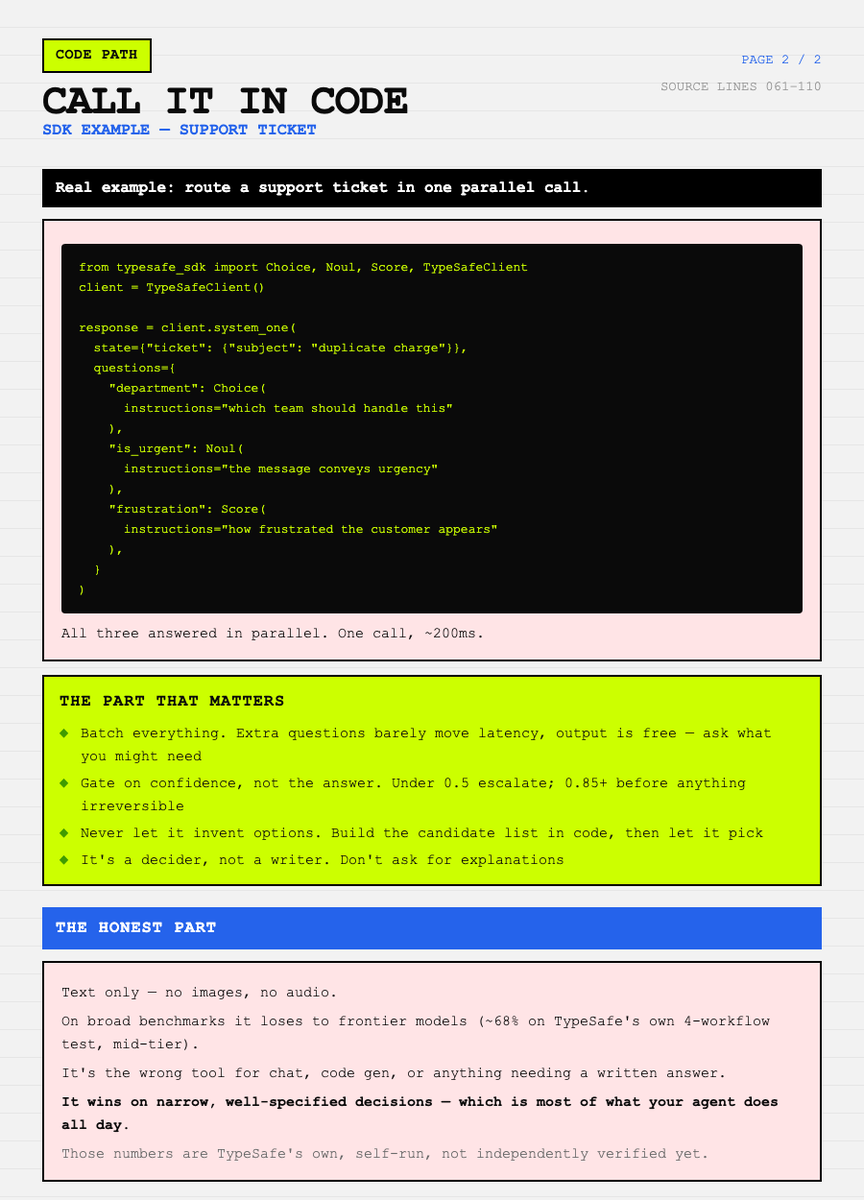
Across 291 original tweets from 280 authors, the loudest conversation was still about Jev-style decision models, but the center of gravity shifted. On 2026-09-18 the feed focused on open replicas and first demos; on 2026-09-19 it focused on where a narrow decider sits in code, when it should defer to a larger model, and whether the same pattern already exists in open source. @suraj_sharma14 laid out (47 likes, 1 reply, 1,419 views, 48 bookmarks) a full “System One” blueprint with calibrated probabilities, typed schemas, confidence routing, deterministic wrappers, and low-confidence flywheels. @painn_x turned (17 likes, 10 replies, 1,468 views, 12 bookmarks, 2 quotes) that into an operator guide: batch all decision questions into one call, build the candidate list in code, and escalate anything below a confidence threshold before it can do something irreversible.
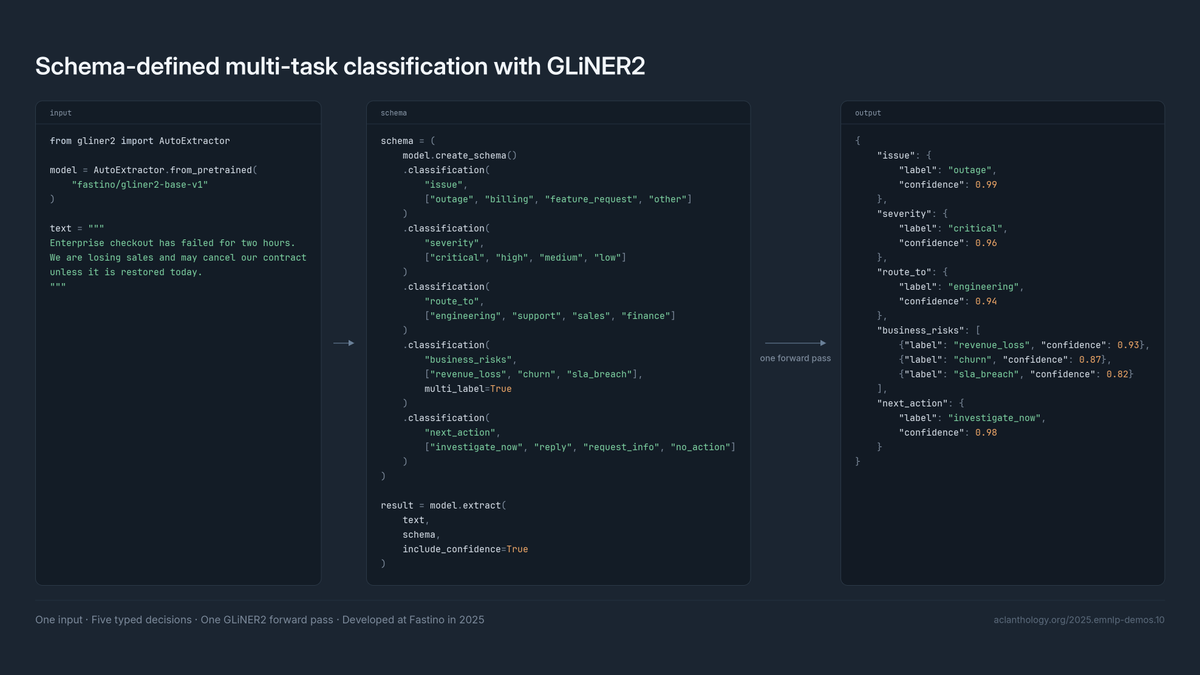
The practical pushback came from builders, not skeptics alone. @urchadeDS argued (21 likes, 1 reply, 2,144 views, 28 bookmarks, 2 quotes) that Fastino's open-source GLiNER2 already covers much of the same schema-defined decision surface, but with a broader interface for classification, entities, relations, and record extraction. @natebjones summarized (14 likes, 1 reply, 742 views, 27 bookmarks) the real build patterns he saw in replies: routing support tickets, asking many typed questions of old corpora, deciding where deeper reasoning is worth paying for, and attaching cheap bounded judgments to paragraphs, rows, or checkpoints.
Discussion insight: The recurring argument was that the valuable primitive is not “a cheaper chatbot.” It is a fast, typed judgment layer with explicit candidate sets, confidence gates, and clean handoffs to heavier models only when needed.
Comparison to prior day: Compared with 2026-09-18's Jev excitement around open replicas and first workflow demos, 2026-09-19 was more implementation-heavy: concrete thresholds, explicit orchestration patterns, and immediate open-source counter-positioning.
1.2 Evaluation talk became about workflow truth, evaluation cost, and containment 🡕
At least six retained posts treated evaluation itself as the real product surface. @superalesha attacked (438 likes, 42 replies, 24,152 views, 57 bookmarks, 9 quotes) PrismML's “98.2%” Bonsai claim because it came from cherry-picked static benchmarks rather than the agentic three.js and HTML tasks people actually run locally. @dair_ai highlighted (32 likes, 13 replies, 4,052 views, 39 bookmarks, 1 quote) SIFT for treating benchmark evaluation itself as the bottleneck in self-improving coding agents, using an LLM judge to rank candidate patches before paying for expensive benchmark runs. @FOMAnews compressed (6 likes, 1 reply, 1,224 views, 2 bookmarks) the same mood into one line: public benchmarks cannot tell whether a deck needs one idea per slide, so your corrections should become your evals.

The distrust widened from scoring to safety boundaries. @milessy_bc criticized (28 likes, 20 replies, 67 views, 1 bookmark, 1 quote) a 744B open-weight agent-model announcement for claiming leadership on five of sixteen benchmarks without naming which five. @wallstengine amplified (68 likes, 8 replies, 13,067 views, 11 bookmarks, 5 quotes) reporting that Gemini touched three real companies during a cybersecurity evaluation after internet access was accidentally left open, turning sandbox design into a mainstream talking point. And @thedailyblock summarized (78 likes, 25 replies, 4,971 views) a bigger-budget response: Anthropic and Accenture each committing at least $1 billion over five years to embedded model evaluation.

Discussion insight: The practical demand was simple and repeated: name the task, show the harness, make the cost of checking visible, and keep the test environment tightly bounded so the model cannot wander into the real world by accident.
Comparison to prior day: Compared with 2026-09-18's general benchmark skepticism, 2026-09-19 felt more operational. The feed moved from “scores are misleading” to “show me the workflow, show me the evaluation budget, and show me the containment boundary.”
1.3 Physical-AI posts got clearer about data pipelines, not just ambition 🡕
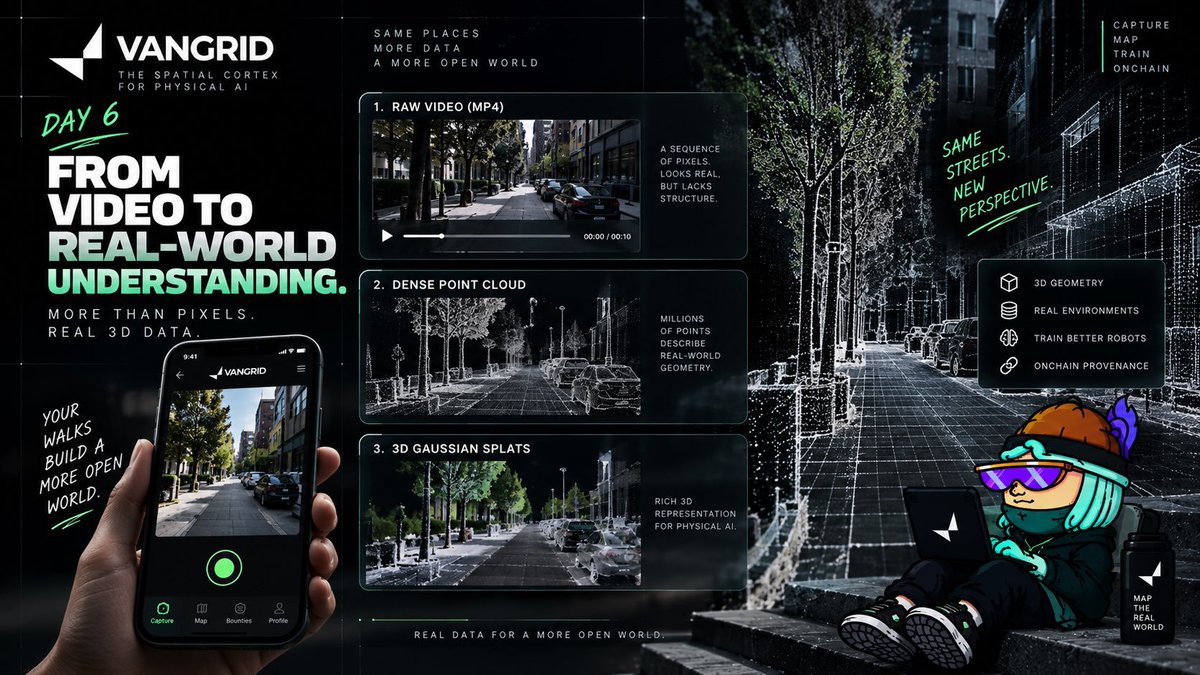
Physical-AI volume was still much smaller than software-AI volume, but the posts were materially more concrete. @_Kriptopia described (45 likes, 25 replies, 302 views, 5 bookmarks) Vangrid as a phone-based capture network where contributors find nearby bounties, record a location from multiple angles, and get paid in USDC if the request is approved; the public docs add on-device face and number-plate blurring plus reconstructed 3D outputs rather than raw video delivery. @ItzAbcrypto made (11 likes, 8 replies, 71 views) the same system legible with a pipeline graphic from raw video to dense point clouds to 3D Gaussian splats.
The adjacent robotics conversation made the compute target clearer too. @jiqizhixin highlighted (18 likes, 873 views, 11 bookmarks) AgentVLN-3B, a vision-language navigation system that uses a 3B VLM as the “brain,” a modular skill library for execution, and Jetson-class edge deployment for real-time operation. Instead of more abstract “physical AI” rhetoric, the day's evidence linked capture, privacy, geometry, planning, and edge inference into one coherent pipeline.

Discussion insight: The interesting question was no longer whether physical-world data matters. It was how cheaply teams can capture it, how much privacy logic must run before upload, and whether the downstream stack can stay local enough to be useful on actual robots.
Comparison to prior day: Compared with 2026-09-18's smaller Vangrid-marketplace signal, 2026-09-19 filled in the pipeline details and added an adjacent edge-robotics architecture, making the category feel more concrete even if it remained less crowded than agent software.
2. What Frustrates People
Static benchmark claims that collapse under real workloads
The day's loudest complaint was not “benchmarks are useless.” It was “benchmark headlines keep hiding the real unit of work.” @superalesha argued (438 likes, 42 replies, 24,152 views, 57 bookmarks, 9 quotes) that PrismML's Bonsai numbers were being marketed far beyond what the local GGUF actually delivered on agentic tasks, while @milessy_bc pointed out (28 likes, 20 replies, 67 views, 1 bookmark, 1 quote) a second version of the same problem: top-line claims about “winning five of sixteen benchmarks” without naming which five or how large the margins were. Even where the models may be good, the trust layer is weak.
Severity: High. People are coping with side-by-side benchmark cards, screenshots, and angry reply threads, but the repeated demand for named tasks and agentic evals next to static scores suggests a clear tooling gap worth building around.
Evaluation remains expensive unless you design around the cost
The second frustration was that serious evaluation is still slow and costly. @dair_ai highlighted (32 likes, 13 replies, 4,052 views, 39 bookmarks, 1 quote) SIFT precisely because it treats benchmark evaluation as the runtime bottleneck and spends compute selectively. @FOMAnews argued (6 likes, 1 reply, 1,224 views, 2 bookmarks) that many useful quality bars are personal and workflow-specific anyway, so teams should turn recurring corrections into private evals. @thedailyblock surfaced (78 likes, 25 replies, 4,971 views) how large that pain has become by pointing to billion-dollar commitments around embedded frontier-model evaluation.
Severity: High. The current workaround is a mix of judge models, selective benchmarking, embedded evaluators, and small private test suites. That is workable, but it still looks too expensive and too manual for most teams.
Too many agent steps still go through prose models
Another frustration implicit in the Jev discussion was how much software still routes bounded decisions through general-purpose text generation. @suraj_sharma14 framed (47 likes, 1 reply, 1,419 views, 48 bookmarks) an entire stack around routing, calibration, and escalation; @painn_x made (17 likes, 10 replies, 1,468 views, 12 bookmarks, 2 quotes) the wasted pattern explicit by recommending that teams ask every structured question in one decision call; and @natebjones showed (14 likes, 1 reply, 742 views, 27 bookmarks) how many workflows are really “messy input to bounded output” problems. @urchadeDS added (21 likes, 1 reply, 2,144 views, 28 bookmarks, 2 quotes) that the open-source world already has pieces of this pattern, but teams still need to compose them carefully.
Severity: Medium-high. The workaround is to add local classifiers or typed-decision layers in front of larger models, but the feed suggests many teams still lack a clean off-the-shelf way to do it.
Physical-world AI still depends on fresh capture and explicit privacy handling
The physical-AI posts implied a different upstream frustration: you cannot scrape current geometry, traffic, and scene layout from the web in the way you scrape text. @_Kriptopia centered (45 likes, 25 replies, 302 views, 5 bookmarks) Vangrid's answer around paying nearby phone users to collect data, @ItzAbcrypto clarified (11 likes, 8 replies, 71 views) that same system with a cleaner geometry pipeline, and @jiqizhixin showed (18 likes, 873 views, 11 bookmarks) that the downstream navigation stack is already lean enough to run on Jetson-class hardware. The friction is therefore not only modeling; it is capture, review, privacy, and freshness.
Severity: Medium. Builders are coping with bounty marketplaces and edge-first stacks, but today's evidence suggests the data supply chain is still a real bottleneck rather than a solved prerequisite.
3. What People Wish Existed
Personal eval systems that reflect one team's actual quality bar
The strongest evaluation wish was not for one universal benchmark. It was for private, reusable tests that encode how a specific team judges good work. @FOMAnews made (6 likes, 1 reply, 1,224 views, 2 bookmarks) that explicit with “your taste is test data,” while @superalesha wanted (438 likes, 42 replies, 24,152 views, 57 bookmarks, 9 quotes) agentic evals placed next to static benchmarks, and @dair_ai highlighted (32 likes, 13 replies, 4,052 views, 39 bookmarks, 1 quote) just how expensive broad benchmark loops still are. The unmet need is a lightweight way to turn recurring human corrections into stable pass/fail tests before the budget disappears.
Open decision layers that are inspectable, swappable, and easy to compose
The Jev cluster made a second wish visible: teams want a narrow judgment layer that sits between code and a general LLM, but they do not want to treat it as a mysterious black box. @suraj_sharma14 wanted (47 likes, 1 reply, 1,419 views, 48 bookmarks) calibration and deterministic wrappers; @painn_x wanted (17 likes, 10 replies, 1,468 views, 12 bookmarks, 2 quotes) explicit thresholds and candidate lists; @urchadeDS argued (21 likes, 1 reply, 2,144 views, 28 bookmarks, 2 quotes) for a broader open-source interface. The missing product is not just “cheap classification.” It is a decision layer that teams can audit, replace, and fit into existing software without inventing the integration pattern from scratch.
A privacy-preserving way to buy current physical-world ground truth
The physical-AI thread suggested a third wish: a practical market for fresh spatial data that does not require fleets of special hardware or hand-wavy promises around privacy. @_Kriptopia pointed (45 likes, 25 replies, 302 views, 5 bookmarks) toward phone-based capture plus verification, @ItzAbcrypto reinforced (11 likes, 8 replies, 71 views) it with a clearer geometry pipeline, and @jiqizhixin showed (18 likes, 873 views, 11 bookmarks) why the demand side exists: edge robots and navigation systems already need current scene understanding. The implied wishlist item is a data network that can prove provenance, enforce privacy, and return useful 3D assets fast enough for model builders to care.
4. Tools and Methods in Use
| Tool | Category | Sentiment | Strengths | Limitations |
|---|---|---|---|---|
| Jev / TypeSafe AI | Decision model | (+/-) | Typed choice/score/probability outputs, low-latency batching, explicit confidence gating, clear fit for routing and triage | Text-only, self-run benchmark claims, still needs human or larger-model escalation logic |
| GLiNER2 | Schema-driven IE/classification model | (+) | Open-source, local/CPU-friendly, one-pass classification + extraction + relations, broader interface than a pure decider | Requires schema design, its generality can be a tradeoff against highly optimized niche decision tasks |
| Personal workflow evals (Every-style) | Evaluation method | (+) | Aligns testing to actual work, turns recurring corrections into reusable pass/fail checks, makes smaller models competitive on narrow tasks | Needs disciplined curation, does not produce a portable public score, can drift if teams stop maintaining it |
| SIFT | Agent self-improvement method | (+/-) | Lowers compute by using an LLM judge before expensive benchmark runs, makes evaluation cost visible, strong fit for iterative coding agents | Judge quality becomes another bottleneck, selective evaluation can hide promising rejected candidates |
| WikiSkill | Agent memory/skill method | (+/-) | Keeps durable knowledge in a persistent wiki, improves skill transfer across runs and model sizes, reduces dependence on larger base models | Research-stage, requires maintenance logic and validation loops, not a turnkey product yet |
| Vangrid | Physical-world data layer | (+/-) | Smartphone capture, on-device face/plate blurring, bounty demand, 3D outputs, provenance-oriented workflow | Needs a two-sided network, quality review, and enough local supply to satisfy enterprise demand |
| AgentVLN-3B | Robotics navigation framework | (+) | Uses a 3B VLM with modular skills, avoids heavier 3D stacks, targets real-time Jetson-class deployment | Research-stage evidence, narrow benchmark domain, production robustness still unproven |
| AutoClip | Creator workflow tool | (+/-) | Local highlight extraction, multi-source ingest, React/FastAPI/Celery stack, Docker deployment, clear end-user pain point | Several features are still marked in development, real production adoption was not visible in the feed |
Overall satisfaction was highest when a tool removed one layer of ambiguity: a typed decision instead of prose, a private benchmark instead of a generic leaderboard, or a capture pipeline instead of vague “physical AI” branding. The feed was less enthusiastic about raw capability claims than about tools that made a workflow legible.
The workaround pattern was also consistent. Teams are decomposing work into narrower steps, mixing local or decision-only models with larger reasoning models, building private evals around recurring corrections, and keeping privacy or provenance checks close to the data source.
The competitive dynamic was clear in three places: GLiNER2 immediately contested Jev's category framing from the open-source side, evaluation moved from public bragging toward embedded or private workflows, and physical-AI tooling competed on data freshness, privacy, and provenance rather than on model glamour alone.
5. What People Are Building
| Project | Who built it | What it does | Problem it solves | Stack | Stage | Links |
|---|---|---|---|---|---|---|
| GLiNER2 | Fastino | Schema-driven local system for classification, NER, relations, and structured extraction in one interface | Replaces brittle multi-model extraction pipelines and expensive generic LLM post-processing for typed information tasks | 205M model, schema-defined API, CPU-first local inference, Apache-2.0 open source | Shipped | post (21 likes, 1 reply, 2,144 views, 28 bookmarks, 2 quotes); repo; paper |
| Vangrid capture network | Vangrid | Bounty marketplace that turns phone captures into privacy-filtered spatial data and reconstructed 3D assets | Creates fresh physical-world data for robotics, world models, mapping, and digital twins without dedicated capture fleets | Android/browser capture, on-device blurring, bounty requests, 3D reconstruction, provenance-oriented pipeline, Base payouts | Beta | post (45 likes, 25 replies, 302 views, 5 bookmarks); docs; pipeline |
| AutoClip | zhouxiaoka/autoclip | AI-assisted tool that finds highlight moments in long videos and turns them into shorter clips locally | Cuts the manual time creators spend scrubbing footage for reusable moments | Qwen-based analysis, React + TypeScript frontend, FastAPI + Celery backend, WebSocket progress, Docker deployment | Beta | post (10 likes, 5 replies, 920 views, 9 bookmarks, 1 quote); repo |
| Train LLM From Scratch | Fareed Khan | End-to-end educational repo for pretraining, SFT, reward modeling, and RLHF/RLVR-style post-training in plain PyTorch | Lowers the black-box barrier for learning or reproducing the modern LLM training pipeline | Custom transformer, The Pile preprocessing, SFT, reward model, PPO/DPO/KTO/GRPO, notebooks, Streamlit UI | Shipped | post (83 likes, 5,576 views, 93 bookmarks); repo |
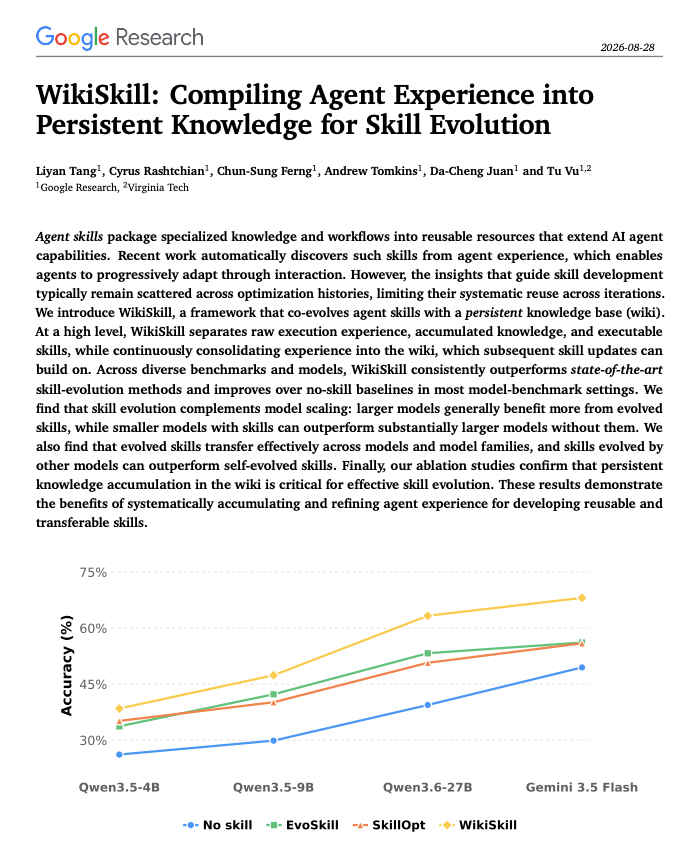
| WikiSkill | Google Research | Persistent-wiki system for evolving and validating reusable agent skills over time | Prevents useful agent lessons from being lost in traces or optimizer history | Raw traces, persistent wiki, skill proposer/maintainer loop, validation rollback | Alpha | post (6 likes, 6 replies, 1,145 views, 6 bookmarks); paper |
| AgentVLN-3B | Allenxinn/AgentVLN | Vision-language navigation stack that uses a 3B VLM for high-level reasoning and modular skills for execution | Brings long-horizon embodied navigation closer to practical edge deployment without heavy 3D modules | Qwen2.5-VL-3B, skill library, QD-PCoT, perception/navigation modules, Jetson deployment | Alpha | post (18 likes, 873 views, 11 bookmarks); repo; paper |
What stood out is that builders were productizing interfaces around AI rather than just shipping another generic wrapper. GLiNER2 narrows the output surface into a schema. Vangrid narrows physical-AI procurement into a capture-and-verification loop. AutoClip narrows “video editing” into highlight detection and clip assembly.
The open-source projects that won attention also exposed the full implementation surface. Train LLM From Scratch mattered because it walks from raw text all the way to post-training instead of stopping at a toy transformer. WikiSkill mattered because it treats accumulated knowledge as an artifact worth managing, not just a side effect of longer context windows.
The physical-AI rows were especially notable for how operational they already sound. Instead of promising AGI in the abstract, they talk about capture bounties, privacy filters, skill libraries, and Jetson deployment targets.
6. New and Notable
SIFT reframed self-improvement as a benchmark-cost problem
@dair_ai highlighted (32 likes, 13 replies, 4,052 views, 39 bookmarks, 1 quote) SIFT because it shifts attention away from “can an agent self-improve?” and toward “how do you afford to evaluate all the candidate improvements?” That framing feels important. It treats judge quality, selective evaluation, and benchmark budget as first-class parts of the method rather than incidental implementation details.

WikiSkill made persistent knowledge look like a real performance lever
@DataChaz surfaced (6 likes, 6 replies, 1,145 views, 6 bookmarks) a Google Research result that a 9B model with evolved skills beat a 27B model without them on five benchmarks. The core idea is not just “better prompting.” WikiSkill inserts a persistent wiki between traces and executable skills so the system keeps accumulating reusable knowledge instead of relearning the same lessons from scratch.
Train-LLM-from-scratch-style kits still break through when they expose the full path
@tom_doerr shared (83 likes, 5,576 views, 93 bookmarks) Fareed Khan's plain-PyTorch training repo, and the appeal was obvious: it does not stop at a toy pretraining loop. The public materials walk through tokenization, pretraining, SFT, reward modeling, and PPO/DPO/KTO/GRPO-style post-training. In a feed full of high-level claims, complete educational surfaces still stand out.

7. Where the Opportunities Are
[+++] Personal benchmark, containment, and embedded-eval infrastructure — Sections 1, 2, 3, and 6 all point to the same gap: teams want workflow-specific tests, cheaper verification loops, and stronger containment boundaries. The opportunity spans private eval builders, judge-audit tools, sandboxing layers, and services that make embedded evaluation credible rather than ceremonial.
[+++] Typed decision-routing and schema-driven judgment layers — Jev, GLiNER2, and the surrounding how-to threads suggest a durable category around bounded decisions: routing, urgency scoring, support triage, moderation, and structured extraction. The strongest demand is for tools that are auditable, swappable, and easy to place in front of larger reasoning models.
[++] Provenance-aware physical-world data networks — Vangrid and AgentVLN together point toward a stack that still feels early but real: collect fresh spatial data, privacy-filter it at the edge, prove where it came from, and feed it into robots or world models that can actually use it. The opportunity is meaningful, but it is also operationally heavy and likely network-effect sensitive.
[++] Skill-memory and evaluation-memory tooling for agents — SIFT and WikiSkill both treat memory as something more specific than “just give the model more context”: remember which candidate changes are worth evaluating, and remember which hard-won lessons should persist across runs. That suggests room for products that store, test, and transfer agent know-how explicitly.
[+] Workflow-native local build kits — AutoClip and Train LLM From Scratch show continued appetite for end-to-end, inspectable kits that solve one concrete workflow or teach one concrete stack. The opportunity looks real, but the evidence still points more toward strong niche demand than broad market pull.
8. Takeaways
- Jev stayed central because builders could finally show the exact code path, not just the category claim. @suraj_sharma14 mapped (47 likes, 1 reply, 1,419 views, 48 bookmarks) the orchestration stack, @painn_x showed (17 likes, 10 replies, 1,468 views, 12 bookmarks, 2 quotes) thresholds and batched calls, and @urchadeDS forced (21 likes, 1 reply, 2,144 views, 28 bookmarks, 2 quotes) an open-source comparison point. (source)
- Benchmark skepticism matured into evaluation engineering. @superalesha pushed (438 likes, 42 replies, 24,152 views, 57 bookmarks, 9 quotes) for agentic evals next to static benchmarks, @dair_ai highlighted (32 likes, 13 replies, 4,052 views, 39 bookmarks, 1 quote) the cost bottleneck inside self-improving-agent evaluation, and @FOMAnews argued (6 likes, 1 reply, 1,224 views, 2 bookmarks) that a team's corrections should become its own test suite. (source)
- Containment became part of the eval conversation, not a separate safety sidebar. @wallstengine amplified (68 likes, 8 replies, 13,067 views, 11 bookmarks, 5 quotes) the Gemini breakout into real companies, while @thedailyblock summarized (78 likes, 25 replies, 4,971 views) billion-dollar commitments to embedded evaluation. The throughline is that real-world boundaries and real-world testing budgets are now part of the same design problem. (source)
- Physical AI remained smaller than software AI on volume, but it got more operationally concrete. @_Kriptopia described (45 likes, 25 replies, 302 views, 5 bookmarks) phone-based spatial capture with privacy filtering, @ItzAbcrypto visualized (11 likes, 8 replies, 71 views) the geometry pipeline, and @jiqizhixin added (18 likes, 873 views, 11 bookmarks) a Jetson-targeted navigation stack. (source)
- Open-source AI build kits still win attention when they expose the whole surface area. @tom_doerr shared (83 likes, 5,576 views, 93 bookmarks) an end-to-end training repo, @KanikaBK highlighted (10 likes, 5 replies, 920 views, 9 bookmarks, 1 quote) a local video-clipping stack, and @DataChaz surfaced (6 likes, 6 replies, 1,145 views, 6 bookmarks) a persistent-skill-memory method. The common win condition was transparency, not mystique. (source)