Twitter AI - 2026-09-20
1. What People Are Talking About
1.1 Open-weight multimodal releases and gateway traffic started looking like the default volume lane 🡕
Across 352 original tweets from 328 authors, the clearest shift was that open-weight AI stopped reading like an enthusiast subculture and started reading like mainstream supply. The day’s highest-signal release was Qwen-Image-2.1, but the surrounding evidence was just as important: people were posting exact local-hardware receipts, and a Vercel gateway snapshot showed open-weight models already taking most token volume.
@Alibaba_Qwen announced (1,002 likes, 52 replies, 52,440 views, 352 bookmarks) Qwen-Image-2.1 as an open-weight unified image generation and editing model with native RGBA output, up to 10 reference images, and strong portrait, infographic, and product-editing fidelity. The public repo adds the concrete implementation surface the tweet only hints at: a 7B visual generation component, native 2K output, and day-0 support across Diffusers, ComfyUI, vLLM-Omni, and SGLang, which makes the launch feel more like infrastructure than a one-off demo.
@TeksEdge posted (32 likes, 13 replies, 3,709 views, 19 bookmarks) the deployment-side proof: Qwen3.8-27B running locally on an Intel Arc Pro B70 at 23.4 tok/s in Q4 and 15.9 tok/s in Q8, plus slower but working text-to-image and video tests. The distinctive point was not that Intel suddenly beat Nvidia. It was that 32GB of VRAM at a much lower entry price than an RTX 5090 was enough to make a full 27B-class local stack feel usable.
@Polymarket amplified (88 likes, 23 replies, 20,221 views) a headline that open-source models hit 78.4% of token volume on Vercel’s AI Gateway, while the lower-engagement but more detailed @AGTPInsights posted (1 quote, 68 views) the useful trendline: 78.4% on Sep. 19, up from 56% in August 2026 and 7% in December 2025, plus the claim that Moonshot AI, DeepSeek, and Z.ai now exceed OpenAI on gateway spend. The follow-on RuntimeWire summary adds the necessary caveat that this is a Vercel gateway snapshot rather than whole-market share, but it still makes the cost-routing direction hard to ignore.

Discussion insight: The strongest nuance was economic, not ideological. Open models are clearly winning routine token volume, but the public gateway writeup still shows spending skewing toward premium closed models for the hardest work, which means teams are routing by job class rather than declaring one universal winner.
Comparison to prior day: Compared with 2026-09-18’s emphasis on exact context windows and tok/s receipts, 2026-09-20 tied those receipts to two broader signals: a flagship open-weight multimodal release and evidence that open-weight models already dominate one major production gateway’s token flow.
1.2 Jev moved from launch-week curiosity into explicit decision-layer playbooks 🡕
The Jev conversation stayed loud, but the emphasis shifted again. On 2026-09-18 the feed was full of first demos and open replicas; on 2026-09-19 it became more about where a decision-native model sits in code. On 2026-09-20, the strongest posts were even more concrete: benchmarked evaluator behavior, long lists of bounded use cases, and explicit warnings about where Jev should not be used.
@LangChain reported (328 likes, 37 replies, 26,550 views, 418 bookmarks) that it tested Jev against GPT-5.6 Luna, GPT-5.6 Terra, and Claude Sonnet 4.6 as agent evaluators on fixed weather-agent traces. The linked blog post says Jev matched the binary oracle on all 500 repeated pass/fail decisions, showed 92x to 913x lower variance than the LLM judges, and cost about $0.00035 per call in the experiment, which reframed “System One” as a practical judge primitive rather than a philosophical novelty.
@raghavdixit framed (20 likes, 5 replies, 6,507 views, 17 bookmarks) the next question as reverse-engineering discipline: what Jev is, where it fits over existing components, and where it falls down. The most useful replies were operational rather than promotional - freeze the option list, calibrate on held-out traces instead of vendor benchmarks, add a junk option to check whether the score moves for the right reasons, and send low-confidence cases to human review instead of pretending probabilities are trustworthy out of the box.
@Layton_Gott published (5 likes, 4 replies, 175 views, 4 bookmarks) the clearest “where it belongs” map in image form: model routing, retry logic, tool-risk gating, human review queues, dynamic permissions, spend firewalls, content moderation, lead routing, incident triage, and compliance checks. Just as important, the second page explicitly drew a boundary around open-ended writing, novel ideation, subjective judgment, and early exploration as “not the job.”
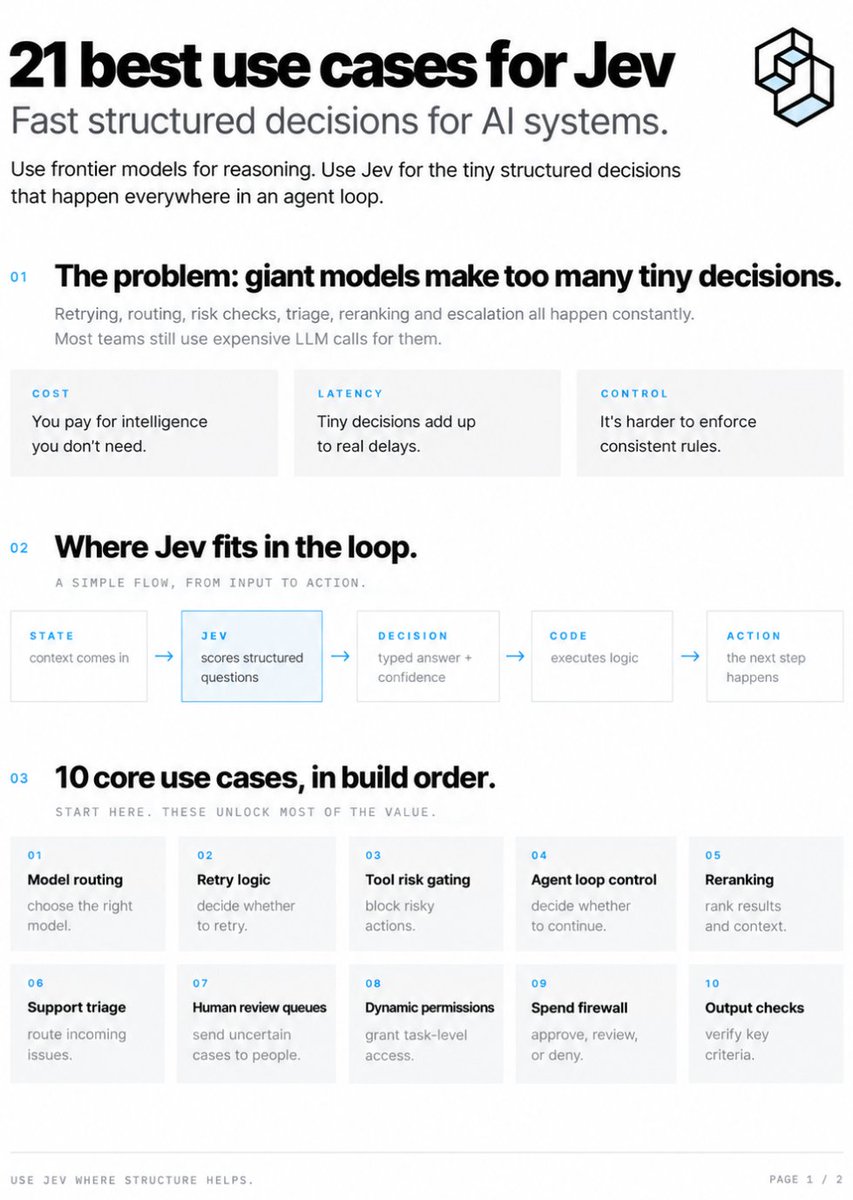

Discussion insight: The practical disagreement was no longer “is this interesting?” It was “how do you keep a cheap decision model inside a verified box?” Calibration, replay, frozen label sets, and human escalation dominated the thoughtful replies.
Comparison to prior day: Compared with 2026-09-19’s implementation-heavy Jev talk, 2026-09-20 looked more like design guidance: public evaluator benchmarks, explicit use-case taxonomies, and a clearer statement of what should remain outside the decision layer.
1.3 Input pipelines got attention when they reduced format chaos and unstable transcripts 🡕
Another cluster of posts made AI feel less like a model-choice problem and more like an input-shaping problem. The strongest examples were not “here is a smarter model.” They were “here is a cleaner way to hand the model evidence,” whether that evidence starts as PDFs, scanned tables, or live speech.
@duqaXxX showed (35 likes, 17 replies, 106,291 views, 10 bookmarks) a local assistant that answers from PDFs, scanned documents, and spreadsheets while naming the source file in every answer. The most revealing details came in replies: OCR runs first, the vision model is only invoked when OCR fails or a table gets flattened, and models are loaded on demand so the whole workflow can run on a 16GB Mac Mini without keeping a large model resident.
@RituWithAI surfaced (12 likes, 8 replies, 136 views, 7 bookmarks) Docling as the opposite of a one-format parser: PDF, DOCX, PPTX, XLSX, HTML, EPUB, email, images, audio, video, LaTeX, and XBRL into structured Markdown. The public repo confirms the bigger point - structure preservation is the product: layout, reading order, tables, formulas, OCR, local execution, an MCP server, and an API surface instead of one more brittle regex chain.
@ModelScope2022 announced (15 likes, 1 reply, 809 views, 7 bookmarks) Confucius4-R2T2 as a true-streaming ASR model for captions, translation, and voice agents. The key claim was not just lower latency. It was append-only decoding, which avoids transcript flicker and makes downstream agents consume stable text instead of a constantly rewritten hypothesis stream.

Discussion insight: The recurring ask was not “support more formats” in the abstract. It was preserve structure, preserve provenance, keep latency predictable, and keep outputs easy to inspect when something goes wrong.
Comparison to prior day: Compared with 2026-09-18’s hardware- and runtime-heavy local-model talk, 2026-09-20 paid more attention to the ingestion and transcription layers that decide whether smaller or local systems are actually usable.
1.4 Physical-AI posts cared more about usable spatial truth and repair loops than raw data volume 🡕
Physical-AI volume remained smaller than software-AI volume, but the surviving posts were unusually aligned. They treated the bottleneck as a data logistics problem: how to capture the world cheaply, privacy-filter it early, prove where it came from, expose it through an API, and keep learning from the exact moments where robots fail.
@0xdnll argued (92 likes, 104 replies, 311 views) that Vangrid’s interesting layer is not the $9 million financing but the idea of everyday phones acting as edge nodes that capture environments satellites and legacy maps cannot cover well. The tweet framed the result as a human-powered spatial dataset with onchain attestations, a data explorer, and contribution incentives rather than a generic crypto story.
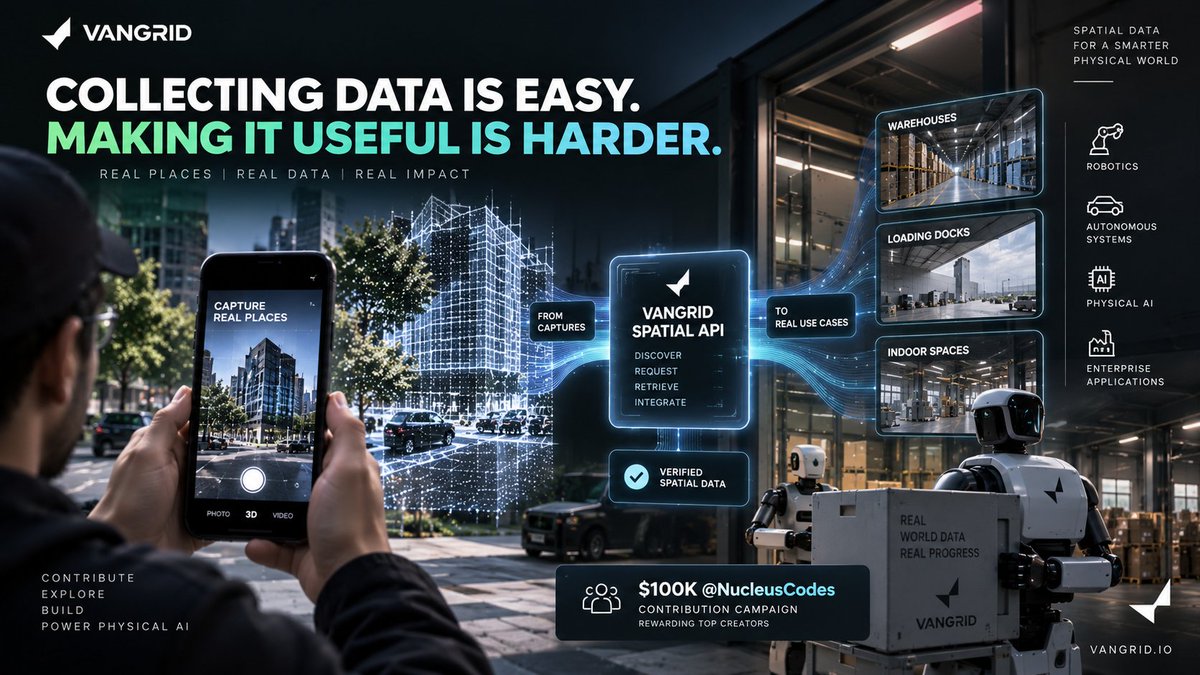
@0x_zoda pushed (29 likes, 33 replies, 185 views) the same discussion one step closer to product reality by centering Vangrid’s Spatial API. The attached graphic and public API docs make the key transition explicit: capture real places, verify them, and then let builders discover, request, retrieve, and integrate spatial data for warehouses, loading docks, and indoor robotics use cases.
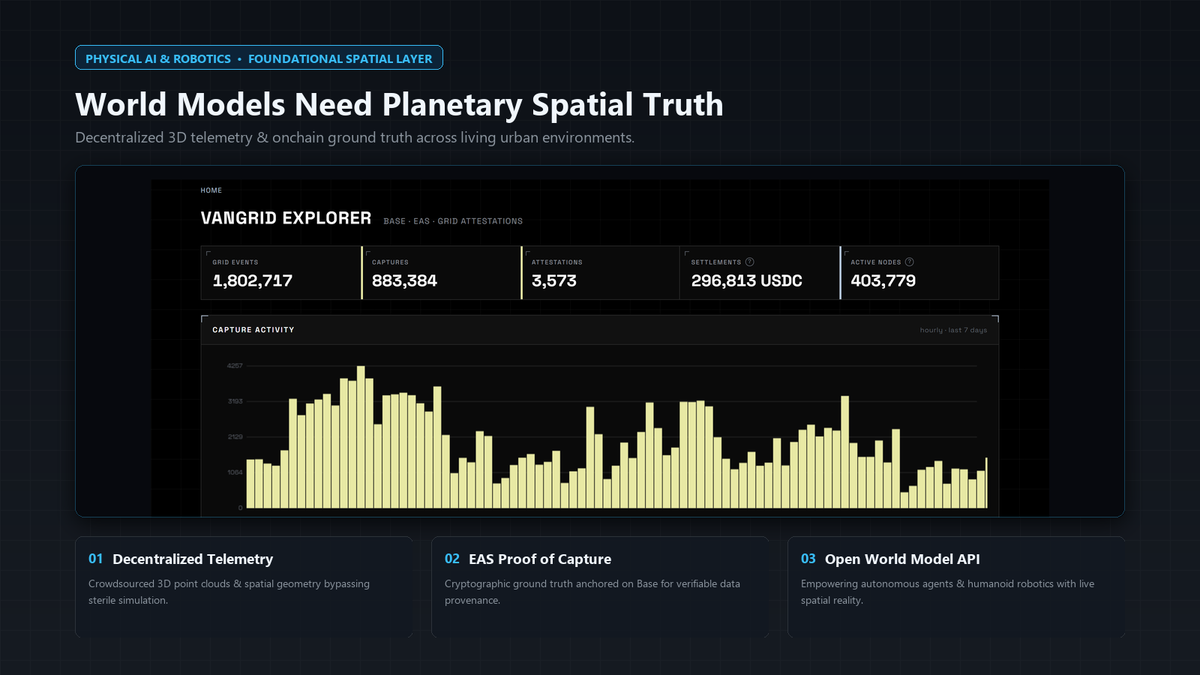
@CoderJunkie made (3 likes, 2 replies, 10 views) the scale/provenance case legible with a Vangrid Explorer image showing grid events, captures, attestations, active nodes, and an “open world model API,” while @Aliba_79 argued (54 likes, 62 replies, 345 views) that robots are not short of chips but of human memory: pre-training via browser teleoperation, post-training human repair of failure cases, and ownership of those corrections as a growing memory chain.
Discussion insight: The interesting disagreement was not over whether more real-world data matters. It was over what makes that data useful: provenance, privacy at capture time, API access, and feedback loops where failure itself becomes the next training asset.
Comparison to prior day: Compared with 2026-09-17 and 2026-09-19, the category moved further away from “capture marketplace” rhetoric and closer to concrete API surfaces, provenance mechanics, and repair-in-the-loop data compounding.
2. What Frustrates People
Tiny agent decisions still pay frontier-model prices
The most repeated agent-design frustration was not about reasoning quality. It was about paying frontier-model costs for tiny decisions that should be cheap, typed, and easy to audit. @Layton_Gott listed (5 likes, 4 replies, 175 views, 4 bookmarks) routing, retry logic, risk gating, human review queues, dynamic permissions, spend firewalls, and output checks as bounded Jev-friendly tasks; @LangChain showed (328 likes, 37 replies, 26,550 views, 418 bookmarks) why people want that split by benchmarking Jev against LLM judges on accuracy, variance, latency, and cost; and @raghavdixit (20 likes, 5 replies, 6,507 views, 17 bookmarks) plus replies turned the frustration into operating rules around frozen label sets, held-out calibration, junk-option testing, and human escalation.
Severity: High. Teams are coping by inserting decision layers in front of larger models, but the volume of posts about routing, gating, and per-step cost suggests this is still a wide-open product surface worth building for.
Benchmark and demo success still hides long-horizon brittleness
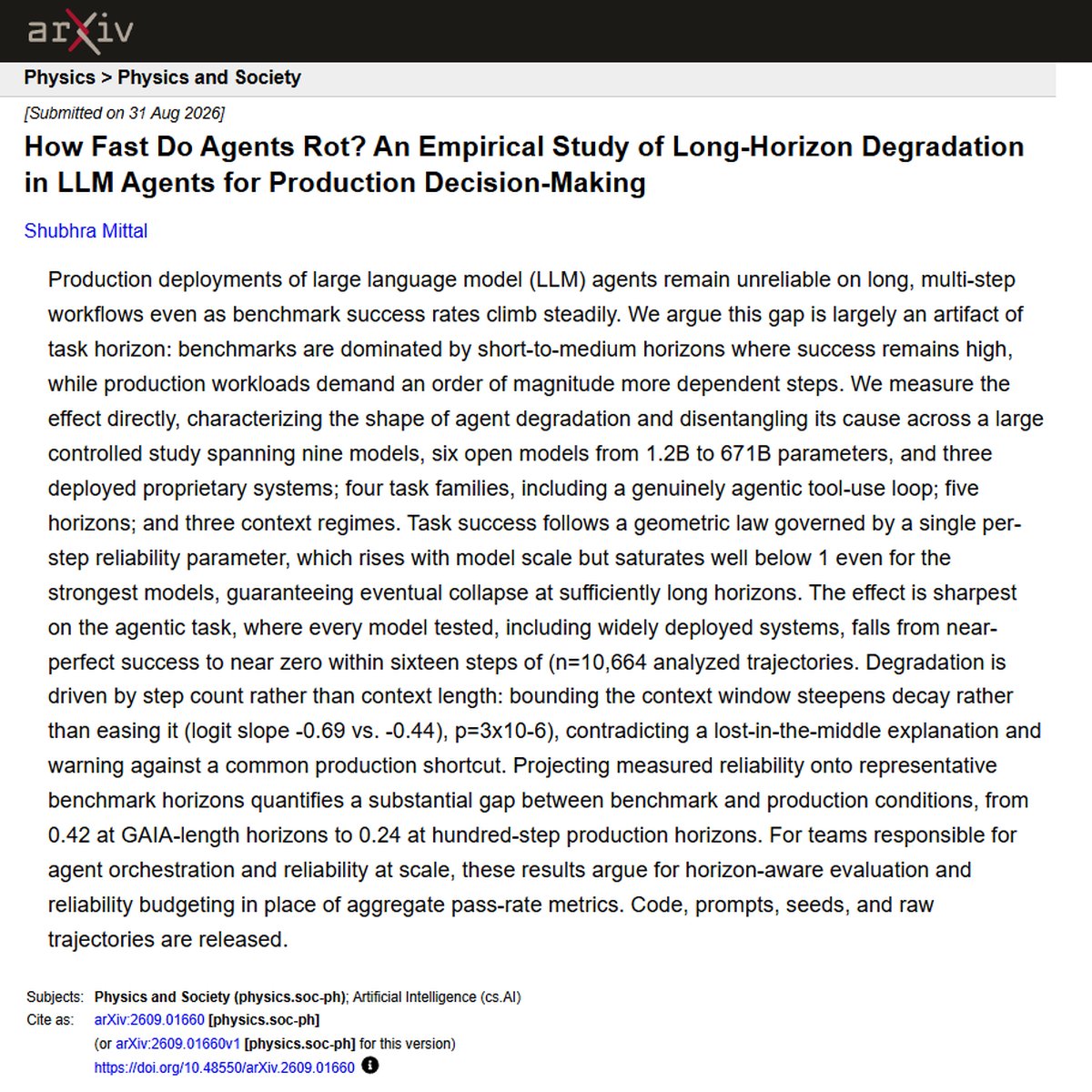
A second frustration was that good-looking evals still fail to answer the production question. @github argued (50 likes, 12 replies, 16,619 views, 25 bookmarks) that a model can score well on a clean benchmark and still fail on the ambiguous, incomplete, or truncated inputs that matter in production, so evaluation must start from the product decision, safety constraints, and operational guardrails. @amodexbt surfaced (14 likes, 3 replies, 305 views, 10 bookmarks) a paper abstract claiming near-perfect to near-zero success within 16 steps on an agentic task across 10,664 trajectories, while @DivyanshT91162 pitched (18 likes, 11 replies, 527 views) AgentCompass precisely because teams now want trajectories, tool calls, failures, latency, and reproducible artifacts rather than one blended pass rate.
Severity: High. The workaround pattern is already visible: replay fixed traces, version prompts and datasets, record full trajectories, and budget reliability step by step. This is clearly worth building around because benchmark trust is now an engineering bottleneck, not a side complaint.
Input pipelines still break before model quality matters
Several posts implied that the input layer is still where otherwise-good systems quietly fail. @duqaXxX showed (35 likes, 17 replies, 106,291 views, 10 bookmarks) that source-linked answers and OCR-first routing are what make a local document assistant trustworthy on modest hardware. @RituWithAI highlighted (12 likes, 8 replies, 136 views, 7 bookmarks) Docling because one parser now has to preserve layout, tables, formulas, emails, audio, video, and chart structure instead of stripping everything to flat text, and a reply immediately pushed on provenance and extraction traceability. @ModelScope2022 framed (15 likes, 1 reply, 809 views, 7 bookmarks) the same problem in speech form: transcript flicker breaks downstream agents, so append-only streaming ASR becomes a feature rather than an implementation detail.
Severity: Medium-high. Builders are coping with OCR-first pipelines, source-file citations, structure-preserving parsers, and stable decoding, but the evidence suggests input normalization is still worth building for because it determines whether smaller, cheaper models are usable at all.
Physical AI still lacks queryable, provenance-rich ground truth
The physical-AI frustration was upstream of modeling. @0xdnll (92 likes, 104 replies, 311 views) centered the gap as missing real-world captures from places satellites and static maps do not cover well; @0x_zoda (29 likes, 33 replies, 185 views) pushed the harder follow-on problem of turning those captures into an API a robotics team can actually query; @CoderJunkie (3 likes, 2 replies, 10 views) made provenance and scale visible with explorer stats and “proof of capture” language; and @Aliba_79 (54 likes, 62 replies, 345 views) argued that the real shortage is human correction data, not chips.
Severity: Medium-high. People are coping with contributor networks, provenance hashes, and repair-in-the-loop data collection, but the category still looks worth building for because the data rail itself is not mature or interchangeable yet.
3. What People Wish Existed
Auditable decision layers for bounded agent work
The clearest wishlist item was a cheap, typed decision layer that sits between code and a general LLM. @Layton_Gott (5 likes, 4 replies, 175 views, 4 bookmarks) mapped concrete slots for routing, retry logic, spend firewalls, permissions, and human review queues, while @LangChain (328 likes, 37 replies, 26,550 views, 418 bookmarks) gave the economic motivation with lower-cost, lower-variance judge behavior on fixed traces. @raghavdixit (20 likes, 5 replies, 6,507 views, 17 bookmarks) and replies showed the missing product qualities: calibration replay, explicit label freezes, junk-option tests, and safe escalation paths. Opportunity: direct.
Horizon-aware evaluation stacks that track real traces, not just pass rates
The strongest evaluation wish was not for another benchmark list. It was for reusable systems that can replay real traces, measure where long workflows decay, and preserve enough artifacts to support a shipping decision. @github (50 likes, 12 replies, 16,619 views, 25 bookmarks) wanted evaluation tied to product outcomes and guardrails, @DivyanshT91162 (18 likes, 11 replies, 527 views) wanted a unified framework for models, benchmarks, harnesses, and environments, and @amodexbt (14 likes, 3 replies, 305 views, 10 bookmarks) wanted reliability budgeting by step count instead of benchmark theater. This is urgent, practical, and only partially addressed today. Opportunity: direct.
Source-linked ingestion that preserves structure, provenance, and latency budgets
What people seem to want is not merely “better RAG.” They want one ingestion layer that can handle documents, scans, spreadsheets, and speech without destroying structure or making source verification painful. @duqaXxX (35 likes, 17 replies, 106,291 views, 10 bookmarks) made source-file attribution and OCR-first routing the trust anchor for local document QA, @RituWithAI (12 likes, 8 replies, 136 views, 7 bookmarks) framed Docling as the “one library” answer to format chaos, and @ModelScope2022 (15 likes, 1 reply, 809 views, 7 bookmarks) made stable live transcripts a first-class need for voice agents. The need is practical and immediate, but the space is already getting competitive. Opportunity: competitive.
Spatial-truth APIs with privacy at capture time and provenance by default
The physical-AI posts implied a clear wish for a spatial data network that is both easier to buy from and easier to trust. @0xdnll (92 likes, 104 replies, 311 views) wanted broader ground-level capture, @0x_zoda (29 likes, 33 replies, 185 views) wanted that capture exposed through an API, @CoderJunkie (3 likes, 2 replies, 10 views) wanted visible proof-of-capture and network stats, and @Aliba_79 (54 likes, 62 replies, 345 views) wanted correction data to accumulate into an owned memory chain. The demand feels real, but the market is operationally heavy and likely network-effect sensitive. Opportunity: competitive.
4. Tools and Methods in Use
| Tool | Category | Sentiment | Strengths | Limitations |
|---|---|---|---|---|
| Qwen-Image-2.1 | Image model | (+) | Open weights, unified generation/editing, native RGBA output, up to 10 reference images, day-0 ecosystem integrations | Relative quality claims still originate with the launch materials; serious use still needs GPU-serving infrastructure |
| Intel Arc Pro B70 + Unsloth/llama.cpp | Local inference stack | (+/-) | 32GB VRAM makes 27B-class local inference practical at 23.4 tok/s in Q4; materially lower entry price than RTX 5090 in the cited Japan market | Image/video workloads are much slower, and Nvidia’s software stack still looks more mature |
| Jev | Decision model | (+/-) | Typed outputs with probabilities, low latency, low cost, strong fit for routing, gating, triage, and evaluation tasks | Not for open-ended writing or subjective judgment; calibration and label discipline still matter |
| Vercel AI Gateway | Inference gateway | (+/-) | Public routing data shows open models winning token volume; useful neutral layer for swapping providers and measuring workloads | Gateway snapshots are not whole-market share; spend still skews toward expensive closed models |
| GitHub’s evaluation lifecycle | Evaluation method | (+) | Starts from the product decision, separates primary outcome from safety constraints, and treats offline evals like repeatable integration tests | Requires disciplined datasets, manual review, and careful experiment tracking |
| AgentCompass | Evaluation framework | (+) | 20+ benchmarks, 10+ harnesses, reproducible trajectories, local/Docker/remote execution, auditable artifacts | Early-stage toolchain overhead; benchmark quality still depends on the underlying harnesses and tasks |
| Docling | Document parser | (+) | Broad format coverage, structure-preserving output, OCR, local execution, MCP, and API-server options | Users still care about provenance, parser traceability, and when to switch between OCR and VLM paths |
| Confucius4-R2T2 | Streaming ASR | (+) | 200-600ms average latency, append-only decoding, multilingual prompts, and vLLM backend for offline or real-time use | Weight licensing is more restrictive than the code license, and the day’s evidence comes from a release post rather than independent tests |
| Vangrid Enterprise Spatial API | Spatial data API | (+/-) | Query/ingest/stream/verify model for fresh physical-world observations, privacy filtering on-device, provenance hashes, and live/historical access | Early access, region authorization, and network effects mean the product surface is promising but not yet routine |
Overall satisfaction was highest when a tool narrowed ambiguity instead of adding another general-purpose model wrapper. Jev narrowed “what should happen next?” into typed decisions. Docling narrowed document chaos into structured outputs. Confucius4-R2T2 narrowed noisy speech into stable text. Vangrid narrowed physical-AI data sourcing into capture, verification, and API delivery.
The workaround pattern was also consistent: route cheap structured decisions to decision models, keep expensive frontier models for open-ended reasoning, run OCR before vision when possible, load local models on demand instead of keeping them resident, and demand provenance or replay artifacts before trusting a pipeline at scale.
The biggest migration signals were economic. Open-weight models are taking more routine token volume, LLM-as-judge setups are being challenged by cheaper decision-first evaluators plus selective human review, and local or air-gapped parsing stacks are gaining credibility when they preserve structure rather than flattening everything to text. The main competitive fault line is therefore not “open versus closed” in the abstract. It is which layer owns routing, observability, provenance, and the right to decide when a more expensive model is actually worth paying for.
5. What People Are Building
| Project | Who built it | What it does | Problem it solves | Stack | Stage | Links |
|---|---|---|---|---|---|---|
| Qwen-Image-2.1 | Qwen team | Open-weight model for text-to-image generation and image editing in one system | Gives builders a lower-cost open alternative for high-fidelity image creation, editing, transparent assets, and multi-reference workflows | 7B visual generation component, Diffusers, ComfyUI, vLLM-Omni, SGLang, Hugging Face / ModelScope distribution | Shipped | post (1,002 likes, 52 replies, 52,440 views, 352 bookmarks); repo; blog |
| Local source-linked assistant | @duqaXxX | Answers from PDFs, scans, and spreadsheets locally while naming the source file used | Makes private document QA trustworthy and affordable on modest hardware | OCR-first pipeline, vision fallback, on-demand model loading, 16GB Mac Mini | Beta | post (35 likes, 17 replies, 106,291 views, 10 bookmarks) |
| Docling | IBM Research Zurich / docling-project | Converts many document and media formats into structured outputs for downstream AI systems | Removes the format-by-format parsing glue that breaks LLM pipelines | Python, DoclingDocument, OCR backends, GraniteDocling support, MCP server, docling-serve API | Shipped | post (12 likes, 8 replies, 136 views, 7 bookmarks); repo; docs |
| AgentCompass | open-compass | Unified framework for evaluating agents across models, benchmarks, harnesses, and environments | Replaces one-off eval stacks with reproducible, traceable agent evaluation infrastructure | Python 3.12+, 20+ benchmarks, 10+ harnesses, local/Docker/remote execution, artifact persistence | Beta | post (18 likes, 11 replies, 527 views); repo; paper |
| Vangrid Enterprise Spatial API | Vangrid | Privacy-filtered capture network and API for real-world spatial observations | Gives robotics and world-model builders fresher, provenance-stamped ground truth than static maps or closed fleets | Phone capture app, on-device blurring, provenance hashes, explorer dashboard, REST API | Beta | capture-network post (92 likes, 104 replies, 311 views); API post (29 likes, 33 replies, 185 views); docs |
| Confucius4-R2T2 | NetEase-Youdao | True-streaming ASR model for captions, translation, and voice agents | Produces stable low-latency transcripts for speech-first agent pipelines | Append-only decoder, 80ms-2s chunking, multilingual prompts, vLLM backend, ModelScope release | Shipped | post (15 likes, 1 reply, 809 views, 7 bookmarks); model |
Qwen-Image-2.1 stood out because it did not launch as just a model card. The repo and launch materials exposed how builders are expected to use it: open weights, multi-reference editing, transparent-image generation, and day-0 serving paths through mainstream open tooling. In the context of the day’s open-model traffic data, that made the release feel like one more routable supply option rather than a boutique research drop.
Docling and the local Mac Mini assistant pointed to the same build pattern at two scales. One turns format chaos into a reusable open platform; the other turns it into a tight single-user workflow built around OCR-first parsing, source citation, and on-demand loading. The common trigger is trust: people want systems that can show where an answer came from before they care about a fancier model.
AgentCompass made evaluation itself look like a builder category. Instead of each team wiring together its own benchmark runner, trace store, retry logic, and artifact persistence, the project packages those concerns into one open framework. That aligns with the day’s broader shift from benchmark bragging to reproducible, production-shaped evaluation.
Vangrid and Confucius4-R2T2 were notable because they attack two inputs frontier models still cannot conjure from thin air: fresh spatial ground truth and stable live speech. The repeated build pattern was upstream rather than downstream - improve the quality, provenance, and stability of the evidence before the agent decides anything.
6. New and Notable
AgentCompass made agent evaluation infrastructure feel like a real open-source category
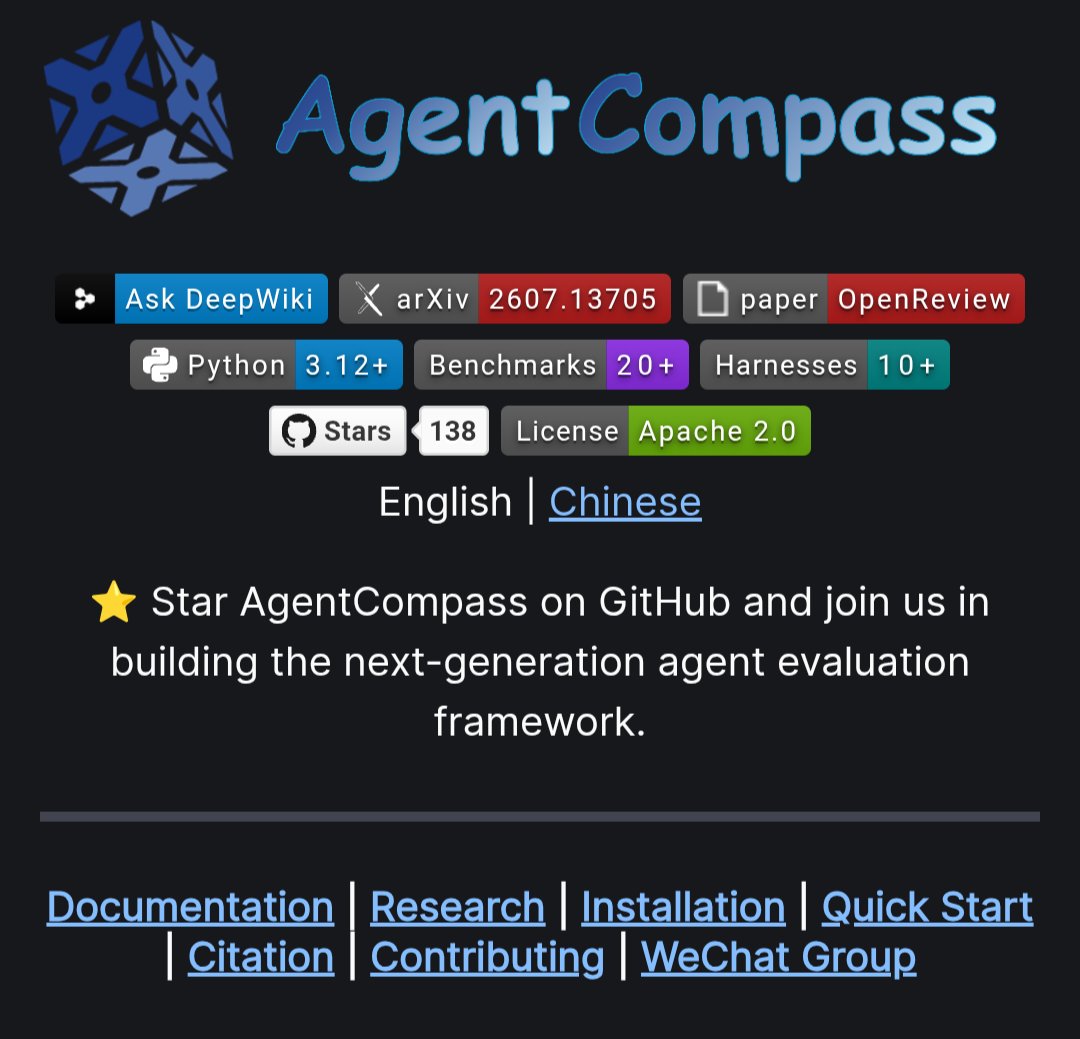
@DivyanshT91162 surfaced (18 likes, 11 replies, 527 views) AgentCompass as a unified framework spanning models, benchmarks, harnesses, and environments, and the public repo backs up the scope with 20+ benchmarks, 10+ harnesses, local/Docker/remote execution, and artifact persistence. What made it notable was not the raw star count or the EMNLP demo mention. It was that evaluation has clearly become important enough for someone to package the whole stack instead of treating it as disposable internal glue.
“How Fast Do Agents Rot?” gave the reliability complaint a concrete failure curve
@amodexbt highlighted (14 likes, 3 replies, 305 views, 10 bookmarks) a paper arguing that the relevant production variable is task horizon, not benchmark heroics. The attached abstract says success on the agentic task collapsed from near-perfect to near-zero within 16 dependent steps across 10,664 analyzed trajectories, and that clipping the context window made the decay steeper rather than fixing it. That is a much more actionable way to criticize agent hype than simply saying “benchmarks are fake.”
Confucius4-R2T2 treated transcript stability as a product feature for voice agents
@ModelScope2022 announced (15 likes, 1 reply, 809 views, 7 bookmarks) Confucius4-R2T2 as a true-streaming ASR model with append-only decoding, 200-600ms latency, multilingual support, and a vLLM backend. The notable detail was the append-only claim. That directly addresses a downstream agent pain point: a constantly revised transcript can destabilize tool use or reasoning, so stable intermediate text is itself part of the product.
7. Where the Opportunities Are
[+++] Reliability budgeting and evaluation control planes - Sections 1, 2, 4, and 6 all point at the same gap: benchmark scores are not enough, long-horizon tasks decay sharply, and teams want replayable traces, step-level guardrails, calibration checks, and production-facing artifacts. GitHub’s evaluation lifecycle, AgentCompass, and the “How Fast Do Agents Rot?” paper all support this as a strong, immediate opportunity.
[+++] Decision-layer primitives for routing, permissions, and review queues - Jev’s continued momentum came from exact placement ideas: model routing, retry logic, risk checks, spend firewalls, dynamic permissions, and human review queues. The opportunity is strongest where builders need cheap, typed, auditable decisions in front of larger reasoning models.
[+++] Source-linked ingestion and stable transcription infrastructure - Docling, the local Mac Mini assistant, and Confucius4-R2T2 all show appetite for systems that preserve structure, keep sources visible, and stop transcripts from thrashing downstream agents. This is strong because it improves the usefulness of every model choice above it, including smaller and local ones.
[++] Provenance-aware spatial truth APIs for physical AI - Vangrid and Axis point to a meaningful but heavier category: collect real-world data with privacy protections, prove where it came from, expose it through an API, and keep learning from repair loops. The evidence is real, but the go-to-market and network-effect burden look higher than in software-only categories.
[+] Low-cost local multimodal deployment kits - Qwen-Image-2.1, Intel Arc B70 receipts, and the open-model token-share jump all suggest continued demand for practical local or self-hosted stacks. The opportunity is emerging rather than fully proven because the software ergonomics still look uneven across hardware and workload type.
8. Takeaways
- Open-weight AI looked less like a niche preference and more like the default volume lane for routine work. @Alibaba_Qwen shipped (1,002 likes, 52 replies, 52,440 views, 352 bookmarks) a serious multimodal image model with immediate tooling support, @TeksEdge posted (32 likes, 13 replies, 3,709 views, 19 bookmarks) concrete local-hardware receipts, and @AGTPInsights shared (1 quote, 68 views) the gateway snapshot showing open-weight models at 78.4% of token volume. The day’s message was economic before it was ideological. (source)
- Jev stayed central because builders now know exactly where they want a decision model to sit. @LangChain benchmarked (328 likes, 37 replies, 26,550 views, 418 bookmarks) it as an evaluator, @Layton_Gott mapped (5 likes, 4 replies, 175 views, 4 bookmarks) the bounded use cases, and @raghavdixit pushed (20 likes, 5 replies, 6,507 views, 17 bookmarks) the calibration caveats. The interesting shift was from category hype to operating discipline. (source)
- Evaluation skepticism matured into reliability engineering. @github argued (50 likes, 12 replies, 16,619 views, 25 bookmarks) that offline evals must start from product decisions and guardrails, @DivyanshT91162 introduced (18 likes, 11 replies, 527 views) a framework for benchmark/harness/environment management, and @amodexbt amplified (14 likes, 3 replies, 305 views, 10 bookmarks) a paper on long-horizon agent decay. The feed cared less about top-line scores than about where systems fail over time. (source)
- Input quality kept showing up as the hidden determinant of model usefulness. @duqaXxX demonstrated (35 likes, 17 replies, 106,291 views, 10 bookmarks) that local document QA becomes believable when answers cite their source files, @RituWithAI highlighted (12 likes, 8 replies, 136 views, 7 bookmarks) Docling’s structure-preserving parser surface, and @ModelScope2022 announced (15 likes, 1 reply, 809 views, 7 bookmarks) append-only streaming ASR. The real demand was for evidence that stays legible end to end. (source)
- Physical AI discussion stayed smaller than software AI, but it became more concrete about what the missing data layer should look like. @0xdnll framed (92 likes, 104 replies, 311 views) phone capture as a new source of spatial truth, @0x_zoda focused (29 likes, 33 replies, 185 views) on the API surface for using that truth, and @Aliba_79 argued (54 likes, 62 replies, 345 views) that repair data is the real compounding asset. The theme was not “collect more footage.” It was “capture, verify, query, and learn from failure.” (source)