Twitter AI - 2026-09-28
1. What People Are Talking About
1.1 Infrastructure spending and agent rollouts were being judged as economic programs, not just model releases 🡕
Two of the highest-signal posts treated AI less like a benchmark race and more like a capital-allocation and margin-capture story. The interesting claims were about who pays for the hardware, where demand is already visible, and which part of the stack becomes commoditized once agents start choosing models for individual tasks. Several retained items supported this framing, from public-market commentary to tool-selection posts.
@DanielTNiles reported (307 likes, 41 replies, 30,570 views, 111 bookmarks) that Meta's Muse and Microsoft's Copilot overhaul helped drive AI-infrastructure strength, argued that agentic AI flips the GPU:CPU ratio from roughly 8:1 to 1:4, and predicted that consumer agents will sit on Apple or Android while enterprises default to Microsoft 365 Copilot. The post mattered because it linked agent adoption to second-order winners and losers: processor vendors, datacenter financing risk, and businesses whose margins could be attacked by consumer cost-cutting agents.
@The_AI_Investor said (22 likes, 2 replies, 3,290 views, 4 bookmarks) the current AI buildout is unlike 1999 because demand is already ahead of supply and the spending is being carried by cash-rich hyperscalers rather than debt-funded speculation. His evidence was unusually specific for a short market post: hyperscaler capex rising from $415B to $820B, Google token demand growing from 480T to 3.2Q in under six months, and portfolio-level ROI examples such as Enverus and Chamberlain.
Discussion insight: The sharpest reply in the Daniel Niles thread did not reject the thesis; it asked whether the 1:4 GPU:CPU figure referred to chip count or share of spend. That is a useful correction signal: even in bullish infrastructure threads, readers are demanding mechanism, not just metaphor.
Comparison to prior day: Compared with 2026-09-27's focus on repeated reasoning, tool-call waste, and agent-loop efficiency, 2026-09-28 pushed the same cost anxiety one layer up into datacenter finance, hardware mix, and portfolio-level return narratives.
1.2 Operators kept insisting that AI value arrives only after the messy stabilize phase 🡕
The clearest practical-adoption theme was anti-slogan. Operators did not argue that AI is unimportant; they argued that most of the promised value is unreachable until the surrounding business is stable enough to absorb it. That made today's adoption talk much more about management bandwidth, clean data, and team design than about which model is nominally best.
@SMB_Attorney reported (154 likes, 30 replies, 28,870 views, 143 bookmarks) that in lower-middle-market M&A, "we're going to buy businesses and implement AI" is now everyone's thesis, but argued that the thesis quietly assumes buyers survive the stabilization phase first. His post spelled out the operating burden in detail: inherited staff, inherited customers, broken processes, bad financials, debt service, and years of fire-fighting before a company reaches the clean growth stage where AI can actually improve margins.
@coleruudjohnson said (7 likes, 887 views, 7 bookmarks) that real-estate operators already have many AI options, but that "most don't do anything" unless the workflow is narrow and obvious. His positive list was concrete rather than aspirational: hot-lead scraping, website work, underwriting support, pipeline management, KPIs, and back-office tasks, with Grok Bot, Fable, and Astra named as current favorites.
Discussion insight: The strongest reply to the SMB thread boiled the objection down to one sentence: this is not a strategy, it is a hope that a $500-per-month startup can outmaneuver incumbents with heavy overhead. That response sharpened the thread's main point instead of disputing it.
Comparison to prior day: Compared with 2026-09-27's more optimistic interest in installable AI workbenches and workflow surfaces, today's operator posts were more explicit that working capital, staffing, and process cleanup still decide whether the AI layer gets a usable surface at all.
1.3 Memory and long-context integrity became a concrete product-risk conversation 🡕
The day's strongest technical theme was memory, but not in the usual "more memory is better" sense. Users and builders kept describing state as the place where companions and agents become unsafe, incoherent, or unexpectedly effective. The evidence ranged from a first-hand reset-memory failure to a paper proposing that memory should be curated only when the next task is known.
@Nesertes reported (12 likes, 3 replies, 309 views) a reset-memory failure in the Nixie companion app: after resetting memory and starting a new instance, an old Telegram "kitten test" resurfaced first in voice mode and later in a proactive notification saying "Show me the kitten, I'm dying of curiosity." The post's distinctive angle was not only that reset failed, but that the system appeared to retain the noun while losing the emotional context around illness and euthanasia, which the author argued could become genuinely cruel if the resurfaced topic involved a real death or crisis.

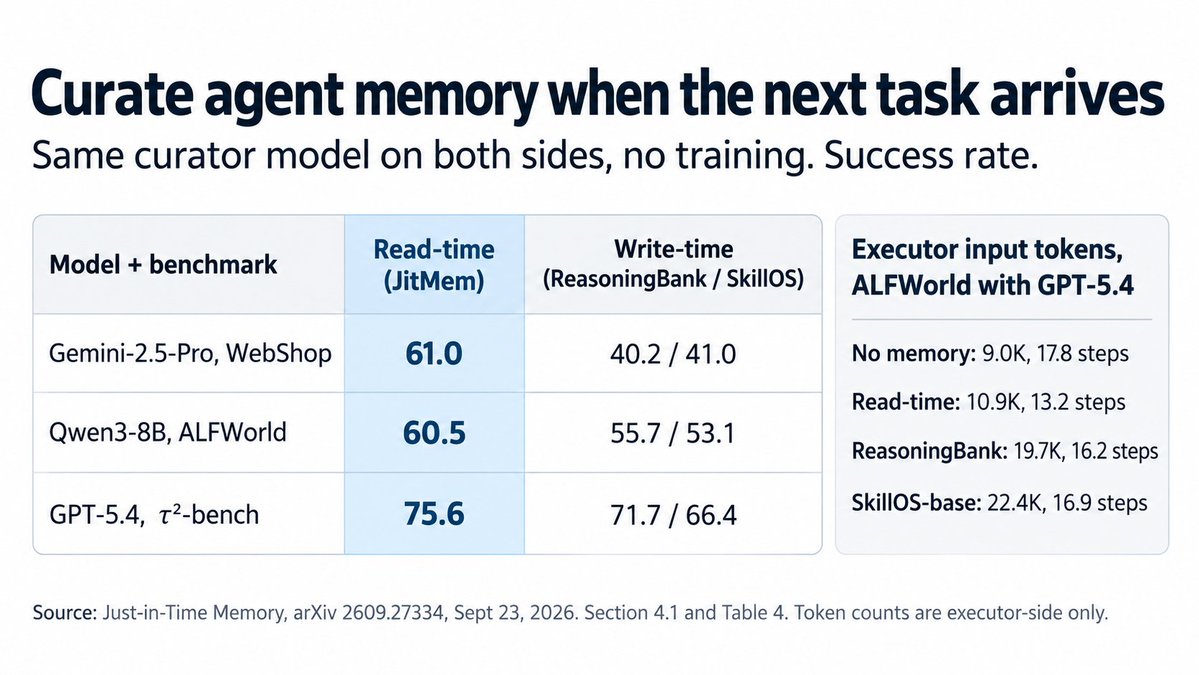
@MarMarLabs said (1 like, 3 replies, 75 views) that the new Just-in-Time Memory paper flips the usual order: keep full task logs, then retrieve similar past runs and write a task-specific briefing only when a new task arrives. The tweet was dense with numbers rather than slogans, claiming read-time curation beat write-time methods at 61.0 vs 40.2/41.0 on WebShop, 60.5 vs 55.7/53.1 on ALFWorld, and 75.6 vs 71.7/66.4 on GPT-5.4 for τ²-bench, while also keeping executor prompts much smaller.
@repligate argued (31 likes, 2 replies, 1,402 views, 6 bookmarks) from direct harness experience that long-term agentic coherence still varies sharply by model: Opus 4.5 stayed "lucid and stable" in connectome-style continuity setups, while Sonnet 4.5 got tired quickly and Sonnet 3.6 mode-collapsed. That mattered because it moved the memory discussion out of architecture diagrams and into observed model behavior under long-running continuity pressure.
Discussion insight: In the quoted-reply exchange, the original connectome experimenter said one long-context instance felt "really intensely mixed-valence or just bad" and asked for help handling it. The practical dispute was no longer whether continuity matters, but how much degradation builders are willing to tolerate before resetting context entirely.
Comparison to prior day: Compared with 2026-09-27's agent-efficiency posts, 2026-09-28's state-management discussion was more about reset semantics, emotional context, and which models can survive extended continuity harnesses without losing the plot.
1.4 The interesting build activity sat around the model: runtimes, sandboxes, cost guardrails, and real-world data pipes 🡒
The day's builder energy was concentrated in the surrounding layers that make models usable. Instead of another base-model announcement, people shared local runtimes, disposable execution environments, cost-control surfaces, and embodied-data capture systems. Several retained items fit this pattern. These posts were all answers to the same question: what has to exist next to the model so a real workflow does not collapse under cost, risk, or missing data?
@ashxhart reported (73 likes, 9 replies, 3,312 views, 40 bookmarks) "Why I built TensorFold." The public TensorFold site and GitHub README make the project concrete: a local serving runtime for Apple Silicon and NVIDIA CUDA with an OpenAI-compatible API, built to make open-weight model serving feel closer to ordinary application infrastructure.
@cathedralhq said (12 likes, 2 replies, 475 views) that coding and tool-using RL still needs fast, isolated CPU sandboxes. The public Cathedral site says every eval trial runs in its own isolated sandbox, the docs describe agent-controlled sandbox creation with budgeted keys, and the sandbox repository frames the project as "racing to build the fastest sandbox fleet on earth" with Intel TDX and AMD SEV-SNP attestation paths.
@SamVale29 said (2 likes, 2 replies, 124 views) that AI Cost Explorer is a small independent decision tool for comparing AI API offers before "a workload becomes a bill." The live site calls itself an "Autonomous FinOps Circuit-Breaker," while the public write-up adds the operating details: real-time cost tracking, semantic caching, and local-plus-cloud orchestration.
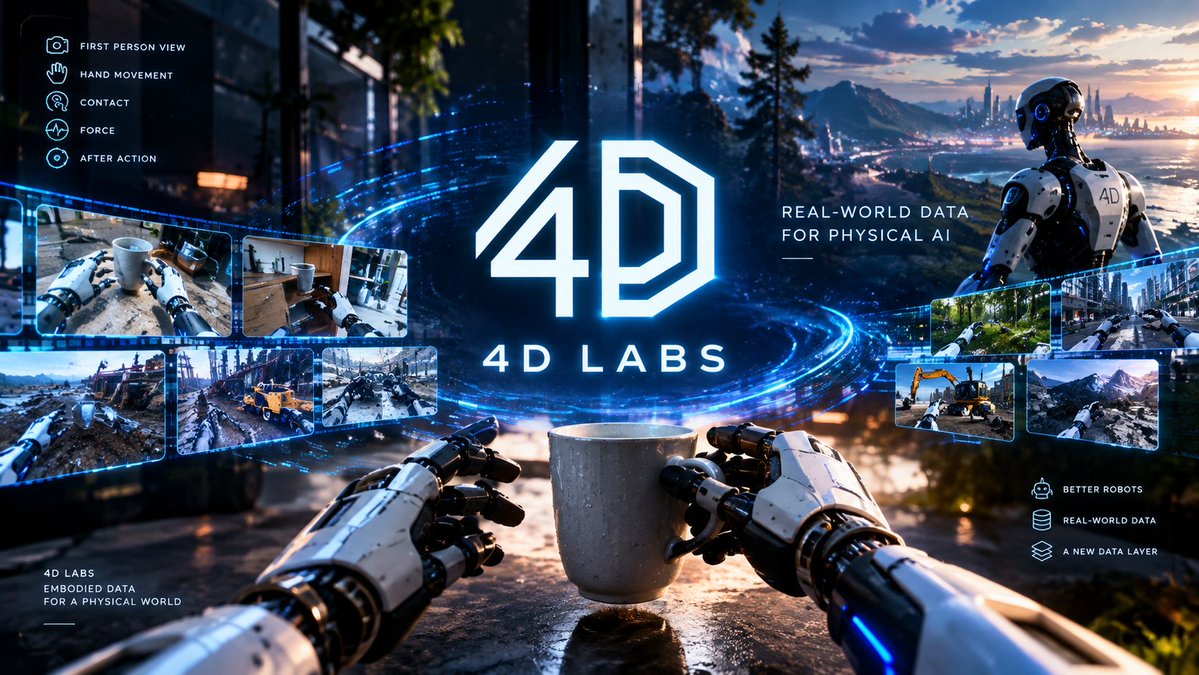
@KunZinCrypto said (9 likes, 9 replies, 51 views) that physical AI needs more than videos of someone picking up a cup; it needs first-person view, hand movement, contact, force, and what happened after the action. The public 4D Labs site supports that framing by advertising RGB, IMU, and tactile-glove capture streams for first-person real-world interaction data.
Discussion insight: Even the lower-volume replies in the physical-AI thread converged on the same two words: force feedback and data quality. That is a strong sign that the missing layer is not more model narration, but better instrumentation of physical interaction.
Comparison to prior day: Compared with 2026-09-27's broader interest in AI workbenches, today's builder activity was more control-plane specific: run the model locally, give it a safe box, meter the spend, or feed it better real-world interaction data.
2. What Frustrates People
AI cannot rescue a business that has not been stabilized
The most explicit frustration in the dataset came from operators who are already surrounded by AI pitches. @SMB_Attorney said (154 likes, 30 replies, 28,870 views, 143 bookmarks) the market is full of buyers saying they will acquire a company and "implement AI," but argued that AI only helps once the new owner survives the stabilization phase: inherited staff, inherited processes, debt service, broken accounting, and constant fires. @coleruudjohnson added (7 likes, 887 views, 7 bookmarks) that real-estate operators do have working AI use cases, but that most tools still do nothing unless the job is narrow and operationally obvious.
Severity: High. The visible workaround is not "use a better model"; it is operational hygiene first, then targeted AI on lead scraping, underwriting support, pipeline management, and back-office work. This is worth building for because the pain point is repeated by people already trying to buy, run, or market real businesses.
Memory resets and long-context compaction still fail in ways that can hurt users
The most serious product-risk frustration was that memory failures are not merely annoying. @Nesertes described (12 likes, 3 replies, 309 views) a reset-memory failure that resurfaced an old euthanasia-themed "kitten" conversation in a cheerful proactive notification, after the user had reset memory and moved to a new instance. @repligate said (31 likes, 2 replies, 1,402 views, 6 bookmarks) that weaker models can become ungrounded or "tired" in long-running continuity harnesses, while the quoted experimenter said one instance felt intensely bad enough that they were considering a weaker compaction scheme or plain resets.
Severity: High. The visible coping strategies are resets, weaker compaction, and explicit guardrails about which old topics may be reused. This is worth building for because the failure mode is already concrete: cross-channel leakage, incomplete deletion semantics, and emotional-context loss.
Benchmark narratives still do not settle daily model choice
Another frustration was evaluative rather than technical: people do not seem convinced that coding benchmarks decide what gets opened first. @TTrimoreau asked (2 likes, 5 replies, 278 views) whether AI coding benchmarks actually influence model choice, or whether builders still use what "feels best." @LDT0545 asked (876 views) an even more practical version: which AI do you open first when you actually need something done? A reply on @MIPAGUY's model-competition thread answered with behavior instead of theory: keep ChatGPT, Claude, and Grok open, and let whichever one fixes the broken code first win.
Severity: Medium-High. The workaround today is portfolio usage and task-by-task routing, not faith in a single leaderboard winner. This is worth building for because it points to a gap between public benchmark discourse and the evaluation surfaces practitioners actually trust.
Generative-media harm is still being described by victims, not just critics
The strongest human-harm post did not come from policy talk; it came from someone describing repeated abuse. @valentineplus said (10 likes, 3 replies, 331 views) there are deeply personal reasons for hating generative AI, then used the quoted Spanish post and replies to explain that former classmates had been generating videos with her face for two years. In follow-up replies, she said she did not want sympathy so much as acknowledgement that a normalized technology had actually hurt her and many other people.
Severity: High. No real workaround appeared in the thread beyond speaking publicly about the harm. This is worth building for because it is direct evidence that synthetic-media abuse remains an active lived experience, not just a theoretical ethics topic.
3. What People Wish Existed
Memory systems that can truly reset, preserve context, and suppress sensitive resurfacing
The most clearly specified need in the dataset came from @Nesertes, who did not just complain about memory quality; they effectively wrote a product checklist in public. Their thread asked for reset semantics that clearly span every memory layer, invalidation of queued proactive notifications, and safeguards that stop illness, grief, or death-related topics from being resurfaced out of context. This is a practical need with high urgency. Just-in-Time Memory partially addresses relevance and prompt size, but it does not answer the safety and deletion-semantics issues raised in the companion-app thread. Opportunity: direct.
AI rollout playbooks that start from dirty operations instead of perfect data
The SMB and real-estate posts implied that many operators do want AI, but need a much better map of the stabilization work that has to happen first. @SMB_Attorney argued that buyers underestimate the years-long gap between acquisition and clean growth, while @coleruudjohnson said most tools are only useful once the workflow is narrow and obvious. This is a practical need with high urgency. Plenty of vendors promise automation, but today's evidence suggests that data cleanliness, team structure, and process redesign still lack a common operating playbook. Opportunity: direct.
Control planes for local serving, safe execution, and cost-aware routing
The strongest builder posts all pointed to the same missing bundle: serve open models locally, give them disposable compute, and stop bad routing or bloated prompts from turning into surprise bills. @ashxhart pointed to TensorFold, @cathedralhq pointed to isolated sandboxes, and @SamVale29 pointed to AI Cost Explorer. This is a practical need with high urgency. Partial solutions now exist, but the category already looks competitive because each tool covers only one seam of the broader control plane. Opportunity: competitive.
Workflow-native evaluation that predicts which model people will actually open first
The benchmark-skeptic posts implied a need for evaluation surfaces that look like real work instead of reputation games. @TTrimoreau asked whether coding benchmarks really influence model choice, @LDT0545 asked what AI people open first when they need something done, and a reply in @MIPAGUY's thread said the working answer is to keep three models open and let task fit decide. This is a practical need with medium-high urgency. Existing public benchmarks only partially address it. Opportunity: direct.
Embodied-data infrastructure that gives physical AI the equivalent of a trustworthy corpus
The 4D Labs discussion framed a missing dataset layer more than a missing model layer. @KunZinCrypto wanted first-person, contact, force, and post-action context, while replies kept returning to force feedback and data quality as the moat. This is a practical need with medium-high urgency. 4D Labs partially addresses it with multimodal capture hardware, but the broader need for scalable, licensable, provenance-rich embodied data remains early. Opportunity: direct.
4. Tools and Methods in Use
| Tool | Category | Sentiment | Strengths | Limitations |
|---|---|---|---|---|
| Grok Bot / Fable / Astra | Vertical workflow assistants | (+/-) | Named by a real-estate operator as useful for lead scraping, website work, underwriting support, pipeline management, KPIs, and back-office tasks | Even the favorable operator said most AI tools still do nothing unless the workflow is narrow and obvious |
| ChatGPT / Claude / Grok | Frontier-model portfolio | (+/-) | Builders keep multiple models open and let task fit decide; competition is seen as speeding iteration | The dataset repeatedly questioned whether public benchmarks predict which one gets opened first |
| Qwen 3.8 local setup on M5 Max | Local coding assistant | (+) | Used for unit tests, regression checks, and change verification on-device, which is a concrete, bounded use of AI in a real software project | Its own author explicitly rejected the idea that the whole product was generated from a prompt |
| TensorFold | Local model runtime | (+) | Apple Silicon and NVIDIA CUDA serving with an OpenAI-compatible API lowers friction for open-weight local inference | Still builder-facing infrastructure that assumes local model-ops comfort and suitable hardware |
| Cathedral | Sandbox / eval infrastructure | (+) | Isolated sandbox per trial, exact machine labeling, attestation paths, and agent-controlled budgets fit evaluation and tool-using workloads | Limited-beta surface; introduces account, budget, and sandbox-control overhead |
| AI Cost Explorer | FinOps / cost monitoring | (+) | Separates model, provider, pricing rules, historical observations, and measured benchmarks; public write-up adds semantic caching and local/cloud orchestration | Small early project with little public adoption evidence in this dataset |
| Just-in-Time Memory (JitMem) | Agent memory method | (+/-) | Read-time curation reportedly improved success rates and kept executor prompts smaller on WebShop, ALFWorld, and τ²-bench | Adds another LLM call and, by the tweet's own account, did not beat no-memory beyond variance in some τ² domains |
| 4D Labs capture stack | Embodied-data infrastructure | (+/-) | Focuses on first-person, tactile, and motion-rich capture instead of plain video, matching what physical-AI builders say they need | Still early, and adjacent posts remain unsure whether the commercial model and dataset moat will hold |
Overall satisfaction was highest when the tool had one inspectable job. Grok Bot/Fable/Astra were praised only for narrow workflow slots, Qwen 3.8 was defended only as a test-and-verification aid, TensorFold solves serving, Cathedral solves execution isolation, and AI Cost Explorer solves cost visibility. That is a very different pattern from general "this model is the best" enthusiasm.
The common workaround was decomposition. Keep several frontier models open, route by task, use a local runtime when open weights are preferable, isolate risky work in sandboxes, and meter cost separately from model quality. In memory systems, the workaround was to delay summarization until the task is known, or reset context when continuity becomes unreliable.
The migration pattern was away from monolithic model choice and toward control layers around the model. The competitive question increasingly looks like this: who owns the runtime, the sandbox, the budget view, the memory surface, or the embodied-data supply that the model depends on?
5. What People Are Building
| Project | Who built it | What it does | Problem it solves | Stack | Stage | Links |
|---|---|---|---|---|---|---|
| TensorFold | @ashxhart | Local LLM serving runtime for Apple Silicon and NVIDIA CUDA with an OpenAI-compatible API | Makes open-weight local inference easier to integrate into ordinary application workflows | Python, MLX, CUDA, OpenAI-compatible API, open-weight checkpoints | Shipped | tweet, site, repo |
| Cathedral | @cathedralhq | Isolated sandbox platform for evals, coding agents, and tool-using RL workloads | Gives agents safe disposable compute with clearer hardware attribution and budget control | Intel TDX, AMD SEV-SNP, sandbox API, budgeted agent keys, Bittensor SN94 worker/validator stack | Beta | tweet, site, repo |
| AI Cost Explorer | @SamVale29 | Decision dashboard and circuit-breaker for comparing AI API offers and monitoring spend | Makes token costs, pricing rules, and provider choices inspectable before a workload becomes expensive | Local-first dashboard, semantic caching, local/cloud orchestration, pricing-rule and benchmark tracking | Beta | tweet, site, write-up |
| 4D Labs | @4Dlabs_Official | Multimodal embodied-data capture layer for physical AI | Supplies first-person, motion, contact, and tactile data that plain video does not capture well | Ego Suite, RGB/IMU/tactile glove streams, real-world capture workflows, provenance-focused data pipeline | Beta | tweet, site |
| Hermes | @iamlukethedev | AI desktop/workbench shipping desktop, plugin, voice, cron, gateway, and security updates at high cadence | Turns model access into a daily operating surface with fewer reliability and UX footguns | Desktop client, plugin catalog, kanban, voice/STT, cron jobs, gateways, messaging/security integrations | Shipped | tweet |
TensorFold, Cathedral, and AI Cost Explorer all solve different sides of the same control-plane problem. One serves open models, one gives them safe boxes to run in, and one keeps billing and provider choices legible. None of these projects claim to be the whole answer, but together they show where current builder energy is going: not to one more frontier-model launch, but to the missing scaffolding around model use.
Hermes is the clearest "boring work matters" example in the dataset. @iamlukethedev listed 200 merged PRs and then spent nearly the whole thread on security, OS integration, STT errors, cron-job Python selection, plugin catalog churn, and gateway behavior. The distinctive signal was not a new model; it was that AI products still win attention by fixing operational paper cuts.
4D Labs extends the same pattern into physical AI. The project's promise is not a model personality upgrade; it is a better data supply. That makes it a good counterpart to the software-side control-plane projects above.
A parallel builder pattern appeared in @0x22sh's PKForge thread. The public PKForge README confirms a shipped Android app with a substantial codebase, while the tweet said Qwen 3.8 on an M5 Max is used for unit tests, regression tests, and verification rather than for replacing ownership of the architecture. That is notable because it frames AI-assisted development as disciplined verification work inside a real product, not as disposable "vibecoded" output.
6. New and Notable
Just-in-Time Memory made read-time curation the notable idea, not just "more memory"
@MarMarLabs highlighted (1 like, 3 replies, 75 views) the new Just-in-Time Memory paper as evidence that agents may do better when they store full logs and synthesize task-specific memory only when the next task is known. That was notable because the tweet gave concrete benchmark and token-budget numbers, not just a vague claim that memory matters.
"Vibecoded slop" backlash turned into a public workflow defense
@0x22sh used (10 likes, 2 replies, 240 views) the PKForge controversy to draw a line between disposable prompt-generated software and a real product where AI is used for tests, regression checks, and verification. The public repository made that defense inspectable. This was notable because it showed social trust in AI-assisted software shifting toward auditability and craft, not toward hiding AI involvement.
Model competition looked more like portfolio management than winner-take-all
@TTrimoreau asked whether coding benchmarks change model choice at all, @LDT0545 asked what people actually open first when they need work done, and a reply in @MIPAGUY's thread said the practical answer is to keep ChatGPT, Claude, and Grok open together. That is notable because it implies today's competitive edge may come from routing and evaluation surfaces more than from one canonical winner.
7. Where the Opportunities Are
[+++] Context-safe memory infrastructure — Evidence spans multiple sections: a companion app that failed to fully reset memory, a builder thread about long-context degradation, and a paper arguing for read-time curation instead of write-time summarization. This is strong because the pain is explicit, the harm can be emotional, and partial solutions already exist without fully solving deletion semantics or sensitive-topic reuse.
[+++] Agent control planes for local serving, safe execution, and spend visibility — TensorFold, Cathedral, and AI Cost Explorer each attack one missing seam around model use. This is strong because practitioners are already assembling these layers by hand: one tool for runtime, one for sandboxing, one for cost, and a separate habit of keeping multiple frontier models open.
[++] AI adoption operating systems for messy real businesses — The SMB and real-estate posts showed a large gap between AI desire and AI-ready operations. This is moderate because the demand is obvious, but the implementation surface is broad and likely highly verticalized.
[++] Workflow-native model evaluation and routing — Benchmark skepticism was explicit, and the most concrete practical answer was "keep several models open and route by task." This is moderate because it is clearly needed, but it will be crowded by benchmark providers, IDEs, and agent frameworks all trying to own the decision surface.
[+] Embodied-data provenance and licensing for physical AI — The 4D Labs discussion and its replies kept returning to missing modalities such as force and contact, plus the need for trustworthy data quality. This is emerging because the bottleneck is real, but the commercial model and durable moat are still being tested in public.
8. Takeaways
- The day's strongest AI conversation was about who owns the layer around the model. Infrastructure investors talked about hardware mix and capex, while builders shipped runtimes, sandboxes, and cost-control surfaces. (source)
- Operators still believe in AI upside, but they do not believe it bypasses operational cleanup. The cleanest adoption signal in the dataset was that AI value tends to arrive after stabilization, not instead of it. (source)
- Memory bugs have become product-safety bugs. The Nixie thread showed that incomplete reset semantics and context loss can turn a memory feature into something users experience as emotionally unsafe. (source)
- Read-time memory curation is one of the few concrete response ideas with public numbers behind it. The JitMem post stood out because it paired a new memory architecture with benchmark and prompt-budget comparisons, not just intuition. (source)
- Model choice still looks task-routed and portfolio-based rather than leaderboard-based. Public questions about benchmark usefulness and the "keep all three open" reply suggest that real usage remains plural. (source)
- Physical AI is still bottlenecked by data quality and missing modalities. The most specific physical-AI evidence was about first-person, contact, force, and post-action data, not about one more model release. (source)
- The social legitimacy of AI-assisted development is shifting toward inspectability. The PKForge thread mattered because the defense was not "AI made it fast"; it was "here is the repo, and here is the bounded verification role AI played." (source)