Twitter AI - 2026-10-04
1. What People Are Talking About
1.1 Open-weight releases were being read as geopolitical and capital-intensive programs, not just model launches 🡕
The strongest base-model conversation was not about benchmark trivia. It was about who can afford to ship open weights, which governments want domestic alternatives to Chinese models, and whether those releases arrive with enough independent validation to matter. Several retained items supported that framing, from a high-engagement rumor thread about Reflection AI to a smaller but concrete post about Aleph Alpha's Kolibri-1 release.
@AndrewCurran_ reported (395 likes, 36 replies, 25,970 views, 81 bookmarks) that Axios was saying Reflection AI was close to releasing an open-weight model expected to compete with leading Chinese open-weight systems, and tied that possibility to unusually large disclosed compute commitments: $150 million per month at Colossus plus a separate $1 billion compute deal with Nebius. The distinctive angle was not only model capability, but the claim that unnamed American labs and even US government interest were lining up behind an “American OSS Renaissance,” turning open models into an explicit strategic contest rather than a hobbyist release cycle.
@SKatalystAI said (18 likes, 4 replies, 622 views, 3 bookmarks) that Aleph Alpha's Kolibri-1 pairs 78B total parameters with only about 3.5B active per token, a 1M context window, German-and-English support, reasoning, tool calling, and Apache 2.0 open weights while targeting sovereign on-prem deployments for European industry and government. The useful caution was inside the post itself: the benchmark claims were Aleph Alpha's own, and the author explicitly said the next step is seeing how Kolibri behaves under independent repo-level evaluation.
Discussion insight: The sharpest reply in the Reflection thread was not ideological. It was mechanical: one person immediately turned the $150 million monthly Colossus figure into roughly $1.8 billion per year, while another said they would believe the model only when it shipped. That is a useful signal that even bullish open-weight threads are now being stress-tested on spend and deliverability.
Comparison to prior day: Compared with 2026-09-28's infrastructure-winner conversation, today's model talk was more explicitly about who ships open weights under which political and sovereign umbrella.
1.2 Compute economics moved closer to everyday product decisions: pricing, serving, and routing 🡕
The dataset treated compute less like a hidden ops line and more like a daily product constraint. Pricing volatility, rack-capacity expansion, serving efficiency, and “which model is cheap enough for this task?” all appeared as first-order concerns. The common pattern was that model quality alone no longer explained usage; people kept talking about the control surfaces around the model.
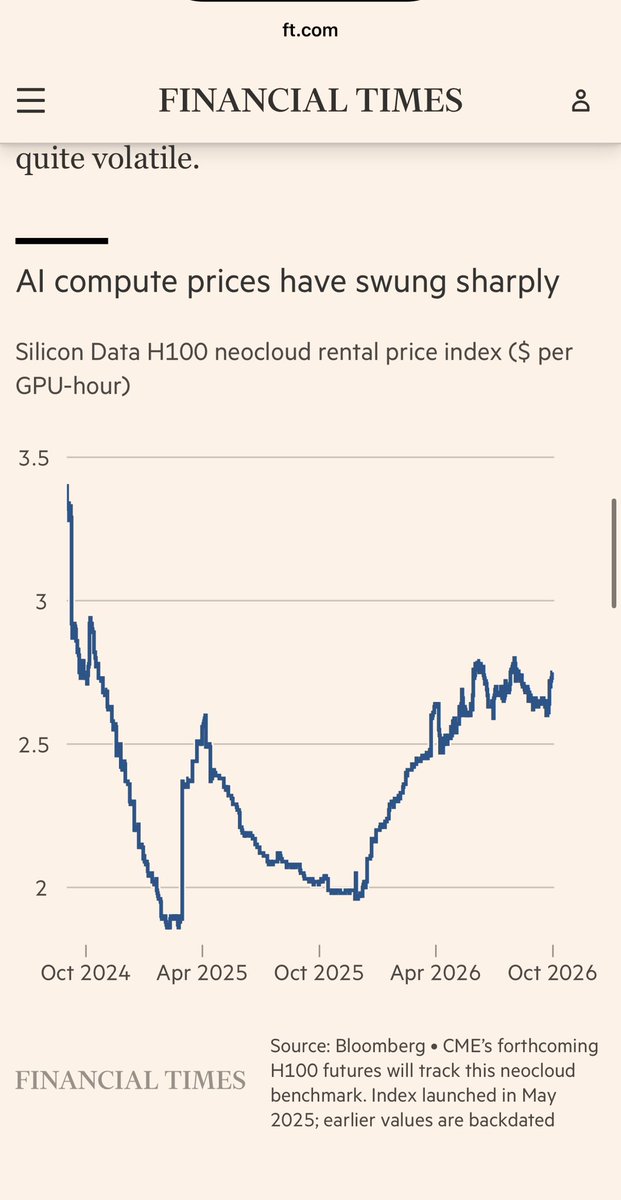
@carmenli reported (43 likes, 7 replies, 13,359 views, 26 bookmarks) that the Financial Times had published “The coming futures market in AI compute,” using Silicon Data's H100 rental index to argue that volatility is now large enough that the market needs benchmarks and derivatives. The second attached screenshot materially added evidence: the H100 neocloud rental index fell below $2 per GPU-hour in early 2025 and then climbed back toward roughly $2.7 by October 2026, which is exactly the kind of swing the post said makes compute hedgeable rather than merely expensive.
@DanielTNiles argued (23 likes, 5 replies, 2,926 views, 8 bookmarks) that AI infrastructure was still one of the few places he wanted to stay selective and constructive, but paired that with a more interesting token-pricing observation: the Ramp Index of business token spend was up 9.1x year-to-date through August 2, then roughly flat to down afterward, even as Anthropic plus OpenAI token volume kept rising. His interpretation was a public version of the same concern builders voiced elsewhere: open-weight pricing may already be squeezing average selling prices even while usage grows.
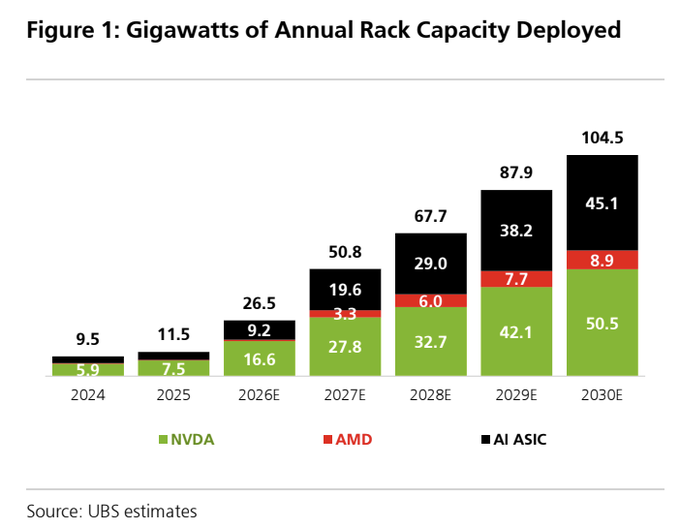
@MilkRoadAI shared (1 like, 2 replies, 544 views, 2 bookmarks) a UBS chart forecasting annual AI rack-capacity deployment rising from 9.5 GW in 2024 to 104.5 GW in 2030, with Nvidia still the largest slice but AI ASIC capacity growing close behind. The tweet itself was a stock-basket pitch, but the image was informative because it turned “infrastructure boom” into a concrete capacity curve rather than a slogan.
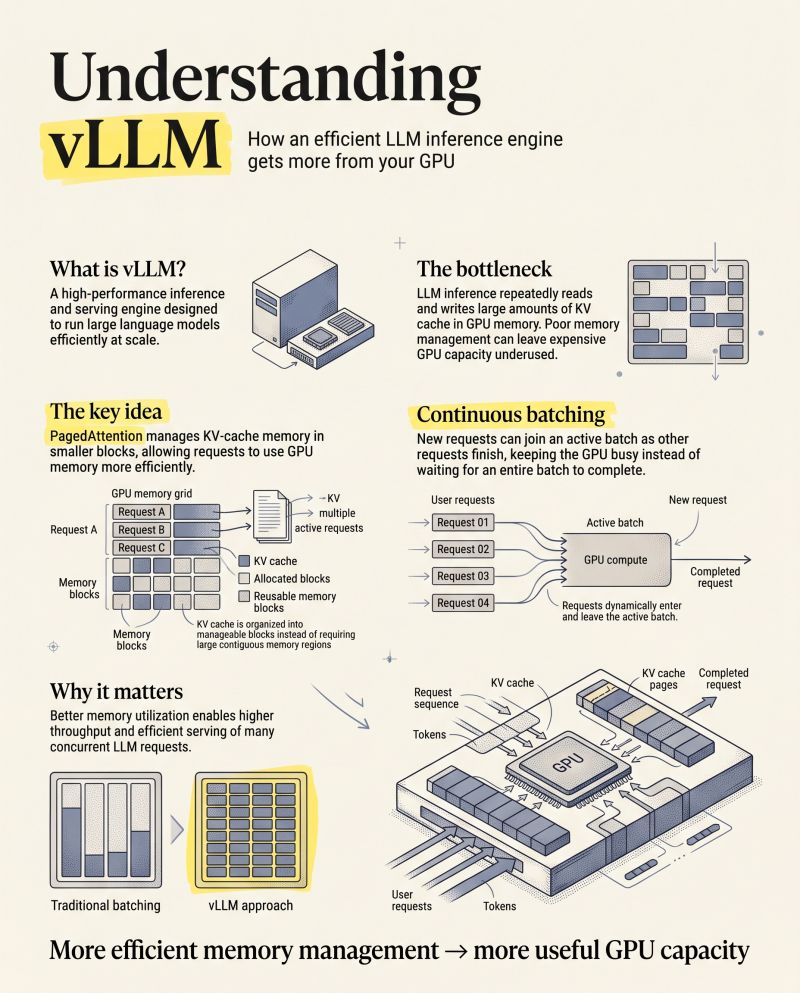
@YoussefHosni951 said (2 likes, 1 reply, 149 views, 3 bookmarks) that the real ROI question in production LLM systems is often the inference engine, not the model, and used vLLM's PagedAttention and continuous batching as the concrete example. @dustinhollywood made (5 likes, 2 replies, 356 views, 3 bookmarks) the same point in workflow language instead of infrastructure language: start with the cheapest model and lightest reasoning level that can finish the task, then escalate only when the problem earns it.
Discussion insight: The notable convergence here is that one side of the dataset talked about compute as a tradable market and the other talked about it as a daily budgeting habit, but both were reacting to the same reality: model choice now has explicit cost surfaces that people expect to inspect.
Comparison to prior day: Compared with 2026-09-28's runtime, sandbox, and cost-explorer posts, today's compute conversation moved closer to price indices, spend curves, and model-routing discipline.
1.3 Evaluation discourse shifted from “which model wins?” to “which harness catches errors and routes work correctly?” 🡕
The most technical conversation in the dataset was no longer a pure benchmark race. Builders kept posting about judges, verifiers, multi-attempt comparisons, fresh-CVE harnesses, and benchmark dashboards that combine quality, cost, and speed in the same surface. That is a stronger sign of workflow maturation than another leaderboard screenshot because it reflects distrust of single-pass answers and distrust of one-dimensional rankings.
@0xDepressionn reported (19 likes, 1 reply, 996 views, 14 bookmarks) that Google's VeriHarness paper found “consensus can conceal errors” when multiple agent runs all make the same mistake, and highlighted the proposed fix: one verifier that checks the claims runs disagree on, and another that attacks the claims they all agree on. The post was unusually specific for an X summary, citing +6.2 points over a single run with Gemini 3.5 Flash, +6.4 with Claude Opus 4.8, and roughly 26,000 rollouts that cost more than $100,000 to produce.

@OrenMe reported (14 likes, 2 replies, 568 views, 11 bookmarks) that GitHub Copilot was adding Agent Bakeoff: 2-10 isolated worktree attempts on the same task, followed by a Judge and a Synthesizer. The distinctive detail was that the author did not present it as flawless. He explicitly said the synthesis step failed for him, which made the post stronger evidence about real evaluation workflows rather than launch-day marketing.
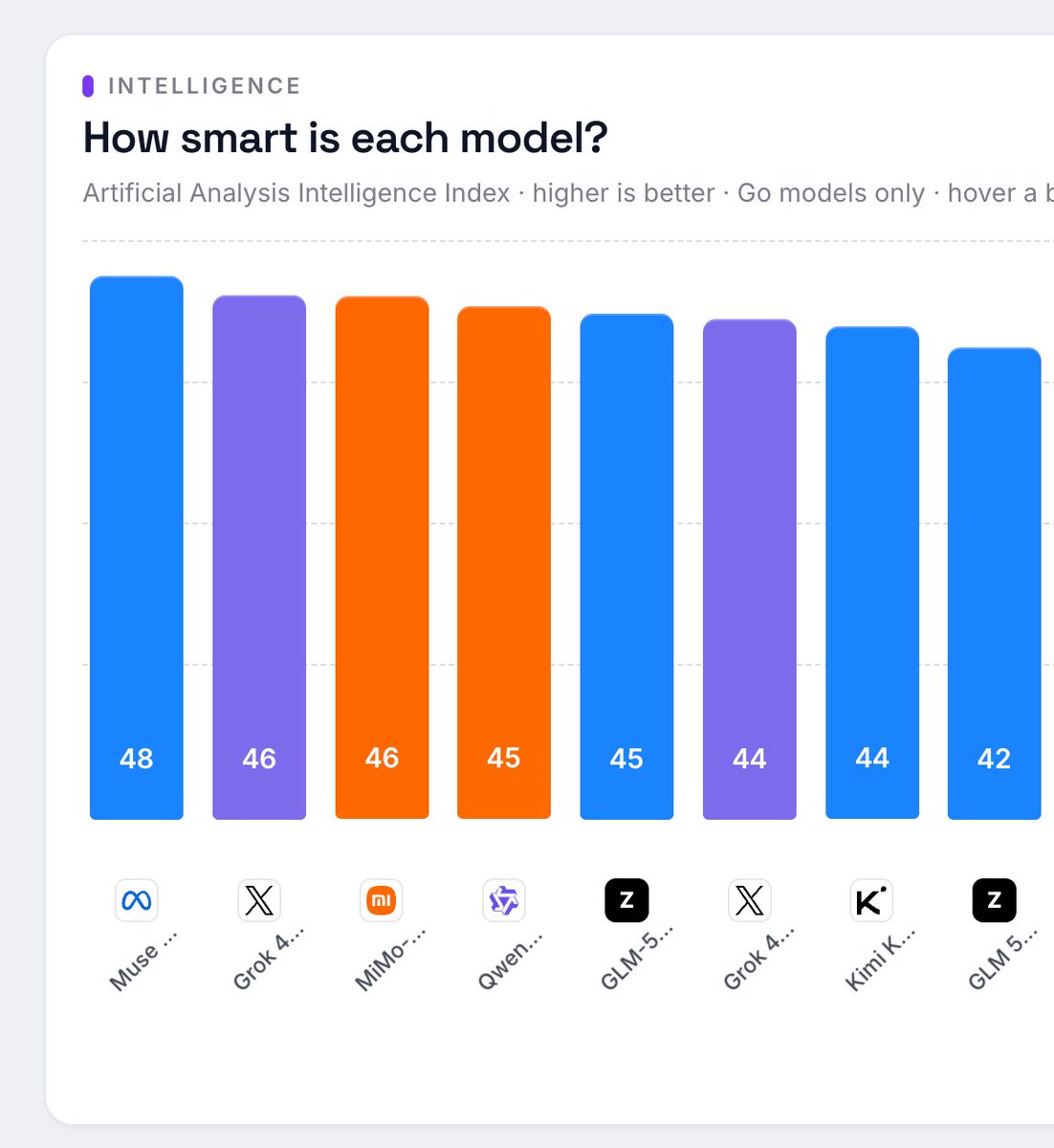
@sheye_majek built (13 likes, 2 replies, 385 views) a live Go benchmark site because he was “tired of guessing” which opencode Go model to use, and the site itself says it joins the full opencode.ai/go lineup to Artificial Analysis benchmarks with intelligence, skills, cost, and speed in one auto-updated view. That made it a practical counterpart to the more research-heavy VeriHarness and Agent Bakeoff posts.
@mark_k said (6 likes, 3 replies, 1,208 views, 5 bookmarks) that Jev had already picked up open-source competition from Amazon Strands Decider and Cloudflare Clef, both of which are designed to choose among bounded options and return probabilities instead of paragraphs. @pentest_swissky pointed (12 likes, 1 reply, 656 views, 14 bookmarks) to Aikido's fresh-CVE benchmark, whose public blog post says three DeepSeek V4 Pro runs reached 28 of 32 rediscoveries and that three cheap runs can beat a single expensive frontier pass on total coverage.
Discussion insight: The implicit argument across all four posts was the same: the right question is often not “which model is best?” but “what comparison, verifier, or bounded decision surface do I trust enough to put in front of a real task?”
Comparison to prior day: Compared with 2026-09-28's emphasis on memory and continuity failures, today's technical emphasis moved toward harness design, disagreement checking, and model-routing surfaces.
1.4 Narrow models and governed domain systems kept outcompeting generic-assistant talk on substance 🡕
The most informative lower-volume posts were usually the narrowest ones. Instead of another “AI changes everything” thread, people shared translation models with explicit format-preservation goals, speech models that fix diarization labels, patient-facing clinical systems grounded in approved protocols, and biotech theses that move the bottleneck from idea generation to wet-lab throughput. These items mattered because they were inspectable and because each one named the missing operational layer around the model.
@TeksEdge highlighted (7 likes, 1 reply, 564 views, 6 bookmarks) Bilibili's Index-Translate family as a 150-language translation stack with official GGUFs, a free OpenAI-compatible API for the 35B-A3B preview, and explicit goals around glossary use, formatting, placeholders, and tone preservation. The screenshot added real scope: text, speech, syllable-controlled translation, and long-document translation were presented as separate surfaces rather than one generic multilingual boast.

@HuggingPapers reported (20 likes, 2 replies, 1,163 views, 7 bookmarks) that Google had released a 4B Gemma-based speaker-diarization post-processor on Hugging Face, and a reply added that it claims SOTA gains across Fisher, Callhome, ICSI, and AMI. @FredaDuan argued (1 like, 543 views, 3 bookmarks) that AI drug discovery has shifted from “use computation to reduce wet-lab search” toward “use AI to explode the hypothesis space, then let wet labs generate the training data,” and her attached tables showed both the mixed record of the 2020/21 cohort and why the 2026 bottleneck thesis now sits downstream in experimentation capacity.
@joshuapliu reported (1 like, 1 reply, 140 views, 1 bookmark) that Seamless Answers, a patient-facing conversational AI grounded only in clinician-approved education, had been adopted by 13 healthcare organizations since April 2026. His five lessons were practical rather than visionary: governance timelines ranged from instant approval to six months, existing vendor trust accelerated rollout, health systems wanted whitepapers and safety documentation, tightly constrained RAG improved clinician buy-in, and customers valued dashboards that expose knowledge gaps and unanswered questions.
Discussion insight: The recurring nuance across these narrow-domain posts was that the hard part is rarely “add AI.” It is preserve formatting, fix speaker labels, route clinical questions only through approved content, or create enough negative wet-lab data for the next model iteration.
Comparison to prior day: Compared with 2026-09-28's focus on runtimes, sandboxes, and cost scaffolding, today's narrower posts made the specialization itself more visible: translation, speech cleanup, clinical support, and drug-discovery feedback loops.
2. What Frustrates People
Model choice still feels wasteful, under-instrumented, and too expensive to guess at
The clearest practical frustration in the dataset was that people are still burning budget because they do not trust a simple answer to “which model should I use here?” @sheye_majek said (13 likes, 2 replies, 385 views) he built Go Bench because he was tired of guessing which opencode Go model to use, and the live site now puts intelligence, skills, cost, and speed on the same surface. @dustinhollywood argued (5 likes, 2 replies, 356 views, 3 bookmarks) that most people are still using frontier models on tasks that do not earn them, and explicitly recommended starting with the cheapest model and lightest reasoning level that can finish the job.
Severity: High. The visible workaround is to build your own benchmark surface, keep multiple models in rotation, and escalate only when the failure mode justifies it. This is worth building for because the pain is explicit, repeated, and already producing homegrown dashboards and heuristics.
Agents are still too easy to trust and too hard to verify
The evaluation posts showed a second frustration: even when people run the same task multiple times, they do not trust the agreement surface. @0xDepressionn said (19 likes, 1 reply, 996 views, 14 bookmarks) the scary part of Google's VeriHarness paper is how many current setups are effectively “run it five times, take the majority,” which is exactly the configuration the paper says can hide shared errors. @farrukh_codes argued (10 likes, 10 replies, 309 views) that giving an agent full laptop access is a huge trust decision and that capable agents need tighter boundaries, not broader permissions. @OrenMe added (14 likes, 2 replies, 568 views, 11 bookmarks) that Agent Bakeoff needs judges and synthesizers on top of isolated attempts, and also admitted the synthesis step failed for him in practice.
Severity: High. The workaround today is layered supervision: isolated worktrees, judges, explicit verifiers, and least-privilege execution. This is worth building for because the failure mode is not abstract; it is silent consensus error combined with overbroad access.
Open-weight and benchmark claims still need independent proof before practitioners trust them
Several strong posts carried their own credibility caveats. @AndrewCurran_ reported (395 likes, 36 replies, 25,970 views, 81 bookmarks) that Reflection AI was rumored to be nearing a major open-weight release, but one of the most useful replies was simply “I will believe it when they ship.” @SKatalystAI said (18 likes, 4 replies, 622 views, 3 bookmarks) Kolibri-1's benchmark claims were Aleph Alpha's own and explicitly said the next step is seeing how it performs on an independent repo. Even the upbeat benchmark material in the dataset leaned this way: @pentest_swissky linked (12 likes, 1 reply, 656 views, 14 bookmarks) Aikido's fresh-CVE benchmark precisely because it moves the argument out of vendor claims and into a public harness with repeated runs and disclosed trade-offs.
Severity: Medium-High. The current workaround is independent benchmarking, fresh datasets, and public side-by-side comparisons. This is worth building for because model releases are arriving faster than shared trust surfaces.
Real-world adoption is still bottlenecked by governance, provenance, and feedback loops
The domain-specific posts showed that deployment pain remains mostly operational. @joshuapliu reported (1 like, 1 reply, 140 views, 1 bookmark) that health-system approval for patient AI ranged from “turn it on” to six months of questionnaires, committees, and testing, and that customers wanted whitepapers, safety documentation, grounded RAG, and dashboards that expose knowledge gaps. @FredaDuan argued (1 like, 543 views, 3 bookmarks) that in AI drug discovery the new bottleneck is not hypothesis generation but wet-lab capacity and negative-data production. @HabibPaart44952 added (8 likes, 7 replies, 73 views) that physical-AI map data needs cryptographic provenance and fresher capture cycles than centralized mapping can provide.
Severity: High. The workaround is not “add a better model.” It is more paperwork, better provenance, tighter content control, and faster feedback from the physical or clinical system. This is worth building for because the posts describe the missing operational layers very clearly.
3. What People Wish Existed
Routing and evaluation layers that tell people the cheapest model that is good enough
The most obvious implied need in the dataset was not another frontier model. It was a trustworthy surface that says which model is smart enough, fast enough, and cheap enough for this exact job, and then verifies the result when it matters. @sheye_majek built (13 likes, 2 replies, 385 views) Go Bench because he was tired of guessing; @dustinhollywood argued (5 likes, 2 replies, 356 views, 3 bookmarks) that people should escalate intelligence only when the problem earns it; and @0xDepressionn highlighted (19 likes, 1 reply, 996 views, 14 bookmarks) a verifier architecture built specifically to catch majority-vote failures. This is a practical need with high urgency. Existing benchmarks, bakeoffs, and benchmark blogs partially address it, but today's evidence says the job is still fragmented. Opportunity: direct.
Least-privilege agent environments that make trust boundaries visible by default
People were not asking for “more autonomous agents” so much as better ways to contain them. @farrukh_codes said (10 likes, 10 replies, 309 views) agents should get only the access a task needs, for only as long as it needs it. @mark_k pointed (6 likes, 3 replies, 1,208 views, 5 bookmarks) to decision models that return bounded probabilities instead of free-form text, and @OrenMe showed (14 likes, 2 replies, 568 views, 11 bookmarks) evaluation built around isolated worktrees, judges, and synthesis. This is a practical need with high urgency. Parts of it exist in agent harnesses and decision-model surfaces, but today's posts suggest people still have to assemble the safety story themselves. Opportunity: direct.
Provenance-rich data and feedback loops for regulated, physical, and biological AI
The strongest operational need in the dataset was for systems that do not just answer questions, but close the loop with trusted real-world feedback. @joshuapliu reported (1 like, 1 reply, 140 views, 1 bookmark) that patient AI wins adoption when it is grounded in approved content, documented clearly, and monitored for knowledge gaps. @HabibPaart44952 wanted (8 likes, 7 replies, 73 views) spatial capture with cryptographic provenance, while @LT_Navarro described (4 likes, 2 replies, 68 views) robot-data collection loops where people step in exactly when the policy slips. @FredaDuan extended (1 like, 543 views, 3 bookmarks) the same logic into biotech, where failed experiments become training data instead of waste. This is a practical need with high urgency. Partial solutions exist, but the common thread is that every domain still lacks enough trustworthy ground truth. Opportunity: direct.
Durable single-purpose products that do one job better than a generic wrapper
The dataset also implied a market need for products that survive model commoditization by being narrow, inspectable, and operationally useful. @ScriptedAlchemy argued (15 likes, 3 replies, 865 views, 2 bookmarks) that most AI startups are building things labs will eat, while the quoted reply said the durable value is in tool calls or skills that do one unit of work exceptionally well. The same pattern showed up in @AdeiWeb2 building (10 likes, 1 reply, 428 views, 1 bookmark) Antislop as a syntax-based deslopper instead of another humanizer, and in @TeksEdge sharing (7 likes, 1 reply, 564 views, 6 bookmarks) a translation family built around formatting and glossary preservation rather than generic chat. This is a practical need with medium-high urgency. The space is already competitive, but the observed demand is for bounded tools with inspectable jobs, not one more vague AI wrapper. Opportunity: competitive.
4. Tools and Methods in Use
| Tool | Category | Sentiment | Strengths | Limitations |
|---|---|---|---|---|
| GitHub Copilot Agent Bakeoff | Agent evaluation / orchestration | (+) | Compares 2-10 isolated attempts under the same harness, then adds a judge and synthesizer on top | The author reported that synthesis already failed in a real run, and the workflow adds coordination overhead |
| VeriHarness | Agent verification harness | (+/-) | Treats disagreement and consensus as separate audit surfaces and reports measurable gains on long-horizon benchmarks | Requires multiple runs plus a verifier, so the quality gain comes with extra cost |
| Go Bench | Benchmark dashboard | (+) | Puts intelligence, skills, cost, and speed on one auto-updated surface for real model-routing decisions | Limited to the opencode Go lineup and the benchmark sources the builder selected |
| Cloudflare Clef / Amazon Strands Decider / Jev | Decision models | (+) | Return bounded choices with probabilities instead of prose, which fits routing and approval tasks | Narrow by design; they help with choice surfaces, not open-ended execution |
| Aikido cyber benchmark harness | Security evaluation | (+) | Uses fresh CVEs, repeated runs, and pooled recall to surface reliability/cost trade-offs | Domain-specific and expensive enough that few teams will reproduce it casually |
| vLLM | Inference engine | (+) | PagedAttention and continuous batching improve GPU utilization, throughput, and cost per token | Solves serving efficiency, not benchmark trust or workflow quality |
| Kolibri-1 | Open-weight foundation model | (+/-) | Sovereign/on-prem pitch, low active-parameter count per token, long context, and tool calling | Public benchmarks in the post were self-reported and explicitly need independent testing |
| Index-Translate | Translation model family | (+) | 150-language coverage, local GGUFs, API access, and explicit attention to formatting and glossary fidelity | Users still need to test document quality and instruction-following on their own material |
| Gemma diarization post-processor | Speech / audio model | (+) | Narrow, measurable job: fix speaker labels after ASR, with public benchmark claims across four datasets | Only addresses one speech-processing seam rather than a broader workflow |
| Thinking Reward Model | Visual evaluation model | (+) | Generates task-adaptive rubrics before scoring and reportedly improves downstream RL for generation and editing | Best suited to scoring and preference pipelines, not as a general assistant |
| Seamless Answers | Grounded clinical assistant | (+) | Uses clinician-approved content, citations, and monitoring dashboards that health systems can inspect | Adoption is gated by governance speed, documentation quality, and vendor trust |
Overall satisfaction was highest when the tool had one inspectable job. @YoussefHosni951 argued (2 likes, 1 reply, 149 views, 3 bookmarks) that vLLM matters because serving efficiency, not just model choice, decides whether production systems feel slow and expensive. @HuggingPapers shared (20 likes, 2 replies, 1,163 views, 7 bookmarks) a diarization model that fixes speaker labels, and @TeksEdge shared (7 likes, 1 reply, 564 views, 6 bookmarks) a translation family whose selling point is preserving terminology, placeholders, and formatting. That is a very different satisfaction pattern from “this is the best general AI.”
The common workaround was decomposition. @0xDepressionn used (19 likes, 1 reply, 996 views, 14 bookmarks) a verifier to doubt the runs that agree, @OrenMe used (14 likes, 2 replies, 568 views, 11 bookmarks) bakeoffs plus a judge and synthesis layer, and @sheye_majek used (13 likes, 2 replies, 385 views) a benchmark site because raw model names were not enough. In regulated settings, @joshuapliu added (1 like, 1 reply, 140 views, 1 bookmark) that dashboards, documentation, and grounded protocols are part of the tool, not post-launch paperwork.
The migration pattern was away from monolithic “pick one model” behavior and toward layered control surfaces: benchmark the candidates, route by cost and task type, verify the answer, and only then put the result in front of users. The competitive dynamic increasingly looks like this: open weights and narrow models are getting closer to frontier usefulness, while the valuable differentiation shifts into serving, routing, evaluation, provenance, and governance.


5. What People Are Building
| Project | Who built it | What it does | Problem it solves | Stack | Stage | Links |
|---|---|---|---|---|---|---|
| Go Bench | @sheye_majek | Live benchmark dashboard for opencode Go models across intelligence, skills, cost, and speed | Replaces fuzzy model-picking with a concrete routing surface developers can inspect | Benchmark aggregation, cost/speed telemetry, auto-refreshing comparison UI | Shipped | tweet, site |
| Inventable | Inventable team | One-sentence-to-startup workspace that builds, designs, deploys, and markets a product in one flow | Compresses product creation and launch for beginner founders or tiny teams | App builder, design/deploy loop, marketing automation, GitHub repo import with PR-based changes | Live | tweet, site |
| Seamless Answers | @joshuapliu / SeamlessMD | Patient-facing AI assistant grounded in clinician-approved education and monitored with dashboards | Makes patient AI deployable inside health-system governance constraints | RAG over approved content, multilingual responses, citations, knowledge-gap reporting, dashboards | Shipped | tweet |
| Vangrid | @vangrid_io | Distributed spatial-data capture network using everyday devices plus provenance proofs | Produces fresher, requestable map/spatial ground truth for physical-AI systems | Edge capture, orbital filming, Merkle proofs, EAS attestations on Base, bounty-driven demand | Early | tweet |
| Axis | @axisrobotics | Browser-based robot-data collection loop where users teleoperate, then correct failures | Expands robot-training data beyond closed labs and ties data back to contributors/tasks | Browser teleoperation, policy correction loop, simulated tasks, Base-recorded trajectories | Early | tweet |
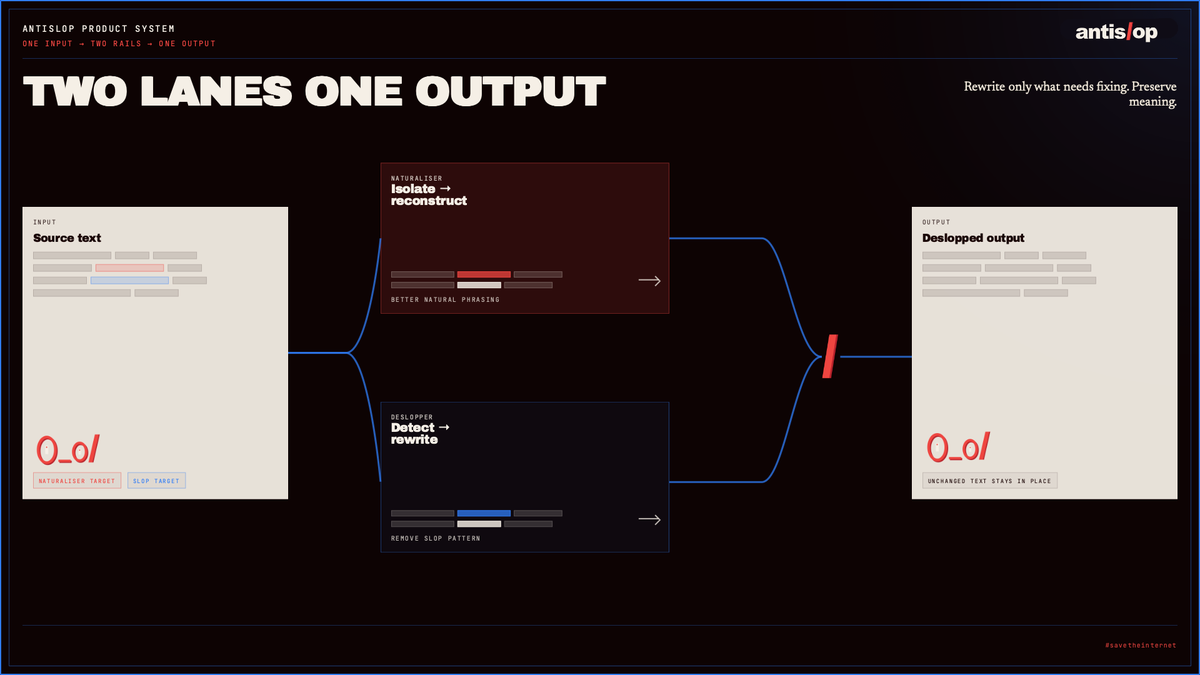
| Antislop | @AdeiWeb2 | Deterministic “deslopper” that rewrites generic AI prose via syntax/linguistics rather than another LLM rewrite pass | Removes robotic LLM writing patterns without relying on another generic model to mask them | Parser-backed rewrite engine, formula VM, typed edit programs, optional AI proofing | Beta | tweet |
Go Bench and Antislop are the cleanest examples of builders narrowing the job until the value is obvious. @sheye_majek did not pitch (13 likes, 2 replies, 385 views) “the best AI assistant”; he shipped a scoreboard that helps a developer choose a Go model. @AdeiWeb2 did not pitch (10 likes, 1 reply, 428 views, 1 bookmark) a general writing copilot; he pitched a deterministic anti-slop engine with a very specific theory of failure. That supports the day's broader pattern: durable builder energy is moving toward bounded tools that fix a visible pain seam.
Seamless Answers, Vangrid, and Axis show the second builder cluster: systems where the hard part is not generating text, but collecting trusted data and closing the loop with the real world. @joshuapliu described the documentation, governance, and monitoring stack needed for patient AI, while @HabibPaart44952 described provenance-rich spatial capture and @LT_Navarro described a robot-data loop where humans correct precisely the failures the policy still makes. Those are not “wrapper” products; they are data and control products.
Inventable is the most interesting counterexample because it pushes in the opposite direction. The site promise, echoed in @david_marco45's tweet (4 likes, 4 retweets, 2 replies, 311 views, 4 bookmarks), is maximal compression: one sentence in, product plus marketing out. That is exactly the kind of surface people are curious about, but it also sits closest to the startup-wrapper commoditization warning elsewhere in the dataset. So the builder split today looks real: compress everything into one workspace, or make one narrow layer exceptionally useful.
6. New and Notable
The open-weight race was discussed like industrial policy, not just product launch timing
@AndrewCurran_ reported (395 likes, 36 replies, 25,970 views, 81 bookmarks) that Reflection AI was nearing a highly capable American open-weight release and tied it directly to enormous compute spending plus broader U.S. interest in competing with Chinese open models. That was notable because the conversation did not sound like an ordinary release rumor. It sounded like people tracking a state-backed capability race, with compute contracts, national positioning, and open distribution all treated as strategic variables.
VeriHarness made “the agreeing agents might all be wrong” feel like a mainstream lesson
@0xDepressionn pulled out (19 likes, 1 reply, 996 views, 14 bookmarks) the most important line from Google's new VeriHarness result: consensus can conceal errors. The post stood out because it paired the warning with concrete numbers, cost, and a release of roughly 26,000 rollouts, rather than just another vague “evals matter” claim. It was notable that the paper's practical takeaway was not “run more agents,” but “appoint one agent to doubt the ones that agree.”
Kolibri-1 turned “sovereign AI” from a slogan into a testable open-weight artifact
@SKatalystAI flagged (18 likes, 4 replies, 622 views, 3 bookmarks) Aleph Alpha's Kolibri-1 as a German open-weight model with 1M context, tool calling, and only ~3.5B active parameters per token. That was notable because the post framed a very specific European deployment thesis: long-context, on-prem, tool-capable models that governments and industry can actually run. The caveat that the published scores were Aleph Alpha's own made it more, not less, important, because it sharpened the next obvious question: which sovereign models survive independent evals?

AI drug discovery looked less like a model story and more like a wet-lab bottleneck story
@FredaDuan argued (1 like, 543 views, 3 bookmarks) that AI drug discovery is entering a regime change where hypothesis generation becomes cheap and validation capacity becomes the scarce resource. The quoted thread was notable because it made the downstream implication concrete: wet labs, assays, synthesis, preclinical capacity, and even failed experiments become the new bottleneck assets because they generate the negative labels that train the next model iteration. That is a sharper, more investable framing than the usual “AI will transform biotech” generality.

7. Where the Opportunities Are
[+++] Model-routing and verification control planes — Evidence spans multiple sections: Go Bench for cost/quality/speed comparison, Dustin Hollywood's “cheapest model first” advice, Aikido's repeated-run benchmark framing, and VeriHarness's explicit attack on consensus failure. This is strong because users are already stitching these surfaces together manually, which usually means the product boundary is real.
[+++] Least-privilege agent runtime infrastructure — The dataset repeatedly returned to the same pain: agents are useful, but people do not want to give them unbounded access or trust majority vote. This is strong because the need is both technical and behavioral: isolation, bounded permissions, decision-model surfaces, and explicit verification all showed up at once.
[++] AI adoption operating systems for regulated workflows — Seamless Answers and the health-system thread showed that trust, documentation, approved-content grounding, and monitoring dashboards are part of the product. This is moderate-to-strong because the demand is real and the willingness to adopt exists, but distribution and compliance work will stay domain-specific.
[++] Provenance-first data networks for physical AI — Vangrid and Axis both point to the same missing layer: fresh, traceable data collection tied to tasks, contributors, and outcomes. This is moderate-to-strong because the bottleneck is clearly shifting toward data quality and refresh, though durable moats and incentives are still being tested in public.
[++] Wet-lab feedback infrastructure for AI drug discovery — The most compelling biotech framing in the dataset was that AI makes hypothesis generation cheap and validation throughput scarce. This is moderate because the need may be very large, but the buying center, timelines, and scientific proof loops are slower than in software.
[+] Deterministic cleanup layers for generic model artifacts — Antislop and related “anti-slop” complaints show a real appetite for products that remove recurring LLM style failures without calling another general model. This is emerging because the pain is obvious and broad, but the category could fragment quickly unless a tool proves durable quality on professional workflows.
8. Takeaways
- The day's core AI argument was no longer “which model wins,” but “who owns the layer around model choice.” Benchmarks, routing heuristics, and cost/speed trade-offs were more actionable than leaderboard chest-thumping. (source)
- Compute is being discussed as a financial market as much as an infrastructure input. Posts about H100 rental pricing, token-spend compression, and giant open-weight compute deals all pointed to a market where access and efficiency matter as much as raw capability. (source)
- Consensus between agents is increasingly treated as a possible failure signal, not a safety signal. VeriHarness stood out because it gave public numbers and a concrete architecture for distrusting unanimous wrong answers. (source)
- Durable builder energy is shifting toward narrow, inspectable tools instead of generic wrappers. Go Bench, Antislop, and the quote-tweet on startup differentiation all converged on the idea that bounded jobs survive model churn better than vague AI layers. (source)
- Regulated AI adoption depends on governance surfaces, not just better model quality. The health-system evidence was explicit that whitepapers, approved-content grounding, trust, and dashboards are part of shipping. (source)
- Physical AI bottlenecks are moving toward data freshness, provenance, and correction loops. Both Vangrid and Axis described systems where value comes from better ground truth and traceable feedback, not from a new model release alone. (source)
- In biotech, AI may create more demand for experiments than it removes. The notable framing was that failed wet-lab work becomes training data, which turns validation capacity into an AI leverage point rather than a leftover cost center. (source)