Twitter AI - 2026-10-05
1. What People Are Talking About
1.1 Open-weight competition was being judged on cost curves, sovereignty, and who could actually ship (🡕)
The strongest cluster was not a single benchmark win. It was the combination of open-weight releases, falling average selling prices, and explicit sovereign positioning. At least four retained items supported the pattern: Dan Niles tying token-spend compression to open-weight pricing, Seb Johnson and Arnaud Bertrand debating what Aleph Alpha's Kolibri-1 means for European AI, and Reflection AI moving from rumor to a named Beam release with a detailed compute story.
@DanielTNiles argued (366 likes, 49 replies, 35,546 views, 126 bookmarks) that AI infrastructure was still one of the few places worth staying selective, but the important detail was the pricing signal underneath it: Anthropic plus OpenAI spend was down 11% from 2026-08-02 to 2026-09-27 while token volume still rose, which he explicitly framed as a possible open-weight pricing effect. That post mattered because it turned "model commoditization" into something operators can watch in spend data rather than just argue about ideologically.
@SebJohnsonUK argued (187 likes, 28 replies, 34,485 views, 49 bookmarks) that Mistral had fumbled the sovereign-AI window just as cheap enough open source became viable, while Aleph Alpha's quoted launch post positioned Kolibri-1 as a 78B-parameter model with 3.46B active parameters, 1M context, Apache 2.0 weights, and on-prem viability. @RnaudBertrand added (74 likes, 5 replies, 5,627 views, 9 bookmarks) the sharpest nuance: Kolibri was trained from scratch in Europe, but it still leaned heavily on Chinese open-source papers and synthetic-data methods, which made "sovereign" AI look more like an open-commons derivative than a sealed national stack.
@wallstengine reported (71 likes, 9 replies, 15,504 views, 13 bookmarks) that Reflection AI had launched Beam as a 501B-parameter open-weight mixture-of-experts model with 23B active parameters, 1M context, and 100 million RL rollouts, while also noting that the benchmark claims were still unverified. That combination of very specific infrastructure detail and explicit caveat is what defined the day's open-weight mood: more concrete than rumor, but still not trusted until independent evaluation lands.
Discussion insight: The replies kept pulling the conversation back to proof. Kolibri supporters immediately had to answer whether "built in Europe" meant "trained from scratch" or merely "fine-tuned on Chinese work," and Beam's supporters still had to defend unverified numbers and extreme compute intensity.
Comparison to prior day: Compared with 2026-10-04, when open weights were discussed as a strategic race and spending thesis, 2026-10-05 pushed the discussion toward named artifacts, parameter counts, and pricing pressure that could already be felt in spend data.
1.2 Benchmark trust shifted from leaderboard excitement to deployment constraints, watermarking, and proprietary data claims (🡕)
The next cluster was about what benchmark wins are actually worth once product policy and evaluation design get involved. Kairos 1's human-behavior simulation claim and OpenAI's EU watermarking rollout pointed to the same underlying tension: the community still wants public, adversarial validation before it treats a neat chart as operational truth.
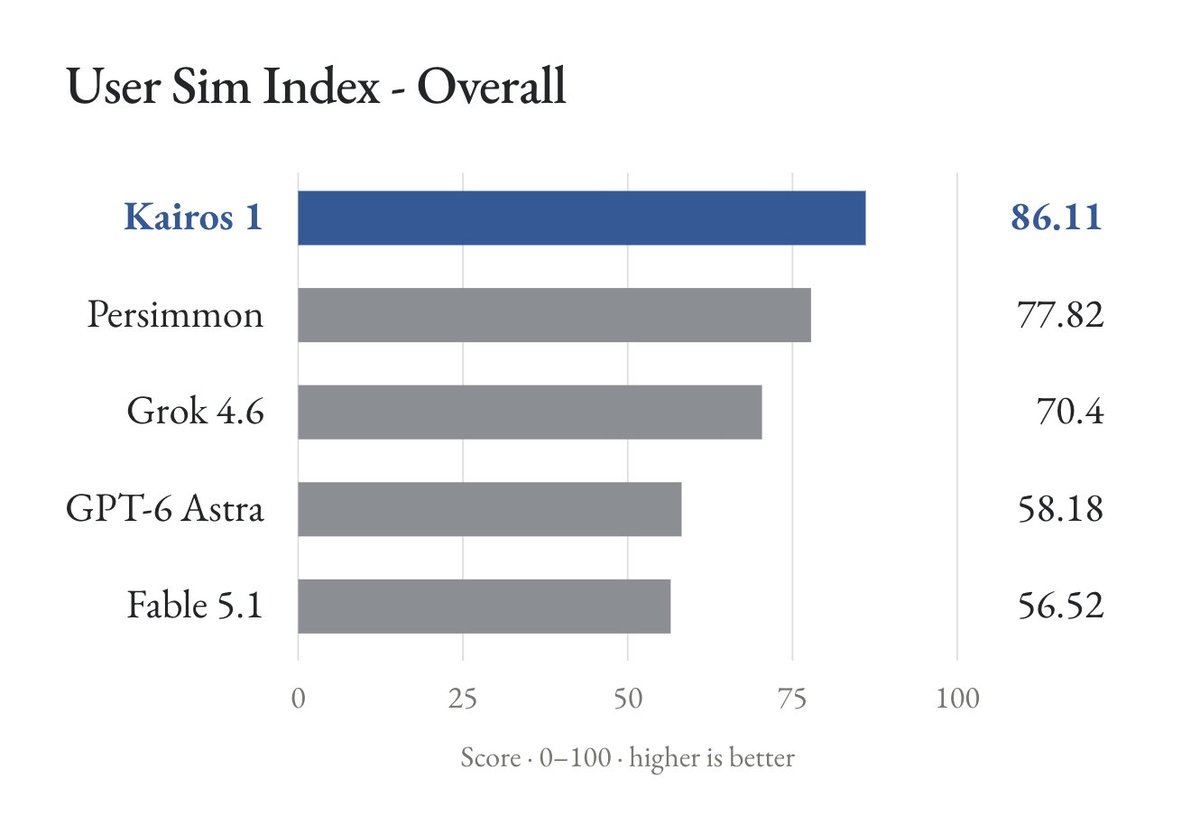
@kevinbanghe introduced (172 likes, 95 replies, 6,235 views, 44 bookmarks) Kairos 1 as a model built to simulate individual human behavior rather than population averages, and said it beat Persimmon, Astra, Fable, and Gemini across 13 simulation benchmarks. The follow-on replies added the core evidence behind that claim: the author said more than 100,000 people had contributed open-ended personal stories and decisions into the proprietary training set, and that the published scores still came from an early checkpoint rather than a finalized system.
@testingcatalog reported (174 likes, 18 replies, 16,594 views, 37 bookmarks) that OpenAI would start watermarking ChatGPT and Codex text in the EU in the coming weeks, while leaving API watermarking opt-in, and quoted OpenAI's internal claim that Astra showed no meaningful benchmark degradation. That was immediately challenged in replies asking how watermarking would behave on code diffs and highlighting that a small gain on Terminal-Bench with watermarking deserves public testing rather than blind acceptance.

Discussion insight: Both posts attracted the same kind of skepticism from different directions. Kairos had to answer questions about closed data and early checkpoints; OpenAI had to answer what an "invisible" watermark means once generated code gets reformatted, refactored, or merged into human edits.
Comparison to prior day: On 2026-10-04, evaluation talk was mostly about better harnesses and judges. On 2026-10-05, evaluation trust moved much closer to product policy and proprietary training data.
1.3 Physical AI arguments kept converging on data engines, simulation assets, and coverage gaps rather than smarter robot brains (🡕)
Physical AI remained a smaller cluster than open weights or evaluation, but its framing sharpened noticeably. The posts that retained signal did not celebrate one more robot demo. They argued that the scarce asset is a system that can keep generating diverse, validated experience.
@Captainmetax argued (124 likes, 146 replies, 347 views) that Axis's real moat is not a robot policy, but a browser-based data engine that collects trajectories, validates them, feeds them into training, and then learns from real-world failures. The most concrete evidence in the post was scale: 222,000 users and 6.9 million trajectories in the live hub, paired with a detailed loop of simulation, validation, training, and real-world feedback.

@xtrabeee added (32 likes, 22 replies, 259 views) that Axis's partnership with Manycore Tech was really about supplying physics-ready simulation assets to a 3D generative model, so the model can learn from grounded environments instead of pixels alone. That widened the theme from "collect more data" to "collect the right physical signals for spatial intelligence."
Discussion insight: The strongest reply under the Axis thread said points campaigns are really behavioral-economics experiments in disguise, which is useful because it surfaced the unresolved question: a community data engine can scale, but it still has to prove that it attracts the right coverage, not just more clicks.
Comparison to prior day: Compared with 2026-10-04, where physical AI sat beside translation, speech, and biotech as one of several domain-specific threads, 2026-10-05 made the data engine itself the core object of discussion.
2. What Frustrates People
Model choice still feels expensive, indirect, and under-instrumented
Severity: High. The clearest operator frustration was that token demand can rise while spend falls, yet users still do not get a clean answer to which model is "good enough" for a given task. @DanielTNiles showed (366 likes, 49 replies, 35,546 views, 126 bookmarks) exactly that mismatch, and both the Beam and Kolibri posts turned release quality into a pricing and deployment question rather than a pure benchmark question. The workaround today is selective routing plus manual skepticism. Worth building: High.
Benchmark claims still outrun independent proof
Severity: High. @wallstengine said (71 likes, 9 replies, 15,504 views, 13 bookmarks) Beam's performance claims had not been independently verified. @kevinbanghe said (172 likes, 95 replies, 6,235 views, 44 bookmarks) Kairos's scores came from an early checkpoint built on a proprietary dataset. @testingcatalog surfaced (174 likes, 18 replies, 16,594 views, 37 bookmarks) OpenAI's "no meaningful hit" watermarking claim, which replies immediately challenged on code-specific grounds. The workaround is public skepticism plus waiting for third-party tests. Worth building: High.
Physical AI still lacks enough validated edge-case data
Severity: Medium-High. @Captainmetax made (124 likes, 146 replies, 347 views) the complaint explicit: more data is not enough unless it covers harder tasks, failure cases, and distribution shifts. @xtrabeee echoed (32 likes, 22 replies, 259 views) that world models still need grounded, physics-ready environments rather than static imagery. The current workaround is browser simulation plus contributor incentives, but the public evidence still treats this as an unsolved bottleneck. Worth building: High.
3. What People Wish Existed
Routing layers that combine quality, cost, and deployment constraints
What people implicitly want is not another model announcement. It is a surface that joins benchmark trust, deployment policy, and price. @DanielTNiles tracked token growth against spend compression, @testingcatalog highlighted compliance-side changes that could affect coding workflows, and Beam plus Kolibri made deployment location itself part of the buying decision. Existing benchmark dashboards only partially address that need. Opportunity: Direct.
Sovereign open-weight stacks that are cheap enough to run and honest enough to audit
The Kolibri and Beam discussion shows a practical need, not just a patriotic one. Teams want long-context, tool-capable, locally controllable models they can actually evaluate on their own hardware or infrastructure. @SebJohnsonUK framed the market opening, while @RnaudBertrand insisted on being honest about dependency chains and borrowed methods. Opportunity: Competitive.
Data engines that expose coverage, validation, and feedback loops for physical AI
The Axis posts are really requests for a system that says what data exists, what it covers, how it is validated, and what new experience the model still needs next. @Captainmetax described the loop explicitly, and @xtrabeee described the asset side of the same problem. Existing teleoperation and simulation tools address parts of it, but the need still looks urgent. Opportunity: Direct.
4. Tools and Methods in Use
| Tool | Category | Sentiment | Strengths | Limitations |
|---|---|---|---|---|
| Kolibri-1 | Open-weight foundation model | (+/-) | 1M context, low active parameters per token, Apache 2.0 weights, and an explicit on-prem thesis | Public performance claims still need independent validation |
| Beam | Open-weight coding/reasoning model | (+/-) | Large context, agentic/coding positioning, and unusually detailed compute disclosure | Weights were still pending and benchmark claims were explicitly unverified |
| Kairos 1 | Human-behavior simulation model | (+/-) | Targets individual-level decision simulation instead of population averages | Proprietary dataset and early-checkpoint evaluation make external trust hard |
| textGrain watermarking | Compliance / provenance layer | (+/-) | Offers a route to EU AI Act compliance without a claimed benchmark penalty | It is still unclear how well the signal survives real coding workflows and edits |
| Axis Hub / Axis Suite | Physical-AI data engine | (+) | Connects browser simulation, validation, and real-world feedback into one training loop | Public proof still centers on volume and narrative rather than error breakdowns |
| Physics-ready simulation assets | World-model data method | (+) | Gives 3D or spatial systems grounded environments instead of flat pixels | Asset pipelines are expensive and still only cover part of the real world |
Overall sentiment was positive about methods that exposed their operating assumptions. Kolibri and Beam drew attention because they named context windows, active-parameter counts, and compute budgets. Kairos drew attention because it named the underlying dataset thesis instead of only posting a leaderboard. Axis drew attention because it showed the collection and feedback loop directly rather than just claiming "better robotics."
The visible workaround was layered skepticism. People combined parameter cards, deployment claims, spend data, and reply-thread challenges before treating any claim as reliable. That is why methods that only showed a benchmark screenshot felt weaker than methods that also exposed route-to-production details.
5. What People Are Building
| Project | Who built it | What it does | Problem it solves | Stack | Stage | Links |
|---|---|---|---|---|---|---|
| Kairos 1 | @kevinbanghe | Simulates individual human behavior instead of only population averages | Frontier models often miss personal context, history, and decision variance | Proprietary human-decision dataset, simulation benchmarks, large-scale preference traces | Alpha | post |
| Beam | Reflection AI via @wallstengine | 501B open-weight MoE for coding, reasoning, and agent workloads | Gives enterprises and sovereign users an open model positioned against Chinese leaders | 501B total / 23B active parameters, 1M context, large-scale RL rollouts on GB300 clusters | Alpha | post |
| Kolibri-1 | Aleph Alpha via @SebJohnsonUK | European open-weight model for long-context, tool-capable, on-prem deployment | Offers a sovereign deployment option for industry and government buyers | 78B parameters, 3.46B active per token, 1M context, Apache 2.0 weights | Shipped | launch, commentary |
| Axis data engine | @axisrobotics via @Captainmetax | Collects robot trajectories in browser simulation, validates them, and feeds them back into policy training | Physical-AI teams need more diverse, structured, and continuously improving training data | Browser simulation, validation filters, real-world feedback loop, live contributor network | Shipped | post |
Kairos and Axis were the clearest examples of teams building around what they think the real bottleneck is. @kevinbanghe did not pitch a better general assistant; he pitched a dataset and benchmark setup for modeling individual behavior. @Captainmetax did not pitch smarter robot weights; he pitched a loop that keeps generating better robot experience.
Kolibri and Beam, by contrast, show the open-weight builder pattern splitting in two directions. Kolibri emphasizes local control and sovereign deployment, while Beam emphasizes scale, RL compute, and enterprise-grade openness. Both are trying to solve the same meta-problem: make advanced model capability portable enough that buyers do not have to trust only the frontier API vendors.
6. New and Notable
Beam turned the U.S. open-weight conversation into a named release with disclosed scale
@wallstengine reported (71 likes, 9 replies, 15,504 views, 13 bookmarks) a 501B-parameter Reflection AI model, 100 million rollouts, and more than $7B in compute deals, while still noting the lack of independent verification. That was notable because it shifted the conversation from rumor to an actual artifact with auditable claims.
Watermarking moved from policy talk into ChatGPT and Codex product behavior
@testingcatalog reported (174 likes, 18 replies, 16,594 views, 37 bookmarks) that invisible text watermarking is coming to ChatGPT and Codex in the EU, with API usage remaining opt-in. That matters because it makes compliance a visible part of everyday coding-output behavior, not just a policy memo.
Axis made the physical-AI data-engine thesis unusually legible
@Captainmetax showed (124 likes, 146 replies, 347 views) a more complete public story than the usual robot-model promotion: collection, validation, training, feedback, user count, and trajectory count. That is notable because it turned an abstract bottleneck into a visible operating loop.
7. Where the Opportunities Are
[+++] Independent routing and verification surfaces for open and closed models - Evidence from Dan Niles's spend analysis, Kairos's proprietary-benchmark claims, OpenAI's watermarking rollout, and Beam's unverified release all points to the same gap: teams still need one surface that joins quality, cost, compliance, and trust.
[++] Data engines for physical AI that expose coverage, validation, and failure harvesting - Axis and the Axis/Manycore partnership both argue that better model weights are downstream of better experience loops. The opportunity looks strong because the pain is explicit and the current public solutions still center on partial coverage.
[++] Sovereign open-weight deployment stacks - Kolibri and Beam show clear demand for large-context open models that can run under local or national control. The opportunity is moderate because serious entrants already exist, but the trust, tooling, and evaluation layer around them is still immature.
[+] Policy-aware provenance tooling for generated text and code - EU watermarking made provenance a product question. The signal is early, but it is becoming hard to separate coding output from the compliance rules around it.
8. Takeaways
- Open-weight discourse is now as much about pricing and deployment as it is about model quality. Dan Niles's token-vs-spend gap and the Kolibri/Beam posts all pointed in that direction. (source)
- The community still does not trust a neat benchmark table without operational context. Kairos, Beam, and EU watermarking all attracted immediate calls for adversarial or independent testing. (source)
- Physical AI builder energy is moving toward data engines and simulation assets, not only bigger robot models. Axis and the Manycore partnership made data coverage the center of the story. (source)
- Sovereign AI is increasingly framed as an open-source supply-chain question. Kolibri's "built in Europe" story became more credible, and more complicated, once people traced the Chinese research it built on. (source)