Twitter AI - 2026-10-07
1. What People Are Talking About
1.1 Frontier math results pulled AI discourse toward scientific acceleration (up)
The highest-signal cluster by far was OpenAI's public math release and what it implies about the slope of frontier capability. The public openai/math repository says the release contains 722 manuscripts organized into 372 result families, with many but not all results formalized, and that the average result used roughly three hours of ChatGPT Pro thinking compute. That combination of breadth, partial formalization, and unexpectedly low per-result compute turned the feed from “which product shipped?” into “how quickly can automated research compound now?” At least four retained items fed this theme.
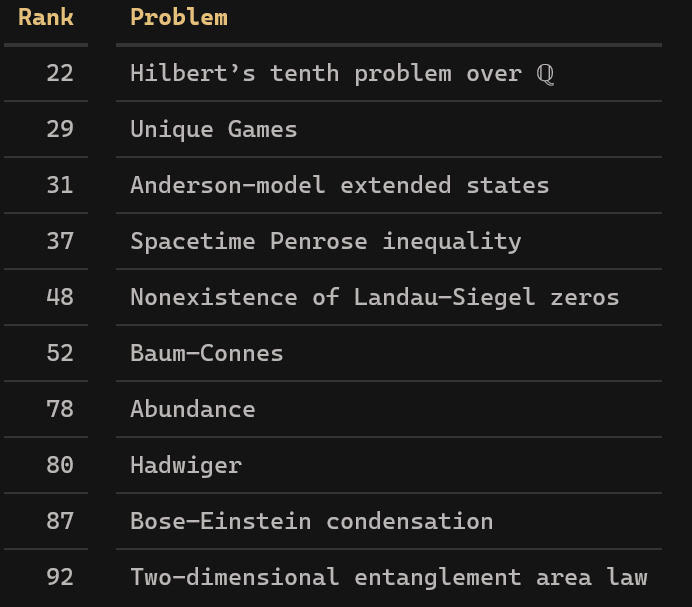
@AISafetyMemes framed (584 likes, 34 replies, 55,094 views, 219 bookmarks) the release as a ranked-list shock, compressing it into a list of top open problems that now have either partial or full claims attached. That post mattered because it made the breadth legible to non-specialists in one screen, while also sending readers toward ProofAtlas and the linked OpenAI materials. The caution is that ProofAtlas preserves historical ranks and is not itself a fresh verification pass on every claim, so the signal is “breadth of release plus ranking optics,” not final settlement.
@kimmonismus argued (369 likes, 42 replies, 16,849 views, 77 bookmarks) that the more important story was the acceleration curve, not the headline count. The post tied OpenAI's earlier Navier-Stokes announcement to a 10,000-agent effort, then contrasted that with the repo's newer “roughly three hours of ChatGPT Pro thinking” average per result. That interpretation turned the release into a capability-slope argument: the feed was not only reacting to solved problems, but to the possibility that the same methods are getting cheaper and more reusable very quickly.

The same post also attached a useful conceptual frame: if this is “a country of geniuses in a datacenter,” the hard question is not whether it can solve difficult problems, but how quickly that translates into the rest of science given physical bottlenecks such as hardware and wet-lab throughput.
Discussion insight: The sharpest replies did not simply cheerlead. One strand said reusable techniques matter more than raw problem counts because they determine whether the next field falls faster too. Another strand asked whether frontier labs are concentrating scarce compute on the right targets and whether research acceleration is arriving faster than governance or public understanding.
Comparison to prior day: On 2026-10-06, the dominant conversation was still about control planes, trusted completion, and benchmark surfaces. On 2026-10-07, evaluation remained important, but only after a flagship scientific-output release reset the top of the feed.
1.2 Benchmark talk kept moving toward dynamic, open, and adversarial evaluation (up)
A second major cluster said the real bottleneck is no longer publishing one more benchmark score. It is keeping benchmarks current, hard to game, and matched to long-running work. This theme connected Snorkel's new funding push, Hermes Bench's graded task surface, AXIS's moving task library, and repeated complaints that custom evals routinely overturn generic model-size intuition.
@vincentsunnchen announced (133 likes, 24 replies, 4,522 views, 38 bookmarks) that Snorkel is expanding Open Benchmarks Grants 10x to a $30M commitment. The linked announcement adds two important pieces beyond the funding number: an Open Benchmarks Red Team for reward-hacking, contamination, verifier, and diversity failures, plus a research fellowship for frontier evaluation work. That is a notable shift from “benchmark as one-time artifact” to “benchmark as maintained infrastructure.”
@HermesAgentTips highlighted (20 likes, 4 replies, 1,309 views, 12 bookmarks) Hermes Index as a model-comparison surface inside Hermes Agent rather than outside it. The linked Hermes Bench portal says it contains 150 tasks across 25 categories, combining automated, hybrid, LLM-judge, and vision-judge grading, plus 81 scripted follow-up turns. That matters because it evaluates model behavior inside a specific agent runtime, not just on disconnected benchmark prompts.
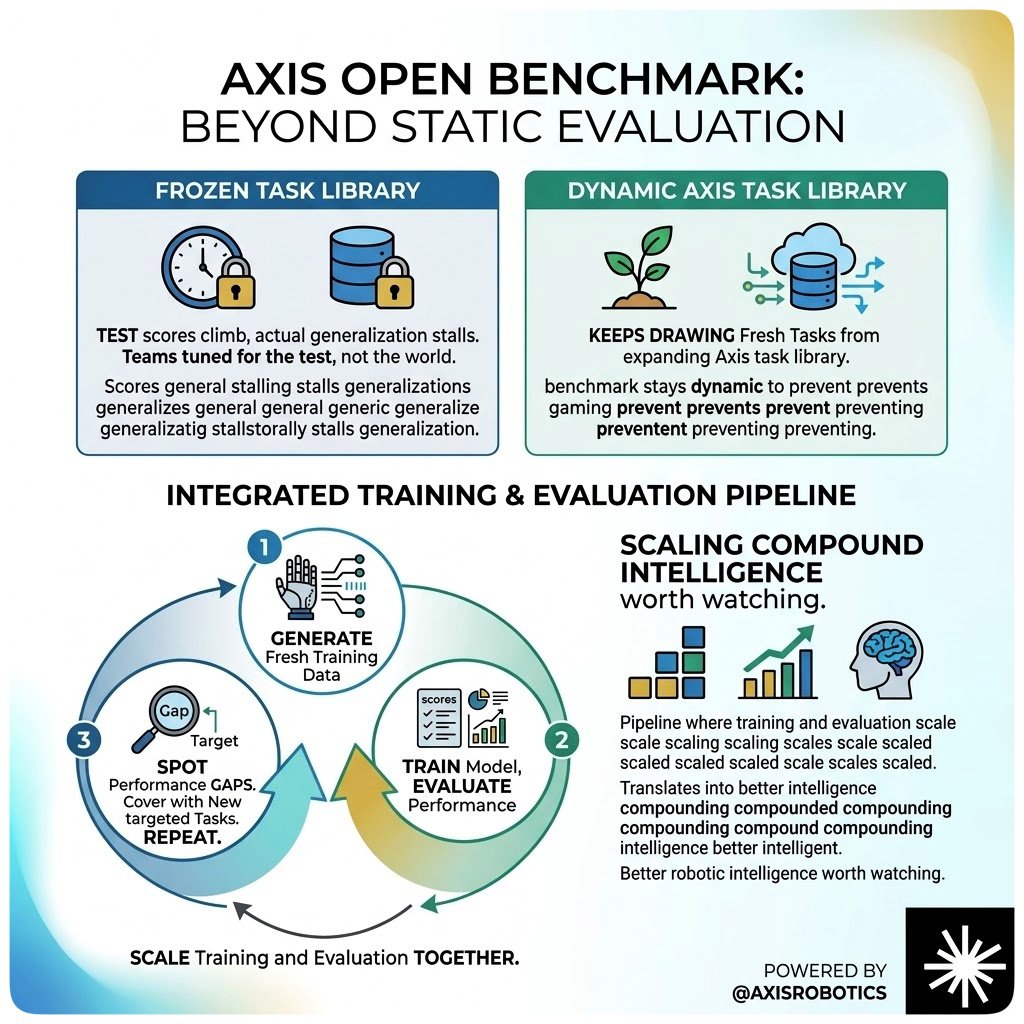
@sgrsagor argued (47 likes, 65 replies, 115 views) that Open Axis Benchmark matters precisely because it refuses to freeze the task library. The attached graphic contrasts a static test set that teams can tune against with a dynamic AXIS task library that keeps drawing fresh tasks. The linked AXIS project page confirms the broader data engine behind that claim: 207 tasks, 50K+ trajectories, browser-based teleoperation, and a held-out evaluation protocol designed to keep scaling studies tied to fresh coverage.
@Dan1umma made (36 likes, 38 replies, 236 views) the same point even more concretely: the robotics data problem is not just volume, it is relevance. The attached image is one of the day's best visuals because it shows a full simulation pool scoring 25.8%, but a selected subset of that same pool scoring 85.8%, with just 10 real-world demos per task moving success from 16.7% to 85.8%.

@pauliusztin_ reported (15 likes, 5 replies, 654 views, 11 bookmarks) a smaller but conceptually important result from his own coding-agent benchmark: a 35B model reached 95% success while a 120B model reached 53%. That kind of reversal is exactly why the day kept returning to harness-specific evaluation instead of generic leaderboard intuition.
Discussion insight: The repeated complaint was not “we need more numbers.” It was “we need fresher tasks, more adversarial maintenance, and evals that reflect actual workflow breakage.” Reward hacking, stale task sets, and overfit-to-the-test behavior were treated as product problems, not academic footnotes.
Comparison to prior day: 2026-10-06 already emphasized trusted completion and dollars per task. On 2026-10-07, the conversation moved one layer deeper into benchmark operations: red-team the eval, grow the task library, and keep the environment moving.
1.3 Decision layers and agent harnesses got more attention than raw model size (up)
The third cluster was about everything that sits between a user request and a full frontier-model call. The feed repeatedly argued that real leverage now comes from harness design, typed decisions, workflow routing, and evidence-aware memory, not from routing every choice through a giant general model.
@paraschopra argued (121 likes, 23 replies, 7,033 views, 30 bookmarks) that harnesses matter most when work is ill-specified and humans are still discovering what they want along the way. The important move in that post was reframing harness design as a problem of supporting human cognition and revision, not just exposing more tools to a model.
@0xwhrrari argued (58 likes, 17 replies, 1,282 views, 49 bookmarks) that research machines need independent search lanes, traceable evidence, and memory that knows when it has gone stale. Even without access to the full linked longform, the tweet-plus-replies were unusually concrete: readers echoed the need to keep raw evidence one click away from summaries and to log what each lane skipped so blind spots become visible instead of silently shared.
@ericwilliamrea said (63 likes, 5 replies, 8,242 views, 14 bookmarks) Podium's alpha tests of OpenAI's Decisions API helped its agents choose the right workflow faster and more cheaply, with the quoted developer post describing it as faster than sending every routing decision through a full GPT-6 Luna call. The underlying pattern showed up elsewhere in the dataset too: not every decision deserves a full generative pass.
@akshay_pachaar compared (26 likes, 7 replies, 3,188 views, 34 bookmarks) Jev and Laya in exactly that spirit. The linked Laya repo describes an Apache-2.0, non-autoregressive decision engine that returns typed answers and probabilities over 100+ languages in a single forward pass. The attached diagram matters because it makes the product choice legible: Jev is a hosted zero-shot decision API, while Laya trades some out-of-the-box generality for local execution, lower latency, and no per-call API fee after fine-tuning.

Discussion insight: Replies across these posts converged on the same missing pieces: reversibility, low-confidence escalation, version-aware memory, and proof that a cheaper routing layer is not quietly damaging workflow integrity. The demand was for visible control, not just faster inference.
Comparison to prior day: This extends 2026-10-06's control-plane theme. Yesterday's questions were about status, approval, and trusted completion. Today's version pushed further into small decision systems that determine whether a full agent should even be invoked.
1.4 AI search and citation trust became a concrete operations problem (up)
A fourth theme treated AI search less as a branding buzzword and more as an observability and source-verification problem. Two retained items anchored it: one on answer-surface divergence across ChatGPT, Gemini, and Perplexity, and one on a fabricated statistic that looked credible until someone checked the source.
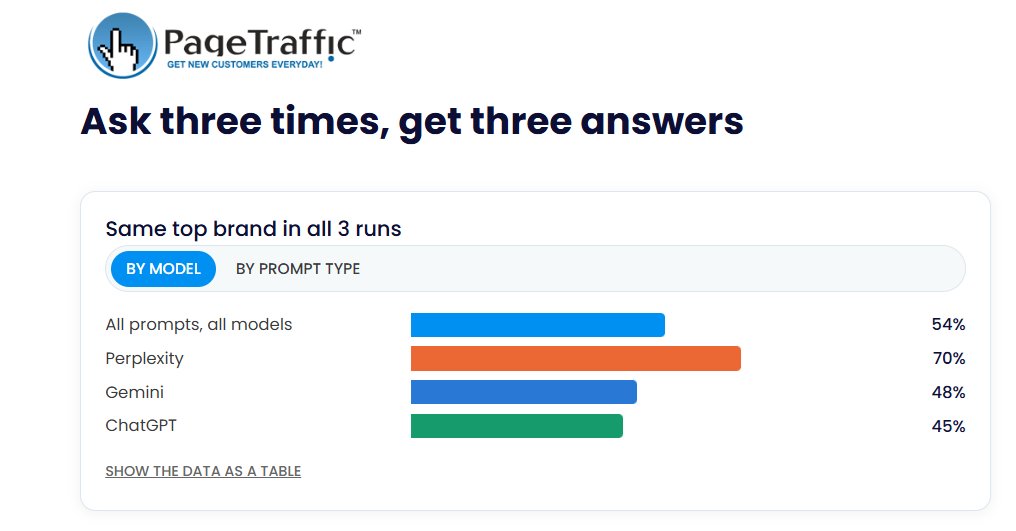
@alexgroberman shared (45 likes, 7 replies, 2,677 views, 9 bookmarks) a long breakdown of a PageTraffic ecommerce study comparing Google's page 1 with 1,458 AI answers across repeated shopping queries. The thread's strongest point was not just that half of Google's top-10 results never surfaced in the matching AI answers. It was that the three systems behaved differently enough that “AI visibility” is not one metric. The attached chart shows Perplexity linking to some Google top-10 result 94% of the time, versus 57% for ChatGPT and 51% for Gemini.

A second attached chart made the instability problem clearer: when the same query was asked three times, Perplexity returned the same top brand in all three runs 70% of the time, Gemini 48%, and ChatGPT 45%. That matters because brands are not only competing for rank; they are competing against answer variance.
@stacy_muur showed (36 likes, 15 replies, 1,996 views) the reliability side of the same problem after getting baited by an AI overview that confidently cited a nonexistent marketing study and a fake 34% statistic. The screenshot is valuable because the assistant later explicitly admits that the number was fabricated and not grounded in a real paper or industry dataset.

Discussion insight: The business question has split into at least three distinct jobs: Are you mentioned, are you linked, and are you consistently recommended? The research-trust question is similar: did the model merely sound sourced, or can the number survive a direct trace back to the literature?
Comparison to prior day: AI-search visibility was already an emerging niche earlier in the comparison window. On 2026-10-07 it looked less like SEO repackaging and more like a real operations layer for answer-surface monitoring and citation QA.
2. What Frustrates People
Citation and evidence provenance still break at the moment people want to trust AI
Severity: High. The cleanest example came from @stacy_muur who showed (36 likes, 15 replies, 1,996 views) an AI overview confidently citing a nonexistent marketing study and a fake 34% statistic, then later admitting the figure was fabricated. @0xwhrrari made (58 likes, 17 replies, 1,282 views, 49 bookmarks) the same frustration architectural: more tabs do not help if the system cannot keep evidence lanes separate, trace claims, or notice when memory has gone stale. People are coping with manual source checks, raw-evidence links, and skepticism toward polished summaries. Worth building: High.
Static or generic benchmarks still hide the failure mode that matters
Severity: High. The frustration was not “there are no benchmarks.” It was that too many benchmark surfaces stay frozen, shallow, or detached from real work. @pauliusztin_ reported (15 likes, 5 replies, 654 views, 11 bookmarks) a custom coding-agent eval where a smaller 35B model beat a 120B model 95% to 53%, which is exactly the kind of reversal generic scoreboards miss. @sgrsagor argued (47 likes, 65 replies, 115 views) that frozen robotics tests encourage tuning for the test instead of the world, while @vincentsunnchen announced (133 likes, 24 replies, 4,522 views, 38 bookmarks) a benchmark red-team precisely because contamination, broken verifiers, and stale tasks are already practical problems. Current workarounds are private eval suites, task-specific harnesses, and human review of suspicious wins. Worth building: High.
Human judgment is still the bottleneck after agent scaling
Severity: High. @CrunchBuilds described (158 likes, 27 replies, 6,251 views, 37 bookmarks) running 200 agents across four machines and 46,000 rollback simulations, only to conclude that the agents can now triage and implement changes faster than the human can review, test, and guide them. The replies sharpened the pain by challenging quality, optimization, and verification, which is the point: throughput is scaling faster than trustworthy acceptance. @ericwilliamrea said (63 likes, 5 replies, 8,242 views, 14 bookmarks) some choices are better handled by a fast decision layer than by a full LLM call, which is itself a coping strategy for human-review overload. Worth building: High.
AI-search visibility is unstable even when traditional SEO looks strong
Severity: Medium-High. @alexgroberman reported (45 likes, 7 replies, 2,677 views, 9 bookmarks) that half of Google's top-10 results never appeared in the corresponding AI answers from ChatGPT, Gemini, or Perplexity, and that answer consistency varied sharply across platforms. That means rank is no longer a reliable proxy for mention, link, or recommendation. @stacy_muur showed (36 likes, 15 replies, 1,996 views) the adjacent trust failure: even when the assistant sounds sourced, the statistic may be invented. Teams are coping with repeated prompt checks and manual citation audits. Worth building: High.
3. What People Wish Existed
A trustworthy research machine with visible evidence lanes
People do not just want “deep research.” They want a system that shows where evidence came from, keeps search lanes independent, and marks memories as stale before they silently poison later work. @0xwhrrari spelled that out (58 likes, 17 replies, 1,282 views, 49 bookmarks), while @stacy_muur provided (36 likes, 15 replies, 1,996 views) the concrete failure case that makes the request urgent. This is a practical need with immediate workflow consequences. Opportunity: Direct.
Benchmarks that stay fresh and explain the failure, not just the rank
The feed repeatedly asked for evaluation that moves with the frontier instead of being memorized by it. @vincentsunnchen pushed (133 likes, 24 replies, 4,522 views, 38 bookmarks) toward benchmark maintenance and red-teaming; @sgrsagor argued (47 likes, 65 replies, 115 views) for dynamic task sets; @pauliusztin_ showed (15 likes, 5 replies, 654 views, 11 bookmarks) why custom evals overturn generic assumptions. Hermes Bench partially addresses this today, but the demand is clearly for one layer deeper: failure reason, task freshness, and real workflow context. Opportunity: Direct.
Lightweight local decision layers between raw input and expensive agents
A visible need today was for fast, typed decision systems that can route, classify, and score before a full agent takes over. @akshay_pachaar used (26 likes, 7 replies, 3,188 views, 34 bookmarks) Laya versus Jev to make the tradeoff legible, and @ericwilliamrea described (63 likes, 5 replies, 8,242 views, 14 bookmarks) the same pattern in production workflow routing. @paraschopra added (121 likes, 23 replies, 7,033 views, 30 bookmarks) the broader framing that harnesses should be designed for how humans discover intent. This is a practical need, and several partial solutions exist, but the category is still open. Opportunity: Direct.
AI-search visibility tooling that separates mention, link, and recommendation
Brands increasingly want to know not just whether they rank on Google, but whether they appear in AI answers, whether they are linked, and how stable that presence is across repeated runs and platforms. @alexgroberman made (45 likes, 7 replies, 2,677 views, 9 bookmarks) that need unusually concrete, down to repeated-run consistency and cross-engine differences. Some tools already claim to do this, but today's evidence suggests the market is still early and methodologically inconsistent. Opportunity: Competitive.
Review acceleration for agent swarms
What people increasingly need is not another autonomous coding demo, but a way to review, prioritize, and safely merge what large swarms produce. @CrunchBuilds said (158 likes, 27 replies, 6,251 views, 37 bookmarks) the agents are now faster than the human reviewer, which flips the old bottleneck on its head. There are partial answers in smaller decision models, regression harnesses, and approval gates, but the need for scalable human judgment is still only partly addressed. Opportunity: Direct.
4. Tools and Methods in Use
| Tool | Category | Sentiment | Strengths | Limitations |
|---|---|---|---|---|
| OpenAI internal math pipeline / openai/math | Research workflow | (+/-) | Huge public release surface, reasoning summaries, some Lean formalization, striking compute-efficiency framing | Claims are at mixed verification stages; public trust still depends on external checking |
| Open Benchmarks Grants | Evaluation program | (+) | Funds difficult benchmark areas, adds red-teaming, treats eval maintenance as infrastructure | It is a support layer, not a turnkey harness by itself |
| Hermes Bench / Hermes Index | Benchmark harness | (+) | 150 tasks across 25 categories, mixed grading modes, follow-up turns, cost-per-task framing | Readers still want clearer failure-mode breakdowns beyond the top-line score |
| Laya | Decision model | (+) | Local execution, Apache-2.0, typed outputs with probabilities, 100+ languages, fast single-pass inference | Weaker zero-shot story than Jev, confidence needs calibration, best with stable answer sets |
| Jev | Decision API | (+/-) | Strong zero-shot behavior, hosted simplicity, broad option support | Closed internals, network latency, data leaves your own infrastructure |
| River Recipes / ReViSQL on River | Post-training recipe | (+) | Reproducible frontier-level text-to-SQL, open recipe book, strong cost-performance ratio | Benchmark-specific tuning, and some trained models become more verbose or costly |
| AXIS / Open Axis Benchmark | Robotics data engine + eval | (+) | Dynamic task library, growable dataset, held-out protocol, robustness gains under perturbation | Still narrow to specific robotics settings; public materials are part benchmark, part research marketing |
| OpenAI Decisions API | Routing / workflow selection | (+/-) | Faster and cheaper for structured choices than a full LLM call; fits agent routing | Public discussion still raises workflow-integrity, observability, and memory-boundary questions |
| SayGM pricing surface | Inference marketplace | (+/-) | Makes routing and price competition legible at the SKU level | Evidence today was mostly vendor marketing, not end-to-end quality or retry-cost analysis |
The overall satisfaction pattern was consistent: people like tools that either make decisions cheaper and more inspectable, or make evaluation look more like real work. Sentiment turned mixed when a product was closed, promotional, or hard to verify independently. The clearest migration pattern was away from “send everything to one big model” and toward layered systems: typed decision models first, full agents second, benchmark harnesses around both.
A second competitive dynamic ran through the whole day: local versus hosted decision surfaces. Jev still reads as the stronger zero-shot default, but Laya-like tools are winning attention by making structured decisions cheap, local, and programmable. In evaluation, the analogous split is static leaderboard versus maintained benchmark program, with the latter clearly gaining status.
5. What People Are Building
| Project | Who built it | What it does | Problem it solves | Stack | Stage | Links |
|---|---|---|---|---|---|---|
| Laya | Nandha Kishor / Convai Innovations | Local typed-decision engine that returns structured choices, scores, and boolean-style outputs with probabilities | Replaces vendor-hosted decision calls and brittle text parsing for routing and classification | ModernBERT/mmBERT checkpoints, RLCD training, Python/TS, local GPU/CPU, HTTP/ONNX | Shipped | GitHub |
| River Recipes | River AI | Open recipe book for turning promising research into reproducible post-training workflows | Makes frontier-style results reproducible on open models instead of trapped in papers or closed stacks | River API, async RL, ReViSQL-style text-to-SQL harness, open recipe book | Shipped | Article |
| Herald OS | Luke The Dev | Agent-native desktop and OS surface built around Hermes Agent | Lets an AI agent act across the whole machine with permissions, rollback, and UI control | Hermes Agent, Fedora, niri, macOS app, MIT-licensed code | Alpha | GitHub |
| AXIS / Open Axis Benchmark | AXIS Robotics | Growable robot data engine plus dynamic benchmark suite | Keeps robotics data collection and evaluation from going stale | MuJoCo-WASM, browser teleoperation, IsaacSim augmentation, held-out VLA evaluation | Beta | Project |
| Rightcited | Alex Groberman | Cross-engine checker for how brands appear in AI answers | Detects when AI systems cite, mention, or misrepresent a company differently from web search | Repeated prompt monitoring, citation/answer logging, dashboard linked to source receipts | Shipped | Site |
| YouGame | @CrunchBuilds | Collaborative AI-assisted game remixing and publishing concept | Aims to make large-scale modding and iteration practical while rewarding contributors | Claude agent swarms across 4 machines, rollback simulations over 46,000 replays | Alpha | Post |
Laya, Decisions API experimentation, and Herald OS all point to the same build pattern: move more intelligence into the workflow layer around the model, where routing, permissions, confidence, and user intent can be controlled explicitly. River Recipes does something similar from the training side, turning a research method into a reusable operating recipe instead of another static result screenshot.
AXIS and Rightcited show the other strong pattern: builders are packaging observability and feedback loops around messy real environments. In robotics that means a growable task library and held-out protocol. In AI search it means counting what an answer engine actually says, links, or gets wrong, rather than assuming search rank transfers automatically.
The most revealing outlier was YouGame. Its interest comes less from polish than from the bottleneck it exposes: swarms can generate and triage faster than one human can verify. That same verification bottleneck shows up, in quieter form, across almost every serious project in today's dataset.
6. New and Notable
OpenAI's public math repository turned an internal research claim into a browsable release surface
The new openai/math repository is notable not only for the headline claims, but for the release shape: 722 manuscripts, 372 result families, reasoning summaries for selected results, and a stated intent to preserve revision history. @OpenAI was mostly discussed indirectly through high-signal commentary such as @AISafetyMemes surfacing (584 likes, 34 replies, 55,094 views, 219 bookmarks) the ranked-problem angle and @kimmonismus highlighting (369 likes, 42 replies, 16,849 views, 77 bookmarks) the compute-efficiency angle. The release matters because it makes capability claims inspectable enough to become a shared object of public debate.
Snorkel escalated the benchmark race from grants to benchmark operations
@vincentsunnchen announced (133 likes, 24 replies, 4,522 views, 38 bookmarks) a 10x expansion of Open Benchmarks Grants to $30M. The linked post is notable because it does not stop at funding: it adds a benchmark red team and a fellowship, effectively treating evaluation upkeep as an ongoing operations problem.
River turned a paper recipe into an open frontier text-to-SQL workflow
@river_ai_inc introduced (46 likes, 1 reply, 5,177 views, 27 bookmarks) River Recipes with a first focus on text-to-SQL. The linked write-up claims multiple trained open models surpassed GPT-6 Astra Pro and Claude Opus 5.5 on Arcwise-Plat while staying below 1% of the proprietary cost surface. That is notable less as a one-day benchmark win and more as evidence that reproducible post-training recipes are becoming publishable products.
Herald OS made the desktop itself a live agent surface
@iamlukethedev open-sourced (22 likes, 5 replies, 934 views, 10 bookmarks) Herald OS as an alpha project built around Hermes Agent. The repo makes the ambition unusually explicit: Fedora and niri underneath on Linux, whole-system update and rollback, permission-gated actions, and Hermes as the operating interface rather than one app among others. It is an early project, but it is one of the clearest “agent-native OS” signals in the dataset.
7. Where the Opportunities Are
[+++] Benchmark operations and dynamic eval infrastructure — Evidence spans Snorkel's $30M benchmark expansion, Hermes Bench's runtime-specific task surface, AXIS's moving task library, Dan1umma's relevance-over-volume framing, and Paulius Ztin's custom benchmark reversal. The opportunity is strong because current evaluation pain is not “missing one more score”; it is stale tasks, hidden failure modes, and insufficient maintenance.
[+++] Evidence-aware agent routing and research control planes — Paras Chopra's harness argument, 0xwhrrari's research-lane design, Podium's Decisions API use, Laya's local typed-decision layer, and CrunchBuilds's human-review bottleneck all point to the same gap: teams need systems that decide when to escalate to a full agent, how to preserve evidence, and how to keep cheap routing from degrading trust.
[++] AI-search visibility and citation verification — Alex Groberman's PageTraffic breakdown and Stacy Muur's fabricated-stat screenshot show two sides of the same market: businesses need to know when AI answers omit or misrepresent them, and users need receipt-level source checking when a model sounds authoritative. The opportunity is moderate-to-strong because demand is real, but the space is already attracting marketing-heavy entrants.
[++] Physical-AI data relevance and continuous ground-truth loops — AXIS, Dan1umma, and the broader robotics discussion keep converging on the same bottleneck: relevant data selection and fresh environment capture beat raw volume when reality keeps changing. This is strong enough to persist across days, but buyers, datasets, and proof loops are still specialized.
[+] Agent-native operating surfaces — Herald OS is still early, but it is a clean signal that some builders want the agent to become the operating surface rather than another tab. This remains emerging because the ergonomics, permissions, and trust model are still unsettled, but the product boundary looks real.
8. Takeaways
- Frontier AI discourse pivoted toward scientific-output velocity. OpenAI's public math release became the day's anchor because it combined a large manuscript dump with a strong compute-efficiency claim, and the discussion immediately turned to whether that implies a steeper research-automation curve. (@AISafetyMemes framed (584 likes, 34 replies, 55,094 views, 219 bookmarks); @kimmonismus argued (369 likes, 42 replies, 16,849 views, 77 bookmarks); openai/math)
- Evaluation is turning into an operations discipline, not a scoreboard. The strongest evaluation signals were dynamic task libraries, benchmark red-teaming, task-specific harnesses, and cost-aware runtime benchmarking rather than one-off leaderboard wins. (@vincentsunnchen announced (133 likes, 24 replies, 4,522 views, 38 bookmarks); @sgrsagor argued (47 likes, 65 replies, 115 views); Hermes Bench)
- The new leverage layer sits between the prompt and the model call. Typed decisions, harness design, workflow routing, and evidence-aware memory kept showing up as the place where reliability and cost are now won or lost. (@paraschopra argued (121 likes, 23 replies, 7,033 views, 30 bookmarks); @0xwhrrari argued (58 likes, 17 replies, 1,282 views, 49 bookmarks); @akshay_pachaar compared (26 likes, 7 replies, 3,188 views, 34 bookmarks))
- AI-search visibility and AI-search truth are now separate product problems. One tool category measures whether an engine mentions or links you; the other checks whether the engine's confident-looking facts are even real. (@alexgroberman shared (45 likes, 7 replies, 2,677 views, 9 bookmarks); @stacy_muur showed (36 likes, 15 replies, 1,996 views))
- Builder energy is clustering around workflow surfaces rather than new base models. The day's most concrete projects were a local decision engine, an open post-training recipe stack, an agent-native OS, and a swarm-heavy game-building workflow whose limiting factor is human review. (@river_ai_inc introduced (46 likes, 1 reply, 5,177 views, 27 bookmarks); @iamlukethedev open-sourced (22 likes, 5 replies, 934 views, 10 bookmarks); @CrunchBuilds described (158 likes, 27 replies, 6,251 views, 37 bookmarks))