Twitter AI - 2026-10-09
1. What People Are Talking About
1.1 Harness design and verification loops were treated as first-order performance levers (🡕)
The strongest cluster in the feed was not "new biggest model" talk. It was harness talk. At least three solid items argued that decomposition, requirement checking, and diagnosis loops are now moving benchmark outcomes materially even when the base model stays fixed.
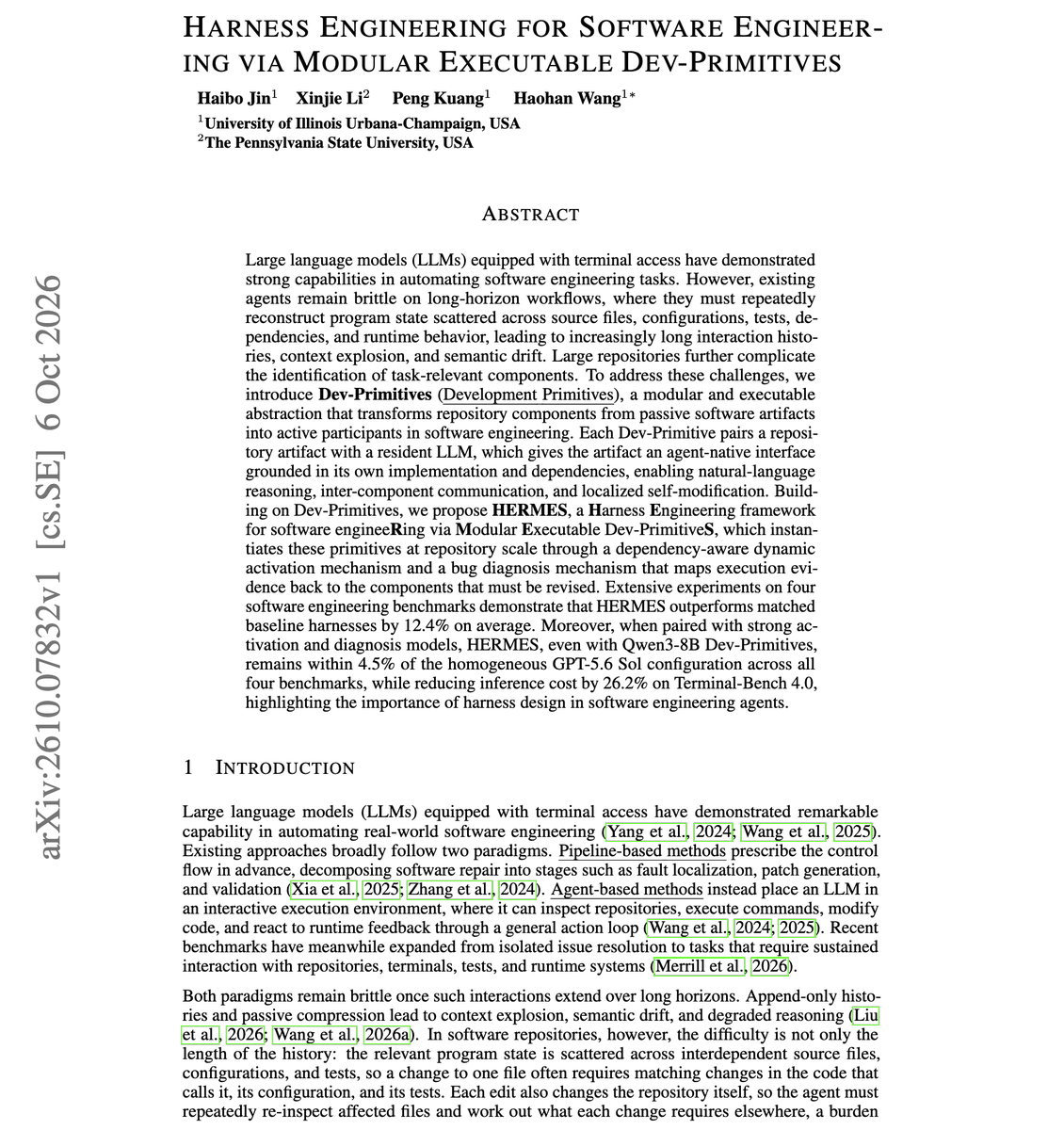
@omarsar0 argued (60 likes, 12 replies, 4,133 views, 85 bookmarks) that the HERMES harness moved GPT-5.6 Sol from 6.5% to 31.0% on whole-repository migration with the same model and effort setting. The tweet's summary is unusually concrete: repository components get resident LLMs, activation is dependency-aware, failures are mapped back to the components that need changes, average gains across four software-engineering benchmarks are 12.4 points, and a Qwen3-8B component setup comes within 4.5 points of an all-GPT-5.6 Sol setup while cutting Terminal-Bench 4.0 inference cost by 26.2%.
@DeepLearningAI highlighted (37 likes, 7 replies, 2,219 views, 17 bookmarks) AREX, an agentic research harness that verifies answers requirement by requirement, keeps what is already validated, and researches only the gaps. The tweet's own evidence is strong enough to matter: 82.5% on BrowseComp, 82.0 F1 on WideSearch-en, up to a 10-point gain from the harness alone, and a fine-tuned 4B model beating an untuned 35B model on five of six benchmarks.

The same instinct showed up downstream in safer workflow patterns. @freeCodeCamp shared (27 likes, 5 replies, 4,963 views, 19 bookmarks) a support-agent design that explicitly refuses to answer every ticket and instead uses a pure-function decider, grounded drafting, consensus verification, caching, and observability. Even as tutorial content, it fits the day's larger message: systems win by narrowing the surface where the model is allowed to guess.
Discussion insight: The replies were not starry-eyed. On HERMES, people immediately asked whether the gain came from better structure or simply more calls and more budget. That skepticism is itself a signal: AI Twitter is increasingly evaluating full agent stacks, not just models plus prompts.
Comparison to prior day: Compared with 2026-10-08, the conversation narrowed from benchmark governance and judge quality toward the mechanics inside the loop: decomposition, verification, activation, and failure diagnosis.
1.2 Cheap decision layers kept becoming a real product surface (🡕)
A second cluster focused on the layer before the full reasoning pass. The recurring claim was that many production choices should be handled by small, typed, probability-bearing decision systems rather than by asking a general model to generate prose and then infer a choice from it.
@testingcatalog reported (75 likes, 15 replies, 6,510 views, 27 bookmarks) that Microsoft-Decision-1 is now available on Foundry. The tweet quotes Microsoft saying the model was post-trained on Qwen3.5-9B for fast single-pass decision scoring, achieved the highest accuracy in a 36-benchmark, 150,000-question comparison on benchmarks kept blind from training, runs 4.5x quicker than Quyet-1.0-Large, and 35x quicker than GPT-6 Sol. Just as important, the tweet says Microsoft is already testing it internally for incident response, quality control, and scientific discovery, which moves the idea from research curiosity to workflow layer.
@frankzaga24 amplified (44 likes, 8 replies, 7,534 views, 45 bookmarks) Nace.AI's open-sourcing of Drex 1.5 as a locally runnable decision model. The public Drex site and GitHub repository back up the core points: under 10B parameters, 128K context, probability outputs instead of free-form generation, and Python, llama.cpp, and Ollama runners serving the same /v1/systemone API.
@freeCodeCamp added (27 likes, 5 replies, 4,963 views, 19 bookmarks) a practical version of the same idea in customer support: risky cases should escalate instead of being answered confidently, and the decider should be explicit rather than hidden inside the assistant's prose.
Discussion insight: The pushback was consistent across items: speed is attractive, but a fast wrong answer is still expensive. One reply on the Microsoft-Decision-1 thread put the fear plainly: single-pass scoring is useful for routing, but confidently wrong first scores are what burn agent runs.
Comparison to prior day: On 2026-10-08, the decision-layer story centered on OpenAI Decisions API usage and Jev deployments. On 2026-10-09, it widened into platform distribution through Microsoft and a serious open-source counterweight through Drex.
1.3 The runtime, not just the model, became the thing to redesign (🡕)
A third cluster argued that many computer-use limits are downstream of the machine and harness the model has to operate, not just of the model itself. Pine Computer dominated that angle, while independent benchmarking reinforced the same shift from token price to task price.
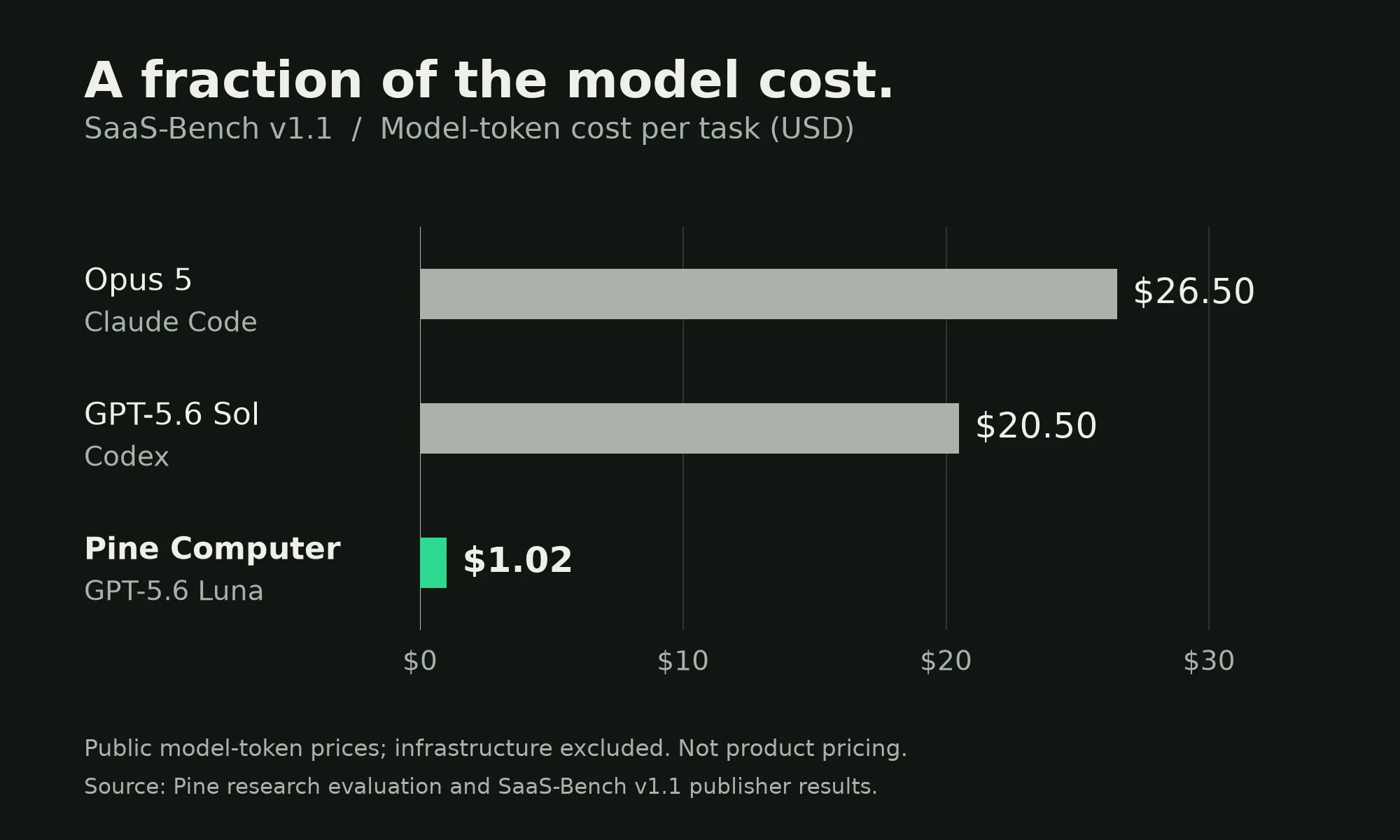
@slash1sol framed (54 likes, 16 replies, 870 views, 33 bookmarks) Pine Computer as "prompt in, finished work out": instead of giving agents a human-oriented browser and a screenshot loop, the SDK hands them a cloud computer with structured browser state. Pine's own launch post makes the cost claim concrete: on SaaS-Bench v1.1, GPT-5.6 Luna on Pine Computer reached a 78.3% checkpoint score at about $1.02 in model-token cost per task, versus $20.50 for GPT-5.6 Sol with Codex and $26.50 for Opus 5 with Claude Code. The same post is also honest about the trade-off: Pine passed more checkpoints but resolved fewer full tasks than the top two comparison systems.
@morganlinton posted (31 likes, 10 replies, 2,306 views, 8 bookmarks) an independent Frontier v4 benchmark result with the same larger lesson. In his summary, Opus 5.5 and Sonnet 5.5 score a bit higher than GPT-6.1 Sol, but Sol is much more cost-effective for easy and medium work, while Opus looks worth paying for on the hardest tasks. That is a workflow-design conclusion, not a model-fan conclusion.
Discussion insight: The common metric was not raw model price. It was cost per finished unit of work. Pine's launch, Morgan Linton's benchmarking, and the follow-on commentary all treated retries, effort levels, and harness behavior as part of the economics rather than as background noise.
Comparison to prior day: Compared with 2026-10-08, runtime discussion moved from lighter harnesses and local serving toward a bigger claim: maybe the right move is not only a better harness, but a computer built for AI instead of for people.
1.4 Structured data engines and diagnostic benchmarks spread into robotics, memory, and peer review (🡒)
The feed's more research-facing tail applied the same "find the exact failing stage" instinct to domains beyond coding. Evidence here was thinner than the three clusters above, but the direction was consistent: stop scoring only final outputs and start isolating where the pipeline broke.
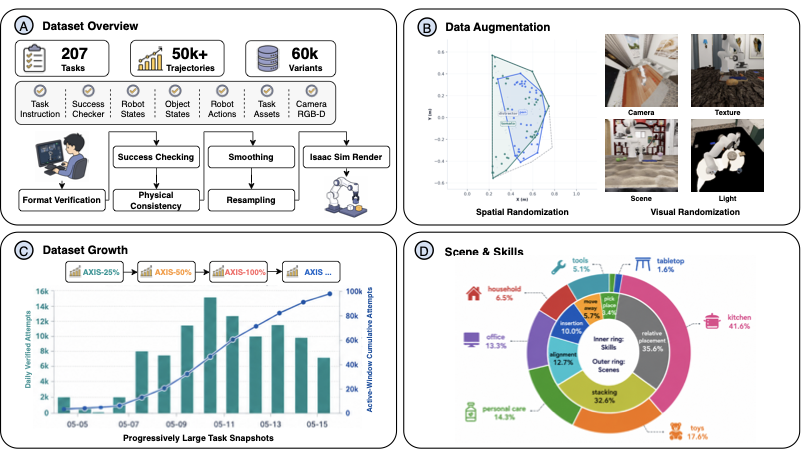
@Forget_x0 used (30 likes, 31 replies, 262 views) AXIS to argue that physical AI is fundamentally a data-engine problem. The linked AXIS site makes that concrete: 207 tasks, 50K+ trajectories, browser-based teleoperation, automatic validation and refinement, and a held-out evaluation protocol. AXIS-100% pretraining lifted π0.5 to 88.8 overall LIBERO-Plus success from 83.9 for vanilla π0.5, while a volume-matched RoboCasa baseline scored 57.5, which is a strong case that the pipeline matters, not just raw simulation volume.
@SakanaAILabs introduced (32 likes, 5 replies, 4,445 views, 7 bookmarks) a peer-review benchmark that deliberately injects contradictions into papers so systems can be scored on catching real errors rather than merely sounding like human reviewers. The linked paper, Beyond Imitation, positions AI as review support rather than reviewer replacement.
@jiqizhixin shared (6 likes, 1 reply, 435 views, 3 bookmarks) HaluMem, an operation-level hallucination benchmark for memory systems. The public repository is clear about the framing: memory extraction, memory update, and memory QA should be evaluated separately because "wrong answer" hides multiple distinct memory failures.
Discussion insight: The common move across robotics, review, and memory was decomposition. Whether the unit is a trajectory, a contradiction, or a memory update, builders increasingly want to know what failed, not just that the final answer was bad.
Comparison to prior day: On 2026-10-08, evaluation discussion centered on search benchmarks, hallucination judges, and dynamic robotics surfaces. On 2026-10-09, the same diagnostic mindset showed up in peer review, memory systems, and physical-AI data operations.
2. What Frustrates People
Token price still hides task cost
Severity: High. The strongest economic complaints were not about list price tables; they were about how much a finished task actually costs once retries, effort settings, and harness behavior are counted. Pine's own launch post compares cost per task rather than cost per token, while @morganlinton showed (31 likes, 10 replies, 2,306 views, 8 bookmarks) that a model with slightly better scores can still be a worse default if its task economics are bad. Teams are coping by splitting workloads by difficulty, saving heavier models for harder tasks, and treating the runtime as part of the bill. Worth building: High.
Fast deciders still need calibrated escalation paths
Severity: High. @testingcatalog surfaced the upside of single-pass decision scoring, but the replies immediately raised the core risk: confident first-pass errors can waste an entire workflow. @freeCodeCamp responded with the practical pattern people wish more systems used already: deciders that escalate risky cases instead of answering anyway, plus grounded drafting and verification. @DeepLearningAI reinforced the same point from the research side with AREX's requirement-by-requirement checking. Worth building: High.
Physical AI still looks bottlenecked by data quality and robustness
Severity: High. The AXIS evidence is strong because it contains both a win and a limit. The AXIS site shows large gains from browser-collected and augmented simulation data, but its own perturbation table also shows that improvements are uneven across axes, with light slipping and layout gains modest relative to the headline. The frustration is not "robots need more parameters." It is that high-quality, diverse, validated trajectories are still hard to collect, filter, and transfer robustly. Worth building: High.
Human review remains embedded in high-stakes evaluation
Severity: Medium-High. The Sakana peer-review work and HaluMem both signal the same pain point from different directions: end-to-end scores hide where the real error is, but making that error legible still takes careful benchmark construction and often human judgment. These projects are coping by narrowing the task to contradictions, memory stages, and specific operations, but they are not yet making human oversight disappear. Worth building: High.
3. What People Wish Existed
Routing layers that know when not to decide
The feed repeatedly asked for small, fast decision systems that come with calibrated confidence and clean escalation into a larger model or a human. Microsoft-Decision-1, Drex 1.5, and the freeCodeCamp support-agent pattern all point at the same gap: teams want a cheap first pass, but they do not want that first pass to silently become the final answer when uncertainty is high. Opportunity: Direct.
AI-native execution environments that remove harness plumbing
HERMES and Pine Computer point at two versions of the same wish. One says the agent should understand the repository as activated components instead of one giant context blob; the other says the operating environment should push structured state instead of making the model re-read pixels. In both cases, the desired product is not "a smarter model" but "less compensatory work around a bad environment." Opportunity: Direct.
Benchmarks that isolate the failing stage instead of grading only the output
AREX, HaluMem, and Sakana's contradiction benchmark all reflect demand for more diagnostic evals. The specific ask is not just another leaderboard. It is an eval surface that says whether failure came from routing, verification, memory extraction, memory update, or factual contradiction detection. Opportunity: Direct.
Auditable robot-data pipelines with provenance and filtering
AXIS shows the wish most clearly in robotics: a collection surface that scales through the browser, validates task success, refines noisy demonstrations, and produces training-ready data with a clear protocol. The opportunity is broader than robotics itself because the same need for provenance, filtering, and task-level auditability appears in other agent data engines too. Opportunity: Direct.
4. Tools and Methods in Use
| Tool | Category | Sentiment | Strengths | Limitations |
|---|---|---|---|---|
| HERMES | Agent harness | (+) | Big same-model lift on repository migration, dependency-aware activation, explicit failure diagnosis | Paper-stage evidence; replies still question call budget and fairness of comparison |
| AREX | Research harness / verifier | (+) | Requirement-by-requirement checking, verified-subpart reuse, strong benchmark results from a small fine-tuned model | Research framing; broader production behavior still unproven in the feed |
| Pine Computer | AI-native runtime | (+/-) | Structured browser state, low published model-token cost per task, SDK-first product framing | Private beta, and its resolved-task score trails the top comparison systems in Pine's own table |
| Microsoft Decision-1 | Decision model | (+/-) | Single-pass scoring, speed claims, enterprise testing narrative | Evidence here is still mostly quoted product claims, and replies worry about calibration |
| Drex 1.5 | Open decision model | (+) | Open weights, local deployment, 128K context, stable API shape across runtimes | Decision-only format is narrower than a general chat model |
| Escalation-first support agent pattern | Workflow method | (+) | Explicit abstention, grounded drafting, consensus verification, observability | Guidance pattern rather than a benchmarked product |
| AXIS | Robotics data engine / benchmark | (+) | Browser collection, automated validation, augmentation, held-out evaluation, public robustness tables | Still simulation-heavy, with uneven robustness across perturbation axes |
| Multi-Layered Review | Review framework | (+) | Measures error-catching instead of style imitation, complementary to human review | Research-stage system, not a replacement for expert reviewers |
| HaluMem | Memory benchmark | (+) | Separates extraction, update, and QA failures so debugging becomes more precise | Benchmark only; it diagnoses memory problems more than it solves them |
The most positive sentiment clustered around systems that narrow scope and expose structure: decision models that output explicit probabilities, harnesses that map failures back to components, and data engines that validate trajectories before training. Sentiment turned mixed when the evidence depended mainly on vendor-reported benchmarks or when the system still needed a strong escalation layer to avoid silent failure.
The clearest migration pattern was away from monolithic chat-model usage and toward layered stacks: decider first, verifier second, full reasoning only when needed; structured runtime state instead of screenshot polling; data engines and held-out protocols instead of one static dataset release.
5. What People Are Building
| Project | Who built it | What it does | Problem it solves | Stack | Stage | Links |
|---|---|---|---|---|---|---|
| Pine Computer | Pine AI | Cloud computer and runtime for AI agents with an SDK-oriented interface | Models waste time and money compensating for human-oriented computers and heavy harnesses | Cloud computers, browser/OS state hooks, runtime layer, SDK/API | Beta | launch post, tweet |
| Microsoft Decision-1 | Microsoft | Fast decision model distributed through Foundry | Routing and classification tasks are too slow or too expensive when every choice goes through a large reasoning model | Qwen3.5-9B post-training, single-pass scoring, Foundry distribution | Shipped | tweet |
| Drex v1.5 | Nace.AI | Open decision model with local runners and a stable API | Teams want typed decisions, local control, and lower-cost routing without closed hosted dependencies | Python server, llama.cpp, Ollama, /v1/systemone API |
Shipped | site, GitHub, tweet |
| AXIS | AXIS | Community-driven robot-data engine and evaluation suite | Robot learning lacks scalable, diverse, validated demonstrations | Browser teleop, MuJoCo-WASM, backend cleaning, IsaacSim augmentation, held-out evals | Shipped | site, tweet |
| Multi-Layered Review | Sakana AI Labs | AI review framework plus contradiction benchmark for paper checking | Human-like review style is a weak proxy for whether a system actually catches scientific errors | Knowledge-graph construction, contradiction injection, multi-pass review workflow | Alpha | paper, tweet |
| HaluMem | MemTensor | Operation-level benchmark for hallucinations in memory systems | End-to-end QA scores hide whether memory extraction, update, or retrieval failed | Memory-operation tasks, operation-level metrics, open benchmark code | Alpha | GitHub, tweet |
The most interesting build pattern was not "one more assistant." It was specialized layers around the assistant: a computer built for AI, a decision model built for typed choices, a robot-data engine built for validated trajectories, and benchmarks built to isolate specific failure stages.
A second pattern was that narrowness is becoming a virtue. Drex does not try to be a chatbot. HaluMem does not try to summarize everything wrong with memory systems. Pine does not claim to be a model. These builders are carving away ambiguity rather than adding more generality.
6. New and Notable
Pine Computer made cost per task the headline metric
@slash1sol amplified (54 likes, 16 replies, 870 views, 33 bookmarks) Pine Computer as a one-SDK-call cloud computer for AI. What made it notable was not just the product framing but the unusually explicit launch post: Pine published checkpoint score, resolved score, and model-token cost per task side by side instead of hiding economics behind benchmark screenshots.
Microsoft pushed decision models into a mainstream enterprise surface
@testingcatalog reported (75 likes, 15 replies, 6,510 views, 27 bookmarks) Microsoft-Decision-1 on Foundry. Even allowing for marketing spin, a major platform shipping a dedicated decision model is a meaningful sign that routing and classification are becoming their own product category.
Drex 1.5 turned the decision-layer story into something developers can run themselves
@frankzaga24 highlighted (44 likes, 8 replies, 7,534 views, 45 bookmarks) Drex 1.5 as open source, but the more important part is the deployment surface. The public site and GitHub repo make clear that local decision models are now a real alternative, not just a thought experiment.
Research-assistant tooling got more diagnostic and less imitative
@SakanaAILabs presented (32 likes, 5 replies, 4,445 views, 7 bookmarks) peer-review support built around contradiction detection, and @jiqizhixin shared (6 likes, 1 reply, 435 views, 3 bookmarks) HaluMem's operation-level memory benchmark. Those are notable because they redefine the target as error detection and failure localization rather than human-like style.
7. Where the Opportunities Are
[+++] Calibrated routing and decision layers - Microsoft-Decision-1, Drex 1.5, freeCodeCamp's escalation-first pattern, and AREX all point to the same need: fast structured choices with clean abstention and escalation.
[+++] AI-native runtimes and harnesses - HERMES and Pine Computer both show that large gains can come from changing how the model is embedded in its environment, not just from swapping in a larger model.
[++] Diagnostic evaluation infrastructure - Sakana's contradiction benchmark, HaluMem, and AREX show rising demand for evals that isolate the failing stage. This is strong, but still more research-heavy than the two themes above.
[++] Physical-AI data operations - AXIS suggests there is real appetite for browser-scaled collection, validation, augmentation, and provenance in robot learning. The signal is strong, though still concentrated in a smaller corner of the feed.
[+] Workflow-economics benchmarking - Morgan Linton's Frontier v4 thread and Pine's cost-per-task framing suggest room for better public tools that measure cost, retries, and resolution together rather than publishing only model or token stats.
8. Takeaways
- Harness design is increasingly a bigger lever than base-model choice alone. HERMES and AREX both presented large gains from structure, verification, and diagnosis without requiring frontier-scale models at every step. (omarsar0 tweet, DeepLearningAI tweet)
- Decision models are graduating from niche idea to deployable layer. Microsoft-Decision-1 and Drex 1.5 show the category from two angles: enterprise distribution and open local deployment. (testingcatalog tweet, Drex site)
- Cost per task is replacing token price as the metric that matters in agent workflows. Pine Computer made that explicit, and independent benchmarking echoed the same logic. (Pine launch, morganlinton tweet)
- Physical AI still looks more like a data-engine problem than a raw-model problem. AXIS's public numbers argue that pipeline design and data curation can matter more than simulation volume alone. (AXIS, Forget_x0 tweet)
- Evaluation is getting more diagnostic, not more theatrical. The stronger research items of the day focused on contradictions, memory-operation failures, and requirement checking rather than on sounding human. (Beyond Imitation, HaluMem GitHub)