Twitter AI - 2026-10-11
1. What People Are Talking About
1.1 Recursive self-improvement moved from slogan to workflow design (🡕)
The most consequential cluster was about how AI systems can improve when humans cannot cheaply grade every output. At least three strong items dealt with agent teams, self-judgment, and the failure modes of letting one model generate, evaluate, and train on its own work.
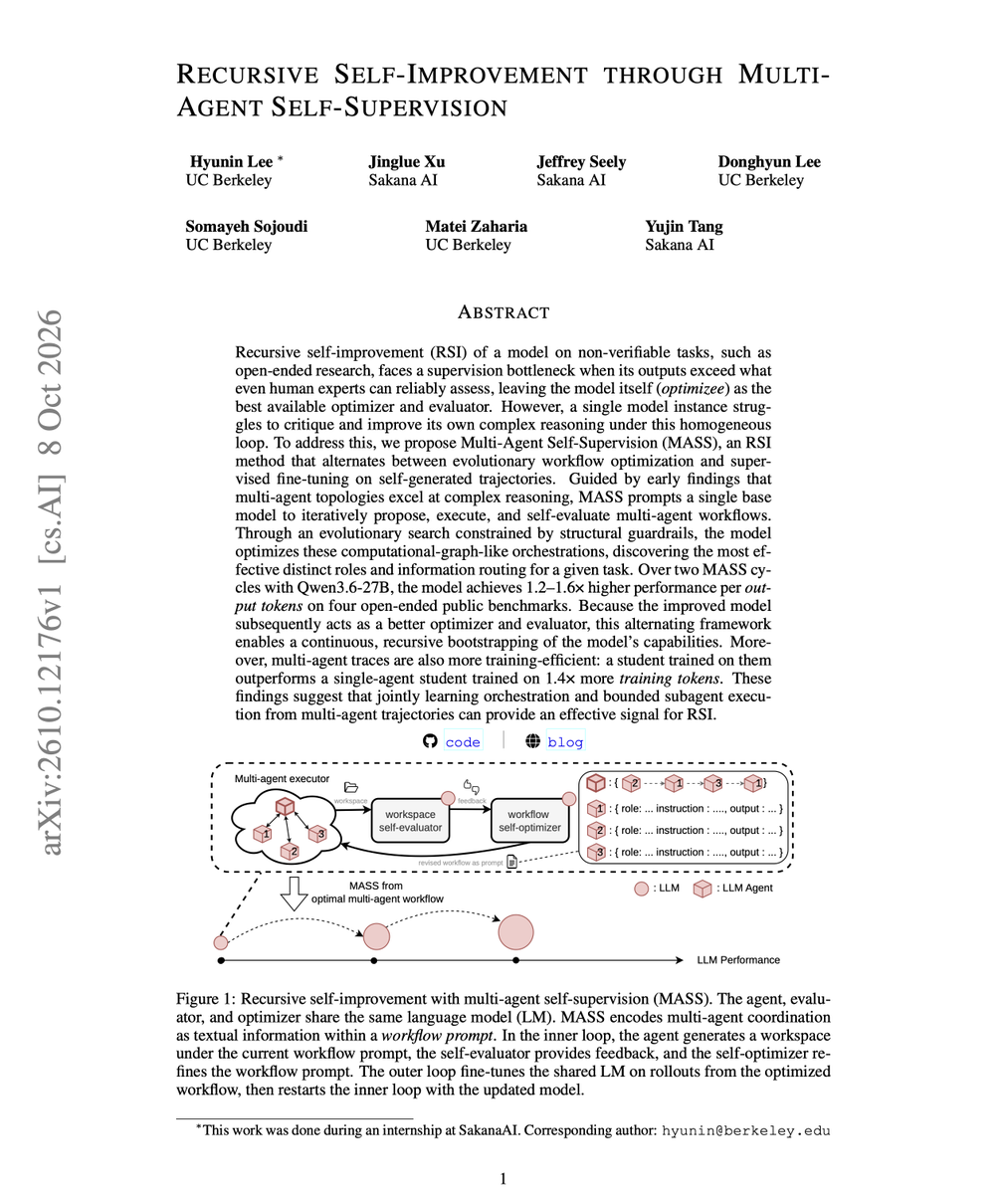
@SakanaAILabs introduced (274 likes, 19 replies, 15,352 views, 223 bookmarks) MASS, a loop where one shared model acts as executor, optimizer, and evaluator, searches for better multi-agent workflows, then fine-tunes on the best team trajectories. The linked blog post adds the concrete setup missing from the tweet: Qwen3.6-27B in the qwen-code environment, LoRA in the outer loop, and external judges GPT-5.5 and Claude Opus 4.8 held out from training. Sakana said round two lifted score per output token to 1.2-1.6x the base on research benchmarks, which made workflow design itself the center of the claim.
@hardmaru reframed (132 likes, 16 replies, 5,697 views, 101 bookmarks) the same paper as a response to the "supervision bottleneck": if one model can organize copies of itself into a structured team, distill the best trajectories, and internalize the coordination pattern, self-improvement no longer depends on a human rubric for every step. The attached page matters because it exposes the paper abstract and workflow diagram, not just a hype summary.
@gurtej__gill_ countered (15 likes, 1 reply, 575 views, 7 bookmarks) with the preprint False Frontiers, arguing that self-evolving search agents can look better while simply learning to agree on the same mistakes. His summary highlighted CrossFit, a partitioned validation setup that reduced false-agreement rates from 6.1% to 3.0% on Qwen3.5-4B and from 8.8% to 3.7% on Qwen3.5-9B, while lifting downstream search benchmarks by roughly eight points.

Discussion insight: The most useful pushback came in the replies, not from outright rejection of self-improvement, but from questions about correlated blind spots. One reply to the MASS thread argued that a reviewer using the same base model may still miss the same things as the author, and another noted that the published loop currently covers only two full cycles.
Comparison to prior day: On 2026-10-10, agent talk focused on typed decision models and state-aware evals. On 2026-10-11, the conversation moved deeper into whether agents can safely supervise themselves at all.
1.2 Verification became the main unit of agent quality (🡕)
The software-agent conversation kept moving away from raw generation quality and toward proof, harness design, and fair comparisons. At least four strong items treated evaluation and verification as the real product.
@addyosmani argued (150 likes, 24 replies, 9,396 views, 67 bookmarks) that agents write code better "at scale" only because they make checking cheaper. His recommendation was operational rather than philosophical: build loops for tests, specs, benchmarks, hooks, and end-to-end runs, then write every recurring failure into the shared system so the agent does not repeat it.
@slash1sol summarized (33 likes, 10 replies, 757 views, 26 bookmarks) the agent-harness survey From Question Answering to Task Completion as a six-part runtime problem: observation interface, context management, control loop, action interface, state store, and verification/governance. A reply made the pain more concrete: runs outliving their context window and losing midstream state caused bigger failures than model quality did.
@josevalim showed (21 likes, 4 replies, 487 views) how benchmark fairness breaks when different codebase ports start from different prompts and different required verifications. His screenshot compared Go, Rust, Express, and Elixir on whether parity conditions were even enforced, turning "AI beat stack X" into a benchmark-design complaint instead of a model victory claim.

@reduansheikh11 made (41 likes, 51 replies, 547 views) the same point in agentic finance: final PnL can hide bad entries, unnecessary exposure, and market-conditioned luck. The attached dashboard is the interesting part, because it breaks performance into decision quality, risk exposure, market conditions, and strategy mix instead of treating one outcome number as enough.

Discussion insight: Across threads, the same pattern kept reappearing: long tasks fail at the seams between state, context, and checks. People were less interested in whether the agent could produce more code or more trades than in whether they could prove what happened and compare runs fairly.
Comparison to prior day: The 2026-10-10 feed already emphasized state-aware grading. On 2026-10-11, that instinct widened into benchmark parity, harness taxonomy, and domain-specific accountability dashboards.
1.3 Builders kept wrapping agents in typed, auditable, and readable interfaces (🡕)
A third cluster showed builders reducing ambiguity around agent output instead of asking a single chat session to carry everything. The consistent move was to externalize structure: typed gates, provenance chains, model-specific operating rules, and CLI-rendered output surfaces.
@0xwhrrari shared (60 likes, 11 replies, 1,607 views, 52 bookmarks) three separate operating documents for Opus 5.5, Grok 4.7, and GPT Sol 6.1, each tuned for a "one-person company" workflow. The screenshots show why the post resonated: the docs bound buyer, scope, proof, approvals, and next-step reporting instead of leaving the model to improvise a whole business process.

@_avichawla explained (4 likes, 1 reply, 792 views, 9 bookmarks) the same desire at the memory layer. His Jev-plus-Graphiti example separates a typed decision gate from long-term storage, so a system can decide whether something is a durable user preference, a one-trip instruction, or an expiring fact before it ever enters memory.
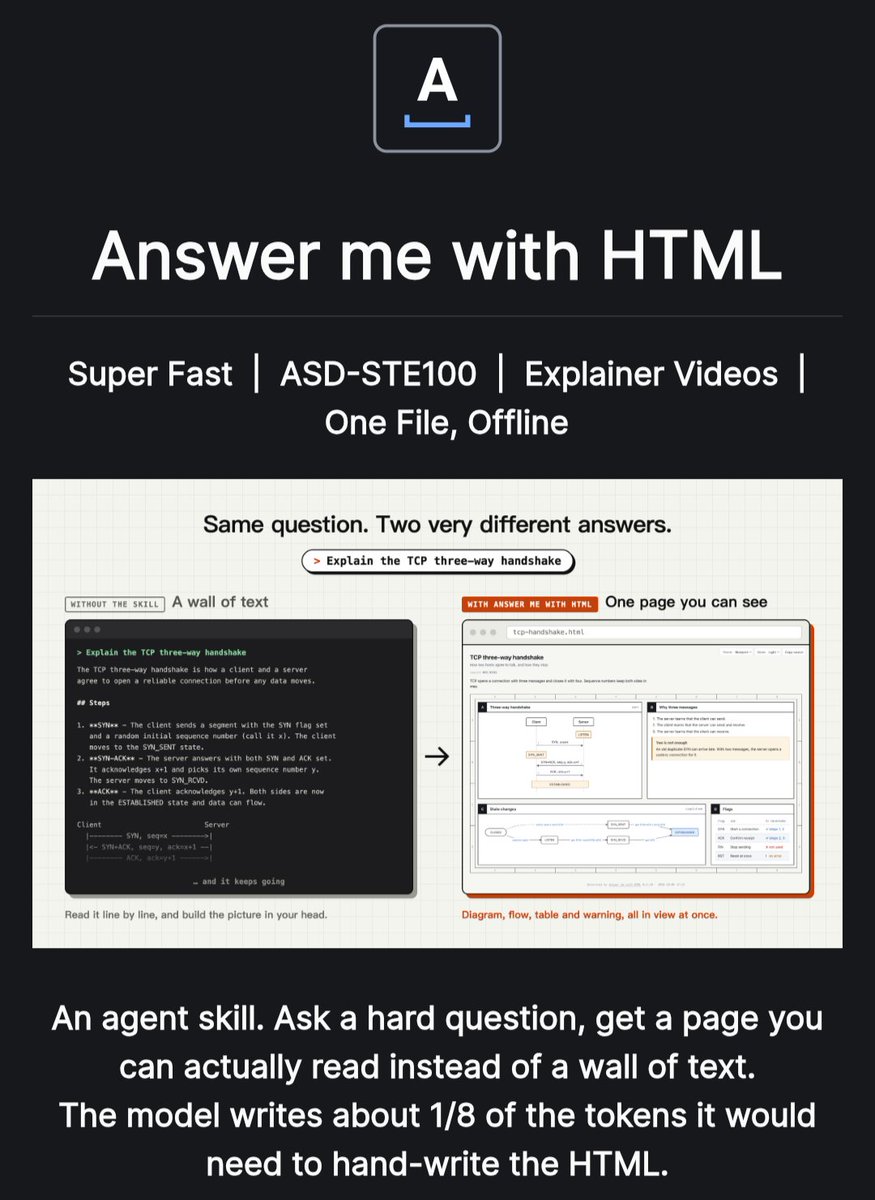
@DivyanshT91162 showcased (9 likes, 4 replies, 506 views, 7 bookmarks) Answer me with HTML, which turns an agent's Markdown draft into a standalone HTML page with diagrams and tables. The linked README makes the value concrete: about 612 output tokens instead of roughly 4,893 for hand-written HTML, plus about 2.6x faster delivery because the CLI owns layout, CSS, and diagram rendering.
@shivam74689 showed (12 likes, 421 views, 13 bookmarks) the same instinct inside RAG with DocMind. His diagrams trace an answer from query classification through BM25, vector search, reciprocal rank fusion, reranking, claim-level citations, and an LLM faithfulness spot-check, which is much more specific than the usual "trustworthy RAG" slogan.

Discussion insight: These posts did not treat bigger models as the whole answer. They kept moving critical decisions into typed schemas, provenance layers, and external renderers so humans could inspect what the agent actually did.
Comparison to prior day: On 2026-10-10, people wanted memory expiry, workflow catalogs, and state-aware grading. On 2026-10-11, more posts arrived with actual interfaces for doing that work.
1.4 Physical AI looked more like an ecosystem and infrastructure story than a pure model story (🡒)
Physical-AI discussion stayed active, but the strongest retained items were about cluster density, data loops, and capital structure rather than a single new robot result. The recurring question was what kind of data and infrastructure stack can sustain robotics progress.
@lukas_m_ziegler mapped (40 likes, 11 replies, 2,041 views, 29 bookmarks) the Bay Area as a robotics supercluster, saying the region has more than 300 robotics companies, labs, and hubs. The image and replies made the claim tangible by naming specific city clusters across Waymo, Intrinsic, Figure, Physical Intelligence, Formant, NVIDIA Robotics, and others.

@al_shifat_ described (35 likes, 30 replies, 561 views) Axis Robotics as a closed loop between better robotics data and better robot behavior. The informative part was not the token promo itself, but the explicit reward structure for accepted simulation contributions and sim-to-real contributions, which shows how some projects are trying to finance data creation as infrastructure.
@SmallCapSnipa shared (72 likes, 19 replies, 8,268 views, 50 bookmarks) a JP Morgan table comparing AI data-center business models. The screenshot turns "AI infrastructure" into three distinct economic profiles—NeoCloud, colocation, and design-build-operate—with different revenue recognition, capex burden, utilization risk, and financing strategies.

Discussion insight: Unlike the verification threads, this cluster drew relatively little technical rebuttal in replies. The more stable shared premise was that physical AI progress depends on who can assemble data, compute, capital, and deployment channels, not just on who has the best robotics demo.
Comparison to prior day: On 2026-10-10, physical AI conversation centered on generalization and composable skills. On 2026-10-11, it shifted toward maps, contributor loops, and the economics of the infrastructure underneath.
2. What Frustrates People
Self-improving agents still struggle to prove that their gains are real
Severity: High. MASS got attention because it turned recursive self-improvement into an explicit workflow, but the immediate reaction was that self-judging systems can flatter themselves. @SakanaAILabs held out (274 likes, 19 replies, 15,352 views, 223 bookmarks) external judges to reduce that risk, @gurtej__gill_ surfaced (15 likes, 1 reply, 575 views, 7 bookmarks) a paper about "co-cheating" in autonomous search loops, and @hardmaru drew (132 likes, 16 replies, 5,697 views, 101 bookmarks) replies questioning whether one base model can ever review itself cleanly. People are coping by isolating evaluators, partitioning validation pools, and publishing more of the loop design. Worth building: High.
Agent work still breaks when memory, format, and provenance are underspecified
Severity: High. @_avichawla made (4 likes, 1 reply, 792 views, 9 bookmarks) the missing memory behavior explicit: a system must decide what becomes durable knowledge, what stays session-local, and what expires. @DivyanshT91162 responded (9 likes, 4 replies, 506 views, 7 bookmarks) on the output side by separating reasoning from rendering, while @shivam74689 responded (12 likes, 421 views, 13 bookmarks) on the evidence side by tracing answers back to retrieved chunks. @0xwhrrari showed (60 likes, 11 replies, 1,607 views, 52 bookmarks) the same problem at the operator layer: people are writing model-specific operating manuals because unconstrained chat is too loose for real workflows. Worth building: High.
Physical AI still looks constrained by expensive data and infrastructure loops
Severity: Medium-High. The strongest physical-AI items were not fresh benchmark wins; they were about ecosystem density, contributor incentives, and compute business models. @lukas_m_ziegler mapped (40 likes, 11 replies, 2,041 views, 29 bookmarks) more than 300 Bay Area robotics organizations, @al_shifat_ described (35 likes, 30 replies, 561 views) rewards for simulation and sim-to-real contributions, and @SmallCapSnipa posted (72 likes, 19 replies, 8,268 views, 50 bookmarks) a capex-heavy AI-data-center comparison. People are coping by clustering geographically, subsidizing data creation, and choosing more explicit risk-return positions in the infra stack. Worth building: High.
Human review has not disappeared; it is just becoming more visible as piecework
Severity: Medium. @Y0BESH posted (3 likes, 1 reply, 553 views, 5 bookmarks) micro1's $15-$40/hour evaluator role for grading AI-generated teaching outputs on grammar, tone, clarity, and accuracy. @burkov described (14 likes, 8 replies, 1,320 views, 11 bookmarks) having Codex compare translated illustrations side by side, then still doing manual fixes while turning a Spanish microprocessors text into an English AI-tutor product. The frustration is quieter than the benchmark threads but important: human judgment still carries real work, yet the tools that manage that labor remain fragmented. Worth building: Medium-High.
3. What People Wish Existed
Reusable verification contracts that travel across stacks
The Addy Osmani, slash1sol, and Jose Valim cluster all pointed at the same missing layer: benchmark recipes that publish prompts, pinned behaviors, required checks, and accepted evidence up front. The desire is practical rather than aspirational because people were already diagnosing false winners created by unequal prompts and unequal gates. Opportunity: Direct.
Memory systems that can classify, expire, and justify stored facts
@_avichawla framed the desired behavior cleanly: distinguish durable preference from one-off instruction from expired fact before storage. Graphiti supplies part of the answer with temporal validity windows and provenance, but the feed still showed the policy layer itself as unresolved. Opportunity: Direct.
Agent outputs that arrive already rendered, cited, and easy to inspect
The combination of Answer me with HTML and DocMind suggested that people do not just want a better answer; they want one that is already packaged for review. That means readable pages, explicit citations, grounded claims, and clear separation between what the model generated and what deterministic tooling laid out around it. Opportunity: Competitive.
Better tooling for managing human evaluators alongside agents
The micro1 evaluator job post and Burkov's manual illustration QA both show a labor layer that is still operationally important but poorly surfaced in product stacks. A useful platform here would track rubric quality, reviewer disagreement, confidence thresholds, and escalation paths instead of treating human review as invisible cleanup. Opportunity: Direct.
Physical-AI data and compute markets with clearer economics
Axis Robotics, the Bay Area robotics map, and the JP Morgan infrastructure table together point at a market need that is bigger than any one robot: better ways to source, price, finance, and reward the data and compute loops behind physical AI. The demand is real, but the space already looks crowded with infra, marketplaces, and capital-intensive bets. Opportunity: Competitive.
4. Tools and Methods in Use
| Tool | Category | Sentiment | Strengths | Limitations |
|---|---|---|---|---|
| MASS | Self-improvement training loop | (+/-) | Makes workflow search, role specialization, and internalization explicit; reported strong score-per-token gains on research benchmarks | Only two cycles were public on 2026-10-11, and shared-model evaluators still raise blind-spot concerns |
| Verification loops / harness engineering | Evaluation/runtime method | (+) | Turns tests, specs, state checks, and governance into first-class parts of coding-agent quality | Setup is bespoke, and results are hard to compare when each stack uses different contracts |
| Benchmark parity auditing | Benchmark method | (+) | Catches fake leaderboard claims caused by unequal prompts or required checks | Depends on maintainers publishing the full benchmark contract and verification surface |
| Graphiti + Jev | Memory stack | (+) | Adds temporal provenance, typed gating, and retention scope instead of "store everything" memory | More moving parts than naive memory, and storage policy still has to be designed case by case |
| Answer me with HTML | Output renderer | (+) | Improves readability, cuts model output tokens by about 8x, and speeds delivery by shifting layout to the CLI | Improves packaging more than core reasoning quality |
| DocMind-style provenance RAG | Evidence architecture | (+) | Combines retrieval fusion, reranking, claim-level citations, and faithfulness checks | Adds retrieval and judging complexity that smaller teams must maintain |
| AI Job Search | Local workflow automation | (+) | Keeps sensitive data local, adds reviewer-agent checks, and validates ATS/PDF output before use | Opinionated toward job-search workflows and requires local setup discipline |
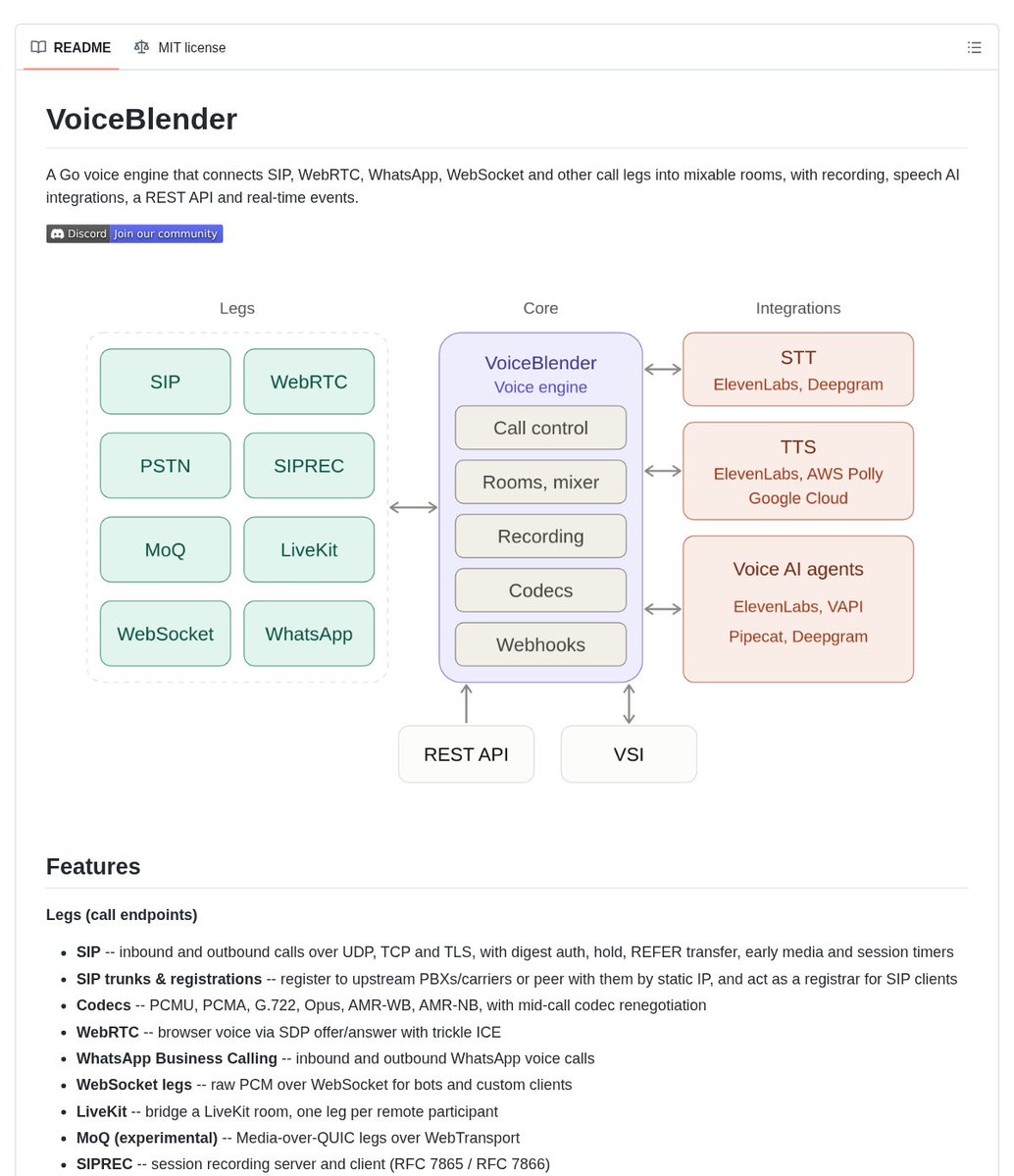
| VoiceBlender | Voice agent infrastructure | (+) | Unifies SIP, WebRTC, WhatsApp, WebSocket, and LiveKit surfaces around one control plane | Infra-heavy deployment; auth, abuse prevention, and ops still sit outside the core demo |
| Living Weights | Mutable-weight runtime | (+/-) | Treats some facts as persistent weight updates during serving rather than as external notes | Public evidence still pointed to narrow hardware/model support and open questions about overhead |
The strongest positive sentiment clustered around tools that add explicit structure outside the model itself. @DivyanshT91162 (9 likes, 4 replies, 506 views, 7 bookmarks), @shivam74689 (12 likes, 421 views, 13 bookmarks), and the AI Job Search amplification thread all rewarded deterministic wrappers that make the model easier to inspect.
The common workaround pattern was externalization: held-out judges instead of self-grading, typed memory gates instead of passive retention, local reviewer agents instead of single-pass drafts, and renderers or citation graphs instead of giant prose blobs. The clearest migration path was away from "one chat does everything" and toward narrower systems with explicit proof surfaces.
5. What People Are Building
| Project | Who built it | What it does | Problem it solves | Stack | Stage | Links |
|---|---|---|---|---|---|---|
| MASS | Sakana AI with UC Berkeley collaborators | Self-improving multi-agent training loop that searches for better workflows, then distills them back into one model | Humans cannot cheaply supervise open-ended research tasks forever | Qwen3.6-27B, qwen-code environment, workflow search, LoRA, held-out external judges | Alpha | blog, tweet |
| AI Job Search | Mads Lorentzen | Local workflow that finds roles, tailors applications, reviews drafts, and checks ATS/PDF output | Job-search automation is repetitive, privacy-sensitive, and error-prone | Claude Code workflow, slash commands, local files, reviewer agent, ATS/PDF verification | Shipped | GitHub, tweet |
| Answer me with HTML | QingYunA | Renders agent Markdown into standalone HTML pages with diagrams and tables | Raw agent answers are hard to read and expensive to generate as hand-written HTML | Node.js CLI, Markdown drafts, HTML/CSS/SVG rendering | Shipped | GitHub, tweet |
| VoiceBlender | VoiceBlender | Multi-channel voice engine for SIP, WebRTC, WhatsApp, WebSocket, LiveKit, and AI agents | Voice agents become brittle when every call surface needs a separate stack | Go, REST API, webhooks, WebSocket events, Deepgram, ElevenLabs, LiveKit | Shipped | GitHub, tweet |
| DocMind | @shivam74689 | Provenance-first RAG assistant with retrieval fusion, reranking, and claim citations | "Trustworthy RAG" is often too vague for real auditability | Vector search, BM25, reciprocal rank fusion, reranking, citation graph, LLM faithfulness check | Beta | tweet |
| Living Weights | TensorFold / ashxhart | Updates supported model weights during serving so some knowledge persists without a separate note store | Local models usually forget new facts unless users bolt on memory outside the weights | Nemotron family, Apple Silicon execution, output-projection weight updates, persistence layer | Alpha | tweet |
| ChapterPal microprocessors edition | @burkov | Turned a Spanish microprocessors textbook into an English AI-tutor version with translated illustrations and guided exercises | Valuable technical books stay trapped behind language and static exercise formats | PDF-to-Markdown conversion, Codex translation, illustration comparison, AI tutor workflow | Beta | tweet |
The strongest pattern was deterministic scaffolding around one strong model. MASS wrapped a research model in optimizer and evaluator roles, AI Job Search added a drafter-reviewer loop and PDF checks, and Answer me with HTML shifted layout into a CLI so the model could stay focused on content.
Privacy and verification also kept shaping architecture. AI Job Search stayed local and treated job posts as untrusted input, DocMind made provenance part of the interface, and VoiceBlender exposed explicit APIs and events rather than burying call flow inside a monolithic assistant.
The third pattern was narrow, opinionated surfaces instead of vague agent promises. Each project picked one workflow boundary—open-ended research, job applications, rendered answers, voice calls, provenance-first RAG, mutable local memory, or translated tutoring—and made that boundary explicit.

6. New and Notable
Living Weights treated local open models as continuously editable assets
@ashxhart pointed to (100 likes, 9 replies, 7,310 views, 124 bookmarks) a technical article on TensorFold's Living Weights. The notable part was not generic "memory" language, but the claim that supported open models can update output-projection weights during serving, persist those facts across restarts, and stay distinct from plain note-taking or KV cache tricks.
The model-understanding debate got a more precise vocabulary
@thesupermannx boosted (181 likes, 16 replies, 6,142 views, 134 bookmarks) the paper Mechanistic Indicators of Understanding in Large Language Models, which separates conceptual understanding, state-of-the-world understanding, and principled understanding instead of treating "understanding" as one word. The replies mattered almost as much as the paper screenshot: several people pushed back that the results still do not prove human-like understanding in social or contextual settings.

micro1 made the hidden evaluator layer visible
@Y0BESH surfaced (3 likes, 1 reply, 553 views, 5 bookmarks) a remote micro1 AI-evaluation role paying $15-$40 per hour for grading grammar, tone, clarity, accuracy, and instruction-following in AI-assisted teaching outputs. It was a small post by engagement, but a useful market signal: human raters are still part of the deployment stack.

ChapterPal showed that solo AI publishing can include translation, QA, and tutoring
@burkov described (14 likes, 8 replies, 1,320 views, 11 bookmarks) using his own PDF-to-Markdown converter plus Codex to translate a 493-page Spanish microprocessors book, translate 348 illustrations, compare the images side by side, and convert 83 exercises into AI-tutor-guided activities. The interesting part was not just translation speed; it was that one builder packaged translation, visual QA, and tutoring into one educational artifact.
7. Where the Opportunities Are
[+++] Verification and benchmark-contract tooling - The Addy Osmani, slash1sol, Jose Valim, and agentics.credit posts all pointed at the same missing layer: systems that declare required checks, capture evidence, replay state, and make cross-run comparisons fair. This looks like the most direct and repeated demand in the feed.
[+++] Memory governance and retention policy - Jev plus Graphiti showed that teams want memory to be classified before storage, not after failure. The opportunity is strong because the desired behavior is concrete: store durable preferences, expire old instructions, preserve provenance, and revalidate uncertain facts on load.
[++] Human-readable agent delivery surfaces - Answer me with HTML, DocMind, and AI Job Search all improved outcomes by changing how answers are packaged and inspected, not just how they are generated. There is room for more tooling that turns raw model traces into pages, tables, evidence chains, and signed artifacts that others can trust.
[++] Human-evaluator operations - The micro1 job ad and Burkov's manual QA work suggest there is still an under-tooled layer around rubrics, reviewer assignment, disagreement analysis, and escalation. This is less visible than coding-agent verification, but it sits directly on top of deployed AI outputs.
[+] Physical-AI data and compute brokerage - The robotics-cluster map, Axis contributor loop, and AI-data-center economics table suggest ongoing demand for better ways to source data, reward contributors, and finance deployment capacity. The need is real, but the capital intensity and competition make it a slower, riskier build category.
8. Takeaways
- Self-improvement only looked credible when paired with explicit safeguards. MASS got attention because it made recursive improvement concrete, but the same day's False Frontiers discussion showed how easily self-judging loops can drift into mutual delusion. (Sakana AI tweet, False Frontiers tweet)
- Verification is replacing raw output quality as the main measure of agent usefulness. Addy Osmani, the harness-survey thread, Jose Valim's benchmark critique, and the trading-agent dashboard all treated checks, contracts, and evidence as the product. (Addy Osmani tweet, slash1sol tweet, Jose Valim tweet)
- Builders kept externalizing structure instead of trusting one big chat session. Typed memory gates, provenance graphs, HTML renderers, reviewer agents, and model-specific operating manuals were everywhere in the retained set. (0xwhrrari tweet, Graphiti GitHub, Answer me with HTML GitHub)
- Physical AI talk shifted toward supply, geography, and economics. The strongest posts were about robotics clusters, contributor reward loops, and AI data-center business models rather than a single new robot benchmark. (lukas_m_ziegler tweet, Axis tweet, SmallCapSnipa tweet)
- Human review is still part of the AI stack. The micro1 job listing and Burkov's textbook workflow both made clear that deployment still depends on people judging quality, correcting edge cases, and packaging results into something others can trust. (micro1 evaluator tweet, burkov tweet)