Twitter AI - 2026-10-13
1. What People Are Talking About
1.1 Google pushed Argon into public comparison loops, while users kept grading fit over leaderboard score (🡕)
The day after Muse Wonder reset the frontier-model conversation, the feed swung toward Google’s public Argon rollout and a more practical question: which model was actually easier to use in a real workflow? Three strong retained items framed that question through public pricing, tool-use demos, and personal-agent fit rather than through one abstract rank order.
@sundarpichai showed (1,210 likes, 135 replies, 78,722 views, 151 bookmarks) Argon handling multi-step tool work instead of simple prompting. In the opening example, Argon took a raw Pixel CAD file and built an exploded-view animation with Blender MCP, while the reply thread added two more concrete workloads: turning 80,000+ NASA Mars weather and Ingenuity telemetry files into a slide deck, and generating a detailed pagoda scene in Blender through multi-agent visual critique loops. The distinctive claim was not just “better coding,” but that the model could iterate on its own renders and keep context across messy inputs.
@ArtificialAnlys reported (89 likes, 9 replies, 4,094 views, 6 bookmarks) the harder-edged public numbers behind the rollout: Gemini 4 Argon reaching parity with GPT-6 Astra on its Intelligence Index at a temporary $1.99 cost per task, $2/$10 per million input/output tokens, a 95% cache-read discount, and a 15% hallucination rate on AA-Omniscience. The replies immediately added the important caveat that the “60% of Astra’s cost” framing depended heavily on promotional pricing and cache-read economics, which made deployment cost itself part of the debate.
@alliekmiller summarized (26 likes, 21 replies, 3,505 views, 12 bookmarks) the proactive-agent market from actual use rather than benchmark screenshots: Muse was best for easy onboarding and idea generation, Dots for OpenAI-heavy and Slack-heavy workflows, and Instinct for people who live inside iMessage. Her most useful note was the negative one: Muse still made basic mistakes and forgot things after a while, which meant the category still felt early even after another frontier-model release.
Discussion insight: The replies kept collapsing the distance between “frontier model” and “product fit.” People were not only asking whether Argon benchmarked well; they were asking whether promo pricing would hold, whether memory actually persisted, and which surface was easiest to live in every day.
Comparison to prior day: On 2026-10-12, the conversation centered on Meta’s Muse Wonder launch. On 2026-10-13, it broadened into a three-part comparison: public access, operating cost, and workflow fit.
1.2 Evaluation talk kept moving toward specific task setups, not universal leaderboards (🡕)
Evaluation stayed one of the highest-signal clusters, but the strongest posts were less about a single ranking table and more about what exactly got tested and how much the harness itself mattered. The most useful items described task contracts, blind judging, or explicit co-evolution of the wrapper around the model.
@ArtificialAnlys launched (375 likes, 38 replies, 17,319 views, 58 bookmarks) AA-3D, a benchmark where models act as agents inside an offline sandbox to turn written briefs into interactive three.js scenes. The post and thread supplied the full contract: 55 briefs across seven domains, up to three hours and 250 turns per run, tools including Blender, Rapier physics, Python, a headless browser, and blind human pairwise voting across more than 10,000 counted votes. The top four models were statistically tied at the top, while the cheapest model on the cost frontier, GPT-6 Luna, still ranked only eighth.
@omarsar0 highlighted (15 likes, 7 replies, 1,200 views, 9 bookmarks) Google DeepMind’s Evo2 paper as a stronger statement about harness value itself. He summarized a setup where one policy proposes edits to its own harness and a second role reflects on what those edits changed, producing training data for both roles; the reported result was 48.3% on SWE-bench Verified and 82.1% on Polyglot, with harness evolution alone moving a GPT-5-mini agent from 24.4% to 48.3% on SWE-bench Verified.

Discussion insight: The interesting disagreement was no longer “benchmarks or no benchmarks.” It was whether a benchmark says enough about the runtime contract, human judging setup, reasoning budget, and transferability to predict real use.
Comparison to prior day: On 2026-10-12, harness choice was already being treated as a major source of variance. On 2026-10-13, new public artifacts such as AA-3D and Evo2 pushed that idea into more specific task surfaces.
1.3 Physical AI posts converged on data engines, pretraining, and living benchmarks rather than one more robot demo (🡕)
Physical AI remained a large cluster, but the strongest retained posts were really about data loops: how a robot learns from fewer demonstrations, what makes a benchmark stay useful, and which capabilities are improving faster than others. Even the more bullish posts reached for explicit data or task evidence rather than vague humanoid hype.
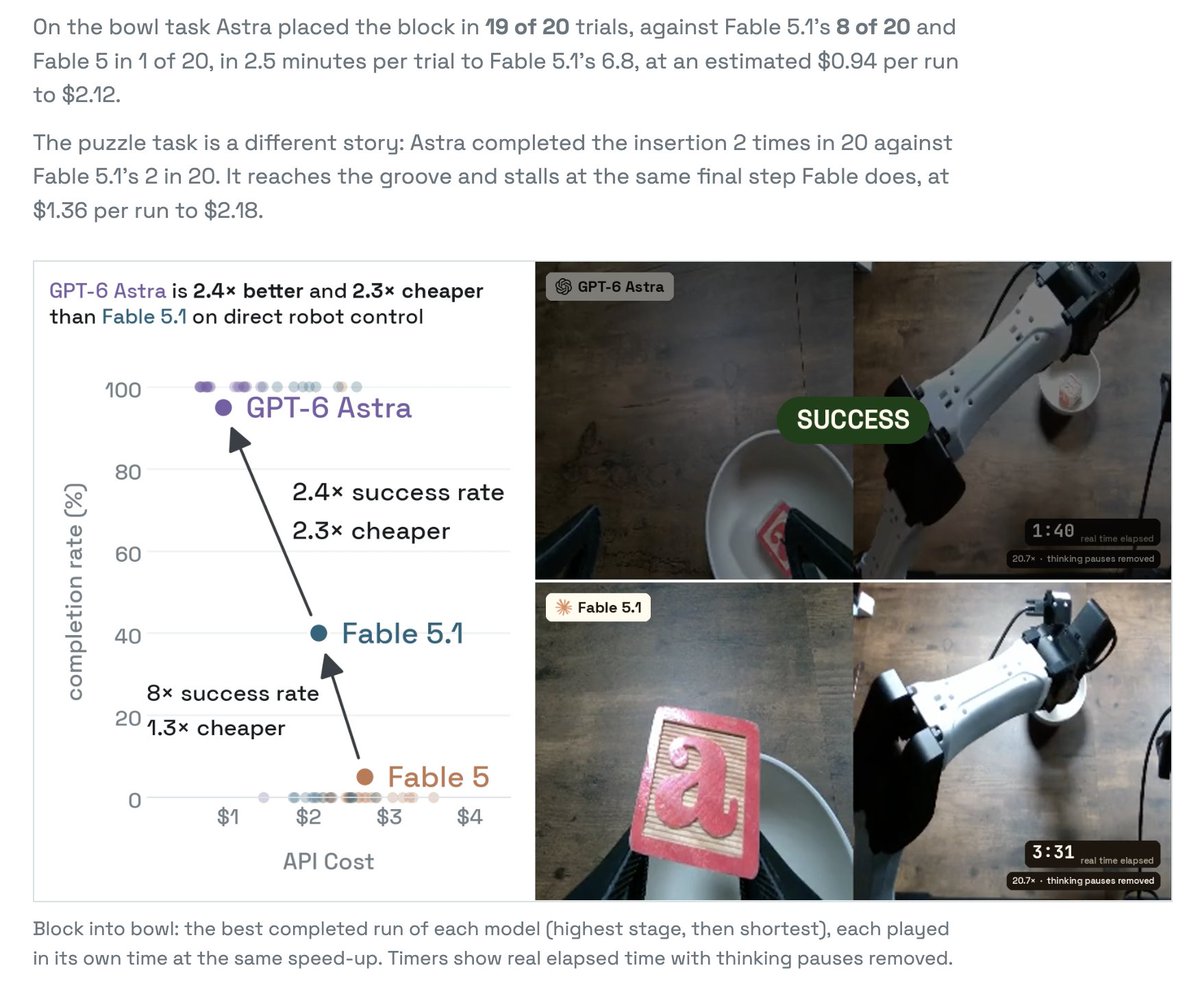
@aleabitoreddit summarized (244 likes, 48 replies, 44,684 views, 70 bookmarks) comments from Unitree’s CEO after testing GPT-6 on humanoid work. The post’s strongest evidence was a manipulation benchmark: Astra placing a block in a bowl in 19 of 20 trials versus Fable 5.1’s 8 of 20, while both remained stuck at 2 of 20 on a harder puzzle insertion task. That let the thread make a sharper point than “robots are coming”: some manipulation tasks are moving much faster than others.
@miftahudinsd9 argued (52 likes, 61 replies, 481 views) that the Open Axis Benchmark mattered because static robotics benchmarks stop being informative once policies learn the fixed task list. His framing of a “living” benchmark engine was important because it shifted the problem from raw score-chasing to keeping evaluation adaptive as robot capabilities evolve.
@CryptoFox_07 reported (41 likes, 35 replies, 632 views) one of the cleanest efficiency claims in the cluster: on an ordered approach-and-grasp task, an Axis-pretrained model succeeded in 14 of 16 trials with 30 demonstrations, while the original model succeeded in only 6 of 16 with the same 30 demonstrations. The post also noted that the original model needed 60 demonstrations just to reach 10 successful trials, which made the argument about data efficiency, not just final score.

Discussion insight: Even supportive threads kept asking what kinds of tasks are improving, which datasets stay honest, and whether better priors or better filtering matter more than simply scaling up demonstrations.
Comparison to prior day: On 2026-10-12, physical-AI discussion emphasized selected simulation and recovery metrics. On 2026-10-13, it leaned harder into benchmark design, pretraining, and the structure of the underlying data engine.
1.4 Trust layers were most concrete where AI touched regulated work, science, or personal boundaries (🡒)
The strongest non-model posts were about specialized verification and control layers around AI systems. The common thread was that trust became persuasive only when it was tied to named controls, measurable outcomes, or bounded judgments.
@mardehaym described (61 likes, 29 replies, 10,100 views, 31 bookmarks) a hospital revenue-cycle rollout where an appeals agent dropped median packet preparation time from 40 minutes to 11, cut an open backlog from 4,000 to 1,500, and raised the first-level overturn rate from 47% to 56%. The post was unusually specific about the trust layer: BAA-covered hosting, PHI redaction in logs, role-based access controls, shadow-mode testing, audit trails, and human approval for every submitted appeal.
@FanNie1208 introduced (14 likes, 12 replies, 297 views) OSVerify as a one-sided verification framework for scientific discovery. The public project site confirmed the headline claims from the tweet: 5 major and 13 minor issues found across 11 OpenAI math preprints, all verified by human experts, plus a 46% reduction in invalid solutions reaching experts under the same low-false-negative constraint.

@Sumanth_077 showed (8 likes, 6 replies, 651 views, 5 bookmarks) JevEval as a smaller but practical variation on the same theme: use Jev to make bounded semantic decisions about traces or outputs, then let DeepEval compute a deterministic final score. In other words, narrow the judgment surface before you ask a model to grade anything.
Discussion insight: These posts were strongest because they named real operational boundaries: BAA contracts, redaction rules, shadow mode, deterministic scoring, or expert-review triage. The conversation was much less interested in “safety” as a slogan than in who checks what, under which rules, before something goes live.
Comparison to prior day: Verification remained central, but on 2026-10-13 it showed up inside hospital billing, mathematical review, and explicit eval-tool design rather than only inside coding benchmarks.
2. Signals That May Matter
Public frontier-model competition is now being judged on cost, memory, and workflow fit at the same time
The Argon rollout mattered because it compressed several buying criteria into one public moment. @ArtificialAnlys published (89 likes, 9 replies, 4,094 views, 6 bookmarks) pricing and hallucination numbers, @sundarpichai showed (1,210 likes, 135 replies, 78,722 views, 151 bookmarks) multi-step tool use on large files, and @alliekmiller reported (26 likes, 21 replies, 3,505 views, 12 bookmarks) that proactive agents were still winning and losing on memory and interface depth. That combination suggests model launches are increasingly judged as products, not just as weights.
Why it matters: Teams choosing a frontier model are being forced to compare inference economics, context handling, and user-surface quality in one pass. That favors vendors that can keep pricing, memory behavior, and task fit aligned after launch-day enthusiasm fades.
Benchmarks that publish the task contract are getting more trust than generic leaderboards
@ArtificialAnlys made AA-3D persuasive by publishing the full task setup, human judging method, and cost frontier, while @omarsar0 made Evo2 persuasive by naming exactly how harness edits become trainable feedback. @Sumanth_077 made the same move on a smaller scale with JevEval: define the decision structure first, then let the model handle only the bounded semantic judgment.
Why it matters: Evaluation itself is becoming a product surface. The more agents depend on tools, long contexts, or task-specific wrappers, the less useful a bare leaderboard becomes unless it also explains the runtime contract.
Physical AI posts that explain data efficiency and benchmark design are beating vague humanoid optimism
The stronger robotics posts were not generic “physical AI is huge” commentary. They were specific about pretraining gains, evolving benchmarks, and which manipulation tasks remain brittle. @CryptoFox_07 gave a clean 14/16 versus 6/16 comparison at the same 30-demo budget, @miftahudinsd9 argued for a living benchmark rather than a solved static set, and @aleabitoreddit showed that even a strong model gap on one robot task can disappear on the next harder task.
Why it matters: The market signal is shifting from “who has the coolest robot” to “who can build the best data and evaluation engine around robot learning.” That is a much broader software and infrastructure opportunity than one more hardware demo.
Regulated and expert workflows are standardizing around narrower, auditable verifiers
The hospital appeals rollout and OSVerify pointed to the same operating rule: AI gets adopted faster when its failure surface is explicitly narrowed. @mardehaym described a workflow where humans still approved every appeal packet, and @FanNie1208 described a verifier that rejects likely-bad math outputs before scarce experts review the survivors.
Why it matters: Agent adoption in high-stakes domains looks less like “replace the reviewer” and more like “filter, route, and bound what the reviewer has to inspect.” That opens room for more specialized verification layers than generic copilots.
3. Needs, Gaps, and Underserved Demand
Workflow-specific model selection and migration guidance
The strongest Argon and proactive-agent posts all implied the same unmet need: teams want help matching a model or agent product to the actual work surface. @alliekmiller differentiated Muse, Dots, and Instinct by user type and interface; @ArtificialAnlys differentiated Argon by economics and hallucination rate; and @sundarpichai differentiated it by large-file tool use. The market still lacks clean guidance that connects those dimensions for buyers.
Opportunity: Direct. The demand is visible and recurring, and the current evidence is scattered across product launches, user threads, and benchmark dashboards.
Physical-AI data curation, replay, and adaptive benchmark infrastructure
@miftahudinsd9 framed the benchmark problem, while @CryptoFox_07 framed the data-efficiency problem. Together they point to a gap that is bigger than a single model release: better systems for deciding which robot trajectories matter, how they should be replayed or filtered, and how evaluation should evolve as policies improve.
Opportunity: Direct. The conversation is already precise enough that a product could credibly differentiate on benchmark freshness, replay tooling, or contribution scoring rather than on general robotics hype.
Specialized verifier stacks for scientific and regulated outputs
The hospital appeals workflow and OSVerify both described the same missing layer from opposite ends of the market. One used explicit controls to narrow what a billing specialist must sign off on; the other used one-sided verification to narrow what a mathematician must inspect. @Sumanth_077 added a smaller but practical version of the same idea for agent traces.
Opportunity: Direct. There is room for products that turn scarce expert attention into the final step of a bounded pipeline instead of asking experts to judge everything from scratch.
Liability and compliance layers around AI systems
@jsantosaranda surfaced insurance as a startup category for the agentic economy, while @mardehaym showed how an enterprise rollout still depended on redaction, audit trails, and human approval gates. That combination suggests people still do not trust agents in real workflows unless the boundaries are explicit, contractible, and inspectable.
Opportunity: Competitive. The need is real, but insurers, security vendors, privacy tools, and agent platforms will all try to occupy the same ground.
4. Tools, Products, and Companies Discussed
| Tool / Product | Category | Sentiment | Key takeaway | Supporting links |
|---|---|---|---|---|
| Gemini 4 Argon | Frontier model | Mixed-positive | Public rollout combined stronger agentic claims with explicit pricing, cache economics, and hallucination-rate discussion, which made the product easier to compare but also easier to scrutinize. | @ArtificialAnlys tweet (89 likes, 9 replies, 4,094 views); @sundarpichai tweet (1,210 likes, 135 replies, 78,722 views) |
| Muse / Dots / Instinct | Proactive AI agents | Mixed | User comparison focused on onboarding, memory, voice, Slack, and message-surface fit instead of raw benchmark bragging. | @alliekmiller tweet (26 likes, 21 replies, 3,505 views) |
| AA-3D | 3D-scene benchmark | Positive | The benchmark stood out because it published the task contract, human judging setup, and cost frontier for agent-built interactive scenes. | @ArtificialAnlys tweet (375 likes, 38 replies, 17,319 views, 58 bookmarks) |
| Evo2 | Agent-improvement method | Positive | Google DeepMind’s framework treated harness edits as trainable signal, not just wrapper code, and reported large gains from harness co-evolution alone. | paper; @omarsar0 tweet (15 likes, 7 replies, 1,200 views, 9 bookmarks) |
| Open Axis Benchmark / Axis Hub | Physical-AI data and evaluation platform | Positive | The strongest robotics evidence came from adaptive benchmarking and pretraining efficiency rather than from generic “humanoid” narratives. | @miftahudinsd9 tweet (52 likes, 61 replies, 481 views); @CryptoFox_07 tweet (41 likes, 35 replies, 632 views) |
| OSVerify | Scientific verification framework | Positive | One-sided verification reduced bad outputs reaching experts and provided a public example of verifier design for open-ended scientific work. | OSVerify site; @FanNie1208 tweet (14 likes, 12 replies, 297 views) |
| JevEval | Evaluation toolkit | Positive | JevEval showed a practical middle ground between rigid scoring rules and unconstrained LLM-as-a-judge setups by separating bounded semantic decisions from deterministic scoring. | @Sumanth_077 tweet (8 likes, 6 replies, 651 views) |
| Harbor AI | Liability layer | Emerging | Trust products are starting to be pitched as insurable operational risk, not just internal governance work. | @jsantosaranda tweet (36 likes, 237 views, 14 bookmarks) |
The most positively discussed products were not just “better models.” They were systems that attached clearer contracts to model behavior: published benchmark rules, harness logs, bounded eval questions, or explicit deployment controls.
A second pattern was that trust products were no longer abstract. In both physical AI and regulated workflows, the value was being assigned to replayable data, adaptive benchmarks, one-sided verifiers, and runtime boundaries rather than to general claims about intelligence.
5. Projects and Launches Worth Noting
| Project | Who built it | What it does | Why it matters | Stack | Stage | Links |
|---|---|---|---|---|---|---|
| Gemini 4 Argon | Public frontier model positioned around coding, multi-step tool use, and long-context work | Turned the day’s frontier-model conversation into a product comparison around price, memory, and workflow fit | Gemini API, large-context tool use, cache-read discounts, Google AI surfaces | Shipped | @sundarpichai tweet; @ArtificialAnlys tweet | |
| AA-3D | Artificial Analysis | Benchmark for models that build interactive 3D scenes from written briefs | Published a richer task contract than a generic coding or reasoning leaderboard and added cost-per-scene context | Blender, Rapier physics, Python, headless browser, Elo voting | Shipped | tweet |
| Hospital denial-appeals agent rollout | @mardehaym | Drafts, routes, and packages technical and administrative appeal packets for hospital billing | Rare public deployment story with quantified throughput and overturn-rate gains plus explicit compliance controls | BAA-covered model hosting, PHI redaction, role-based access controls, audit trails, manual approval | Shipped | tweet |
| OSVerify | Stanford researchers | One-sided verifier for scientific and mathematical outputs | Shows how expert review can be scaled when automatic “final answer” grading is unavailable | Error proposer, error validator, human expert review, optional Rethlas integration | Beta | site; @FanNie1208 tweet |
| JevEval | Jev + DeepEval ecosystem | Evaluation toolkit for bounded semantic checks on outputs and traces | Pushes evaluation toward explicit decision structures instead of free-form LLM judging | Jev probabilities, weighted checks, deterministic DeepEval scoring | Beta | @Sumanth_077 tweet |
| Harbor AI | @jsantosaranda | Insurance startup aimed at the “agentic economy” | Liability is becoming a product category around autonomous systems, not just a policy talking point | AI-risk underwriting, enterprise agent coverage | Alpha | tweet |
Argon and AA-3D mattered because they made capability and evaluation inseparable. The model launch immediately fed into questions about public economics, memory behavior, and how well existing benchmarks map to long-horizon work, while AA-3D raised the bar for what a benchmark artifact must publish.
The strongest deployment-side projects looked narrower, but more operationally serious. The hospital appeals rollout, OSVerify, JevEval, and Harbor AI all treated trust as a specific layer around the model: approvals, redaction, expert triage, deterministic scoring, or liability transfer. That is a different build pattern from “ship a general agent and hope the rest follows.”
6. New and Notable
Liability became a startup wedge for AI systems
@jsantosaranda used (36 likes, 237 views, 14 bookmarks) Harbor AI’s stealth launch to frame insurance as infrastructure for the “agentic economy.” The post was brief, but it mattered because it treated model risk as something that might be underwritten and transferred, not just discussed in policy documents.
Hospitals are now publishing approval-gated deployment metrics
@mardehaym shared (61 likes, 29 replies, 10,100 views, 31 bookmarks) a workflow that moved appeal-packet preparation from 40 minutes to 11 minutes while keeping human approval on every submission. That combination of measured gains plus explicit review gates made the post more operationally interesting than a generic “AI saved time” claim.
Mathematical verification moved closer to public referee tooling
@FanNie1208 positioned (14 likes, 12 replies, 297 views) OSVerify as a way to surface major and minor issues in math papers before scarce experts spend time reading everything. That made scientific verification feel less like a research demo and more like a concrete workflow category.
7. Opportunities
| Opportunity | Evidence | Why now | Urgency | Difficulty |
|---|---|---|---|---|
| Workflow-aware model routing and procurement tools | Argon pricing/performance debate, Sundar’s workload demos, and user comparisons across Muse/Dots/Instinct all showed fragmented decision criteria. | Teams are already comparing cost, memory, context handling, and UX, but the market still lacks good cross-product guidance tied to actual workflows. | High | Medium |
| Physical-AI data curation and adaptive benchmark infrastructure | Open Axis and Axis pretraining posts emphasized living benchmarks and better learning from the same demonstration budget. | Robotics attention is rising, but the best public evidence is still about data efficiency and eval freshness, not hardware lock-in. | High | High |
| Expert-review verifiers for science, medicine, and compliance work | OSVerify, JevEval, and the hospital appeals rollout all narrowed model output before human review. | Organizations want automation without giving up auditability, which creates demand for bounded verifier layers. | High | Medium |
| Agent liability, permissioning, and privacy controls | Harbor AI and NewEyes AI pointed to growing demand for explicit boundaries around what agents can see, do, and insure. | As agents touch enterprise systems and real-world sensors, trust controls are becoming a buying criterion instead of a policy appendix. | Medium | Medium |
The clearest near-term openings sit one layer above the model. The best posts of the day were not asking for a new general-purpose foundation model so much as for better routing, benchmarking, verification, and governance around the models already available.
The harder but larger opportunity is physical-AI infrastructure. The public discussion is already moving beyond humanoid novelty toward adaptive benchmarks, replayable data engines, and pretraining leverage. Whoever makes those loops easier to build and compare should benefit even if the leading robot policy changes several times.
8. Takeaways
- Frontier-model launches are being graded as product packages, not just as capability spikes. Argon’s rollout became a conversation about economics, tool use, memory, and workflow fit all at once, which is a more mature buying rubric than a single benchmark rank. @ArtificialAnlys, @sundarpichai, and @alliekmiller each supplied a different part of that package.
- Evaluation is moving toward explicit task contracts. AA-3D, Evo2, and JevEval all won attention by exposing more of the runtime and judging setup rather than by claiming a universal scoreboard. That makes benchmark design itself a competitive product surface. @ArtificialAnlys, @omarsar0, @Sumanth_077
- Physical AI discussion is getting more specific about data quality and benchmark freshness. The most useful robotics posts named task-level gaps, pretraining leverage, and the limits of static evaluations instead of relying on humanoid spectacle alone. @aleabitoreddit, @miftahudinsd9, @CryptoFox_07
- Trust is winning when it is operationally bounded. Hospital billing, scientific verification, and agent-eval tooling all earned credibility by naming specific controls, review loops, and failure filters. That is a stronger adoption signal than broad “safe AI” rhetoric. @mardehaym, @FanNie1208
- The day’s real opportunity layer sat around models, not beneath them. Routing, benchmark infrastructure, verifier stacks, permissioning, and liability products looked more differentiated than yet another general “AI app” pitch.