YouTube AI - 2026-04-20
1. What People Are Talking About
1.1 Claude Design and Anthropic's Product Expansion 🡕
The week's dominant signal is Anthropic's Claude Design launch, which drew the highest engagement of any video in the dataset by a wide margin: 647K views, 22K likes, 1.1K comments.

Fireship tested whether Claude Design, powered by Opus 4.7, can turn a rough Figma wireframe into production-ready UI. The video positions Claude Design as Anthropic's most disruptive tool since Claude Code and a direct competitor to Figma and Adobe for AI-assisted interface design (Claude just got another superpower...).
In the same news cycle, Anthropic quietly removed Claude Code from the $20 Pro plan. Universe of AI framed this as a significant pricing shift, forcing budget-conscious developers to upgrade or lose access (OpenAI LEAKED 5 NEW Models + Two New Agent Platforms + Anthropic REMOVES Claude Code!).
AI Master published a 23-minute tutorial on Claude-specific prompting techniques: XML tags, prefill, constraint stacking, motivated instructions, and a 3-step iterative workflow. The video explicitly frames Claude prompting as different from ChatGPT prompting, suggesting model-specific prompt engineering is emerging as a distinct skill (Unlock Claude God-Mode in 20 Minutes). 7.4K views.
1.2 Enterprise Agent Platforms Launch Week 🡕
Three major cloud providers shipped or showcased enterprise agent platforms within the same week, signaling rapid convergence on "agentic AI" as the next enterprise infrastructure layer.

Google Cloud presented the blueprint for the "agentic enterprise" at Cloud Next '26. CEO Thomas Kurian announced the Gemini Enterprise Agent Platform, AI Hypercomputer, Agentic Data Cloud, Agentic Defense, and Agentic Taskforce -- a full stack from model serving to governance (Google Cloud Next '26 Opening Keynote). 197K views.

Microsoft Mechanics walked through Foundry Agent Service and Microsoft Agent Framework: deploying agents from a local environment with secure identity, scoped permissions, and traceability, then publishing directly into Microsoft 365. The platform integrates Work IQ, Foundry IQ, and Fabric IQ (Foundry Agent Service + Microsoft Agent Framework Explained). The Microsoft Foundry GitHub org has 14 repositories including foundry-samples (306 stars), mcp-foundry (240 stars), and foundry-agent-webapp (82 stars).

IBM Technology published an educational explainer on AI agent skills -- the procedural knowledge agents still lack. Martin Keen walks through how skills, LLMs, RAG, and MCP combine to help agents follow workflows and automate tasks (What AI Agent Skills Are and How They Work). 65.6K views, 2,630 likes, 79 comments. The high engagement reflects demand for foundational understanding as the "agent" concept saturates product marketing.

Universe of AI covered both platform launches alongside OpenAI's leaked models and Anthropic's Claude Code pricing change, framing the week as a three-way platform race (OpenAI LEAKED 5 NEW Models + Two New Agent Platforms + Anthropic REMOVES Claude Code!). 3.6K views, 18 comments.
1.3 OpenAI Codex Evolves into a Workflow Agent 🡕
Multiple creators covered OpenAI Codex 2.0, which repositions the tool from a coding assistant into a full software workflow agent with a new free tier.
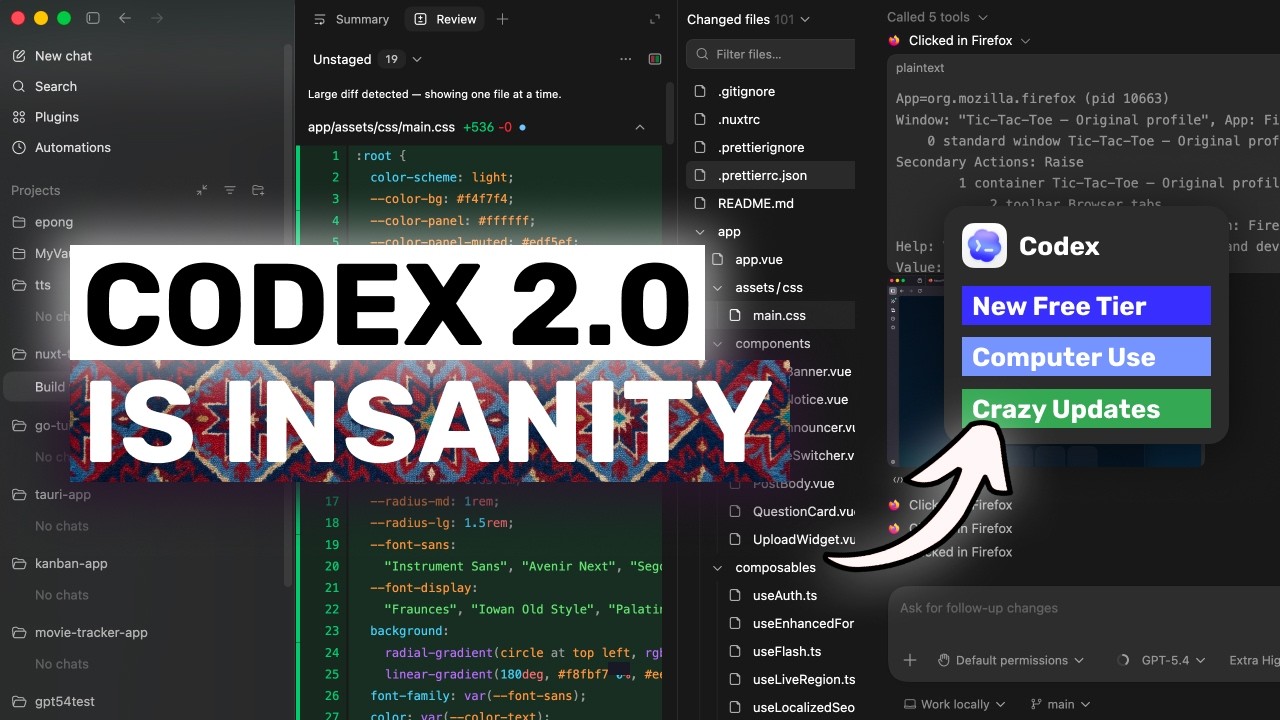
AICodeKing broke down the key features: background computer use (click, type, interact with apps), an in-app browser, image generation within workflows, 90+ plugin integrations, persistent memory, and a new free tier for ChatGPT Free and Go users (Codex 2.0 + NEW CRAZY Free Tier). 18.7K views, 421 likes, 35 comments.
Julian Goldie SEO covered the same update with a focus on automation: parallel multi-agent mode, full computer control, and UI generation workflows. The video frames the shift as moving from "prompting" to "delegating" (New ChatGPT Codex Update: Automate ANYTHING!). 8.8K views.
1.4 Vibe Coding: Practice, Problems, and Products 🡒
Three videos addressed vibe coding from different angles -- as a product, a revenue stream, and a reliability problem.
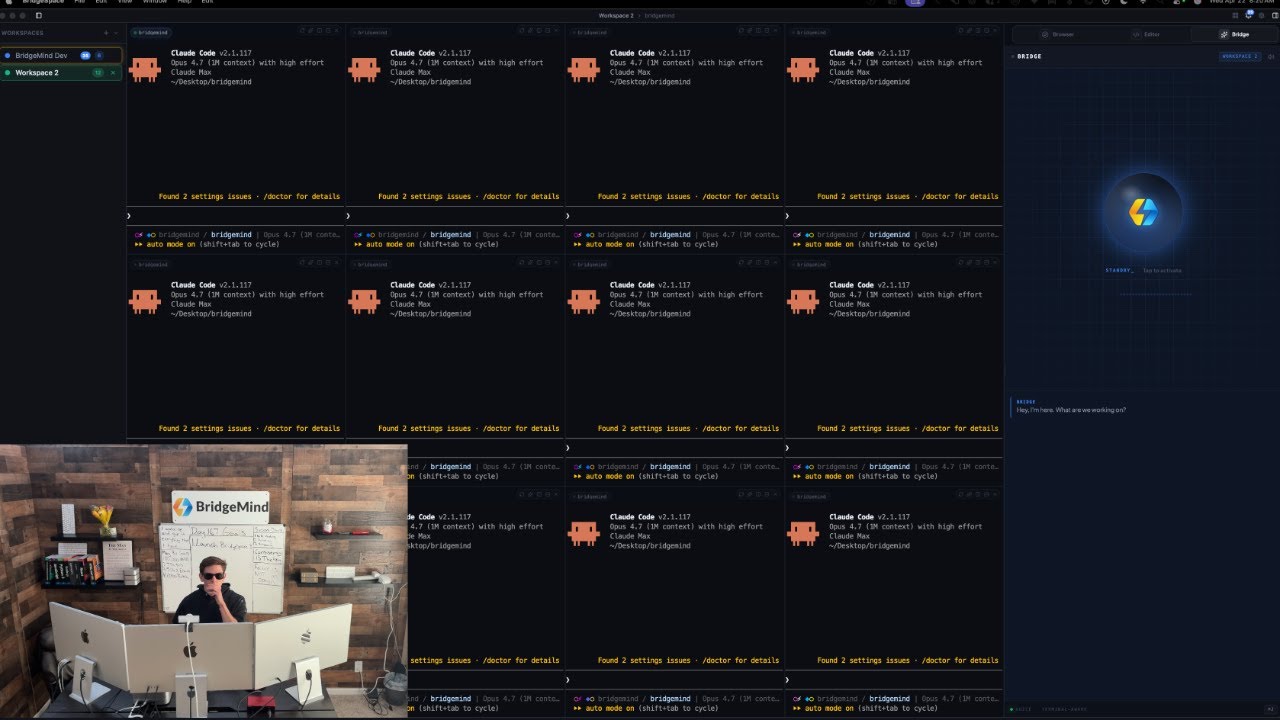
BridgeMind livestreamed Day 167 of their "$1M vibe coding" series at $91,860 ARR. The stream centered on the BridgeSpace 3 Product Hunt launch -- a cloud IDE with multi-agent swarm orchestration using Claude Opus 4.7, GPT 5.4, Claude Code, and Codex (Day 167 -- Vibe Coding an App Until I Make $1,000,000). 29.6K views, 1,187 likes.
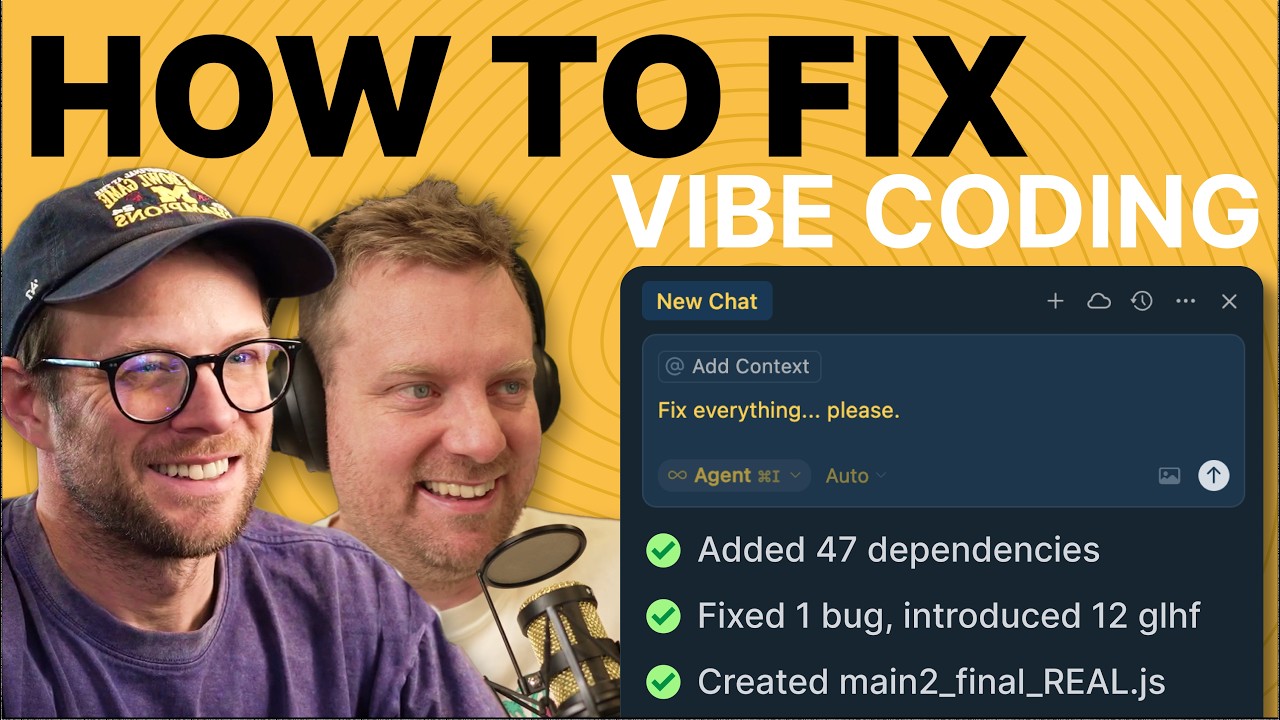
Syntax (Wes Bos and Scott Tolinski, 472K subscribers) took a practitioner stance: vibe coding produces unreliable output, and the fix is deterministic tooling. They discussed fallow, knip, ESLint, StyleLint, Sentry, headless browsers, and TanStack Code Mode as ways to constrain AI-generated code into maintainable patterns (How to Fix Vibe Coding). 8.1K views, 36 comments.
1.5 Open-Source AI Models 🡒
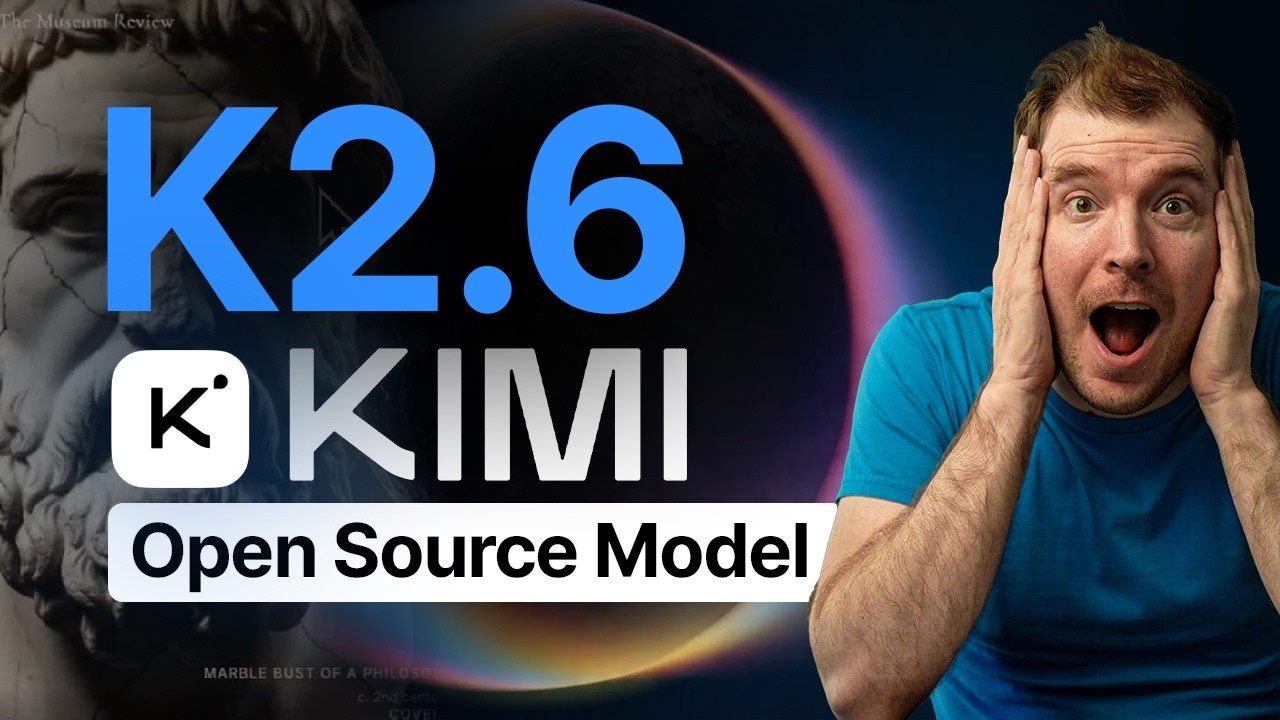
Codex Community covered the Kimi K2.6 release from Moonshot AI -- an open-source, open-weights model featuring agent swarms, web design capabilities, and code generation. The model can be self-hosted (Kimi K2.6 - Open Source Model for Code / Web Design / AI). 56K views. Moonshot AI sponsored the video. The Kimi platform also offers Deep Research, Slides, Sheets, and Kimi Claw (beta) alongside the K2.6 model.
1.6 Enterprise Adoption of AI Coding Tools 🡕

Dr. Know-it-all Knows it all analyzed the SpaceX-Cursor deal, referencing 11 tweets from industry commentators. The video drew 4,090 views and an unusually high 39 comments relative to its view count, suggesting strong opinions on what SpaceX's adoption signals for enterprise legitimacy of AI coding tools (The Real Story Behind the SpaceX-Cursor Deal).
2. What Frustrates People
Vibe Coding Produces Unreliable Output
The Syntax episode "How to Fix Vibe Coding" is built entirely around the frustration that AI-generated code is unpredictable and hard to maintain. Wes Bos and Scott Tolinski describe a pattern where AI "guesses" instead of following deterministic rules, producing code that works initially but creates maintenance debt. Their proposed fix: enforce linting (ESLint, StyleLint), dead-code detection (knip), headless browser testing, and structured task workflows to constrain the AI's output (How to Fix Vibe Coding). Severity: High -- a daily frustration for developers relying on AI coding tools.
Claude Code Access Removed from Pro Plan
Universe of AI reported that Anthropic removed Claude Code from the $20 Pro plan "overnight," forcing users who relied on it to either upgrade or lose access. The framing suggests this was done without adequate notice (OpenAI LEAKED 5 NEW Models + Two New Agent Platforms + Anthropic REMOVES Claude Code!). Severity: Medium -- affects budget-conscious developers who adopted Claude Code early.
3. What People Wish Existed
Deterministic Guardrails for AI Code Generation
The Syntax hosts describe wanting AI coding tools that respect linting rules, use existing components instead of generating new ones, and produce output that passes CI checks without manual cleanup. They mention TanStack Code Mode as a partial solution but frame the need as largely unmet: AI tools need native integration with deterministic quality enforcement (How to Fix Vibe Coding). Opportunity: direct -- tooling that bridges AI code generation and existing CI/CD pipelines.
Affordable Access to Advanced AI Coding Tools
The Anthropic pricing change and OpenAI's new free Codex tier represent two sides of the same need: developers want access to powerful AI coding tools without premium pricing. OpenAI is moving toward broader access (free tier), while Anthropic is restricting it (Codex 2.0 + NEW CRAZY Free Tier, OpenAI LEAKED 5 NEW Models). Opportunity: competitive -- pricing and access tiers are active battlegrounds.
4. Tools and Methods in Use
| Tool | Category | Sentiment | Strengths | Limitations |
|---|---|---|---|---|
| Claude Code | AI coding agent | (+/-) | Powerful agentic coding, deep integration | Removed from $20 Pro plan |
| Claude Design | AI design tool | (+) | Figma wireframe to production UI, Opus 4.7 powered | New, unproven at scale |
| OpenAI Codex 2.0 | AI workflow agent | (+) | Computer use, 90+ plugins, memory, free tier | Breadth may sacrifice depth |
| Cursor AI | AI IDE | (+) | Adopted by SpaceX | No detail on limitations in data |
| Microsoft Foundry | Enterprise agent platform | (+) | 11,000+ models, MCP tools, M365 integration, open SDK | Enterprise-only, Azure dependency |
| Gemini Enterprise | Enterprise agent platform | (+) | Full stack from Google Cloud, agentic blueprint | Enterprise-only, Google Cloud dependency |
| BridgeSpace 3 | Vibe coding IDE | (+) | Multi-agent swarm, 16 parallel terminals, MCP support | Indie product, early stage |
| Kimi K2.6 | Open-source LLM | (+) | Open weights, agent swarms, web design, self-hostable | Sponsored coverage, unverified benchmarks |
| ESLint / StyleLint | Linting | (+) | Deterministic code quality enforcement | Must be integrated with AI workflow |
| knip | Dead code detection | (+) | Finds unused code AI generates | Not AI-native |
| Sentry | Error monitoring | (+) | Catches bugs in AI-generated code | Reactive, not preventive |
| MCP | Agent protocol | (+) | Mentioned across IBM, Microsoft, BridgeMind | Emerging standard, fragmented implementations |
The week shows a clear bifurcation: enterprise platforms (Microsoft Foundry, Google Gemini, IBM watsonx) compete on governance, security, and integration breadth, while developer-facing tools (Codex, Claude Code, Cursor, BridgeSpace) compete on speed, autonomy, and pricing. MCP (Model Context Protocol) appears as a common thread across both camps.
5. What People Are Building
| Project | Who built it | What it does | Problem it solves | Stack | Stage | Links |
|---|---|---|---|---|---|---|
| BridgeSpace 3 | BridgeMind | Cloud IDE with multi-agent swarm orchestration | Coordinating multiple AI agents for complex coding tasks | Claude Opus 4.7, GPT 5.4, Claude Code, Codex, MCP | Shipped | bridgemind.ai, Product Hunt |
| Microsoft Foundry Agent Service | Microsoft | Enterprise agent deployment and management | Prototype-to-production gap for AI agents | Azure AI, Semantic Kernel, LangChain, CrewAI | Shipped | ai.azure.com, GitHub |
BridgeSpace 3 is a cloud IDE built around "vibe coding" -- developers describe intent in natural language and AI agents handle implementation. It features a vibe kanban board, up to 16 parallel terminal sessions for concurrent agent work, and BridgeMCP for shared context across tools. The product also includes BridgeVoice (voice-to-text coding) and BridgeCode (CLI). At $91,860 ARR with 8,500+ Discord members, it represents one of the more tangible vibe coding businesses.
Microsoft Foundry includes a GitHub org with 14 repositories. Notable repos: foundry-samples (306 stars, embedded docs samples), mcp-foundry (240 stars, MCP server for Azure AI Foundry), and foundry-agent-webapp (82 stars, web app with Entra ID auth). The platform supports Python, TypeScript, C#, and integrates with popular agent frameworks.
6. New and Notable
OpenAI Model Leaks
Universe of AI reported that 5+ unreleased models were accidentally leaked inside the OpenAI Codex CLI, including references to GPT-5.5 and a model codenamed "Hermes." This suggests OpenAI has a deep pipeline of unreleased models (OpenAI LEAKED 5 NEW Models).
Claude Prompt Engineering as a Distinct Skill
AI Master's 23-minute Claude-specific prompting tutorial (XML tags, prefill, constraint stacking, motivated instructions) explicitly differentiates Claude usage from ChatGPT. Model-specific prompt engineering is crystallizing as a skill category, not just generic "prompting" (Unlock Claude God-Mode in 20 Minutes).
7. Where the Opportunities Are
[+++] Deterministic quality enforcement for AI-generated code -- The Syntax episode identifies a clear gap: AI coding tools produce output that doesn't respect existing linting rules, component libraries, or CI pipelines. Tools that bridge AI generation with deterministic validation (lint-on-generate, component-aware scaffolding, CI-integrated feedback loops) address a daily pain point for the growing vibe coding audience.
[++] Enterprise agent deployment and governance -- Google, Microsoft, and IBM all shipped enterprise agent platform content in the same week. The convergence on agent governance, traceability, and M365/workspace integration signals strong enterprise demand. Tooling that helps enterprises evaluate, compare, or bridge these platforms has a window while the market is fragmented.
[+] Model-specific prompt engineering education -- The AI Master Claude tutorial and IBM's agent skills explainer both drew strong engagement for educational content. As models diverge in capabilities and optimal usage patterns, platform-specific training materials and tooling (prompt libraries, technique comparisons) have growing demand.
8. Takeaways
-
Claude Design is the week's breakout product. Fireship's demo drew 647K views and 1,100 comments, making it the most-watched AI video in the dataset. Anthropic is expanding from text and code into UI/design generation. (Claude just got another superpower)
-
Enterprise agent platforms are launching simultaneously. Google (Gemini Enterprise Agent Platform), Microsoft (Foundry Agent Service), and IBM (watsonx agent skills) all shipped agent platform content in the same week, competing for the enterprise AI infrastructure layer. (Google Cloud Next '26, Foundry Agent Service, AI Agent Skills)
-
OpenAI is broadening Codex access while deepening capabilities. Free tier + computer use + 90 plugins positions Codex as a general workflow agent, not just a coding tool. (Codex 2.0)
-
Vibe coding is maturing into a real product category. BridgeMind at $91K ARR with a Product Hunt launch, and Syntax's 44-minute episode on fixing vibe coding's reliability problems, show the space moving from buzzword to ecosystem. (Day 167, How to Fix Vibe Coding)
-
SpaceX adopting Cursor AI signals mainstream enterprise acceptance of AI coding tools. The high comment-to-view ratio on Dr. Know-it-all's coverage shows the community is watching enterprise adoption closely. (SpaceX-Cursor Deal)