YouTube AI - 2026-05-16
1. What People Are Talking About
1.1 AI credibility is being tested on proof, not polish 🡕
The sharpest thread in today's set is that model credibility now depends less on polished demos and more on whether claims can survive audit. Four different items push that point from different directions: benchmark-manipulation allegations, doubts about whether current systems "reason" at all, formal verification as the alternative, and direct political pressure around AI safety.

Coding with Lewis turns Meta into the trust-collapse case at 44,565 views. The Decoder summary linked in the description says Yann LeCun described Llama 4 benchmark results as "fudged a little bit," while Meta's own launch post still markets Scout and Maverick as best-in-class multimodal models with strong benchmark wins. That makes provenance and benchmarking part of the product itself, not just launch-week commentary (video, The Decoder, Meta).

World Science Festival broadens the same distrust beyond one company. Gary Marcus uses a long-form discussion to argue that current systems may be giving a convincing impression of reasoning without actually reasoning in a human sense, which makes the "just scale it" story look less settled than frontier marketing suggests (video).

Ksenia | Turing Post offers the most concrete technical alternative. The video frames energy-based models as constraint satisfaction rather than next-token prediction, and Logical Intelligence says Aleph is aimed at scalable verified code generation where proofs either close or fail completely. That moves the conversation from "better demos" to systems that can prove correctness before deployment (video, Logical Intelligence).

Roman Yampolskiy shows that the trust crisis is political as well as technical. The description routes viewers to ControlAI's direct lawmaker-action page, which means skepticism about superintelligence is no longer just a research argument; it is being turned into organized public pressure (video, ControlAI).
Discussion insight: The trust problem now spans launch claims, reasoning theory, verification architecture, and governance. The shared demand is not merely "more capable AI," but AI whose claims can be checked.
Comparison to prior day: On 2026-05-15 trust already centered on benchmark theater and provable systems. On 2026-05-16 that same theme widens into a broader attack on the "reasoning" narrative itself and a more explicit public-advocacy response.
1.2 Local and open AI is spreading from coding into 3D and video workflows 🡕
Yesterday's local-first agent story continues, but the scope is broader now. The local/open cluster in this set is not just about coding agents. It now includes image-to-3D generation, side-by-side local model evaluation, and local video pipelines for creators, which makes locality look like a general product direction rather than a niche privacy feature.

Stefan 3D AI gives the clearest media-side example at 33,835 views. The video says Pixal3D may beat some paid closed-source systems, and the project page says it uses pixel back-projection conditioning to establish direct pixel-to-3D correspondence, improve fidelity, and extend naturally to multi-view generation. That makes open-weight local 3D feel like a practical builder option instead of a toy demo (video, Pixal3D).
STARTUP HAKK turns the same logic into a local coding-agent thesis. The video asks what developers are still paying for if open local models are getting close to frontier subscriptions, and OpenMonoAgent.ai makes the answer concrete with a terminal-native local agent, unlimited tokens, Docker sandboxing, Roslyn-aware code intelligence, and 20 tools plus MCP. The build pattern here is ownership: infrastructure you run, not rent (video, OpenMonoAgent.ai, repo).
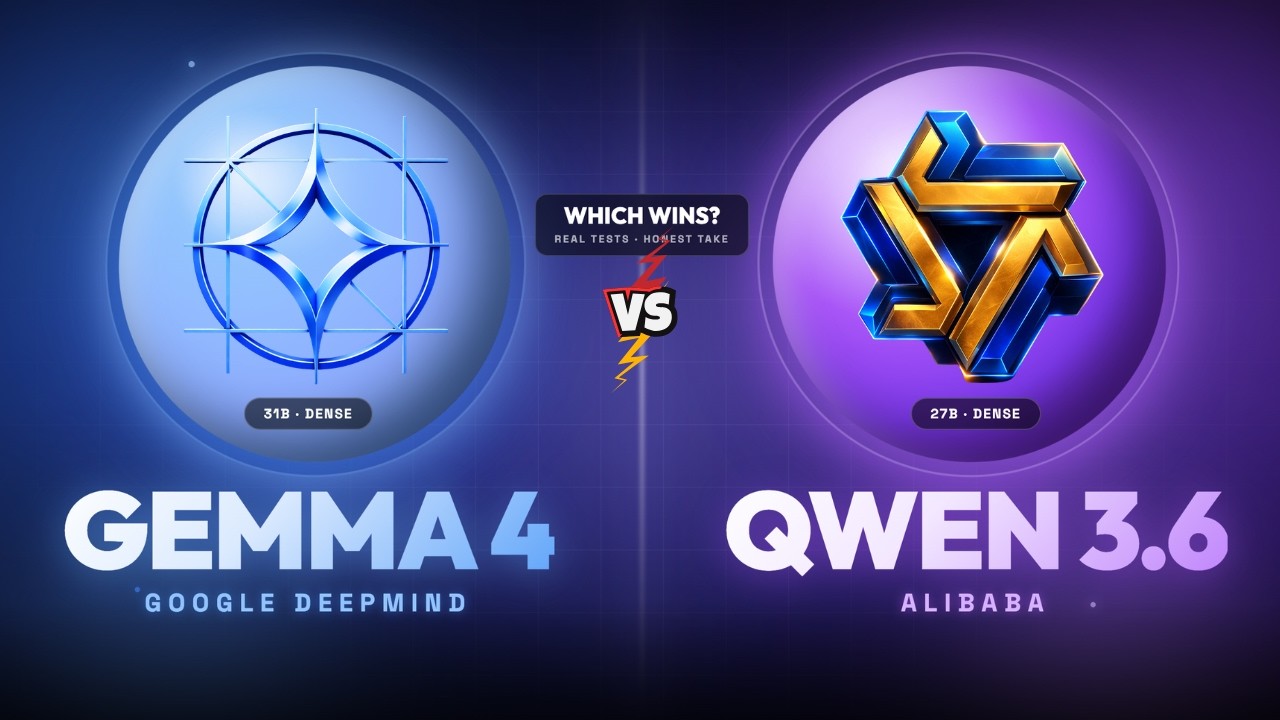
AI Stack Engineer shows how practical that local shift has become. Instead of arguing abstractly for open models, the video compares Gemma 4 and Qwen 3.6 on benchmark numbers, hardware requirements, licenses, and real apps, which is the behavior of a market that already expects local deployment to be viable (video).

AI Research extends the theme into creator video. The pitch is a local, uncensored LTX 2.3 workflow without ComfyUI, which matters because it frames local execution as the simplest way to gain flexibility and control instead of as an advanced hobbyist path (video).
Discussion insight: "Local" now means much more than private chat. In this set it covers coding agents, dense-model selection, image-to-3D pipelines, and creator video workflows.
Comparison to prior day: On 2026-05-15 local-first energy centered on agentic coding and private runtime control. On 2026-05-16 the same movement spreads into 3D assets, local model benchmarking, and local video generation.
1.3 The AI race is still being framed through chips, China, and capital allocation 🡒
The infrastructure story remains one of the largest themes in the set, and the biggest item by far is still about semiconductor capacity rather than about a new model release. What changes today is the financial layer: alongside geopolitics and supply chains, the dataset now includes explicit stock-picking and validation talk around who captures the AI buildout.

Bloomberg Originals anchors the entire set at 602,008 views. Its chapter list keeps ASML lithography, AMD design, TSMC's supply chain, China's reshoring efforts, and new US fabs at the center, so the AI race is still being narrated as an industrial-capacity problem before it is a software story (video).

ABC News adds the state-deployment angle. The report says AI is already being embraced by the Chinese government and that AI education is being mandated in schools, which makes the competitive story about institutional rollout and workforce preparation, not just private-sector experimentation (video).

Options With Ryan shows how quickly that industrial story gets translated into capital allocation. The whole item is a bet on which Nvidia-adjacent infrastructure names capture the buildout, and the stock-focused videos elsewhere in the set keep returning to the same question: which parts of the AI supply chain have real validation and which parts are still narrative (video).
Discussion insight: The infrastructure theme is no longer just about bottlenecks. It is now also a market-selection problem, with creators trying to decide which chip, optics, and data-center stories are grounded enough to deserve capital.
Comparison to prior day: On 2026-05-15 the China-plus-chips story was already strong. On 2026-05-16 it stays intact, but the market and stock-selection layer becomes more explicit.
1.4 AI is being packaged as vertical workflow software and paid enablement 🡕
Another clear pattern is that AI adoption is increasingly being sold as a guided workflow, a domain copilot, or a formal training path. Instead of one model promising everything, today's evidence bundles AI into creator software, supervised healthcare support, structured courses, and concrete implementation patterns like RAG.
TheAIGRID gives the strongest vertical example. The video explains DeepMind's AI co-clinician, and DeepMind's own post says the system is meant for "triadic care" under physician authority, recorded zero critical errors in 97 of 98 realistic primary-care queries, and uses a planner/talker architecture for patient-facing safety. The value proposition is careful augmentation inside a domain, not generalized autonomy (video, DeepMind).

Malva AI shows the creator-software version of the same move. The video routes Qwen creator workflows into Higgsfield Marketing Studio, and Higgsfield markets SUPERCOMPUTER as an agent with skills, memory, and 24/7 automations while also selling ready-made ad formats. That is workflow software wrapped around AI, not just raw generation (video, Higgsfield).

Simplilearn packages the same demand into education. The 22-hour course links paid programs whose module list spans AI literacy, advanced generative AI, agentic frameworks with Model Context & Tooling Protocols, image generation, governance, and a capstone. That is a sign that "learning AI" is itself becoming a structured product category (video).

codebasics supplies the implementation layer. The creator says RAG is a common skill in GenAI job posts, and the linked RAG Basics resource page shows the material being packaged as a reusable builder asset rather than as a one-off explainer (video, RAG Basics).
Discussion insight: The commercial AI layer is getting more legible. In this set, adoption arrives through copilot boundaries, creator workflow software, paid courseware, and practical implementation methods rather than through frontier-model spectacle alone.
Comparison to prior day: On 2026-05-15 packaging showed up in local workbenches and job maps. On 2026-05-16 it is more explicitly vertical and monetized: healthcare support, creator automation, formal training, and reusable implementation skills.
2. What Frustrates People
Trust breaks when AI claims cannot be verified
This is High severity because several high-signal items attack the same gap from different sides. Coding with Lewis turns benchmark credibility into a public trust problem around Llama 4, Gary Marcus argues persuasive output is not the same thing as reasoning, and Ksenia's Aleph coverage says correctness has to be provable instead of merely plausible (How Meta Went From Open Source Hero to AI's Biggest Villain, The Decoder, The Uncomfortable Truth About AI “Reasoning”, Aleph and Energy-Based Models: The AI That Refuses to Bullshit, Logical Intelligence). Roman Yampolskiy shows the same frustration crossing into direct lawmaker outreach (AI Safety Expert: Ban Superintelligence!, ControlAI). The visible coping strategies are verification layers, alternative architectures, and public-pressure campaigns rather than higher trust in default model claims. This is directly worth building for.
Local AI is attractive, but hardware and setup are still part of the product
This is High severity because the strongest local-first videos spend real time on model choice, hardware constraints, and workflow simplification instead of acting as though local AI is turnkey. Stefan 3D AI sells Pixal3D partly on the fact that it can be run openly, AI Stack Engineer compares Gemma 4 and Qwen 3.6 on hardware and license tradeoffs, STARTUP HAKK emphasizes the economics of owning local inference, and AI Research markets LTX 2.3 specifically as a simpler local video path without ComfyUI (New Local 3D AI Generator Is Pixel-Perfect — Pixal3D (Open Weights), Google Gemma 4 VS Qwen 3.6: I Ran Both Side by Side and Picked One, Local Models are the Future of AI, UNCENSORED LTX2.3 Is HERE! Generate AI Videos Locally Without ComfyUI, OpenMonoAgent.ai). The coping strategies are wrappers, hardware autodetection, and more opinionated local stacks. This is directly worth building for.
AI infrastructure still depends on chips, geopolitics, and proof of real demand
This is High severity because the biggest infrastructure items are all still constraint stories. Bloomberg centers lithography, TSMC, reshoring, and fabs, ABC turns AI into state deployment and school policy, and the stock-market videos keep asking which AI infrastructure names have actual validation versus speculative narrative (How AI Is Pushing the Semiconductor Supply Chain to the Limit | Bloomberg Primer, In China, artificial intelligence isn’t the future. It’s already here, 4 Nvidia AI Infrastructure Stocks I’m Watching In 2026 + My $37K LEAPS Position, Navitas vs. POET: Why One AI Infrastructure Stock Has the Better Setup). The coping strategy is more investment, more selectivity, and more industrial planning rather than resolution. This is worth building for, but most value sits close to infrastructure operators and enterprise buyers.
Vertical AI only earns trust when humans stay visibly in charge
This is High severity because the most credible domain-specific AI item in the set is careful about boundaries rather than bold about replacement. DeepMind frames AI co-clinician as triadic care under physician authority, reports zero critical errors in 97 of 98 realistic primary-care queries, and still says the work is not intended for diagnosis or treatment use at this stage (Google’s New AI Could Change Healthcare Forever, DeepMind). Even CBS's travel segment frames AI as operational integration inside a legacy industry rather than as an autonomous overhaul (How AI is changing travel). The coping strategy is narrow augmentation with clear supervision, which makes this directly worth building for.
People still pay for structure because the AI learning surface is too wide
This is Medium severity because the signal shows up as market behavior more than as direct complaint, but it is consistent. Simplilearn packages AI into a 22-hour course and paid programs, codebasics turns RAG into a downloadable builder skill, and AI Master sells step-by-step agent training rather than assuming people can assemble the stack from scattered clips alone (Generative Artificial Intelligence Full Course 2026, RAG Explained | All about RAG, AI Agents Explained: How to Create and Use AI Agents in 2026, RAG Basics). The coping strategy is to buy structure, templates, and community instead of learning everything from raw release notes. This is real, but the market is already competitive.
3. What People Wish Existed
Verification-first AI with clear provenance
The strongest practical need in the set is for systems that can show what was tested, what evidence supports a claim, and whether an output satisfies hard constraints before anyone relies on it. Lewis' Meta story shows how quickly benchmark trust can collapse, World Science Festival challenges whether current systems reason in the first place, and Ksenia's Aleph coverage points toward formal verification as the more credible answer (How Meta Went From Open Source Hero to AI's Biggest Villain, The Uncomfortable Truth About AI “Reasoning”, Aleph and Energy-Based Models: The AI That Refuses to Bullshit, Logical Intelligence). This is an urgent practical need. Opportunity: direct.
Local-first workbenches for developers and creators
People clearly want AI stacks that run closer to the user, cost less after setup, and leak less code or media to outside providers. Pixal3D, OpenMonoAgent, Gemma-versus-Qwen local comparisons, and LTX 2.3 all point toward the same product desire: one coherent local environment for coding, media generation, and model orchestration without cloud-metered dependency (New Local 3D AI Generator Is Pixel-Perfect — Pixal3D (Open Weights), Local Models are the Future of AI, Google Gemma 4 VS Qwen 3.6: I Ran Both Side by Side and Picked One, UNCENSORED LTX2.3 Is HERE! Generate AI Videos Locally Without ComfyUI, OpenMonoAgent.ai). This is a practical and urgent need because the current workaround is still too setup-heavy. Opportunity: direct.
Infrastructure-readiness and deployment intelligence
The infrastructure cluster implies demand for software that tracks which AI buildout stories are real, which suppliers are bottlenecks, and where deployment is already happening at national or enterprise scale. Bloomberg frames fabs and supply chains, ABC frames school policy and state adoption, and the stock-analysis creators try to separate validated infrastructure stories from speculative ones (How AI Is Pushing the Semiconductor Supply Chain to the Limit | Bloomberg Primer, In China, artificial intelligence isn’t the future. It’s already here, 4 Nvidia AI Infrastructure Stocks I’m Watching In 2026 + My $37K LEAPS Position, Navitas vs. POET: Why One AI Infrastructure Stock Has the Better Setup). This is a practical enterprise need rather than a consumer wish. Opportunity: direct.
Supervised domain copilots with explicit escalation paths
The healthcare and travel items suggest people want narrow AI systems that fit into real operations without pretending the human expert disappears. DeepMind's AI co-clinician is strongest precisely because it keeps physician authority central, and CBS frames AI in travel as operational support inside an existing industry stack rather than as a fully autonomous service layer (Google’s New AI Could Change Healthcare Forever, DeepMind, How AI is changing travel). This is an urgent practical need where trust depends on handoffs and boundaries. Opportunity: direct.
Clear implementation maps for builders and learners
The learning and tutorial items show persistent demand for products that tell people what to learn first, what stack to use, and how agent, RAG, and vertical AI pieces fit together. Simplilearn, codebasics, and AI Master all sell that structure in different forms, which means the need is real even if the market is already crowded (Generative Artificial Intelligence Full Course 2026, RAG Explained | All about RAG, AI Agents Explained: How to Create and Use AI Agents in 2026). This is partly practical and partly reassurance-driven. Opportunity: competitive.
4. Tools and Methods in Use
| Tool | Category | Sentiment | Strengths | Limitations |
|---|---|---|---|---|
| Pixal3D | 3D generation model | (+) | Pixel-aligned image-to-3D generation with strong fidelity and multi-view extension | Still specialist and compute-heavy for most teams |
| OpenMonoAgent.ai | Local coding agent | (+) | Fully offline, Docker-sandboxed, single-command install, Roslyn-aware, MCP-capable | Early beta and still dependent on local hardware quality |
| Qwen 3.6 / Gemma 4 local workflow | Local open model stack | (+/-) | Gives builders real choice on local coding and inference without cloud rent | Hardware, licensing, and model selection still require active tradeoffs |
| LTX 2.3 local workflow | Local video generation | (+/-) | Promises local, uncensored video generation without ComfyUI complexity | Quality, stability, and production readiness are still unclear |
| Higgsfield Marketing Studio / SUPERCOMPUTER | Creator workflow platform | (+) | Bundles skills, memory, automations, and ready-made ad workflows | Adds another proprietary layer in an already fragmented creator stack |
| RAG | Retrieval method | (+) | Still treated as a core practical pattern for real GenAI projects and jobs | Needs data prep, indexing, and domain-specific tuning to work well |
| AI co-clinician | Clinical AI copilot | (+/-) | Strong evidence synthesis, multimodal support, and explicit safety architecture | Useful only with clinician supervision and not yet for direct care delivery |
| Aleph / Kona | Verification-first reasoning | (+) | Focuses on formal proofs and verified code generation rather than plausible output | Narrower and earlier-stage than general-purpose assistant workflows |
| ARR + OODA loops / prompt contracts | Agent design method | (+) | Makes roles, review loops, and task boundaries explicit for agent work | Still exposes weak goals and bad underlying processes instead of fixing them |
The happiest items in the set are the ones that add control, locality, or proof. Pixal3D, OpenMonoAgent, RAG, AI co-clinician, and Aleph each win by making one important thing more reliable: fidelity, privacy, grounding, supervision, or correctness (New Local 3D AI Generator Is Pixel-Perfect — Pixal3D (Open Weights), Local Models are the Future of AI, RAG Explained | All about RAG, Google’s New AI Could Change Healthcare Forever, Aleph and Energy-Based Models: The AI That Refuses to Bullshit).
Sentiment turns mixed as soon as operation depends on local hardware, creator-platform sprawl, or shaky trust in upstream claims. Gemma versus Qwen comparisons, local video workflows, and creator automation platforms all promise more ownership, but they still demand setup, judgment, and switching costs (Google Gemma 4 VS Qwen 3.6: I Ran Both Side by Side and Picked One, UNCENSORED LTX2.3 Is HERE! Generate AI Videos Locally Without ComfyUI, FINALLY! Free & Unlimited AI Video Generator (No Watermark)).
The clearest migration patterns are from cloud-metered tools toward local/open stacks, from generic chat toward RAG and structured agents, and from benchmark-based trust toward proof, supervision, and auditability.
5. What People Are Building
| Project | Who built it | What it does | Problem it solves | Stack | Stage | Links |
|---|---|---|---|---|---|---|
| Pixal3D | Pixal3D authors | Pixel-aligned image-to-3D generator with higher-fidelity outputs and multi-view extension | Reduces the fidelity gap in open image-to-3D workflows | Pixel back-projection conditioning, sparse latent VAE, 3D feature volumes | Alpha | project, video |
| OpenMonoAgent.ai | StartupHakk | Terminal-native coding agent that runs on local LLMs with Docker sandboxing | Cuts subscription cost and privacy leakage for coding agents | C#/.NET, local Qwen models, Roslyn intelligence, Docker, MCP | Beta | site, repo, video |
| AI co-clinician | Google DeepMind | Physician-supervised AI teammate for evidence synthesis and telemedical support | Improves care support without removing physician control | Gemini, Project Astra, dual-agent planner/talker, retrieval and citation checking | Alpha | DeepMind, video |
| Higgsfield SUPERCOMPUTER / Marketing Studio | Higgsfield | Agent, memory, automation, and ad-creation workflow for creators | Compresses creator and marketing work into one guided AI surface | Skills, memory, automations, ad templates, creator workflows | Shipped | site, video |
| Aleph / Kona | Logical Intelligence | Verification-first reasoning system for theorem proving and code generation | Gives high-stakes users a path to provable correctness | Energy-based reasoning, formal verification, benchmarked theorem proving | Alpha | article, video |
Pixal3D is notable because it is not just another generative-media demo. The project page is unusually concrete about how fidelity is improved, and the comparison section directly positions it against TRELLIS 2 and HY3D V3.1. That makes it a meaningful open-weight builder signal in a category where closed tools often dominate the conversation.
OpenMonoAgent.ai is the clearest "own the stack" build in the set. Its differentiation is not a new frontier model but a local operational layer: local inference, Docker sandboxing, Roslyn-aware tooling, and MCP support. The strongest local-model videos around it suggest this direction is becoming a serious product category rather than an ideological niche.
DeepMind and Logical Intelligence point toward two very different trust-building patterns. AI co-clinician tries to win by staying narrow, supervised, and evidence-heavy inside healthcare, while Aleph tries to win by replacing plausibility with formal verification. Across the whole table, the repeated build pattern is control around AI, not raw model novelty.
6. New and Notable
Same-day uploads split between trust skepticism and local/open media tools
Seven of the 22 videos in the set were uploaded on 2026-05-15, and the highest-signal fresh items fall into two clusters. Coding with Lewis, World Science Festival, and Ksenia all question frontier-AI credibility in different ways, while Stefan 3D AI, Curious Refuge, and Brain Project keep pushing open or lower-cost media workflows. The freshest material is less about one new model and more about whether current AI can be trusted or owned.
AI infrastructure is now being narrated as an investor-selection problem
Bloomberg still owns the biggest infrastructure story, but the new wrinkle is that creators are translating that same buildout into stock-selection logic. Options With Ryan and Rick Orford both focus on which AI-infrastructure names have real proof behind them, which is a stronger financialization signal than yesterday's broader geopolitical framing (How AI Is Pushing the Semiconductor Supply Chain to the Limit | Bloomberg Primer, 4 Nvidia AI Infrastructure Stocks I’m Watching In 2026 + My $37K LEAPS Position, Navitas vs. POET: Why One AI Infrastructure Stock Has the Better Setup).
DeepMind still has the clearest supervised high-stakes AI story
The notable thing about AI co-clinician is not that it claims autonomy. It is that DeepMind makes the case through physician preference, quantified error analysis, multimodal simulation work, and explicit architectural safeguards. In a set full of sweeping AI claims, it stands out by narrowing the promise (Google’s New AI Could Change Healthcare Forever, DeepMind).
RAG, agents, and full-course content keep turning AI know-how into productized training
Simplilearn, codebasics, and AI Master all treat AI adoption as something that must be taught through structured curriculum, downloadable assets, or paid step-by-step guidance. That makes "how to use AI" a durable commercial category in its own right rather than a temporary onboarding layer (Generative Artificial Intelligence Full Course 2026, RAG Explained | All about RAG, AI Agents Explained: How to Create and Use AI Agents in 2026).
7. Where the Opportunities Are
[+++] Verification and provenance layers for AI outputs - This is the strongest direct opportunity in the set. Lewis, Gary Marcus, Ksenia, and Roman Yampolskiy all converge on the same gap from different angles: people need systems whose claims, benchmarks, and outputs can be checked before they are trusted.
[+++] Local-first developer and creator workbenches - Pixal3D, OpenMonoAgent, Gemma-versus-Qwen comparisons, and LTX 2.3 all point toward demand for AI stacks that users can run, inspect, and budget for themselves instead of renting capabilities from the cloud one token at a time.
[++] Infrastructure-readiness intelligence - Bloomberg, ABC, and the stock-analysis videos suggest room for software that tracks bottlenecks, supplier validation, deployment milestones, and where AI buildout is actually becoming durable rather than speculative.
[++] Supervised vertical copilots - DeepMind and CBS together point toward narrow AI systems that win by fitting into existing professional workflows with explicit handoffs and human authority rather than by promising replacement.
[+] Structured AI implementation and training systems - Simplilearn, codebasics, and AI Master show stable demand for products that tell teams what to learn, what to deploy, and how to operationalize agents and RAG. The need is real, but the space is crowded and easy to imitate.
8. Takeaways
- AI credibility is being judged on auditability, not just performance claims. Lewis, Gary Marcus, and Ksenia all point toward the same shift: benchmark wins and polished demos matter less when people doubt the underlying reasoning or provenance. (source, source, source)
- Local/open AI is broadening from coding into creator infrastructure. Pixal3D, OpenMonoAgent, Gemma-versus-Qwen comparisons, and LTX 2.3 show that locality now spans 3D, coding agents, model choice, and video generation rather than just privacy-conscious chat. (source, source, source, source)
- The AI race still looks industrial and geopolitical before it looks consumer. Bloomberg and ABC keep fabs, supply chains, and state rollout at the center of the story, while stock-picking videos show that the market is already trying to monetize that framing. (source, source, source)
- The most credible high-stakes AI story in the set is supervised, not autonomous. DeepMind's AI co-clinician stands out because it emphasizes physician authority, measured error analysis, and safety architecture instead of promising to replace clinicians. (source, source)
- AI implementation knowledge is now a product category of its own. Simplilearn, codebasics, and AI Master all monetize structure, suggesting that people still need help turning model capabilities into actual workflows and job-ready skills. (source, source, source)
- The strongest builders in this set compete on control around AI, not on raw frontier scale. Pixal3D competes on fidelity, OpenMonoAgent on ownership and sandboxing, Higgsfield on workflow orchestration, and Aleph on verification. (source, source, source, source)