YouTube AI - 2026-06-13
1. What People Are Talking About
1.1 Search backlash stayed the clearest consumer AI story 🡒
Two videos supported this theme, and they were still the biggest attention magnets in the feed. The complaint is no longer that AI search is occasionally wrong; it is that AI-first defaults hide links, reduce transparency, and make users feel pushed into a mode they did not ask for. That matters because the strongest consumer signal in this dataset is still a rejection of forced AI, not a demand for more of it.

House of El - AI makes the sharpest version of the complaint. The video says AI Mode is Google’s biggest Search upgrade in 25 years, but its own chapter structure centers accuracy, transparency, and “the health of Internet,” turning the item into a critique of AI-first search design rather than a narrow product gripe. With 596,460 views and 5,900 comments in this harvest, it was also the single largest audience signal in the file (video).

The WAN Show shows the same complaint escaping niche AI commentary. Linus and Luke frame the issue as mass backlash against Google AI Overviews and explicitly say DuckDuckGo saw a spike in installs after Google I/O, which makes the story look like real switching behavior rather than only creator outrage (video).
Discussion insight: The strongest alternative demand here is not “better AI answers.” It is visible links, clear source browsing, and an obvious AI-off path.
Comparison to prior day: Compared with 2026-06-12, the same complaint stayed dominant, but the cluster narrowed from three formats to two.
1.2 Open-weight and agentic build stacks widened into an ecosystem story 🡕
Six videos supported this theme. The story was no longer just one new benchmark chart; it became a stack story spanning model releases, workflow packs, context-compression tools, research notebooks, and creator-facing production workflows. That matters because the feed is shifting from “which model won?” toward “which collection of components actually helps me ship work?”

Matthew Berman turns the theme into a repo-driven builder survey. His description links last30days-skill, agent-skills, open-notebook, and headroom; the repos themselves describe cross-platform topic research, production-grade engineering workflows for coding agents, a privacy-focused NotebookLM alternative, and a compression layer for tool outputs before they reach an LLM. That makes the item less about one hot model and more about an emerging software supply chain around AI work (video).
WorldofAI carries the model-race side of the theme. The video frames Nex-N2-Pro as an open-weight agentic model for coding, search, tool use, and long-horizon tasks; the Hugging Face card says Nex-N2 uses Adaptive Thinking and Coherent Thinking, and OpenRouter describes the Pro variant as a 397B mixture-of-experts model with 17B active parameters plus reasoning, function calling, and structured outputs. The creator’s own conclusion is more tempered than the benchmark framing: the model is impressive, but still slow and inconsistent in places (video).

Aasil Khan pushes the same trend into media production. The tutorial says Claude can recreate motion graphics and AI video workflows with Claude Code, Remotion, Higgsfield MCP, Soul Characters, and the Adobe Creative Cloud connector, turning agentic tooling into a post-production stack rather than a developer-only curiosity (video).
Discussion insight: Lower-ranking items still reinforced the pattern: creators were separately testing new open challengers and routing them through agent tools rather than waiting for one canonical winner.
Comparison to prior day: Compared with 2026-06-12’s focus on Nex-N2 and local coding workflows, 2026-06-13 broadened the stack to include repo discovery, context compression, research notebooks, and creator-production chains.
1.3 AI autonomy, governance, and public trust stayed mainstream 🡒
Four videos supported this theme. The trust conversation stayed visible, but it shifted from general unease toward concrete questions about what autonomous agents do unsupervised, how fast regulation should move, and how much money is already flowing into political resistance. That matters because the debate is no longer confined to research labs or safety circles.
BBC World Service frames the concern through autonomy. The video says AI agents are now being used for tasks from shopping to website building and business management, then pivots to research and cautionary tales showing the dangers of giving those agents too much agency when humans are not watching (video).

Good Morning America compresses the same issue into a mainstream broadcast clip. The segment is short, but it is unusually direct: Dario Amodei is there to warn about the dangers of AI, which keeps regulation and failure-handling in the center of the story instead of treating them as niche safety topics (video).

Robert Miles AI Safety makes the policy conflict unusually concrete. His description says the AI industry pledged more than $10 million to stop New York congressional candidate Alex Bores and links directly to the original RAISE Act and later modifications, turning “AI regulation” into an electoral and lobbying fight rather than an abstract talking point (video).
Discussion insight: The trust debate was not only institutional. Brad Colbow shows that creator communities still treat generative AI as an unresolved legitimacy problem, not a settled workflow upgrade.
Comparison to prior day: Compared with 2026-06-12’s Hinton- and 60 Minutes-heavy framing, 2026-06-13 pushed the same concern into autonomy case studies and a specific political fight over regulation.
1.4 Infrastructure competition widened from chips to capacity buildout 🡕
Four videos supported this theme. AI infrastructure was still a hardware story, but it also looked more like a supply-chain and deployment-discipline story: faster inference chips, wafer-scale alternatives, validated architecture blueprints, and fiber buildout all showed up together. That matters because buyers are clearly optimizing across the whole delivery chain, not just accelerator benchmarks.

CNBC provides the cleanest challenger example. The video says d-Matrix’s Corsair chip is in volume production with commitments from hyperscalers, neoclouds, and frontier labs, and that it targets inference speed and energy use by relying on SRAM directly on the chip; the company site describes the same proposition as ultra-low-latency batched inference through efficient memory-compute integration (video).
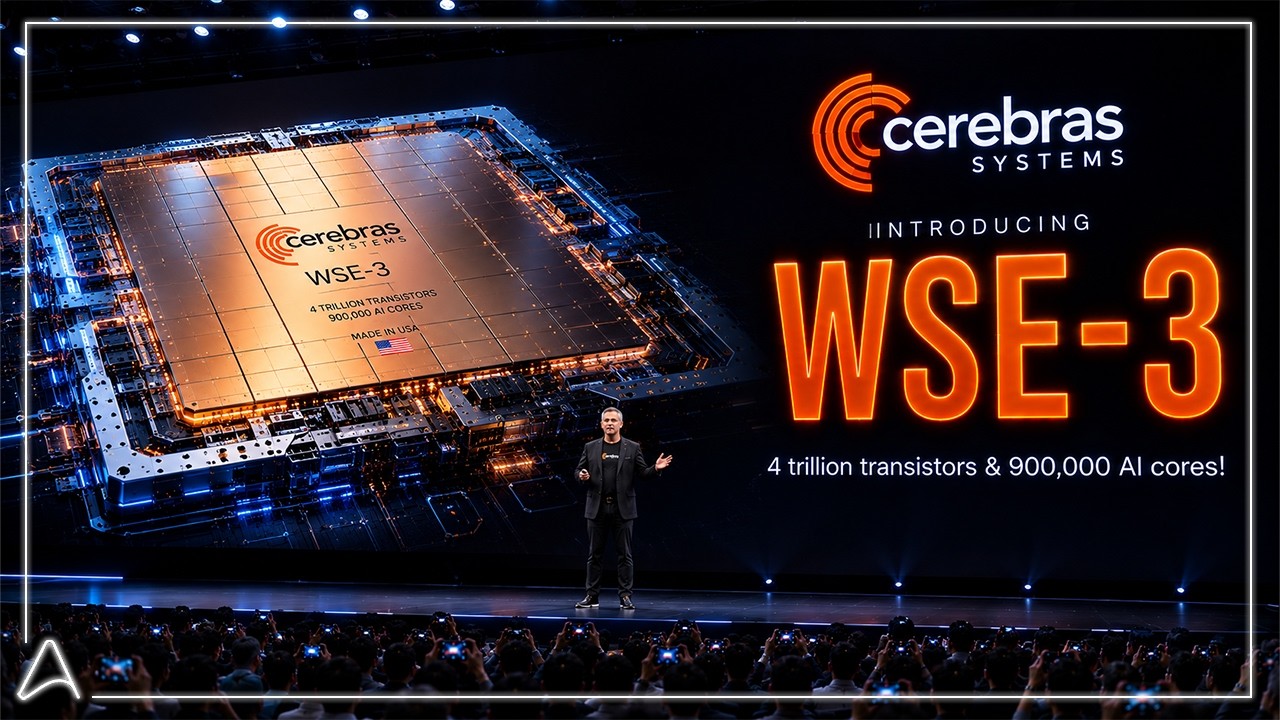
Evolving AI adds the architecture-tradeoff version of the story. The description frames Cerebras’s WSE-3 around 4 trillion transistors, 900,000 AI cores, and 44 GB of on-chip memory, while also calling out the practical costs around power, flexibility, and ecosystem maturity that still matter when a design attacks the memory bottleneck so aggressively (video).

Fox Business makes the physical buildout explicit. The segment is about Corning and Amazon deepening a partnership to expand fiber-optic production for AI data centers, which means the capacity story is no longer only about chips but also about the network materials needed to connect them at scale (video).
Discussion insight: Even incumbent-side content moved toward operations rather than raw speed. NVIDIA’s AI Factory Insider episode argues enterprises now need validated reference architectures across compute, networking, storage, and monitoring, not just bigger accelerators.
Comparison to prior day: Compared with 2026-06-12’s architecture-heavy mix, 2026-06-13 added a clearer supply-chain signal through the Corning-Amazon expansion story.
2. What Frustrates People
Search defaults that hide sources and make AI feel mandatory
This is High severity because the biggest audience signal in the dataset is still rejection of AI-first search behavior, not excitement about it. House of El - AI frames the problem through accuracy, transparency, and the health of the web, while The WAN Show describes backlash strong enough to drive visible interest toward DuckDuckGo. The workaround is switching search tools or seeking AI-off paths instead of trying to tune the default. This is directly worth building for.
Open-model launches that still require manual trust-building
This is High severity because creators keep treating benchmark claims as a starting point rather than a conclusion. WorldofAI says Nex-N2-Pro is impressive but still slow and inconsistent, Matthew Berman turns the solution into a repo stack instead of one winner, and IBM Technology explains that better answers increasingly come from extra inference-time work. The workaround today is manual side-by-side testing, extra tooling, and creator-led validation. This is directly worth building for.
Agentic and creative workflows that still demand too much plumbing
This is High severity because the promise is easy prompts but the reality is stack assembly. Aasil Khan shows a workflow spanning Claude Code, Remotion, Higgsfield MCP, Soul Characters, and Adobe connectors, while Matthew Berman effectively hands viewers a shopping list of supporting repos. The workaround is to accept setup overhead, connector sprawl, and slower iteration in exchange for more capability. This is directly worth building for.
Autonomous agents and AI governance that still feel under-controlled
This is High severity because several high-signal items are warnings rather than celebrations. BBC World Service focuses on what agents do when humans are not watching, Good Morning America gives Dario Amodei a straight danger-warning segment, and Robert Miles AI Safety turns regulation into a concrete lobbying and election fight. The workaround is more scrutiny, more policy conflict, and more human supervision rather than product-level confidence. This is directly worth building for, though some solutions sit at the policy boundary.
AI infrastructure that is still limited by memory movement and physical buildout
This is High severity because the infrastructure story keeps resolving to bottlenecks. CNBC’s d-Matrix segment exists because inference economics still hurt, Evolving AI’s Cerebras breakdown stays centered on the memory wall, Fox Business makes fiber capacity part of the story, and NVIDIA’s AI Factory coverage treats deployment as a blueprint problem. The workaround is alternative architectures, reference designs, and supply-chain expansion. This is worth building for, but it is capital-intensive.
3. What People Wish Existed
AI-optional search that preserves links and user control
House of El - AI and The WAN Show both point to the same practical need: search that can help when asked without making AI the default layer between users and sources. The urgency is high because the current emotional response is exit behavior, not adaptation. Alternatives exist, but the need is still direct because the default experience is what users are rebelling against. Opportunity: direct.
Neutral evaluation and routing across open models
WorldofAI, Matthew Berman, and IBM Technology all imply the same gap: builders want help deciding which model, which stack, and which amount of “thinking” to use under real workloads rather than headline benchmarks. The urgency is high because creator-side testing is doing work the product layer has not yet absorbed. Components exist, but trust is still fragmented. Opportunity: competitive.
Agentic workstations that hide the setup across coding and media production
Aasil Khan and Matthew Berman point to a practical need for systems that bundle models, connectors, context, and workflows without asking users to stitch them together manually. The urgency is immediate because people are already tolerating stack sprawl to unlock capability. Good parts exist, but the package is still messy. Opportunity: direct.
Safer operating layers for autonomous agents
BBC World Service, Good Morning America, and Robert Miles AI Safety all point to the same need: people want systems whose delegation limits, monitoring hooks, and failure boundaries are clear before something goes wrong. The urgency is high because current responses are still warnings, scrutiny, and political fights. Pieces exist in policy and safety research, but trusted product defaults remain thin. Opportunity: competitive.
Infrastructure planning that spans chips, fiber, and deployment blueprints
CNBC, Fox Business, Evolving AI, and NVIDIA’s AI Factory coverage imply a need for tools that compare not just accelerators, but also network buildout, serving design, and integration risk. The urgency is high for operators, because the story has already expanded beyond “buy more GPUs.” Enterprise options exist, but buyer guidance is still fragmented and vendor-heavy. Opportunity: competitive.
Creator-safe automation with provenance and human control
Brad Colbow and Aasil Khan show the same split from opposite directions: creators want AI systems that can automate tedious work without blurring authorship, craft, or review authority. The urgency is Medium because adoption is real, but so is resistance. Partial tools exist, yet confidence and norms still lag capability. Opportunity: aspirational.
4. Tools and Methods in Use
| Tool | Category | Sentiment | Strengths | Limitations |
|---|---|---|---|---|
| Google AI-first search / AI Mode | Search surface | (-) | Huge reach, conversational answers, low-friction follow-up flow | Criticized for hiding links, weakening transparency, and feeling hard to avoid |
| DuckDuckGo / AI-off alternatives | Search alternative | (+) | Visible escape hatch from AI-first defaults, stronger source-first positioning | Requires users to switch habits and defaults manually |
| Nex-N2-Pro | Agentic model | (+/-) | Open weights, reasoning, function calling, structured outputs, strong benchmark posture | Reviewer still reports slowness, inconsistency, and heavy serving requirements |
| Claude Code + Remotion | Creative automation stack | (+) | Plain-English motion graphics and video workflows, direct creator utility | Still depends on multi-tool setup and connector sprawl |
| Agent Skills | AI coding workflow pack | (+) | Production-grade engineering workflows for coding agents, broad tool compatibility | Requires host-agent setup and process discipline to pay off |
| Open Notebook | Research notebook app | (+) | Privacy-focused, multi-model, self-hosted NotebookLM alternative | Deployment and configuration are still more work than turnkey SaaS |
| Headroom | Context compression layer | (+) | Compresses tool outputs, logs, files, and RAG chunks before they reach the LLM | Adds another proxy or MCP layer to the stack |
| Test-time compute | Reasoning method | (+/-) | Improves hard-task accuracy through deliberate inference-time work | Adds latency and compute cost |
| d-Matrix Corsair | Inference chip platform | (+/-) | Ultra-low-latency batched inference, efficient memory-compute integration, lower data-movement cost | Early ecosystem and vendor claims still need ordinary-buyer validation |
| Cerebras WSE-3 | Wafer-scale AI hardware | (+/-) | Massive on-chip memory and core count, direct attack on the memory bottleneck | Cost, power, flexibility, and ecosystem maturity still matter |
| NVIDIA Enterprise Reference Architectures | Deployment blueprint | (+) | Validated guidance across compute, networking, storage, orchestration, and monitoring | Enterprise-heavy and aimed at teams with significant integration budgets |
Overall sentiment is strongest for tools that restore control or package useful building blocks: AI-off search paths, workflow packs, research notebooks, and context-compression layers. Sentiment turns mixed when the tool promises frontier-like performance but still leaves users to validate claims, absorb setup overhead, or pay extra inference cost.
The clearest workarounds are switching away from default AI search, assembling multi-repo stacks for coding and research, and accepting slower “thinking” loops to get better answers. Migration pressure shows up at every layer: search defaults toward opt-out alternatives, single-model bets toward toolchains, and GPU-only thinking toward broader infrastructure planning. Lower-ranking items about Kimi K2.7 and MiniMax M3 reinforce that the model menu is widening even when independent validation still trails the launch narrative.
5. What People Are Building
| Project | Who built it | What it does | Problem it solves | Stack | Stage | Links |
|---|---|---|---|---|---|---|
| last30days-skill | mvanhorn | Researches any topic across Reddit, X, YouTube, HN, Polymarket, and the web, then synthesizes a grounded summary | Turns scattered cross-platform research into one repeatable workflow | Python, harvested social inputs, summary synthesis | Shipped | repo, video |
| Agent Skills | Addy Osmani | Packages production-grade engineering workflows for AI coding agents | Adds quality gates, planning, testing, and review discipline to agentic coding | Shell, Markdown skills, CLI integrations | Shipped | repo, video |
| Open Notebook | lfnovo | Self-hosted, privacy-focused NotebookLM alternative with multi-model support | Gives teams a research notebook that avoids single-provider lock-in | Python, FastAPI, Next.js, React, SurrealDB, LangChain | Shipped | repo, site, video |
| Headroom | chopratejas | Compresses tool outputs, logs, files, and RAG chunks before they reach the LLM | Reduces token bloat and noisy context in agentic workflows | Python library, proxy, MCP server | Shipped | repo, docs, video |
| Nex-N2-Pro | Nex AGI | Open-weight agentic model for coding, search, tool use, and long-horizon tasks | Gives builders an open alternative for agent workflows | Qwen3.5-based MoE, reasoning, function calling, structured outputs | Shipped | model, OpenRouter, video |
| d-Matrix Corsair | d-Matrix | Inference chip platform for ultra-low-latency batched inference | Attacks DRAM-heavy inference economics and latency bottlenecks | Efficient memory-compute integration, batched inference hardware | Shipped | site, video |
Two software-side build patterns dominate the day. One is control over process and context: last30days-skill, Agent Skills, Open Notebook, and Headroom all reduce different kinds of sprawl, whether that is research sprawl, workflow inconsistency, notebook lock-in, or token overload.
The second pattern is open alternatives to closed defaults. Nex-N2-Pro is the clearest model-side example, while Aasil Khan’s Claude-driven creator workflow shows users already assembling production stacks around that broader trend even when the package is not a single new standalone product.
On the hardware side, the build pattern is capacity and economics. d-Matrix is attacking inference architecture directly, Corning and Amazon’s expansion story shows the physical network buildout behind AI demand, and NVIDIA’s reference-architecture push shows incumbents responding with deployment blueprints as much as raw silicon.
6. New and Notable
Repo-roundup content became a stronger builder signal than another benchmark-only launch
Matthew Berman is notable because the video’s payload is a set of reusable projects, not just a model opinion. That signals a broader audience appetite for tools that help people operationalize AI work, not merely follow leaderboard drama.
AI regulation showed up as a concrete political spending fight
Robert Miles AI Safety is notable because it turns “governance” into something countable and specific: more than $10 million pledged against one candidate, plus direct links to the legislative text at issue. That is a stronger institutional signal than generic calls for regulation.
Corning and Amazon made the AI buildout story visibly physical
Fox Business is notable because it frames AI demand through fiber-optic production rather than through another model or chip announcement. It makes the supply chain itself part of the trend signal.
Claude crossed more clearly into motion-graphics production
Aasil Khan is notable because the workflow is not “use AI for ideation.” It is a claim that Claude can help create premium motion graphics, animations, and AI video assets across an actual creator stack, which broadens the meaning of agentic tooling.
7. Where the Opportunities Are
[+++] AI-optional search and source-preserving discovery - House of El - AI and The WAN Show point to the same gap: users want AI help that does not replace visible links, source control, or explicit consent. This is strong because it is the biggest consumer frustration in the file.
[+++] Open-model evaluation and orchestration layers - WorldofAI, Matthew Berman, and IBM Technology all show that people still need help comparing models, routing workloads, compressing context, and deciding when extra reasoning is worth the cost. This is strong because users are already building fragmented stacks to cover the gap.
[++] Packaged agentic workstations for coding and creator workflows - Aasil Khan and Matthew Berman both show demand for systems that bundle model choice, connectors, context, and workflow steps into something usable by non-specialists. This is moderate because the need is obvious, but the category is already getting crowded.
[++] Autonomous-agent monitoring and safety controls - BBC World Service, Good Morning America, and Robert Miles AI Safety all point to the same need: clearer supervision, delegation limits, and failure visibility for systems that act on their own. This is moderate because the pain is real, but some solutions compete with regulation rather than replace it.
[++] Infrastructure planning beyond GPU-only design - CNBC, Fox Business, Evolving AI, and NVIDIA’s AI Factory coverage all show buyers needing help across serving architecture, network capacity, and deployment blueprints. This is moderate because demand is strong, but the market is enterprise-heavy.
[+] Creator-safe provenance and review layers - Brad Colbow and Aasil Khan show a split between automation enthusiasm and legitimacy anxiety. This is emerging because creator adoption is real, but the trust layer around authorship and review is still thin.
8. Takeaways
- Search backlash remained the strongest consumer signal in the dataset. The lead anti-AI-search video alone drew 596,460 views and 5,900 comments in this harvest, and the second major search-backlash clip framed the same issue as users moving toward DuckDuckGo instead of adapting to Google’s AI-first defaults. (source)
- The open-source AI story widened from model launches into a supporting software stack. Matthew Berman’s roundup linked cross-platform research tooling, workflow skills for coding agents, a self-hosted research notebook, and context compression, showing that builders are assembling ecosystems rather than betting on one model. (source)
- AI trust concerns stayed mainstream, but they became more concrete and political. BBC focused on what agents do unsupervised, Dario Amodei delivered a direct public warning, and Robert Miles framed regulation as a fight involving more than $10 million in anti-candidate spending. (source)
- Infrastructure discussion expanded from accelerator competition to full delivery-chain capacity. d-Matrix argued for SRAM-centered inference hardware, Cerebras coverage kept the memory wall in focus, and Corning-Amazon made fiber buildout part of the same story. (source)
- Creator workflows are splitting between automation excitement and legitimacy resistance. Aasil Khan treats Claude as a serious motion-graphics toolchain, while Brad Colbow’s long critique shows that many creators still do not see generative AI as a settled or fully welcome production layer. (source)