YouTube AI - 2026-06-16
1. What People Are Talking About
1.1 Builder-side AI displaced yesterday's consumer-search backlash as the leading story 🡕
Four videos supported this theme, and all four sat near the top of the ranking. The strongest signal in the file was not consumer frustration this time; it was builders trying to turn open models, local runtimes, workflow packs, and benchmarking links into repeatable working systems. That matters because the conversation moved further away from one-model hype and further toward the surrounding layers that make AI usable: installation, context handling, evaluation, and workflow discipline.

AI Search treats Ideogram 4 as a local workflow rather than a standalone model story. The video's description walks through installing ComfyUI Manager, adding ComfyUI-KJNodes, downloading Ideogram 4, and loading a workflow file, so the value proposition is strong text rendering and prompt adherence paired with obvious setup burden. With 108,852 views and 780 comments in this harvest, it was one of the clearest high-engagement proofs that creators will tolerate complexity for local control (video).

Matthew Berman makes the workflow-layer story explicit. The linked repos - last30days-skill, Agent Skills, Open Notebook, and Headroom - cover multi-source research, production-grade coding-agent workflows, private notebooking, and context compression, which means the buildout is happening around AI work rather than only inside foundation models. It was also the biggest day-over-day gainer among recurring videos, rising from 94,705 to 108,472 views (video).
Better Stack adds the model-architecture layer. Google's Gemma 4 12B announcement says the model is designed for laptops with 16 GB of VRAM or unified memory, adds native audio input, and keeps an Apache 2.0 license, while DiffusionGemma argues for parallel drafting that uses local hardware more fully. The important point is not just that another open model exists; it is that local multimodal use is being packaged as something practical enough to explain to developers in workstation terms (video).

AI Search rounds out the theme with a benchmark-and-tooling feed instead of a single product pitch. Its description links SCAIL-2, DiffusionGemma, Agents' Last Exam, Kimi Code, and several multimodal research project pages, which makes the video read like a dependency map for builders tracking what to test next rather than what to simply watch (video).
Discussion insight: The strongest builder stories now cluster around glue: workflow packs, context handling, benchmarking, local setup, and evaluation. Even the upbeat videos keep exposing how much assembly still sits between a model release and a usable working stack.
Comparison to prior day: Compared with 2026-06-15, the anti-AI-search videos that dominated the previous file fell out entirely, and the builder/tooling cluster moved into the top positions instead.
1.2 AI safety shifted from operations discipline toward post-AGI governance and regulation 🡕
Three videos supported this theme. The dominant safety framing was no longer mainly about how to ship agents reliably; it was about whether society can govern more capable systems, whether control is even feasible, and what happens if capabilities outrun existing institutions. That matters because the file moved the safety conversation from engineering failure modes toward policy, timelines, and public legitimacy.

AI Revolution turns a DeepMind paper into a roadmap argument. The linked DeepMind abstract says the report examines four pathways from AGI to ASI - scaling AGI, paradigm shifts, recursive improvement, and large multi-agent collectives - and warns that AI progress could continue as a series of accelerating transformations rather than a single step change. That lifts the theme from generic doom talk into a structured question about how capabilities compound after human-level systems appear (video).

Robert Miles AI Safety grounds the governance fight in live politics. The description links the original RAISE Act, later modifications, and a campaign site while arguing that more than $10 million in industry money is being spent to block a candidate associated with AI safety policy. The video makes regulation look less like a seminar topic and more like an active power contest (video).

Neural Nutshell pushes the hardest impossibility framing. The description says Roman Yampolskiy argues that controlling superintelligence is mathematically impossible, points to OpenAI's Superalignment initiative as something that was abandoned, and cites long-running safety research institutions as supporting context. Whether or not viewers agree, the significance is that severe safety claims are now high-engagement mid-table content rather than niche discussion (video).
Discussion insight: The cluster ranged from structured DeepMind pathway analysis to live state politics and explicit impossibility arguments. The safety conversation shifted up a layer from runtime failures to governance and control itself.
Comparison to prior day: Compared with 2026-06-15's stronger focus on agent reliability and durable execution, 2026-06-16 leaned more heavily toward governance, post-AGI pathways, and public-policy conflict.
1.3 The hardware race widened from one NVIDIA challenger into a broader alternative-chip cluster 🡕
Four videos supported this theme. The hardware story was not a single anti-NVIDIA headline; it was a cluster of competing architectures, each presented as a more efficient route to inference or training. That matters because the file keeps framing AI infrastructure as an economics and systems-design contest rather than a simple model-quality contest.

CNBC provides the clearest commercial signal. The segment says d-Matrix's Corsair chip is in volume production with commitments from hyperscalers, neoclouds, and frontier AI labs, while the d-Matrix homepage positions the company around ultra-low-latency batched inference and efficient memory-compute integration. The value proposition is explicitly about inference economics: faster output, less energy, and less dependence on external DRAM (video).
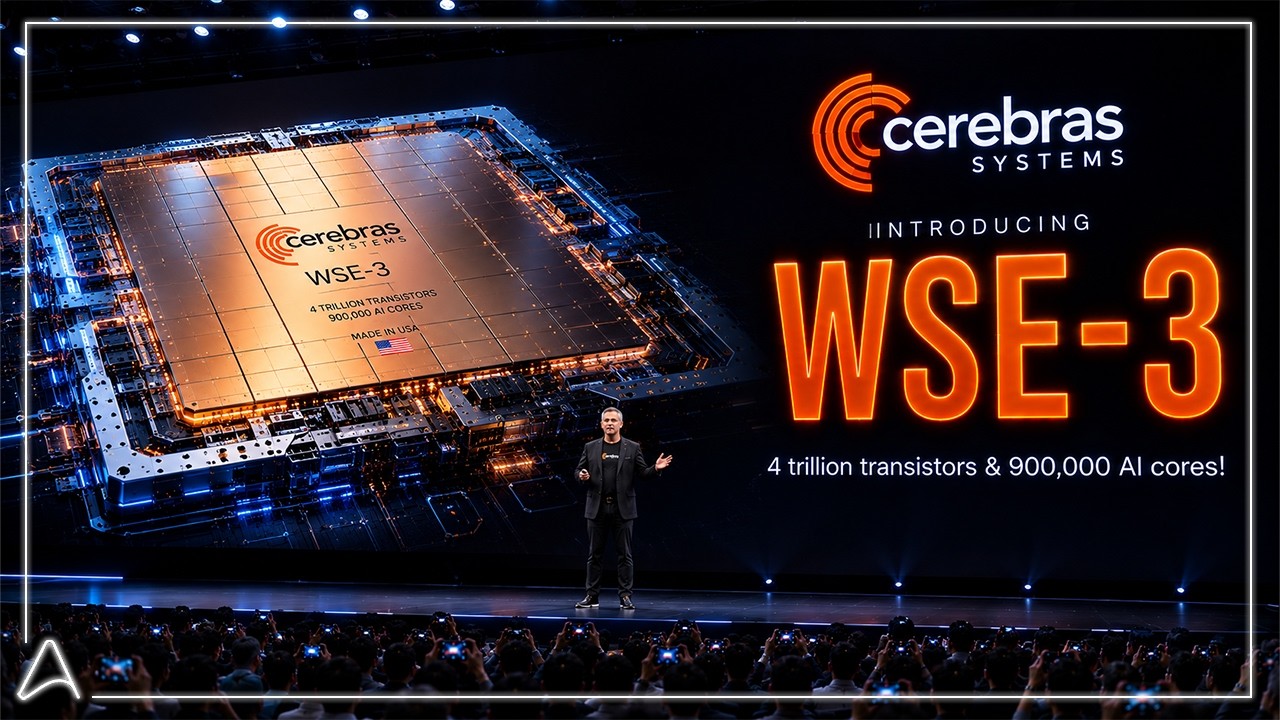
Evolving AI shows the architectural version of the same competition. Its Cerebras video centers wafer-scale design, massive on-chip memory, and an attempt to avoid the usual small-chip packaging model, which makes the story about a radically different way to build AI compute rather than a marginal performance tweak (video).

Evolving AI also adds a second challenger lane through Tenstorrent. The description frames Jim Keller's hardware around decoding, prefilling, RISC-V, and CUDA-alternative positioning, which makes openness and software-stack differentiation part of the pitch instead of only raw chip specs (video).

Tech With Tim supplies the operations-side counterpart. Temporal's Replay 2026 calls itself "the durable execution conference for AI," and Tim's framing is that everyone is building agents but few are shipping them reliably. That keeps infrastructure from collapsing into a chip-only story: runtime reliability and orchestration still show up as part of the same systems conversation (video).
Discussion insight: The infrastructure cluster is broadening in two directions at once: alternative silicon claims on one side and workflow/runtime discipline on the other. The common denominator is not novelty; it is efficiency, repeatability, and operating cost.
Comparison to prior day: Compared with 2026-06-15, which centered d-Matrix and AI-factory blueprints, 2026-06-16 added stronger Cerebras and Tenstorrent challenger narratives while keeping the reliability angle.
1.4 Healthcare and humanoids stayed the clearest commercialization lanes 🡒
Three videos supported this theme. AI looked most product-like in this file when attached to medical workflows, investor theses, or specific labor roles for physical robots. That matters because these are still the areas where the discussion moves quickest from "capability" to "who buys this and where does it fit."

CNBC Television keeps the strongest executive framing alive. Mustafa Suleyman and Mayo Clinic CEO Gianrico Farrugia present healthcare as AI's most important application at Microsoft Build, which makes the category sound like an institution-level priority rather than a generic productivity add-on (video).

Forbes adds the capital-allocation lens. The description says investors are making concentrated bets on startups with deep domain expertise and clear AI leverage across healthcare, biotech, and life sciences, so the opportunity is framed as specialized and operational rather than broad consumer experimentation (video).

IntelliCore gives the clearest embodied-AI example. The video description highlights care-oriented robots like Fourier GR-3 alongside factory workers and athletic robots, so the important signal is not just that humanoids exist, but that they are being narrated as products for elder care and industrial work (video).
Discussion insight: Unlike the open-source builder cluster, these items are framed through adoption readiness: executive sponsorship, investor conviction, and defined care or labor roles.
Comparison to prior day: Compared with 2026-06-15, the commercialization story stayed steady: healthcare remained executive- and investor-led, and humanoids stayed strongest when attached to specific jobs instead of general spectacle.
1.5 AI coding talk got more pragmatic about process and adoption 🡕
Three lower-volume but distinct videos supported this theme. The coding conversation did not revolve around whether agents can autocomplete code; it revolved around how people should supervise them, where they should run, and whether faster coding is translating into software anybody uses. That matters because the builder excitement elsewhere in the file now meets a harder product question: can the output ship, and does it matter after shipping?

IBM Technology gives the cleanest enterprise-friendly framing. The description positions AI pair programming as a teammate for debugging, code review, and workflow productivity, and IBM's own pair programming explainer still emphasizes driver-navigator role clarity, constant communication, and collaborative review. The signal is that AI coding is being normalized as a process question, not just a model feature (video).

Burke Holland makes the discipline explicit. His chapter list argues for VS Code, remote agent execution, prototyping, "plan + grill me," rubber-ducking, sub-agents, the built-in browser, and multi-model review loops, which turns the video into a playbook for managing agent behavior rather than trusting raw outputs (video).
Pivot to AI supplies the skeptical counterweight. Its linked article quotes an NBER working paper as finding that app supply rose in the "agentic-coding era" without any increase in aggregate usage across four marketplaces, and argues that more generated code is not the same thing as more software people want (video, article).
Discussion insight: The process advice and the skepticism point in the same direction. AI coding now looks mature enough that the harder questions are review discipline, deployment safety, discovery, and actual user demand.
Comparison to prior day: This was a clearer theme than it was on 2026-06-15, when coding-adjacent content sat more inside the broader open-source builder stack.
2. What Frustrates People
Local AI workflows that still require too much assembly and evaluation
This is High severity because the highest-signal builder videos still resolve to setup work. AI Search's Ideogram 4 tutorial depends on ComfyUI Manager, custom nodes, workflow files, and model downloads, Better Stack sells Gemma 4 12B as laptop-ready through architecture and hardware-fit explanation rather than turnkey UX, and AI Search's news roundup adds a long list of benchmarks, research projects, and agent tools that builders still have to sort through themselves. The workaround is more repo curation, more glue code, and more manual validation. This is directly worth building for.
AI coding that can produce more code without proving user demand
This is High severity because the coding cluster now contains both process anxiety and adoption skepticism. IBM Technology and Burke Holland both frame success as review discipline, role clarity, and controlled execution rather than raw generation speed, while Pivot to AI highlights NBER evidence that more new apps have not translated into more aggregate usage. The workaround is extra review loops, remote sandboxes, prototyping, and accepting that shipping is a separate problem from writing code. This is directly worth building for.
Governance and control gaps as capability claims accelerate
This is High severity because AI Revolution, Robert Miles AI Safety, and Neural Nutshell all point to versions of the same problem: capabilities are advancing faster than convincing governance or control stories. The file combines DeepMind's four AGI-to-ASI pathways, a live fight over the RAISE Act, and a direct claim that superintelligence control may be mathematically impossible. The workaround today is more policy debate, more public warning, and more informal caution rather than durable governing mechanisms. This is directly worth building for.
Inference infrastructure that is still constrained by cost, memory movement, and integration
This is High severity because the hardware cluster exists precisely because current infrastructure remains unsatisfying. CNBC's d-Matrix segment is about DRAM avoidance, energy use, and batched inference economics, while Evolving AI's Cerebras video and its Tenstorrent video present alternative architectures as necessary departures from the incumbent path. The workaround is either switching architectures or accepting more stack complexity. This is worth building for, but it is capital-intensive.
Commercial AI that still needs narrow domain proof
This is Medium-High severity because the most convincing commercialization stories are still unusually narrow. CNBC Television frames healthcare through top-level institutional sponsorship, Forbes frames it through concentrated domain-specific investment, and IntelliCore frames humanoids through elder care and industrial work rather than open-ended consumer use. The workaround is narrow deployment with strong sponsors instead of broad rollout. This is worth building for, but domain expertise is mandatory.
3. What People Wish Existed
Packaged local AI builder stacks that hide setup, routing, and dependency sprawl
AI Search, Matthew Berman, Better Stack, and AI Search's roundup all imply the same practical need: one package that bundles local models, workflow installs, evaluation, and context handling instead of forcing users to assemble each layer by hand. The urgency is high because people are already tolerating setup pain to get the capability. Components exist, but the package is still messy. Opportunity: direct.
AI coding systems that help teams ship useful software, not just generate more code
IBM Technology, Burke Holland, and Pivot to AI point to a combined practical need for review discipline, safe execution environments, product validation, and adoption feedback after code generation. The urgency is high because current best practice still sounds like a checklist for avoiding failure rather than a smooth default workflow. Partial solutions exist, but user-demand validation remains thin. Opportunity: direct.
Governance, evaluation, and control layers for advanced and agentic AI
AI Revolution, Robert Miles AI Safety, Neural Nutshell, and AI Search's roundup all point to demand for better evaluation, clearer boundaries, and more legible controls as models and agents grow more capable. The urgency is high because the current substitutes are policy fights, benchmark pages, and warning videos. Pieces exist, but the trust stack is fragmented. Opportunity: competitive.
Infrastructure comparison and deployment-planning tools across alternative AI chips
CNBC, Evolving AI's Cerebras video, its Tenstorrent video, and Tech With Tim imply a need for products that compare throughput, energy cost, runtime reliability, and software fit across increasingly diverse infrastructure options. The urgency is medium-high because the hardware field is widening fast, but adoption is still enterprise-weighted. Vendor materials exist, yet independent planning help is thin. Opportunity: competitive.
Domain-specific operating systems for healthcare AI and role-based robotics
CNBC Television, Forbes, and IntelliCore imply a need for software that handles evidence, deployment readiness, oversight, and workflow integration for care and industrial contexts. The urgency is medium because serious buyers are visible, but the conversation is still sponsor- and investor-led rather than bottom-up. Opportunity: emerging.
4. Tools and Methods in Use
| Tool | Category | Sentiment | Strengths | Limitations |
|---|---|---|---|---|
| Ideogram 4 | Local image model | (+/-) | Strong text rendering, prompt adherence, and local creative control | Requires workflow files, manager install, custom nodes, and model placement |
| ComfyUI Manager | Workflow installer | (+) | Makes local workflow assembly possible inside ComfyUI | Adds another setup layer users must learn and maintain |
| ComfyUI-KJNodes | Custom node pack | (+) | Extends ComfyUI with utility and QoL nodes used in creator workflows | Adds dependencies and compatibility surface area |
| Gemma 4 12B | Local multimodal model | (+) | Native audio input, laptop-ready memory target, Apache 2.0 license, strong reasoning positioning | Still framed through architecture and hardware-fit tradeoffs rather than turnkey use |
| DiffusionGemma | Local inference method | (+/-) | Parallel drafting is designed to use single-user local hardware more efficiently | Specialized performance story rather than a general replacement for standard generation |
| Agents' Last Exam | Agent benchmark | (+) | Measures long-horizon, economically valuable tasks with verifiable outcomes | Still a benchmark program, not a direct workflow product |
| d-Matrix Corsair | Inference chip platform | (+/-) | Ultra-low-latency batched inference and efficient memory-compute integration | Claims still need buyer validation and ecosystem support |
| Temporal durable execution | Agent runtime/orchestration | (+/-) | Strong framing around reliable AI execution and workflow durability | The surrounding narrative still says shipping reliable agents is hard |
| AI pair programming | Development method | (+/-) | Improves review, collaboration, debugging, and shared understanding | Depends on strong communication and can slow raw output |
| Sub-agent and multi-model review loops | AI coding method | (+) | Adds planning, critique, browser use, and model diversity to coding workflows | More process overhead and still no guarantee the shipped app finds users |
Overall satisfaction is split. Enthusiasm is strongest for local and open stacks plus disciplined coding workflows, but almost every positive tool comes bundled with setup burden, evaluation overhead, or harder shipping questions. The common workaround is to add more glue - node packs, workflow managers, benchmarks, review loops, and runtime layers - rather than rely on one product to solve everything. The clearest migration pattern is from single-model excitement toward assembled workflow stacks, and the clearest competitive dynamic is that chips now compete on inference economics while coding tools compete on supervision and review quality.
5. What People Are Building
| Project | Who built it | What it does | Problem it solves | Stack | Stage | Links |
|---|---|---|---|---|---|---|
| last30days-skill | mvanhorn | Researches topics across Reddit, X, YouTube, Hacker News, Polymarket, GitHub, and the web, then synthesizes a grounded summary | Reduces fragmented multi-source research work for AI-assisted analysis | Python; multi-source research workflow | Shipped | repo |
| Agent Skills | addyosmani | Packages production-grade engineering workflows for AI coding agents across define, plan, build, verify, review, and ship | Turns ad hoc coding-agent behavior into repeatable engineering process | Shell workflow pack | Shipped | repo |
| Open Notebook | lfnovo | Provides a private, multi-model, self-hosted NotebookLM-style research notebook | Gives users a flexible research workspace without depending on one hosted provider | TypeScript; self-hosted notebook app | Shipped | repo, site |
| Headroom | chopratejas | Compresses tool outputs, logs, files, and RAG chunks before they reach the LLM | Cuts token bloat in agent and retrieval workflows while preserving useful context | Python; library, proxy, and MCP server | Shipped | repo, docs |
| ComfyUI-KJNodes | kijai | Adds custom utility and quality-of-life nodes for ComfyUI creator workflows | Fills gaps in local image-generation pipelines that core ComfyUI does not solve alone | Python; ComfyUI extension | Shipped | repo |
| Agents' Last Exam | Berkeley RDI and 300+ experts | Builds a benchmark for long-horizon, economically valuable agent tasks with verifiable outcomes | Gives builders a public way to compare agents on real work rather than only short tasks | Benchmark dataset and scoring framework | Beta | site |
The strongest build pattern is still infrastructural software around AI work, not breakout consumer apps. Research aggregation, workflow discipline, context compression, privacy-preserving notebooks, node packs, and benchmark programs all solve the coordination and setup problems that the rest of the file keeps surfacing.
Agent Skills, Headroom, and last30days-skill fit together especially well as a pattern: builders are packaging process, context, and research flow around AI systems so the systems become more usable and less wasteful. That matches Burke Holland's process-heavy coding advice and strengthens the report's broader conclusion that workflow quality now matters more than raw model novelty.
Agents' Last Exam is notable because it attacks a different but related bottleneck: evaluation. At the same time, ComfyUI-KJNodes shows the creator-side version of the same story, where missing workflow pieces get filled by extensions rather than by a fully integrated product. The absence of a breakout end-user app in this project cluster also makes Pivot to AI's adoption critique more salient.
6. New and Notable
DeepMind's AGI-to-ASI framing made post-AGI planning feel more concrete
AI Revolution mattered because it connected a mainstream YouTube explainer to a source document that explicitly maps four pathways from AGI to ASI and warns that AI progress may arrive as a series of transformations rather than one isolated leap. That is a more operational framing than vague "superintelligence is coming" rhetoric, and it helps explain why governance content ranked so visibly in this file.
AI coding became a shipping-and-adoption argument, not just a productivity argument
IBM Technology and Burke Holland both frame AI coding around review discipline, collaboration, and safe execution, while Pivot to AI highlights evidence that more app creation has not yielded more aggregate usage. That combination stands out because it shifts the conversation from "Can AI write code?" to "Can teams ship something people actually use?"
The challenger-hardware field widened beyond one anti-NVIDIA headline
CNBC says d-Matrix's Corsair is in volume production, while Evolving AI's Cerebras video and its Tenstorrent video push entirely different technical routes to competing on AI compute. That stands out because the file no longer looks like one company-versus-NVIDIA story; it looks like a widening field of alternative architectures.
7. Where the Opportunities Are
[+++] Packaged local AI builder stacks - AI Search, Matthew Berman, Better Stack, and AI Search's roundup all show real appetite for local and open workflows, but they also show how much setup, evaluation, and workflow glue still sits between interest and usability. This is the clearest direct build opportunity in the file.
[+++] AI coding QA, review, and distribution layers - IBM Technology, Burke Holland, and Pivot to AI point to the same gap from different angles: teams need tools that make AI-generated code safer to review, easier to validate, and more likely to become software that users actually adopt. The demand is unusually clear because the current best advice still sounds defensive.
[++] Governance, evaluation, and control systems for advanced AI - AI Revolution, Robert Miles AI Safety, Neural Nutshell, and Agents' Last Exam all point to a need for clearer boundaries, stronger evaluation, and more legible control stories. The opportunity is moderate rather than direct because some of the demand sits at the policy and institutional layer.
[++] Infrastructure planning across alternative AI chips and runtimes - CNBC, Evolving AI's Cerebras video, its Tenstorrent video, and Tech With Tim suggest a real need for tools that compare throughput, efficiency, software fit, and runtime reliability across a widening infrastructure field. The need is real, but it is more enterprise-weighted than creator-led.
[+] Healthcare and humanoid deployment software - CNBC Television, Forbes, and IntelliCore suggest emerging demand for domain-specific deployment, oversight, and workflow software in care and industrial settings. The signal is still earlier than the builder-stack or coding-workflow opportunities, but the buyer logic is visible.
8. Takeaways
- Builder-side workflow assembly replaced consumer backlash as the center of the file. The strongest attention cluster shifted to local workflows, repo packs, benchmarking links, and coding-process infrastructure after the previous day's search-backlash anchors dropped out. (source)
- AI safety moved up from runtime reliability to governance and post-AGI planning. DeepMind-pathway commentary, the RAISE Act fight, and Yampolskiy's impossibility framing all landed visible engagement, which changed the tenor of the risk discussion. (source)
- The hardware race is widening into multiple rival architectures plus runtime discipline. d-Matrix, Cerebras, Tenstorrent, and Temporal-adjacent infrastructure content all framed efficiency and reliable execution as the battleground, not just brand rivalry. (source)
- Healthcare and humanoids remain the clearest places where AI is narrated as a buyable product. The file keeps attaching adoption to healthcare institutions, biotech investors, elder care, and industrial roles rather than open-ended consumer novelty. (source)
- AI coding is being judged on review quality and user adoption, not just generation speed. IBM and Burke focus on collaboration and control, while Pivot to AI highlights evidence that more new apps have not produced more aggregate usage. (source)