YouTube AI - 2026-06-18
1. What People Are Talking About
1.1 Open-weight AI stopped being just a benchmark story and became a distribution story for coding workflows 🡕
Five videos in the final evidence set supported this theme, and the top-ranked item in the file belonged to it. The conversation shifted from asking whether open-weight models are credible to asking how to plug them into coding work right now. That matters because the winning pitch is no longer openness by itself; it is free or local access, supported toolchains, and a believable migration path away from closed models.
AI Search treats GLM 5.2 as a usable coding stack, not just a benchmark headline. The description links Z Code, chat.z.ai, and the official GLM Coding Plan quick start, where Z.AI says the plan uses a dedicated coding API and works only inside supported tools such as Claude Code, Cursor, Roo Code, and Cline. With 293,355 views, it was the clearest sign that open-weight attention is now being converted into concrete setup behavior (video).

AI Revolution widens the field beyond one vendor. Its GLM-versus-Kimi framing matches the official Kimi K2.7 Code docs, which position the model around long-horizon coding, a 256K context window, and a HighSpeed mode around 180 tokens per second. The important signal is that creators are now comparing open models through coding-task fit and throughput, not just ideological openness (video).
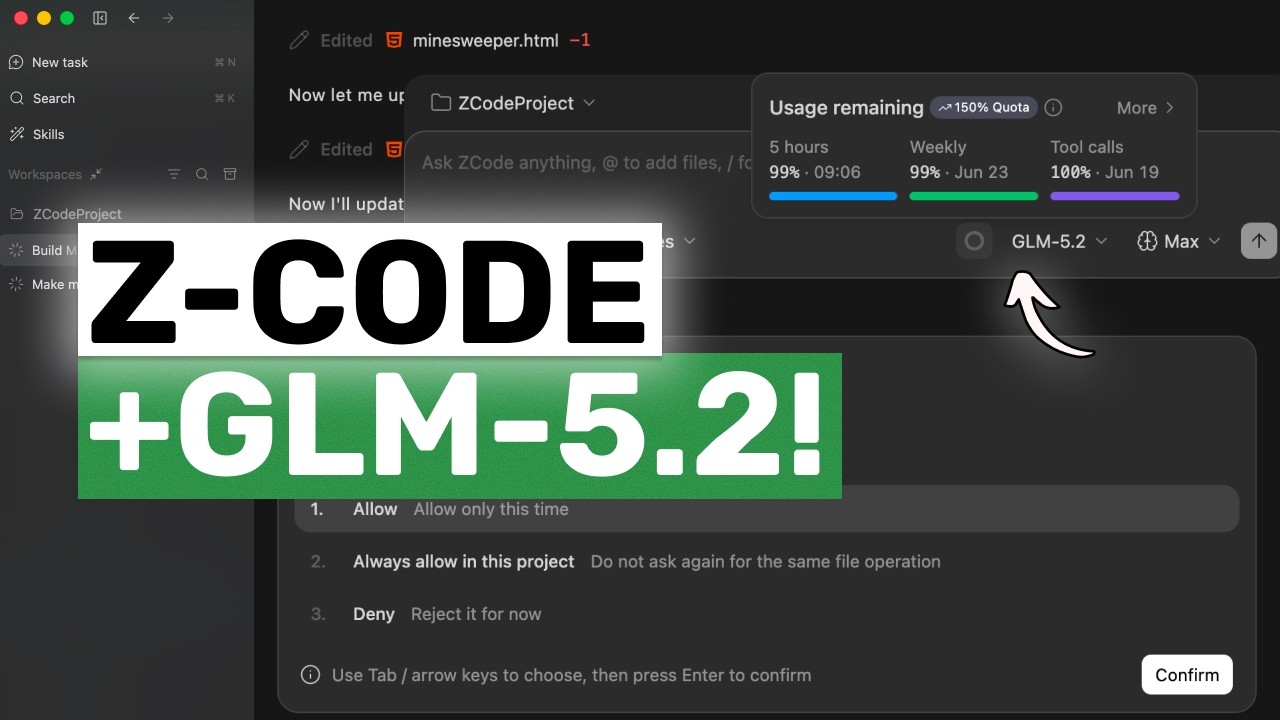
AICodeKing pushes the distribution layer even further. He presents Z Code as a Codex-like agent with 5 million daily free tokens, MCP servers, plugins, and usage tracking, but also calls out missing file explorer, changelog, worktree, and one-click git initialization. That mix of excitement and missing ergonomics is exactly what a maturing open-model market looks like: good enough to try seriously, not yet smooth enough to disappear into the background (video).
Discussion insight: The new competitive axis is access. Free quotas, local testing, dedicated coding APIs, and supported-tool lists matter as much as benchmark bragging rights.
Comparison to prior day: Compared with 2026-06-17, when the file centered on head-to-head leaderboard talk, 2026-06-18 pushed the story into free agent access, local evaluation, and real onboarding friction.
1.2 Agent content moved from abstract "agents are coming" talk into concrete build, evaluate, and internet-access recipes 🡕
Six videos in the final evidence set supported this theme. The strongest agent videos no longer pitch agents as a vague future category; they show specific frameworks, evaluation concerns, orchestration constraints, and retrieval gaps. That matters because the YouTube conversation is converging on an actual stack: framework plus context management plus real-world policy constraints plus access to the open internet.

Google Cloud Tech makes the framework layer explicit. The video links Google's ADK docs and a sample repo; ADK describes itself as an open framework that works with many model providers, manages context structurally, and can deploy anywhere from local setups to Google Cloud. The result is a much more operational agent pitch than a standard prompt-engineering tutorial (video).
IBM Technology focuses on the failure modes that appear after the demo. Its linked agentic AI explainer argues that autonomous systems can magnify ordinary AI risks and create cascading bottlenecks or conflicts, while the video itself frames scaling in terms of cost, latency, and failure risk. The signal is that agent content is getting less magical and more systems-oriented (video).

Better Stack contributes the retrieval layer. The linked Agent Reach README says the tool gives agents one-command internet access and routes across primary-plus-fallback backends for sources like YouTube, GitHub, Twitter, Reddit, and web search. That is a direct admission that codebase-native agents are not enough when the real evidence lives in public discussion and tutorial ecosystems (video).
Discussion insight: The emerging stack is no longer "one agent plus one model." It is framework, retrieval, evaluation, orchestration, and policy constraints all at once.
Comparison to prior day: Compared with 2026-06-17, which leaned more on sub-agents, permissions, and security boundaries, 2026-06-18 was more tutorialized and platformized.
1.3 AI safety and governance spread across documentary, policy, and morning-TV formats 🡕
Three videos in the final evidence set anchored this theme, but they were disproportionately visible. The second-ranked item in the file was a scenario-driven takeover video, and the adjacent items show the same concern translated into election spending fights and broadcast-news warnings. That matters because AI risk is no longer confined to specialist channels; it is being repackaged for much broader audiences.

Species | Documenting AGI turns the safety conversation into a documentary-style narrative. The description links Igor Babuschkin's "Life on Claude Nine" scenario and a public source document, which makes the video's dramatic framing more than just title bait. With 191,559 views and 1,500 comments, it was strong evidence that scenario-based AI-risk storytelling is getting mainstream-style traction on YouTube (video).

Robert Miles AI Safety grounds the worry in live politics. The description links the original RAISE Act, later modifications, and a campaign site while arguing that AI-industry money is being deployed against one congressional candidate. The notable part is not just regulation itself; it is that AI governance is being framed as an active electoral fight (video).

Good Morning America shows the same concern translated into general-audience TV. The video is framed as a sit-down with Anthropic CEO Dario Amodei about the dangers of AI, which means the cautionary narrative is no longer limited to policy creators or safety researchers. Broadcast packaging matters here because it widens the audience beyond people who would actively seek out AI-risk channels (video).
Discussion insight: The safety conversation now spans independent documentary creators, policy-focused explainers, and morning television. That is a broader surface area than the usual niche safety debate.
Comparison to prior day: Compared with 2026-06-17, which paired frontier capability with governance anxiety, 2026-06-18 pushed the same anxiety into more mainstream packaging and more explicit political conflict.
1.4 AI media creation became a full workflow stack, while anti-AI creator backlash stayed in the room 🡕
Three retained items anchored this theme, with several other review-set videos repeating the same creator-tool energy. The dominant creator pitch was not "press a button and win"; it was workflow quality, control, originality, and monetizable output. That matters because the file treats media generation as a production system now, not just a novelty demo.

AI Search makes the tooling stack visible. The description links ComfyUI Manager install docs, KJNodes, and the Ideogram 4 model page, which packages model files for local ComfyUI use. That turns image generation into a real workflow story about nodes, installs, and model packaging rather than a one-off prompt trick (video).

Malva AI extends that logic into video. Its description lays out an end-to-end pipeline - topic research, 3D animated scenes, consistent characters, image-to-video, voiceover, music, editing, thumbnails, and branding - and explicitly argues that low-effort AI slop is a dead end. The interesting signal is that creator AI advice is moving toward workflow quality and distribution discipline, not just generation speed (video).

Brad Colbow supplies the counterweight. He positions the video as a durable statement of artist concerns now that more people have moved toward the skepticism artists voiced earlier. That keeps the creator-tool theme from reading as pure enthusiasm; even when the workflow talk is practical, resistance and distrust remain visible in the same dataset (video).
Discussion insight: The positive creator content is increasingly about originality, controllability, and monetization quality, which indirectly acknowledges the backlash problem.
Comparison to prior day: Compared with 2026-06-17, which leaned more heavily on image-generation feature coverage, 2026-06-18 widened into end-to-end video workflows and creator-economics language while keeping skepticism visible.
1.5 AI infrastructure talk kept moving from chips to execution, capital, and enterprise rollout 🡒
Four retained items supported this theme. The hardware story is still present, but the larger shift is toward infrastructure as a deployment and finance problem: benchmarked challengers, capex theses, and reliable runtime execution for agents. That matters because the AI buildout story on YouTube is getting more operational and less purely speculative.

Market Signal frames infrastructure as a capital-allocation story. Even in its short description, the video centers institutional hardware research, supplier exposure, and a broad semiconductor-and-systems buildout rather than a single breakout stock. The signal here is that AI infrastructure is being narrated as a durable capex wave, not just a chip headline (video).

Tech With Tim adds the execution layer. The linked Replay 2026 page explicitly calls itself "the durable execution conference for AI," which backs the video's claim that everyone wants agents but far fewer teams can ship them reliably. That folds runtime reliability into the same infrastructure conversation as compute and data centers (video).

Evolving AI keeps the hardware-challenger angle alive. The description focuses on Jim Keller, Tenstorrent, and AI inference benchmarks, which means even the more speculative infrastructure items are still trying to ground themselves in measurable throughput and architecture choices. The file treats infrastructure as something to benchmark, finance, and operationalize all at once (video).
Discussion insight: Durable execution keeps showing up beside chips and capex. Reliability is being absorbed into the infrastructure narrative rather than staying a separate software-only topic.
Comparison to prior day: Compared with 2026-06-17, which leaned more on lower-layer supply-chain and board exposure, 2026-06-18 shifted toward capex narratives, benchmarked challengers, and runtime execution.
2. What Frustrates People
Open models that still demand too much comparison and setup work
This is High severity because the most enthusiastic open-model coverage is still full of integration friction. AI Search pushes GLM 5.2 through a dedicated coding plan and supported-tool list, AI Revolution frames Kimi K2.7 Code and GLM 5.2 as a workflow choice around context length and speed, and AICodeKing explicitly calls out missing Z Code features like worktrees and a proper file explorer. The workaround is more tutorial watching, more side-by-side testing, and more tolerance for immature coding-agent UX. This is directly worth building for.
Agent systems that break once they need real-world context, evaluation, and orchestration
This is High severity because the strongest agent videos are all about what goes wrong after the prototype. Google Cloud Tech leans on a full framework, IBM Technology says scaling creates cost, latency, and failure risk, IBM Technology shifts the conversation toward policies and human alignment, and Better Stack exists because agents still miss half the public internet without extra tooling. The workaround is more framework adoption, more retrieval layers, and more orchestration discipline. This is directly worth building for.
Safety talk that gets louder faster than control mechanisms do
This is High severity because the file pairs narrative intensity with weak resolution. Species | Documenting AGI turns risk into a takeover scenario, Robert Miles AI Safety turns it into a live regulatory spending fight, and Good Morning America turns it into a general-audience warning segment. The workaround today is more explanation, more campaigning, and more warnings rather than a settled control stack. This is worth building for, though some demand lives in policy rather than software.
Creator AI that is easy to generate with but hard to turn into distinctive work
This is Medium-High severity because the creator-side videos repeatedly imply that raw generation is not enough. AI Search depends on a full ComfyUI workflow, Malva AI explicitly says low-effort AI slop is not a viable strategy, and Brad Colbow shows that creator distrust has not gone away. The workaround is more workflow assembly, more brand and story work, and more manual quality control. This is worth building for, but it is already becoming competitive.
Infrastructure that requires capital, benchmarking, and reliability discipline
This is High severity because even the more bullish infrastructure coverage is constraint-heavy. Market Signal frames the buildout through institutional hardware research and supplier exposure, Tech With Tim says reliability is still the missing piece for production agents, and Evolving AI has to justify challenger hardware through inference benchmarks rather than pure hype. The workaround is more capex, more benchmarking, and more runtime discipline. This is worth building for, but it is enterprise-weighted.
3. What People Wish Existed
Open-model routing and onboarding layers
AI Search, AI Revolution, xCreate, and AICodeKing all imply the same practical need: one place that turns benchmark claims, free-tier access, local runtimes, context limits, and supported-tool setup into a trustworthy default recommendation. The urgency is high because creators are already trying to swap these models into real coding work today. Pieces exist, but the user still has to assemble the decision and the setup path themselves. Opportunity: direct.
Production agent control planes with retrieval, evaluation, and policy gates
Google Cloud Tech, IBM Technology, IBM Technology, Better Stack, and Tech With Tim all point to a combined need for frameworks, context management, internet access, evaluation, orchestration, and reliability in one workflow. The urgency is high because the best current advice still sounds like "add more layers until it stops breaking." This is mostly a practical need, though the trust angle makes it emotionally salient too. Opportunity: direct.
Creator workflow stacks that produce distinctive AI media instead of slop
AI Search, Malva AI, and Brad Colbow imply a need for workflows that bundle model choice, prompt assets, scene continuity, editing, branding, and quality checks into something creators can actually publish with confidence. The urgency is medium-high because creators clearly want the output, but they also know generic AI media is easy to dismiss. This is both practical and emotional: they want usable output without reputational damage. Opportunity: competitive.
Infrastructure planning layers that connect chips, capex, and runtime reliability
Market Signal, Tech With Tim, and Evolving AI together imply a need for products that connect hardware benchmarks, supplier exposure, runtime reliability, and deployment economics in one planning surface. The urgency is medium-high because the buyer logic is visible, but the audience is still more enterprise than creator. Existing content is fragmented across finance, engineering, and conference ecosystems. Opportunity: competitive.
Public-facing AI risk translation and governance tooling
Species | Documenting AGI, Robert Miles AI Safety, and Good Morning America point to a softer but real need: tools that turn lab risk, legislative change, and public warnings into something ordinary organizations and voters can act on. The urgency is medium because attention is high, but the path from awareness to action is still muddy. This is more emotional and institutional than purely workflow-driven, which makes the opportunity less direct but still meaningful. Opportunity: aspirational.
4. Tools and Methods in Use
| Tool | Category | Sentiment | Strengths | Limitations |
|---|---|---|---|---|
| GLM 5.2 | Open-weight coding model | (+/-) | Strong enthusiasm, long-context positioning, and an explicit coding-use story | Still depends on a separate coding plan and setup path rather than a simple default experience |
| Z Code | Coding agent | (+/-) | Free daily quota, MCP support, plugins, and usage tracking | Missing file explorer, changelog, worktrees, and one-click git setup according to creators testing it |
| Kimi K2.7 Code | Coding model | (+) | Long-horizon coding focus, 256K context, and a HighSpeed mode around 180 tokens/s | Choice still depends on benchmark interpretation and resource availability |
| Google ADK | Agent framework | (+) | Multi-model support, structured context management, and deploy-anywhere flexibility | Requires framework adoption and still looks like an engineering stack, not a consumer-simple tool |
| Agent Reach | Retrieval / internet context | (+) | Gives agents one-command access to web, GitHub, YouTube, and other public-signal sources with fallback backends | Some platforms still require cookies, login state, or extra environment setup |
| IBM's real-world agent workflow approach | Evaluation / orchestration method | (+/-) | Centers policies, workflows, and human alignment instead of demo-only autonomy | Adds governance and architecture overhead before teams see the upside |
| Temporal durable execution | Agent runtime | (+/-) | Strong reliability framing for long-running agent workflows | Adds state and orchestration complexity that smaller teams may not want early |
| Ideogram 4 in ComfyUI | Image-generation workflow | (+) | Local packaging, controllable workflows, and stronger text/image control than lightweight prompt tools | Installation, node management, and workflow assembly are still non-trivial |
| Higgsfield-style AI video workflow | Video creation workflow | (+/-) | End-to-end process from topic research to voiceover, scenes, thumbnails, and branding | Still depends heavily on creative direction and quality control to avoid generic output |
Overall satisfaction is split between excitement and assembly burden. The strongest positive sentiment surrounds open coding models, agent frameworks, and creator tooling, but almost every promising tool arrives with onboarding friction, architecture choices, or missing ergonomics. The dominant workaround is to layer more systems around the core model: routing, frameworks, retrieval, orchestration, reliability, or workflow packaging.
The clearest migration pattern is from single-tool optimism toward stacked workflows. Creators are moving from "which model is best?" to "which model plus which agent plus which runtime plus which retrieval layer?" On the media side, the shift is from one-click generation demos toward production workflows that include editing, branding, and consistency. The competitive dynamics are similar in both spaces: the tool that wins is increasingly the one that removes the most coordination work around the model, not just the one with the flashiest raw output.
5. What People Are Building
| Project | Who built it | What it does | Problem it solves | Stack | Stage | Links |
|---|---|---|---|---|---|---|
| Z Code / GLM Coding Plan | Z.AI | Packages GLM models into a coding-specific plan and agent workflow | Makes open-weight coding models usable in supported developer tools instead of leaving them as raw model endpoints | GLM 5.2; dedicated coding API; supported coding-tool integrations | Shipped | quick start, Z Code |
| Build an AI Agent with Google ADK | Smitha Kolan | Provides a starter repo and codelab for a blog-writing agent built with ADK | Gives developers a concrete first agent instead of abstract agent theory | Python; Google ADK; Gemini-flash-latest | Alpha | sample repo, codelab, ADK docs |
| Agent Reach | Panniantong | Gives AI agents one-command internet access across web, GitHub, YouTube, and other platforms | Agents fail when they need public discussion, tutorials, and platform-specific context outside the codebase | Python CLI; backend routing; yt-dlp; gh CLI; mcporter/Exa | Shipped | repo, README |
| /last30days | mvanhorn | Searches and synthesizes signals across Reddit, X, YouTube, TikTok, GitHub, and the web | Reduces fragmented multi-platform research work for agents and humans | Skill pack; multi-source search; AI synthesis | Shipped | repo |
| Agent Skills | addyosmani | Packages production-grade workflows and quality gates for AI coding agents | Turns ad hoc agent behavior into repeatable engineering process | Markdown skill pack; lifecycle commands; workflow references | Shipped | repo |
| ComfyUI-KJNodes | kijai | Adds utility, optimization, and quality-of-life nodes for ComfyUI workflows | Makes local image workflows more controllable and extensible than bare model installs | ComfyUI custom nodes; local image pipeline tooling | Shipped | repo, Ideogram 4 model |
Z Code and the Google ADK sample are notable because they represent two different answers to the same question: how do you turn agent hype into something a developer can actually run? Z.AI productizes the model and onboarding path, while the ADK sample lowers the barrier for builders who want a first working agent.
Agent Reach, /last30days, and Agent Skills point in the same direction from outside the model vendors. Builders are putting their effort into the scaffolding around AI systems - internet context, research synthesis, and disciplined workflow execution - rather than betting that model quality alone will solve the usability gap.
ComfyUI-KJNodes extends the same pattern into media creation. Even on the creator side, the build energy is clustering around workflow control and packaging layers rather than around a single magic prompt box. The repeated signal across the whole file is that the valuable build surface is increasingly everything around the model.
6. New and Notable
Open models were pitched through access and ergonomics, not just scoreboards
AI Search, xCreate, and AICodeKing stand out because they push GLM 5.2 through supported-tool onboarding, local testing, and free-token access instead of relying only on benchmark bragging. That is a more mature product pitch than simple "new model dropped" coverage.
Internet-context tooling emerged as its own agent product category
Better Stack's Agent-Reach video is notable because it turns a recurring pain point into a named product shape: agents that can actually read the web, GitHub, YouTube, and social platforms without hand-built integrations. It is one of the clearest builder signals in the file.
Safety content crossed documentary, policy, and broadcast formats at once
Species | Documenting AGI, Robert Miles AI Safety, and Good Morning America matter together because they show the same AI-risk concern translated for three very different audiences. That breadth of packaging is itself a signal.
Creator AI advice hardened around anti-slop production discipline
Malva AI is notable because it explicitly says low-effort AI slop is dead and then backs that claim with a full publishing workflow. Paired with AI Search's Ideogram tutorial and Brad Colbow's critique, it suggests the creator market is already moving from novelty toward quality filters.
7. Where the Opportunities Are
[+++] Open-model routing, onboarding, and coding-agent UX - Sections 1.1, 2, 3, and 4 all point to the same gap: people want to use open-weight coding models, but they still need help choosing among them, wiring them into supported tools, and understanding where the UX is still weak. The signal is strong because demand is already present and the current workflow is still comparison-heavy.
[+++] Production agent control planes with retrieval and reliability built in - Sections 1.2, 2, 4, and 5 show that framework choice alone is not enough. Builders and creators alike still need internet context, evaluation, orchestration, and durable execution in one coherent surface. The signal is strong because the best current advice is still a manual systems recipe.
[++] Creator-grade AI media workflows with quality and originality safeguards - Sections 1.4, 2, 4, and 6 show that creators do want AI media tooling, but they increasingly reject low-effort output. The opportunity is moderate because demand is obvious, but the market is already competitive and success depends on workflow quality rather than simple generation.
[++] Infrastructure intelligence for AI buildout economics and execution - Sections 1.5, 2, 3, and 4 show a real need for software that connects hardware benchmarks, supplier exposure, capex logic, and runtime reliability. The signal is moderate because the need is real, but the buyer base is still more enterprise-weighted than mass-market.
[+] Public-facing AI governance translation - Sections 1.3, 3, and 6 show that attention around AI risk is high across policy, documentary, and news formats, but the path from awareness to action is still unclear. The opportunity is emerging rather than immediate because much of the demand sits in institutions, media, and policy ecosystems rather than a clean developer workflow.
8. Takeaways
- Open-weight competition is now being sold through access paths, not just benchmark wins. The strongest GLM 5.2 coverage emphasized supported tools, dedicated APIs, free-token access, and onboarding friction rather than abstract model quality alone. (source)
- Agent workflows are converging on a stack, not a single assistant. Frameworks, retrieval, orchestration, evaluation, and durable execution all appeared as separate layers that teams still have to compose. (source)
- AI-risk messaging has become broad-audience content. The same concern showed up as a documentary scenario, a live regulatory spending fight, and a morning-news warning segment. (source)
- Creator AI is already being judged by production quality instead of novelty. The most practical creator advice was about consistency, branding, and avoiding low-effort slop rather than generating more assets faster. (source)
- The strongest builder energy is clustering around scaffolding around the model. Internet-context tools, cross-platform synthesis, and workflow discipline packs showed up more clearly than any single breakout end-user app. (source)
- Infrastructure coverage is getting more operational and financial. Benchmarking, capex logic, and runtime reliability now sit beside chips in the same AI buildout conversation. (source)