YouTube AI - 2026-06-19
1. What People Are Talking About
1.1 Open-weight coding models became productized developer stacks with free, local, and benchmark-tested distribution paths 🡕
Four retained items supported this theme. The conversation moved another step away from "open source is catching up" and toward "which open-weight coding stack can I actually adopt this week?" That matters because creators are no longer selling these models through ideology alone; they are selling them through supported tools, free usage, local testing, and believable day-to-day coding ergonomics.
AI Search treats GLM 5.2 as an adoptable coding product, not just a leaderboard result. The description links Z Code, chat.z.ai, and the official GLM Coding Plan quick start, where Z.AI says the plan uses a dedicated Coding API and works inside officially supported tools such as Claude Code, Cursor, Roo Code, and Cline. With 338,582 views, it was the clearest sign that open-weight attention is turning into onboarding behavior and toolchain choice (video).
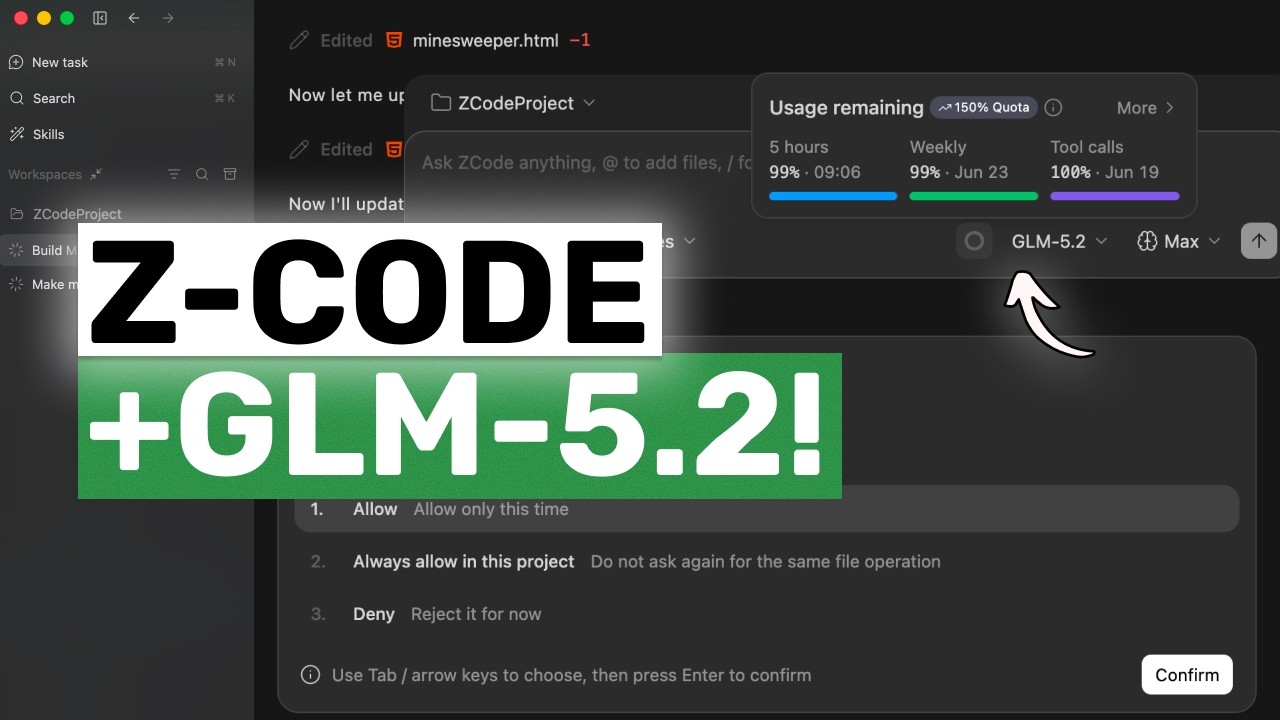
AICodeKing pushes the productization story further. He frames Z Code as a Codex-like coding agent with 5 million free GLM-5.2 tokens per day, MCP servers, plugins, previews, and usage tracking, but also calls out missing file explorer, changelog, worktree, and one-click git setup features. That combination matters because it shows the market moving into real UX comparison: free access is compelling, but the winner still has to remove workflow friction (video).

AI Revolution widens the contest beyond one vendor. Its linked Kimi K2.7 Code model card describes a coding-focused agentic model with a 256K context window and roughly 30 percent lower thinking-token use than K2.6, which matches the video’s framing of open-weight coding as an efficiency and workflow race instead of a philosophical one. The result is a much more practical competitive frame: long-horizon completion, token economics, and real developer fit (video).
Discussion insight: The adjacent GLM testing videos pushed the same idea toward local deployment. Instead of asking only which model scored best, creators increasingly asked whether it runs locally, whether it has a codex-like shell, and whether the setup is simple enough to become a default.
Comparison to prior day: Compared with 2026-06-18, which already emphasized free access and supported tools, 2026-06-19 pushed harder into codex-style product surfaces and local evaluation.
1.2 AI safety moved deeper into mainstream politics without resolving the optimism-versus-catastrophe split 🡕
Four retained items anchored this theme. The file did not settle on a single future-of-AI story; it stacked takeover scenarios, post-AGI planning, and live legislative conflict into the same daily conversation. That matters because AI risk is no longer being packaged only for safety specialists - it is now broad-audience media and electoral material too.

Species | Documenting AGI turns AI risk into a documentary-style scenario with unusually high traction. The video cites Igor Babuschkin’s "Life on Claude Nine" post and a public source document instead of relying on vague alarmism, and it still reached 206,039 views with 1,600 comments. That combination suggests scenario-based safety storytelling is still resonating far beyond the usual research audience (video).

AI Revolution adds a more formal roadmap. The linked DeepMind abstract says human-level AGI is now a concrete next-decade target and outlines four possible paths from AGI to ASI, including recursive improvement and large-scale multi-agent collectives. That raises the level of the discussion from generic doom or hype into a more explicit planning problem about what happens after human-level performance (video).

Robert Miles AI Safety turns governance into live politics. The description links both the original RAISE Act and later modifications while arguing that more than $10 million is being spent to stop one congressional candidate from winning office. The notable signal is not just that regulation exists; it is that AI regulation is now being narrated as an active electoral conflict with money behind it (video).
Discussion insight: The regulation angle is no longer fringe. MS NOW framed AI rules as a cross-ideological TV-news topic tied to the G7, which means the safety conversation is spreading through mainstream politics as well as creator channels.
Comparison to prior day: Compared with 2026-06-18, which broadened safety into documentary and broadcast packaging, 2026-06-19 sharpened the argument by adding explicit post-AGI planning and legislative conflict.
1.3 Creator AI hardened around local workflow control, while anti-AI creator resistance stayed loud 🡕
Four retained items supported this theme. The dominant creator pitch was not "click once and get magic output"; it was local control, reusable workflows, and higher production standards. That matters because the file treats creator AI less like novelty software and more like a craft stack that still has to survive audience skepticism.

AI Search makes the local-stack story explicit. The description links ComfyUI Manager install docs, KJNodes, and the Ideogram 4 package, which together turn image generation into a real install-and-configure workflow rather than a simple model announcement. The most important signal is that control, packaging, and node-level workflow composition are now central selling points (video).

Malva AI extends that workflow logic into video. The description lays out a full YouTube production stack - topic research, 3D scenes, consistent characters, image-to-video, AI voiceover, music, editing, thumbnails, and branding - and explicitly argues that low-effort AI slop is what fails. That makes the creator-side message much stricter than a generic "free AI video generator" pitch: the output has to feel publishable, not merely generated (video).

Brad Colbow supplies the counterweight. He positions the video as a durable statement of artist concerns now that more audiences are catching up to the skepticism creators voiced earlier, which keeps the entire creator-AI cluster from reading as pure excitement. Even as tooling gets more controllable, the legitimacy fight is still happening in public (video).
Discussion insight: The local-pipeline angle keeps getting stronger. Mickmumpitz’s local 3D movie workflow adds Blender, FLUX-guided reference frames, and LTX-2.3 rendering to the same cluster, which suggests creator energy is moving toward reusable pipelines rather than isolated prompts.
Comparison to prior day: Compared with 2026-06-18, which leaned more on creator-economics and anti-slop rhetoric, 2026-06-19 pushed harder into local installation, workflow control, and durable public skepticism.
1.4 AI infrastructure now means challenger chips, AI factories, and durable execution all at once 🡕
Four retained items supported this theme. The file no longer treats infrastructure as a one-dimensional Nvidia story. Instead it combines challenger inference hardware, capital-allocation narratives, validated AI-factory blueprints, and runtime reliability for agents. That matters because the bottleneck is increasingly being narrated as deployment shape and operational resilience, not just access to GPUs.

CNBC gives the clearest challenger-hardware story. Its interview says d-Matrix’s Corsair chip is in volume production, uses SRAM to reduce dependence on scarce DRAM, and claims up to 10x faster inference than a standalone GPU, while the d-Matrix product page adds a software layer called Aviator. The important signal is that infrastructure challengers are being sold as full hardware-plus-software systems, not just raw silicon bets (video).

Tech With Tim shifts infrastructure toward runtime execution. The linked Replay 2026 page calls itself "the durable execution conference for AI," which validates the video’s claim that everyone is building agents but far fewer teams are shipping them reliably. Reliability, retries, and long-running workflow state now sit inside the same infrastructure frame as chips and cloud spend (video).
NVIDIA provides the blueprint version of the same story. The description says Enterprise Reference Architectures are validated, repeatable patterns for turning a data center into a high-performance AI factory, which means infrastructure is now being packaged as deployable design patterns rather than as a raw bill of materials. That is a more operational pitch than generic hardware enthusiasm (video).
Discussion insight: Market Signal pushes the same theme into capital allocation, treating AI infrastructure as a supplier-and-capex basket rather than a single breakout name. The shared concern across the cluster is not novelty but whether the system can actually be financed, installed, and run.
Comparison to prior day: Compared with 2026-06-18, which already leaned toward capex and execution, 2026-06-19 pushed harder into challenger chips and explicit AI-factory packaging.
1.5 Builder energy clustered around agent scaffolding rather than another generic assistant demo 🡕
Three retained items supported this theme. The strongest builder signals in the file are not consumer-simple assistants. They are search surfaces, workflow packs, coordination architectures, and policy-aware deployment patterns built around agents. That matters because the value is increasingly being attached to everything around the model rather than to the model alone.

Matthew Berman makes the scaffolding trend easy to see. The standout linked projects are not another chatbot shell: /last30days is an agent-led multi-platform search engine scored by engagement, while Agent Skills packages production-grade workflows and quality gates for coding agents. The notable point is where the build energy is going - into research synthesis and disciplined process, not only model access (video).

Two Minute Papers adds the research architecture layer. The RecursiveMAS site says the framework improves average accuracy by 8.3 percent while speeding up multi-agent systems by 1.2x-2.4x and cutting token use by 34.6 percent-75.6 percent across 9 benchmarks. That turns "better agent collaboration" into a concrete efficiency claim rather than a metaphor (video).
IBM Technology provides the enterprise deployment frame. IBM’s linked real-world agent article argues that deterministic automation breaks on ambiguity while agentic systems handle more, but only if workflows, policies, orchestration, and human alignment are built in from the start. The signal is that serious agent content now assumes structure and governance rather than autonomous magic (video).
Discussion insight: Across all three items, the build surface is coordination. Search, workflow packs, recursive collaboration, and policy-aware orchestration are showing up more clearly than any single breakout end-user assistant.
Comparison to prior day: Compared with 2026-06-18, which emphasized ADK tutorials and internet access, 2026-06-19 leaned more toward collaboration architecture, workflow packaging, and enterprise control.
2. What Frustrates People
Open models that still require too much routing, setup, and UX tolerance
This is High severity because the most enthusiastic coding-model coverage still comes with comparison work and missing ergonomics. AI Search uses a supported-tool list and a separate coding API for GLM 5.2, AICodeKing likes the free 5 million-token Z Code offer but calls out missing file explorer, worktree, and git-init features, and AI Revolution frames Kimi K2.7 Code versus GLM-5.2 through efficiency and context-window tradeoffs. The workaround is more benchmarking, more local testing, and more willingness to swap between shells and plans. This is directly worth building for.
Agent systems that still need workflow design, policy layers, and runtime reliability
This is High severity because the highest-signal agent items are about coordination burdens, not model ignorance. Two Minute Papers needs a better collaboration architecture to get efficiency gains, IBM Technology says real agents need workflows, policies, and human alignment, and Tech With Tim frames reliable execution as the missing piece between demos and production. The workaround is more scaffolding: workflow packs, orchestrators, and durable execution. This is directly worth building for.
Creator AI that is powerful locally but hard to make distinctive and trusted
This is Medium severity because the tools are getting better faster than creator trust is. AI Search makes local image workflows more controllable through ComfyUI, Malva AI says success now depends on research, pacing, branding, and consistency rather than mass generation, and Brad Colbow shows skepticism remains strong among artist audiences. The workaround is more manual art direction, more workflow assembly, and more quality control. This is worth building for, but it is already competitive.
AI infrastructure that is constrained by deployment shape, not just chip supply
This is High severity because every infrastructure cluster item comes with a different bottleneck. CNBC highlights SRAM-versus-DRAM and software-stack differentiation, NVIDIA turns deployment into a blueprint problem, and Market Signal treats the whole space as a capex-and-supplier basket rather than a simple product winner. The workaround is more planning, more capital, and more operational discipline. This is worth building for, but it skews enterprise-heavy.
AI governance talk that is louder than the actionable control story
This is High severity because the file pairs vivid scenarios with live politics but not with a settled response. Species | Documenting AGI makes takeover risk legible, AI Revolution says post-AGI acceleration could arrive through several pathways, and Robert Miles AI Safety makes regulation look like a high-stakes electoral spending fight. The workaround today is more argument, more campaigns, and more public education rather than a clearly adopted control stack. This is worth building for, though some demand lives outside software.
3. What People Wish Existed
Open-model decision and onboarding layers that hide the comparison work
AI Search, AICodeKing, AI Revolution, and xCreate all imply the same practical need: one surface that combines benchmark position, local-versus-cloud viability, free quotas, supported tools, and exact setup steps into a trustworthy default recommendation. The urgency is high because creators are already trying to adopt these models for real coding work today. The need is overwhelmingly practical, and current solutions still make the user stitch the decision together themselves. Opportunity: direct.
Production agent control planes that combine coordination, policy, evaluation, and durable execution
Two Minute Papers, IBM Technology, Tech With Tim, and Matthew Berman point to a combined need for collaboration patterns, workflow packs, search context, policy gates, and reliable runtime execution in one coherent system. The urgency is high because the best current advice still sounds like “add more scaffolding until the agent stops breaking.” This is mostly a practical need, though trust and governance make it emotionally salient too. Opportunity: direct.
Creator workflow products that pair local control with originality safeguards
AI Search, Malva AI, Mickmumpitz, and Brad Colbow imply a need for products that bundle local model setup, reusable workflow nodes, style consistency, and review gates so creators can ship work that feels intentional instead of generic. The urgency is Medium because the desire to use these tools is obvious, but creator reputation and audience trust remain fragile. This is both practical and emotional. Opportunity: competitive.
AI infrastructure planning surfaces that connect challengers, factories, and capex
CNBC, NVIDIA, Market Signal, and Tech With Tim imply a need for one planning surface that compares chip architectures, software stacks, AI-factory blueprints, runtime reliability, and financing tradeoffs together. The urgency is Medium because enterprises clearly care, but the current information is split across vendors, investors, and conference ecosystems. This is a practical need with enterprise-weighted buyers. Opportunity: competitive.
Public AI governance translation for non-specialists
Species | Documenting AGI, Robert Miles AI Safety, MS NOW, and AI Revolution point to a softer but real need: tools that translate lab scenarios, proposed rules, and political fights into concrete implications for voters, workers, and ordinary organizations. The urgency is medium because attention is clearly high, but most of the current output is still argument rather than action support. The need is partly practical and partly institutional. Opportunity: aspirational.
4. Tools and Methods in Use
| Tool | Category | Sentiment | Strengths | Limitations |
|---|---|---|---|---|
| GLM Coding Plan | Coding platform | (+/-) | Supported-tool onboarding and a dedicated coding API for GLM workflows | Separate subscription/configuration path and supported-tool constraints |
| Z Code | Coding agent | (+/-) | Free daily quota, MCP support, plugins, previews, and usage tracking | Missing file explorer, changelog, worktree support, and one-click git setup |
| Kimi K2.7 Code | Coding model | (+) | 256K context, lower thinking-token use than K2.6, and strong coding/agentic benchmark framing | Still evaluated through heavy comparison work and deployment choices |
| RecursiveMAS | Multi-agent framework | (+) | Promises better collaboration efficiency, speedups, and token reduction across benchmarks | Research-stage complexity, checkpoint orchestration, and external-search setup |
| /last30days | Research / search skill | (+) | Parallel multi-platform search scored by real engagement | Full value depends on configuring access across walled-garden platforms |
| Agent Skills | Workflow pack | (+) | Production-grade lifecycle workflows and quality gates for coding agents | Adds process structure that some teams may treat as overhead |
| Temporal durable execution | Agent runtime | (+/-) | Makes reliability, retries, and state management first-class concerns for long-running agents | Introduces orchestration complexity before teams necessarily see the payoff |
| IBM's real-world agent workflow approach | Agent workflow method | (+/-) | Centers workflows, policies, and human alignment for ambiguous tasks | Emphasizes enterprise caution and operational overhead |
| ComfyUI Manager + ComfyUI-KJNodes | Creator workflow | (+) | Makes local image workflows installable, modular, and more controllable | Setup, dependency management, and node complexity remain non-trivial |
| Ideogram 4 | Image model package | (+) | Local packaging for high-control text and image generation inside ComfyUI | Requires model-file management and the broader ComfyUI stack |
| d-Matrix Corsair / Aviator | AI inference hardware/software | (+/-) | Challenger inference system pitched on speed, energy, and a software-first stack | Still needs to prove deployment scale and ecosystem traction against incumbents |
Overall satisfaction is split between genuine excitement and assembly burden. Open-weight coding tools, agent frameworks, and local creator stacks all look useful, but almost every promising option arrives with setup cost, orchestration overhead, or missing ergonomics. The dominant workaround is to wrap the model with more structure: a coding plan, a workflow pack, a runtime, a search layer, or a node-based pipeline.
The clearest migration pattern is from choosing one model to constructing a stack. On the coding side that means model plus shell plus workflow plus runtime; on the creator side it means model plus local packaging plus reusable pipeline. The competitive dynamics are similar in both cases: the tool that wins is increasingly the one that removes the most coordination work around the model, not just the one with the strongest raw output.
5. What People Are Building
| Project | Who built it | What it does | Problem it solves | Stack | Stage | Links |
|---|---|---|---|---|---|---|
| GLM Coding Plan / Z Code | Z.AI | Packages GLM models into a coding-specific plan and codex-like agent surface | Makes open-weight coding models usable in supported tools instead of leaving them as raw endpoints | GLM 5.2; dedicated coding API; supported-tool integrations; MCP/plugins | Shipped | quick start, video |
| Kimi K2.7 Code | Moonshot AI | Coding-focused agentic model positioned for long-horizon software tasks | Gives teams an open-weight alternative for codebase-scale coding and agent workflows | 1T MoE; 256K context; token-efficiency improvements; compatible API access | Shipped | model card, video |
| RecursiveMAS | RecursiveMAS | Recursive multi-agent framework that passes latent state between collaborating agents | Reduces the cost and inefficiency of text-only multi-agent coordination | RecursiveLink modules; multiple collaboration patterns; benchmark suite | Alpha | site, repo |
| /last30days | mvanhorn | Agent-led search engine that searches social platforms, GitHub, and the web in parallel | Reduces fragmented multi-platform research across walled-garden sources | Skill pack; multi-source search; engagement scoring; AI synthesis | Shipped | repo, video |
| Agent Skills | addyosmani | Workflow and quality-gate pack for AI coding agents | Turns ad hoc coding-agent behavior into repeatable engineering process | Markdown skills; slash commands; lifecycle workflows | Shipped | repo, video |
| ComfyUI-KJNodes | kijai | Extensible node pack for local ComfyUI workflows | Makes local image-generation pipelines more controllable and modular | ComfyUI custom nodes; subgraph support; Set/Get workflow tools | Shipped | repo, video |
| d-Matrix Corsair / Aviator | d-Matrix | AI inference system paired with a software stack for deployment | Attacks inference speed, energy, and memory bottlenecks for production workloads | Corsair chip; SRAM-centric design; Aviator software | Shipped | product, video |
| NVIDIA Enterprise Reference Architectures | NVIDIA | Validated patterns for turning data centers into AI factories | Reduces deployment ambiguity for enterprise AI infrastructure rollouts | Reference architectures; enterprise infrastructure blueprints | Shipped | video |
GLM Coding Plan / Z Code and Kimi K2.7 Code are notable because they show open-weight competition moving from raw models into product form. The build question is no longer just “who released weights?” but “who packaged the model into something developers can actually adopt with a clear setup path?”
RecursiveMAS, /last30days, and Agent Skills point in the same direction from outside the model vendors. Builders are spending effort on collaboration architecture, research synthesis, and workflow discipline rather than betting that one stronger model will eliminate the need for scaffolding.
ComfyUI-KJNodes, d-Matrix Corsair, and NVIDIA’s enterprise reference architectures extend the same pattern into creator tooling and infrastructure. Across the whole file, the repeated build pattern is packaging: control layers, deployment surfaces, and integration glue around the core model.
6. New and Notable
Open-source AI project roundups shifted toward scaffolding instead of base models
Matthew Berman stands out because the most interesting linked projects were /last30days and Agent Skills, not another generic model wrapper. That is a strong sign that the builder surface is moving toward research orchestration and workflow discipline.
Recursive multi-agent collaboration became a concrete benchmark story
Two Minute Papers is notable because it turns “better agent collaboration” into measurable claims about accuracy, speed, and token savings through RecursiveMAS. That is a more mature signal than vague multi-agent enthusiasm.
Open-weight coding competition is now testing free quotas, codex-like UX, and local deployment at the same time
AI Search, AICodeKing, and xCreate matter together because they sell GLM 5.2 through supported tools, free daily tokens, and local-versus-cloud testing rather than only through benchmark talk. That makes the competition look more like product distribution than model release theater.
AI factory and durable execution language crossed into mainstream infrastructure coverage
Tech With Tim and NVIDIA are notable because they make runtime reliability and validated deployment blueprints sound like ordinary parts of the AI infrastructure conversation. Paired with CNBC’s d-Matrix segment, the file treats infrastructure as a systems-and-deployment problem, not only as a chip race.
7. Where the Opportunities Are
[+++] Open-model onboarding, routing, and coding-agent UX - Sections 1.1, 2, 3, 4, and 5 all point to the same gap: people want open-weight coding models, but they still need help comparing them, wiring them into supported tools, and understanding where the UX remains immature. The signal is strong because adoption demand is already present and current workflows are still setup-heavy.
[+++] Agent control planes with coordination, search, policy, and durable execution - Sections 1.5, 2, 3, 4, and 5 show that framework choice alone is not enough. Builders still need collaboration patterns, research context, workflow packs, policy gates, and reliable runtime behavior in one coherent surface. The signal is strong because the best current advice is still a manual systems recipe.
[++] Creator-grade local AI media workflows with quality controls - Sections 1.3, 2, 3, and 6 show clear demand for local creator stacks, but they also show that output quality and legitimacy are the real bottlenecks. The opportunity is moderate because demand is obvious, but competition is rising and success depends on originality safeguards rather than raw generation alone.
[++] Infrastructure planning across chips, factories, and runtime reliability - Sections 1.4, 2, 3, 4, and 6 show a real need for software that connects challenger hardware, AI-factory design patterns, supplier exposure, and durable execution choices. The signal is moderate because the need is real, but the buyer base is still more enterprise-weighted than mass-market.
[+] Public AI governance translation for non-specialists - Sections 1.2, 2, 3, and 6 show that attention around AI regulation and post-AGI risk is high, but most of the current content is still argument and narrative rather than decision support. The opportunity is emerging because the audience is broad, even if the product path is less direct.
8. Takeaways
- Open-weight coding competition is now a distribution and UX contest, not only a benchmark contest. The strongest GLM and Kimi coverage emphasized supported tools, free usage, local testing, and codex-like ergonomics rather than abstract model quality alone. (source)
- AI safety and governance have become mainstream political media topics. The same daily file paired documentary-style takeover scenarios, post-AGI planning, and live legislative conflict instead of keeping those conversations in specialist circles. (source)
- Creator AI is being judged on controllability and publishable quality, not novelty. The most practical creator videos focused on local workflow setup, consistent outputs, and avoiding generic AI slop rather than simply generating more assets faster. (source)
- AI infrastructure now includes runtime reliability as part of the core stack. Durable execution and validated deployment blueprints appeared beside chip and capex talk in the same cluster of infrastructure coverage. (source)
- The strongest builder energy is clustering around scaffolding around agents. Multi-platform search, workflow packs, recursive collaboration, and policy-aware orchestration showed up more clearly than any single breakout end-user assistant. (source)
- Free or low-friction access remains a major adoption lever. The items getting the most attention repeatedly highlighted free token budgets, local deployment paths, or installable workflows as reasons to try a tool now instead of later. (source)