YouTube AI - 2026-06-21
1. What People Are Talking About
1.1 Open-weight coding coverage kept turning into workflow proof instead of leaderboard hype 🡕
Three retained items supported this theme. The strongest coding-model coverage was still about GLM 5.2, but the focus kept moving away from "a new model dropped" and toward concrete adoption proof: exact tool setup, local-versus-cloud testing, and IDE workflow integration. That matters because the audience is no longer treating open-weight coding models as curiosities; it is trying to decide which one can actually slot into an everyday development loop this week.
AI Search remained the biggest adoption signal in the file. The linked GLM Coding Plan quick start says users need a dedicated Coding API, a subscription flow, and one of the officially supported tools such as Claude Code, Cline, Cursor, Goose, OpenClaw, or Roo Code. With 394,002 views, 12,032 likes, and 1,200 comments, the video's core value is not just that GLM 5.2 is strong; it is that Z.AI is packaging it as a usable coding product instead of raw weights alone (video).

xCreate supplied the strongest local-verification angle. Its description centers an M3 Ultra 512GB test system, an Inferencer search for GLM 5.2 weights, and direct local-versus-cloud checks across coding, logic, math, photorealism, sound generation, and safety. That makes the open-weight story less about benchmark screenshots and more about whether a creator can reproduce the result on their own hardware (video).

Riley Brown pushed the same model conversation deeper into workflow tooling. The video frames GLM 5.2 as a low-cost rival to Opus 4.8 and GPT 5.5, shows how to bring open models into Cursor, and links OpenAI's Record & Replay, which turns a demonstrated Mac workflow into a reusable skill. Even at 11,783 views, the distinctive signal is that open-model evaluation is now entangled with IDE choice, reusable skills, and agent ergonomics rather than model quality alone (video).
Discussion insight: These items are not really arguing about whether open coding models matter. They are arguing about the easiest way to trust and operationalize them: official onboarding, reproducible local tests, or direct IDE-and-skill integration.
Comparison to prior day: Compared with 2026-06-20, when the same GLM wave leaned harder on benchmark corroboration and local deployment viability, 2026-06-21 added more explicit workflow language around Cursor and recorded skills.
1.2 Agent content kept mainstreaming through first-project tutorials and reusable working patterns 🡕
Three retained items supported this theme. Agent coverage kept widening because the biggest videos simplified the category into first-agent tutorials, reusable search skills, or familiar developer collaboration patterns instead of abstract autonomy. That matters because the file keeps rewarding agent content that feels copyable by ordinary teams, not only by framework enthusiasts.

Google Cloud Tech still provided the broadest-reach tutorial. The video walks through ReAct, planner and writer agents, validation, and retry loops, while the ADK site describes an open framework for production-grade agents with structured context management, parallel jobs, failure handling, and deploy-anywhere flexibility. At 162,166 views, the important signal is that a first-agent build tutorial can now reach a mass technical audience when it packages the concept as a repeatable system rather than a research demo (video).

Matthew Berman kept the builder surface pointed at workflow scaffolding. The linked /last30days repo describes an AI agent-led search engine across YouTube, Reddit, X, Hacker News, GitHub, and the web, while Agent Skills packages production-grade engineering skills, workflow gates, and lifecycle commands for coding agents. That shifts the agent story away from one assistant window and toward search, repeatability, and engineering discipline (video).

IBM Technology translated the same trend into conventional developer practice. The linked pair programming overview defines driver and navigator roles around real-time collaboration, edge-case checking, and shared ownership, while the video applies that framing to debugging, code review, and productivity. The result is an agent-adjacent pattern that feels less like "replace the developer" and more like "wrap development in a structured collaboration loop" (video).
Discussion insight: Across all three items, the repeated value is not pure autonomy. It is scaffolding: structured context, validation, search, workflows, and collaboration patterns that make the system easier to repeat and easier to trust.
Comparison to prior day: Compared with 2026-06-20, which leaned further into operating systems and workflow packs, 2026-06-21 stayed tutorial-first but added a more explicit pair-programming interpretation for mainstream developers.
1.3 Creator AI split between high-control local stacks and backlash against low-effort output 🡕
Three retained items supported this theme. Creator-side AI stayed active, but the strongest evidence no longer treated "generate a video" as enough. The file split between high-control local stacks, full storytelling workflows, and direct criticism of generic output. That matters because creator demand is increasingly about publishable quality and reputation management, not just faster generation.

AI Search made the control-stack story concrete. The linked ComfyUI-Manager install guide says the manager is now built into ComfyUI core but still has to be enabled, ComfyUI-KJNodes adds node-routing and Set/Get workflow control, and Ideogram 4 ships as repackaged model files for local ComfyUI use. With 119,916 views, the video's distinctive signal is that creators are being asked to assemble a configurable local stack instead of depending only on prompt-only web surfaces (video).

Malva AI pushed harder on workflow discipline than on any single model. The description says "AI video is not dead - low-effort AI slop is" and then frames success as viral topic research, character consistency, image-to-video generation, voiceover, music, editing, thumbnails, branding, and better pacing. That turns creator demand into a full production-system problem rather than a model-picking problem (video).

Brad Colbow represented the backlash edge of the same market. The video exists specifically to consolidate his view of generative AI after years of artist criticism, and it still drew 48,131 views, 3,954 likes, and 622 comments. In this file, creator AI is therefore not only about new tools; it is also about creator trust, taste, and whether the output feels defensible to a human audience (video).
Discussion insight: The creator cluster is converging on the same bottleneck from opposite directions. Proponents want more local control and stronger workflows; skeptics want less generic output and more human judgment. Both sides are really talking about quality.
Comparison to prior day: Compared with 2026-06-20, which emphasized local workflows and monetizable production recipes, 2026-06-21 became more openly polarized because an explicit artist critique sat alongside the control-stack tutorials.
1.4 AI infrastructure stayed a three-layer story: chips, durable execution, and capex 🡕
Four retained items supported this theme. Infrastructure coverage no longer read like a single GPU supply story. The file combined challenger inference hardware, runtime reliability, enterprise deployment blueprints, and investor-grade capex framing. That matters because the infrastructure bottleneck is being described as operating and financing a system, not only buying accelerators.

CNBC anchored the silicon story. The interview says d-Matrix's Corsair chip is already in volume production, claims up to 10x faster inference than a standalone GPU, and says SRAM-centric design cuts DRAM exposure and uses five times less energy for data transfer, while the d-Matrix product page adds the Aviator software stack. The notable point is that the challenger pitch is hardware plus software plus deployability, not raw silicon alone (video).

Tech With Tim added the runtime layer. The video opens with "Almost nobody is shipping them reliably," and the linked Replay 2026 page calls itself "the durable execution conference for AI." That makes long-running reliability, retries, and orchestration part of the infrastructure story instead of a mere application concern (video).
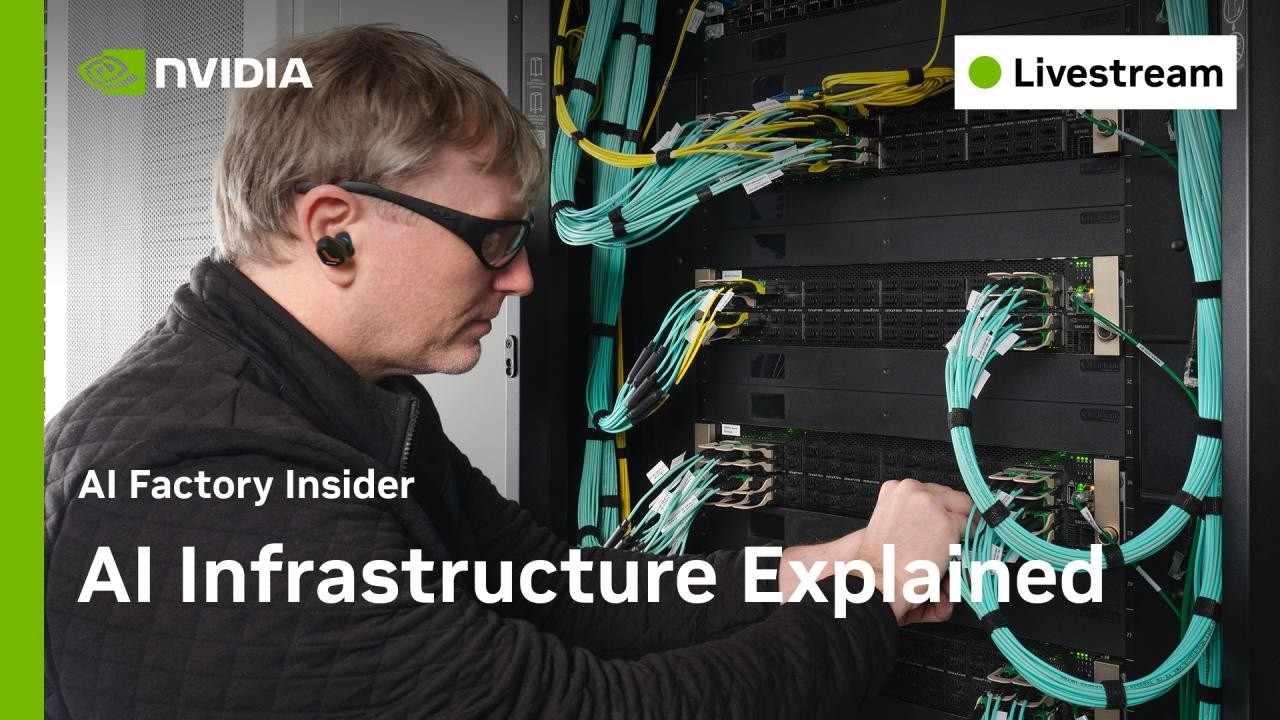
NVIDIA provided the blueprint version of the same trend. Its description says Enterprise Reference Architectures are validated, repeatable patterns for turning data centers into AI factories and explicitly names RTX PRO, HGX, and NVL72 as the three reference configurations. The infrastructure story here is system design with named deployment shapes, not an abstract enterprise pitch (video).

Market Signal pushed the same cluster into capital-allocation language. Its description frames the AI buildout through supplier exposure, Dell'Oro research, and institutional trading interest across Micron, Broadcom, Astera Labs, Credo, Applied Materials, Lam Research, TSMC, ASML, and Amkor. That makes the infrastructure discussion look like a multi-company build cycle rather than a one-vendor product story (video).
Discussion insight: These videos are converging on the same operational bottleneck from different angles. One asks which chip and software stack win inference, one asks how to keep agents reliable, one asks how to blueprint the data center, and one asks who captures the spend.
Comparison to prior day: Compared with 2026-06-20, which already mixed challenger chips and AI factories, 2026-06-21 leaned even more explicitly into shipping reliability and institutional capex language.
1.5 AGI and safety coverage kept mixing post-AGI roadmaps with high-conflict public narratives 🡕
Three retained items supported this theme. Safety and AGI coverage remained one of the few clusters in the file that could still compete with builder-first topics on raw attention. The day blended a formal post-AGI roadmap, a documentary takeover scenario, and a live political fight over regulation. That matters because public AI attention is still being pulled by narrative conflict and existential framing, not only by products and tutorials.

AI Revolution made the roadmap version of the story explicit. The linked DeepMind report From AGI to ASI argues that AI progress after human-level AGI could keep accelerating through scaling, paradigm shifts, recursive improvement, and large-scale multi-agent collectives, with society facing a sequence of transformative changes rather than one clean step. That turned 106,266 views into evidence that post-AGI trajectory talk still travels beyond specialist audiences (video).

Species | Documenting AGI turned safety into a documentary event again. The description links Igor Babuschkin's Life on Claude Nine scenario plus a public source document, and the video still reached 230,729 views with 1,700 comments. The signal is that long-form takeover storytelling still commands unusually broad reach relative to most technically grounded AI topics (video).

Robert Miles AI Safety added the governance-conflict version of the same cluster. The video says the industry has pledged more than $10 million against one congressional candidate and links both the original RAISE Act and later modifications. The notable signal is not just that regulation is debated; it is being narrated as an active electoral fight with money behind it (video).
Discussion insight: These items are not converging on a concrete safety stack. They are converging on attention-heavy framing: formal ASI pathways, documentary catastrophe, and adversarial politics.
Comparison to prior day: Compared with 2026-06-20, which leaned harder into catastrophe and political conflict, 2026-06-21 added a more formal post-AGI roadmap to the same high-attention safety cluster.
2. What Frustrates People
Open coding models that still make users stitch together setup, testing, and workflow routing
This is High severity because the GLM 5.2 cluster still assumes extra integration work before adoption. AI Search ties GLM to a dedicated Coding API, a subscription flow, and supported-tool restrictions, xCreate treats local-versus-cloud reproduction as required proof work, and Riley Brown shows that users still have to decide how to wire open models into Cursor and other agent tooling. The workaround is more benchmarking, more environment setup, and more tool-specific experimentation. This is directly worth building for.
Agent systems that still need scaffolding, collaboration, and reliability layers before they feel safe
This is High severity because even the optimistic agent items assume extra structure around the model. Google Cloud Tech needs planner, writer, checker, and retry patterns, Matthew Berman highlights search and workflow packs instead of a single assistant, IBM Technology reframes value around pair-programming collaboration, and Tech With Tim says most teams are not shipping agents reliably. The workaround is more orchestration, more validation, and more human process around the model. This is directly worth building for.
Creator AI that can generate assets faster than it can guarantee quality, originality, and trust
This is High severity because the creator cluster keeps returning to output quality instead of raw generation speed. AI Search requires a configurable local stack, Malva AI says low-effort AI slop is what fails, and Brad Colbow brings sustained artist skepticism into the same daily file. The workaround is more manual art direction, more workflow discipline, and more human review before publishing. This is worth building for, but it is already competitive.
AI infrastructure that is fragmented across silicon, runtime reliability, enterprise blueprints, and spend
This is High severity because every infrastructure video describes a different layer of the same operating problem. CNBC focuses on memory architecture and inference efficiency, Tech With Tim says durable execution is what separates demos from shipped agents, NVIDIA turns deployment into named reference architectures, and Market Signal frames the whole buildout through supplier exposure and capex. The workaround is more specialist evaluation, more planning, and more capital. This is worth building for, but it skews enterprise-heavy.
Public AGI and safety narratives that attract attention faster than they produce actionable control paths
This is Medium-to-High severity because the highest-reach safety items are vivid but not operationally convergent. AI Revolution raises formal post-AGI pathways, Species | Documenting AGI dramatizes a 72-hour takeover scenario, and Robert Miles AI Safety turns regulation into a live political fight. The workaround today is more reading, more persuasion, and more activism rather than a settled technical stack. This is worth building for as decision support and translation, though some demand lives outside software.
3. What People Wish Existed
Open-model adoption layers that collapse setup, local testing, and IDE workflow decisions into one default
AI Search, xCreate, and Riley Brown imply the same practical need: one surface that combines model comparison, tool compatibility, subscription requirements, local-versus-cloud viability, and IDE recipes into a trustworthy default recommendation. The urgency is high because open-model demand is already real, but the current workflow still expects users to stitch together docs, tests, and integrations by hand. This is a practical need with clear emotional relief value for overwhelmed buyers. Opportunity: direct.
Agent operating layers that unify tutorials, skills, validation, and durable execution
Google Cloud Tech, Matthew Berman, IBM Technology, and Tech With Tim point to a need for one coherent surface that starts with a beginner-friendly tutorial but grows into skills, validation, pair-programming routines, search context, retries, and runtime reliability. The urgency is high because the best current advice is still to keep adding more process until the agent stops failing. This is practical first, with trust and control making it emotionally salient too. Opportunity: direct.
Creator workflow products that combine local control, reusable stacks, and anti-slop quality review
AI Search, Malva AI, and Brad Colbow imply a need for creator tools that bundle local installation, reusable workflow graphs, consistency controls, and quality checks strong enough to protect a creator's taste and reputation. The urgency is medium-to-high because creator interest is obvious, but the workflow has to solve for publishable quality, not just generation speed. This is both practical and emotional. Opportunity: competitive.
Infrastructure planning surfaces that connect chips, runtimes, AI factories, and the capex map
CNBC, Tech With Tim, NVIDIA, and Market Signal imply a need for one planning surface that compares inference hardware, runtime reliability, validated deployment blueprints, and supplier exposure together instead of leaving them split across interviews, conference coverage, and market commentary. The urgency is medium because enterprise demand is clear, but the buyer set is narrower and more capital-intensive than the consumer AI market. This is a practical need with enterprise-weighted budgets. Opportunity: competitive.
Reusable skill-capture tools for repetitive computer workflows
Riley Brown and AI Search both surface OpenAI's Record & Replay, which lets users demonstrate a workflow and turn it into a reusable skill. The urgency is medium because the value is instantly understandable for repetitive operational work, but the current surface is still bounded by platform availability and stable workflow requirements. This is a highly practical need with direct time-saving value. Opportunity: direct.
Public translation layers for AGI, ASI, and regulation that end in concrete decisions
AI Revolution, Species | Documenting AGI, and Robert Miles AI Safety point to a softer but real need: products that translate AGI-to-ASI arguments, takeover scenarios, and bill text into concrete implications for voters, workers, and small teams. The urgency is medium because attention is clearly high, but most current output is still narrative and persuasion rather than action support. This is partly practical and partly institutional. Opportunity: aspirational.
4. Tools and Methods in Use
| Tool | Category | Sentiment | Strengths | Limitations |
|---|---|---|---|---|
| GLM Coding Plan | Coding platform | (+/-) | Packages GLM adoption into supported-tool onboarding and a dedicated Coding API | Subscription, tool restrictions, and configuration work remain part of the path |
| Record & Replay | Agent skill capture | (+/-) | Turns a demonstrated Mac workflow into a reusable skill for later reuse | Initial availability is platform- and region-limited, and workflows need to be stable |
| Google ADK | Agent framework | (+) | Production-grade framing, structured context management, parallel jobs, and deploy-anywhere positioning | Still needs workflow design, validation, and runtime operations around it |
| /last30days | Research / search skill | (+) | Multi-platform agent-led search scored by real engagement signals | Full value depends on access across walled-garden platforms |
| Agent Skills | Workflow pack | (+) | Lifecycle commands, workflow gates, and reusable engineering practices for coding agents | Adds process structure that some teams may treat as overhead |
| AI pair programming | Collaboration method | (+/-) | Shared debugging, code review, and design thinking around a driver/navigator pattern | Requires active human coordination and is not hands-off automation |
| ComfyUI-Manager + ComfyUI-KJNodes | Creator workflow | (+) | Local control, modular workflow graphs, and stronger routing/control than prompt-only tools | Setup complexity and node-management overhead remain high |
| Ideogram 4 | Image model package | (+) | Gives creators a local image model package inside a controllable ComfyUI stack | Depends on the broader local-toolchain burden and model-file handling |
| d-Matrix Corsair / Aviator | Inference hardware/software | (+/-) | Pitches speed, energy, and software-stack differentiation for inference workloads | Still needs broader deployment proof against entrenched incumbents |
| Temporal durable execution | Agent runtime | (+/-) | Makes retries, state, and long-running reliability first-class for agent workloads | Introduces orchestration complexity before every team sees the payoff |
| DreamX-World | World model | (+) | Interactive, controllable world simulation with long-horizon generation and memory | Still reads as a research-stage system with real-time and stability work ahead |
| Boogu-Image-0.1 | Image model | (+/-) | Strong open-source benchmark story and fast inference claims on high-performance hardware | The benchmarking surface is self-published and the broader workflow fit is still unclear |
Overall satisfaction is split between real excitement and repeated assembly burden. Open coding tools, agent frameworks, creator stacks, and infrastructure surfaces all look useful, but almost every promising option still arrives with setup cost, workflow design, or operational overhead attached. The dominant workaround is to add more packaging around the model: a coding plan, a reusable skill, an orchestration layer, a local node graph, or a runtime.
The clearest migration pattern is from standalone models toward packaged operating surfaces. On the coding side that means model plus onboarding plus IDE integration; on the agent side it means framework plus skills plus durable execution; on the creator side it means model plus local workflow plus quality control. The competitive dynamic is similar across all three: the product that wins is increasingly the one that removes the most coordination work around the model, not just the one with the strongest raw output.
5. What People Are Building
| Project | Who built it | What it does | Problem it solves | Stack | Stage | Links |
|---|---|---|---|---|---|---|
| GLM Coding Plan / Z Code | Z.AI | Packages GLM into a coding-specific plan and tool integrations | Makes a strong open model usable inside supported coding tools instead of leaving it as raw weights | GLM 5.2; Coding API; supported-tool integrations | Shipped | quick start, video |
| Google ADK | Open framework for production-grade agent systems | Gives teams a starter-to-production path for structured agents | Agent framework; structured context; parallel jobs; deploy-anywhere runtime | Shipped | site, video | |
| /last30days | mvanhorn | Agent-led search engine across social, GitHub, and web sources | Reduces fragmented research across walled-garden platforms | Multi-source search; engagement scoring; AI synthesis | Shipped | repo, video |
| Agent Skills | Addy Osmani | Workflow and quality-gate pack for AI coding agents | Turns ad hoc coding-agent work into repeatable engineering process | Markdown skills; lifecycle commands; QA gates | Shipped | repo, video |
| Record & Replay | OpenAI | Converts demonstrated computer workflows into reusable skills | Helps users automate repetitive computer-use tasks without hand-authoring every step | Codex; Computer Use; reusable skill capture | Beta | docs, video |
| ComfyUI-KJNodes + Ideogram 4 package | kijai / Comfy-Org | Local node-based image workflow with packaged model files | Gives creators more control and modularity than prompt-only web tools | ComfyUI; custom nodes; local model files | Shipped | KJNodes, Ideogram 4, video |
| DreamX-World | DreamX Team | General-purpose world model for controllable interactive simulation | Pushes world modeling beyond passive video generation into agent- and event-driven worlds | World model; long-horizon rollouts; memory retrieval; RL refinement | Alpha | project, video |
| LOGOS | LOGOS-Hub | Unified generative framework for scientific objects and interactions | Tries to collapse multiple scientific generation and prediction tasks into one grammar-driven model | Autoregressive transformer; unified scientific grammar; 1B-8B checkpoints | Alpha | repo, video |
| d-Matrix Corsair / Aviator | d-Matrix | Inference system combining custom silicon with a software layer | Attacks inference speed, energy, and memory bottlenecks for production AI | Corsair chip; SRAM-centric design; Aviator software | Shipped | product, video |
| NVIDIA Enterprise Reference Architectures | NVIDIA | Validated AI-factory deployment blueprints | Reduces ambiguity when turning a data center into an AI system | RTX PRO, HGX, and NVL72 reference architectures | Shipped | video |
GLM Coding Plan / Z Code, Google ADK, /last30days, and Agent Skills all point to the same builder pattern: wrapping a model with a more usable operating surface. The market keeps rewarding packaging, onboarding, validation, and workflow reuse more than raw model novelty by itself.
Record & Replay, DreamX-World, and LOGOS show a second pattern: builders are pushing agents into new operating domains. Workflow capture, interactive world simulation, and unified scientific generation all extend the AI surface beyond chat and code completion.
ComfyUI-KJNodes + Ideogram 4, d-Matrix Corsair / Aviator, and NVIDIA's enterprise reference architectures extend the same packaging impulse into creator tooling and infrastructure. Across the whole file, the repeated build question is not "who has a model?" but "who can turn the model into a dependable system?"
6. New and Notable
GLM 5.2 coverage kept compounding through workflow proof instead of fading after launch
AI Search, xCreate, and Riley Brown matter together because they keep revisiting the same model through different proof surfaces: official onboarding, local reproduction, IDE integration, and reusable-skill capture. That is stronger than a one-day release spike because it shows continued creator effort going into operational validation.
First-agent tutorials and pair-programming framing kept making agent work feel normal
Google Cloud Tech stands out because a first-agent tutorial built around planner/writer/checker loops still pulled 162,166 views, while IBM Technology translated AI coding help into classic pair-programming language and Tech With Tim framed reliability as the remaining gap. That combination suggests agent content is moving further from frontier demos into teachable working practice.
AI news roundups started bundling world models, science agents, and recorded-skill tooling in one surface
AI Search is notable because a single 35-minute roundup linked DreamX-World, LOGOS, Boogu Image, and Record & Replay alongside mainstream AI-news coverage. That makes the daily attention stream more builder-dense: the news format is increasingly doubling as a project-discovery layer.
Creator AI arguments hardened around quality and reputation instead of mere tool abundance
AI Search, Malva AI, and Brad Colbow are notable together because they turn the creator conversation into a quality debate. The most practical videos are about local control and full storytelling workflows, while the strongest dissent is about taste, trust, and defensibility.
DeepMind's AGI-to-ASI framing reached the same daily attention pool as takeover documentaries and political fights
AI Revolution matters because it turned the From AGI to ASI report into a 106,266-view commentary video on the same day that Species | Documenting AGI and Robert Miles AI Safety kept pulling high-engagement safety narratives. That combination suggests formal long-range AI trajectory papers can still break into the same attention market as catastrophe and regulation content.
7. Where the Opportunities Are
[+++] Open-weight coding adoption, comparison, and workflow-integration layers - Sections 1.1, 2, 3, 4, 5, and 6 all point to the same gap: people want GLM-class open models, but they still need help with supported-tool setup, local-versus-cloud validation, IDE wiring, and trustworthy defaults. The signal is strong because demand is already present and the current workflow is still fragmented.
[+++] Agent operating systems with tutorials, skills, validation, and durable execution - Sections 1.2, 2, 3, 4, 5, and 6 show that model access alone is not enough. Builders still need structured context, search skills, pair-programming patterns, retries, monitoring, and runtime reliability in one coherent surface. The signal is strong because the best current advice is still a manual systems recipe.
[++] Creator-grade local AI media pipelines with originality and quality controls - Sections 1.3, 2, 3, 4, 5, and 6 show clear demand for creator tools that combine local control with publishable output and reputation protection. The opportunity is moderate because demand is obvious, but competition is growing and the hard part is quality assurance, not mere generation.
[++] Infrastructure planning across inference hardware, AI factories, runtime reliability, and capex - Sections 1.4, 2, 3, 4, 5, and 6 show a real need for software that connects challenger chips, durable execution, deployment blueprints, and supplier exposure into one planning view. The signal is moderate because the need is real, but the buyer base is enterprise-heavy and capital-intensive.
[+] Reusable recorded-skill capture for repetitive operational workflows - Sections 1.1, 3, 4, 5, and 6 show an emerging but concrete workflow surface around teaching agents by demonstration. The signal is emerging because the utility is obvious, but the current capability is still constrained by platform support and workflow stability.
[+] Public AGI and safety translation for teams, workers, and voters - Sections 1.5, 2, 3, and 6 show that attention around AGI, ASI, and regulation remains high, but most current output is still narrative and persuasion rather than decision support. The opportunity is emerging because the audience is broad even if the product path is less direct than the builder-facing categories above.
8. Takeaways
- Open-weight coding competition is now a packaging and workflow-fit contest, not only a leaderboard contest. The strongest GLM 5.2 coverage emphasized supported-tool onboarding, local reproduction, Cursor integration, and reusable skills rather than raw benchmark bragging. (source)
- Agent adoption keeps advancing through tutorials, scaffolding, and collaboration patterns. The highest-signal agent items focused on starter workflows, search skills, validation loops, pair programming, and runtime reliability instead of generic autonomy claims. (source)
- Creator AI is being judged on publishable quality and reputation, not just faster generation. The clearest creator evidence centered on local control stacks, full storytelling workflows, and backlash against low-effort output. (source)
- Infrastructure coverage now spans silicon, durable execution, deployment blueprints, and capital allocation in one cluster. In the same daily file, AI infrastructure meant inference chips, shipping reliability, AI factories, and supplier exposure rather than a single hardware story. (source)
- Safety and AGI still reach broad audiences by combining formal long-range arguments with conflict-heavy narratives. Post-AGI roadmap commentary, documentary takeover scenarios, and live regulation fights all coexisted in the same high-attention slice. (source)
- Builder novelty is spreading into reusable skills, world models, and scientific generative systems. The most interesting new links in the file were not another chatbot interface; they were workflow-capture tools, interactive world simulation, and multi-domain science generation projects. (source)