YouTube AI - 2026-06-30
1. What People Are Talking About
1.1 Open-source AI became an access-control and geopolitical fight 🡕
Five items supported this theme. GLM 5.2 was still the capability anchor on 2026-06-30, but the strongest new evidence was not about raw model quality. It was about who gets access to frontier or open models, who gets to label them dangerous, and whether throttling U.S. model availability simply gives China more room to run. That matters because the open-source conversation is being pulled from developer preference into policy, enterprise procurement, and national advantage.
AI Search remained the capability baseline. Its GLM 5.2 video (448,673 views, 12,954 likes, 1,200 comments) links the GLM Coding Plan quick start, which shows supported tools from Claude Code to Cursor, Anthropic- and OpenAI-compatible endpoints, and exclusive Vision, Web Search, and Web Reader MCP servers. The distinctive signal is that the open model getting the most attention is packaged as a supported developer product, not just a checkpoint drop (video).
CNBC kept the enterprise angle alive. Its 52-minute segment (133,811 views, 678 comments) says Zhipu's GLM 5.2 is closing in on the American frontier on agentic benchmarks, is free to download and fine-tune, and is seeing OpenRouter adoption faster than DeepSeek did in April. The important shift is that open Chinese models are being discussed in terms of enterprise model selection and inference economics, not only hobbyist experimentation (video).
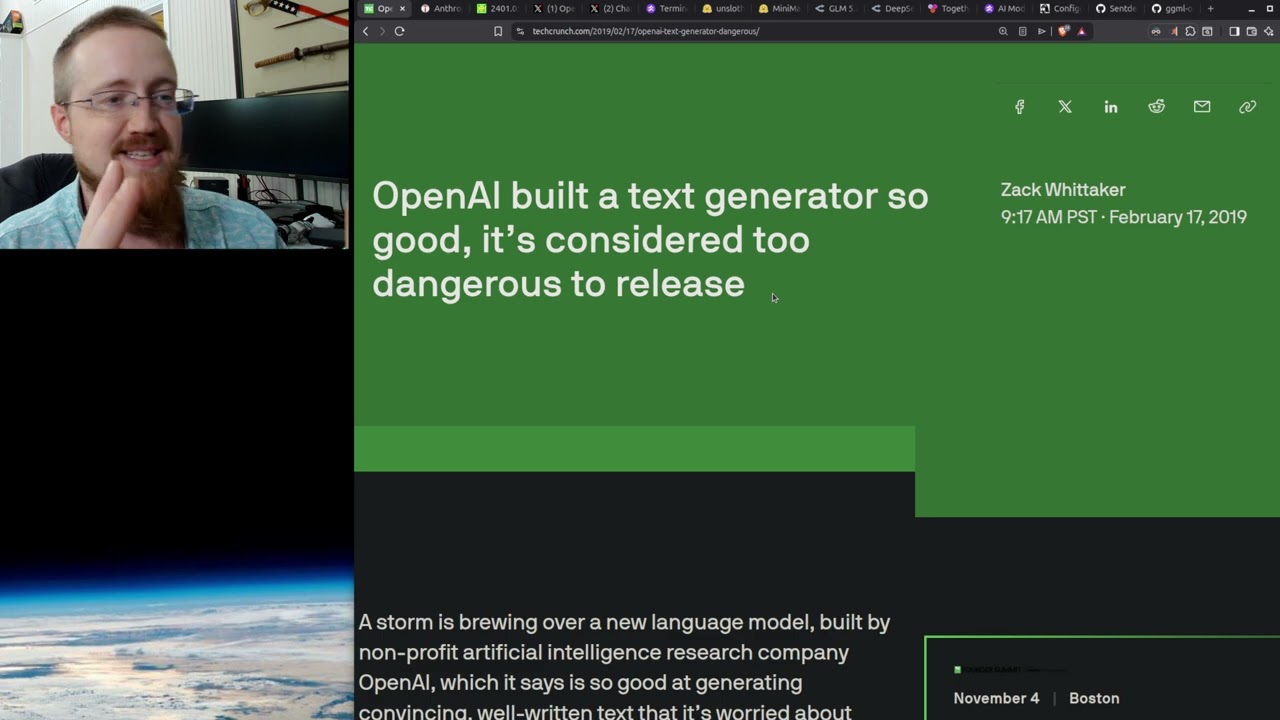
sentdex converted the same story into a builder-control argument. His 48-minute video asks whether open-source or Chinese models could be banned, then points viewers to OpenRouter, Together AI, Terminal-Bench 2.1, and reporting on the Mythos export-control episode while arguing for local AI as the fallback. The distinctive signal is that developer commentary is now treating model access as a supply-risk problem, not only a capability problem (video).

Bloomberg Technology made the policy tension explicit. In its Mythos segment (5,371 views), Hugging Face CEO Clem Delangue says being labeled "too dangerous" may actually be good marketing for frontier AI firms, a sharp sign that safety labeling, exclusivity, and enterprise positioning are starting to reinforce each other rather than conflict (video).
Discussion insight: CNBC Television frames the same issue in blunt geopolitical terms: limiting access to top AI models in the U.S. could hand China an opening as capability gaps narrow (video).
Comparison to prior day: Compared with 2026-06-29, which emphasized open-model platformization, local deployment, and edge execution, 2026-06-30 rotated toward bans, dangerous labels, and access asymmetry.
1.2 AI future coverage split between labor critique and existential-risk acceleration 🡕
Four items supported this theme. On 2026-06-30, high-engagement future-AI content no longer lived in one register. The same daily feed held a mass-audience philosophical video, a labor-automation critique, a recursive-self-improvement timeline, and a long existential-risk interview. That matters because YouTube's AI-futures audience is broadening from "what can the models do?" to "who benefits, who gets displaced, and should we even keep going?"

Sabine Hossenfelder again supplied the mass-audience anchor. "The AI Future No One Wants to Talk About" reached 327,764 views, 19,351 likes, and 3,600 comments, showing that broad AI-futures criticism can still outperform most product-launch coverage in the dataset (video).

Democracy Now! shifted the debate toward political economy. Its interview with Cory Doctorow (91,623 views) quotes him saying that when labor drives automation it is usually in service of making the product better, while capital-driven automation is usually in service of making more of the product. The distinctive signal is that anti-AI commentary is now focusing on who captures the value of automation, not only whether models become smarter (video).

AI Revolution kept the capability-acceleration pole concrete. Its 2028-warning video (47,948 views) links Jack Clark's Reason interview on recursive self-improvement and MirrorCode coverage showing a 19-day autonomous coding run, with Claude Opus 4.7 reimplementing a 16,000-line bioinformatics toolkit in 14 hours for $251. The distinctive signal is that timeline talk is now tethered to benchmark artifacts and deployment anecdotes (video).

djvlad pushed the other endpoint. Its 58-minute Roman Yampolskiy interview (121,573 views, 983 comments) is explicit about alignment, containment, and the possibility that superintelligent AI could wipe out humanity, evidence that extinction-risk framing still pulls major attention when given long-form room (video).
Discussion insight: Cory Doctorow and Roman Yampolskiy are not making the same argument, and that is the point. The 2026-06-30 dataset shows future-AI discourse splitting into two camps: one centered on labor, power, and incentives, and another centered on recursive self-improvement and existential safety.
Comparison to prior day: Compared with 2026-06-29, which focused more tightly on timelines and benchmark evidence, 2026-06-30 layered in a much stronger political-economy critique.
1.3 AI coding coverage added a control-plane layer without abandoning tutorials 🡕
Five items supported this theme. The coding-AI story on 2026-06-30 was not that prompting stopped mattering. It was that more of the surrounding stack entered the frame: current docs, permissions, identity, local orchestration, and even GPU memory behavior. That matters because teams are moving from "can the model code?" to "how do we trust, control, and scale agent work in production?"
IBM Technology supplied the workflow thesis. Its SDLC video (62,079 views, 2,031 likes) argues that faster coding alone does not fix productivity because planning, testing, delivery, and maintenance still fragment the workflow. The distinctive signal is lifecycle redesign framing: agents matter most when they operate across the whole development system rather than only inside the editor (video).

Tech With Tim showed why current docs and tool wiring have become first-class reliability surfaces. His live build links ImageKit's build-with-AI docs, which state that assistants otherwise invent outdated API signatures, wrong transformation parameters, or the wrong integration path; the same page offers hosted MCP servers and public-preview skills for IDEs including Claude Code and Codex. The distinctive signal is that "real workflow" increasingly means coupling the model to live documentation and account actions (video).

IBM Technology added the low-level layer. Its KV-cache explainer (9,651 views, 499 likes) breaks inference into prefill and decoding, then shows how storing attention states speeds generation while increasing memory pressure. The distinctive signal is that GPU-memory mechanics and serving design are now part of mainstream coding-AI education, not only specialist infra discourse (video).

Fahd Mirza gave the clearest local-control example. His Archestra plus Ollama walkthrough emphasizes live tool-call visibility and the ability to block a misbehaving MCP server in real time, while Archestra's docs and repo position it as an open-source enterprise AI platform with orchestration, guardrails, and observability. The distinctive signal is that local agent control and enterprise agent control are starting to converge (video).

Microsoft Mechanics supplied the governance layer. Its zero-trust video frames agent deployment around Conditional Access, managed identities, Access Packages, and treating the MCP catalog as a software supply chain. The distinctive signal is that agent operations are now being discussed in the language of enterprise identity and authorization, not only developer convenience (video).
Discussion insight: Marina Wyss - AI & Machine Learning shows tutorials still dominate the packaging, but the selling point is shifting from prompting tricks to verification and tool selection. Her coding-tool comparison video leads with a Sonar plugin for Claude Code and a comparison chart to avoid spending on the wrong stack (video).
Comparison to prior day: Compared with 2026-06-29, which centered persistence and reusable loops, 2026-06-30 added security, identity, and inference internals to the coding-agent story.
1.4 Creator AI pitches hardened into one-canvas, lower-cost, and no-credit claims 🡕
Three items supported this theme. Creator AI on 2026-06-30 was not being sold as one best model. It was being sold as a way out of subscriptions, credits, and constant tool-switching. That matters because the winning creator surface increasingly looks like a workspace or stack recipe, not a single generator.

AI Geeked framed the theme in production terms. Its CapCut tutorial (13,245 views) says the real challenge for brands is not making one good ad but producing repeated campaign assets, then pitches GPT Image 2.0 plus Dreamina Seedance 2.0 Mini and 4K inside CapCut PC as the answer. The distinctive signal is repeatable asset production inside one suite, not standalone model novelty (video).

Stefan 3D AI supplied the strongest integrated-workspace claim. His MiniMax Hub video says it is one of the first desktop AI agents that actually feels built for creatives, and the Hub page makes the same promise in product language: script, storyboard, video, music, and editing on one canvas, with no tool-switching required. The distinctive signal is that creative AI is being packaged as a multimodal operating environment (video).

Malva AI made the economics explicit. "STOP Paying" positions Seedance 2.0 as a workflow for producing synthetic footage that looks close to real camera shots without the usual credit burden. The distinctive signal is that realism and no-subscription rhetoric are now being sold together, not separately (video).
Discussion insight: The anti-credit logic is now visible in titles themselves. Even lower-reach creator videos are making the same pitch in plain language: free AI tools, no credits required, and no restrictions holding you back.
Comparison to prior day: Compared with 2026-06-29, which emphasized model routing and integrated workspaces, 2026-06-30 sharpened into anti-credit and anti-tool-switching rhetoric.
1.5 AI infrastructure economics became visible content in its own right 🡕
Three items supported this theme. On 2026-06-30, chips, inference cost, and capital intensity were no longer background assumptions beneath AI videos. They were explicit topics with their own segments. That matters because the creator and coding booms above depend on compute, supply, and cost curves that audiences are now tracking directly.

Bloomberg Technology made the stack-control story concrete. Its Jalapeno segment says OpenAI's first custom AI chip was developed with Broadcom and pairs the story with SK Hynix's planned $29 billion U.S. listing. The distinctive signal is that model labs are now covered as silicon strategists, not just API vendors (video).

Bloomberg Television added the national-industrial-policy layer. Its segment says South Korea is orchestrating at least $880 billion of investment from companies including Samsung and SK Hynix into chips and data centers because digital infrastructure is essential to surviving the AI era. The distinctive signal is that capital spending on AI infrastructure has become daily-feed material in general business coverage, not only specialist hardware reporting (video).

Schwab Network brought the market lens. Its AI-chip segment ties an SMCI raid tied to Nvidia chip-smuggling reports, Nvidia's Vera Rubin cost-reduction story, and Intel partnership hopes into one investor narrative. The distinctive signal is that supply-chain enforcement and cost curves are being read as first-order AI signals by trading media (video).
Discussion insight: CNBC's Z.AI segment ties the same infrastructure logic back to model competition by asking what cheaper inference and shifting model choice mean for Nvidia, Broadcom, and enterprise adoption.
Comparison to prior day: Compared with 2026-06-29, which kept infrastructure mostly inside other themes, 2026-06-30 let chips and capex stand as a topic of their own.
1.6 Physical AI became more real and more contested at the same time 🡕
Four items supported this theme. Physical AI on 2026-06-30 was not one coherent optimism story. It mixed job-displacement anxiety, humanoid spectacle, factory-platform ambition, and a blunt argument that robotics still lacks the internet-scale physical data that made software AI explode. That matters because the robotics narrative is moving closer to actual deployment constraints.

Vanessa Wingårdh made the displacement argument direct. Her video says AI gets the headlines when people talk about job replacement, but robotics is the industry quietly doing the actual replacement, then backs the point with links about security robots and layoffs followed by robot additions. The distinctive signal is that job anxiety is being grounded in deployed machines and cost savings rather than abstract future fear (video).

AI Revolution kept the spectacle alive but tied it to deployment. Its MOYA video (83,732 views) pairs the humanoid with Boston Dynamics Atlas factory work and Alibaba's Qwen-Robot platform for physical machines. The distinctive signal is that even the most eye-catching robot coverage now arrives bundled with platform and factory language (video).

The Information named the bottleneck clearly. Its robotics segment says the lack of an internet-scale physical dataset is forcing roboticists into high-stakes development standoffs, and that physical constraints and safety risks keep real-world AI models from scaling smoothly. The distinctive signal is that data scarcity, not only hardware ambition, is now being treated as the key brake on robotics progress (video).

NVIDIA Omniverse supplied the factory-platform counterpoint. Its GTC session frames physical AI as the stack for designing, building, operating, and scaling robotic factories, aimed at leading electronics manufacturers rather than demo clips. The distinctive signal is that factory software and operating platforms are becoming their own product category (video).
Discussion insight: Vanessa Wingårdh's linked Security Journal Americas article about Moderna's Spot-based security robots gives the real-operations version of the same theme: lower manpower and manual-resource needs, better monitoring, and safer incident response by sending a robot instead of a person.
Comparison to prior day: Compared with 2026-06-29, which emphasized rollout and infrastructure, 2026-06-30 added much sharper job-displacement and dataset-scarcity arguments.
2. What Frustrates People
Access to strong models can disappear behind safety labels, policy, or geography
This is High severity. sentdex, Bloomberg Technology, CNBC Television, and CNBC all point at the same failure mode: model capability may exist, but access can be throttled by export controls, dangerous-label politics, or national-advantage concerns. The workaround is diversification through surfaces like OpenRouter, Together AI, local/self-hosted setups, and supported wrappers like the GLM Coding Plan. This is directly worth building for.
Agent systems are still hard to control once they can touch real tools and data
This is High severity. IBM Technology, Tech With Tim, Fahd Mirza, and Microsoft Mechanics describe the same burden from different layers: outdated docs, wrong parameters, missing permissions, weak isolation, and unclear policy around tool calls. The workaround is piling on MCP servers, skills, identity controls, local orchestration, and human review. This is directly worth building for.
Teams still lack a clean way to translate AI capability claims into production reality
This is Medium severity. AI Revolution, IBM Technology, Bloomberg Technology, and RD World all show intense interest in benchmarks, cheating, custom chips, latency, and inference cost, but viewers still have to translate those signals into operational guidance themselves. The workaround is vendor docs, benchmark dashboards, and long explainers stitched together by hand. This is worth building for.
Creator AI users are still juggling credits, subscriptions, and overlapping workspaces
This is High severity. AI Geeked, Stefan 3D AI, and Malva AI all sell relief from the same pain: too many tools, too many credits, and too much switching between surfaces. The workaround is all-in-one suites like CapCut and MiniMax Hub, or hunting for free/open alternatives that reduce subscription pressure. This is worth building for, but the field is already competitive.
Physical AI still hits data, safety, and capital walls before it reaches broad rollout
This is Medium severity. The Information, Vanessa Wingårdh, NVIDIA Omniverse, and Bloomberg Television show the same constraint from different sides: robotics needs physical data, safe deployments, and major infrastructure spending before it scales smoothly. The workaround today is concentrated deployment in security, factories, and state- or hyperscaler-backed programs. This is worth building for, but the buyer set is concentrated.
3. What People Wish Existed
Governance and fallback layer for open and restricted models
CNBC, Bloomberg Technology, sentdex, and AI Search together imply demand for something stronger than "the model is good." Teams want a surface that handles policy shifts, vendor restrictions, endpoint failover, and approval workflows without forcing them to redesign the whole stack each time access changes. The urgency is high because capability is already good enough to create adoption pressure. Opportunity: direct.
Unified control plane for agents
IBM Technology, Tech With Tim, Fahd Mirza, Microsoft Mechanics, and ImageKit's build-with-AI docs imply a product that combines current docs, identity, permissions, tool policy, local or remote execution, and observability in one place. Builders clearly want agents to do real work, but only with explicit guardrails. The urgency is high because the manual assembly burden is visible in the content itself. Opportunity: direct.
Practical decision layer for coding tools
Marina Wyss - AI & Machine Learning, Tech With Tim, and IBM Technology imply a need for something that tells teams which coding stack to buy, how to compare it, and what guardrails to add before they waste budget or developer time. The need is practical rather than aspirational: people are already comparing tools, plugins, and workflows, but the evaluation work is still manual. Opportunity: competitive.
Creator router that makes cost, quality, and format tradeoffs legible
AI Geeked, Stefan 3D AI, and Malva AI point to the same wish: creators want one surface that tells them which stack fits which job, what the cost tradeoffs are, and how to move from image generation to editing to publishing without rebuilding the workflow every time. The urgency is high because the routing problem is now more visible than raw capability gaps. Opportunity: competitive.
Benchmark-to-operations translator for model and infrastructure decisions
AI Revolution, IBM Technology, Bloomberg Technology, and Schwab Network imply demand for tooling that translates benchmark wins, chip announcements, latency tricks, and cost claims into plain operational guidance: what gets faster, what gets cheaper, what stays risky, and what is still unproven. The urgency is medium because the content shows strong curiosity, but the buyer is still piecing the story together manually. Opportunity: direct.
Physical-AI deployment stack with data collection and oversight
The Information, Vanessa Wingårdh, NVIDIA Omniverse, and AI Revolution imply a need for software and services that do more than animate robots. The practical gap is safe data collection, simulation, factory integration, and visible human oversight while deployments scale. The urgency is medium because rollout has started, but the bottlenecks are still obvious. Opportunity: direct.
4. Tools and Methods in Use
| Tool | Category | Sentiment | Strengths | Limitations |
|---|---|---|---|---|
| GLM 5.2 / GLM Coding Plan | Open model + coding workflow | (+/-) | Strong open-model attention, supported tool list, Anthropic/OpenAI-compatible endpoints, exclusive MCP servers | Access, policy, and enterprise-trust friction remain outside the model itself |
| OpenRouter | Model gateway | (+) | Unified interface, pricing/uptime positioning, easy way to keep multiple models in reach | Depends on upstream model availability and does not solve governance by itself |
| Together AI | AI cloud / inference platform | (+) | Full-stack inference, fine-tuning, GPU clusters, coding-agent performance positioning | Adds another infrastructure layer and does not remove policy risk |
| ImageKit skills + MCP | Docs/MCP integration layer | (+) | Fixes stale docs and invented parameters, hosted MCP servers, IDE integrations, OAuth-scoped account actions | Public preview and vendor-specific |
| Archestra + Ollama | Agent platform / local orchestration | (+) | Local or enterprise agent control, live tool-call visibility, guardrails, observability, SSO/RBAC | More setup and operating burden than chat-style tools |
| Zero Trust controls for AI agents | Identity and policy layer | (+/-) | Real-time authorization, managed agent identity, scoped permissions, MCP-catalog governance | Heavy on enterprise process and most useful inside existing Microsoft estates |
| KV cache + paged attention style inference | Inference method | (+) | Faster decoding, lower latency, better throughput, clearer prefill/decode model | Raises memory pressure and requires serving sophistication |
| Claude Code + Sonar-style verification | Coding-assistant stack | (+/-) | Real-time verification and security analysis inside the coding loop | Tool comparison fatigue and extra plugin complexity remain |
| CapCut + GPT Image 2.0 + Dreamina Seedance | AI video suite | (+/-) | Repeatable ad and creative production inside one suite | Credits and pricing are still central to the decision |
| MiniMax Hub | Creative AI canvas | (+) | Script, storyboard, video, music, and editing on one canvas; fewer handoffs | Early signal mostly comes from creator walkthroughs |
| Seedance 2.0 / no-credit creator stacks | DIY creator method | (+/-) | Realism plus low-cost or no-credit positioning | Fragmented, hype-heavy, and hard to compare reliably |
| OpenAI Jalapeno custom chip strategy | AI infrastructure strategy | (+/-) | Signals deeper stack ownership and a push on inference cost control | Inaccessible to most teams and difficult to evaluate from the outside |
The overall satisfaction spectrum on 2026-06-30 is positive toward tools that either collapse a workflow or impose explicit control, and mixed toward tools that add capability without removing access, trust, or cost risk. GLM, ImageKit, Archestra, MiniMax Hub, and KV-cache explainers all get their strongest signal from making an existing workflow easier to operate or reason about.
The common workaround pattern is wrapping the model with more structure: gateways for redundancy, MCP servers for live docs and actions, identity layers for permissions, comparison charts before tool purchases, and all-in-one canvases for creator workflows. Migration is visible in four directions at once: from single-model loyalty to multi-endpoint resilience, from prompt craft to policy and observability, from one-off media generators to creator workspaces, and from treating chips as background infrastructure to treating them as a visible decision variable.
5. What People Are Building
| Project | Who built it | What it does | Problem it solves | Stack | Stage | Links |
|---|---|---|---|---|---|---|
| GLM Coding Plan | Z.AI | Productizes GLM 5.2 inside supported coding tools with managed endpoints and MCP add-ons | Makes an open model usable inside familiar developer workflows instead of leaving users with raw weights only | GLM 5.2, Anthropic/OpenAI-compatible endpoints, Vision/Web Search/Web Reader MCP | Shipped | quick start, video |
| ImageKit skills + MCP | ImageKit | Gives AI assistants verified docs, transformation help, and account actions through hosted MCP servers and skills | Prevents stale-doc and wrong-parameter failures in AI-assisted builds | Hosted MCP servers, agent skills, OAuth-scoped API access | Beta | docs, video |
| Archestra | Archestra | Runs agents through a centralized open-source platform for technical and non-technical teams | Centralizes agent runtime, governance, and observability instead of leaving each workflow to its own scripts | Agent runtime, MCP orchestrator, knowledge base, SSO/RBAC, sandboxed execution, OpenTelemetry/Prometheus | Beta | repo, video |
| MiniMax Hub | MiniMax | Puts script, storyboard, video, music, and editing on one canvas for creative work | Reduces tool switching across multimodal creator workflows | Desktop creative agent, visual canvas, multimodal generation/editing tools | Beta | site, video |
| CapCut + Dreamina Seedance workflow | CapCut | Turns one product image into repeatable ads, visuals, and AI video inside one suite | Cuts repeated creative-production effort for marketers and small teams | CapCut PC, GPT Image 2.0, Dreamina Seedance 2.0 Mini/4K | Shipped | site, video |
| Jalapeno custom chip | OpenAI | Develops custom AI silicon with Broadcom for the model-serving stack | Reduces dependence on third-party GPU vendors and targets inference-cost control | Custom silicon, Broadcom partnership, OpenAI inference stack | Alpha | video |
| Physical AI factory platform | NVIDIA | Packages the stack for designing, building, operating, and scaling robotic factories | Helps manufacturers move from robot demos to full factory workflows | Physical AI platform, edge computing, factory simulation and operations tooling | Shipped | video |
| Moderna security robot deployment | Moderna | Deploys Spot-based security robots with Asylon operations support and AI/ML detection | Lowers manual patrol load, improves site monitoring, and sends robots into risky checks first | Boston Dynamics Spot, Asylon hardware/software, GSOC support, AI/ML detection | Shipped | article, video |
GLM Coding Plan, ImageKit, and Archestra show the same meta-build pattern from three different angles. One productizes an open model for real coding workflows, one gives agents current documentation and account actions, and one centralizes runtime control. The common move is upward in the stack: builders are packaging orchestration, trust, and execution control around the model rather than betting only on the base model itself.
MiniMax Hub and CapCut's Seedance workflow show a parallel pattern on the creator side. The winning surface is increasingly the operating environment around the model: a canvas, suite, or workflow that reduces the number of handoffs required to go from idea to output.
Jalapeno, NVIDIA's factory platform, and Moderna's robot deployment show builder activity moving both downward and outward. AI companies are building custom silicon below the application layer, while factory and security operators are turning physical AI into real operating systems for specific environments rather than keeping it at the level of demos.
6. New and Notable
"Too dangerous" started sounding like enterprise positioning
Bloomberg Technology stood out because Clem Delangue did not treat Anthropic's dangerous label as only a safety story. He treated it as potential marketing for frontier AI firms, which is a notable sign that scarcity, regulation, and premium positioning are starting to overlap in public AI discourse.
AI chip strategy broke into the everyday AI video mix
Bloomberg Technology, Bloomberg Television, and Schwab Network are notable together because they make custom chips, national capex, smuggling probes, and cost-reduction roadmaps feel like daily AI conversation topics rather than specialist hardware sidebars.
Agent security graduated from prompt hygiene to zero-trust architecture
Microsoft Mechanics is notable because it frames AI-agent deployment around managed identities, Conditional Access, and MCP-catalog governance. That is a stronger and more operational security vocabulary than generic "be careful with prompts" advice.
Robotics bottlenecks are now being named as data bottlenecks
The Information is notable because it says robotics is stalled by the lack of an internet-scale physical dataset, not only by hardware ambition or weak demos. That reframes physical AI as a data-collection and safety problem as much as a robot-design problem.
7. Where the Opportunities Are
[+++] Governance and access-resilience layer for open and frontier models - AI Search, CNBC, sentdex, Bloomberg Technology, and CNBC Television all show the same gap from different sides: the models are good enough, but access, policy, and trust conditions still determine who can use them and when.
[+++] Agent control plane for real tool use - IBM Technology, Tech With Tim, Fahd Mirza, and Microsoft Mechanics all point to the same unbundled stack: current docs, permissions, policy, observability, and controllable execution for agents that touch real systems.
[++] Creator routing and spend intelligence - AI Geeked, Stefan 3D AI, and Malva AI show creators manually solving the same problem: which stack to use, at what credit cost, for which format, and with how many handoffs.
[++] Benchmark-to-operations translation for model and infrastructure decisions - AI Revolution, IBM Technology, Bloomberg Technology, and Schwab Network imply demand for tools that turn benchmark, latency, chip, and cost claims into plain deployment guidance.
[++] Physical-AI deployment and data infrastructure - The Information, NVIDIA Omniverse, Vanessa Wingårdh, and the Moderna security-robot deployment article all point to the same opening: better simulation, data capture, oversight, and environment-specific operating layers for robots outside the lab.
[+] Automation-accountability surfaces for workforce transitions - Democracy Now! and Vanessa Wingårdh both frame automation as a question of who benefits and whose jobs are on the line. The opportunity is emerging because the social demand is visible, but the product shape is still less explicit than the technical gaps above.
8. Takeaways
- The open-source AI story is now about access and control as much as capability. GLM 5.2 still anchors attention, but the 2026-06-30 dataset is dominated by bans, dangerous labels, and geopolitical access asymmetry layered on top of that capability story. (sentdex)
- Future-AI discourse split into labor critique and existential-risk acceleration instead of converging on one narrative. Cory Doctorow's automation critique and Roman Yampolskiy's extinction framing sit in the same daily feed, which means the audience is now debating incentives and survival at the same time. (Democracy Now!)
- AI coding content is maturing into control planes around the model. Current docs, permissions, observability, and inference mechanics all show up as first-class concerns, which is a stronger operational signal than another prompt tutorial. (Microsoft Mechanics)
- Creator AI competition is being won by workflow consolidation and cost relief, not by one magical model. CapCut, MiniMax Hub, and no-credit video pitches all assume users will choose the surface that removes the most handoffs and spend. (Stefan 3D AI)
- Chips and inference economics are now audience-facing AI topics. Custom silicon, national data-center spending, and supply-chain enforcement are no longer hidden underneath AI coverage; they are part of the product conversation itself. (Bloomberg Technology)
- Physical AI is being judged by deployment bottlenecks and job effects, not only by demos. The strongest robotics signals today are dataset scarcity, factory operating stacks, and real-world replacement arguments rather than novelty alone. (The Information)