YouTube AI - 2026-07-03
1. What People Are Talking About
1.1 Public attention stayed centered on AI's consequences for trust, work, and information access 🡕
Six items supported this theme. The highest-reach cluster in the 2026-07-03 YouTube AI dataset was not a product-launch wave but a bundle of search frustration, cost skepticism, unemployment fear, and long-horizon safety anxiety. That matters because the broadest audience is still using AI coverage to decide whether the technology is making core systems better or worse.

Switch and Click delivered the clearest real-world backlash signal. "Google Just Ruined Search, So I Tested Every Alternative" reached 296,628 views, 15,154 likes, and 2,000 comments, and the description links directly to DuckDuckGo, Startpage, Brave Search, and Kagi. The distinctive signal is that mainstream AI frustration is now translating into hands-on switching behavior around search itself, not just abstract complaints about quality (video).

Sabine Hossenfelder again carried the broadest audience. "The AI Future No One Wants to Talk About" reached 336,153 views, 19,671 likes, and 3,600 comments, keeping a general future-of-AI critique above every builder or creator workflow item in the same daily feed. The distinctive signal is that mass attention still flows first to interpretation and skepticism, not to the newest model or tool (video).

The Infographics Show added the sharpest cost-and-ROI critique. Its 2026-07-03 upload says Microsoft has started pulling back internal AI tools, Uber exhausted its AI budget in a few months, and leading companies are struggling to justify replacement economics, pushing the theme beyond culture-war rhetoric into operating-cost skepticism. The distinctive signal is that the "AI will replace office work" narrative is now being challenged through cost blowback rather than capability denial alone (video).

djvlad kept existential-risk coverage high in the ranking. Its Roman Yampolskiy interview climbed to 141,557 views and 1,100 comments while staying explicit about AGI, superintelligence, and catastrophic downside. The distinctive signal is that long-form safety pessimism still draws large engagement when it is presented as a full argument rather than a quick headline (video).
Discussion insight: AI Nutshell sharpened the same concern into a 2027 AGI and 99 percent unemployment claim, while the United Nations pushed the story toward governance and collective responsibility through the new international scientific panel report.
Comparison to prior day: Compared with 2026-07-02, which already had future-of-AI critique, labor anxiety, and safety pessimism near the top of the feed, 2026-07-03 made the downside conversation more concrete through search-switching behavior and explicit cost-justification failures.
1.2 Builders kept climbing from coding help to control layers, bounded agents, and workflow ownership 🡕
Six items supported this theme. The clearest builder activity on 2026-07-03 still sat above the model layer: loops, codebase memory, SDLC redesign, workflow packaging, and explicit limits on autonomy. That matters because the strongest product-building signal in the dataset is still about making agents dependable and commercially usable, not just more powerful.
Google DeepMind remained the cleanest control-layer anchor. Its 42-minute video reached 134,985 views and links to an AI Control Roadmap that treats internal agents as potential insider threats, layers system-level defenses on top of model alignment, and measures protection through coverage, recall, and time-to-response. The distinctive signal is that advanced-agent work is increasingly framed as security architecture and access control, not prompt craft (video).

Matthew Berman supplied the strongest reusable-infrastructure example. His roundup reached 80,434 views and points directly to Loop Library / Loopy, where loops tell agents what to do, how to check work, what to try next, and when to stop, and to codebase-memory-mcp, which packages a local knowledge graph and sub-millisecond structural queries for coding agents. The distinctive signal is that more builder energy is going into repeatable scaffolding and code intelligence than into one-off demos (video).
IBM Technology kept the workflow-redesign thesis explicit. Its SDLC video reached 65,872 views and argues that productivity gains stall if AI only accelerates coding while planning, testing, deployment, and maintenance remain unchanged. The distinctive signal is that enterprise-facing AI education is now treating agents as a delivery-system redesign problem rather than a faster autocomplete story (video).
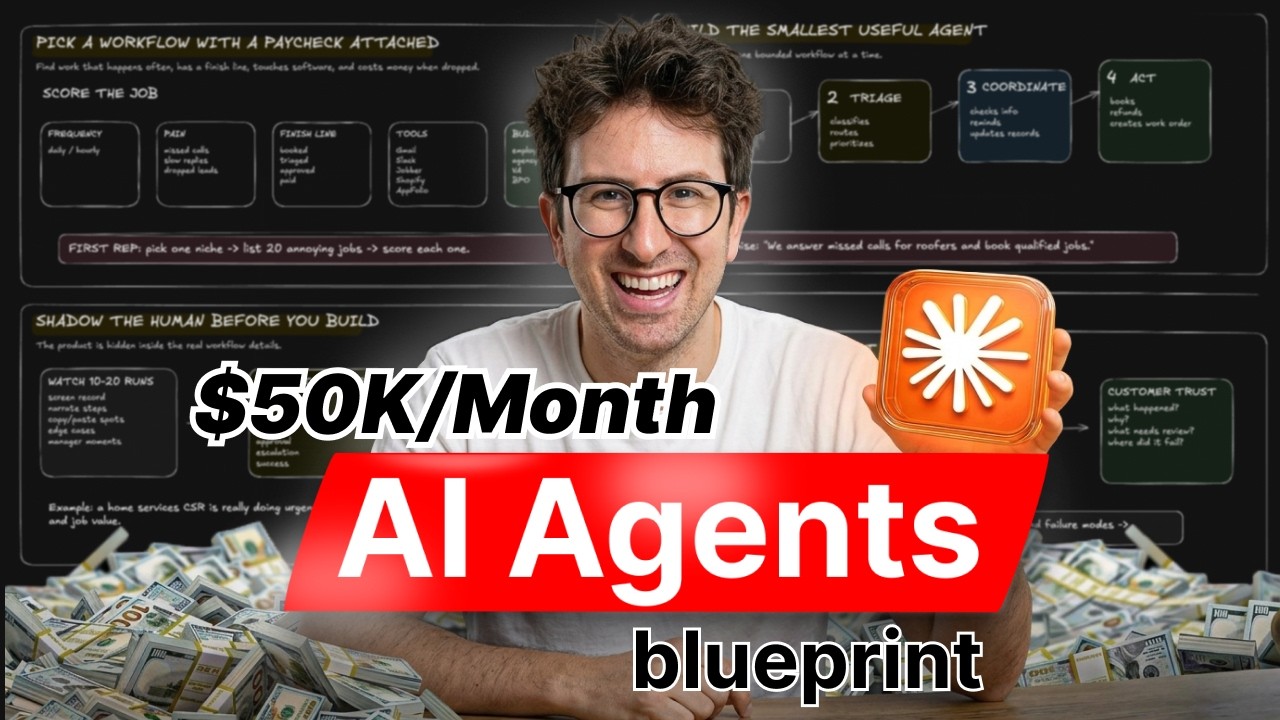
Greg Isenberg added the strongest commercialization angle. His episode says agent businesses should start with one workflow that already has a paycheck attached, shadow the human operator, sell the pilot like labor, and only then productize the repeatable parts. The distinctive signal is that builder ambition is clustering around owning a bounded workflow end to end rather than exposing another generic model surface (video).
Discussion insight: Cole Medin used Dan Shapiro's five-level coding-autonomy ladder to argue that the best setup is often below full autonomy today, while AI Brain framed the adjacent enterprise move as ambient agents that assist in the background rather than waiting for prompts.
Comparison to prior day: Compared with 2026-07-02, which already emphasized wrappers around the model, 2026-07-03 made the ceiling on autonomy more explicit and added stronger business-language about workflow ownership and ambient assistance.
1.3 Open and local AI was framed as useful only when paired with the right access and control surface 🡕
Five items supported this theme. The 2026-07-03 open-model conversation was not just about "best model" status. It mixed local image generation, open-model deployment paths, unfiltering workflows, and the opposite case of frontier capabilities that remain tightly gated. That matters because model quality is increasingly being judged together with access rules, workflow fit, and controllability.

AI Search delivered the highest-reach local-model signal. Its Krea 2 review reached 133,945 views and links to the technical report, ComfyUI weights, a conditioning-rebalance node, and Ostris AI Toolkit, while Krea's own report positions Krea 2 as an open-weights text-to-image family built for aesthetic diversity, prompt expansion, and style-reference control. The distinctive signal is that local creative AI is being sold as a controllable workflow stack, not a single "generate" button (video).

Matt Wolfe kept the open-model deployment story practical. His GLM-5.2 guide says the model can be used through a hosted web app, an API and agent harness, or self-hosted infrastructure, and he explicitly recommends traffic mirroring before a full cutover. The distinctive signal is that open-model excitement is being translated into staged migration tactics rather than benchmark bragging alone (video).

Siliconversations contributed the sharpest access-control counterexample. Its 2026-07-02 upload reached 44,375 views and points to Anthropic's Project Glasswing, where Claude Mythos Preview reportedly found thousands of zero-day vulnerabilities and remains restricted to a partner program rather than general release. The distinctive signal is that frontier-model safety is now being expressed through concrete cyber capability plus gated deployment, not abstract alignment language alone (video).

Aiconomist supplied the most explicit unfiltering angle. Its advanced Krea 2 tutorial links to the ComfyUI Conditioning Rebalance project, which pitches per-layer weighting and a way around the model's built-in quality dilution and filtering behavior. The distinctive signal is that community builders are already publishing control surfaces that let users push local models past the defaults set by the base release (video).
Discussion insight: Ai Dadaji showed the same access logic in the consumer-creator tier by collecting free video-generation surfaces from Wavespeed, Qwen, Arena, and Meta AI for people who want usable output now without paid lock-in.
Comparison to prior day: Compared with 2026-07-02, which pushed GLM and access hedging near the top of the feed, 2026-07-03 widened the frame into local creative control, explicit gating versus unfiltering, and stronger debate over who gets to use which capabilities under what constraints.
1.4 Creator AI stayed focused on free, repeatable, and automatable workflows rather than one perfect generator 🡕
Three items supported this theme. Creator-side demand on 2026-07-03 still clustered around lower spend, reusable prompt systems, and higher-throughput production flows. That matters because the winner in creator AI still looks more like the workflow that removes friction than the model that wins a single quality test.

Ai Dadaji made the free-access pitch explicit. Its roundup names Wavespeed, Qwen, Arena, and Meta AI as no-spend text-to-video and image-to-video options for creators who want output without subscriptions. The distinctive signal is that creator attention still goes first to cost removal and basic workflow viability, not to declaring one generator categorically best (video).

metricsmule added the strongest reusable-method signal. Its video turns one image-prompt formula into a reusable Claude Artifact and explicitly suggests testing the same system across Midjourney, Nano Banana 2, Ideogram 4, Seedream 4 4k, and Recraft v4. The distinctive signal is that creators increasingly value transferable prompt assets and model-routing habits over loyalty to one image stack (video).
aiTrends pushed the theme toward throughput. Its tutorial shows how to build a bulk image generator around Claude Code and Heclus, which pitches automated and customizable production from niche selection to full video. The distinctive signal is that creators are no longer just asking how to make a good image; they are trying to industrialize volume production (video).
Discussion insight: The adjacent AI Search and Aiconomist Krea 2 videos show the same preference from the open-source side: local control and fewer restrictions matter because creators want repeatable workflows, not one blessed closed model.
Comparison to prior day: Compared with 2026-07-02's louder "free" and "unlimited" rhetoric, 2026-07-03 pushed further toward reusable prompt assets, bulk generation, and workflow automation.
1.5 Physical AI kept grounding the story in current hardware stacks, not only humanoid spectacle 🡒
Two items supported this theme. Physical AI was a smaller share of the 2026-07-03 feed than policy, agent, and creator topics, but the strongest items were concrete about hardware, models, and assembly choices. That matters because embodied AI still looks most credible when it is presented as system integration instead of pure sci-fi theater.

AI Revolution kept humanoid spectacle tied to a broader platform story. Its MOYA video reached 96,134 views and links the warm-skin robot moment to Boston Dynamics Atlas and Alibaba's Qwen-Robot push for embodied systems. The distinctive signal is that even attention-grabbing robot clips now get bundled with platform, model, and factory language (video).

Coding with Lewis supplied the most concrete builder example. Its "Bop" robot uses an NVIDIA Jetson Orin Nano Super for the brain, Mistral Voxtral for voice, Mistral Vibe for firmware writing, and a 3D-printed body on an off-the-shelf chassis and battery pack. The distinctive signal is that embodied AI on YouTube is being assembled from current dev kits and model APIs rather than from mysterious proprietary stacks (video).
Discussion insight: Across both items, the common pattern is narrow capability plus explicit hardware choice: the story is less "general intelligence in a body" and more "which chip, which model, which task, and which physical constraints."
Comparison to prior day: Compared with 2026-07-02, which spread physical AI across companion robots, mine-clearing robots, and scientific copilots, 2026-07-03 narrowed toward consumer humanoids and maker-level robot builds.
2. What Frustrates People
Search quality and AI economics still feel worse than the pitch
This is High severity. Switch and Click, The Infographics Show, Sabine Hossenfelder, and AI Nutshell all point to the same gap from different angles: people are not only worried about AI in theory, they are testing alternatives because search feels worse, questioning whether automation pencils out economically, and worrying that the upside may bypass workers entirely. The current coping pattern is to route around the problem with alternative search tools, slower adoption, or governance language. This is directly worth building for.
Agentic workflows still need too much scaffolding, monitoring, and human judgment
This is High severity. Google DeepMind, Matthew Berman, IBM Technology, Greg Isenberg, and Cole Medin all show the same failure mode: once agents touch real work, teams still need loops, codebase memory, SDLC redesign, staged autonomy, and constant review just to keep the output trustworthy. The workaround is to wrap the model in checks, bounded workflows, and business-process ownership rather than let it run alone. This is directly worth building for.
Open and local models still require too much workflow glue and access negotiation
This is High severity. AI Search, Matt Wolfe, Siliconversations, and Aiconomist show the same friction from different sides: local and open models are attractive, but teams still need ComfyUI nodes, toolkit layers, self-hosting decisions, traffic mirroring, partner programs, or filter workarounds before the model is actually usable. The workaround is more control surface, not less. This is directly worth building for.
Creator automation is still fragmented across too many free tools and point solutions
This is Medium severity. Ai Dadaji, metricsmule, and aiTrends all sell relief from the same mess: too many separate generators, too much prompt translation, and too much manual work to move from one output to hundreds. The workaround today is free-tool roundups, reusable Claude Artifacts, and custom automation built around creator pipelines. This is worth building for, but the field is already getting crowded.
Physical AI still depends on manual integration and narrow task design
This is Medium severity. AI Revolution and Coding with Lewis both make the same constraint visible: embodied AI still works best when the builder is explicit about the chip, the model, the chassis, the power system, and the narrow task boundary. The workaround is to keep scope small and build on dev kits plus off-the-shelf parts instead of aiming for a general robot from day one. This is worth building for, but the hardware burden is real.
3. What People Wish Existed
Trustworthy search and discovery surfaces for the AI web
Switch and Click, The Infographics Show, Sabine Hossenfelder, and the United Nations together imply a practical need for search and information products that feel more accountable, less polluted, and easier to trust when AI changes how results are produced and ranked. The urgency is high because users are already testing alternatives instead of waiting for incumbent fixes. Opportunity: direct.
Operating layer for bounded, reviewable agents in coding and business workflows
Google DeepMind, Matthew Berman, IBM Technology, Greg Isenberg, Cole Medin, and AI Brain all imply the same missing layer: permissions, loops, memory, traces, receipts, and human review in one system. The need is practical rather than emotional because builders already want agents in production, but not without clear boundaries and current context. The urgency is high because almost every serious builder video is filling in part of this stack manually. Opportunity: direct.
Governance-aware deployment layer for open, local, and gated models
AI Search, Matt Wolfe, Siliconversations, and Aiconomist imply demand for something stronger than "this model is open" or "this model is powerful." Teams want the deployment path, control surface, access policy, and filter behavior to be legible before they commit a workflow to any model. The urgency is high because both local-image and coding-model adoption are already running into this problem. Opportunity: direct.
Creator workspace for low-cost multimodel production
Ai Dadaji, metricsmule, aiTrends, and AI Search point to the same practical wish: one surface that tells creators which model to use for which task, how to reuse a prompt asset, and how to turn one job into one hundred without rebuilding the flow every time. The urgency is high because the workflow problem is more visible than any single missing model capability. Opportunity: competitive.
Narrow-task embodied-AI starter stacks
AI Revolution, Coding with Lewis, and AI Nutshell imply a need for easier starter stacks that combine models, chips, chassis, sensors, and task boundaries for one real physical job at a time. The need is practical, but the urgency is only Medium because most evidence in the dataset still sits at the demo or enthusiast-build stage rather than broad operational rollout. Opportunity: aspirational.
4. Tools and Methods in Use
| Tool | Category | Sentiment | Strengths | Limitations |
|---|---|---|---|---|
| Krea 2 | Open-weight image model | (+/-) | Open weights, aesthetic diversity, prompt expansion, style-reference control, strong local-workflow appeal | Needs ComfyUI/toolkit glue and quickly runs into filtering and workflow-complexity debates |
| GLM-5.2 | Open model | (+/-) | 1 million token context, MIT-licensed open weight, hosted/API/self-hosted paths | Switching trust, governance, and cutover risk remain outside the model itself |
| Project Glasswing / Mythos Preview | Frontier cyber model / access program | (+/-) | Concrete zero-day discovery claims, strong coding and reasoning signal, partner-grade defensive workflows | Gated access and concentration risk are central to the story |
| AI Control Roadmap | Agent governance method | (+) | Defense-in-depth framing, insider-threat model, measurable coverage/recall/time-to-response metrics | Requires continuous monitoring and a surrounding supervisor stack |
| Loop Library / Loopy | Agent workflow library | (+) | Bounded loops, clear checks, stop rules, reusable catalog for repeated work | Still needs local adaptation and a runtime that can execute the loop safely |
| codebase-memory-mcp | Code intelligence / MCP | (+) | Persistent local knowledge graph, structural queries, fast code exploration, local processing | Separate install, indexing, and configuration step |
| Bitrix24 Co-pilot / ambient AI | Enterprise workspace assistant | (+/-) | Proactive, context-aware assistance that does not wait for explicit prompts | Trust boundaries, oversight, and handoff rules stay fuzzy |
| Claude Code + coding-agent ladder | AI coding workflow | (+/-) | Makes staged autonomy and review responsibilities legible, supports spec-to-code workflows | Full autonomy still produces more review burden than many teams can absorb |
| Claude Artifacts prompt systems | Prompt workflow method | (+) | Reusable prompt assets that transfer across multiple image models | Still needs manual tuning and model-specific judgment |
| Heclus + Claude Code bulk pipeline | Creator automation stack | (+/-) | Automated and customizable high-volume production flow | Requires custom setup and still depends on upstream generation tools |
| Wavespeed / Qwen / Arena / Meta AI | AI video generation | (+/-) | Free or low-friction experimentation across several video surfaces | Fragmented quality, fragmented UX, and no single reliable workflow |
| Jetson Orin Nano Super + Mistral Vibe/Voxtral | Robotics build stack | (+) | Reachable dev-kit path for embodied AI, pairing edge compute with voice and firmware generation | Hardware integration, power, and mechanical assembly stay manual |
The overall satisfaction spectrum on 2026-07-03 is most positive toward tools that add structure around the model and mixed toward tools that add raw capability without removing workflow friction. Krea 2, GLM-5.2, Project Glasswing, and the free video stack all attracted attention, but the strongest praise went to methods and tools that make AI behavior more controllable, reviewable, or reusable.
The common workaround pattern is more wrapper around the base capability: loops for repeated work, local memory for code context, traffic mirroring before a model switch, prompt assets for repeatable creator output, and dev kits for narrow robotics builds. Migration is visible in three directions at once: from single-model loyalty to routed multimodel workflows, from faster coding to bounded agent operations, and from one-off creator generations to reusable, automatable production systems.
5. What People Are Building
| Project | Who built it | What it does | Problem it solves | Stack | Stage | Links |
|---|---|---|---|---|---|---|
| Loop Library / Loopy | Forward Future | Publishes reusable loops and an installable skill that helps agents find, adapt, and run them | Gives agents bounded playbooks with checks and stopping rules for repeated work | Live loop catalog, installable Loopy skill, agent guide | Shipped | site, repo, video |
| codebase-memory-mcp | DeusData | Provides a persistent code knowledge graph and structural search layer for coding agents | Reduces file-by-file exploration and missing repository memory | Tree-sitter, Hybrid LSP, local MCP binary, knowledge graph | Shipped | repo, video |
| Project Glasswing | Anthropic | Gives selected partners access to Mythos Preview for vulnerability discovery and defensive cyber work | Helps defenders find and fix critical software flaws faster | Claude Mythos Preview, partner program, cloud API access | Beta | program, video |
| Krea 2 local creator stack | Krea | Ships open-weight image models that creators can run locally and adapt with community tooling | Gives creators more control, local execution, and fewer restrictions than closed image generators | Krea 2, ComfyUI, Conditioning Rebalance, Ostris AI Toolkit | Shipped | report, rebalance node, video |
| Dark Factory Experiment | coleam00 | Runs a public software factory where AI agents triage, implement, validate, and merge work with minimal human involvement | Turns issue-to-code work into a repeatable AI-managed workflow | Archon, Claude Code, MiniMax M2.7, GitHub workflows | Alpha | repo, background, video |
| Bop AI robot | Coding with Lewis | A DIY robot build with voice, generated firmware, and an edge-compute brain | Makes embodied-AI experimentation accessible to individual builders | Jetson Orin Nano Super, Mistral Voxtral, Mistral Vibe, 3D-printed body | Alpha | video, Jetson |
| Bulk AI image generator workflow | aiTrends | Automates large-batch image generation instead of creating one asset at a time | Helps creators scale from single outputs to high-volume production | Claude Code, Heclus, Nano Banana workflows | Alpha | Heclus, video |
Loop Library and codebase-memory-mcp show the same meta-build pattern from different directions. One packages repeated agent behavior into bounded loops; the other packages repository context into a fast local memory surface. In both cases, the product is the control layer around the agent, not the base model.
Project Glasswing and the Dark Factory Experiment sit at opposite ends of the autonomy spectrum, but they share one design instinct: validation and control are first-class product features. Glasswing narrows access to a dangerous frontier model inside a partner program for defensive cyber work, while the Dark Factory experiment treats holdout validation and workflow orchestration as the only way a specs-to-software loop can be trusted.
Krea 2, Bop, and the bulk-image workflow point to a second repeated pattern: builders are using accessible hardware and open or configurable software to move from one-off demos to local systems and higher-throughput pipelines. The common trigger is the same one visible elsewhere in the report: people want more control over cost, routing, filters, and repeatability than closed one-click products currently provide.
6. New and Notable
Search-alternative backlash became a top-tier AI audience signal
Switch and Click is notable because one of the largest videos in the entire 2026-07-03 dataset was not about a model launch but about abandoning Google search for alternatives. That is a stronger signal of user behavior change than generic complaints about AI quality.
The UN pushed AI governance into the daily YouTube feed
United Nations is notable because it brought the Preliminary Report of the Independent International Scientific Panel on Artificial Intelligence into the same daily feed as creator tutorials and safety arguments. The signal is not only policy talk, but that governance language is now part of mainstream AI media consumption.
Frontier-model safety showed up as concrete cyber capability, not abstract alignment talk
Siliconversations is notable because it anchors the day's safety coverage in Anthropic's Project Glasswing, where Mythos Preview reportedly found thousands of zero-day vulnerabilities and remains confined to a partner program. That is a far more operational safety signal than a generic "be careful with AI" warning.
Local creator tooling around Krea 2 crossed from niche workflow talk into high-reach coverage
AI Search is notable because the Krea 2 story combined open weights, ComfyUI integration, technical-report depth, and strong view velocity in one package. That suggests local-image workflows are now important enough to break out beyond small open-source circles.
7. Where the Opportunities Are
[+++] Operating layer for bounded, reviewable agent work - Google DeepMind, Matthew Berman, IBM Technology, Greg Isenberg, Cole Medin, and AI Brain all point to the same gap: teams want agents, but they want them wrapped in loops, memory, permissions, traces, and clear human handoffs.
[+++] Search and discovery products that feel more trustworthy in an AI-shaped web - Switch and Click, The Infographics Show, Sabine Hossenfelder, and the United Nations all reinforce the same opening: users are willing to change behavior when search quality, accountability, and economic value feel worse than promised.
[+++] Control plane for open, local, and gated model access - AI Search, Matt Wolfe, Siliconversations, and Aiconomist show the same need from different sides: users want model choice, deployment clarity, filter control, and access resilience together.
[++] Creator automation workspace for multimodel production - Ai Dadaji, metricsmule, aiTrends, and AI Search all point to the same manual routing problem: which model to use, how to reuse a prompt asset, and how to scale from one output to many.
[+] Embodied-AI starter kits for narrow tasks - AI Revolution and Coding with Lewis imply a smaller but real opening for products that package chips, models, sensors, and safe task boundaries into approachable robotics stacks.
8. Takeaways
- The biggest YouTube AI audience still leans toward backlash and interpretation, not launches. The top of the 2026-07-03 feed was dominated by search frustration, future-of-AI critique, and cost skepticism rather than by one new product release. (Switch and Click)
- Builder activity is still climbing above the model layer. The strongest product signals came from agent controls, loops, repository memory, and SDLC redesign rather than from raw capability gains alone. (Matthew Berman)
- Teams want open and local models only when the deployment path is legible. Hosted, API, self-hosted, gated, and unfiltered paths are now part of the product evaluation itself. (Matt Wolfe)
- Creator AI demand keeps shifting from one-off generation to reusable and automatable workflows. Prompt assets, free routing, and bulk pipelines matter more than declaring a single image or video model the winner. (metricsmule)
- Physical AI remains a stack-integration story. The most credible embodied-AI evidence in the dataset came from explicit hardware, model, and task choices rather than from general humanoid claims. (Coding with Lewis)
- Safety and governance are getting more operational. On this date, the clearest governance signals came from the UN's international-panel framing and Anthropic's partner-only cyber program, not just from abstract calls for caution. (Siliconversations)