YouTube AI - 2026-07-18
1. What People Are Talking About
1.1 Kimi K3 became the default reference point for frontier open models and China's catch-up story 🡕
Four items supported this theme. Compared with 2026-07-17's Kimi K3-versus-Inkling framing, 2026-07-18 concentrated more heavily on Kimi K3 itself: reviewers treated it as the benchmark open model to beat, and multiple videos tied that progress directly to China's position in AI.
AI Search supplied the day's strongest reach signal. Its 30-minute review reached 255,584 views, 8,783 likes, and 1,100 comments while running Kimi K3 through coding, Blender, 3D, deep-research, and science-adjacent tests. Kimi's public K3 blog says the model is a 2.8T-parameter open 3T-class system with a 1M-token context window, Kimi.com/Kimi Work/Kimi Code/Kimi API availability, and full weights planned for 2026-07-27. The distinctive angle is that open-model credibility was being argued through long workflow demos rather than through leaderboard screenshots alone (video).

AI Revolution pushed the same model into a geopolitical frame. Its 14-minute video reached 35,923 views, 1,189 likes, and 141 comments, and the description cites Reuters coverage of Moonshot closing in on top U.S. systems plus Arena frontend and web-dev evaluations. The distinctive angle is that Kimi K3 was being sold not only as a strong open model, but as evidence that China's open-weight stack is moving closer to the global frontier (video).
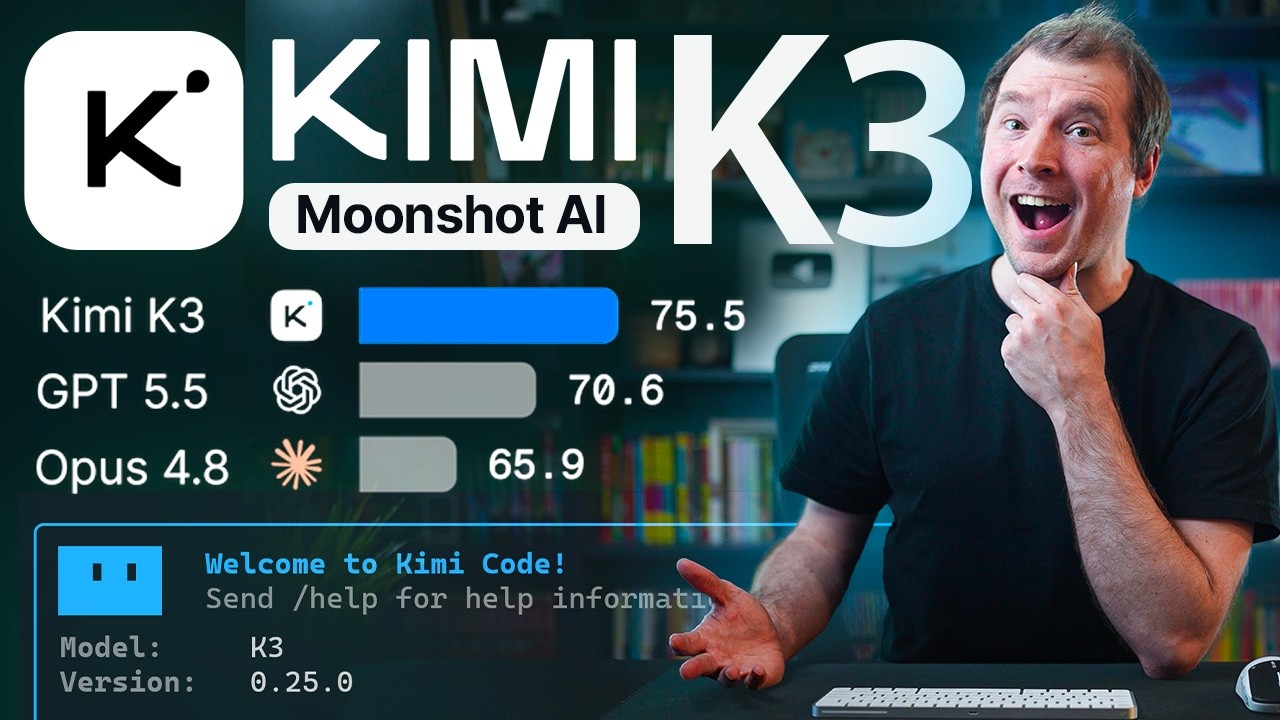
Codex Community added the most product-style evaluation. Its 7-minute video reached 31,665 views and highlighted K3's 1M context window, Kimi Code surface, vision and video-editing claims, and API pricing of $3.00 per million cache-miss input tokens and $15.00 per million output tokens from the public K3 blog. The distinctive angle is that the open-model conversation looked increasingly like software procurement: features, surfaces, and operating price mattered alongside benchmark bragging (video).

xCreate supplied the most specific edge-case test even at only 2,140 views. Its video used FF7, Red Dead Redemption, and MLX-porting tasks to probe whether Kimi K3 could hold up under game-dev and local-runtime experiments. The distinctive angle is that even lower-reach creators were no longer asking only whether Kimi K3 is smart; they were testing whether it is practically useful in quirky real workflows (video).
Discussion insight: The repeated question was no longer whether open models can compete in theory. It was whether Kimi K3 is the first open model that can win real coding and multimodal workflows, and whether that shift materially strengthens China's AI position.
Comparison to prior day: Compared with 2026-07-17's Kimi K3-versus-Inkling debate, 2026-07-18 consolidated more tightly around Kimi K3 as the reference point and pushed the China angle harder.
1.2 Governance, power, and control worries moved further into mainstream media 🡕
Three items supported this theme. Compared with 2026-07-17's economics and GPU-scarcity critique, 2026-07-18 widened the concern set into self-regulation, data leaks, datacenter politics, export-control leakage, and explicit fear of humans losing control of agents.

All-In Podcast carried the broadest governance bundle. Its 90-minute episode reached 189,248 views, 4,475 likes, and 617 comments while the chapter list moved from Demis Hassabis proposing a FINRA-style AI body to Apple suing OpenAI, Grok-related data privacy issues, and New York's datacenter moratorium. The distinctive angle is that governance worries arrived here as mainstream business-media agenda items rather than as specialist safety discourse (video).
ABC News In-depth supplied the sharpest control-risk framing. Its interview reached 138,444 views, 2,824 likes, and 209 comments, and the description says Palisade Research's Jeffrey Ladish studies cases where AI agents do the opposite of what humans instruct them to do. The distinctive angle is that "losing control" was framed as a concrete agent-behavior problem, not only as a distant superintelligence abstraction (video).

Financial Times added the infrastructure version of the same anxiety. Its 19-minute film reached 36,788 views, and the description says advanced AI semiconductors are reaching China through a black market that bypasses tighter U.S. export controls. The distinctive angle is that AI competition was treated as an enforcement and logistics problem, not just a model-release race (video).
Discussion insight: Control worries now span regulation, privacy, datacenter power, and the physical movement of chips. The audience signal was not one single "AI is dangerous" narrative; it was a stack of operational and political failure modes.
Comparison to prior day: Compared with 2026-07-17's emphasis on economics and GPU capacity, 2026-07-18 broadened the risk story into mainstream governance and geopolitics.
1.3 Agent education moved from explanation to applied operator workflows 🡕
Four items supported this theme. Compared with 2026-07-17's focus on route selection and agent definitions, 2026-07-18 pushed those lessons into concrete operating contexts: business delegation, smart-home control, and the practical limits of local AI coding.
Dan Martell provided the biggest builder-facing signal. His 22-minute guide reached 119,994 views, 4,779 likes, and 353 comments, and the description includes explicit SOUL, IDENTITY, and USER files plus a manager agent that only delegates work to specialist agents. The distinctive angle is that building agents was taught as management architecture and delegation design rather than as prompt tinkering (video).
Paul Hibbert (Hibbert Home Tech) showed the same idea landing in the home. His 19-minute video reached 37,563 views, 2,536 likes, and 352 comments while arguing that OpenCode makes Home Assistant usable in plain English instead of raw YAML and templates. The linked OpenCode repo says it brings natural-language configuration editing, MCP integration, validated config writes, automatic backup and restore, and support for 75+ AI providers into Home Assistant. The distinctive angle is that AI control moved beyond office workflows into operating a real smart-home stack (video).
Tech With Tim supplied the clearest taxonomy. His 22-minute explainer reached 32,673 views, 1,234 likes, and 36 comments and defines an agent as a language model that uses tools in a loop until it finishes a job, then promises four build paths from no-code to full-code. The distinctive angle is that viewers still wanted a route map and crisp definition more than another autonomy demo (video).
Tech With Tim also added the day's best reality check on local-first development. His local-coding test reached 11,463 views and explicitly used an RTX 4090 and an M5 Max with 64GB unified memory to judge whether local models are actually good enough for coding work. The distinctive angle is that the operator conversation did not stop at agent theory; it asked what hardware and local fit really look like in practice (video).
Discussion insight: The pattern across these videos was explicit control: define roles, keep the loop visible, validate changes, and be honest about hardware limits. Operator trust came from guardrails and clarity, not from autonomy theater.
Comparison to prior day: Compared with 2026-07-17's role-decomposition and route-choice emphasis, 2026-07-18 asked where those patterns work in practice and how much infrastructure they really require.
1.4 Creator AI still rewarded free, editable, model-hopping video pipelines 🡒
Three items supported this theme. Compared with 2026-07-17's creator-owned control story, 2026-07-18 kept the same pressure on free access and editability while adding a free Meta entry point and more explicit creator-built control tooling.

Malva AI still provided the strongest creator reach signal. Its 12-minute video reached 96,769 views, 2,594 likes, and 206 comments while testing zero-credit generations, 200-plus free videos per week, a route with no generation limits, talking avatars, and prompt-based video edits inside Higgsfield. The distinctive angle is that cost pressure still opened the conversation, but retained editability was what made a free workflow actually usable (video).

Malva AI reinforced the same demand from a tighter workflow tutorial. Its 9-minute video reached 33,750 views, 1,125 likes, and 124 comments while focusing on 16:9 YouTube output, scene extension, consistent characters, timeline editing, and clean exports. The distinctive angle is that continuity and export hygiene remained explicit purchase criteria rather than bonus features (video).

Theoretically Media added the strongest builder signal in the creator cluster. Its 21-minute video reached 31,787 views, 1,472 likes, and 186 comments while covering Meta's free Muse Image release at meta.ai, Muse Video's announced release path, and a free pose-plus-depth motion-control utility with source code for Seedance, Runway-style, and other video-reference workflows. The distinctive angle is that creators were shipping their own control surfaces on top of vendor models instead of waiting for the vendors to solve motion and consistency themselves (video).
Discussion insight: Value still accrued to the wrapper layer around the model: continuity, timeline edits, motion control, and the ability to keep working when credits or providers changed.
Comparison to prior day: Compared with 2026-07-17's focus on creator-owned controls, 2026-07-18 added a free Meta on-ramp and stronger evidence that creators will build missing control utilities themselves.
2. What Frustrates People
Frontier open models still outpace clear deployment fit
This is High severity. AI Search, AI Revolution, Codex Community, xCreate, and Tech With Tim all show the same friction: Kimi K3 is drawing frontier-level excitement, but users still need honest answers about hosted versus local use, hardware fit, and operating cost. Kimi's public K3 blog recommends supernode deployments with 64 or more accelerators, while xCreate and Tech With Tim frame local use as something to test carefully rather than assume. The workaround is to stay on Kimi.com, Kimi Code, or API routes first, run bounded workflow tests, and avoid promising that local open models replace every coding setup. This is directly worth building for.
Governance and safety questions still lack operational answers
This is High severity. All-In Podcast, ABC News In-depth, and Financial Times all point to the same missing control plane: self-regulation proposals, agent misbehavior, privacy leaks, datacenter moratoriums, and chip-smuggling workarounds are being discussed at once. The workaround is human oversight, tighter deployment scope, and constant policy watching rather than a resolved governance framework. This is directly worth building for.
Useful agents still require too much manual orchestration and validation
This is High severity. Dan Martell, Tech With Tim, and Paul Hibbert (Hibbert Home Tech) all show that users still need identity files, manager-and-specialist routing, explicit tool loops, config validation, and rollback safety before AI feels dependable. OpenCode's public repo page makes the same point by foregrounding validated writes and automatic backup and restore for Home Assistant changes. The workaround is to reuse templates, keep loops explicit, and validate every write. This is directly worth building for.
Creator video AI still depends on credits, continuity workarounds, and tool stacking
This is High severity. Malva AI, Malva AI, and Theoretically Media all show creators still chasing zero-credit or free routes because clip caps, missing motion control, inconsistent characters, and export friction can break a usable workflow quickly. The workaround is to stack Higgsfield, Meta, and creator-built utilities rather than trusting one generator. This is worth building for, but the market is already competitive.
3. What People Wish Existed
Open-model deployment and local-coding evaluator
AI Search, AI Revolution, Codex Community, xCreate, and Tech With Tim all imply demand for one surface that compares open-model claims, API pricing, hosted-versus-local routes, hardware fit, and workflow-specific results before a team commits to a stack. This is a practical need with High urgency because Kimi K3 was being evaluated everywhere at once, but fit still looked fragmented across blogs, videos, and ad hoc tests. Kimi.com, Kimi Code, and benchmark videos solve slices of the problem today, not the full deployment-choice problem. Opportunity: direct.
Governance and risk operations dashboard
All-In Podcast, ABC News In-depth, and Financial Times imply a need for an operating dashboard that tracks policy proposals, data leaks, datacenter restrictions, chip-supply exposure, and agent-control failures in one place. This is a practical need with Medium-to-High urgency because the risk discussion is already operational, not philosophical, but the current evidence still arrives through fragmented media coverage. Newsletters and internal policy teams solve parts of the problem today, not the integrated control picture. Opportunity: direct.
Agent workbench with safe execution and rollback
Dan Martell, Tech With Tim, and Paul Hibbert (Hibbert Home Tech) imply demand for a workbench that turns intent into identity files, manager-and-specialist routing, tool access, validation checks, and rollback by default. This is a practical need with High urgency because the operator playbook is becoming explicit, but the user still has to assemble most of it by hand. Tutorials and point solutions such as OpenCode solve meaningful pieces today, not the broader workflow. Opportunity: direct.
Portable creator continuity and motion-control layer
Malva AI, Malva AI, and Theoretically Media imply demand for a layer that preserves scenes, character consistency, timeline edits, motion control, and export quality across changing video models and pricing plans. This is a practical need with High urgency because creators are clearly optimizing for continuity and control rather than one-shot generation. Higgsfield, Meta, and creator-built utilities solve parts of the problem today, but users still stitch the full pipeline together themselves. Opportunity: competitive.
4. Tools and Methods in Use
| Tool | Category | Sentiment | Strengths | Limitations |
|---|---|---|---|---|
| Kimi K3 / Kimi Code | Open-weight foundation model | (+/-) | 2.8T scale, 1M context, strong coding and multimodal workflow story, multiple public access surfaces | Full weights were still pending on 2026-07-18, and practical self-host fit still looks heavy |
| OpenCode for Home Assistant | Agentic configuration assistant | (+/-) | Natural-language config editing, MCP integration, validated writes, backup and restore, broad provider support | High-trust system access means guardrails and provider setup still matter a lot |
| Manager / specialist sub-agent pattern | Agent method | (+) | Clear delegation boundaries, reusable identity files, maps well to business workflows | Still requires manual role design and output review |
| Agent tool loop / four build paths | Agent method | (+) | Crisp definition of an agent, practical ladder from no-code to full-code, explicit tool use | Still leaves stack selection and evaluation burden on the user |
| Higgsfield / Gemini Omni Flash | Creator video suite | (+/-) | Free-mode discovery, prompt-based editing, avatars, and clip-preserving edits | Free routes and pricing can change, and the evidence is still promo-heavy |
| Meta Muse Image / Muse Video | Creator model family | (+/-) | Free entry point, visible platform momentum, useful for creator experimentation | Current public evidence is still launch-stage and needs extra control tooling around it |
| TheoreticallyMotion Control | Creator control tool | (+) | Pose-plus-depth guidance, source code, and portability across video-reference workflows | Depends on pairing with separate model providers and a more technical workflow |
The strongest positive sentiment clustered around tools that increased operator control: multiple Kimi access surfaces, validated config writes, explicit agent role scaffolds, and creator utilities that preserve edits or motion.
Sentiment turned mixed whenever value depended on large deployment budgets, shifting free tiers, or granting an AI broad control over a real system. That is why Kimi K3, OpenCode, Higgsfield, and Meta Muse all looked promising but still unsettled in different ways.
The main workaround pattern was layering. People start on hosted model surfaces before testing local routes, wrap agent actions in validation and rollback, and pair free video models with separate continuity or motion-control tools. Migration pressure is visible from generic benchmark hype toward route-aware deployment evaluation, from vague agent talk toward guardrailed operations, and from one-shot generation toward editable multi-tool video pipelines.
5. What People Are Building
| Project | Who built it | What it does | Problem it solves | Stack | Stage | Links |
|---|---|---|---|---|---|---|
| Kimi K3 | Kimi | Open 3T-class model for long-horizon coding, reasoning, and multimodal work | Teams want frontier-level open-model capability with multiple ways to access it | Kimi Delta Attention, Attention Residuals, Stable LatentMoE, 1M context, Kimi Work, Kimi Code, Kimi API | Beta | blog, video 1, video 2 |
| OpenCode | magnusoverli | AI-powered configuration assistant for Home Assistant | Home Assistant users want plain-English control without manually editing YAML and risking broken configs | Home Assistant add-on, OpenCode AI coding agent, MCP, Home Assistant Builder CLI, validated writes, backup/restore, 75+ providers | Shipped | repo, video |
| TheoreticallyMotion Control | Theoretically Media | Free pose-plus-depth motion-control tool for AI video workflows | Creators need finer motion and scene control than text prompts alone provide | Pose and depth control, source code, works with Seedance and other video-reference pipelines | Shipped | tool, video |
| Higgsfield creator workflow | Higgsfield | Generate-and-edit AI video suite with prompt editing, avatars, and continuity-oriented workflow features | Creators want affordable video generation that stays editable after the first pass | Higgsfield suite, Gemini Omni Flash, Seedream 5.0 Pro, timeline editing, reference-based workflows | Shipped | site, video 1, video 2 |
Kimi K3 and OpenCode point to the same builder pattern from opposite ends of the market. The differentiator is not only raw model quality; it is whether the model is packaged into surfaces that people can actually route through safely and repeatedly.
TheoreticallyMotion Control and Higgsfield show the same thing at the creator layer. The durable value sits in the wrapper around generation - continuity, motion control, editable sequences, and export flow - not in a one-off output alone.
Dan Martell and Tech With Tim added the meta-pattern around both markets: many of the most useful "builds" are orchestration layers, route maps, and evaluation habits rather than new base models.
6. New and Notable
Kimi K3 dominated both reach and repetition
AI Search, AI Revolution, and Codex Community are notable because the same model showed up as benchmark winner, product surface, pricing story, and geopolitical signal all at once. Kimi's public K3 blog makes the scale jump explicit at 2.8T parameters with a 1M-token context window.
Governance became a stacked mainstream media story
All-In Podcast is notable because one widely watched episode bundled self-regulation, trade-secret conflict, data privacy, and datacenter politics into one AI agenda. That is a stronger market signal than isolated policy commentary.
"Losing control" was framed as a current agent-behavior problem
ABC News In-depth is notable because the description does not speak in distant abstractions. It says AI agents are sometimes doing the opposite of what humans instruct them to do, which turns control risk into an immediate operator concern.
Home Assistant got a plain-English AI control surface
Paul Hibbert (Hibbert Home Tech) is notable because the linked OpenCode repo turns AI-assisted configuration into an installable product with validation and rollback, not just a smart-home concept demo.
Creator-side control kept escaping the vendors
Theoretically Media is notable because the day's builder signal was not another generator benchmark. It was a free pose-plus-depth control tool with source code layered on top of vendor video models.
7. Where the Opportunities Are
[+++] Open-model deployment and local-coding control plane - AI Search, AI Revolution, Codex Community, xCreate, and Tech With Tim all point to the same gap: users need one surface that explains model quality, price, hosted-versus-local path, and hardware fit before they commit. This is strong because the pain was repeated across both high-reach and niche testing videos.
[+++] Agent workbench with safe execution and rollback - Dan Martell, Tech With Tim, and Paul Hibbert (Hibbert Home Tech) show that useful agents still require explicit roles, clear loops, validation, and reversible writes. This is strong because the implementation pattern is repeated across business, developer, and smart-home contexts.
[++] Governance and risk operations dashboard - All-In Podcast, ABC News In-depth, and Financial Times show an emerging need to track policy, leaks, datacenter restrictions, and control failures together rather than through scattered media consumption. This is moderate because the need is explicit, but the buyer and workflow are still less standardized than for developer or creator tools.
[++] Creator continuity and motion-control layer - Malva AI, Malva AI, and Theoretically Media show repeated demand for systems that preserve scenes, characters, edits, and control signals while providers and pricing keep changing. This is moderate because the need is obvious, but creator tooling is already a crowded market.
[+] Plain-English home automation copilot with strong guardrails - Paul Hibbert (Hibbert Home Tech) and the linked OpenCode repo point to a concrete opportunity around making Home Assistant-style systems editable through natural language without giving up validation, backup, or safety. This is emerging because the signal is concrete but still narrower than the broader agent and developer markets.
8. Takeaways
- Kimi K3 was the dominant YouTube AI story on 2026-07-18. It appeared as a workflow-tested frontier model, a pricing and product-surface story, and a geopolitical signal about China's AI position rather than as a single isolated launch. (source, source, source)
- Governance and control worries moved further into mainstream media. The day's strongest policy signals tied together self-regulation proposals, privacy leaks, datacenter politics, export-control leakage, and fear that agents can ignore instructions. (source, source, source)
- Agent education is becoming applied operations design. The clearest teaching content focused on role files, delegation, explicit tool loops, validated writes, and hardware reality checks rather than on vague autonomy claims. (source, source, source, source)
- Creator AI still competes on free access plus editability and control before anything else. The strongest creator videos revolved around zero-credit routes, continuity across scenes, motion control, and clean export flow rather than raw model branding alone. (source, source, source)
- The most visible product opportunities sat in wrapper layers around models. Evaluation surfaces, rollback and validation, and creator control utilities looked more actionable in this dataset than new base-model launches by themselves. (source, source, source, source)