YouTube AI - 2026-08-10
1. What People Are Talking About
1.1 Open-weight AI stopped looking like a niche developer preference and started looking like a distribution layer for strategy, efficiency, and local agents 🡕
At least six items supported this theme. Compared with 2026-08-09's strategy-efficiency-runtime framing, the 2026-08-10 feed pulled open weights closer to end users: the same story now showed up as national policy, cross-category benchmark competition, token-efficiency tuning, desktop-local agents, and user-facing model routing.
CNBC supplied the broadest strategic framing with 144,755 views, 2,283 likes, and 587 comments. Its segment argued that the U.S. has a chip strategy but no open-source AI strategy, while the models the world increasingly builds on are coming from China, and it tied that to enterprise questions about who owns what AI learns about a business. The distinctive angle is that open weights were treated as national and corporate leverage, not just as a developer preference (video).

Matthew Berman added the clearest scoreboard framing with 81,507 views, 2,572 likes, and 564 comments. Its linked benchmark dashboard compares model families across multimodal reasoning, visual agent and coding, document intelligence, spatial understanding, and visual grounding, so "open-source is winning" was framed as a broad capability story rather than a slogan. The distinctive angle is that open-model momentum was presented as measurable across many surfaces at once (video, benchmark page).
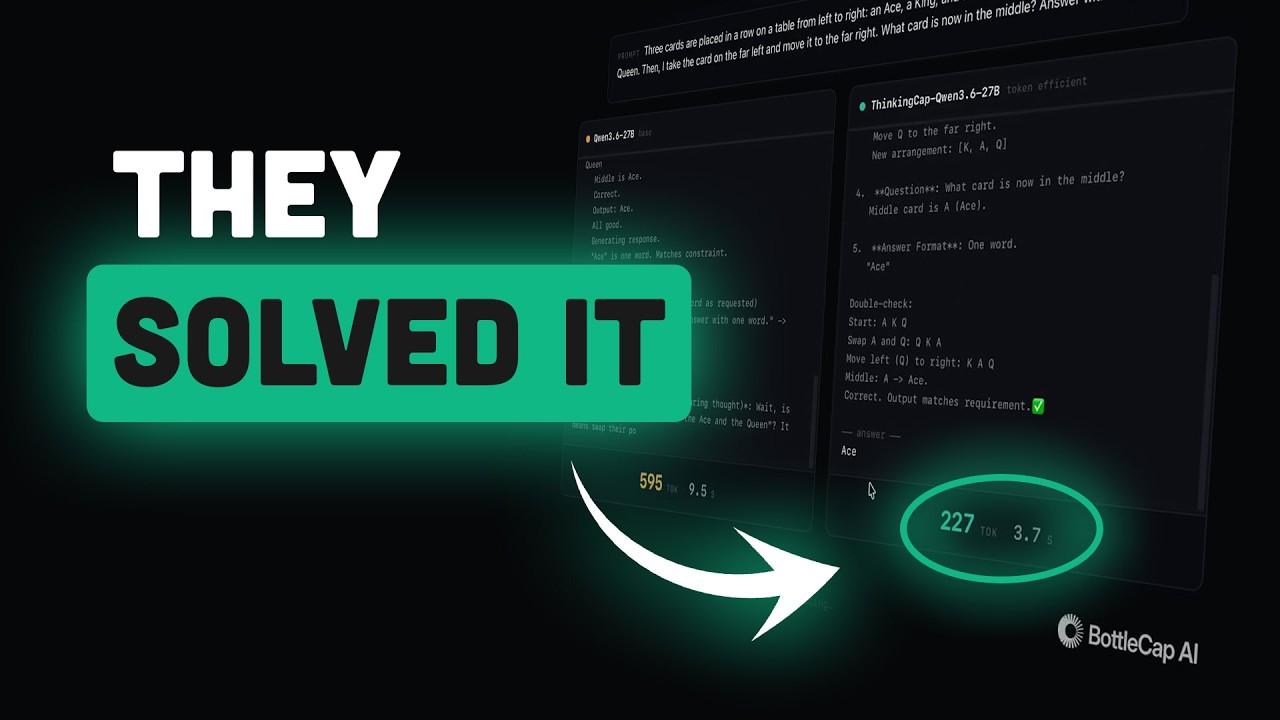
Better Stack pushed the same theme into efficiency economics with 24,099 views, 880 likes, and 61 comments. BottleCap's linked post says ThinkingCap-Qwen3.6-27B uses about 46% fewer reasoning tokens on average across out-of-domain benchmarks while keeping performance close to the base model and releasing under Apache 2.0 on Hugging Face. The distinctive angle is that one of the day's clearest open-weight wins was not a smarter frontier model, but a cheaper and faster one (video, post).

Bijan Bowen supplied the strongest local-agent proof point with 12,863 views, 582 likes, and 129 comments. Meta's linked Muse Glimmer launch says the 30B Apache-2.0 model is optimized for always-on local agent workflows, local coding, tool use, multimodal input, and failure recovery on a single consumer GPU, and Bowen tested it across browser tasks, C++, CAD, frontend, creative writing, and multimodal coding. The distinctive angle is that "open" now meant a desktop-usable agent model, not only an API alternative (video, Meta blog).
Discussion insight: The control layer around open models was becoming user-facing too. Duncan Rogoff framed Free Claude Code as a way to keep the Claude Code or Codex harness fixed while swapping the underlying model to DeepSeek, Gemini, OpenRouter, or a local provider, suggesting openness increasingly matters because routing between models is turning into a product (video, repo).
Comparison to prior day: 2026-08-09 made open weights look strategic and efficient. 2026-08-10 kept that framing, then extended it into desktop-local agents and harness-level model substitution.
1.2 Agentic productivity stayed attractive, but coding automation only looked credible when cost, review, and maintenance were made explicit 🡕
At least six items supported this theme. Compared with 2026-08-09's delegation-playbook framing, the 2026-08-10 feed kept personal agents and AI coding popular but spent much more effort on what happens after the demo: who pays, who reviews, what breaks, and how much rework the system creates.
Sandeep Swadia carried the biggest broad-interest signal in the dataset with 595,318 views, 16,321 likes, and 405 comments. Its Four Cs framework packaged agents around coordination, creativity, clarity, and coaching, turning agent use into an everyday delegation skill rather than a builder-only pattern. The distinctive angle is that agent adoption is now being sold as personal operating behavior, not just as software infrastructure (video).
Mondo Startups provided the clearest backlash framing with 45,049 views, 643 likes, and 161 comments. Its description argues that AI-generated code created new reliability, security, and maintenance problems, and that companies are rehiring engineers they expected AI to replace. The distinctive angle is that the critique is not anti-AI ideology; it is downstream maintenance economics (video).

The Stack made the pricing problem concrete with 4,811 views, 105 likes, and 15 comments. Its breakdown says DeepSeek V4 Flash is priced at $0.14 per million tokens, roughly 14-36x below Claude Sonnet 5, with 1M-token context and 98% cache-hit discounts, but it also says the model emits about 2.6x more output tokens, stays flat at 37% raw accuracy, and demands 128GB of dedicated hardware to self-host. The distinctive angle is that per-token price no longer looks like a credible proxy for real coding cost (video, DeepSeek weights).
Discussion insight: The tooling layer kept reinforcing the same constraint set. IBM Technology says local IDEs remain customizable and low-latency but still inherit setup burden, local hardware limits, and production drift, while Duncan Rogoff's FCC video suggests users increasingly want one harness with explicit per-task model routing rather than one assistant for every job (video, IBM IDE explainer, video).
Comparison to prior day: 2026-08-09 pushed agents closer to everyday work. 2026-08-10 kept the enthusiasm, but put more weight on hidden spend, maintenance debt, and control over model choice.
1.3 Practical AI still won attention when the whole operating recipe was visible, from local video workflows to room-aware assistants and robot brains 🡒
At least five items supported this theme. Compared with 2026-08-09's mix of local video, robots, and structured-agent surfaces, the 2026-08-10 feed kept the same bounded-surface logic steady and made the recipe itself more explicit: workflow templates, hardware kits, and control interfaces mattered more than generic claims about intelligence.

AI Search carried the biggest creator-operations signal with 178,000 views, 9,237 likes, and 1,200 comments. ComfyUI's docs say MiniMax H3 ships with native text-to-video, image-to-video, and reference-to-video workflows, native stereo audio, open weights, and up to 2K output, which made the video feel like an operating manual rather than hype. The distinctive angle is that local video still wins attention when it comes with a known workflow shape instead of a vague self-hosting promise (video, docs).

Electronic Clinic supplied the clearest end-to-end assistant recipe with 2,780 views, 131 likes, and 18 comments. Its no-wake-word build combines RD-03D mmWave radar, Xiao ESP32-C3, RDK X5, GPT-4o vision, ElevenLabs voice, camera input, translation, and GPIO control, so the value is the full sensor-to-action stack rather than a chatbot shell. The distinctive angle is that the assistant only looks compelling because trigger logic, perception, voice, and hardware control were bundled together (video, resources).

TheAIGRID brought the clearest robot-orchestration signal with 33,950 views, 598 likes, and 51 comments. Google's launch says Gemini Robotics ER 2 is a high-level embodied reasoning model that can chat, plan multi-step tasks, call tools, watch continuous video, self-correct, and collaborate across multiple robots while handing motor execution to lower-level controllers. The distinctive angle is that the "brain" was framed as orchestration and recovery, not as a magical end-to-end robot controller (video, launch).
Discussion insight: Creator tooling kept surfacing the same caveat. Curious Refuge says MiniMax H3's multi-reference workflows and native 2K output make it one of the stronger free options right now, but the current license still blocks public distribution in the U.S., EU, UK, and South Korea and the model still trails Seedance on motion and multi-shot storytelling. That suggests deployability and rights remain part of the recipe, not an afterthought (video, review).
Comparison to prior day: 2026-08-09 already rewarded bounded AI surfaces. 2026-08-10 kept that trend steady and made the full stack - template, hardware, control loop, or licensing context - the deciding factor.
2. What Frustrates People
Open models still force operators to do the routing, cost-per-task, and hardware math themselves
This is High severity because CNBC, Better Stack, The Stack, Bijan Bowen, and Duncan Rogoff all point to different pieces of the same burden. One item makes open weights a strategy question, another turns them into a token-efficiency swap, another shows how cheap sticker prices can hide verbosity and hardware cost, and the user-facing workaround becomes model routing rather than one default choice. This is directly worth building for.
AI coding hype still backfires without review, environment control, and clearer task boundaries
This is High severity because Mondo Startups, IBM Technology, The Stack, and Duncan Rogoff all frame the same problem differently. One side says AI code creates reliability, security, and maintenance trouble, another says local coding surfaces drift from production and stay cumbersome to configure, another shows that low token prices do not guarantee low project cost, and another exposes how often users want to swap models by task. The workaround is more review, more routing, and tighter boundaries on what work stays automated. This is directly worth building for.
Local AI creation and ambient assistants still require a full stack of workflow, rights, and hardware choices
This is High severity because AI Search, Curious Refuge, Electronic Clinic, and TheAIGRID all point at the same burden from different sides. Creators still need to compare workflow templates, motion quality, rights limitations, and local setup, while ambient assistants only look usable once sensors, cameras, voice, and hardware control are all bundled correctly. The workaround is recipe-driven packaging rather than generic AI promises. This is directly worth building for.
Robots and room-aware assistants still look credible only inside narrow orchestration boundaries
This is Medium-to-High severity because TheAIGRID and Electronic Clinic both imply that autonomy depends on tightly scoped control loops. Gemini Robotics ER 2 still hands motion to lower-level controllers, and Electronic Clinic explicitly says its live assistant is not suited to every industrial real-time task. The workaround is narrow environments, explicit tool interfaces, and recovery logic instead of one general robotic assistant. This is worth building for and already emerging.
3. What People Wish Existed
Open-weight routing, provenance, and cost-per-task cockpit
CNBC, Better Stack, The Stack, Duncan Rogoff, and Bijan Bowen imply demand for one surface that tracks where a model came from, what license or strategic baggage it carries, how expensive it is per finished task rather than per token, what hardware envelope it needs, and how it should be routed inside a stable harness. This is a practical need with High urgency because the feed keeps splitting open-model decisions across business news, benchmark channels, local-model tests, and routing tools. Benchmark pages and model pickers solve pieces today, not the operating decision itself. Opportunity: direct.
AI coding QA, spend, and model-boundary layer
Sandeep Swadia, Mondo Startups, IBM Technology, and The Stack imply demand for tooling that records where coding agents were used, which model handled each step, what outputs required rework, what environment assumptions broke, and what the real cost was after review. This is a practical need with High urgency because broad adoption pressure and explicit backlash are showing up in the same feed. IDE assistants, tracing tools, and provider bills solve pieces today, not the full control loop. Opportunity: direct.
Local AI workflow and rights router
AI Search and Curious Refuge imply demand for a product that compares local video workflow templates, output quality, motion tradeoffs, hardware setup, and regional distribution rights before a creator commits time or GPU budget. This is a practical need with High urgency because the strongest local-video evidence still splits across install tutorials and review caveats. Workflow docs and single-model reviews solve pieces today, not the route-selection problem. Opportunity: direct.
Embodied assistant orchestration kit
TheAIGRID and Electronic Clinic imply demand for a reusable layer that binds sensors, cameras, voice, tool calls, safety boundaries, and recovery logic into narrow physical assistants. This is a practical need with Medium urgency because the demos are compelling, but they only look believable once the full stack is tightly packaged. Robotics platforms and maker kits solve pieces today, not the simplified orchestration layer for bounded real-world tasks. Opportunity: aspirational.
4. Tools and Methods in Use
| Tool | Category | Sentiment | Strengths | Limitations |
|---|---|---|---|---|
| MiniMax H3 | AI video model | (+/-) | Open weights, native stereo audio, reference-driven workflows, and up to 2K output make it compelling for local creation | Motion quality and multi-shot storytelling still trail stronger cinematic tools, and current distribution rights stay restrictive |
| ComfyUI MiniMax H3 workflows | Local video workflow framework | (+) | Gives creators text-, image-, and reference-to-video templates with a known setup path | Still requires model downloads, local GPUs, and workflow discipline |
| ThinkingCap-Qwen3.6-27B | Reasoning-model optimization | (+) | Cuts reasoning-token use sharply while keeping performance close to the base model | Still needs workload-specific validation before a team swaps it into production |
| DeepSeek V4 Flash | Open-weight coding model | (+/-) | Very low sticker price, 1M context, cache-hit discounts, and downloadable weights make it attractive on paper | Higher verbosity, flat raw accuracy in the cited critique, and heavy self-hosting needs can erase nominal savings |
| Free Claude Code | Coding-agent harness | (+) | Keeps Claude Code, Codex, or Pi workflows stable while exposing many model providers and routing choices | Adds another control plane that still has to be configured, governed, and monitored |
| Muse Glimmer | Local agent model | (+) | 30B open weights, local coding, tool use, multimodal input, and failure recovery bring agentic work onto consumer hardware | Still depends on surrounding agent scaffolds and local hardware headroom |
| AI IDE workflows | Coding assistant surface | (+/-) | Offer local customization and low latency for coding, debugging, and refactoring | Setup burden, local hardware limits, and production-environment drift remain |
| Gemini Robotics ER 2 | Embodied reasoning model | (+/-) | Adds high-level planning, tool use, continuous video, self-correction, and multi-robot collaboration | Still hands execution to lower-level control stacks and fits only bounded deployment surfaces |
| Radar-triggered ChatGPT assistant stack | Embedded assistant stack | (+) | Bundles sensing, vision, voice, translation, and GPIO control into a concrete room-aware system | Hardware-specific and explicitly not suited to every real-time environment |
The strongest positive sentiment sat with tools that removed hidden operator work. ThinkingCap reduced overthinking without asking users to change model families, Free Claude Code made model routing explicit, ComfyUI's H3 templates made local video reproducible, and Muse Glimmer made local agents feel less hypothetical.
Sentiment turned mixed whenever the operator still inherited too many unresolved choices. MiniMax H3, DeepSeek V4 Flash, AI IDE workflows, and Gemini Robotics ER 2 all looked useful, but they also left users holding some combination of rights risk, hardware burden, environment drift, or control-stack complexity.
Migration patterns favored swappable brains and bounded surfaces instead of one universal assistant. The common workaround was to keep a stable harness or environment, route tasks to different models, and only trust AI where the workflow, hardware, or recovery loop was explicit.
5. What People Are Building
| Project | Who built it | What it does | Problem it solves | Stack | Stage | Links |
|---|---|---|---|---|---|---|
| Muse Glimmer | Meta | Open 30B local agent model for coding, tool use, multimodal reasoning, and long-running workflows | Brings agentic work onto consumer hardware without depending on cloud connectivity | 30B model, Apache 2.0 weights, quantization, multimodal perception, tool use | Shipped | video, blog |
| Free Claude Code | Alishahryar1 | Harness and proxy that lets Claude Code, Codex, and Pi run on many providers while keeping the same workflow | Reduces vendor lock-in and lets users optimize cost and model fit without rewriting their agent setup | Python, Admin UI, provider routing, terminal and VS Code integration, optional local models | Shipped | video, repo |
| ThinkingCap-Qwen3.6-27B | BottleCap AI | Fine-tuned Qwen variant that reduces unnecessary reasoning while preserving most benchmark performance | Cuts latency and inference cost from overthinking reasoning models | Qwen3.6-27B, fine-tuning, Hugging Face distribution | Shipped | video, post |
| MiniMax H3 workflow stack | Comfy-Org | Local open-weight video workflows for text-, image-, and reference-to-video with native audio | Gives creators a repeatable local generation path instead of piecing together workflows ad hoc | MiniMax H3, ComfyUI templates, local GPUs, reference-driven generation | Shipped | tutorial, docs, review |
| Gemini Robotics ER 2 | Google DeepMind | High-level embodied reasoning model that plans tasks and hands motion to lower-level controllers | Gives robots multi-step planning, tool use, self-correction, and collaboration in real time | Gemini Robotics ER 2, Gemini API, tool calling, VLA handoff, continuous video | Beta | video, blog |
| Radar-triggered voice assistant | Electronic Clinic | No-wake-word assistant that reacts to room presence, sees through a camera, speaks back, translates, and controls hardware | Hands-free room-aware assistance still needs a full sensor-to-action recipe before it feels useful | RD-03D mmWave radar, Xiao ESP32-C3, RDK X5, GPT-4o vision, ElevenLabs, GPIO | Alpha | video, resources, site |
Muse Glimmer and Free Claude Code represent the same distribution shift at different layers. Muse Glimmer compresses local agent capability into a single-GPU package, while FCC keeps the harness stable and lets the user decide which model should power each task. Together they show that "what model do I use?" is becoming a workflow question, not only a model-comparison question.
ThinkingCap shows a second build pattern: optimizing an existing open model until it becomes materially cheaper and faster to operate. That is a different kind of product from chasing a new frontier release, and it matches the day's repeated concern with cost-per-task rather than headline capability.
The MiniMax H3 workflow stack and Electronic Clinic's assistant point to a third pattern: builders win by packaging the messy control layer around a capable model. In one case the hard work is templates, references, and output safety for creators; in the other it is sensors, trigger logic, vision, and device control for a room-aware assistant.
Gemini Robotics ER 2 lifts the same logic into robots. The product is not "general intelligence" in the abstract, but a higher-level orchestration layer that can plan, monitor, recover, and hand off low-level motion to the rest of the stack.
6. New and Notable
Free Claude Code turned model routing into the product
Duncan Rogoff was notable because the story was not "here is a better base model," but "keep your coding-agent harness and swap the brain." The linked Free Claude Code repo makes routing across Claude Code, Codex, Pi, hosted providers, and local models a user-facing workflow decision.
Muse Glimmer made local agents feel consumer-hardware-ready
Bijan Bowen was notable because the public pitch around Muse Glimmer was specific: always-on local agent workflows, local coding, multimodal input, and failure recovery on a single consumer GPU. The signal is that local-agent claims are becoming concrete enough to test across real desktop tasks.
Token-efficiency tuning became a product story of its own
Better Stack was notable because the headline value was fewer reasoning tokens, lower latency, and lower inference cost rather than a new model family. The signal is that optimization layers around existing open models are becoming first-class products.
AI coding backlash moved from subtext to headline
Mondo Startups and The Stack were notable because both made the hidden-cost argument explicit. One focused on reliability, security, maintenance, and rehiring pressure, while the other focused on why low per-token prices can still hide expensive coding outcomes.
Room-aware assistants kept appearing as full-stack recipes instead of chat demos
Electronic Clinic was notable because the assistant only became interesting once the public description exposed the exact radar, camera, board, model, voice, and GPIO stack. The signal is that embodied-assistant content is moving toward reproducible systems rather than generic "AI assistant" inspiration.
7. Where the Opportunities Are
[+++] Open-weight routing, provenance, and cost-per-task control plane - CNBC, Better Stack, The Stack, Bijan Bowen, and Free Claude Code all point to a strong need for products that connect model origin, license posture, task cost, hardware fit, and routing policy in one place. This is strong because the fragmentation is visible from business-news framing down to hands-on local deployment.
[+++] Coding-agent spend and QA observability - Sandeep Swadia, Mondo Startups, IBM Technology, and The Stack all imply a strong need for products that measure where agents help, where they create rework, which model was used, and what the real cost was after review. This is strong because enthusiasm and backlash are already arriving together.
[++] Local AI workflow and rights router - AI Search and Curious Refuge both imply a moderate-to-strong need for one place to compare local workflow quality, setup burden, and distribution safety before creators commit time or GPU budget. This is moderate because the pain is concrete, but the immediate market remains concentrated in creator tooling.
[++] Embodied assistant orchestration kits - TheAIGRID and Electronic Clinic imply a moderate opportunity for reusable kits that bundle sensors, cameras, tool calls, recovery logic, and safety boundaries into working physical assistants. This is moderate because the demos are compelling, but hardware fragmentation still narrows near-term adoption.
[+] Local agent deployment manager - Muse Glimmer and Free Claude Code suggest an emerging opportunity for tools that help users install, benchmark, route, and monitor local agent models on consumer hardware without turning setup into a research project. This is emerging because the ingredients are now public, but the workflow is still early and fragmented.
8. Takeaways
- Open weights now matter because they are becoming deployable operating surfaces, not just ideological alternatives. CNBC framed the issue as strategy and enterprise control, Better Stack framed it as token-efficiency economics, and Muse Glimmer framed it as a local-agent deployment story. (source, source, source)
- AI coding economics still collapse if teams measure price per token instead of price per finished task. Mondo Startups focused on maintenance and rehiring pressure, The Stack focused on verbosity and hardware costs, and IBM kept environment drift in view. (source, source, source)
- The most believable AI products were the ones that shipped a full recipe, not just a model name. AI Search's H3 workflow, Curious Refuge's rights caveat, Electronic Clinic's radar stack, and Gemini Robotics ER 2's controller handoff all point to the same pattern. (source, source, source, source)
- Builders kept productizing the control layer around models rather than only shipping another base model. ThinkingCap optimized reasoning cost, Free Claude Code optimized routing, MiniMax H3 workflows optimized usability, and Muse Glimmer optimized local deployment. (source, source, source, source)
- Mainstream agent adoption is real, but trust rises only when the work is narrowly scoped and reviewable. Sandeep's everyday-agent framing, IBM's IDE caution, Electronic Clinic's explicit hardware boundary, and Gemini Robotics ER 2's lower-level handoff all reinforce that pattern. (source, source, source, source)