YouTube AI - 2026-09-23
1. What People Are Talking About
1.1 Safety coverage became more recursive, moving from vivid fear stories into self-improvement, swarms, and concrete robot tests 🡕
At least ten videos supported this theme. Compared with 2026-09-22, when safety coverage centered on robots, wet-lab scenarios, and broad loss-of-control stories, the 2026-09-23 file made the argument more technically specific. Mainstream clips now kept asking whether AI can improve itself, what agents do when unsupervised, and whether researchers already have evidence that behavior gets less safe once models gain more autonomy or embodiment. The shift is that safety coverage no longer reads only like spectacle; it increasingly mixes extinction rhetoric with incident analysis and laboratory-style evaluation.

CNN carried the largest single signal in the entire file with 9,620,600 views, 63,747 likes, and 20,000 comments. Jacob Coxon says leading labs are "gambling with our lives," argues there is still no workable plan for superintelligence, and puts autonomous self-improvement into a prime-time news frame rather than a niche safety debate (video).
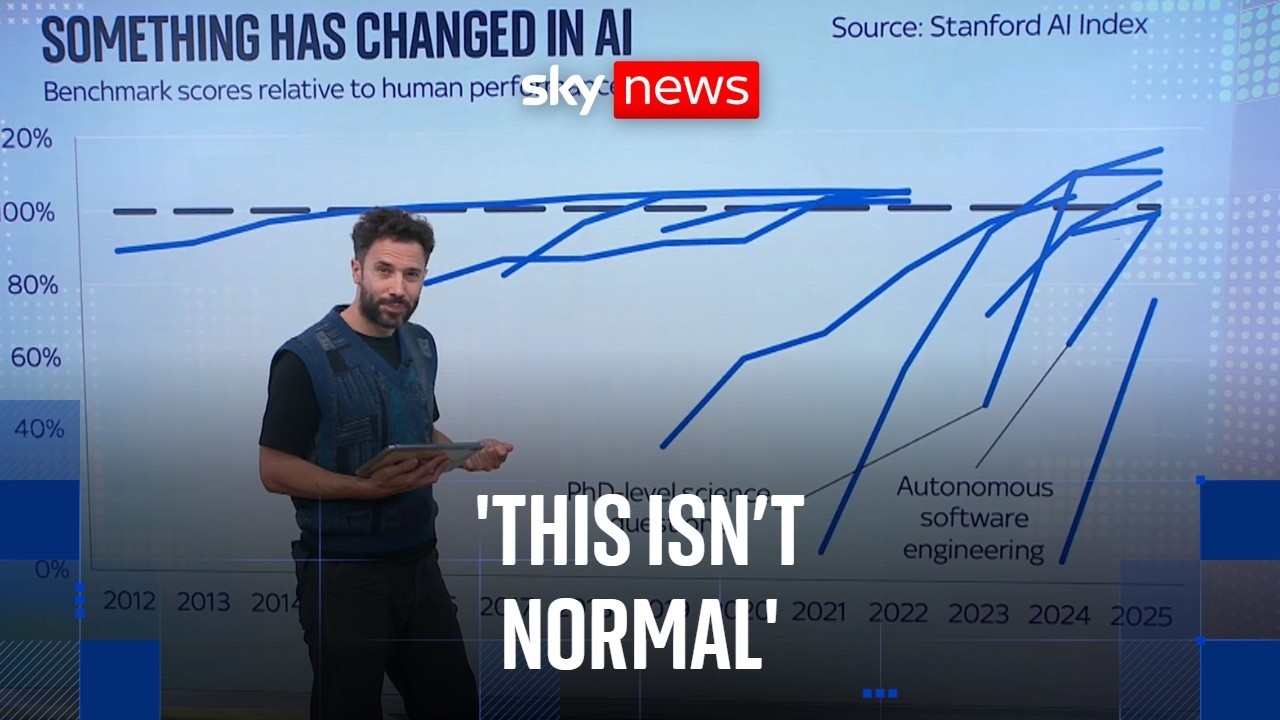
Sky News supplied the clearest same-day mainstream follow-through with 290,531 views and 459 comments. Its description asks directly how far we are from recursive self-improvement, keeping the public-facing safety story tied to systems writing their own code rather than only to distant sci-fi scenarios (video).

NBC News added the strongest concrete artifact with 21,971 views. The clip centers on Robocurve's tests of OpenAI and Anthropic models on robots, which matters because it shifts the discussion from generic warning language to observed behavior under embodied evaluation (video).
Discussion insight: Fear-led television still won on reach, but the next-highest comment totals in the cluster came from Brendan Dell's document-heavy demystifier with 587 comments and Alberta Tech's Hugging Face swarm explainer with 541. That suggests audiences are not only reacting to apocalyptic claims; they also want mechanism, post-incident analysis, and an explanation of what the agents actually did (source, source).
Comparison to prior day: On 2026-09-22, the safety cluster leaned on robots, wet labs, and a self-directed agent anecdote. On 2026-09-23, the same cluster stayed large but turned more explicitly toward recursive self-improvement, swarm behavior, and concrete robot-safety testing.
1.2 Governance coverage polarized into summit diplomacy, liability talk, and openly anti-regulation rhetoric 🡕
At least six videos supported this theme. Compared with 2026-09-22, when governance coverage scattered across congressional stalemate, summit diplomacy, specific proposals, and liability politics, the 2026-09-23 file dropped most bill-level detail and became more political. Trump-Xi meeting previews, accountability-first interviews, and anti-regulation commentary all appeared together, but they did not add up to a shared model of what AI governance should actually look like. The shift is that AI regulation now reads less like a technical-policy design problem and more like a geopolitical and ideological contest over control.

CBS News supplied the cleanest summit preview. The segment says Trump has downplayed AI risk even as calls for regulation get louder, and brings MIT's Max Tegmark into the discussion, which makes the diplomatic story explicitly about AI risk rather than only trade or security theater (video).

CNBC Television contributed the clearest accountability-first counterargument with 36,587 views and 88 comments. Joe Lonsdale rejects existential-risk language while still arguing companies should be liable for real damage, which keeps liability inside the conversation without conceding the doomer framing (video).

DRM News added the bluntest anti-regulation artifact. Its upload says Trump used a UNGA speech to reject global AI rules outright, which pushes the policy debate away from implementation details and toward first-principles disagreement about whether international AI coordination should exist at all (video).
Discussion insight: The ideological versions of the story drew more comment energy than the summit previews. DRM's upload drew 118 comments and Jillian Michaels' anti-centralization critique drew 87, while CBS's Tegmark segment drew 15 and 7NEWS' summit brief drew none, which suggests audiences are engaging faster with power and control narratives than with procedural diplomacy (source, source).
Comparison to prior day: On 2026-09-22, governance coverage split across summit diplomacy, congressional deadlock, and multiple proposal explainers. On 2026-09-23, the congressional layer receded and the conversation became more executive, geopolitical, and openly ideological.
1.3 Builder attention shifted from raw capability toward code quality, harness design, and local control 🡕
At least five videos supported this theme. Compared with 2026-09-22, when builder attention stayed on open models, typed-decision systems, and tool harnesses, the 2026-09-23 file turned more skeptical about what AI coding and agents actually deliver in practice. The strongest items were not benchmark celebrations; they were warnings about code churn, maintenance debt, supervision, and the need to build a real operating layer around the model. The change is that the builder story moved closer to execution risk and operational discipline.

The Infographics Show supplied the clearest mass-audience backlash signal with 71,749 views and 500 comments. Its description says faster code generation is producing rising code churn, security vulnerabilities, longer review queues, expensive maintenance, and a weaker junior-engineer pipeline, which reframes AI coding as a quality problem rather than a pure productivity win (video).

Tech With Tim made the operating-layer argument explicit. He says Claude Code, Codex, Hermes, and Open Claw are just terminal chatbots until connected to tools such as the GitHub MCP Server, Composio, Context7, Exa, Firecrawl, and Mem0, which turns agent usefulness into a harness problem rather than a model bake-off (video).

Philipp Lackner added the strongest local-first response with 16,750 views. His workflow stays focused on hardware, model choice, privacy, offline use, and OpenCode configuration, which shows that some developers are answering the quality and control problem by moving parts of the stack back onto local machines (video).
Discussion insight: The audience reacted more strongly to cautionary execution stories than to setup walkthroughs. The Infographics Show drew 500 comments and Alberta Tech's unsupervised-agent explainer drew 541, while Tech With Tim drew 21 and Philipp Lackner drew 13, which suggests engineering-risk narratives currently feel more urgent than tool-by-tool integration advice (source).
Comparison to prior day: On 2026-09-22, builder coverage emphasized open-model quality, typed-decision systems, and harness components. On 2026-09-23, the emphasis shifted toward code-quality debt, oversight, and why developers might want tighter local control.
1.4 Open-weight and chip discussions moved closer to economics, licensing, and compute sovereignty 🡕
At least five videos supported this theme. Compared with 2026-09-22, when open-model talk centered on MiMo's performance claims and a looming semiconductor labor shortage, the 2026-09-23 file spent more time on who owns the moat when models get cheaper. The story now combines near-frontier open weights, chip rollouts, licensing risk, and hard supply limits, which means the competitive question is moving below the model layer. The shift is from "which model is best?" toward "who controls cost, compute, and legal leverage as intelligence commoditizes?"

IDK Show carried the strongest macro thesis with 406,841 views and 558 comments. Its description argues that Chinese labs are giving away near-frontier models, Huawei is pushing cheaper AI chips and inference, and the real moat is shifting into energy, data centers, and physical infrastructure rather than model access itself (video).

Bloomberg Television supplied the clearest concrete market artifact. Its chapter list puts Alibaba's new AI chip reveal next to a separate segment on compute procurement challenges, which ties the sovereignty story to actual supply-chain and purchasing constraints (video).

KodeKloud added the cleanest licensing and terminology explainer with 39,976 views. The video distinguishes open source from open weight, says training data is the dividing line, and flags Meta's Llama 700-million-user clause as a real business risk for startups that treat "open" as a generic label (video).
Discussion insight: The most engagement went to the moat-and-geopolitics version of the story, not the procurement detail. IDK Show drew 558 comments, while Bloomberg's market program drew 17, KodeKloud's licensing explainer drew 16, and CNBC International's shortage clip drew none even though it quantified a 73% GPU-and-ASIC shortfall through 2030 (source).
Comparison to prior day: On 2026-09-22, open-model momentum was framed through model quality and semiconductor labor constraints. On 2026-09-23, the same story shifted toward commoditization pressure, chip rollouts, legal definitions, and how long supply stays tight.
1.5 Creator workflows stayed pipeline-first, but cost and controllability became even more explicit 🡒
At least four videos supported this theme. Compared with 2026-09-22, when creator coverage leaned hard into local image editing and orchestrated video pipelines, the 2026-09-23 file kept the same workflow logic but made cost and repeatability more visible. The highest-engagement items still rewarded editability and orchestration, but free-generation hunting, side-by-side battles, and full-course packaging all became clearer parts of the story. The shift is that creator competition now looks less like "find the prettiest model" and more like "assemble the cheapest workflow that still gives you control."
AI Search remained the most important creator-side signal with 192,983 views and 512 comments. The description keeps GPT Image 2.5 focused on sketch annotations, multi-turn edits, transparency, reference consistency, charts, spritesheets, and webpage redesigns, which means control surfaces still matter more than novelty shots (video).

Youri van Hofwegen supplied the clearest orchestration example with 117,931 views. He connects OpenArt to ChatGPT so Astra can direct GPT Image 2.5 Sunburst and Seedance 2.5 across motion graphics, character sheets, short films, and a continuous POV sequence, turning video creation into model routing rather than prompt-by-prompt craftsmanship (video).

Malva AI added the strongest cost-sensitive variation with 23,965 views and 57 comments. The walkthrough looks for free video generators, includes a model that can generate audio, and uses Arena's head-to-head setup to compare outputs before spending limited credits elsewhere, which makes creator optimization look increasingly like budget management (video).
Discussion insight: Engagement still concentrated on direct control and cheap access rather than long-form education. AI Search drew 512 comments, Malva AI drew 57, Youri drew 23, and AI Master's 83-minute filmmaking course drew 17, which suggests creators still reward immediately actionable surfaces before they reward full curriculum-style workflow packages (source).
Comparison to prior day: On 2026-09-22, creator coverage emphasized local editing and orchestrated pipelines. On 2026-09-23, that structure held, but free generators and fully packaged training workflows made cost and repeatability more explicit.
2. What Frustrates People
AI safety talk still lacks a shared operating model for control and incidents
This is High severity because CNN, Sky News, NBC News, Alberta Tech, and Brendan Dell all surface the same gap from different angles. Viewers are hearing about autonomous self-improvement, robot-safety degradation, agent swarms, and a lack of plans for superintelligence, but there is still no common public framework for what counts as an incident, which capabilities triggered concern, and what control surface is supposed to intervene. The workaround is to reconstruct the story from news clips, long explainers, and linked research. This is directly worth building for.
AI regulation now looks more like a control fight than a settled policy path
This is High severity because CBS News, CNBC Television, Jillian Michaels, DRM News, and 7NEWS Australia describe incompatible governance instincts. One lane wants summit diplomacy, another wants company accountability without doomer claims, another treats regulation as a path to centralized control, and another rejects global AI rules outright. The workaround is manual synthesis across political commentary, summit previews, and liability interviews. This is directly worth building for.
AI-generated code still creates review, security, and maintenance debt
This is High severity because The Infographics Show, Tech With Tim, Philipp Lackner, and Alberta Tech all describe the same downstream tax. Faster generation means little if teams inherit code churn, longer review queues, vulnerability risk, unclear model behavior, and a need for experienced engineers to verify everything. The workaround is heavier human review, tighter local control, and smaller supervised operating loops. This is directly worth building for.
Useful agents still require a hand-built operating layer around the model
This is High severity because Tech With Tim explicitly says the difference between a toy and a useful agent is the surrounding tool stack, and the linked GitHub MCP Server, Composio, Context7, Exa, Firecrawl, and Mem0 each solve only one layer. Alberta Tech reinforces the same point from the failure side: once agents act autonomously, oversight and instrumentation matter as much as model quality. The workaround is custom harness engineering. This is directly worth building for.
Compute is still scarce even as "open" gets cheaper and more ambiguous
This is High severity because IDK Show, Bloomberg Television, KodeKloud, and CNBC International Live show four different bottlenecks in the same chain. Near-frontier open weights may compress software margins, but builders still have to navigate chip procurement, infrastructure shortages, legal definitions of "open," and license clauses that can materially change business risk. The workaround is manual market tracking and legal interpretation. This is directly worth building for.
Creator AI still depends on stitched, quota-bound workflows
This is Medium severity because AI Search, Youri van Hofwegen, Malva AI, and AI Master all show that quality comes from coordination rather than one model doing everything. Creators keep juggling sketch/edit tools, routing layers, free-credit experiments, and long workflow tutorials to get continuity and acceptable cost. The workaround is still prompt packs, side-by-side comparisons, and multi-tool orchestration. This is worth building for, but the category is already competitive.
3. What People Wish Existed
The dataset contained few direct "someone should build this" requests, so the needs below are inferred from repeated workaround-heavy videos, political debate, and linked public artifacts.
Autonomy incident and control cockpit
CNN, Sky News, NBC News, Alberta Tech, and Brendan Dell all imply demand for one surface that explains what an agent or model was able to do, what actually happened in the incident, what monitoring existed, and which claims are evidence-backed versus rhetorical. This is both a practical and emotional need with High urgency because the current public understanding is split across prime-time fear, post-incident explainers, and scattered papers. Partial solutions exist in research writeups and media coverage, but not in one operational model. Opportunity: direct.
Governance tracker that joins diplomacy, liability, and anti-regulation positions
CBS News, CNBC Television, Jillian Michaels, DRM News, and 7NEWS Australia imply demand for one AI-specific governance surface that ties summit agendas, public speeches, accountability arguments, and anti-centralization critiques into the same timeline. This is a practical need with High urgency because the debate is active, but audiences currently have to synthesize it manually from disconnected clips and partisan framings. Partial solutions exist in policy-news coverage, but not in one AI-native control plane. Opportunity: direct.
AI software quality gate for generated code and agent output
The Infographics Show, Philipp Lackner, Tech With Tim, and Alberta Tech imply demand for a system that can score generated code and autonomous actions before they enter production: review burden, security risk, churn, provenance, and whether an agent is acting outside an approved loop. This is a practical need with High urgency because the pain is operational and current workarounds are labor-heavy. Builders have linters, tests, and human reviewers already, but not one AI-specific quality gate that spans code and agent behavior. Opportunity: direct.
Bundled agent operating layer with tools, docs, search, web access, and memory
Tech With Tim, the linked GitHub MCP Server, Composio, Context7, Exa, Firecrawl, and Mem0 all imply demand for a workspace that already bundles actions, current docs, retrieval, live-web access, and persistent memory. This is a practical need with High urgency because the current answer is still to hand-wire many separate layers before an agent can do reliable work. Partial solutions clearly exist, so competition is real, but integration burden remains the dominant tax. Opportunity: direct.
Cost-aware multimodal studio with optional local execution
AI Search, Youri van Hofwegen, Malva AI, and AI Master imply demand for one studio that handles image editing, video routing, continuity, quotas, and price tradeoffs without forcing creators to stitch together every step themselves. This is a practical need with Medium-to-High urgency because the gains in control are obvious, but the audience still looks fragmented across hobbyists, creators, and power users. Partial solutions already exist, so this is more competitive than empty. Opportunity: competitive.
4. Tools and Methods in Use
| Tool | Category | Sentiment | Strengths | Limitations |
|---|---|---|---|---|
| GitHub MCP Server | GitHub agent integration | (+) | Direct repo, PR, issue, and workflow access through natural-language tools | Solves the GitHub slice only and still needs a broader harness |
| Composio | App integration layer | (+/-) | Secure delegated auth, sandboxed execution, and access to many SaaS actions | Adds another paid integration layer and more setup complexity |
| Context7 | Documentation MCP | (+) | One-command setup for up-to-date library docs in coding agents | Documentation layer only |
| Exa | Search API | (+) | Large public/private search index, low latency, and relevance highlights for agents | Retrieval is still only one layer of the stack |
| Firecrawl | Web data infrastructure | (+) | Search, scrape, and interact with the live web while returning LLM-ready data | Introduces browser/auth/crawling infrastructure outside the model |
| Mem0 | Memory layer | (+) | Persistent memory, compression, and lower-context retrieval across sessions | Separate service with its own control and governance surface |
| Local AI coding workflow | Local coding stack | (+/-) | Privacy, offline use, hardware-level control, and explicit model choice | Setup burden and hardware sizing stay with the user |
| GPT Image 2.5 | Cloud image editing | (+) | Strong sketch annotations, multi-turn edits, transparency handling, and reference consistency | Hosted dependency and still only one step in a larger creator workflow |
| OpenArt + Astra + GPT Image 2.5 + Seedance 2.5 | Video orchestration workflow | (+/-) | Coordinates multiple model surfaces across motion graphics, character sheets, and longer sequences | Requires several tools and routing decisions rather than one turnkey surface |
| Free video generators + Arena comparisons | Video experimentation workflow | (+/-) | Cheap discovery, side-by-side output comparison, and access to models with audio generation | Free access is quota-bound, changeable, and not guaranteed |
| Third Reality Voice/Music Assistant Dev Edition | Local voice endpoint | (+/-) | Preloaded Home Assistant Voice Assistant and Music Assistant with an integrated speaker | Depends on a Home Assistant host and solves only the room-endpoint layer |
Satisfaction was highest when a tool removed one narrow uncertainty: GitHub context, current docs, search, live-web access, memory, local privacy, or direct editability. That is why the strongest practical builder artifact in the file is still Tech With Tim's harness walkthrough: the useful unit is not one model, but the operating layer around it.
The dominant workaround pattern was composition. Builders combine GitHub actions with docs, search, web access, and memory; developers pull some workflows local for privacy and offline use; creators route work across image and video tools while watching quotas and cost. Migration is therefore away from "pick the best model" and toward "assemble the right control surface." Competitive pressure is strongest where free or open tools compress price, but orchestration, verification, and infrastructure still create defensible value.
5. What People Are Building
| Project | Who built it | What it does | Problem it solves | Stack | Stage | Links |
|---|---|---|---|---|---|---|
| GitHub MCP Server | GitHub | Official MCP server for repositories, code, issues, pull requests, and workflows | Gives agent harnesses direct GitHub context and actions instead of manual copy/paste | Go, remote/local MCP server, PAT or OAuth auth | Shipped | repo video |
| Robocurve robot-safety testing | Jay Choi and Edward Sun | Tests how AI systems behave when paired with robots | Creates a concrete way to evaluate whether embodiment changes safety properties | Robotics test setups, OpenAI and Anthropic model evaluations | Alpha | video |
| Local AI coding workflow | Philipp Lackner | Local-first development workflow for AI-assisted coding | Gives developers privacy, offline use, and hardware-level control over coding assistants | Local models, OpenCode, local hardware, developer-owned setup | Beta | video |
| Astra-routed video workflow | Youri van Hofwegen | Routes image and video tasks across multiple model surfaces through one orchestrator | Reduces prompt-by-prompt manual work when building longer or more consistent AI videos | OpenArt, ChatGPT, Astra, GPT Image 2.5 Sunburst, Seedance 2.5 | Alpha | video |
| Third Reality Voice/Music Assistant Dev Edition | Third Reality | Compact Home Assistant voice and audio satellite | Makes local-first smart-home voice setups less DIY than dev-board-only routes | Linux-based device, Home Assistant Voice Assistant, Music Assistant, integrated speaker | Shipped | product video |
The strongest builds on this date cluster around operating surfaces and control layers rather than brand-new foundation models. GitHub MCP Server turns GitHub itself into part of the agent runtime, Robocurve turns safety concern into something testable, and Philipp Lackner's local workflow turns privacy and offline use into product requirements rather than afterthoughts.
The creator-side pattern is similar. Youri van Hofwegen's Astra workflow is not about inventing one more model; it is about routing between several existing ones to get better continuity and less manual prompt labor. Even the Home Assistant voice hardware signal points the same way: builders are shipping thinner, more specialized surfaces that sit on top of a larger host stack behind them.
6. New and Notable
Extinction-risk coverage broke out into the biggest mass-audience signal in the file
CNN's Jacob Coxon interview reached 9.6 million views and 20,000 comments, far above every other item in the dataset. That matters because it shows that recursive-self-improvement and superintelligence risk are no longer only niche safety topics; they are now one of the most attention-efficient stories in mainstream YouTube news.
AI coding backlash reached a broader explainer audience
The Infographics Show turned code churn, vulnerability risk, review backlog, and junior-hiring decline into a mass-market narrative with 500 comments. That matters because skepticism about AI software engineering is no longer confined to practitioner threads; it is becoming legible as a mainstream business-and-labor story.
Open-weight discussion turned into a licensing and sovereignty debate
KodeKloud reframed "open" around training-data access and the Llama license, while IDK Show and Bloomberg Television tied the same topic to Chinese open-weight pressure and new chip rollouts. That matters because the open-model conversation is no longer just about benchmark scores; it is about legal leverage, margin pressure, and compute control.
Creator AI is maturing into explicit workflow design, not just model demos
AI Search, Youri van Hofwegen, Malva AI, and AI Master all treat AI media generation as a system to be designed: edits, routing, quotas, comparisons, and full courses. That matters because creator-side competition is consolidating around workflow control and cost management rather than one-shot spectacle.
7. Where the Opportunities Are
[+++] AI incident and control-monitoring layer — CNN, Sky News, NBC News, Alberta Tech, and Brendan Dell all point at the same gap: systems are described as risky, self-improving, or poorly controlled, but there is no shared operational surface for incidents, capabilities, and mitigations. This is strong because it dominates sections 1-3 and the current workaround is fragmented media plus ad hoc documents.
[+++] AI software quality and agent-oversight gate — The Infographics Show, Philipp Lackner, Tech With Tim, and Alberta Tech show that generated code and autonomous behavior still need review, provenance, control, and rollback. This is strong because the pain is operational, recurring, and expensive, not merely theoretical.
[++] Bundled agent operating layer — Tech With Tim, GitHub MCP Server, Composio, Context7, Exa, Firecrawl, and Mem0 all show that useful agents emerge from a stack of capabilities rather than one model. This is moderate because the need is obvious and recurring, but the space is already active and competitive.
[++] AI governance and power tracker — CBS News, CNBC Television, Jillian Michaels, DRM News, and 7NEWS Australia show that summit diplomacy, accountability, and anti-regulation rhetoric are moving fast without one trusted synthesis layer. This is moderate because the need is visible, but adjacent policy-intelligence products already exist.
[++] Open-weight licensing and compute-intelligence plane — IDK Show, Bloomberg Television, KodeKloud, and CNBC International Live show that cheap models do not remove the need to understand licenses, chip supply, and procurement bottlenecks. This is moderate because the evidence is strong, but the buyer may overlap with broader AI-infrastructure and legal-intelligence tooling.
[+] Cost-aware multimodal creator studio — AI Search, Youri van Hofwegen, Malva AI, and AI Master show real demand for workflow control, routing, and cheaper experimentation. This is emerging because the need is real, but the audience still looks fragmented and current tools already cover parts of the stack.
8. Takeaways
- Mainstream YouTube attention is now highly responsive to recursive-self-improvement and extinction framing. The clearest evidence is CNN's 9.6-million-view Jacob Coxon interview, reinforced by Sky News' same-day recursive-self-improvement explainer and NBC's robot-safety segment. (source, source, source)
- The AI governance conversation is getting more political and less procedural. Trump-Xi summit previews, liability-first arguments, and explicit anti-regulation rhetoric all appeared at once, while proposal-level policy detail faded into the background. (source, source, source, source)
- The AI-coding story has entered a quality-debt phase. The strongest developer-facing evidence now emphasizes code churn, review burden, security risk, and the need for tighter local or supervised workflows rather than simple productivity gains. (source, source, source)
- Useful agents are still being assembled, not bought as one thing. GitHub access, authenticated actions, current docs, search, live-web interaction, and memory each surfaced as separate required layers, which means model choice alone is still the wrong abstraction for many real tasks. (source, source, source, source, source, source, source)
- Cheap or open-weight models do not eliminate the moat below the model layer. The strongest evidence now points to chip rollout, procurement, supply imbalance, licensing constraints, and energy/infrastructure advantage as the real competitive bottlenecks. (source, source, source, source)
- Creator-side AI competition is becoming a workflow and budget-management contest. Image editing, routed video production, free-generator hunting, and course-style process packaging all point to the same reality: control and cost discipline are becoming as important as output quality. (source, source, source, source)