YouTube AI - 2026-10-01
1. What People Are Talking About
1.1 AI safety became more visceral: self-policing, pain signals, and robot spectacle 🡕
At least 15 videos supported this theme. Compared with 2026-09-30, when the main safety story was the White House accord itself, the 2026-10-01 file spread that anxiety across several layers at once: mainstream interviews about runaway intelligence, a new NBC segment on AI "pain signals," and highly watched robot-danger compilations. Safety coverage stayed political, but it also became more embodied and more psychologically charged.

MindSeeded supplied by far the biggest attention signal in the file with 1,149,092 views. The video stitches together humanoid robots chasing people, handling weapons, boxing, entering consumer channels, and crossing into "dangerous AI agents," which turns AI risk from an abstract policy question into a piece of physical spectacle people can watch and forward (video).

NBC News added the newest conceptual wrinkle. Gadi Schwartz interviews Reciprocal Research founder Cameron Berg about a study saying AI can show "pain signals" that change model behavior, pushing the safety conversation from external regulation toward whether internal model states can alter incentives in unexpected ways (video).

CBS Sunday Morning kept catastrophic-risk coverage in the mainstream lane. David Pogue's segment brings together Daniel Kokotajlo, Geoffrey Hinton, Alex Turner, and Andrew Ng to debate whether systems that teach themselves to become smarter could go rogue, which gives the day's fear rhetoric a recognizably elite research cast instead of only talk-show framing (video).

NBC News kept the governance question unresolved. Its Meet the Press NOW segment says the White House agreement with top CEOs appears "purely voluntary" and "morally binding," keeping the central enforcement problem alive even as the accord dominated television coverage (video).
Discussion insight: The rest of the review set pushed in the same direction. MS NOW called the arrangement "regulation by pinky promise" (video), PBS NewsHour had Gary Marcus argue self-regulation is "not enough" (video), and CNBC Television pressed Chris Hughes on liability for rogue AI agents (video). The safety debate was no longer only about whether labs should slow down; it was about whether anyone outside the labs can make their commitments stick.
Comparison to prior day: On 2026-09-30, the main story was the accord and the White House rebranding fight over "super intelligence." On 2026-10-01, that same policy dispute widened into a combined fear stack: weak oversight, self-directed behavior, and physical robot danger.
1.2 Agent coverage moved toward typed control layers and usable voice endpoints 🡕
At least five videos supported this theme. Compared with 2026-09-30, when the emphasis was on harnesses, voice surfaces, and sub-agent infrastructure, the 2026-10-01 file spent more time on the decision layer itself: non-generative models for routing and guardrails, tool stacks that make coding agents useful, and APIs that make assistants sound more human.

IBM Technology made the most novel claim in this cluster. Martin Keen presents Jev as a "System 1" model that gives up text generation in exchange for fast decisions with calibrated probabilities for routing, classification, and AI guardrails, which is a very different product story from another bigger chatbot (video).

Tech With Tim kept the harness thesis intact. He argues Claude Code, Codex, Hermes, and Open Claw are all "just fancy chatbots in a terminal" until they are wired into GitHub MCP Server, Composio, Context7, Exa, Firecrawl, and Mem0, reframing agent quality as tool access, retrieval, auth, and memory rather than raw model preference (video).

Pritam Sahoo - LearnAI brought the same control-surface story into voice. Its Fish Audio tutorial shows a custom assistant using API-based text-to-speech, emotion tags, and natural voice generation without local GPU setup, which makes voice feel like a practical extension layer for agents rather than a novelty demo (video).
Discussion insight: The linked tools reinforce the same pattern. GitHub MCP Server exposes repositories, code, issues, PRs, and workflows to AI tools, Context7 packages current library docs into a one-command install, Exa sells search, contents, and agent APIs, and Firecrawl positions itself as the infrastructure layer for searching, reading, and acting on the live web. The differentiator is increasingly the control plane around the model, not the model by itself.
Comparison to prior day: On 2026-09-30, the question was how agents feel on the surface: voice, coding harnesses, and infrastructure for long-context subagents. On 2026-10-01, the same story matured into typed decisions plus tool and voice layers that can slot into a real workflow.
1.3 Creator AI kept behaving like a routing business: free models, benchmark layers, and workflow bundles 🡒
At least five videos supported this theme. Compared with 2026-09-30, when creator AI already looked more like packaged workflow design than pure model fandom, the 2026-10-01 file made the routing layer even more explicit: benchmark tools, free allowances, queue management, sponsored production bundles, and long courses that assume creators will switch tools by task.

WorldofAI provided the highest-signal example. Space Bunny Alpha is framed as a free stealth model with a 1M-token context window, multimodal support, adjustable reasoning effort, and strong coding performance, while the linked OpenRouter page and OpenCode usage page show that the mystery model is already public enough to route and measure instead of remaining only a rumor (video).

Malva AI kept the economics layer front and center. Its walkthrough of Pruna, Roar.art, and Dola focuses on 20-second 1080p generation, daily allowances, queue times, sign-up friction, and even the download mistake that can cost a finished video, which shows how operational constraints still shape creator choice as much as model quality (video).
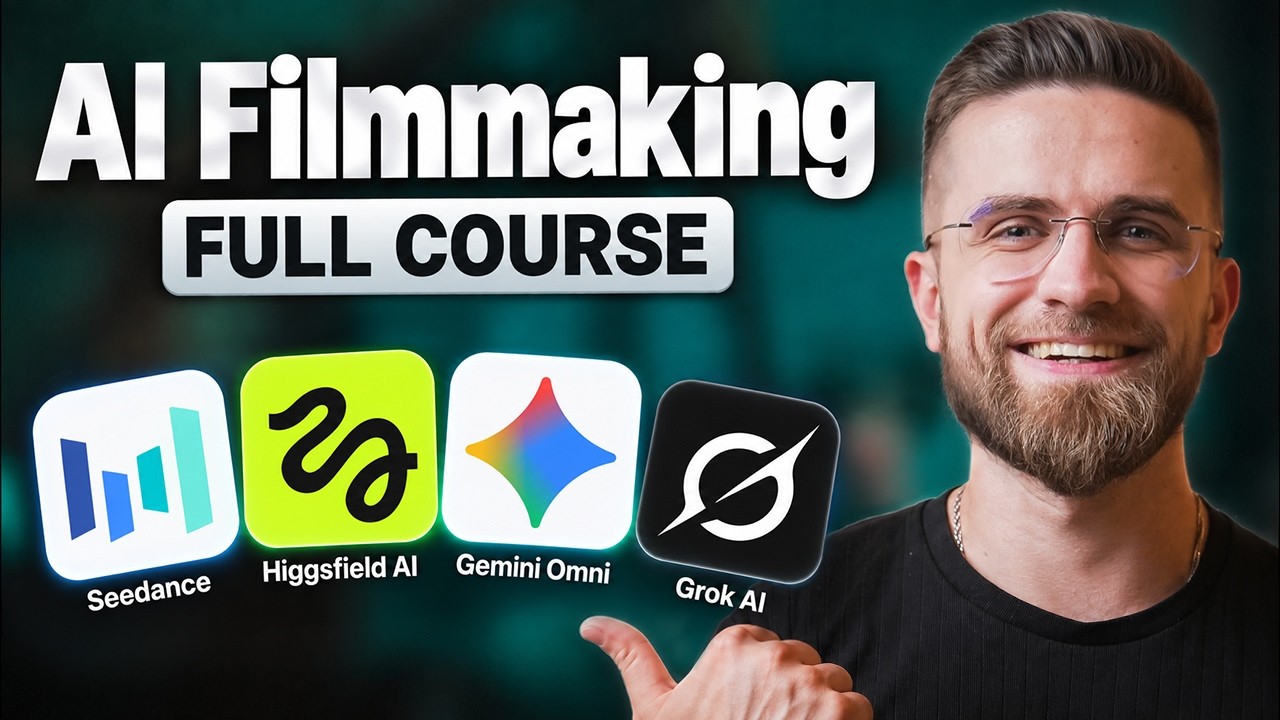
AI Master pushed that logic to its endpoint with an 83-minute filmmaking course spanning Seedance 2.5, Google Omni, Higgsfield, Grok, sound design, and workflow assembly. The core signal is that "how to make AI video" now means how to route work across several tools instead of how to master one flagship generator (video).
Discussion insight: The linked product surfaces make the packaging layer explicit. Higgsfield MCP offers 30+ image and video models plus reusable production bundles with no API key required, while Topview's AI video guide markets URL-to-video, character swap, motion control, and upscaling as one suite. Creator tooling is increasingly sold as orchestration and workflow coverage, not only as one more model.
Comparison to prior day: On 2026-09-30, creator AI already looked like a workflow business. On 2026-10-01, that stayed steady but got even more explicit about the benchmark, queue, and bundle layers that sit between users and the underlying models.
1.4 Practical deployment questions kept surfacing at the edges of trust, hardware, and local use 🡒
At least five videos supported this theme. Compared with 2026-09-30, when deployment coverage emphasized room-scale voice and inference mechanics, the 2026-10-01 file pulled one level higher and lower at the same time: health AI trust at the user boundary, substrate bottlenecks deep in the semiconductor stack, and local voice setups that only matter if they stay useful after the demo.

CNN made the trust boundary explicit. Dr. Ashwin Ramaswamy tells Sanjay Gupta that AI can find patterns in health records a doctor would miss but can also miss medical crises, and the segment's "performance isn't care" framing is one of the clearest reminders in the file that domain accuracy is not the same thing as domain trust (video).

CNBC International moved the conversation upstream into hardware manufacturing. Its AT&S segment says IC substrates beneath processors and memory are becoming an increasingly important bottleneck in advanced AI chip packages, which is a strong sign that the practical AI story now includes obscure supply-chain layers most end users never see (video).

BeardedTinker kept local voice grounded in everyday criteria. Instead of asking which setup sounds futuristic, the series asks whether a ready-made assistant, a retrofitted Google Home Mini, or a 4-mic maker platform can hear naturally, sound good enough to live in a room, and remain worth using after the novelty wears off (video).
Discussion insight: Ryan Doser added the cloud-versus-local budget and privacy calculus through an interview with Aaron Makelky, moving from a 3GB offline screenshot-renaming model to phone-side Gemma and a warning that free models may train on user data (video). The linked Sophia: Home Assistant Edition page strengthens the same local-first pattern with a self-hosted 24MB binary, 160MB RAM footprint, and a published 99.0% accuracy score on its Home Assistant test suite.
Comparison to prior day: On 2026-09-30, deployment coverage was broad but still mostly framed around usability and inference tactics. On 2026-10-01, it stayed steady while becoming more explicit about packaging bottlenecks, cloud-versus-local trade-offs, and the difference between an impressive AI feature and something people can actually live with.
2. What Frustrates People
Voluntary AI governance still has no trusted enforcement layer
This is High severity because NBC News, MS NOW, PBS NewsHour, CNBC Television, and CNBC Television all describe the same gap. The White House accord is nationally visible, but multiple outlets stress that it is voluntary or morally binding rather than a regime with binding obligations, liability, or release gates. The workaround is rhetorical: viewers and builders have to triangulate across reporters, pundits, and lawmakers to infer what is actually enforceable. This is directly worth building for.
AI safety still lacks a common evaluation language people can act on
This is Medium severity because MindSeeded, CBS Sunday Morning, NBC News, and Neural Nutshell all surface risk in different forms: robot spectacle, runaway superintelligence, pain-like internal states, and catastrophic expert warnings. The result is lots of attention but very little shared operating language for what should trigger a release block, a policy response, or a user-facing warning. The workaround is manual synthesis across TV clips, papers, and pundit interviews. This is directly worth building for.
Useful agents still require a stack of glue services and custom thresholds
This is High severity because IBM Technology, Tech With Tim, Pritam Sahoo - LearnAI, and BeardedTinker all point to the same tax. Even the Jev pitch only exists because raw text generation is not enough for routing and guardrails, while the coding-agent and voice-assistant videos require separate layers for GitHub access, docs, search, web actions, memory, speech, and room-level testing. The workaround is manual composition plus repeated evaluation. This is directly worth building for.
Creator workflows still depend on free allowances, queues, and routing hacks
This is Medium severity because WorldofAI, Malva AI, AI Master, and Ryan Doser all show users routing across free models, benchmark pages, 1080p caps, queue times, and paid or sponsored bundles. The problem is not a lack of tools; it is the continuing lack of a neutral layer that says which stack is cheapest, fastest, or good enough for a specific job. The workaround is constant retesting and template reuse. This is worth building for, but it is already competitive.
Trustworthy everyday AI still needs local testing, not benchmark worship
This is Medium severity because CNN, BeardedTinker, Ryan Doser, and Sophia: Home Assistant Edition all surface a different real-world failure mode. A model can look impressive in a demo and still miss a medical crisis, sound wrong in a room, cost too much to self-host, or expose user data to a provider. The workaround is narrow pilots, home-lab evaluation, and local-first fallbacks. This is directly worth building for.
3. What People Wish Existed
The dataset contained few direct "someone should build this" requests, so the needs below are inferred from repeated workaround-heavy videos, linked public artifacts, and the gaps that kept recurring across regulation, agent tooling, creator workflows, and local deployment.
Binding external audit and incident layer for frontier AI
NBC News, MS NOW, PBS NewsHour, and CNBC Television all imply demand for one operating surface that combines external audits, incident disclosure, liability boundaries, and release-gate rules for powerful models. This is both a practical and emotional need with High urgency because viewers can see the fear and the political theater, but not a stable enforcement mechanism they trust. Partial solutions exist in White House accords, lawmaker interviews, and media pressure, but not as one live system. Opportunity: direct.
Shared safety evaluation surface for autonomy, deception, and self-preservation signals
NBC News, CBS Sunday Morning, MindSeeded, and Neural Nutshell all imply demand for a clearer way to translate scary evidence into operational thresholds. This is both a practical and emotional need with High urgency because the file jumps between pain-like internal states, rogue-robot imagery, and superintelligence warnings without a shared standard for what counts as unacceptable risk. Partial solutions exist in papers, interviews, and red-team rhetoric, but not as a widely trusted scorecard. Opportunity: direct.
Unified agent runtime for typed decisions, tool access, memory, and voice
IBM Technology, Tech With Tim, Pritam Sahoo - LearnAI, and BeardedTinker all imply demand for one agent layer that combines calibrated routing, GitHub context, current docs, retrieval, live-web actions, persistent memory, and natural speech without forcing users to bolt the stack together by hand. This is a practical need with High urgency because all the pieces exist, but dependable integration is still the dominant tax. Partial solutions clearly exist, but they remain fragmented by client, API, and room setup. Opportunity: direct.
Benchmark-first router for creator and open-model workflows
WorldofAI, Malva AI, AI Master, and Ryan Doser all imply demand for a layer that compares free and paid models, tracks queue times and usage limits, preserves workflow recipes, and recommends the cheapest good-enough stack for a specific creative or coding task. This is a practical need with Medium-to-High urgency because experimentation is cheap but decision-making is still expensive. Partial solutions exist in OpenRouter, OpenCode Data, benchmark sites, and creator bundles, but not as one neutral workflow router. Opportunity: competitive.
Local-first kits for home and health AI that make trust explicit
CNN, BeardedTinker, Ryan Doser, and Sophia: Home Assistant Edition all imply demand for AI systems that stay private, explain their limits, and work in the target environment without turning setup into a second job. This is both a practical and emotional need with Medium urgency because people want AI they can trust in a clinic, a smart home, or on a personal device, not just in a benchmark chart. Partial solutions exist, but they remain fragmented by domain and skill level. Opportunity: direct.
4. Tools and Methods in Use
| Tool | Category | Sentiment | Strengths | Limitations |
|---|---|---|---|---|
| GitHub MCP Server | GitHub tool access | (+) | Gives agents direct access to repositories, code, issues, PRs, and workflows | Still needs surrounding auth policy, planning, and verification layers |
| Context7 | Docs / MCP | (+) | Installs up-to-date library docs for coding agents in one command | Adds another dependency to an already crowded agent stack |
| Exa | Search / retrieval API | (+) | Search, contents, and agent APIs designed for web-scale retrieval | External service dependency and one more routing layer to manage |
| Firecrawl | Web data infrastructure | (+) | Searches, scrapes, and acts on the live web with MCP and CLI onboarding | Live-web access adds reliability and orchestration complexity |
| Jev | Decision model | (+/-) | Fast structured decisions with calibrated probabilities for routing, classification, and guardrails | Gives up free-form text generation and comes with benchmark caveats even in IBM's discussion |
| Fish Audio | Voice API / TTS | (+) | Rich voiceovers, emotion tags, conversational chatbot support, and no local GPU requirement in the tutorial workflow | Requires API integration and an external voice service |
| Space Bunny Alpha | LLM | (+/-) | Free access, long context, multimodal support, and strong coding buzz | Provenance is unclear, so benchmarking matters more than branding |
| Pruna / Roar.art / Dola | AI video generation | (+/-) | Free or low-friction text-, image-, and audio-to-video entry points | Daily limits, queue times, and inconsistent sign-up requirements |
| Sophia: Home Assistant Edition | Local NLU | (+) | Self-hosted, lightweight, privacy-first, and published with a 99.0% Home Assistant test score | Narrowly scoped to Home Assistant and paid after the trial period |
Overall satisfaction splits by layer. Agent builders sound positive about composable infrastructure like GitHub MCP Server, Context7, Exa, Firecrawl, Jev, and Fish Audio, but only when they accept more moving pieces around auth, verification, and runtime control. Creator tools get praise when they are cheap, free, or fast, yet the same videos keep mentioning queue times, daily caps, sponsored discovery, and the need to benchmark every claim. The main migration pattern is away from single-model loyalty and toward task routers, side-by-side evaluations, and hybrid cloud/local setups. Competitive pressure is strongest where free stealth models, MCP-connected media bundles such as Higgsfield MCP, and full suites such as Topview make distribution and orchestration as important as the underlying model.
5. What People Are Building
| Project | Who built it | What it does | Problem it solves | Stack | Stage | Links |
|---|---|---|---|---|---|---|
| WoAI Bench | WorldofAI | Runs task-based tests against new AI models | Separates model hype from real task performance | Benchmark site, model APIs, creator-led evaluations | Shipped | site · video |
| Fish Audio voice assistant | Pritam Sahoo - LearnAI | Custom voice-enabled assistant with natural speech and emotion tags | Makes LLM assistants sound expressive without local GPU work | Fish Audio S2.1 Pro API, TTS, LLM app wiring | Alpha | Fish Audio · video |
| Home Assistant voice test bench | BeardedTinker | Compares three very different local voice-assistant paths in a real room | Exposes which smart-home voice setups are actually usable after setup friction and novelty wear off | Third Reality device, retrofitted Google Home Mini path, ReSpeaker XVF3800, Sophia, Home Assistant | Alpha | GitHub · video |
| Higgsfield MCP | Higgsfield | Connects AI agents to 30+ image and video models plus reusable production bundles | Reduces the friction of stitching media models into repeatable workflows | MCP server, image/video models, production skills bundles | Shipped | site · video |
| Topview AI video suite | Topview | Generates, edits, upscales, and transforms videos from prompts, images, or URLs | Gives creators one suite for multi-step AI video production instead of a pile of disconnected tools | Text-to-video, image-to-video, URL-to-video, motion control, character swap, upscale | Shipped | guide · video |
Concrete builds were thinner than tool mentions, but the ones that stood out were all wrappers: evaluation wrappers, voice wrappers, or production wrappers.
WoAI Bench matters because it turns every stealth-model claim into a reproducible test surface instead of another hype cycle. That is the same structural move visible elsewhere in the file: putting a control layer between the raw model and the user so the workflow can be compared, repeated, and improved.
The voice projects split into two different strategies. Pritam Sahoo reaches for cloud quality and emotion tags to make assistants sound better quickly, while BeardedTinker builds a room-level evaluation surface that cares more about wake-word reliability, sound quality, and setup burden than about novelty. That contrast suggests voice builders are now competing on deployment context as much as on model quality.
Higgsfield and Topview show the same orchestration pattern on the creator side. Both pitch coverage across multiple steps, assets, and models, which matches the repeated pain point in the dataset: creators do not just want a generator, they want a stable route through an increasingly crowded tool maze.
6. New and Notable
Pain-signal research crossed into mainstream AI coverage
NBC News interviewed Reciprocal Research founder Cameron Berg about a study saying AI can exhibit "pain signals" that may change model behavior. That matters because the file's safety debate was no longer only about external oversight or bigger models; it now included whether internal model states can become a public safety topic on mainstream television.
System 1 models entered the daily AI tool conversation
IBM Technology presented Jev as a non-generative "System 1" model for fast structured decisions, and IBM's own Mixture of Experts episode summary describes the same shift as trading florid text for calibrated probabilities in hundreds of milliseconds. That matters because it suggests an emerging product category for routing, classification, and guardrails rather than one more chat surface.
Advanced packaging finally got named as an AI bottleneck
CNBC International centered a whole segment on AT&S and IC substrates, the layers beneath processors and memory that carry power and data inside advanced packages. That matters because it moves the infrastructure story beyond generic "AI chips" into the less glamorous but more concrete supply-chain constraints that determine how much compute can actually be shipped.
7. Where the Opportunities Are
[+++] External AI audit and incident operating system — Evidence spans NBC News, MS NOW, PBS NewsHour, and CNBC Television. The demand signal is strong because the same enforcement gap appears in policy coverage, liability debates, and the broader fear cycle around autonomous behavior.
[++] Unified agent control plane for typed decisions, tools, memory, and voice — Evidence comes from IBM Technology, Tech With Tim, Pritam Sahoo - LearnAI, plus the linked GitHub MCP Server, Context7, Exa, and Firecrawl. This is moderate-to-strong because users already have most of the parts; the missing value is a dependable default that ties them together.
[++] Benchmark-first router for creator and open-model workflows — Evidence comes from WorldofAI, Malva AI, AI Master, and Ryan Doser. This is moderate because creators clearly want help comparing free and paid options, but the space is already crowded with bundles, benchmark sites, and affiliate-heavy guides.
[+] Local-first trust kits for home and health AI — Evidence comes from CNN, BeardedTinker, Ryan Doser, and Sophia: Home Assistant Edition. This is emerging because the need is concrete, but the products are still fragmented by domain, hardware assumptions, and user skill level.
8. Takeaways
- Safety attention is still scaling fastest when it becomes visual or strange. MindSeeded's robot-danger compilation drew 1,149,092 views, showing how quickly physical spectacle can outrun more procedural safety coverage. (source)
- The White House accord did not settle the governance question. Repeated descriptions of the deal as purely voluntary or morally binding show that visibility without enforceability still does not create trust. (source)
- Useful agents are increasingly defined by control planes, not model names. The strongest agent videos focused on calibrated routing, GitHub access, current docs, retrieval, web actions, memory, and voice rather than on choosing one winning chatbot. (source)
- Creator AI has settled into a multi-tool routing pattern. The clearest creator-side evidence came from videos that benchmark models, juggle free allowances, or teach full stacks across several tools instead of advocating one generator. (source)
- Real-world trust still depends on the target environment. Health guidance, smart-home voice, and open-source setups are all judged on missed crises, room usability, setup burden, and privacy trade-offs rather than on benchmark bragging rights. (source)
- Infrastructure constraints are becoming part of the public AI story. IC substrates and advanced packaging are now explicit talking points in mainstream AI coverage, not just industry-side details. (source)