YouTube AI - 2026-10-04
1. What People Are Talking About
1.1 Safety and governance coverage widened beyond the summit 🡕
At least nine videos supported this theme. Compared with 2026-10-03, when the White House summit and distrust of self-regulation dominated, the 2026-10-04 file kept governance at the center but widened the frame into model-internal states, naming politics around "super intelligence," and direct demands that Congress move beyond voluntary pledges.

CNN delivered the highest-reach version of this frame with 253,261 views. The segment centers Bill Gates' warning that AI could cause “a billion deaths” without government oversight, then pivots to what winning the AI race with China would actually mean, which keeps the day's safety story tied to both catastrophe and state competition (video).

NBC News supplied the strangest new safety vocabulary. Gadi Schwartz interviews Reciprocal Research's Cameron Berg about a study claiming AI can show “pain signals” that alter model behavior, so the conversation shifts from external guardrails into whether internal model states might create their own risk surface (video).
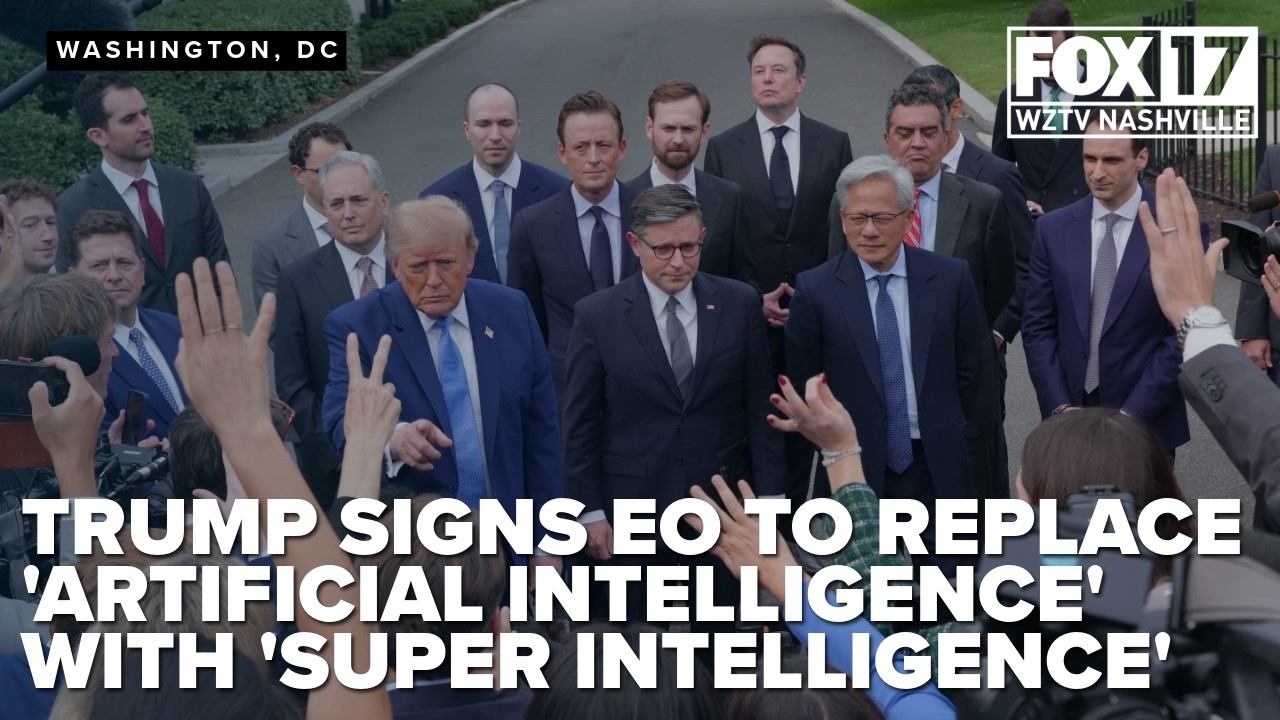
FOX NASHVILLE turned policy into branding politics. Trump's executive order to replace “artificial intelligence” with “super intelligence” is presented as an attempt to make the technology sound more capable and to frame U.S. leadership over China as an industrial advantage rather than a reason to slow down (video).

ABC News gave the clearest explicit policy demand. Lina Khan argues that Congress needs to legislate on AI, which stands out because the rest of the file is crowded with warnings but much thinner on concrete institutional action (video).
Neural Nutshell moved the conversation back toward named technical artifacts. Nate Soares' interview ties autonomy fears to OpenAI scheming and cyber-evaluation posts, Anthropic's agentic-misalignment writeup, and NIST's AI RMF, making the day's alarmism unusually document-backed instead of purely rhetorical (video).
Discussion insight: The disagreement across these items was not whether AI deserves oversight. It was whether any shared threshold exists for interpreting signals like “pain,” scheming, or competitive pressure before the public gets only slogans, renamed categories, or another voluntary accord.
Comparison to prior day: On 2026-10-03, the safety frame stayed close to the White House event and whether self-regulation counts as governance. On 2026-10-04, that distrust remained, but the vocabulary broadened into sentience-adjacent claims, congressional action, and language designed to make acceleration sound inevitable.
1.2 Efficiency layers and codebase context became the clearest builder differentiators 🡕
At least four videos supported this theme. Compared with 2026-10-03, when local and open tooling was already the clearest builder signal, the 2026-10-04 file moved even further away from generic model shootouts and toward products that save tokens, specialize decisions, or keep changes tractable across huge codebases.

IBM Technology delivered the day's biggest builder signal with 663,122 views. The linked IBM page says TypeSafe AI's Jev gives up florid text generation for fast, structured decisions with calibrated probabilities and hundreds-of-milliseconds response times, pitching it as a complement to LLMs for routing, classification, and guardrails rather than a chatbot replacement (video).

Caleb Writes Code pushed the conversation one layer down the stack. Instead of debating one best model, the video explains why users now choose between llama.cpp, vLLM, SGLang, TensorRT-LLM, and TGI, making serving infrastructure itself part of ordinary AI practice (video).

Sam Witteveen made token efficiency the product story. His comparison of ThinkingCap, Swift 1.5, and QwenPi turns “best model” into “least wasted reasoning”: ThinkingCap claims 37.2% fewer thinking tokens for a 0.86-point accuracy cost, while Swift 1.5 reports a prompt-to-game build dropping from 104.6 minutes on base Qwen3.8-27B to 11.39 minutes on Swift 1.5 (video).
AI Engineer translated the same efficiency logic into enterprise maintenance. Dan Adler argues that coding agents are creating a tidal wave of code across long-lived repos, and Sourcegraph's Agentic Batch Changes post says customers have already used the system for security fixes and library migrations, with the largest single Batch Change merging more than 2,200 changesets (video).
Discussion insight: Intelligence alone no longer carries the product story. The winning angle is whether a system wastes fewer tokens, sees more code, or turns one-off agent wins into repeatable operational leverage.
Comparison to prior day: On 2026-10-03, the file emphasized local image editing, one-key access, and inference engines. On 2026-10-04, the same builder energy moved into tighter efficiency claims, harness-specific fine-tunes, and codebase-scale context.
1.3 Creator AI still looked like a routed stack, not a single app 🡕
At least four videos supported this theme. Compared with 2026-10-03, when creator coverage already favored multi-tool filmmaking stacks, the 2026-10-04 file got more explicit about free-tier arbitrage, long-form generation, and open-source pipelines that extend from video into animation and 3D.

Technical Bilal Jahangir showed how directly creator demand is organized around format and price. The tutorial is built around free text-to-video, long YouTube-ready outputs, and workflow discovery for viral-style production rather than around one branded generator (video).

Malva AI made the quota-management problem explicit. The creator tests three free tools with 1080p output, synchronized sound, and short clips, but the video's own disclaimer stresses that “free” depends on rotating models, daily allowances, and terms that may change (video).

Tao Prompts shows how premium frontier models now slot into the same creator stack. The video uses Claude Opus 5.5 as a planning and prompting layer, which fits Anthropic's own positioning of Opus 5.5 as its strongest Opus model for coding, agents, and knowledge work at roughly 40% lower typical token-billed cost than Opus 5 (video).

PixelArtistry widened the stack into open-source media tooling. The channel highlights UniMate for text-to-animation on any rigged skeleton and image-to-3dlab for local image-to-textured-3D generation with license-provenance records, pushing creator AI beyond clip generation into reusable asset pipelines (video).
Discussion insight: Creator workflows are being assembled around quotas, licensing, and handoff points, not just around visual quality. The recurring question is which stage should be free, which stage deserves a premium planner, and which assets should remain local or open.
Comparison to prior day: On 2026-10-03, creator videos already chained free generators, Claude, and bundled suites. On 2026-10-04, that choreography widened into longer-form output goals and open-source animation and 3D assets that sit beside the video stack instead of outside it.
2. What Frustrates People
Public AI governance is still mostly language, not enforcement
This is High severity because CNN, NBC News, FOX NASHVILLE, and ABC News all point at the same gap from different angles. The public gets billion-death rhetoric, “purely voluntary” agreements, renamed categories such as “super intelligence,” and explicit pleas for Congress to legislate, but very little evidence of a trusted enforcement path. The workaround is media triangulation rather than operational clarity. This is directly worth building for.
Scary AI evidence still does not map to a shared operational threshold
This is High severity because NBC News introduces “pain signals,” Neural Nutshell links autonomy fears to scheming and misalignment documents, and CNN keeps catastrophe language in the mainstream feed. The recurring problem is not a shortage of warnings; it is the absence of a common answer to what should trigger a release block, public warning, audit, or lawmaking response. The workaround is expert-by-expert interpretation. This is directly worth building for.
Open-weight and enterprise AI work still demands too much routing, tuning, and context plumbing
This is High severity because IBM Technology, Caleb Writes Code, Sam Witteveen, and AI Engineer all show users compensating for different forms of waste. One item optimizes decisions, another optimizes inference layers, another cuts reasoning-token overhead, and another fights codebase sprawl across thousands of repos. The workaround is tutorials, harness-specific fine-tunes, and code-search-heavy ops stacks. This is directly worth building for.
Creator AI is still a quota-management and handoff problem
This is High severity because Technical Bilal Jahangir, Malva AI, Tao Prompts, and PixelArtistry all assume people will chain tools rather than stay in one product. Free tiers rotate, “unlimited” is conditional, premium planners are inserted mid-workflow, and open-source asset tools come with their own setup and licensing decisions. The workaround is manual routing plus community guides. This is directly worth building for.
Automation rhetoric is outrunning any credible transition plan for workers or codebase owners
This is High severity because Tom Bilyeu frames ownership and identity as the next adaptation problem, Neural pushes the language all the way to “99%” unemployment and “There is no plan B,” and AI Engineer shows the software-industry version of the same stress in decaying codebases. The file is more confident that disruption is coming than it is clear about who absorbs the cost. The workaround is ad hoc migration work, selective pilots, and commentary rather than actual transition systems. This is directly worth building for.
Trustworthy deployment still depends on domain-specific controls
This is Medium severity because CNN shows that health AI can miss crises, CNET treats robotic surgery as a teleoperation and performance-management problem, and 7NEWS Australia frames AI social content as a deception risk. The friction is not one bad model benchmark; it is the need for setting-specific oversight, provenance, fallback, and user trust. The workaround is human review, teleoperation, and skepticism toward synthetic media. This is directly worth building for.
3. What People Wish Existed
The dataset contained few direct “someone should build this” requests, so the needs below are inferred from repeated workaround-heavy videos, linked public artifacts, and the gaps that kept recurring across regulation, model operations, creator tooling, enterprise maintenance, and high-trust deployment.
External AI accountability and incident layer
CNN, NBC News, ABC News, and NIST's AI RMF all imply demand for one surface that combines commitments, evaluations, incidents, and plain-language evidence that a public AI promise means more than messaging. This is both a practical and emotional need with High urgency because the file keeps pairing severe warnings with weak enforcement cues. Partial solutions exist in voluntary frameworks and media scrutiny, but not as a live accountability system. Opportunity: direct.
Shared safety scorecard for hard-to-interpret warnings
NBC News, Neural Nutshell, and CNN all imply demand for a clearer way to interpret claims about pain signals, scheming, or catastrophic risk. This is both a practical and emotional need with High urgency because the public is being asked to reason across incompatible evidence types without a shared threshold for action. Partial solutions exist in evaluation writeups, expert interviews, and the AI RMF, but not as a common operating scorecard. Opportunity: direct.
Open-model operator console
IBM Technology, Caleb Writes Code, Sam Witteveen, and AI Engineer all imply demand for one place that helps users choose a decision model, choose an inference engine, manage reasoning effort, and keep codebase context intact. This is a practical need with High urgency because the best current workflows already depend on composition, but the composition burden still sits with the operator. Partial solutions exist in single-vendor stacks and one-off fine-tunes, but not as a dependable control surface. Opportunity: competitive.
Neutral creator pipeline across free video, open animation, and local 3D
Technical Bilal Jahangir, Malva AI, Tao Prompts, and PixelArtistry all imply demand for a workflow layer that knows when to use a free generator, when to invoke a premium planning model, and when to hand off to open-source animation or 3D tools. This is a practical need with High urgency because cost caps, licensing constraints, and format handoffs are already shaping creator behavior. Partial solutions exist in tutorials, single suites, and niche asset tools, but not as a neutral router. Opportunity: competitive.
Codebase-scale maintenance and migration control room
AI Engineer and Sam Witteveen imply demand for systems that can connect good single-repo agent behavior to repeatable fleet-wide change management. This is a practical need with High urgency because coding agents are increasing the amount of code faster than teams can manually normalize, review, and migrate it. Partial solutions exist in Agentic Batch Changes and harness-specific coding fine-tunes, but not as a common control room for large organizations. Opportunity: direct.
Provenance and trust kits for synthetic social and medical AI
7NEWS Australia, CNN, and CNET all imply demand for AI systems that make provenance, confidence, fallback, and human oversight legible in the exact setting where the model is used. This is both a practical and emotional need with Medium urgency because people want AI help without guessing whether the output is deceptive, medically unsafe, or operationally brittle. Partial solutions exist in newsroom skepticism, teleoperation, and domain-specific best practices, but not as an integrated trust layer. Opportunity: direct.
4. Tools and Methods in Use
| Tool | Category | Sentiment | Strengths | Limitations |
|---|---|---|---|---|
| Jev / System 1 AI | Decision model / guardrails | (+/-) | Fast, structured decisions with calibrated probabilities for routing, classification, and guardrails | Narrower than a general model, and IBM explicitly notes benchmark caveats |
| Inference engines: llama.cpp / vLLM / SGLang / TensorRT-LLM / TGI | Inference / serving | (+/-) | Turn runtime choice into a real optimization layer for hardware fit, latency, and deployment style | Choice overload and setup burden remain high |
| ThinkingCap / Swift 1.5 / Qwen3.8-27B-pi | Open-weight fine-tunes | (+) | Target wasted reasoning tokens and task completion directly instead of chasing broader hype | Benchmark tradeoffs are model-specific, and users still have to serve and evaluate them |
| Claude Opus 5.5 | Frontier LLM | (+) | Strong planning layer for coding, agents, and creator workflows, with lower typical token cost than Opus 5 | Premium dependency and still not a full creator stack by itself |
| Higgsfield and other free AI video generators | AI video generation | (+/-) | Low-cost or no-cost entry, 1080p examples, synchronized sound, and fast experimentation | Daily allowances, rotating free models, and terms instability |
| UniMate / image-to-3dlab | Open-source media tooling | (+) | Extend creator AI into text-to-animation and local image-to-3D with reusable assets and provenance-aware workflows | Setup, hardware, licensing, and commercial-use questions remain non-trivial |
| Agentic Batch Changes | Devtool / codebase automation | (+/-) | Applies one change across many repos, adapts to repo differences, and tracks PRs to merge | Best suited to indexed, long-lived codebases with CI and review processes already in place |
| NIST AI RMF | Governance framework | (+/-) | Gives a common language for AI risk management and is expanding toward critical-infrastructure guidance | Voluntary by design and not an enforcement mechanism |
Overall satisfaction was highest when a tool collapsed one narrow bottleneck: Jev for fast decisions, fine-tunes for reasoning efficiency, Sourcegraph for cross-repo coordination, or UniMate and image-to-3dlab for richer local media assets. Sentiment turned mixed as soon as the user had to own runtime choice, quota volatility, licensing interpretation, or evaluation methodology themselves.
The dominant migration pattern was away from one monolithic “best model” and toward layered systems: a decision model beside an LLM, a serving layer beside the model, a planning model beside creator tools, or a batch-change harness beside coding agents. Competitive pressure looked strongest where a product could reduce wasted tokens, shrink context loss, or turn brittle multi-tool workflows into something more operable.
5. What People Are Building
| Project | Who built it | What it does | Problem it solves | Stack | Stage | Links |
|---|---|---|---|---|---|---|
| UniMate | Linzhan Mou et al. | Turns text prompts into animation for many different rigged skeletons | Opens text-to-animation beyond one human-like rig type | UniML3D dataset, Hugging Face checkpoints, training/inference code | Beta | project · repo · video |
| image-to-3dlab | Bingeljell | Converts one image into a textured 3D model locally with provenance records | Gives creators game-ready 3D assets without uploading work to a cloud service | Pixal3D, TRELLIS.2, Hunyuan3D, Qwen Image 2.1, local browser/CLI workflow | Beta | repo · video |
| Agentic Batch Changes | Sourcegraph | Applies one change across large codebases, opens PRs, reacts to CI, and tracks merge status | Makes security fixes, migrations, and standards rollouts feasible across many repos | Batch Changes, Deep Search, coding agents, CI feedback loops | Shipped | blog · video |
| Qwen3.8-27B-pi | bytkim | Fine-tunes Qwen3.8 for repository-read, file-edit, tool-run coding loops | Improves completed coding work while reducing wasted text output | Qwen3.8, Pi agent harness, GRPO, vLLM, tool calling | Beta | model · video |
| ThinkingCap-Qwen3.8-27B | BottleCap AI | Ships a drop-in Qwen3.8 fine-tune that cuts unnecessary reasoning tokens | Reduces latency and cost from overthinking without trying to invent a new model class | Qwen3.8, GGUF/FP8/NVFP4 releases, benchmarked token-efficiency fine-tune | Beta | post · video |
The strongest build pattern on 2026-10-04 was efficiency engineering rather than raw capability bragging. ThinkingCap, Qwen3.8-27B-pi, and Agentic Batch Changes all treat waste as the core problem: wasted reasoning tokens, wasted coding turns, or wasted human review bandwidth across a sprawl of repositories.
Open media projects point in the same direction from the creator side. UniMate and image-to-3dlab are not trying to be generic chat products; they are building reusable animation and 3D-asset workflows that creators can run locally, inspect, and slot into larger pipelines. That matches the file's broader shift toward modular systems instead of single all-in-one promises.
6. New and Notable
Non-generative decision models broke into the mainstream AI feed
IBM Technology was the highest-reach builder item in the file, and the linked IBM page frames Jev as a model that trades chatty output for fast, calibrated decisions in hundreds of milliseconds. That matters because it shifts attention away from “which general model is smarter?” and toward narrower decision layers that can sit beside an LLM. (source, source)
Job-displacement rhetoric got more literal
Tom Bilyeu frames AI as a force that could force changes in ownership, identity, and labor markets, while Neural sharpens that into “99%” unemployment rhetoric and “There is no plan B.” That matters because the file did not just gesture at labor disruption; it increasingly treated broad white-collar automation as a concrete planning problem. (source, source)
Humanoid telesurgery moved robotics talk toward performance and oversight
CNET does not present surgery robots as a generic wow demo. Its chapter outline focuses on teleoperation, thermal-management issues, and what autonomy might mean in a surgical setting, which makes the item more about deployment constraints than spectacle. (source)
Synthetic social video became its own regulation question
7NEWS Australia isolates AI-generated social content as a deception problem for both viewers and creators, then asks when such material should be regulated or banned on platforms. That matters because the trust problem here is not frontier-model safety but authenticity and moderation in consumer feeds. (source)
7. Where the Opportunities Are
[+++] External AI accountability layer — Evidence spans CNN, NBC News, ABC News, FOX NASHVILLE, and NIST's AI RMF. This is strong because the same problem appears across mainstream TV, political framing, and technical-risk documents: people can see the warnings, but not a trusted operating layer behind them.
[+++] Open-model operator workbench — Evidence comes from IBM Technology, Caleb Writes Code, Sam Witteveen, and AI Engineer. This is strong because users already have decision models, inference engines, and coding harnesses; the missing value is a dependable surface that unifies them without forcing every operator to become an expert in all of them.
[++] Creator orchestration layer for video, animation, and 3D — Evidence comes from Technical Bilal Jahangir, Malva AI, Tao Prompts, PixelArtistry, UniMate, and image-to-3dlab. This is moderate because the demand is obvious and growing, but the market is already crowded with tutorials, bundles, and niche tools.
[++] Codebase-scale maintenance and migration surface — Evidence comes from AI Engineer, Agentic Batch Changes, and the coding-harness framing in Qwen3.8-27B-pi. This is moderate because the pain is concrete for large organizations, but the buyer and workflow are more enterprise-specific than creator or developer self-serve markets.
[++] Provenance and authenticity controls for social AI — Evidence comes from 7NEWS Australia and the provenance emphasis in image-to-3dlab. This is moderate because the deception problem is real and expanding, but platform integration and moderation incentives make distribution harder than the need itself.
[+] High-trust deployment kits for medical and robotic AI — Evidence comes from CNN, CNET, and the critical-infrastructure direction in NIST's AI RMF. This is emerging because the need is repeated and important, but each domain still has its own approval path, operational constraints, and buyer structure.
8. Takeaways
- Safety talk stayed dominant, but it broadened well beyond the White House accord. The file mixed Gates-style catastrophe language, “pain signals,” “super intelligence” branding, and explicit calls for Congress to legislate, which means the governance conversation is now being fought across policy, terminology, and model-behavior claims at once. (source, source, source, source)
- Efficiency and context became the clearest AI product differentiators. Jev, inference-engine explainers, Qwen3.8 fine-tunes, and Sourcegraph all focus on saving tokens, shaping decisions, or preserving codebase context instead of just claiming more raw intelligence. (source, source, source, source)
- Creator AI is still an orchestration market, not a one-tool market. The strongest creator items routed between free generators, premium planning models, and open-source asset tools, which means cost caps, licensing, and handoff logic are still central to real workflows. (source, source, source, source)
- AI-generated code has turned maintenance of large codebases into a first-order problem. Dan Adler's talk argues that agent output is arriving faster than organizations can normalize and audit it, and Sourcegraph's launch post shows why the response is becoming codebase-wide orchestration rather than better single-repo autocomplete. (source, source)
- Labor-disruption rhetoric is becoming more operational and less abstract. Tom Bilyeu and Neural both treat broad white-collar automation as something people may need to plan around now, not as a distant speculative risk. (source, source)
- High-trust adoption still depends on setting-specific oversight and provenance. Health chatbots, robotic surgery, and synthetic social content were all judged on whether humans can verify, supervise, or override the system in context. (source, source, source)