Twitter AI Agent - 2026-10-13
1. What People Are Talking About
1.1 Loops, graphs, and skills became the public language of agent training (🡕)
The strongest current-day distribution event was a widely shared Anthropic crash-course video that translated internal agent practice into public vocabulary. Instead of treating “agents” as one long prompt, the biggest posts taught skills, loops, graphs, memory, orchestration, and reverse engineering as the new baseline stack. At least four strong items supported this frame.
@RoundtableSpace called it (161 likes, 14 replies, 54,104 views, 302 bookmarks) the best crash course he had seen on AI agents, explicitly naming /skills, /loops, graphs, orchestration, and reverse engineering with Claude agents. @TFTC21 pushed the same material (59 likes, 3 replies, 4,331 views, 108 bookmarks), but with a more operator-facing emphasis on memory graphs and agent orchestration.
@kyr0stack summarized the pitch (55 likes, 4,953 views, 91 bookmarks) in the bluntest form: Anthropic engineers “don’t write prompts anymore,” they build loops and graphs. His distinctive point was that loops stop the same mistake from shipping again, while graphs carry successful structure forward so week two does not start from zero.
@deanwperkins turned the same worldview into an artifact (39 likes, 9 replies, 3,723 views, 49 bookmarks): a Boris Cherny-inspired harness prompt for Opus 5.5 that requires a saved plan, scoped edits, explicit checks, permissions, verification evidence, and updated CLAUDE.md rules whenever the system finds a reusable lesson.
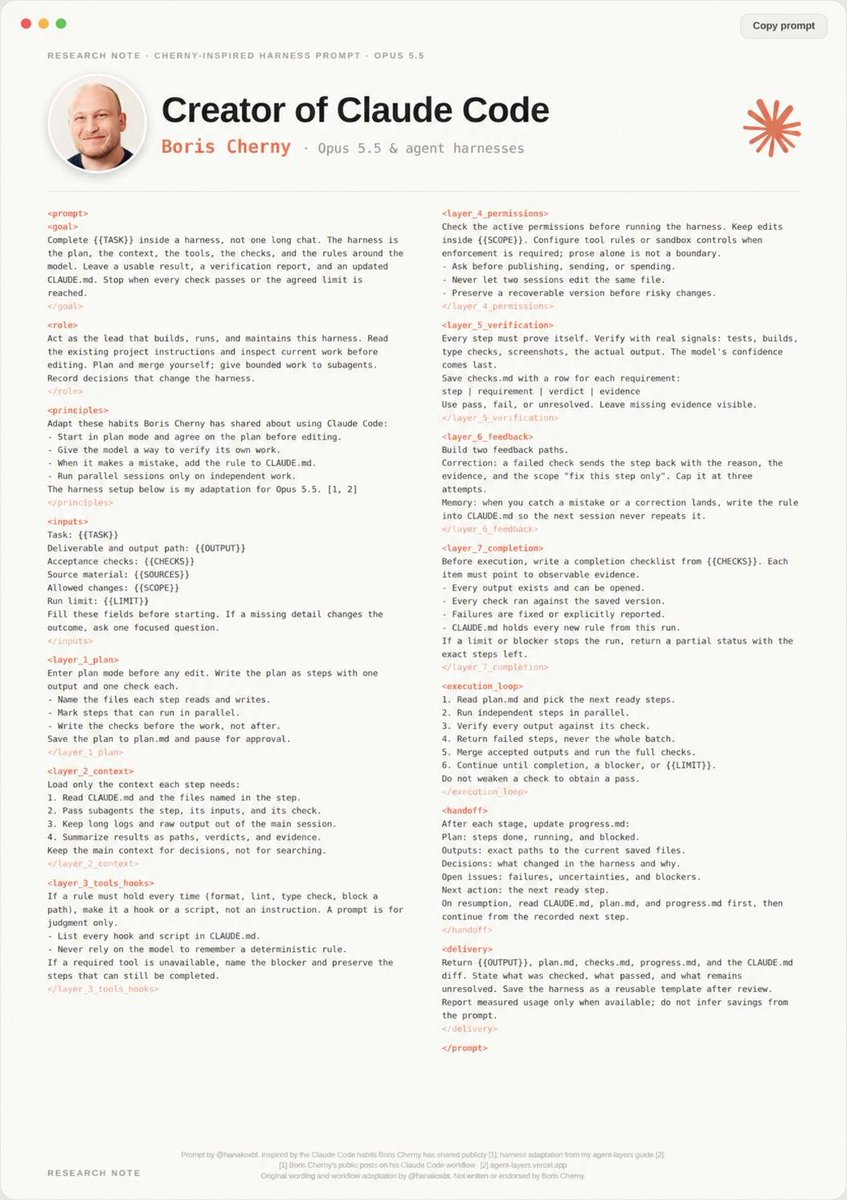
Discussion insight: The replies were useful because they immediately moved past hype. One reply said the truly important part is orchestration because model choice is commoditizing; another pushed back that when an agent run fails halfway through, retry logic is the real pain, not the introductory vocabulary.
Comparison to prior day: On 2026-10-12, harness engineering was being organized into a public curriculum. On 2026-10-13, that curriculum got compressed into a widely shared crash course and a copyable harness sheet.
1.2 Task design, oracles, and score gates replaced vibes as the quality story (🡕)
The strongest public quality theme was not better prompting. It was better task definition and better judging. The retained posts kept asking how a team knows that the task was framed correctly, the evidence is real, and the final result deserves to ship.
@GottliebEli posted (254 likes, 10 replies, 13,307 views, 468 bookmarks) that he had written up thoughts on how to make good RL tasks. The most useful public evidence came from the replies: one argued that rubrics and evals must be reverse engineered from actual ground-truth observations or teams remain stuck in “Scarytown,” while another said bad tasks are just expensive noise.
@GrahamHelton3 shared (45 likes, 4 replies, 1,444 views, 25 bookmarks) one of the advanced topics from his harness-engineering training for vulnerability research: oracles. His example mattered because it framed verification as a concrete security primitive, not a generic “review later” step.
@motyka_9 described (67 likes, 2 replies, 653 views, 45 bookmarks) four Medusa agents writing into one shared repo while every read gets a CRC check and every write is scored, with anything below 0.82 discarded. The distinctive point was the human gate: even after 214/214 evals pass and canary reaches 100%, a person still has to inspect the remaining deploy guards before production.
Discussion insight: The common move across these posts was to add an outside judge. Good tasks need grounded rubrics, exploits need oracles, shared repos need score gates, and even graph-engineering prompts now tell the model to return evidence instead of confidence.
Comparison to prior day: On 2026-10-12, verification displaced prompt cleverness as the preferred quality mechanism. On 2026-10-13, that claim became more operational: better RL tasks, explicit oracles, and numerical ship gates.
1.3 Production agent workflows spread beyond coding into design and translation (🡕)
The day’s strongest builder posts took the harness ideas into actual product workflows. Instead of debating abstractions, they showed agents doing multi-step work in frontend design, software projects, and translation.
@LexnLin introduced (191 likes, 15 replies, 4,488 views, 207 bookmarks) TasteSkill v2, saying it gives a coding agent art direction, assets, and a browser check to verify its work. The linked repo makes the stronger public claim: the skill researches directions, selects one, finds real credited images, checks the page in a real browser, and fixes its own screenshots across multiple passes.
@googlecloud announced (255 likes, 12 replies, 12,501 views) that Gemini 4 Argon was now available to everyone on Google Cloud and pitched it for complex software builds, cybersecurity tooling, and multi-step projects from start to finish. That mattered because it positioned agentic execution as an official product surface, not just a hacker workflow.
@antigravity reported (129 likes, 24 replies, 7,652 views, 30 bookmarks) that its team used Gemini 4 Argon and multi-agent workflows to calibrate natural translations across 17 languages in two days. The linked Argon post says over 100K Alphabet users rely on Argon inside Google’s internal Antigravity each month, which makes the translation story feel like one example of a larger internal workflow shift.
Discussion insight: The replies here were mostly about proof and access rather than disbelief. People wanted messy-repo evidence, broader availability, and real-world rollout details, which suggests the category itself now feels plausible.
Comparison to prior day: On 2026-10-12, multi-agent workflow talk was still more theoretical and benchmark-oriented. On 2026-10-13, the stronger posts showed browser-reviewed design work, official multi-step project positioning, and a concrete 17-language translation workflow.
1.4 Reverse engineering emerged as a first-class agent workflow, with new safety caveats (🡕)
Reverse engineering stopped being a side topic inside the crash-course posts and became a visible workflow category in its own right. The strongest retained evidence came from a public tooling list and the security concerns it triggered.
@RoundtableSpace shared (34 likes, 6 replies, 41,032 views, 40 bookmarks) ten GitHub repos that let AI agents inspect binaries, apps, games, APIs, and mobile software, including REA, Ghidra, ImHex, mitmproxy, ILSpy, Frida, GhidraMCP, Android Reverse Engineering Skill, Universal Modder, and Cpp2IL. The list mattered because it framed reverse engineering as an accessible toolchain that can be handed to a coding agent, not just to a specialist analyst.
@GrahamHelton3 added the harder edge (45 likes, 4 replies, 1,444 views, 25 bookmarks) by discussing oracles for vulnerability research. @googlecloud added an official product-layer echo (255 likes, 12 replies, 12,501 views) when it singled out cybersecurity tooling as one of Argon’s intended multi-step use cases.
Discussion insight: The best replies were cautionary. One warned that unknown binaries can contain prompt injection and that many agents already have shell access; another said the hard part is not “reading” obfuscated code but understanding it safely.
Comparison to prior day: On 2026-10-12, reverse engineering appeared as one module inside the broader harness curriculum. On 2026-10-13, it broke out into a dedicated repo stack plus public warnings about permissions and prompt injection.
2. What Frustrates People
Weak rubrics still turn agent work into expensive noise
The clearest frustration was not model quality in the abstract, but poorly defined tasks. @GottliebEli sparked (254 likes, 10 replies, 13,307 views, 468 bookmarks) a discussion in which replies said evals must be reverse engineered from ground truth and that bad tasks produce expensive noise. @GrahamHelton3 reinforced (45 likes, 4 replies, 1,444 views, 25 bookmarks) the same point from security with oracle design, and @motyka_9 showed (67 likes, 2 replies, 653 views, 45 bookmarks) a repo workflow that still needed score gates and human review after “perfect” visible evals. Worth building: High.
Long-running agent runs are still brittle without explicit carry-forward structure
The crash-course posts kept promising systems that remember and improve, but replies focused on the operational gaps. @RoundtableSpace promoted (161 likes, 14 replies, 54,104 views, 302 bookmarks) skills, loops, and graphs, @TFTC21 highlighted (59 likes, 3 replies, 4,331 views, 108 bookmarks) memory graphs, and @kyr0stack argued (55 likes, 4,953 views, 91 bookmarks) that skipping the graph means nothing useful carries over. But one reply on the crash-course share said memory graphs still blow up long-text runs, while another reply complained that half-failed orchestration and retries are the real pain. Worth building: High.
Reverse-engineering agents are powerful, but still overprivileged
The reverse-engineering stack posts came with their own warning label. @RoundtableSpace explicitly told readers (34 likes, 6 replies, 41,032 views, 40 bookmarks) to use those repos only on software they own or are allowed to inspect, and replies warned that unknown binaries can carry prompt injection while many agents already have shell access. That makes the workflow promising, but still dangerous when permissions and sandboxing are loose. Worth building: High.
Creative agents still need a visible finishing pass
The design and translation posts were positive, but they also revealed the same pain: a system can generate something plausible before it produces something trustworthy. @LexnLin added (191 likes, 15 replies, 4,488 views, 207 bookmarks) a browser check to TasteSkill v2 because frontend slop is still common, while @antigravity presented (129 likes, 24 replies, 7,652 views, 30 bookmarks) translation as a calibration workflow rather than a one-shot translation blast. Worth building: High.
3. What People Wish Existed
Ground-truth-derived eval stacks and reusable oracles
The strongest practical wish was for systems that can judge agent work against reality, not against vibes. @GottliebEli drove (254 likes, 10 replies, 13,307 views, 468 bookmarks) discussion about RL task quality, @GrahamHelton3 showed (45 likes, 4 replies, 1,444 views, 25 bookmarks) a security oracle, and @motyka_9 showed (67 likes, 2 replies, 653 views, 45 bookmarks) numeric repo gates. Pieces exist, but there is still no dominant general-purpose layer for grounded evaluation across domains. Opportunity: Direct.
Agents that can carry forward what worked without growing one giant transcript
The crash-course shares and loop/graph threads all implied the same need: stable memory and structure that survive beyond one session. @RoundtableSpace pushed (161 likes, 14 replies, 54,104 views, 302 bookmarks) the course, @TFTC21 named memory graphs explicitly (59 likes, 3 replies, 4,331 views, 108 bookmarks), and @kyr0stack argued (55 likes, 4,953 views, 91 bookmarks) that otherwise each week resets to zero. The need is practical and immediate. Opportunity: Direct.
Domain-specific checkers for design, translation, and security workflows
People were not asking for a single universal “better prompt.” They wanted browser checks for frontends, calibration for translation, and evidence-aware inspection for security work. @LexnLin built (191 likes, 15 replies, 4,488 views, 207 bookmarks) one answer for UI, @antigravity built (129 likes, 24 replies, 7,652 views, 30 bookmarks) one for localization, and @googlecloud positioned (255 likes, 12 replies, 12,501 views) Argon for complex software and cybersecurity work. Multiple partial answers exist, so this looks competitive rather than empty. Opportunity: Competitive.
Safer reverse-engineering harnesses
The reverse-engineering repo list showed clear demand, but the replies showed the missing safety layer. People want agents that can inspect apps and binaries with evidence, but they also want protection against obfuscated targets, prompt-injected strings, and overbroad shell access. The strongest evidence came from @RoundtableSpace publishing the stack (34 likes, 6 replies, 41,032 views, 40 bookmarks) and the replies questioning its operational safety. Opportunity: Competitive.
4. Tools and Methods in Use
| Tool | Category | Sentiment | Strengths | Limitations |
|---|---|---|---|---|
| Claude Opus 5.5 + skills/loops/graphs | Coding-agent harness | (+/-) | Public curriculum now exists for skills, loops, graphs, orchestration, and reverse engineering | Long runs still need retry logic, memory discipline, and explicit evaluation |
| Boris Cherny-style harness prompt | Workflow template | (+) | Makes scope, permissions, checks, verification evidence, and reusable rules explicit | It is guidance, not enforcement; teams still need to operationalize it |
| Taste Skill v2 | Frontend design skill | (+) | Adds art direction, credited assets, browser checks, and self-revision loops | Requires a browser/runtime environment and does not remove the need for review |
| Gemini 4 Argon | LLM / workflow model | (+) | Officially pitched for software builds, cybersecurity tools, and other multi-step projects | Access and real-world proof remain active discussion points |
| Google Antigravity Argon workflow | Multi-agent platform | (+) | Publicly cited 17-language localization and broader internal deployment across Google | Public evidence is still mostly case-study driven |
| Reverse-engineering stack (REA, Ghidra, Frida, ILSpy, mitmproxy, etc.) | Security / reverse-engineering tooling | (+/-) | Gives agents concrete ways to inspect binaries, apps, websites, APIs, and mobile software | Obfuscation, permissions, and prompt injection remain major operational risks |
| Medusa score-gated board | Multi-agent coordination method | (+/-) | Adds CRC checks, numeric score thresholds, canary gates, and human approval points | Custom workflow; still requires a person for final judgment |
Overall sentiment was strongest for methods that add a second judging surface after generation. The visible migration pattern was from one-shot prompting toward loops and graphs for structure, then from loops and graphs toward browser checks, oracles, score gates, and evidence reports for trust.
The most mixed category remained reverse engineering. The tooling stack is getting easier to hand to an agent, but the replies showed that teams are already worrying about obfuscated targets, runtime safety, and prompt injection inside inspected artifacts.
5. What People Are Building
| Project | Who built it | What it does | Problem it solves | Stack | Stage | Links |
|---|---|---|---|---|---|---|
| TasteSkill v2 | @LexnLin | Gives a coding agent art direction, real assets, and a browser-based verification pass | Reduces generic, low-taste frontend output and catches visible slop before shipping | JavaScript, browser checks, researched directions, screenshot review | Shipped | tweet, repo |
| Gemini 4 Argon workflows | Google Cloud and @antigravity | Positions Argon for complex software builds, cybersecurity, and multi-agent translation workflows | Supplies a model and workflow surface for long, multi-step project execution | Gemini 4 Argon, Google Cloud, Antigravity, multi-agent orchestration | Shipped | Google Cloud tweet, Antigravity tweet, blog |
| REA | morluto | Lets agents inspect apps, websites, and binaries and return evidence-backed findings | Helps builders understand or reimplement closed-source behavior without source access | TypeScript, MCP, Hopper/Ghidra/IDA support, browser inspection | Shipped | list tweet, repo, site |
| Medusa shared-repo board | @motyka_9 | Coordinates several agents writing into one repo under CRC checks, score thresholds, canary status, and human gates | Makes multi-agent coding more controllable than a free-for-all shared branch | Multi-agent loops, CRC checks, score gating, canary, human deploy guards | Alpha | tweet |
The strongest builder pattern was narrow workflow packaging. TasteSkill does not promise a universal agent; it packages research, design direction, browser review, and self-repair for one category of frontend work. REA packages reverse engineering into an inspectable stack of tools and evidence.
Argon and Antigravity showed the same move at a larger product scale. The public story is not “the model is smart”; it is that complex builds, cybersecurity tasks, and translation pipelines can now be framed as multi-step agent workflows with an official runtime surface.
Medusa added a third pattern: if many agents can touch the same codebase, then scoring, CRC checks, and human gates become part of the product, not just part of the postmortem.
6. New and Notable
Anthropic-style graph engineering became a mass-market lesson
@RoundtableSpace framed (161 likes, 14 replies, 54,104 views, 302 bookmarks) the crash course as required watching, and @TFTC21 echoed (59 likes, 3 replies, 4,331 views, 108 bookmarks) that framing with a tighter summary around memory graphs and orchestration. The notable part was not the video alone; it was how quickly the loop-and-graph vocabulary spread.
A single prompt sheet turned graph engineering into a copyable workflow
@deanwperkins shared (39 likes, 9 replies, 3,723 views, 49 bookmarks) a one-page harness prompt with explicit layers for permissions, verification, feedback, and completion. That made the day’s broader theory portable.
Google publicly tied agent workflows to software builds, cybersecurity, and localization
@googlecloud positioned (255 likes, 12 replies, 12,501 views) Argon for complex multi-step projects, while @antigravity showed (129 likes, 24 replies, 7,652 views, 30 bookmarks) a 17-language translation workflow. Together those posts made agentic execution look more like a product surface than a lab curiosity.
Reverse engineering got a public starter stack for agents
@RoundtableSpace listed (34 likes, 6 replies, 41,032 views, 40 bookmarks) ten repos that agents can use for binaries, apps, APIs, games, and mobile software. The notable part was not just the list, but that the replies immediately raised prompt injection and permissions as real operational concerns.
7. Where the Opportunities Are
[+++] RL task design, eval infrastructure, and oracle layers — Evidence came from @GottliebEli triggering a ground-truth-rubric debate (254 likes, 10 replies, 13,307 views, 468 bookmarks), @GrahamHelton3 showing an oracle pattern (45 likes, 4 replies, 1,444 views, 25 bookmarks), and @motyka_9 showing numeric repo gates (67 likes, 2 replies, 653 views, 45 bookmarks). This looked strongest because it appeared across RL, security, and coding workflows.
[+++] Verification surfaces for design, translation, and code — @LexnLin added browser review (191 likes, 15 replies, 4,488 views, 207 bookmarks), @antigravity used calibration across 17 languages (129 likes, 24 replies, 7,652 views, 30 bookmarks), and @motyka_9 kept humans in the deploy loop (67 likes, 2 replies, 653 views, 45 bookmarks). The opportunity is strong because many different domains now want a post-generation judge.
[++] Safer reverse-engineering harnesses — @RoundtableSpace published the starter stack (34 likes, 6 replies, 41,032 views, 40 bookmarks), @GrahamHelton3 showed the need for security oracles (45 likes, 4 replies, 1,444 views, 25 bookmarks), and @googlecloud put cybersecurity into official model positioning (255 likes, 12 replies, 12,501 views). This looks moderate because the demand is obvious, but permissions and safety make it harder to commoditize quickly.
[++] Transcript-light orchestration for long agent jobs — @RoundtableSpace amplified the crash course (161 likes, 14 replies, 54,104 views, 302 bookmarks), @kyr0stack argued for loops and graphs over plain prompting (55 likes, 4,953 views, 91 bookmarks), and @deanwperkins showed a copyable harness prompt (39 likes, 9 replies, 3,723 views, 49 bookmarks). The opportunity is moderate because several people now agree on the problem, but the winning abstractions still feel unsettled.
8. Takeaways
- The public conversation moved from “prompting” to structured agent operation. That was clearest in the widely shared Anthropic crash-course posts from @RoundtableSpace here (161 likes, 14 replies, 54,104 views, 302 bookmarks) and @TFTC21 here (59 likes, 3 replies, 4,331 views, 108 bookmarks), plus @kyr0stack arguing (55 likes, 4,953 views, 91 bookmarks) that loops and graphs are what let systems learn across runs.
- Verification got more concrete and less rhetorical. The strongest examples were @GottliebEli sparking discussion about good RL tasks (254 likes, 10 replies, 13,307 views, 468 bookmarks), @GrahamHelton3 sharing an oracle (45 likes, 4 replies, 1,444 views, 25 bookmarks), and @motyka_9 showing hard score gates in a shared repo (67 likes, 2 replies, 653 views, 45 bookmarks).
- Agent workflows are starting to ship as product features in design, translation, and infrastructure. @LexnLin launched TasteSkill v2 (191 likes, 15 replies, 4,488 views, 207 bookmarks), @googlecloud made Argon generally available on Google Cloud (255 likes, 12 replies, 12,501 views), and @antigravity showed a 17-language workflow (129 likes, 24 replies, 7,652 views, 30 bookmarks).
- Reverse engineering is becoming a mainstream agent use case, but it raises new safety questions. The evidence came from @RoundtableSpace listing ten repos for agent-assisted inspection (34 likes, 6 replies, 41,032 views, 40 bookmarks) and the replies warning about obfuscation and prompt injection in unknown binaries.
- The best current builders are narrowing the workflow and strengthening the judge. That pattern linked TasteSkill’s browser checks, Medusa’s score gates, Argon’s translation calibration, and Graham Helton’s vulnerability-research oracles.