Twitter AI Coding - 2026-10-14
1. What People Are Talking About
1.1 Teams wanted to see the agent's actual path, not just the final diff (🡕)
The strongest conversation shift was from output quality to process visibility. At least three high-signal items treated hidden execution traces and downstream review load as the real bottlenecks: what the agent read, what it retried, where it compacted context, and how much human review the extra code created.
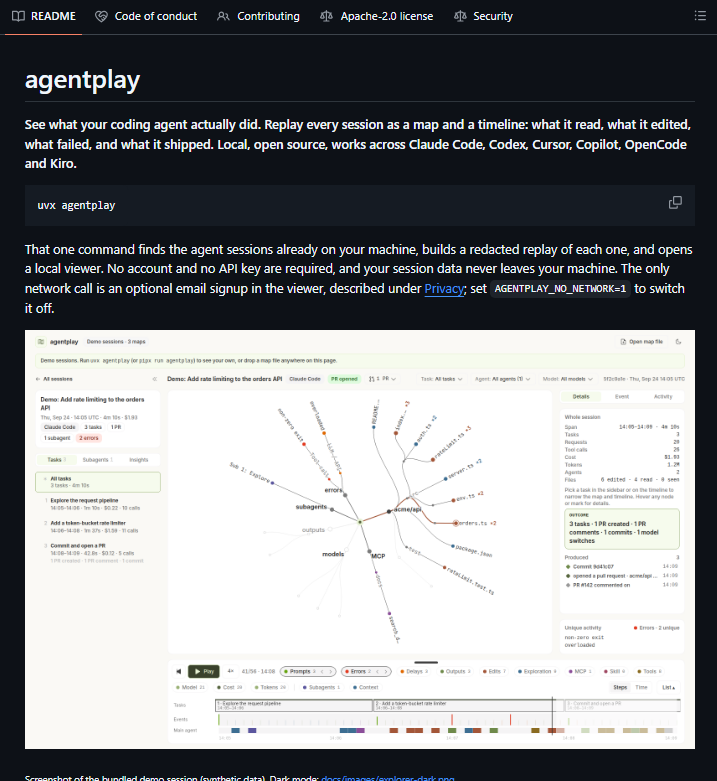
@Aiswarya_Sankar introduced (148 likes, 66 replies, 12,015 views, 93 bookmarks) AgentPlay as a local, open-source replay layer for Claude Code, Codex, Cursor, and Copilot sessions. The linked agentplay repo says it turns transcript files already on disk into maps and timelines without requiring an account or API key, and in replies Aiswarya said it plugs into a self-improving harness that mines traces against code-review failures.
@robiartec framed (89 likes, 30 replies, 2,803 views, 14 bookmarks) the same release as a direct answer to review blindness: final diffs do not show which files the agent read, which tests failed before success, which models it switched between, or when context filled up and got compacted. That sharper pitch landed because it translated abstract observability into a concrete complaint about how people are approving AI-generated code today.
@itamar_mar argued (4 likes, 4 replies, 98 views) that "AI coding ROI is earned in review," citing Harvard and Jellyfish findings that agents added 30% more code without a significant gain in software output, while pull-request review-to-merge time rose 49%. In replies he said review agents should first argue with coding agents and escalate only unresolved issues to humans, which turns the review problem from a staffing question into a workflow-design question.
Discussion insight: The debate was not whether logs or traces exist. It was that most teams do not have a usable surface for reading them, so the human reviewer sees the final diff but not the agent behavior that produced it.
Comparison to prior day: On 2026-10-13, the strongest builder examples added approval, sandbox, and teaching layers around coding agents. On 2026-10-14, the conversation moved one level deeper into replay, trace analysis, and measurable review burden.
1.2 Enterprise teams kept rebuilding the infrastructure around agent-scale coding (🡕)
Large-organization evidence focused less on choosing a favorite model and more on everything around the model: routing, permissions, PR measurement, source control, and incident-response loops. At least three retained items showed that once agents can produce code quickly, the bottlenecks move into the rest of the development system.
@GergelyOrosz shared (46 likes, 7 replies, 8,614 views, 70 bookmarks) a rare tour of Uber's internal developer stack with Uday Kiran Medisetty. The most relevant details were architectural rather than model-centric: Uber built a model- and harness-agnostic Model Gateway, an MCP gateway, a context graph, and it now tags diffs by feature, bugfix, maintenance, testing, or docs because PR count alone is no longer a good productivity proxy in agent-heavy workflows.
@jurlycat summarized (13 likes, 1 reply, 195 views) Anthropic's Scion engineering post: more than 30,000 code changes merged per day by September, about 100 GB of main-branch history, and roughly 25 million CI checkouts per day. Anthropic said the in-house system cut CPU and RAM footprint by 200x versus the old git-mirror infrastructure, made checkouts about 100x faster, and recovered 25% of CI CPU capacity.

@pierceboggan said (10 likes, 1 reply, 1,172 views, 4 bookmarks) that incident response now fits inside the GitHub Copilot app through Azure SRE Agent. Microsoft's Azure SRE Agent page describes an always-on reliability service that connects to Azure resources, telemetry, runbooks, and incident tools, performs explainable root-cause analysis, and can recommend or execute mitigations such as restart, scale, or rollback within policy guardrails and human approval.
Discussion insight: Across Uber, Anthropic, and Microsoft, the shared premise was that code generation is no longer the only system that matters. Routing, review, CI, source control, and incident handling are becoming first-order AI-coding surfaces.
Comparison to prior day: On 2026-10-13, infrastructure wrappers showed up mainly as product features. On 2026-10-14, public evidence from Uber and Anthropic made the same pattern look like a structural enterprise response to agent-scale output.
1.3 Argon was judged by workflow structure and product polish, not just rollout copy (🡒)
Gemini 4 Argon was still one of the day's anchors, but the interesting evidence was no longer the existence of the model. People were judging whether it stayed on-task, whether it fit inside their quota windows, and whether Google's surrounding products were polished enough to let the model matter.
@code announced (94 likes, 5 replies, 10,348 views, 10 bookmarks) that Gemini 4 Argon was generally available in VS Code with GitHub Copilot. In the same thread, @github said (376 likes, 46 replies, 42,282 views, 47 bookmarks) that early testing showed Argon solving more tasks than prior Gemini models across coding benchmarks, with its largest gains in Copilot CLI.
@0xMfox reported (36 likes, 10 replies, 698 views, 30 bookmarks) that an overnight Argon run only became reliable after the operator added a strict /goal prompt plus a repo-level .agents/skills rule set. The before-and-after was unusually concrete: without those controls the agent changed a public schema and ran only 216 of 16,892 tests; with them, the framework ended 40% faster and all 16,892 tests passed before human review.
@ash_twtz showed (99 likes, 46 replies, 3,630 views, 8 bookmarks) a Pro usage panel with just 60% of the current window consumed after 10 to 15 large prompts, but the replies split sharply. One user said Argon was already forcing an Ultra upgrade, another said one large prompt consumed 90%, and another said it was slower than Flash while still wanting Pro-plan access in Antigravity.

@davis7 posted (52 likes, 3 replies, 2,518 views, 5 bookmarks) the harshest first-hand Google hardware and software review in the set. He liked the Googlebook screen and battery, but said the OS had "zero polish," Linux integration felt awkward, and Antigravity still compared badly with Claude desktop; one reply added that Antigravity's yolo mode still does not work.
Discussion insight: Users were not separating model quality from product quality. Quotas, access tiers, desktop polish, and repo-specific rules were all being treated as part of Argon's real performance story.
Comparison to prior day: On 2026-10-13, the feed was dominated by public Argon availability and benchmark claims. On 2026-10-14, the conversation shifted toward operational reality: how to keep long runs on track, who actually gets access, and whether Google's surrounding tools are good enough.
1.4 Portability and coordination layers started looking like the real product surface (🡕)
Another cluster of posts assumed multi-model and multi-tool work as the default and focused on the glue above it: skill syncing, MCP adapters, cloud persistence, shared memory, and task continuity across surfaces. At least five items described products or failure modes in that coordination layer rather than improvements to a single base model.
@DanKornas described (10 likes, 16 replies, 937 views) Agent Skills CLI as one command line for installing and maintaining skills across many coding agents. The public repo README says it supports 45 agents, can pull from marketplace, GitHub, private Git, and npm sources, scans installs for security issues, and indexes more than 222,000 skills from over 21,000 authors.
@leeky_k_crypt said (25 likes, 13 replies, 464 views) that Aptos launched an official MCP server for AI coding tools. Aptos's MCP docs and repo show that the server is designed for Claude Code, Cursor, Codex, and other MCP clients, with Geomi Bot Key automation and current Move-specific workflows rather than generic blockchain prompting.
@atomicbot_ai launched (13 likes, 3 replies, 371 views, 5 bookmarks) cloud-hosted OpenCode sessions so work can continue after a laptop sleeps. The Atomic Bot page presents the product less as a new model and more as a persistent runtime layer with 100-plus models and no need to manage separate vendor accounts and keys.
@eugeniu_ghelbur wrote (9 likes, 18 replies, 704 views) that an Obsidian vault was acting as shared memory for eight agents. The revealing part was in the replies: another operator warned about concurrent writers without a sub-0.5ms gate and single-writer lease, while Eugeniu said he uses optimistic byte-check-and-retry because a lock cannot cover sync clients or git.
@CodexResets1 added (38 likes, 7 replies, 3,493 views, 5 bookmarks) that even basic Codex task continuity still breaks across devices. The specific complaints were that active VS Code tasks could not be monitored from the phone without a session-lock error, and new mobile-started tasks did not reliably appear in the extension.
Discussion insight: By the end of the day, one of the most practical questions in AI coding was no longer "which model?" but "how do the tasks, skills, memories, and permissions stay in sync across all the places we use them?"
Comparison to prior day: On 2026-10-13, model competition dominated the feed. On 2026-10-14, many of the strongest posts assumed model plurality and concentrated on the coordination layer that makes those tools usable together.
2. What Frustrates People
Review and verification debt kept eating the gains from faster generation
Severity: High. @itamar_mar argued (4 likes, 4 replies, 98 views) that Harvard and Jellyfish data showed agents producing 30% more code without a significant gain in software output, while review-to-merge time rose 49%. @robiartec said (89 likes, 30 replies, 2,803 views, 14 bookmarks) the same bottleneck from the operator side: reviewers see the final diff, but not the failed tests, prompt retries, model switches, or context compactions that led to it. @0xMfox added (36 likes, 10 replies, 698 views, 30 bookmarks) a concrete example of the cost of weak verification, where an early Argon run changed a public schema and executed only 216 of 16,892 tests before stricter goals and repo rules fixed it. People coped by adding replay layers, stronger test instructions, and more review structure. Worth building: High.


Task continuity across phone, IDE, and cloud runtimes was still unreliable
Severity: High. @CodexResets1 wrote (38 likes, 7 replies, 3,493 views, 5 bookmarks) that active Codex tasks in VS Code could not be followed from the ChatGPT Android app because another session already held the task lock, and that phone-started tasks did not reliably appear in the extension. @atomicbot_ai pitched (13 likes, 3 replies, 371 views, 5 bookmarks) cloud-hosted OpenCode as the workaround: your laptop sleeps, the agent keeps going. @eugeniu_ghelbur showed (9 likes, 18 replies, 704 views) that even persistent shared memory introduces its own reliability problem, with replies debating single-writer leases versus optimistic retry after concurrent vault edits. Worth building: High.
Google's surrounding product layers still felt inconsistent around Argon
Severity: Medium to high. @ash_twtz showed (99 likes, 46 replies, 3,630 views, 8 bookmarks) a Pro account using only 60% of the current Argon window after 10 to 15 large prompts, but replies immediately contradicted that with reports of 90% usage on one large prompt, forced Ultra upgrades, and slower performance than Flash. @davis7 said (52 likes, 3 replies, 2,518 views, 5 bookmarks) the Googlebook OS had some interesting AI ideas but little polish, awkward Linux integration, and an Antigravity experience that made him appreciate Claude desktop more. The frustration was not simply model quality; it was that access tiers, quota behavior, desktop polish, and feature completeness all changed how useful the model felt in practice. Worth building: Medium.
3. What People Wish Existed
Replayable sessions that surface unresolved risk instead of raw trace volume
The AgentPlay launch from @Aiswarya_Sankar and the review thesis from @itamar_mar point to the same missing layer: teams want a system that can read the agent's full execution trace, resolve the obvious issues automatically, and surface only the unresolved risk to a human reviewer. The demand is practical, not aspirational. People already have transcript data; what they lack is a compact surface that turns it into approval-grade evidence. Opportunity: Direct.
One task that follows the user across IDE, desktop, mobile, and cloud
@CodexResets1 explicitly asked for one Codex task that could be started on desktop, watched from mobile, and resumed from either place without session locks. @atomicbot_ai implicitly asked for the same thing from the runtime side by selling persistence after a laptop sleeps. This is a concrete workflow need rather than a vague convenience request: people want the task state, not the current window, to be the product primitive. Opportunity: Direct.
Portable skills, memory, and domain adapters that survive model churn
@DanKornas highlighted one CLI for skill distribution across 45 agents, @leeky_k_crypt pointed to an official Aptos MCP server for Claude Code, Cursor, Codex, and similar tools, and @eugeniu_ghelbur showed a shared Obsidian vault being used as memory for eight agents. The pattern underneath all three is that teams do not want their prompts, skills, or memory layout trapped inside one vendor surface. Opportunity: Competitive.
Repo-level house rules that keep long-running agents on task
@0xMfox did not ask for a new model. He showed that the missing product was a portable control layer: a /goal instruction that survives context compaction plus a .agents/skills rules folder that the model reads before touching code. That is a request for durable, inspectable workflow structure around long-running coding jobs, especially where tests and public APIs matter. Opportunity: Direct.
4. Tools and Methods in Use
| Tool | Category | Sentiment | Strengths | Limitations |
|---|---|---|---|---|
| Gemini 4 Argon | Frontier coding model | (+/-) | Official Copilot rollout; benchmark gains; can handle long tasks better when given explicit goals and repo rules | Quota behavior felt inconsistent; usefulness depended heavily on surrounding product quality and task structure |
| GitHub Copilot | Coding platform | (+) | Brought Argon into VS Code, CLI, app, and broader GitHub workflows; also hosted Azure SRE Agent workflows | Still one layer in a larger multi-tool stack; real outcomes depended on model choice and workflow design |
| AgentPlay | Observability and replay layer | (+) | Local, open-source replay of agent sessions across multiple tools; exposes reads, retries, errors, subagents, and outputs | Adds visibility after the fact; still requires teams to change how they review agent work |
| Agent Skills CLI | Skill distribution layer | (+) | One CLI for 45 agents; multiple install sources; audit and budgeting features; large marketplace | Another coordination layer to manage; scale raises quality and conflict concerns |
| Aptos MCP Server | Domain MCP integration | (+) | Gives coding agents current Move and Aptos workflows instead of generic blockchain guesses | Requires domain setup and a Geomi Bot Key; useful mainly to Aptos builders |
| Azure SRE Agent | Incident-response agent | (+) | Connects telemetry, runbooks, and mitigations inside Copilot workflows; emphasizes explainable root-cause analysis | Azure-centric and policy-gated; more useful for ops-heavy teams than general solo coding |
| Claude Code | Coding agent | (+) | Switching users said Opus 5.5 understood intent better and got work done more reliably | Still a single-vendor surface, and the feed offered little new evidence on portability or review ergonomics |
| Codex | Coding agent | (+/-) | Still used for ambitious projects, game work, and mobile/desktop workflows | Cross-device task continuity was weak, and some paying users said their accounts now sat unused |
| Atomic Bot + OpenCode | Cloud runtime layer | (+) | Keeps sessions alive when laptops sleep; offers 100+ models without separate lab accounts | Evidence focused on persistence and model access, not code quality or safety outcomes |
| Obsidian shared-vault memory | Coordination method | (+/-) | Human-readable persistent memory shared across many agents | Concurrent writes and lock strategy were still unresolved in discussion |
| PS5LM Plus | Local inference endpoint | (+) | Runs GGUF models on a jailbroken PS5 GPU and exposes an OpenAI-compatible API for networked tools | Requires niche hardware and homebrew setup; more experimental than mainstream |
Overall, satisfaction was highest where tools made agent work more inspectable or more portable. Satisfaction was weakest where the workflow still depended on session locks, opaque quotas, or product polish that lagged the underlying model. The main workarounds were explicit repo rules, replay tools, shared-memory vaults, cloud runtimes that keep jobs alive, and cross-vendor layers that let teams move between Copilot, Claude Code, Codex, OpenCode, and domain MCP servers without rebuilding everything from scratch. The clearest migration signal was still competitive pressure on Codex from Claude Code, while Copilot benefited from being a surface where new models and operational agents could both land.
5. What People Are Building
| Project | Who built it | What it does | Problem it solves | Stack | Stage | Links |
|---|---|---|---|---|---|---|
| AgentPlay | @Aiswarya_Sankar | Replays coding-agent sessions as maps and timelines | Hidden retries, failures, and context loss during review | Python 3.11+, local viewer, transcript parsers for Claude Code/Codex/Cursor/Copilot/OpenCode/Kiro | Shipped | tweet, repo |
| Agent Skills CLI | Karanjot786 | Installs, updates, audits, and budgets skills across 45 coding agents | Repeating the same skill setup separately for each agent | Node.js CLI, marketplace, GitHub/private Git/npm sources, security scanning | Shipped | tweet, repo |
| Aptos MCP Server | Aptos Labs | Gives MCP-compatible coding agents Aptos-specific tools, prompts, and resources | Generic models lag current Move and Aptos workflows | Node.js MCP server, Geomi Bot Key, Claude Code/Cursor/Codex integrations | Shipped | tweet, docs, repo |
| Azure SRE Agent in Copilot | Microsoft Azure | Investigates incidents and recommends or executes mitigations from a Copilot workflow | Incident-response toil spread across logs, runbooks, and tools | Azure telemetry and runbooks, policy guardrails, Copilot app canvas | Shipped | tweet, product page |
| OpenCode on Atomic Bot | Atomic Bot | Keeps OpenCode sessions running in the cloud with flexible model choice | Local sessions stop when the laptop sleeps or disconnects | Hosted runtime, OpenCode, 100+ selectable models | Shipped | tweet, site |
| PS5LM Plus | DrDejaVuNG | Runs GGUF models on a jailbroken PS5 GPU and exposes an OpenAI-compatible API | Cheap local inference and experimentation for networked AI tools | llama.cpp, Vulkan, PS5 native app, GGUF model store, OpenAI-compatible API | Beta | tweet, repo |
@Aiswarya_Sankar launched (148 likes, 66 replies, 12,015 views, 93 bookmarks) the cleanest new builder signal in the set: a replay layer for coding agents that turns raw transcripts into something a person can inspect. The reply about mining traces against code-review failures made the project more interesting than a passive viewer, because it implies a loop where session history becomes training data for better harness behavior.
@DanKornas surfaced (10 likes, 16 replies, 937 views) a second, equally practical pattern: builders are trying to make skills portable across whichever coding agents a team happens to use this month. The Agent Skills CLI repo turns that into a real product surface with install targets for 45 agents, install-time scanning, and marketplace/Git/npm sources.

The Aptos MCP Server and Azure SRE Agent point in a similar direction from two different ends. Aptos is packaging domain-specific development knowledge for MCP-compatible coding agents, while Microsoft is packaging incident investigation and governed remediation into a Copilot workflow. @atomicbot_ai added (13 likes, 3 replies, 371 views, 5 bookmarks) a runtime layer rather than a domain layer: OpenCode that keeps running in the cloud after the local machine goes idle.
The most unusual build in the set was PS5LM Plus. @Techjunkie_Aman said (30 likes, 4 replies, 1,402 views, 8 bookmarks) it turns a jailbroken PS5 into a local AI box that can even serve coding tools, and the public repo backs that up with a native GPU app, a model library, and an OpenAI-compatible API on the local network. It is a niche path today, but it shows how much interest there is in private inference endpoints that developers can fully control.

The repeated build pattern was not another chat frontend. It was control surfaces around agent work: replay, skills distribution, domain adapters, operational agents, persistent runtimes, and self-owned inference endpoints. Multiple builders independently treated portability and inspectability as the product, not just the model behind it.
6. New and Notable
Anthropic publicly quantified what agent-scale source control looks like
@jurlycat pointed (13 likes, 1 reply, 195 views) to Anthropic's Scion post, which said the company went from about 2,500 merged changes per day in May 2026 to more than 30,000 per day by September, with roughly 25 million CI checkouts per day and about 100 GB of main-branch history. The novelty was not merely that Anthropic built an internal VCS. It was the public admission that AI coding had already made human-scale source-control assumptions too expensive for one of the labs building the models.
Azure SRE Agent made the Copilot app look more like an operations surface
@pierceboggan showed (10 likes, 1 reply, 1,172 views, 4 bookmarks) Azure SRE Agent inside the GitHub Copilot app. Microsoft's public product page says it continuously monitors health, investigates alerts using logs, metrics, and dependency context, performs explainable root-cause analysis, and can recommend or execute mitigations like restart, scale, or rollback within policy guardrails and human approval. That is a notable broadening of what "AI coding" surfaces are now expected to do.
Aptos packaged a first-party MCP adapter instead of leaving developers with generic prompts
@leeky_k_crypt reported (25 likes, 13 replies, 464 views) an official Aptos MCP server for Claude Code, Cursor, GitHub Copilot, Codex, and similar tools. Aptos's own docs say the server provides tools, prompts, and resources for building on Aptos through Geomi, with supported-interface guides rather than just sample prompt text. That is a stronger signal of domain tooling maturity than another unofficial community template.
PS5LM Plus pushed local inference into unexpected hardware territory
@Techjunkie_Aman said (30 likes, 4 replies, 1,402 views, 8 bookmarks) that PS5LM Plus can run GGUF models on a jailbroken PS5 and expose an OpenAI-compatible API for other devices on the network. The public repo confirms a native GPU app, a local model store, and browser-accessible chat and API surfaces. It is far from mainstream, but it is a real example of developers turning consumer hardware into controllable private agent infrastructure.
7. Where the Opportunities Are
[+++] Review and verification infrastructure for agent-written code — AgentPlay's replay layer, the Harvard/Jellyfish review-delay data highlighted by @itamar_mar, and @0xMfox's before-and-after test story all point to the same gap: teams can produce code faster than they can confidently understand and approve it.
[+++] Task-state synchronization across IDE, desktop, mobile, and cloud — @CodexResets1 described session-lock failures between VS Code and mobile, while @atomicbot_ai sold persistence as a product in itself. The opportunity is to make the task portable even when the surface changes.
[++] Portable skill, memory, and MCP distribution layers — Agent Skills CLI, the Aptos MCP server, Uber's model-gateway story, and the Obsidian shared-memory thread all show growing demand for infrastructure that survives vendor switching and lets teams keep their workflow logic when the best model changes.
[++] Enterprise developer infrastructure built for agent-scale output — Uber's PR categorization and model gateway, Anthropic's Scion source-control rewrite, and Azure SRE Agent inside Copilot all suggest a wave of products for routing, review, CI, source control, and incident response that assume agent-generated code volume is now normal.
[+] Self-owned local inference endpoints for coding tools — PS5LM Plus is not a mainstream deployment path, but it is evidence that some developers want private, controllable model serving surfaces that can plug into standard agent tools through an OpenAI-compatible API.
8. Takeaways
- Visibility into agent behavior is becoming as important as model quality. The strongest new product signal was AgentPlay, and the strongest review warning was that AI coding ROI gets won or lost during verification, not generation. (source)
- Enterprise teams are already rebuilding the infrastructure around agent-scale output. Uber's model gateway and PR taxonomy, plus Anthropic's Scion rewrite for 30,000-plus daily merges, show that routing, source control, and CI are now core AI-coding problems. (source)
- Argon's real story on this date was workflow control, not pure launch excitement. Official Copilot availability mattered, but the most useful public evidence came from structured-goal prompting, repo rules, quota screenshots, and first-hand product-polish complaints. (source)
- The most credible builders were shipping coordination layers, not generic chat wrappers. Agent Skills CLI, Aptos MCP, Azure SRE Agent, and Atomic Bot all treated portability, domain context, or runtime persistence as the product. (source)
- Cross-surface continuity is still underbuilt. The feed had a clear request for one task that can move cleanly across IDE, mobile, desktop, and cloud without locks or desynchronization, and no strong evidence that today's tools solve it well. (source)