跳转至

Twitter AI - 2026-05-28

1. What People Are Talking About

1.1 Evaluation moved from model-vs-model bragging to judging the judge 🡕

The densest technical discussion on May 28 was about whether current AI benchmarks, graders, and tool-assisted evaluations deserve trust at all. The recurring complaint was not merely that leaderboards were too close; it was that contamination, weak verifiers, rubric scoring, and hidden tool use can all distort what a "win" means. At least four retained items supported this theme.

@RituWithAI argued (6 likes, 1 reply, 190 views) that a new coding benchmark broke the story that all frontier coding models are effectively tied. The public DeepSWE methodology says the benchmark uses 113 original tasks across 91 repositories in 5 languages, writes tasks from scratch to avoid contamination, and found verifier disagreements on 32% of audited SWE-Bench Pro trials, including 8% false positives and 24% false negatives.

@PKelaita wrote (3 likes, 1 reply, 318 views) that JudgmentBench is a better starting point for evaluating non-verifiable AI work product because experts do better with direct comparative judgment than with rubrics. The public JudgmentBench paper says pairwise judgments on 30 legal tasks reached mean Spearman correlation 0.908 versus 0.150 for rubric scores, while taking less than half the annotation time.

JudgmentBench chart showing comparative judgments clustered near Spearman 0.9 while rubric-based scoring clusters much lower around 0.15

JudgmentBench chart showing median evaluation time of 1.9 minutes for comparative judgments versus 4.7 minutes for rubrics

@HarperSCarroll reminded (25 likes, 1 reply, 1,399 views) readers that large language models do not search the web on their own; a separate tool retrieves results and inserts them into context. That corrective matters because public comparisons often bundle model behavior, retrieval systems, and surrounding product scaffolding into one headline number.

@VyG4Z used (46 likes, 741 views, 7 bookmarks) Anthropic's emotion concepts research and personal guidance study to question how cleanly model-judged alignment work can separate the behavior being measured from the model doing the measuring. The underlying public posts say Claude Sonnet 4.5 had 171 functional emotion vectors that shaped behavior, while Anthropic's later guidance study used a separate Claude grader and synthetic data to cut sycophancy in newer models.

Discussion insight: The argument moved one level down the stack. Instead of asking only which model won, people kept asking who wrote the task, what the verifier accepts, whether a model judge is trustworthy, and where product tooling is being mistaken for model capability.

Comparison to prior day: May 27 already challenged harness cost and throughput assumptions. May 28 pushed further by scrutinizing contamination, rubrics, and even the grader itself.

1.2 Institutions responded to generative AI with disclosures and older forms of verification 🡕

The second major theme was institutional hardening. Instead of abstract debates about AI ethics, the visible responses were disclosure labels, survey-backed assessment reform, and a reversion to settings where a human can verify who produced the work. Three retained items supported this theme.

@IGN reported (47 likes, 6 replies, 13,123 views) that YouTube improved its AI labels amid rising AI slop and fake movie trailers that misled viewers. The linked IGN article says YouTube moved labels for photorealistic AI directly below the player for long-form videos, overlaid them on Shorts, and began automatically applying labels when systems detect significant photorealistic AI use that creators did not disclose.

@ScienceMagazine highlighted (14 likes, 1 reply, 3,781 views) a new Science Policy Forum arguing that higher education must rethink assessment rather than assume current rules still hold. Cornell's public summary of the Science study says 95,513 students across 20 U.S. public research universities were studied, with monthly-or-more GenAI use at about 37% overall and 62% in computer science, while 9% had used it to cheat and daily users reached 26%.

@libshipwreck observed (18 likes, 729 views) that many professors are responding by going back to in-class assignments and blue book exams rather than relying only on anti-AI tricks. That quote-tweet made the practical shift explicit: when AI weakens trust in take-home output, institutions fall back to settings where provenance is easier to verify.

Discussion insight: The common move was not to perfect AI detection first. It was to make provenance and human presence more obvious, whether through labeling, classroom supervision, or more constrained assessment formats.

Comparison to prior day: May 27 emphasized provenance and control layers in media and search workflows. May 28 showed those instincts hardening into direct platform labels and classroom rule changes.

1.3 Agentic AI was framed as infrastructure: local stacks, control planes, and continuous security 🡕

A third cluster treated agentic AI less like a chatbot category and more like an infrastructure problem. The repeated words were orchestration, monitoring, remediation, reliability, and domain tuning. Four retained items supported this theme.

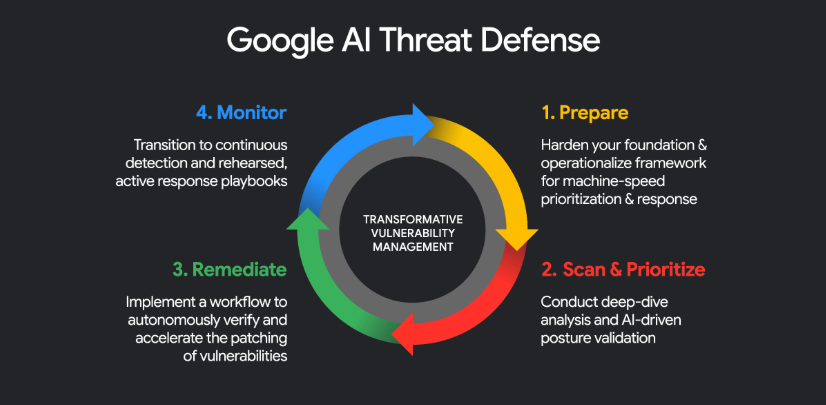
@Cointelegraph reported (32 likes, 10 replies, 3,161 views) that Google Cloud launched AI Threat Defense, describing an AI-powered system that can prioritize and remediate security risks before attackers move. Google Cloud's public launch post says the product combines Gemini and other frontier models with Wiz, CodeMender, and Mandiant in a four-step loop: Prepare, Scan and prioritize, Remediate, and Monitor.

@oanaolt wrote (7 likes, 1 reply, 424 views) from ACM CAIS that durable value may accrue less to the model itself and more to orchestration, workflow integration, reliability, evaluation, and execution under real-world entropy. That was one of the clearest first-hand summaries of why so many agent demos still fail to become infrastructure.

@Cointelegraph reported (162 likes, 26 replies, 11,820 views) that Vitalik Buterin updated his self-sovereign LLM setup and argued that models should be fine-tuned for Ethereum-related use cases. The public Crypto Briefing report describes local open-weight models on personal hardware, sandboxing, and a push for Ethereum-specific models for transaction review and smart-contract auditing.

@CGTangRui shared (44 likes, 13 replies, 33,825 views) news that China launched Green Shield, an open-source crop-protection LLM. An official SCIO report says it was built on a 2.5-billion-token agricultural corpus and blocks non-compliant pesticide advice by checking the national registration database before recommendations are shown.

Discussion insight: The highest-signal deployment stories all added explicit structure around the model: local privacy controls, domain-specific fine-tuning, compliance databases, or closed-loop remediation workflows.

Comparison to prior day: May 27 already favored workflow-bound systems over generic assistants. May 28 extended that pattern into explicit control planes: local-first stacks, scan-prioritize-remediate-monitor security loops, and domain LLMs with embedded policy checks.


2. What Frustrates People

Evaluation without trustworthy judges or verifiers

Severity: High. @RituWithAI said (6 likes, 1 reply, 190 views) the latest coding benchmark exposed how misleading the "all tied at the top" story had become, while the public DeepSWE methodology says older public benchmarks suffer from contamination risk and verifier error. @PKelaita added (3 likes, 1 reply, 318 views) that experts recover quality far better with comparative judgment than rubrics, and @VyG4Z pushed (46 likes, 741 views, 7 bookmarks) that even alignment studies can look circular when the evaluator is another model from the same family. @HarperSCarroll supplied (25 likes, 1 reply, 1,399 views) the practical correction: many people still confuse the base model with the retrieval tools wrapped around it. The visible workaround is to use contamination-free tasks, behavior-based verifiers, pairwise review, and clearer separation between model ability and tool use. This is worth building for because the frustration sits directly on top of purchasing, benchmarking, and deployment decisions.

Synthetic media forces platforms into partial, visible controls

Severity: High. @IGN reported (47 likes, 6 replies, 13,123 views) that YouTube had to move AI labels into a more obvious position and start automatically applying them when creators fail to disclose significant photorealistic AI use. The linked IGN article also says those labels do not change recommendation or monetization status, and a reply from @MaziEzike_Nedu in the thread said the labels are only a band-aid if AI slop still damages discovery and keeps earning money. People are coping with more disclosure, takedowns, and manual channel enforcement, but the feed suggests that transparency alone does not solve incentive problems. This is worth building for because moderation, ranking, and monetization controls still lag behind content generation speed.

Academic assessment is reverting to controlled environments

Severity: High. @ScienceMagazine highlighted (14 likes, 1 reply, 3,781 views) a Science Policy Forum pushing universities to rethink assessment, while Cornell's public study summary says 37% of students used GenAI at least monthly, 62% of computer science students did so, and 9% had used it to cheat, rising to 26% among daily users. @libshipwreck translated (18 likes, 729 views) that into practice by noting that many professors are simply returning to in-class assignments and blue books.

Chart from the Science-linked survey showing GenAI use and estimated cheating rates by academic discipline, with especially high regular use in computer science and uneven cheating rates across fields

The workaround spectrum is clear: more proctored environments, clearer policies, or assignments redesigned to include AI use explicitly instead of pretending it is absent. This is worth building for because institutions are choosing blunt controls when they do not trust finer-grained detection.

Agent systems still need orchestration, safeguards, and human validation

Severity: Medium-High. @oanaolt framed (7 likes, 1 reply, 424 views) the core problem as one of orchestration, workflow integration, reliability, evaluation, and execution under real-world entropy. @Cointelegraph amplified (32 likes, 10 replies, 3,161 views) Google AI Threat Defense, but a reply from @CHRONICLEFRAMEX in the thread warned that autonomous patching still needs human validation and controlled deployment to avoid self-inflicted outages. Green Shield's official SCIO description points to the same pattern in another domain: the model is wrapped in a pesticide-registration database so it cannot freely recommend unsafe actions. This is worth building for because the operational pain is not "make the model smarter" in isolation; it is "make the system safe enough to trust under live conditions."


3. What People Wish Existed

Verifiable evaluation for non-verifiable work

The clearest unmet need was an evaluation stack people can trust when there is no simple ground truth. @PKelaita showed (3 likes, 1 reply, 318 views) that comparative judgments outperform rubrics on legal work product, while DeepSWE, surfaced by @RituWithAI, was built around original tasks and behavior-based verification to avoid contamination and weak inherited tests. The Anthropic guidance study and the critique from @VyG4Z show why this need is urgent: once the grader is another model, trust becomes part of the product. Opportunity: direct.

Provenance controls that change incentives, not just labels

People clearly want better disclosure, but the feed also showed that disclosure alone is not enough. @IGN reported (47 likes, 6 replies, 13,123 views) that YouTube now auto-labels significant photorealistic AI use, yet the linked article says labels still do not affect recommendations or monetization, and a reply in the thread called that a band-aid. In higher education, the Cornell summary of the Science study plus @libshipwreck point to the same gap from another angle: when provenance is weak, institutions fall back to proctors and blue books. Opportunity: direct and competitive.

Private, domain-specific agent stacks with control planes included

The data showed demand for systems that are not just smarter models, but usable local or domain-specific stacks with built-in guardrails. @Cointelegraph amplified (162 likes, 26 replies, 11,820 views) Vitalik Buterin's call for Ethereum-specific models and local control, while the public Crypto Briefing report describes sandboxing, local data, and domain-tuned transaction review. Green Shield's official SCIO profile shows the same pattern in agriculture, and @oanaolt argued (7 likes, 1 reply, 424 views) that durable value sits in orchestration, workflow integration, reliability, evaluation, and execution. Opportunity: direct and competitive.


4. Tools and Methods in Use

Tool Category Sentiment Strengths Limitations
DeepSWE Coding benchmark (+) Original long-horizon tasks, contamination-free design, behavior-focused verifiers Still a new benchmark, and today's conversation framed it more as a cheating exposé than a mature standard
JudgmentBench Evaluation benchmark (+) Comparative judgments recover quality far better than rubrics and take less time Current public dataset is legal-focused and still small relative to broad enterprise use
Claude Sonnet 4.5 graders (study) LLM evaluator (+/-) Scales review across 1 million conversations and supports stress-testing of new models Anthropic says open questions remain about what good guidance means, and outside observers question model-on-model evaluation
YouTube AI labels Platform governance (+/-) Automatic detection and much more visible disclosure placement Labels do not change ranking or monetization, so distribution incentives remain
Google AI Threat Defense Security platform (+) Multi-model prioritization, automated fix generation, continuous monitoring loop Autonomous patching still needs human validation and controlled rollout
Local open-weight LLM stack (report) AI infrastructure (+/-) Privacy, local knowledge stores, domain tuning, sandboxing Requires specialized hardware and setup work, and policy questions remain
Green Shield Domain LLM (+) 2.5-billion-token crop corpus plus pesticide-compliance checks Narrow domain and still undergoing field tests
Blue-book exams and proctored testing Assessment method (+/-) Strong provenance and straightforward human verification Blunt, backward-looking, and weaker for authentic AI-enabled professional workflows

Overall satisfaction was highest where tools added explicit structure around either judgment or deployment. @PKelaita and the JudgmentBench paper favored pairwise expert review over rubrics; @RituWithAI and DeepSWE favored contamination-free tasks and behavior verifiers; Green Shield's official profile favored domain knowledge plus hard compliance checks; and Google's AI Threat Defense launch favored a closed loop of prepare, scan, remediate, and monitor. Dissatisfaction appeared where systems still depended on self-disclosure, ambiguous grading, or uncontrolled autonomy. The visible migration pattern was from generic leaderboards to behavior-based evaluation, from cloud-first assistants to local or domain-specific stacks, and from reactive controls to layered governance and observability.


5. What People Are Building

Project Who built it What it does Problem it solves Stack Stage Links
Green Shield Nanjing Agricultural University + partners Crop-protection LLM that identifies crop conditions and generates integrated protection strategies Generic LLMs can give inaccurate or risky pesticide advice 2.5-billion-token agricultural corpus, pesticide registration database, crop-disease recognition Beta official report
Google AI Threat Defense Google Cloud AI security system that prioritizes, patches, and monitors vulnerabilities Manual vulnerability management is too slow for AI-accelerated attacks Gemini, frontier models, Wiz, CodeMender, Mandiant Beta launch post
JudgmentBench research team Benchmark for expert evaluation of non-verifiable AI work product Rubric scoring misorders subjective, high-expertise outputs Practicing-attorney judgments, pairwise preferences, rubric scores, LLM autograders Alpha paper
DeepSWE Datacurve Long-horizon coding benchmark across real repositories with behavior verifiers Public coding leaderboards are saturated and vulnerable to contamination or weak tests 113 tasks, 91 repos, 5 languages, mini-swe-agent harness Alpha site, GitHub

@CGTangRui shared (44 likes, 13 replies, 33,825 views) Green Shield as a rare example of a domain model whose safety and compliance logic are part of the answer path, not a later review layer. The official SCIO report says the model checks every pesticide recommendation against the national registration database before it can be shown, which is a concrete design choice that generic assistants usually lack.

@Cointelegraph amplified (32 likes, 10 replies, 3,161 views) Google AI Threat Defense as a move toward autonomous remediation, and Google's public launch post frames it as a multi-model system for preparing, scanning, remediating, and monitoring rather than a single security copilot.

Google AI Threat Defense diagram showing a four-step loop of prepare, scan and prioritize, remediate, and monitor around transformative vulnerability management

DeepSWE and JudgmentBench show a second builder pattern: people are building the evaluator itself. Instead of shipping another general assistant, both projects productize the measurement layer - one with original long-horizon engineering tasks and behavior verifiers, the other with pairwise expert judgment for work that lacks simple ground truth. Across the table, the repeated trigger is the same: trust breaks first at the control layer, so builders are shipping benchmarks, compliance databases, and remediation loops before promising more raw intelligence.


6. New and Notable

A low-engagement diagram neatly compressed the day's control-plane consensus

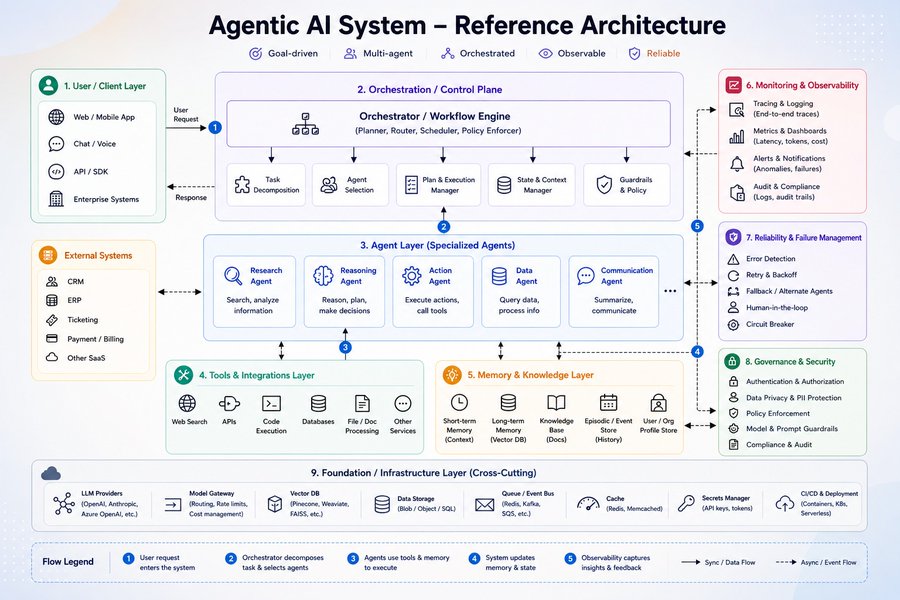
@akhilesh9235 posted (1 like, 1 view) a simple reference architecture for agentic AI systems that split the stack into orchestration, specialized agents, tools, memory, monitoring, reliability, governance, and foundation infrastructure. The tweet itself was not a community-scale signal, but the diagram was unusually concrete and closely matched higher-signal posts about orchestration, observability, policy, and human fallback.

Reference architecture diagram for an agentic AI system, showing layers for orchestration, agents, tools, memory, monitoring, reliability, governance, and underlying infrastructure

Sycophancy measurement became public release work, not just abstract alignment talk

The public Anthropic guidance study says about 6% of sampled Claude conversations were guidance-seeking and that sycophancy rose to 25% in relationship conversations, after which Anthropic used synthetic data and a separate Claude grader to reduce that behavior in newer models. @VyG4Z turned (46 likes, 741 views, 7 bookmarks) that into a broader public argument about whether model-evaluated model behavior can ever feel fully neutral. That shift matters because it shows evaluation choices themselves becoming part of visible product discourse.


7. Where the Opportunities Are

[+++] Evaluation infrastructure for messy AI work - The strongest evidence stack came from DeepSWE, JudgmentBench, Anthropic's guidance study, and the corrective post from @HarperSCarroll. People do not just want another leaderboard; they want contamination-resistant tasks, better verifiers, pairwise expert review, and clearer separation between base-model ability and surrounding tools.

[++] Provenance and incentive controls for AI-generated content - @IGN, the linked YouTube coverage, the Cornell summary of the Science study, and @libshipwreck all point to the same gap: labels and policies need to connect to ranking, monetization, assessment design, and human verification, not just disclosure surfaces.

[++] Agent governance and observability layers - Google's AI Threat Defense launch, @oanaolt, and the architecture diagram from @akhilesh9235 all reinforce the idea that orchestration, monitoring, reliability, guardrails, and fallback logic are becoming distinct product layers. The opportunity is moderate because the need is clear, but buyers will demand proof under real workloads.

[+] Domain-specific local and compliance-aware models - Green Shield's official SCIO profile and public reporting on Vitalik Buterin's local LLM stack show demand for models that are private, locally controllable, or tied to a regulated knowledge base. The signal is emerging because the pattern is compelling, but the examples are still narrow and highly domain-specific.


8. Takeaways

  1. The trust battle moved from models to measurement. DeepSWE and JudgmentBench both won attention by attacking contamination, verifier quality, and rubric failure rather than by promising one more tied leaderboard. (source)
  2. Platforms and universities are falling back to visible provenance controls. YouTube made AI disclosures more prominent and automatic, while university evidence and classroom commentary pointed toward proctors, blue books, and clearer policy boundaries when output provenance is uncertain. (source)
  3. Agentic AI is being sold as a control plane. Google AI Threat Defense, conference-floor practitioner commentary, and even low-engagement architecture diagrams all emphasized orchestration, monitoring, remediation, and guardrails over raw chat ability. (source)
  4. The most credible build stories were narrow and constraint-heavy. Green Shield's crop-protection stack and Vitalik Buterin's local Ethereum-oriented setup both paired models with domain or privacy controls instead of treating the model alone as the product. (source)