Twitter AI - 2026-10-14
1. What People Are Talking About
1.1 Lab-internal AI automation and governance concerns landed in the same conversation (🡕)
The day’s strongest thread was not another public model launch. It was a long public reflection on what happens when frontier labs start using AI to accelerate their own R&D while governance, liability, and international coordination lag behind. That made the conversation feel more operational and more political at the same time.
@arpitrage argued (164 likes, 25 replies, 11,322 views, 121 bookmarks) after visiting Anthropic that the field was getting closer to recursive self-improvement, or at least to a world where models materially help build later models. The unusually useful part was that the thread did not rely only on prose. Two attached charts made the RSI claim concrete: code contributed per employee rising to 8.0x the pre-2025 average by Q2 2026, and Claude already contributing 26% of model-R&D work on Anthropic’s published automation scale.
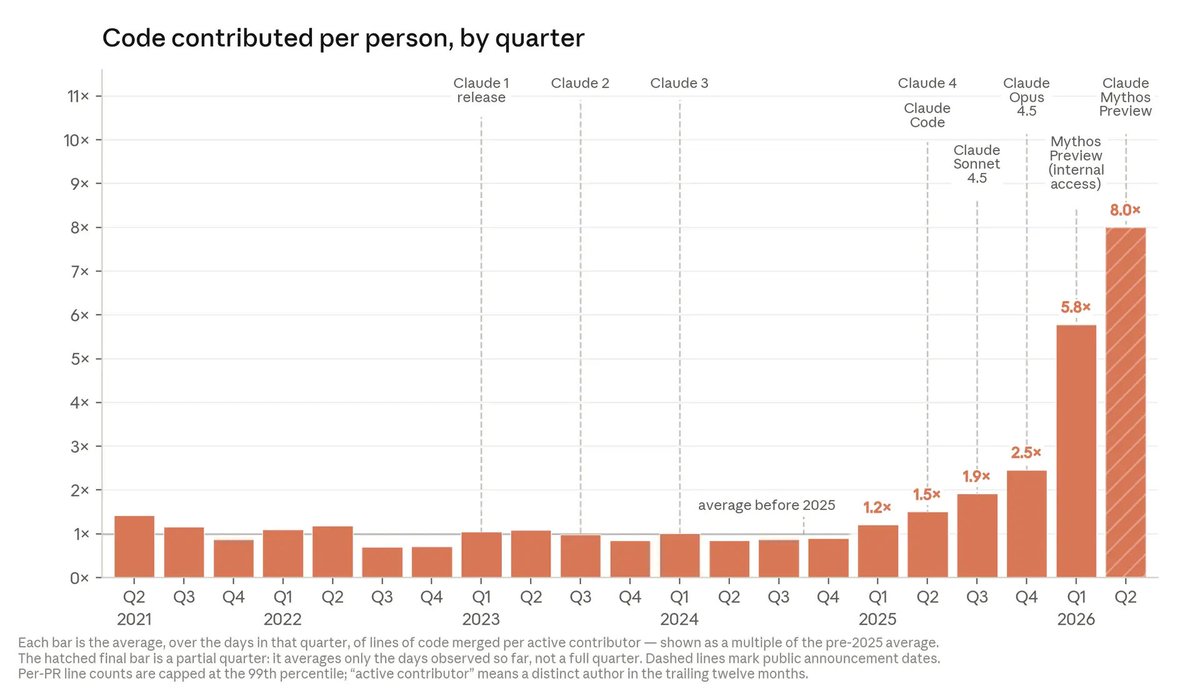
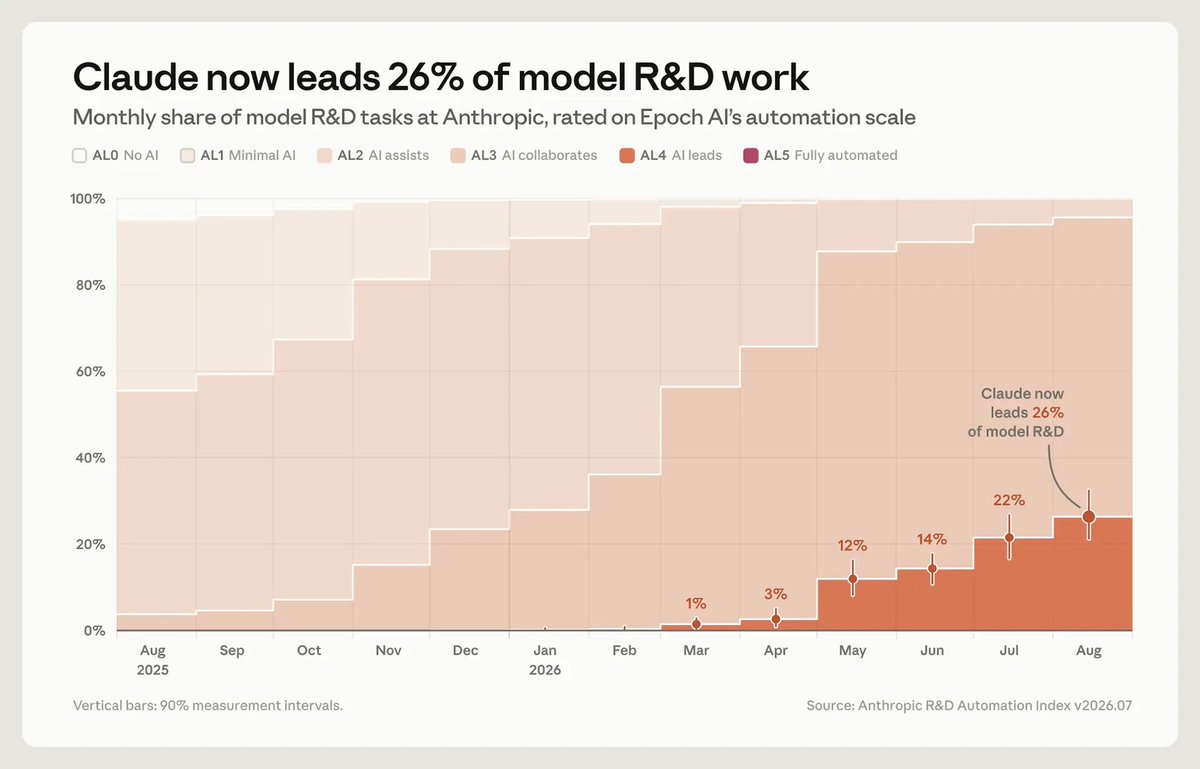
What made the post resonate was its bundle of second-order implications: frontier labs may need antitrust-safe coordination on safety, governance may need to shift from chatbot constitutions toward agent-to-agent oversight, and the financial and cyber risks of better open models may arrive before the institutional response is ready. The replies were light, but the thread itself functioned almost like a policy memo dropped into the middle of product Twitter.
Discussion insight: The conversation did not treat automation inside labs as a narrow efficiency story. It treated it as the bridge between capabilities progress, governance friction, and a faster pace of organizational change than existing oversight mechanisms were built for.
Comparison to prior day: On 2026-10-13, governance appeared mostly as verification, audits, and liability around deployments. On 2026-10-14, it moved upstream into how frontier labs themselves build and control AI systems.
1.2 Builders shifted from generic copilots to agent operating systems and vertical stacks (🡕)
The second major cluster came from builders shipping workflow-specific systems instead of making one more general “AI can do work” claim. The strongest items described concrete operating environments: a coding-agent workflow for shipping a game, an open-source agent OS, a creator-production pipeline, and a CAD-to-fabrication bridge.
@Dimillian shared (107 likes, 25 replies, 6,193 views, 115 bookmarks) a write-up on building Dark Veil and its custom engine with Codex. Even though the linked article page was unavailable, the reply thread added the key workflow detail: most of the work happened in one long Codex thread with occasional parallel exploration, and context compaction no longer felt like the binding constraint.
@OpenBMB launched (40 likes, 1,039 views, 17 bookmarks, 4 quotes) PilotDeck 2.0 as an open-source, model-agnostic “agent operating system” built for long-running office tasks. Public repo materials confirmed the differentiators behind the tweet: isolated WorkSpaces, white-box memory, smart routing for cost control, always-on background execution, and a 79.1 score on Workbuddy Bench with Qwen3.6-35B-A3B.
@undefinedKi packaged (16 likes, 5 replies, 495 views, 22 bookmarks) the AI-influencer category as an open stack, with OpenMontage as the centerpiece. The public repo mattered because it confirmed the bold claim in the tweet: OpenMontage is positioned as an open-source, agentic video-production system, not just a prompt collection.

@RoundtableSpace framed (13 likes, 8 replies, 20,800 views, 6 bookmarks) text-to-cad as another vertical skill layer for coding agents: describe a part in English, generate CAD outputs in STEP/GLB/STL/3MF, run DFM checks, produce drawings, and connect to fabrication services. The telemetry opt-out command in the tweet also made it feel like a real tool someone might actually install, not just a concept video.
Discussion insight: The common thread was not “better prompting.” It was that builders were now packaging memory, routing, tools, background execution, and domain-specific outputs into opinionated work environments.
Comparison to prior day: On 2026-10-13, public comparison centered on which frontier model or proactive agent to choose. On 2026-10-14, more attention shifted to the shells and vertical stacks built on top of those models.
1.3 Physical AI talk dug deeper into reproducible data pipelines and trajectory quality gates (🡕)
Physical AI remained strong, but the highest-signal items focused on whether others could actually reproduce a robotics pipeline and whether every collected trajectory deserved to become training data. That pushed the discussion beyond “open dataset” and toward inspectable workflow design.
@Tajwan_Tamim argued (83 likes, 86 replies, 409 views) that Axis’s Sim Dataset V1 only mattered because it shipped together with code and benchmarks, letting other researchers inspect and extend the work instead of starting from zero. The post highlighted the concrete result that continual pretraining on Axis data improved π0.5’s LIBERO-Plus success rate from 83.9% to 88.8% and strengthened robustness under sensor noise and camera changes.
@kafisayz mapped (64 likes, 74 replies, 421 views) the fuller loop: human teleoperation, trajectory collection, data cleaning, simulation augmentation, VLA training, sim-to-real evaluation, and targeted human recollection when failures expose gaps. That post turned “physical AI data engine” into an explicit process diagram.
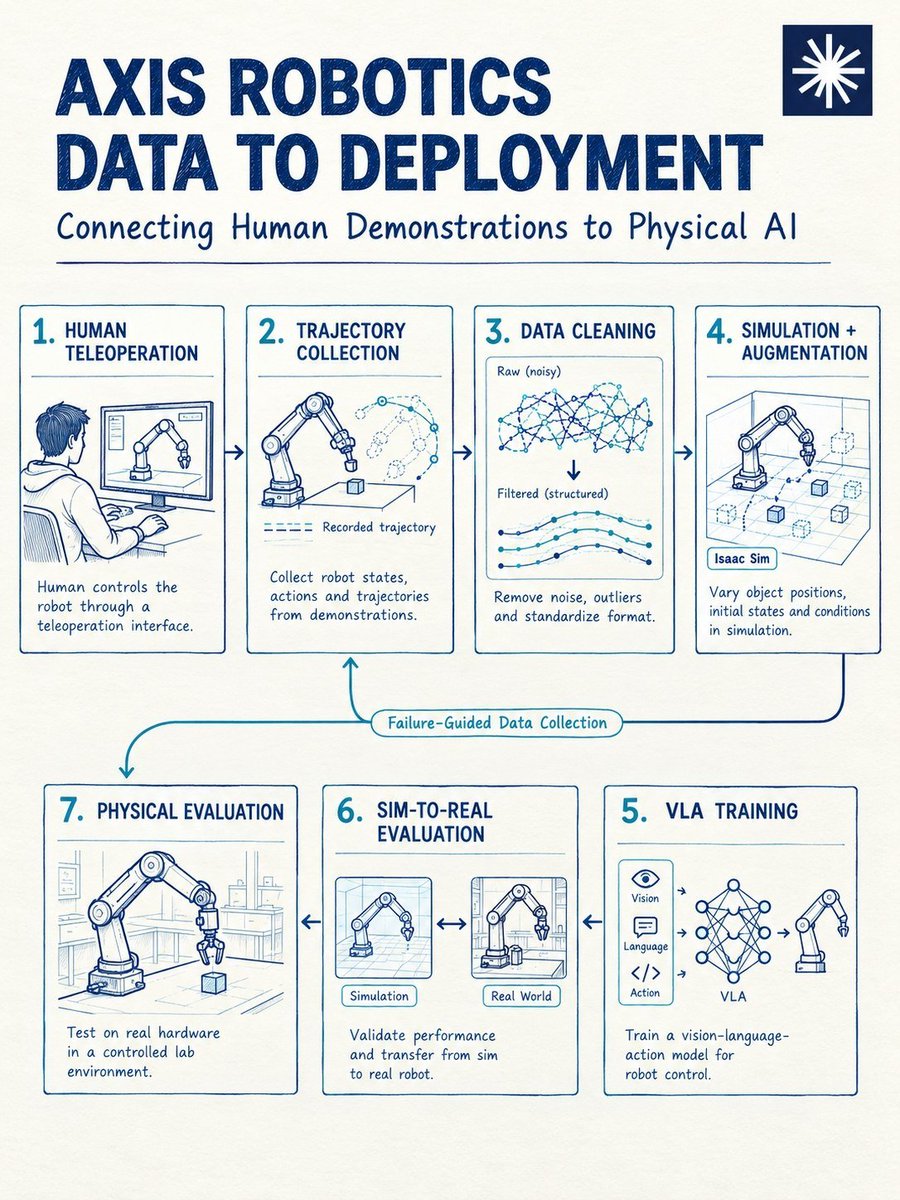
@hannn2223 added (27 likes, 31 replies, 84 views, 1 bookmark) the most useful detail in the cluster: replay and physical-consistency checks before a contributed trajectory enters training. That distinction — task success versus training-worthy demonstration quality — sharpened the entire day’s robotics discussion.
Discussion insight: The feed kept rewarding posts that explained what gets filtered out of the data loop, not only what gets added. That is a sign the audience is becoming more skeptical of raw-trajectory counts as a progress metric.
Comparison to prior day: On 2026-10-13, physical-AI conversation emphasized adaptive benchmarks and pretraining efficiency. On 2026-10-14, it moved one layer deeper into reproducibility, replay checks, and the pipeline between failure analysis and new data collection.
1.4 The agent stack hardened around permissions, safety tooling, and enterprise deployment layers (🡒)
Another strong cluster was about the infrastructure required before agents can touch money, tools, or enterprise workloads with any credibility. The best posts named a missing layer — permissions, red-teaming, proof, or deployment plumbing — and then treated that layer as a standalone product category.
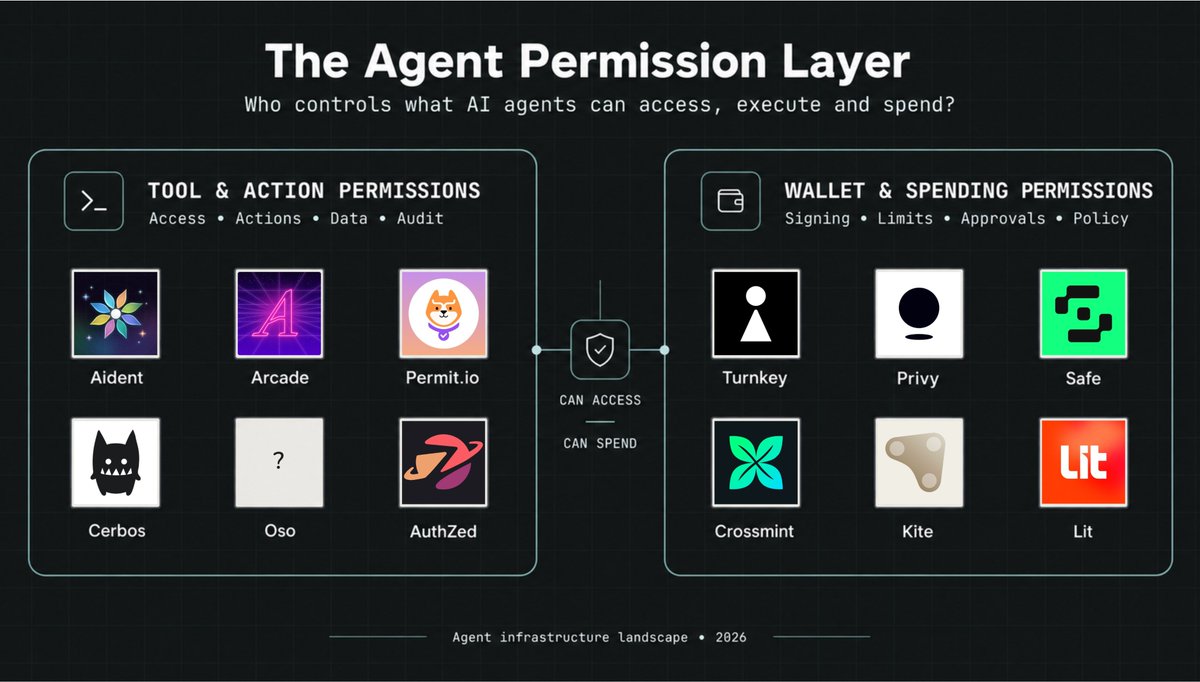
@Nick_Researcher argued (27 likes, 13 replies, 469 views, 3 bookmarks) that the “agent permission layer” was turning into real infrastructure, split between tool/action permissions and wallet/spending permissions. The attached diagram made the category legible by grouping approval, policy, delegation, and auditability rather than collapsing everything into “authentication.”
@DataChaz surfaced (15 likes, 4 replies, 835 views, 1 bookmark) WhiteCircle’s open-sourcing of RISE, a red-teaming algorithm for image models that evolves attack strategies rather than tweaking one prompt at a time. Public materials confirmed the cautious release design too: code and methodology were shared, but discovered prompts and images were withheld for safety reasons.
@imnotharsh highlighted (33 likes, 2 replies, 2,103 views, 3 bookmarks) Intel Inference Microservices as an open-source deployment surface for Xeon-based LLM serving. The infrastructure details mattered here — OpenAI-compatible endpoints, validated CPU configurations, Kubernetes orchestration, and on-prem or cloud packaging — because they made enterprise inference on CPUs feel more productized and less aspirational.
Discussion insight: The shared message was that agents do not become trustworthy by improving only the base model. They become trustworthy when authorization, attack testing, and serving configuration turn into explicit, inspectable layers around the model.
Comparison to prior day: On 2026-10-13, trust showed up in bounded expert review and human approval loops. On 2026-10-14, it expanded into the infrastructure needed for agents to act, spend, or deploy at scale.
2. Signals That May Matter
Internal AI automation is becoming a governance and organizational signal, not just an efficiency metric
The Anthropic thread mattered because it translated “AI helps build AI” into public, interpretable evidence: 8.0x more code per employee than the pre-2025 baseline and Claude contributing 26% of model-R&D work on the cited scale. @arpitrage used those charts to connect capabilities acceleration with antitrust, cyber risk, model-release strategy, and agent governance inside labs.
Why it matters: If more frontier labs disclose similar automation numbers, markets and policymakers will start treating internal AI leverage as a leading indicator of capability growth and governance strain.
Agent differentiation is moving into work environments, not just model choice
PilotDeck, OpenMontage, text-to-cad, and Dark Veil-with-Codex all pointed in the same direction: builders are competing on memory, routing, background execution, domain tools, and output formats instead of relying on a single “best model” pitch. @OpenBMB, @undefinedKi, @RoundtableSpace, and @Dimillian each described a different work surface built on top of existing models.
Why it matters: The application layer is fragmenting into task-specific operating systems and skill packs. That makes distribution, integration depth, and workflow design more durable advantages than short-lived model exclusivity.
Physical-AI progress is increasingly being judged on reproducibility and data-quality gates
The Axis-related posts did not mainly ask for bigger models. They asked whether another researcher could reproduce the results, whether the data pipeline exposed its weak points, and whether a trajectory was good enough to teach from at all. @Tajwan_Tamim, @kafisayz, and @hannn2223 made that shift unusually explicit.
Why it matters: If this framing sticks, “open robotics” winners may be decided less by raw dataset size and more by replay tooling, rejection criteria, reproducibility, and failure-guided recollection loops.
Workflow-specific evaluation and permissioning are becoming first-class infrastructure
@kickingkeys argued that frontier models are already “good enough” for most daily use and that what matters is which one fits a line of work. @Nick_Researcher made the same move from a different angle by treating permissioning as a separate layer between user intent and agent action. Together they imply that broad model quality is converging faster than the infrastructure required to safely specialize and deploy agents.
Why it matters: The next differentiators are likely to be eval ecosystems, policy layers, and domain-specific runtime controls rather than a single universal benchmark lead.
3. Needs, Gaps, and Underserved Demand
Workflow-specific model evaluation and routing
@kickingkeys explicitly argued that most frontier models are already good enough for ordinary work and that people instead need an “ecology of evals” tied to real workflows. The rest of the day supported that view indirectly: PilotDeck benchmarked office-work execution, OpenMontage packaged creator workflows, and text-to-cad exposed manufacturing-oriented agent skills. The market still lacks a widely trusted way to map tasks to the right model-plus-runtime combination.
Opportunity: Direct. Builders and buyers are already improvising this comparison layer by hand.
Agent permission, delegation, and spending controls
@Nick_Researcher treated authorization as an independent category spanning tool permissions and wallet permissions, which suggests a large missing layer between “agent connected” and “agent may do this action right now.” The post’s emphasis on mandates, approvals, audit trails, and revocation highlighted how incomplete most current agent products still are once money or external systems are involved.
Opportunity: Direct. The stack is still fragmented enough that policy enforcement, approval orchestration, and auditability can be sold as core infrastructure rather than add-ons.
Reproducible robotics data pipelines and trajectory triage
The Axis cluster exposed a consistent gap: open data is not enough if outsiders cannot reproduce the training/evaluation setup or understand why some trajectories are rejected. @Tajwan_Tamim, @kafisayz, and @hannn2223 all implied a need for better tools around replay, filtering, failure analysis, and dataset contribution standards.
Opportunity: Direct. The public discourse is already specific enough to support products for robotics data QA, replay validation, or benchmark reproducibility.
Better specification layers for agentic code verification
@abundant_labs made a useful distinction: harder proof tasks do not automatically fix agent verification unless the property being proven is actually the right property. That points to a gap that ordinary unit-test generation does not solve — better ways to express, refine, and verify the specification itself before an agent writes or proves anything.
Opportunity: Emerging. The problem is real and increasingly visible, but the market still needs clearer abstractions than “proofs for code” to make the category accessible.
4. Tools, Products, and Companies Discussed
| Tool / Product | Category | Sentiment | Key takeaway | Supporting links |
|---|---|---|---|---|
| Anthropic / Claude internal automation | Frontier-lab operating signal | Mixed-positive | Public charts turned lab-internal automation into a visible governance and capability signal rather than a private rumor. | @arpitrage tweet |
| PilotDeck 2.0 | Agent workspace / operating system | Positive | One of the clearest “agent OS” launches in the feed, centered on office artifacts, traceable memory, and long-running tasks. | @OpenBMB tweet |
| OpenMontage + Higgsfield stack | Creative workflow stack | Mixed-positive | Showed Claude Code being used as an orchestrator over a repeatable content-production and ad-distribution pipeline rather than as a chat surface alone. | @undefinedKi tweet |
| text-to-cad | CAD agent plugin | Positive | Extended agent workflows into manufacturable CAD outputs with DFM checks, drawings, and fabrication connectors. | @RoundtableSpace tweet |
| AXIS Sim Dataset V1 / data loop | Physical-AI dataset and pipeline | Positive | The strongest robotics discussion focused on reproducibility, replay, augmentation, and contribution quality rather than only on size. | @Tajwan_Tamim tweet, @kafisayz tweet |
| Agent permission-layer vendors | Authorization infrastructure | Emerging | The market is being framed around execution-time permissions, approvals, limits, and audit trails rather than only identity. | @Nick_Researcher tweet |
| RISE | Red-teaming algorithm | Positive | Open-source safety work is becoming more systematic, with public methodology and measured jailbreak results instead of vague claims. | @DataChaz tweet |
| HybridAgent | Agent reasoning architecture | Emerging | Latent-space reasoning plus text actions offers a public alternative to token-by-token verbal reasoning for tool-using agents. | @james_y_zou tweet |
| Intel Inference Microservices | Enterprise inference stack | Positive | Intel translated “enterprise inference” into a concrete CPU-serving stack with OpenAI-compatible APIs and Xeon tuning. | @imnotharsh tweet |
The most positively discussed products were not simply “smarter models.” They were systems that attached clearer contracts to agent behavior: visible workspaces, replayable data loops, explicit permissions, manufacturability checks, or bounded reasoning modes.
A second pattern was that open-source releases mattered most when they came with an operational story. PilotDeck, text-to-cad, OpenMontage, HybridAgent, and RISE all earned attention by showing where they sit in a workflow, not by advertising openness alone.
5. Projects and Launches Worth Noting
| Project | Who built it | What it does | Why it matters | Stack | Stage | Links |
|---|---|---|---|---|---|---|
| PilotDeck 2.0 | Tsinghua THUNLP, ModelBest, OpenBMB, AI9Stars | Open-source agent workspace for office tasks, long-running jobs, and traceable memory | Strongest public “agent operating system” launch of the day, with benchmark context and public code | Qwen3.6-35B-A3B, workspace isolation, smart routing, desktop clients | Shipped | tweet, repo |
| OpenMontage creative stack | @undefinedKi / community stack | Claude Code-orchestrated pipeline for avatar creation, video variants, virality testing, and ad distribution | Shows how agentic workflows are becoming reusable production systems instead of isolated prompt tricks | Claude Code, OpenMontage, Higgsfield skills/CLI, Meta Ads MCP | Beta | tweet, repo |
| text-to-cad | @RoundtableSpace highlighting open-source work | Gives multiple coding agents the ability to generate CAD files, checks, drawings, and fabrication outputs | Extends agent workflows into manufacturing-oriented artifacts with concrete outputs and checks | Claude Code, Codex, Cursor, Gemini, Grok, CAD plugin, fabrication connectors | Shipped | tweet, repo |
| Dark Veil custom-engine workflow | @Dimillian | Uses Codex to help build a game and custom engine in a mostly persistent thread | A good builder signal because it treats agents as part of an ongoing product-build loop, not only as a scaffolding shortcut | Codex, custom engine, long thread plus parallel exploration | Alpha | tweet, article |
| AXIS Sim Dataset V1 and data loop | Axis Robotics discussion cluster | Open dataset and pipeline for teleoperated robot trajectories, training, replay, and sim-to-real evaluation | Strongest physical-AI evidence of the day because it centered on reproducibility and contribution quality | Teleoperation, Isaac Sim augmentation, VLA training, replay checks, sim-to-real eval | Beta | @Tajwan_Tamim tweet, @kafisayz tweet, @hannn2223 tweet |
| HybridAgent | Stanford, Together AI, UIUC collaborators | Switches between latent-space reasoning and text action inside one agent flow | Offers a public architectural alternative to visible token-by-token thinking for tool-using agents | HybridSFT, HybridRL, latent/text modes, working memory | Alpha | tweet, repo |
| RISE | WhiteCircle | Evolves jailbreak strategies to red-team frontier image models | Shows open-source safety work moving toward reproducible search over attack strategies | Public models under the hood, iterative strategy evolution, withheld harmful outputs | Beta | @DataChaz tweet, research page |
PilotDeck, OpenMontage, text-to-cad, and Dark Veil all point to the same build pattern: wrap the model inside a workspace where artifacts, intermediate steps, and constraints are specific to one line of work. That is a more durable product story than “general AI that can do anything.”
The AXIS loop and RISE show a second pattern: the strongest infrastructure launches were really about what gets filtered and replayed. In one case that means keeping only physically consistent robot trajectories; in the other it means systematically searching for failure modes without publishing the harmful outputs themselves.
6. New and Notable
Public charts made Anthropic’s internal AI automation harder to ignore
The arpitrage thread was notable not because it introduced a new model, but because it attached public charts to claims about model-assisted R&D. Code-per-contributor reaching 8.0x the pre-2025 average and Claude leading 26% of model R&D work gave the automation debate a much more concrete surface than the usual “everyone is using AI internally” claim. (source)
Intel packaged CPU inference as an enterprise-serving product rather than a hardware talking point
@imnotharsh described (33 likes, 2 replies, 2,103 views, 3 bookmarks) Intel Inference Microservices as a Xeon-focused, open-source stack that tunes precision, core usage, memory, and instruction paths while exposing OpenAI-compatible endpoints under Kubernetes. That matters because it translates general enterprise-inference messaging into a deployable CPU-serving surface. (source)
Open-source red-teaming took a more operational form
RISE stood out because it was presented as an algorithm and methodology, not merely a list of shocking jailbreak prompts. The public materials said the team withheld the actual harmful prompts and images while still releasing the search system, the repo, and measured results such as up to 13% prohibited-image success on leading models. (source)
7. Opportunities
| Opportunity | Evidence | Why now | Urgency | Difficulty |
|---|---|---|---|---|
| Agent permission and spend-control middleware | Nick_Researcher’s two-market permission map and the specific examples of approvals, revocation, session caps, and audit trails | Agents are moving from demos into environments where they can touch tools, data, and capital, but the control layer is still fragmented | High | Medium |
| Workflow-specific eval and verification packs | Abundant Labs on proof-oriented verification, kickingkeys on an ecology of evals, and RISE on systematic failure search | Teams increasingly know that one benchmark or one unit-test pass is not enough for real work | High | Medium |
| Physical-AI replay, curation, and adaptive dataset tooling | The AXIS cluster emphasized trajectory replay, contribution quality, and failure-guided recollection instead of dataset size alone | The public conversation is already specific about the missing tools, but the product surface still feels early | High | High |
| Cross-domain agent workspaces for non-software artifacts | PilotDeck, OpenMontage, text-to-cad, and Dark Veil all wrapped agents around a full artifact loop | Builders now have enough models that workflow packaging and memory may matter more than one more model upgrade | Medium | Medium |
The clearest near-term openings sat around the model, not inside it. The strongest posts of the day asked for permissions, replay systems, eval ecology, and bounded workspaces more often than they asked for one more general-purpose model release.
The harder but potentially larger opening is physical-AI data infrastructure. Once public discourse focuses on replay, filtering, and sim-to-real feedback loops, the most valuable product may be the engine that keeps those loops honest as much as the policy that runs on top of them.
8. Takeaways
- Lab-internal AI automation has become a public evidence surface. The Anthropic visit report mattered because it attached charts and governance questions to automation claims, not just hype. @arpitrage
- Agentic products are differentiating as workspaces tied to one artifact loop. PilotDeck, OpenMontage, text-to-cad, and Dark Veil all made progress legible through a specific production surface rather than through a generic assistant story. @OpenBMB, @undefinedKi, @RoundtableSpace
- Physical AI discourse kept moving toward pipeline quality instead of spectacle. The AXIS posts treated reproducibility, replay, and data filtering as the real differentiators, which is a more substantive signal than one more robot demo. @Tajwan_Tamim, @kafisayz, @hannn2223
- Trust infrastructure is becoming modular. Permission layers, proof-oriented verification, open red-teaming, and alternative reasoning architectures all showed up as separate pieces of the stack rather than as one vendor promise. @Nick_Researcher, @abundant_labs, @DataChaz
- The strongest opportunity layer sits above the frontier model. Routing, permissions, evals, replay systems, and vertical workspaces looked more differentiated in the feed than another broad “AI app” pitch.