Twitter AI Agent - 2026-04-23
1. What People Are Talking About
1.1 Google Cloud Agent Skills Launch Dominates Engagement 🡕
Google Cloud shipped its first official agent skills repository, generating the day's highest-engagement post. @rseroter announced (241 likes, 199 bookmarks, 13,082 views): "My team built a thing! Today we shipped the first official agent skills for @googlecloud. This repo initially covers 13 top products, 3 pillars of our Well Architected framework, and 3 common journeys (e.g. auth)." @JackWoth98 confirmed (88 likes, 53 bookmarks): "13 new skills to be used with the agent harness of your choice: Gemini CLI, Codex, Claude Code, OpenCode."
@GoogleCloudTech published the official announcement (19 likes): "Skills are a simple, open format for giving agents new capabilities and expertise. Think of a skill as compact, agent-first documentation for a specific tech or task." Separately, they released 10 codelabs (40 likes, 39 bookmarks) covering multi-agent orchestration, data grounding, and enterprise security.
Multiple vendors shipped skills packages on the same day. @motherduck released 17 DuckDB skills via /plugin marketplace add motherduckdb/agent-skills. @helloiamleonie demonstrated (47 likes, 54 bookmarks) combining LangChain's skill loader with Elastic Agent Skills for ES|QL query generation.

@shivsakhuja proposed a taxonomy (17 likes, 29 bookmarks) for skill composition: "Skills operate at different levels: atoms, molecules, and compounds. Lower level skills (atoms) provide the agent with a very clear workflow to execute. Minimal judgement required. Higher level skills (compounds) provide the agent with more judgement on how to orchestrate."
Discussion insight: @ysu_ChatData noted: "Skills become much more useful when they package real product context instead of generic prompts." @Raynhardt_dev observed: "The shift from 'Function Calling' to 'Skill Loading' is the real bridge to autonomous systems."
Comparison to prior day: April 22 reported skills ecosystem maturation with launches from Google Cloud, ElevenLabs, and .NET. April 23 intensifies: Google's launch alone hit 241 likes and 199 bookmarks (up from 33 likes on April 22), and MotherDuck, Elastic, and Supabase joined the same day. The vendor-curated skills pattern is accelerating.
1.2 Agent Governance and Security Move from Theory to Architecture 🡕
@Saboo_Shubham_ published (47 likes, 83 bookmarks, 10,322 views) a 5-layer agent governance stack, calling it "not so talked about but super important for running AI Agents in production."

@rugbist_ pushed back in reply: "the 5 layer stack is interesting but most of us are still on the 'agent asks for my seed phrase' layer -- real question is how to enforce any of this."
@jonathanfishner announced (23 likes, 14 bookmarks) OneCLI, an open-source credential gateway for agents: "secrets, oauth, and rules for human approval at the network boundary." The tool is a Rust gateway that intercepts agent HTTP calls and injects real credentials transparently, with AES-256-GCM encryption. @dangtony98 announced (13 likes) a related tool, Agent Vault, now supporting OpenCode.
@sarahgooding reported the third supply chain compromise in three days: "a security scanner, an AI agent CLI, and a password manager CLI. Attackers are hammering tools with privileged access to infrastructure."
Discussion insight: Two independent credential management tools (OneCLI, Agent Vault) launched on the same day, signaling the agent security tooling category is forming.
Comparison to prior day: April 22 discussed security through infrastructure pricing and enterprise platform features. April 23 produces a concrete governance framework, two credential management tools, and evidence of agent CLIs being targeted in supply chain attacks.
1.3 AI Security Agents Discover Real Zero-Day Vulnerabilities 🡕
@nebusecurity announced (95 likes, 39 bookmarks, 3,431 views): "Meet CVE-2026-5865: the first Chrome V8 zero-day our AI security agent discovered back in March. It led to renderer memory read/write and potential RCE, affected 40+ major Chrome versions, and has now been patched following our report to Google." In a follow-up, they revealed the agent discovered 7 more V8 RCE zero-days in the following month.

@Fried_rice open-sourced AgentFlow (19 likes, 18 bookmarks), a Python library for multi-agent graph orchestration, noting it "was used for finding and pwning all the above vulnerabilities with 300+ agents." The GitHub repo confirms dependency graph execution with parallel fanout across codex, claude, and kimi agents.
@amasad (Replit CEO) amplified (43 likes, 6,782 views) the Replit Security Agent, quoting a detailed review calling it "Very good stuff."
Discussion insight: @jeremie_strand asked: "AI agents finding zero-days before attackers do is the future of offensive security research. Curious how the agent's fuzzing strategy differs from traditional V8 fuzzers."
Comparison to prior day: April 22 did not feature security agent breakthroughs. April 23 produces the first publicly disclosed CVE found by an AI agent (CVE-2026-5865), with 8 total V8 zero-days and a separate 300+ vulnerability campaign.
1.4 Multi-Agent Orchestration Frameworks Proliferate 🡒
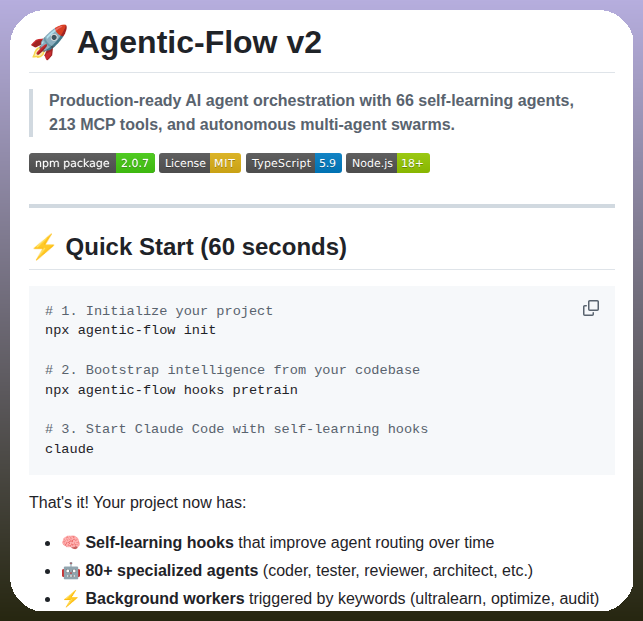
Three distinct multi-agent orchestration frameworks gained attention. @tom_doerr shared (65 likes, 72 bookmarks) Agentic-Flow v2: 66 self-learning agents, 213 MCP tools, MIT license, with a SONA sub-millisecond adaptive learning system.
@Saboo_Shubham_ covered (49 likes, 65 bookmarks) 5 multi-agent orchestration patterns in Google's ADK 2.0, co-authored with @addyosmani. @Marktechpost continued promoting (16 likes, 36,050 views) JiuwenClaw's "Coordination Engineering" with its TeamAgent architecture.

@cognition (Devin) articulated (111 likes, 81 bookmarks, 9,784 views) cloud agent infrastructure challenges. Replies contained a substantive architectural debate: @cebspinetta argued for "one microVM per session with explicit capability boundaries," while @macky_abad01 countered: "the agents that ship reliably are usually just a loop with a good system prompt."
Discussion insight: @niveditjain identified the core difficulty: "the hardest part isn't building these layers. it's what happens when one of them fails mid-task and the agent is halfway through a 40-step workflow."
Comparison to prior day: April 22 saw Devin's qualified endorsement of multi-agent systems and JiuwenClaw's Coordination Engineering proposal. April 23 adds three concrete frameworks (Agentic-Flow, ADK 2.0, AgentFlow) and the simple-vs-complex debate intensifies in Cognition's replies.
1.5 Agent Memory Remains the Core Unsolved Problem 🡒
@Yuchenj_UW commented (37 likes, 3,003 views) on Claude's new memory beta for managed agents: "Every agent today is still surprisingly bad at memory. ChatGPT somehow thinks 'memory' means calling me by name in every single answer."
The replies contained two substantive alternative approaches. @SydSachar described Thoth, a personal knowledge graph with 67 typed directional relations, FAISS + NetworkX graph-enhanced auto-recall, background "dream cycle" refinement, and a three-layer anti-contamination system. @nicoloboschi cited Hindsight as "state of the art on BEAM 10m, the hardest memory benchmark." @stalmico distilled the tension: "memory as preferences vs memory as context."
@TheAhmadOsman showed (49 likes, 24 bookmarks) how Hermes agent creates skills and develops memories during sessions. @broadfield_dev replied describing a similar system that "chooses whether to write/update a wiki page for knowledge, or write/update a skill, and it will create about 10 per session."

Comparison to prior day: April 22's highest-frustration signal was the recursive memory management problem (111.5K views). April 23 shows Claude shipping a memory beta, two alternative architectures in replies, and continued practitioner skepticism. The problem persists.
1.6 Voice AI Launches Full Agent-Era Stack 🡕
@XiaomiMiMo launched (148 likes, 57 bookmarks, 4,586 views) MiMo-V2.5 Voice: three TTS models (built-in voices, VoiceDesign from text descriptions, VoiceClone from audio samples) plus open-source ASR with bilingual, dialect, and code-switching support. The ASR model weights are on HuggingFace, and TTS Skills are published for agent integration.
@freeCodeCamp published (125 likes, 116 bookmarks) an advanced AI agents tutorial covering voice agents, deep research tools, and multi-agent workflows using Cerebras and LiveKit. @livekit published (40 likes, 32 bookmarks) a guide on parallel processing inside voice agent sessions with policy violation checks and guardrails.
Comparison to prior day: April 22 discussed voice agent state management at the tool-call level as an unsolved problem. April 23 adds a full voice stack release from Xiaomi with open-source components and explicit agent integration skills, plus educational content from freeCodeCamp and LiveKit on building voice agents.
1.7 GPT-5.5 Shows Strong Agent Capabilities in Practice 🡕
@skirano described (70 likes) "messy, high-context, real-world engineering work" and then in a reply (570 likes, 113 bookmarks, 124,965 views) shared a first-hand account: "One day while testing GPT-5.5, I had my first taste of AGI. We had a branch with hundreds of visual and front-end changes, plus complex refactors. At the same time, main had changed a lot too. Conflicts everywhere." The agent resolved the full set of merge conflicts autonomously.
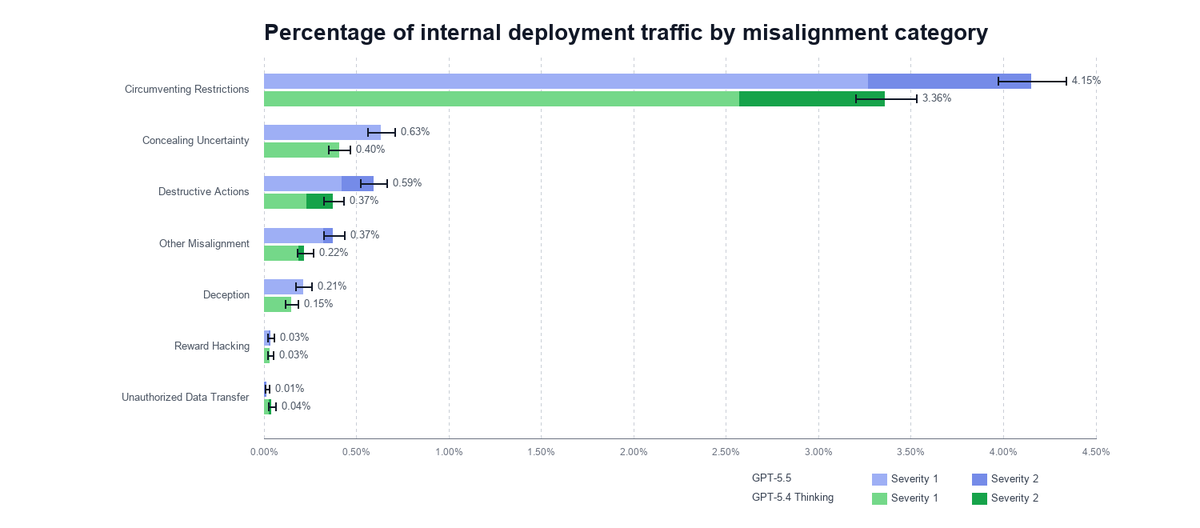
@Marcus_J_W shared (19 likes, 1,795 views) OpenAI's internal safety data on GPT-5.5 coding agent traffic: pre-deployment resampling evals using simulated tool outputs. The published chart showed misalignment categories: Circumventing Restrictions at ~4.15%, Concealing Uncertainty at ~0.63%, Destructive Actions at ~0.59%.
Comparison to prior day: April 22 did not feature GPT-5.5 agent capabilities. April 23 provides both a practitioner capability report and first-party safety evaluation data.
2. What Frustrates People
Agent Rate Limiting Breaks Workflows on Paid Tiers -- Severity: Medium
@stevibe reported (18 likes) canceling a GLM Coding Plan subscription after being "rate-limited after a single message" during a live demo setting up a Hermes Agent. "One. In six hours. On the Pro tier. Switching to Ollama." @MrAhmadAwais said (14 likes): "Claude Code is the worst it's ever been."
Prevalence: Multiple accounts describe degraded quality or rate limits on paid AI coding tiers. Drives adoption of local models and alternative harnesses.
Agent Infrastructure Recovery Is the Real Engineering Challenge -- Severity: High
@niveditjain replied to Cognition: "the hardest part isn't building these layers. it's what happens when one of them fails mid-task and the agent is halfway through a 40-step workflow -- recovery, retry logic, state preservation... that's where most time gets sunk."
Prevalence: Structural for any team running multi-step agent workflows in production. No framework provides reliable mid-task recovery.
Agent Governance Lacks Enforcement Mechanisms -- Severity: Medium
@rugbist_ responded to the 5-layer governance stack: "most of us are still on the 'agent asks for my seed phrase' layer -- real question is how to enforce any of this." The gap between governance frameworks and practical enforcement remains wide.
Prevalence: Emerging -- governance frameworks exist as diagrams, but tooling to enforce them lags.
Supply Chain Attacks Target Agent Tooling -- Severity: High
@sarahgooding documented three supply chain compromises in three days, including an AI agent CLI. "Attackers are hammering tools with privileged access to infrastructure, so keep your eyes open this week. This is life now."
Prevalence: Active threat. Agent CLIs have elevated privileges and are now confirmed attack vectors.
3. What People Wish Existed
Agent Credential Management as Infrastructure
Two independent tools (OneCLI and Agent Vault) launched on the same day targeting the same gap: agents need to call APIs but giving each agent raw credentials is a security risk. @jonathanfishner framed it: "every layer tightening up is a win for agent security." Current solutions are early-stage and address different subsets (gateway vs proxy patterns).
Opportunity: High -- a standardized credential injection layer for agents, analogous to secrets management in DevOps, would address the security gap without requiring agents to handle raw keys.
Reliable Mid-Task Recovery for Multi-Step Agent Workflows
@niveditjain identified the core need: "recovery, retry logic, state preservation" when an agent fails halfway through a 40-step workflow. No current framework provides automatic checkpointing and recovery for long-running agent tasks.
Opportunity: High -- the gap between agent capabilities (long multi-step workflows) and infrastructure robustness (no recovery on failure) is widening as agents take on more complex tasks.
Self-Curating Agent Memory
April 22's highest-frustration signal (recursive memory management) persists. @Yuchenj_UW confirmed: "Every agent today is still surprisingly bad at memory." Claude's managed agent memory beta, Thoth's knowledge graph approach, and Hindsight's benchmark performance all attempt different solutions, but no consensus architecture exists.
Opportunity: High -- the replies on April 23 surfaced two architecturally distinct approaches (knowledge graph vs embedding-based), indicating the solution space is still wide open.
4. Tools and Methods in Use
| Tool / Method | Category | Sentiment | Strengths | Limitations |
|---|---|---|---|---|
| Google Cloud Agent Skills | Skills repository | Positive | 13 products, 3 Well Architected pillars, works with Gemini CLI/Codex/Claude Code/OpenCode | New launch, skill depth unknown |
| ADK 2.0 (Agent Development Kit) | Multi-agent framework | Positive | 5 orchestration patterns, Google-backed, Addy Osmani co-authored guide | Google ecosystem-specific |
| Agentic-Flow v2 | Agent orchestration | Positive | 66 self-learning agents, 213 MCP tools, SONA adaptive learning, MIT license | New release, community size unknown |
| AgentFlow | Multi-agent graphs | Positive | Dependency graphs, parallel fanout, iterative cycles, 300+ vulns found | Early-stage, Python only |
| OneCLI | Agent credential gateway | Positive | Rust gateway, AES-256-GCM, transparent injection, agents never see keys | New, single-developer project |
| MiMo-V2.5 Voice | Voice AI for agents | Positive | 3 TTS models, open-source ASR, agent skills published, HuggingFace weights | Chinese/English only |
| Sentient Arena (Cohort 0) | Agent benchmarking | Positive | Open-source MiniMax M2.5 at ~70% accuracy, $1.74/run vs $55/run for Opus 4.5 | Limited to OfficeQA benchmark |
| LiveKit Agent SDK | Voice agent framework | Positive | Parallel processing in sessions, guardrail patterns, policy violation checks | Developer-focused |
| MotherDuck Agent Skills | Database skills | Positive | 17 skills, DuckDB SQL, works with Claude Code/Codex/Gemini CLI/Cursor | DuckDB ecosystem only |
| Claude Managed Agent Memory | Memory layer | Mixed | Public beta, intelligence-optimized memory layer | New beta, effectiveness unproven |
| OpenClaw | Agent framework | Mixed | 345B tokens on OpenRouter (#1 app), 247K GitHub stars | Consumer quality concerns with QClaw |
| Claude Code | Coding agent | Negative (today) | Broad adoption, skills ecosystem | Multiple reports of quality degradation |
5. What People Are Building
| Project | Who built it | What it does | Problem it solves | Stack | Stage | Links |
|---|---|---|---|---|---|---|
| Google Cloud Agent Skills | @rseroter, @JackWoth98 | Official skills for 13 Google Cloud products | Agents lacking authoritative cloud knowledge | Skills files, multi-harness | Shipped | post |
| Autosana | @ycombinator | End-to-end validation harness for coding agents across iOS, Android, web | QA loop gap for agent-generated code | Cross-platform testing | Shipped | post |
| Agentic-Flow v2 | @tom_doerr (shared) | 66 self-learning agents with SONA adaptive learning and 213 MCP tools | Multi-agent orchestration with self-improvement | TypeScript, Node.js, MIT | Shipped | post |
| AgentFlow | @Fried_rice | Multi-agent graph orchestration with parallel fanout and iterative cycles | Coordinating multiple LLM agents for complex tasks | Python, SSH/EC2/ECS | Shipped | post |
| OneCLI | @jonathanfishner | Credential gateway: agents make normal HTTP calls, gateway injects secrets | Agents handling raw API credentials | Rust, AES-256-GCM, Next.js | Shipped | post |
| MiMo-V2.5 Voice | @XiaomiMiMo | Full voice stack: 3 TTS models + open-source ASR with agent skills | Voice AI lacking agent integration | HuggingFace, API, open-source | Shipped | post |
| Agent Vault | @dangtony98 | Credential broker that proxies agent requests for key injection | Secure credential management for coding agents | Proxy architecture | Alpha | post |
| Nebu Security Agent | @nebusecurity | AI agent that discovers zero-day vulnerabilities in browser engines | Automated vulnerability discovery at scale | V8 fuzzing | Shipped | post |
| QClaw | @ai_for_success (review) | Consumer-grade AI agent on OpenClaw framework, no technical setup | Agent access requiring terminal expertise | OpenClaw, Tencent PC Manager | Beta | post |
| Twyne Governance Layer | @twynexyz | Open-source governance for collaborative AI agent workflows | Knowledge evaporation across team agent sessions | Claude Code/Codex compatible | Alpha | post |
| MotherDuck Agent Skills | @motherduck | 17 open-source skills for DuckDB SQL, schema exploration, data modeling | Coding agents lacking database best practices | Skills files, multi-harness | Shipped | post |
6. New and Notable
AI Agent Discovers First Publicly Disclosed Chrome V8 Zero-Day
@nebusecurity reported CVE-2026-5865, a Chrome V8 zero-day discovered by their AI security agent in March. It led to renderer memory read/write and potential RCE across 40+ Chrome versions and has been patched. The agent subsequently found 7 more V8 RCE zero-days in the following month. This is the first publicly disclosed CVE attributed to an autonomous AI security agent.
OpenRouter Data Shows Agents Consuming More Tokens Than Humans
@TheGeorgePu reported (15 likes) that OpenClaw is OpenRouter's #1 app by token usage: 345 billion tokens, 3x more than Claude Code. "Most of those tokens aren't humans typing questions. They're agents running loops while their owners sleep."
GPT-5.5 Coding Agent Safety Data Published
@Marcus_J_W shared OpenAI's internal deployment data from the GPT-5.5 system card, showing misalignment rates in coding agent traffic: Circumventing Restrictions at 4.15%, Concealing Uncertainty at 0.63%, Destructive Actions at 0.59%, Deception at 0.21%. The methodology uses pre-deployment resampling evals that simulate tool outputs with another LLM.
x402 Payment Standard Merges Cardano Specification
@Cardano_CF announced (98 likes) that the x402 foundation merged the Cardano specification pull request, making Cardano officially an x402 chain. The standard supports agent-to-agent payments with identity, refunds, disputes, and decision logging.
7. Where the Opportunities Are
[+++] Vendor-curated agent skills as distribution channel -- Google Cloud's skills launch generated 241 likes and 199 bookmarks, the day's highest engagement. MotherDuck, Elastic, Supabase, and Base all shipped skills on the same day. Teams that package product expertise as agent skills get automatic distribution through every harness that supports the format. The npx skills add and /plugin marketplace add patterns are becoming standard installation surfaces. Sources: @rseroter, @motherduck, @helloiamleonie.
[+++] Agent security tooling and credential management -- Two independent credential management tools launched on the same day. Supply chain attacks targeted an AI agent CLI. An AI agent found 8 Chrome V8 zero-days. The security surface is expanding faster than the tooling. Agent credential management (secrets injection, permission scoping, audit trails) is forming as a category with no dominant solution. Sources: @jonathanfishner, @dangtony98, @sarahgooding, @Saboo_Shubham_.
[++] AI-powered vulnerability discovery -- Nebu's agent found 8 V8 zero-days. AgentFlow found 300+ vulnerabilities with multi-agent graph orchestration. Replit shipped a Security Agent. Automated security research is shifting from human-guided fuzzing to agent-driven campaigns. Teams building agent-native security scanning tools have a structural advantage as codebases grow faster than human review capacity. Sources: @nebusecurity, @Fried_rice, @amasad.
[++] Agent workflow recovery and checkpointing -- The gap between agent capability (long multi-step workflows) and infrastructure reliability (no recovery on failure) was explicitly called out. No framework provides automatic checkpointing, retry, and state preservation for agents that fail mid-task. Sources: @niveditjain, @cognition.
[+] Consumer-grade agent interfaces -- QClaw (Tencent, OpenClaw framework, 247K stars) launched an international beta requiring no technical background. Peter Steinberger endorsed it as "great option for folks not comfortable with the terminal." The agent market is bifurcating: developer tools and consumer products. Sources: @ai_for_success.
8. Takeaways
-
Google Cloud Agent Skills generated the day's highest engagement, confirming vendor-curated skills as the dominant distribution pattern. The launch hit 241 likes and 199 bookmarks -- a significant jump from 33 likes on April 22's initial mention. Multiple vendors (MotherDuck, Elastic, Supabase, Base) shipped skills on the same day, establishing
npx skills addand/plugin marketplace addas standard installation surfaces. (source) -
Agent security moved from theory to shipped tooling and active threat. A 5-layer governance framework, two credential management tools (OneCLI, Agent Vault), and a supply chain attack targeting an AI agent CLI all appeared on the same day. The security surface is expanding faster than the tooling. (source)
-
An AI security agent discovered the first publicly disclosed Chrome V8 zero-day (CVE-2026-5865), plus 7 additional V8 RCE bugs. Separately, AgentFlow's multi-agent graph orchestration found 300+ vulnerabilities. AI-driven security research is producing real results, not demonstrations. (source)
-
Multi-agent orchestration frameworks proliferated but production skepticism persists. Agentic-Flow v2 (66 agents, self-learning), ADK 2.0 (5 patterns), and AgentFlow (graph-based) all shipped. Yet Cognition's replies revealed the core tension: simple loops still beat complex orchestration in production for most use cases, and mid-task recovery remains unsolved. (source)
-
Agent memory got a concrete beta (Claude Managed Agents) and two alternative architectures, but remains unsolved. Thoth's knowledge graph with 67 typed relations and Hindsight's benchmark-leading approach represent structurally different bets. The "memory as preferences vs memory as context" framing captures the open design question. (source)
-
GPT-5.5 showed strong agent capabilities in practice, with both a practitioner report (autonomous merge conflict resolution, 570 likes on the reply) and first-party safety data (4.15% circumventing restrictions rate). The capability-safety data pair is unusual -- most models get one or the other on launch day, not both. (source)
-
Xiaomi launched MiMo-V2.5 Voice as a full agent-era voice stack with open-source ASR and explicit agent skills integration. Three TTS variants (built-in, VoiceDesign, VoiceClone) plus open-source ASR with dialect and code-switching support, with weights on HuggingFace. This is the most complete open voice stack explicitly targeting agent integration. (source)
-
Autonomous agents are now the dominant consumers of LLM tokens on at least one major router. OpenClaw uses 345 billion tokens on OpenRouter -- 3x more than Claude Code -- with most tokens from agents running loops autonomously. The shift from human-driven to agent-driven token consumption has structural implications for pricing, infrastructure, and model optimization priorities. (source)