Twitter AI Agent - 2026-05-19
1. What People Are Talking About
1.1 Managed runtimes and harness controls moved from advice to shipped product surfaces 🡕
The strongest cluster on May 19 was no longer just about why agents need harnesses; it was about vendors shipping the harness as product. The most useful posts described managed Linux environments, self-hosted sandboxes, MCP tunnels, browser-native QA, and installable guidance packs. Compared with May 18, when the conversation centered on guidebooks, rollout roles, and trust rails, May 19 pushed much harder into first-party execution surfaces and verification tooling.
@_vmlops posted (367 likes, 15,588 views, 348 bookmarks) a cover for "Harness Engineering: A Design Guide to Claude Code." The image mattered more than the caption: it reduced reliable agent systems to control plane, loop, recovery, permissions, interrupts, and verification, then put the thesis in one line: system first, model second.

@GoogleAIStudio introduced (704 likes, 26 replies, 29,816 views, 285 bookmarks) Managed Agents on the Gemini API. The product claim was concrete: one API call gives an agent a remote Linux environment hosted by Google, ready to scale, with custom instructions, skills, and tools defined in Markdown. Replies immediately split between enthusiasm for lower agent-ops overhead and practical worries about pricing and training materials, which suggests the need is real even if the operating model is still new.
@ClaudeDevs announced (207 likes, 15 replies, 8,456 views, 75 bookmarks) self-hosted sandboxes and MCP tunnels for Claude Managed Agents. Anthropic's launch post and docs say tool execution can stay on customer-controlled infrastructure or managed providers such as Cloudflare, Daytona, Modal, or Vercel, while private MCP servers stay reachable without opening inbound firewall rules; a follow-up reply (19 likes, 3,851 views) added that live sessions can swap tools, MCP servers, or vault IDs without restart and can offload very large MCP outputs into sandbox files.

@Google rolled out (36 likes, 4 replies, 10,950 views, 14 bookmarks) Chrome DevTools for agents as a browser-native verification layer. The Chrome docs and GitHub repo say it ships as an MCP server, CLI, and skills bundle so agents can inspect live pages, emulate users, run Lighthouse audits, and analyze performance before shipping; the first reply also introduced WebMCP (26 likes, 2 replies, 6,670 views, 16 bookmarks) as a proposed bridge between websites and coding agents.
@ChromiumDev introduced (20 likes, 2 replies, 3,078 views, 10 bookmarks) Modern Web Guidance, an installable skills pack for Antigravity CLI, Claude Code, and Copilot. The documentation says the pack is evergreen and expert-vetted, with Baseline fallbacks so coding agents stop defaulting to stale web patterns.
Discussion insight: The security rationale behind this whole theme was unusually explicit. @nazirtech01 said (22 likes, 1 reply, 1,657 views, 18 bookmarks) they switched all AI-coding-agent projects to npm ci --ignore-scripts plus a seven-day Renovate cooldown because Claude and Codex will happily install hallucinated packages. The move toward sandboxes, tunnels, and guidance packs looked less like vendor polish and more like a response to observed risk.
Comparison to prior day: May 18 treated harness engineering as curriculum, rollout discipline, and trust infrastructure. May 19 made those same ideas executable products: hosted runtimes, perimeter-aware sandboxes, browser QA, and installable guidance.
1.2 Agent-first products and orchestrators kept replacing single-agent chat 🡕
A second cluster focused on how agents are surfaced and coordinated. The common move was to stop treating agents as one more sidebar and start treating them as long-running workers with delegation, handoff, and explicit isolation. Compared with May 18, when marketplaces and commerce rails got more attention, May 19 talked more about execution surfaces, orchestration commands, and where work should actually run.
@antigravity introduced (793 likes, 132 replies, 33 quotes, 33,684 views, 285 bookmarks) Antigravity 2.0 as a standalone desktop app rebuilt around multi-agent teams, scheduled tasks, native voice, and one-click integration with other Google products. The launch framed the product as an agent-optimized desktop, not just a better IDE extension.
@Google reinforced (246 likes, 23 replies, 21,089 views, 23 bookmarks) that framing by calling the app explicitly "agent-first," centered on agent conversations, agent-produced artifacts, and multi-agent orchestration. Replies kept returning to the same distinction: most software is still file-first or app-first, while this launch treated the agent as the primary interface.
@lobehub launched (383 likes, 62 replies, 67 quotes, 580,400 views, 133 bookmarks) a Chief Agent Operator that hires from a 273K-skill marketplace, runs agents in the cloud 24/7, and reports through IM apps. A reply from @CatCatBros said (5 likes, 2 replies, 590 views) Discord connection was "dead simple," which made the IM-routing claim feel more like a usability story than a pure marketplace boast.
@warpdotdev announced (110 likes, 11 replies, 5 quotes, 5,738 views, 27 bookmarks) multi-agent orchestration in Oz for Claude Code, Codex, and the Warp Agent. The original tweet was a launch teaser; the real evidence came in follow-up replies that said local subagents get their own worktrees, cloud subagents get isolated Docker containers, and local sessions can hand off to the cloud overnight.
@Saboo_Shubham_ showed (57 likes, 13 replies, 2,552 views, 65 bookmarks) a Hermes workflow where a Kanban board decomposes work, SmallCode plus Ollama handles narrow coding tasks, and Claude or Codex handles hard planning and ambiguous work. The image mattered because it made the routing policy legible instead of leaving "multi-agent" as a vague promise.
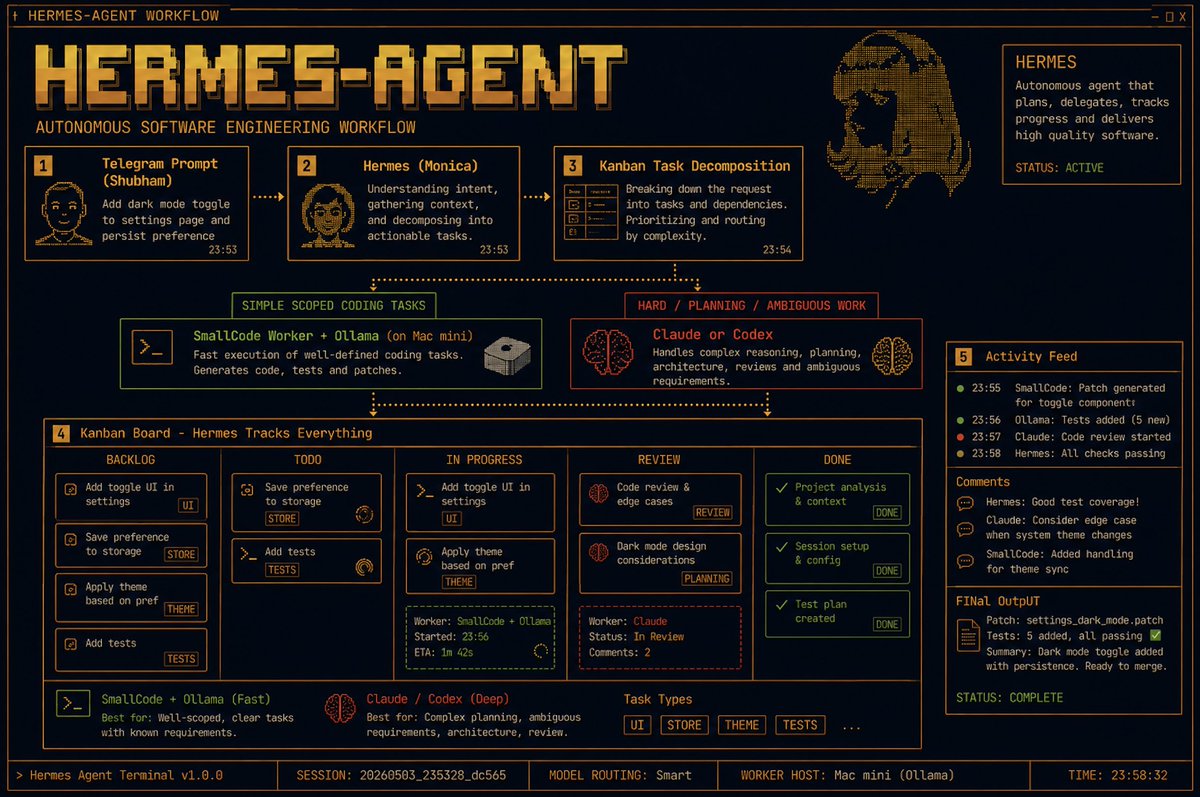
Discussion insight: The best corrective came from @pvncher, who first argued (78 likes, 10 replies, 12,674 views, 67 bookmarks) for manager-led orchestration over swarms and then replied (2 likes, 2 replies, 145 views) that arbitrary agent-to-agent messaging adds irrelevant detail, while parallelism is strongest for read-only work and write paths need locking and validation. That matched the day's product launches: the winning pattern was not more chatter between agents, but better boundaries around them.
Comparison to prior day: May 18's operator layer was more about marketplaces, settlement, and cloud operators. May 19 kept the operator story, but grounded it in isolated worktrees, isolated containers, and agent-first interfaces.
1.3 Memory, context, and skills became the real control surface 🡕
The most substantive non-launch conversation was about what agents carry between runs: constrained context, structured memory, self-correcting stores, and skills that mutate over time. Several of the day's strongest posts explicitly said agent strategy is really data strategy, or that Markdown skill files are becoming a new software unit. Compared with May 18's emphasis on portability, May 19 moved deeper into ownership, invalidation, and retrieval design.
@Aurimas_Gr mapped (141 likes, 7 replies, 6,206 views, 147 bookmarks) agent memory into episodic, semantic, procedural, and short-term working memory. The image made the structure concrete: private knowledge bases and embeddings feed semantic memory, prompt and tool registries become procedural memory, and the orchestrator assembles short-term working memory at run time.

@levie argued (116 likes, 22 replies, 18,427 views, 123 bookmarks) that the biggest challenge in enterprise agent strategy is giving agents the right constrained context, because too much conflicting information or too little context both break outcomes. Replies sharpened the pain: @tokenomicz said (16 views) context ownership matters more than context size when docs, chats, and spreadsheets disagree, while @jatingargiitk said (31 views) the problem is ongoing upkeep because data starts rotting the day after cleanup.
@garrytan said (141 likes, 24 replies, 16,488 views, 125 bookmarks) dynamic skills are powerful because Markdown is code and the agent can change it when new cases appear. The tweet's quoted example pushed the same direction further: skill bundles should carry their own tests, and the agent should be allowed to update tooling in flight instead of plateauing on a static library.
@tom_doerr shared (30 likes, 2 replies, 1,719 views, 32 bookmarks) Pro Workflow, whose GitHub repo describes a single SQLite store for self-correction memory, FTS5-indexed wikis, and auto-research loops. That promise immediately attracted the right skepticism: @Timur_Yessenov replied (16 views) that self-correcting memory also needs a bad-memory path so invalidated assumptions can be revoked, not just remembered.
@Ghast_AI open-sourced (15 likes, 2 quotes, 767 views) Anamnesis, and its repo describes a local-first memory bridge that imports and serves existing memory across Claude Code, Codex, Hermes, OpenClaw, mem0, Letta, and generic MCP sources. That was a smaller signal than the other posts, but it fit the same demand: memory should belong to the user, not to one agent runtime.
Discussion insight: The most specific implementation warning came from @0xMevu, who replied (41 views) that vector memory in a coding agent poisoned recall with stale tool outputs across roughly 3,000 entries until he moved to an append-only event log and replay. The day was enthusiastic about memory, but not naive about retrieval and forgetting.
Comparison to prior day: May 18 emphasized skills, threads, and portability across agents. May 19 spent more time on who owns context, how memory is structured, and what happens when memory is wrong.
1.4 Voice agents looked more deployable and less like demos 🡕
Voice stayed one of the clearest applied-agent clusters, but the evidence shifted toward delivery mechanics: IDE-based build flows, call-center-specific design, generated integrations, and vertical use cases such as education. Compared with May 18, more of the conversation treated voice agents as normal software-delivery targets rather than standalone wow demos.
@tec_aryan said (67 likes, 24 replies, 15,860 views, 8 bookmarks) PolyAI has opened its voice-agent platform to anyone. The strongest evidence came in follow-up replies: @tec_aryan said (16 likes, 709 views) builders can deploy a production-ready voice agent in under ten minutes with no professional services or six-figure contract, and another reply (13 likes, 478 views) said the platform already powers customer conversations for FedEx, Marriott, Caesars, and Gordon Ramsay restaurants.
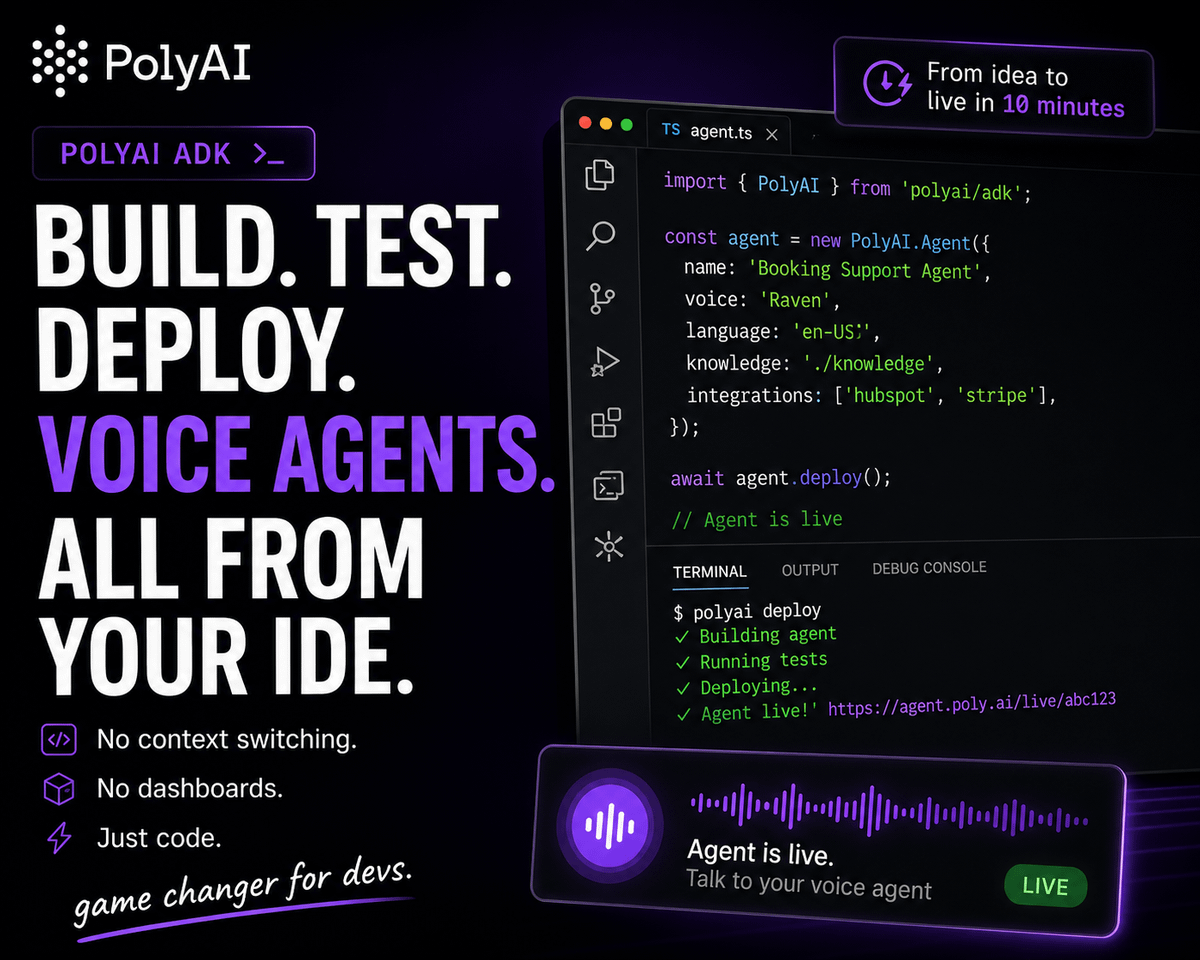
@TheAIColony claimed (110 likes, 12 replies, 7,601 views, 84 bookmarks) Claude plus PolyAI can build a voice agent that answers calls, qualifies leads, and handles customers in under ten minutes. On its own that is a setup demo; paired with the longer PolyAI thread, it read more like a growing developer workflow.
@ElevenLabs launched (197 likes, 19 replies, 13,803 views, 47 bookmarks) an Einstein agent that turns archive material into an interactive voice experience for education. The replies were useful because they were not uniformly positive: one from the company stressed multilingual education value, while another called it a very expensive search engine with an accent, which separated real utility from novelty.
@Google introduced (47 likes, 6 replies, 3,666 views, 5 bookmarks) Gemini Spark as a background personal agent tied to Gmail and Docs that keeps working even when the laptop is closed. It is not strictly a voice-agent post, but it reinforced the same shift toward agents handling long-running real-world tasks instead of waiting for the next prompt.
Discussion insight: The clearest differentiator came from @tec_aryan saying (14 likes, 1 reply, 882 views) most AI voice tools were chatbot systems adapted later, which is why they still struggle with interruptions, accents, background noise, and normal human conversation. That made telephony-specific design a real product wedge rather than a branding claim.
Comparison to prior day: Voice agents were visible on May 18, but May 19 added more evidence that they can be built, tested, and deployed from normal developer workflows instead of through bespoke enterprise projects.
2. What Frustrates People
Context quality is failing faster than context windows are growing
Severity: High. @levie argued (116 likes, 22 replies, 18,427 views, 123 bookmarks) that most enterprise agent failures are really data-strategy failures: too much conflicting information or too little usable context both break outcomes. The replies made the failure mode sharper: @tokenomicz said (16 views) context ownership matters when docs, chats, and spreadsheets disagree, and @jatingargiitk said (31 views) the hard part is upkeep because cleaned-up data starts rotting immediately. @DailyDoseOfDS_ shared (11 likes, 1 reply, 2,505 views, 17 bookmarks) a quoted claim that packaging backend context through InsForge cut Claude Code usage from 10.4M tokens and 10 errors to 3.7M tokens and zero errors, which is the most concrete proof in the dataset that context packaging changes cost and failure rates. The coping pattern is obvious: narrow task scopes, one source of truth, and pre-assembled context layers instead of repeated discovery. Worth building for because people are already spending tokens and engineering time to patch around this.
Security boundaries still depend on hard isolation and stricter package hygiene
Severity: High. @ClaudeDevs announced (207 likes, 15 replies, 8,456 views, 75 bookmarks) self-hosted sandboxes and MCP tunnels so managed agents can execute inside customer infrastructure and reach private services without exposing them publicly. @nazirtech01 said (22 likes, 1 reply, 1,657 views, 18 bookmarks) they now force npm ci --ignore-scripts and a seven-day Renovate cooldown because Claude and Codex will install hallucinated packages. @DarkWebInformer shared (18 likes, 2 replies, 2,848 views, 22 bookmarks) Pentest Agent Suite, but even that security response implies the same thing: agent autonomy expands the attack surface unless execution, dependencies, and tool access are tightly controlled. The current workaround is layered isolation, package conservatism, and more explicit permission boundaries. Worth building for because people are already changing install and runtime policy by hand.
Multi-agent work degrades when too many agents write at once
Severity: Medium. @pvncher argued (78 likes, 10 replies, 12,674 views, 67 bookmarks) that manager-led orchestration beats swarms, and then replied (2 likes, 2 replies, 145 views) that arbitrary agent-to-agent messaging adds irrelevant details while write paths need locking and validation. @warpdotdev answered (110 likes, 11 replies, 5,738 views, 27 bookmarks) with isolated worktrees locally and isolated Docker containers in the cloud, and @Saboo_Shubham_ showed (57 likes, 13 replies, 2,552 views, 65 bookmarks) a Hermes board that routes narrow tasks to one worker class and ambiguous work to another. The workaround is serial decomposition plus strong isolation, not more agent chatter. Worth building for because the community now has a clear opinion about what breaks and what containment looks like.
Memory systems still need forgetting, not just retrieval
Severity: Medium. @Aurimas_Gr described (141 likes, 7 replies, 6,206 views, 147 bookmarks) a layered memory model, but the more revealing evidence was in the replies: @0xMevu said (41 views) stale tool outputs poisoned recall until he moved to an append-only event log and replay, while @Timur_Yessenov replied (16 views) that self-correcting memory needs an explicit bad-memory path. The day was full of memory products and frameworks, but the clearest pain was invalidation: how to revoke or quarantine memories that were once useful but are now wrong. Worth building for because current systems remember more easily than they forget.
3. What People Wish Existed
Portable memory that stays user-owned across tools
People are clearly asking for memory that survives harness changes without locking them into one runtime. @tom_doerr shared (30 likes, 2 replies, 1,719 views, 32 bookmarks) Pro Workflow's SQLite-backed memory and wiki store, @Ghast_AI open-sourced (15 likes, 2 quotes, 767 views) Anamnesis as a bridge across Claude Code, Codex, Hermes, and other tools, and @warpdotdev paired Oz with a cross-harness Agent Memory waitlist. The urgency is practical, not aspirational: people already have context trapped in multiple systems and do not want to start from zero every time they switch tools. Opportunity: direct.
Skill systems that are tested, packaged, and allowed to evolve
The wish is no longer just "more skills." @garrytan said (141 likes, 24 replies, 16,488 views, 125 bookmarks) agents should update Markdown skills in flight, @kotlin published (62 likes, 1 reply, 1,938 views, 29 bookmarks) an official GitHub repo of installable Kotlin agent skills, and @DanKornas showed (10 likes, 2 replies, 509 views, 15 bookmarks) Skill Conductor treating skill authoring as create, eval, edit, review, and package instead of "write SKILL.md and hope." The unmet need is a real software lifecycle for skills: architecture choice, tests, packaging, distribution, and safe revision. Opportunity: direct and competitive.
Private execution with private tool access by default
The biggest infrastructure wish is for agents that can stay useful without leaving the organization's boundary. @ClaudeDevs shipped self-hosted sandboxes plus MCP tunnels, while @GoogleAIStudio introduced a managed Linux environment on the Gemini API. The pattern is the same in both threads: teams want hosted orchestration, but they do not want to give up network policy, private services, or filesystem control to get it. Opportunity: direct and competitive.
Voice-agent builders that behave like normal production software
Voice posts were not asking for better demos; they were asking for deployable systems. @tec_aryan said (67 likes, 24 replies, 15,860 views, 8 bookmarks) PolyAI now lets anyone build and deploy a production-ready voice agent quickly from the IDE, while the follow-up thread stressed interruptions, accents, and call-flow reliability as the real differentiator. @ElevenLabs showed an education-focused voice agent, and @Google described Gemini Spark as a background personal agent that keeps working after the laptop is closed. The missing thing is not interest; it is a reliable, production-grade delivery path for long-lived voice and task agents. Opportunity: direct and competitive.
4. Tools and Methods in Use
| Tool | Category | Sentiment | Strengths | Limitations |
|---|---|---|---|---|
| Gemini API Managed Agents | Agent runtime | (+/-) | One API call provisions a remote Linux environment with Markdown-defined instructions, skills, and tools | Replies immediately raised pricing and onboarding questions; public operational detail is still thin |
| Claude Managed Agents | Managed agent runtime | (+) | Self-hosted sandboxes, MCP tunnels, live tool and MCP swapping, sandbox-file offloading for large outputs | Self-hosted sandboxes do not yet support memory; MCP tunnels remain in research preview |
| Chrome DevTools for agents | Debugging / MCP | (+) | Live browser inspection, Lighthouse audits, emulation, screenshots, performance analysis, CLI plus skills | Browser-specific and intentionally exposes browser state to the MCP client |
| Modern Web Guidance | Skill pack | (+) | Evergreen, expert-vetted web skills with Baseline fallbacks; installable across major coding agents | Narrowly focused on web development |
| Warp Oz | Orchestration platform | (+/-) | Multi-harness orchestration across Claude Code, Codex, and Warp Agent with isolated worktrees and cloud containers | Still beta; Agent Memory is only in research preview |
| Hermes Agent | Orchestrator/runtime | (+/-) | Explicit Kanban decomposition, scoped local workers for simple tasks, stronger models for planning and review | Requires disciplined scoping and routing; swarm-like write paths are still seen as risky |
| Pro Workflow | Memory / context layer | (+) | SQLite-backed self-correction memory, FTS5 wikis, auto-research loops, cross-session recall | Even supporters want a bad-memory path and explicit invalidation |
| PolyAI ADK | Voice-agent platform | (+) | Build, test, and deploy voice agents from the IDE, with telephony-specific flows and generated integrations | Best public evidence is still launch-thread detail plus enterprise references, not broad user review |
| InsForge | Backend context layer | (+) | MCP and CLI surfaces expose backend topology in one place and reportedly cut token use from 10.4M to 3.7M | Works best if the team adopts InsForge as the backend control surface |
| Pentest Agent Suite | Security framework | (+/-) | Large cross-tool bundle with 50 agents, 26 commands, 19 CLI tools, 11 skills, and 2 MCP servers | Security hunting still needs proof and validation to avoid hallucinated findings |
| Kotlin agent skills | Language skill pack | (+) | Reusable migration and tooling skills packaged in standard SKILL.md folders | Kotlin-specific, with an incubator-style catalog |
| Skill Conductor | Skill lifecycle method | (+) | Architecture-first create, eval, edit, review, and package flow with explicit patterns before writing SKILL.md | More process-heavy than quick prompt-to-skill workflows |
The satisfaction spectrum tilted positive when tools made boundaries clearer: self-hosted sandboxes, worktrees, containers, browser QA, and official skill packs all got favorable attention. The mixed sentiment appeared where the tool introduced another layer that still needs governance, such as multi-harness orchestration, cross-session memory, or security automation without strong proof.
The migration pattern is becoming easier to describe. Teams are moving from prompt-first setups to architecture-first skills, from repeated discovery to pre-packed context layers, from single-agent chat to orchestrated local and cloud workers, and from memory silos to portable or self-hosted memory stores. Competitive pressure is also getting clearer: Google and Anthropic are shipping runtimes, Chrome and Chromium are shipping verification and guidance, and the community is racing to own the memory, skills, and orchestration layers around those runtimes.
5. What People Are Building
| Project | Who built it | What it does | Problem it solves | Stack | Stage | Links |
|---|---|---|---|---|---|---|
| Antigravity 2.0 | @antigravity | Standalone agent-first desktop app with multi-agent teams, scheduled tasks, native voice, and Google integrations | Chat-window workflows do not fit long-running autonomous work | Desktop app, multi-agent orchestration, native voice, Google product integrations | Shipped | tweet, blog |
| Managed Agents on Gemini API | @GoogleAIStudio | Managed remote Linux environment where one API call spins up an agent with custom instructions, skills, and tools | Teams want hosted execution without hand-rolling runtime plumbing | Gemini API, remote Linux environment, Markdown skills and tools | Beta | tweet |
| Claude Managed Agents | @ClaudeDevs | Managed agents with self-hosted sandboxes and private MCP tunnels | Enterprises need agent execution and tool access inside their security perimeter | Anthropic agent loop, self-hosted sandboxes, MCP tunnels, Cloudflare/Daytona/Modal/Vercel | Beta | tweet, blog, docs |
| LobeHub Chief Agent Operator | @lobehub | Picks agents from a large skill marketplace, runs them continuously, and reports through IM apps | Manual agent selection and monitoring is too hands-on | Cloud agent marketplace, IM integrations, skill catalog | Shipped | tweet |
| Oz + Agent Memory | @warpdotdev | Orchestrates Claude Code, Codex, and Warp Agent across local and cloud runs; Agent Memory aims to persist learning across harnesses | Teams need coordinated multi-agent work without locking into one harness | Worktrees, isolated Docker containers, multi-harness orchestration, portable memory | Beta | tweet, memory |
| Pro Workflow | @tom_doerr shared | Adds self-correcting memory, FTS5 wikis, and auto-research loops to Claude Code and other agents | Repeated corrections and research disappear between sessions | SQLite, FTS5, hooks, skills, agents | Shipped | tweet, GitHub |
| PolyAI ADK / Agent Studio | @tec_aryan | Builds, tests, and deploys phone-call voice agents from the IDE with generated knowledge and integrations | Most voice tools were adapted from chat and struggle in real call flows | TypeScript ADK, telephony voice stack, HubSpot/Stripe integrations, Studio | Shipped | tweet, Studio |
| Autogenesis | @AI4S_Catalyst | Self-evolving agent protocol and runtime that versions prompts, tools, memory, environments, and agents with rollback | Self-improving agents need explicit lifecycle, versioning, and governance | RSPL/SEPL protocol, tracing, versioning, tool-calling runtime | Alpha | tweet, paper, GitHub |
| Pentest Agent Suite | @DarkWebInformer shared | Autonomous bug-bounty framework for Claude Code and six other coding tools | Security hunting needs repeatable agent workflows across tools | Python, 50 agents, 26 commands, 19 CLI tools, 11 skills, 2 MCP servers | Alpha | tweet, GitHub |
| Kotlin agent skills | @kotlin | Open repository of Kotlin-specific skills for migrations and tooling tasks | Teams want reusable language-specific skills instead of re-prompting every migration | SKILL.md skill folders, plugin and npx install flows | Shipped | tweet, GitHub |
Google and Anthropic both spent the day productizing the same core idea from different angles: keep orchestration hosted, but make execution and control surfaces feel more like real infrastructure. Antigravity, Managed Agents on Gemini API, Claude Managed Agents, and Oz all assume that the next bottleneck is not model quality alone, but how agents are staged, isolated, resumed, and observed.
The second repeated build pattern was packaging memory and skills as durable artifacts. Pro Workflow, Autogenesis, and Kotlin agent skills each treat prompts, rules, context, or task procedures less like disposable chat context and more like software that can be stored, versioned, retrieved, and distributed. Even when they solve different problems, they share the same premise: agent capability compounds only if it survives the session.
The strongest vertical builds were voice and security. PolyAI is turning voice agents into something developers can build and deploy from an IDE, while Pentest Agent Suite turns bug-hunting workflows into a translated bundle that follows the user across coding tools. LobeHub sat between those two extremes by building the coordination layer itself: rather than one more agent, it tries to own selection, execution, and reporting for many agents at once.
6. New and Notable
Chrome DevTools for agents reached stable 1.0
@Google rolled out (36 likes, 4 replies, 10,950 views, 14 bookmarks) Chrome DevTools for agents, and @ChromiumDev said (17 likes, 2 replies, 825 views, 9 bookmarks) it now ships browser debugging, emulation, and Lighthouse audits to coding agents through an MCP server, CLI, and specialized skills. The GitHub project makes the broader point explicit: browser verification is being bundled as reusable agent infrastructure, not left as an ad hoc manual step.
Gemini Spark made background personal agents more concrete
@Google introduced (47 likes, 6 replies, 3,666 views, 5 bookmarks) Gemini Spark as a personal agent integrated with Gmail and Docs that keeps running after the laptop is closed. The example task was mundane on purpose - coordinating block-party logistics - which made the launch notable because it treated background task completion, not clever chat, as the product story.
Skill authoring got more formal
@DanKornas showed (10 likes, 2 replies, 509 views, 15 bookmarks) Skill Conductor, an architecture-first skill lifecycle that forces a choice among patterns before any SKILL.md is written and then moves through create, eval, edit, review, and package modes. That is notable because it treats skills less like prompt snippets and more like software components with tests and release discipline.

Anamnesis turned memory portability into an MCP bridge
@Ghast_AI open-sourced (15 likes, 2 quotes, 767 views) Anamnesis, and the repo says it imports, normalizes, indexes, and serves existing memory across Claude Code, Codex, Hermes, OpenClaw, mem0, Letta, and generic MCP sources. It was a smaller signal than the big launches, but it is one of the clearest examples of builders attacking cross-tool memory fragmentation directly.
7. Where the Opportunities Are
[+++] Private execution plus private tool access — Google Managed Agents and Claude Managed Agents both point at the same demand: teams want hosted orchestration, but they want execution, filesystems, and internal services to stay under their own controls. The package-hygiene warning from @nazirtech01 makes this stronger, because it shows why enterprises are asking for sandboxes and tighter policy boundaries in the first place.
[+++] Portable memory with ownership and invalidation — Pro Workflow, Anamnesis, Warp Agent Memory, and the memory-thread replies all converge on one gap: people want memory that can move across tools, stay self-hosted, and forget bad assumptions when necessary. This is strong because the need shows up in both product launches and practitioner complaints about stale recall.
[++] Architecture-first skill lifecycles and curated skill packs — Garry Tan's dynamic-skills post, Kotlin's official skills repo, Skill Conductor, and Modern Web Guidance all treat skills as software artifacts that need testing, packaging, and distribution. The opportunity is moderate rather than fully open because multiple vendors and communities are already moving quickly here.
[++] Multi-harness orchestration with isolated write paths — Oz, Hermes, and pvncher's replies all argue for the same operating model: scoped subagents, isolation, and serial decomposition for writes. This is a meaningful opportunity because teams clearly want orchestration, but the current consensus is that swarms without control are still fragile.
[++] Telephony-grade voice-agent builders — PolyAI, ElevenLabs, and Gemini Spark show clear demand for agents that can handle calls, education, or long-lived personal tasks. The strongest wedge is not voice itself; it is reliability under interruptions, accents, background noise, and long-running workflows.
[+] Token-efficient backend context layers — InsForge's quoted 10.4M-to-3.7M token reduction and Levie's context-ownership thread both suggest a growing niche for systems that pre-assemble backend and org context before the agent starts coding. This is still emerging, but the cost and error story is already compelling.
8. Takeaways
- Managed execution became the day's clearest product signal. Google and Anthropic both launched stronger runtime surfaces, which means agent reliability is increasingly being sold as infrastructure, not just prompting technique. (source)
- The community is converging on orchestration with boundaries, not swarms without rules. The strongest replies favored scoped subagents, isolated worktrees or containers, and serial decomposition for writes. (source)
- Enterprise agent quality is still fundamentally a context-ownership problem. The most persuasive frustration posts said conflicting data sources and decaying knowledge bases break agents faster than larger context windows can save them. (source)
- Memory now has to be portable and revocable. The important nuance in the memory posts was not that agents should remember more, but that they need ways to move memory across tools and invalidate stale recall. (source)
- Voice agents are starting to look like normal production software. PolyAI's thread was the clearest sign because it described IDE-based build, test, and deploy flows plus real customer-call deployments. (source)
- Skills are being treated more like software packages than prompt snippets. Official skill repositories, guidance packs, and architecture-first creation flows all point toward skills with tests, packaging, and release discipline. (source)