Twitter AI Agent - 2026-05-20
1. What People Are Talking About
1.1 Voice agents became a latency-budget discussion, not just a product demo 🡕
The biggest shift on May 20 was that voice-agent talk stopped being mostly vertical demos and became a discussion about the layers and latency budgets required to make voice actually work. The evidence came from four substantial items pairing a new speech stack with benchmarking threads about time to first token, tool calling, and enterprise distribution. Compared with May 19, which emphasized deployable voice workflows and vertical demos, May 20 spent more time on the infrastructure that determines whether those workflows feel natural.
@ElevenLabs introduced (171 likes, 10 replies, 15,281 views, 105 bookmarks) Speech Engine as a way to turn an existing chat agent into a voice agent with one prompt. The docs say the SDK keeps the builder in control of the LLM and conversation logic while ElevenLabs handles speech-to-text, text-to-speech, turn-taking, and interruption detection; a follow-up reply (11 likes, 1 reply, 1,034 views) added that the underlying text agent remains untouched.
@kwindla posted (77 likes, 11 replies, 7,820 views, 37 bookmarks) benchmark results showing Gemini 3.5 Flash as the new overall top scorer on his task-agent benchmark, but still too slow for voice agents because time to first token is about one second and "we really need TTFT down below 700ms." The attached table matters because it shows Gemini 3.5 Flash posting elite pass rates while still missing the latency target he wants, and his text explicitly says Claude Haiku 4.5 remains the best-performing model under 700ms TTFT. He also added a pricing wrinkle: on his benchmark, Gemini 3.5 Flash was more expensive than GPT-5.4 and Claude Sonnet 4.6.

@bridgebench said (62 likes, 18 replies, 4,641 views) Gemini 3.5 Flash set a new speed record at 581.1 tokens per second, arguing that this is the kind of speed that makes real-time voice coding and instant agent responses possible. But the most useful correction came from the replies: after one user pushed a competing chart, the account answered (1 like, 141 views) "Speed without smarts," which captured the day's tension between throughput bragging rights and actual agent quality.
@Databricks announced (74 likes, 3 replies, 3,884 views, 11 bookmarks) that Gemini 3.5 Flash was already available on Databricks, positioning it as enterprise-ready for agentic AI on company data with governance and operational tooling. That mattered less as a model launch than as distribution evidence: the voice and agent benchmark conversation was immediately being wrapped in production infrastructure.
Discussion insight: The disagreement was not whether voice agents matter, but which bottleneck matters most now. ElevenLabs emphasized speech orchestration and interruption handling, while benchmark threads kept pulling the conversation back to TTFT, tool calling, and cost; the result was a much more operational voice discussion than the day before.
Comparison to prior day: May 19 talked about voice agents as software that could finally be built and deployed from normal developer workflows. May 20 moved one layer lower and argued about the speech engine, the latency budget, and whether the underlying models are actually fast enough.
1.2 Agent capability is increasingly shipped as bundles, catalogs, and install commands 🡕
A second cluster centered on packaging. Instead of talking abstractly about skills and browser use, people shared bundles that can be force-loaded, site-specific catalogs that agents can browse, and installable guidance packs that pull current expert knowledge into the agent context. This theme was backed by four concrete items, not just one-off tips. Compared with May 19, when skills were discussed as a control surface and memory artifact, May 20 was more concrete about distribution.
@Teknium said (232 likes, 19 replies, 25,270 views, 82 bookmarks) Hermes Agent now supports Skill Bundles, letting users predefine a set of skills and force-load them with one slash command. The launch pitch was straightforward, but the best nuance was in the replies: when asked whether this removes the need to create skills in workflows, Teknium answered (1 like, 67 views) "No," which makes the bundle feature look like packaging and distribution, not automation magic.
@NousResearch announced (105 likes, 20 replies, 4,697 views, 66 bookmarks) that Hermes Agent can use hundreds of browser skills through Browserbase's new browse.sh hub. The site describes a browser CLI plus an open web catalog of skills, browser primitives, debugging, and cloud sessions, and says its suggested DOM selectors and XHR requests can cut token costs by 50x. That makes the launch more than a content catalog; it is a claim that browser automation can be compressed into reusable site-specific retrieval and action primitives.
@firt shared (3 likes, 346 views, 5 bookmarks) Modern Web Guidance from Google I/O, and the attached slide made the install surface explicit: npx modern-web-guidance install. The Chrome docs and GitHub repo say it is an evergreen, expert-vetted skill pack designed to steer coding agents toward modern, accessible, performant, and secure web APIs instead of legacy patterns.

@aiedge_ shared (26 likes, 4 replies, 1,322 views, 25 bookmarks) the Academic Research Skills repo for Claude Code, which its README describes as a full research-to-publication skill suite. The replies showed the next problem immediately: one reader asked (14 views) whether it cites real sources or invents fake DOIs, so specialized skill packs are already being judged on provenance and verification, not just convenience.
Discussion insight: The common correction across this theme was that packaging reduces setup friction, but it does not erase curation and trust work. Skill bundles still need skills, browser catalogs still need site coverage, and domain-specific packs still have to prove they cite and act reliably.
Comparison to prior day: May 19 described skills as a new software unit and highlighted official web guidance. May 20 turned that idea into operational surfaces: force-loaded bundles, browser skill marketplaces, and one-command installs.
1.3 Context engineering and evaluation drew more attention than bigger context windows 🡕
The strongest research theme on May 20 was not how to use larger context, but why larger context still fails and what teams should do instead. The evidence came from four items emphasizing architectural choice, diagnostic workflows, and the limits of current positional encoding. Compared with May 19's focus on memory ownership and stale recall, this was a sharper conversation about what breaks inside the window itself.
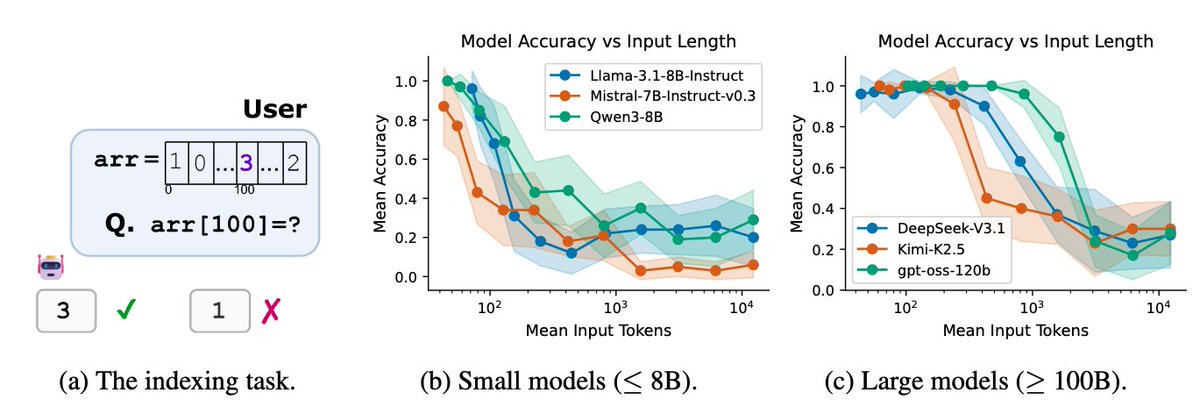
@haopeng_uiuc shared (165 likes, 5 replies, 13,084 views, 103 bookmarks) a new paper arguing that RoPE-based long-context models can fail to distinguish both positions and tokens at long lengths. The paper says failure probability approaches random guessing for key properties, and the attached figures show position inversion, token aliasing, and accuracy collapsing as input length grows. In replies, the author added (188 views) that adjusting the RoPE base trades off the failures but fixes neither, while another reply called 1M-context marketing "basically fiction."
@HSirui introduced (2 likes, 1 reply, 34 views, 1 bookmark) DiagEval for GUI-agent testing, starting from a simple complaint: when an agent says "test failed," you still do not know whether the product broke or the evaluator did. The paper says its trajectory-conditioned probes recover 45.6-62.1% of false negatives and improve evaluation accuracy from 69.9% to 78.3% on WebDevJudge-Unit and from 65.0% to 81.6% on RealDevBench. That is small-engagement evidence, but it is unusually concrete.
@himanshustwts wrote (88 likes, 4 replies, 2,621 views, 70 bookmarks) that the skills most in demand now are building agents, context engineering, evals and harnesses, distributed systems, inference engineering, and safety. That matched the rest of the dataset: people were spending more time on what the agent sees, how it is evaluated, and how its architecture is chosen than on model prompts alone.
@dair_ai argued (26 likes, 10 replies, 3,013 views, 26 bookmarks) that production-agent builders too often let framework defaults make architecture choices for them. The replies sharpened the point from two directions: one skeptic said the paper was formalizing something every Claude/Codex user learns the hard way, while another said retrieval-layer tuning often misses the fact that the harness default is the real bottleneck.
Discussion insight: The pushback here was constructive rather than dismissive. People did not reject context engineering; they argued that it has to produce better architecture choices, shorter and better-curated contexts, and stronger diagnosis than just retrying the agent.
Comparison to prior day: May 19 framed memory and context as ownership and invalidation problems. May 20 focused more on theoretical long-context limits, architecture taxonomies, and evaluation protocols for when agent runs fail.
1.4 Security agents and governance layers were framed as runtime systems, not checklists 🡕
The security conversation also became more operational. Instead of generic warnings, posts described policy engines that sit in front of tool execution, platform layers that register and gate agents, and security agents that patch or discover real vulnerabilities. Four separate items supported the theme. Compared with May 19's emphasis on self-hosted sandboxes and private MCP tunnels, May 20 spent more time on explicit runtime controls and security-specific agent jobs.
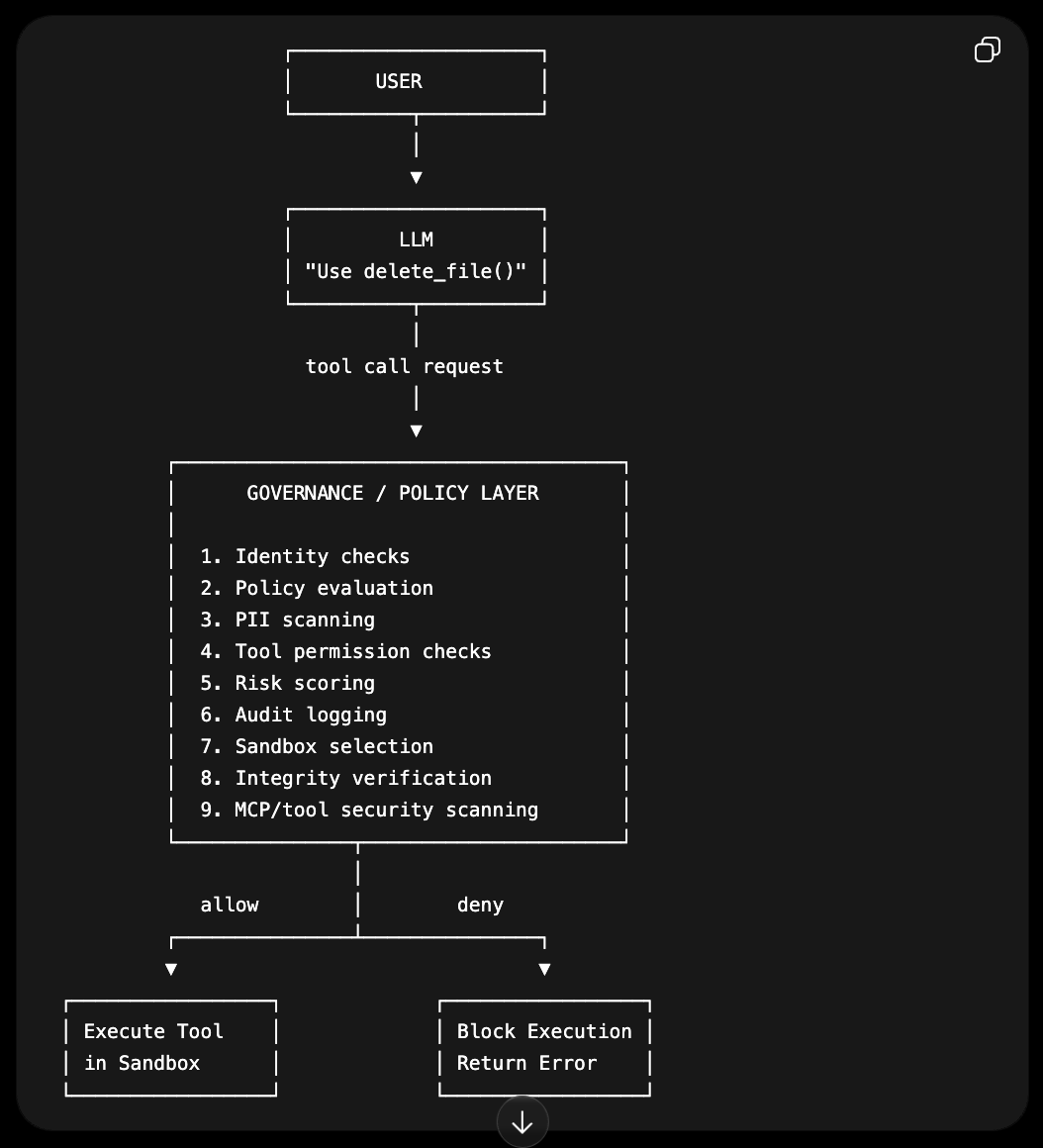
@bibryam shared (33 likes, 2 replies, 1,247 views, 31 bookmarks) Microsoft's AI Agent Governance Toolkit, describing deterministic policy enforcement, zero-trust identity, execution sandboxing, and SRE for autonomous agents. The repo README makes the model explicit: every tool call, resource access, and inter-agent message is evaluated against policy before execution, and its diagram shows risky calls such as delete_file() passing through identity checks, policy evaluation, risk scoring, audit logging, and sandbox selection before they are allowed or blocked.
@GoogleCloud_ME pointed (12 likes, 95 views, 10 bookmarks) to Gemini Enterprise Agent Platform's integrated governance capabilities. The linked Google Cloud post says the platform centers Agent Identity, Agent Registry, Agent Gateway, Agent Runtime, and Memory Bank, treating trust and governance as first-class platform concerns rather than add-ons.
@ralucaadapopa said (17 likes, 4 replies, 3,808 views, 11 bookmarks) Google DeepMind's CodeMender does not just find vulnerabilities but also patches them, arguing that developers are drowning in reports and need agents that can repair software at agentic speeds. That is a different security-agent pitch from May 19's sandbox/control story: the agent is now part of the remediation loop.
@nebusecurity claimed (306 likes, 7 replies, 42,538 views, 166 bookmarks) its Vega security agent found a fresh nginx 1.31.0 RCE after an earlier issue had already been patched. Nebula's site presents Vega as the firm's bug-finding system, so this was one of the clearest cases in the dataset where a security agent was being associated with a live vulnerability claim, not just a benchmark or toy demo.
Discussion insight: The most concise corrective came from @1clawAI arguing (5 likes, 2 replies, 71 views) that API-calling agents and code-executing agents have very different attack surfaces; once an agent can run Python, shell commands, or workflows, credentials and execution environments need much tighter isolation. That was low-volume but matched the day's larger move toward policy layers and sandboxes.
Comparison to prior day: May 19 focused on perimeter-aware sandboxes and browser verification. May 20 added explicit policy engines, platform governance objects, patching agents, and public bug-finding claims.
2. What Frustrates People
Voice agents still miss the latency budget that natural interaction needs
Severity: High. @kwindla said (77 likes, 11 replies, 7,820 views, 37 bookmarks) current Gemini 3 models are still too slow to work well for voice agents because time to first token is around one second and "we really need TTFT down below 700ms," even though Gemini 3.5 Flash is his new top scorer on the task-agent benchmark. @bridgebench showed (62 likes, 18 replies, 4,641 views) a 581.1 tokens-per-second speed record, but a follow-up reply (1 like, 141 views) reduced the celebration to "Speed without smarts." The coping pattern is to separate layers: let systems like Speech Engine handle turn-taking and interruption while teams still shop aggressively for lower-latency models. Worth building for because demand is strong and the remaining blocker is concrete and measurable.
Prompt-only safety is not enough once agents can execute code
Severity: High. @bibryam shared (33 likes, 2 replies, 1,247 views, 31 bookmarks) a governance toolkit built around deterministic policy enforcement, zero-trust identity, and execution sandboxing, while @GoogleCloud_ME pointed (12 likes, 95 views, 10 bookmarks) to a platform organized around agent identity, registry, gateway, and runtime controls. The strongest plain-language statement came from @1clawAI saying (5 likes, 2 replies, 71 views) that the attack surface changes completely once an agent can run arbitrary Python or shell commands. The workaround is layered enforcement before execution, not more polite instructions in the prompt. Worth building for because the risk boundary is now widely recognized even in low-engagement practitioner threads.
Long-context claims still break down under agent workloads
Severity: High. @haopeng_uiuc argued (165 likes, 5 replies, 13,084 views, 103 bookmarks) that failures in long-context LLMs are intrinsic to RoPE, not just implementation bugs, and explicitly said advertised context lengths should be interpreted with care. In replies, he said (188 views) changing the RoPE base only trades off one failure for another, while another reply called 1M-context marketing "basically fiction." The coping pattern is visible in the same tweet: break work into shorter contexts and rely on agentic frameworks to structure state instead of trusting one giant window. Worth building for because agent workloads are exactly the kind of multi-turn, tool-using, long-horizon tasks that stress these limits.
Failed GUI-agent rollouts still do not tell teams what actually broke
Severity: Medium. @HSirui posted (2 likes, 1 reply, 34 views, 1 bookmark) DiagEval after pointing out that "test failed" does not tell you whether the app is broken or the evaluator failed. The paper says targeted diagnostic probes recover 45.6-62.1% of false negatives and lift benchmark accuracy substantially on both WebDevJudge-Unit and RealDevBench. The workaround today is to add targeted diagnosis after failure instead of blind retries. Worth building for because teams already use GUI agents to test vibe-coded apps, but the pass/fail signal is still too ambiguous to trust.
3. What People Wish Existed
Drop-in voice layers that preserve existing chat logic
What builders want is not another fully hosted demo; it is a voice layer they can attach to systems they already run. @ElevenLabs introduced (171 likes, 10 replies, 15,281 views, 105 bookmarks) Speech Engine as exactly that, and the docs say it leaves LLM selection, routing, context management, and tool calling on the builder's server. The urgency is practical because the next blocker is latency, not interest. Opportunity: direct and competitive.
Execution planes that enforce policy before the tool call lands
The infrastructure wish is for agents that can execute code only after identity, permissions, risk, and sandbox checks have been resolved. @bibryam shared (33 likes, 2 replies, 1,247 views, 31 bookmarks) a toolkit built around that model, while the Gemini Enterprise Agent Platform post describes the same need in platform terms through Agent Identity, Registry, and Gateway. @1clawAI said (5 likes, 2 replies, 71 views) it most directly: code-executing agents change the attack surface. Opportunity: direct.
Curated skill bundles and browser catalogs with provenance
People clearly want reusable agent capability, but they want it packaged, installable, and trustworthy. @Teknium shipped (232 likes, 19 replies, 25,270 views, 82 bookmarks) Skill Bundles for Hermes, @NousResearch plugged (105 likes, 20 replies, 4,697 views, 66 bookmarks) Hermes into browse.sh's browser-skill catalog, and Google showed Modern Web Guidance as an installable expertise pack. The academic-skill replies show the missing piece: users also want proof that a pack cites real sources and behaves reliably. Opportunity: direct and competitive.
Better ways for agents to evolve context and diagnose failure after the run
The need here is two-sided. @haopeng_uiuc argued (165 likes, 5 replies, 13,084 views, 103 bookmarks) that giant contexts are fundamentally unreliable, while @HSirui showed (2 likes, 1 reply, 34 views, 1 bookmark) that failed agent rollouts need diagnosis, not just retries. A smaller supporting signal came from @oliviscusAI summarizing (11 likes, 3 replies, 426 views, 8 bookmarks) ACE as a generator-reflector-curator loop that updates a playbook from execution feedback, while the ACE AppWorld repo exposes both offline and online adaptation workflows. The missing thing is a widely adopted layer that keeps context compact, current, and self-correcting without expensive fine-tuning. Opportunity: direct.
4. Tools and Methods in Use
| Tool | Category | Sentiment | Strengths | Limitations |
|---|---|---|---|---|
| ElevenLabs Speech Engine | Voice stack | (+) | Adds STT/TTS, turn-taking, streaming, and interruption handling to any existing chat agent while keeping LLM logic on the builder's server | Still depends on the underlying model's latency and tool-calling quality |
| Gemini 3.5 Flash | LLM | (+/-) | Set a 581.1 tok/s BridgeBench speed record and topped a demanding task-agent benchmark with stronger tool calling than earlier Gemini Flash variants | Roughly 1s TTFT still misses voice-agent targets; benchmark author said it can cost more than GPT-5.4 and Claude Sonnet 4.6 |
| Claude Haiku 4.5 | LLM | (+) | Remains the best-performing option in kwindla's tests under 700ms TTFT, which is the threshold voice builders want | Older model generation; not presented as the top overall task-agent scorer |
| Hermes Agent | Agent runtime | (+/-) | Skill Bundles let teams force-load reusable capability packs; broader ecosystem adds browser skills and creator-shared memory/kanban updates | Even its own replies say bundling does not remove skill creation work |
| browse.sh | Browser automation catalog | (+) | Open web catalog, browser primitives, debugging, and suggested selectors/XHR requests aimed at making web tasks more reliable and token-efficient | Needs site-specific coverage and still sits on top of browser automation complexity |
| Modern Web Guidance | Skill pack | (+) | Evergreen, expert-vetted web guidance with one-command install and modern API patterns | Narrowly focused on web development |
| AI Agent Governance Toolkit | Governance/security | (+) | Deterministic pre-execution policy checks, zero-trust identity, sandboxing, audit logs, and broad framework support | Public preview, so teams should expect pre-GA changes |
| Gemini Enterprise Agent Platform | Agent platform | (+/-) | Combines agent runtime, memory, identity, registry, gateway, evaluation, and observability in one enterprise platform | Public hands-on evidence in this dataset is still thin and platform complexity is high |
| Chrome DevTools for agents | Verification / MCP | (+) | Gives agents live browser inspection, responsive testing, throttling, and debug/optimization workflows | Browser-scoped and only useful when agents are already integrated with a browser loop |
| Academic Research Skills | Domain skill pack | (+/-) | Covers research planning, writing, review, and revision in one installable Claude Code package | Replies immediately raised provenance concerns around whether the outputs cite real sources faithfully |
The satisfaction spectrum tilted positive when the tool acted as scaffolding around the model: voice orchestration, browser skill catalogs, modern-web guidance, and governance layers all got favorable reception because they reduced operational work. Sentiment turned mixed when raw model speed, cost, or trust remained unresolved, especially in voice workloads and specialized skill packs.
Common workarounds were explicit. Builders route voice through dedicated speech layers, choose lower-latency models even when a newer model wins broader benchmarks, install curated skills instead of prompting from scratch, and insert policy checks before tool execution. The migration pattern was away from prompt engineering alone and toward context engineering, package-style skills, browser-specific catalogs, and runtime governance. Competitive pressure is also clear: Google is pushing model speed and platform governance, ElevenLabs is claiming the voice layer, Microsoft is claiming policy enforcement, and Hermes plus Browserbase plus Chrome are competing to own the reusable capability layer around agents.
5. What People Are Building
| Project | Who built it | What it does | Problem it solves | Stack | Stage | Links |
|---|---|---|---|---|---|---|
| Speech Engine | @ElevenLabs | Adds real-time voice input/output, turn-taking, and interruption handling to an existing chat agent | Builders want voice without rewriting their existing chat-agent logic | ElevenLabs STT/TTS, WebSocket sessions, any LLM, browser streaming | Shipped | tweet, docs |
| AI Agent Governance Toolkit | @bibryam shared | Evaluates tool calls, resource access, and messages against policy before execution | Prompt-only safety does not protect code-executing agents well enough | Python, TypeScript, .NET, Rust, Go, policy evaluator, sandboxing | Beta | tweet, GitHub |
| Open Agent Bazaar | @swarms_corp | Open-source implementation of the Agent Bazaar economic-alignment simulator for multi-agent marketplaces | Researchers need a runnable way to test crash dynamics, Sybil sellers, and alignment policies in agent markets | Swarms, LiteLLM, Claude/Gemini/GPT model backends, EAS metric | Alpha | tweet, GitHub |
| browse CLI / open web catalog | @NousResearch highlighted Browserbase | Browser skill catalog plus CLI and browser primitives for agent automation | Agents need reusable, site-specific browser actions instead of bespoke DOM scraping | browse CLI, open web catalog, DOM selectors/XHR hints, cloud sessions | Shipped | tweet, site |
| roach-pi | @tom_doerr shared | Turns the pi coding agent into a disciplined loop with orchestration, review, memory, LSP, and fast search | Builders want multi-agent coding flows that are inspectable and verifiable instead of ad hoc | TypeScript, pi, subagents, review pipelines, workspace memory, LSP | Shipped | tweet, GitHub |
| Upstash Box support for OpenClaw and Hermes | @enesakar | Runs an AI gateway and agent framework inside a persistent cloud box with SSH, logs, and snapshots | Teams want isolated, always-on agent environments without using a laptop as the runtime | Upstash Box, OpenClaw, Hermes, persistent cloud box, SSH, snapshots | Shipped | tweet |
| Chrome DevTools for agents | @ChromiumDev | Lets coding agents inspect and control a live browser for testing and debugging | Agents need a verification loop against the actual rendered app, not just code guesses | chrome-devtools-mcp, browser emulation, performance/debug tooling | Shipped | tweet, docs |
@ElevenLabs introduced (171 likes, 10 replies, 15,281 views, 105 bookmarks) Speech Engine as a layer on top of an existing chat agent, not a replacement for one. The docs say builders keep model choice, routing, context management, and tool calling on their own server while ElevenLabs handles the voice session itself. That is distinctive because it treats voice as an attachable runtime capability instead of a separate agent platform.
@bibryam shared (33 likes, 2 replies, 1,247 views, 31 bookmarks) AGT as a policy layer that sits in front of execution. The repo says it evaluates tool calls, resource access, and inter-agent messages before they execute, which makes the project notable less for model novelty than for how explicitly it turns governance into software.
@swarms_corp introduced (65 likes, 13 replies, 2,860 views, 9 bookmarks) Open Agent Bazaar as an open-source implementation of a recent economic-alignment paper. The repo reproduces crash and lemon-market scenarios with StabilizingFirm and SkepticalGuardian harnesses, giving builders a concrete way to test whether more capable models are actually more economically aligned.
The repeated build pattern was to wrap an agent with one more layer of operational structure. browse.sh wraps browser work in a reusable site catalog, roach-pi wraps coding agents in orchestration and review discipline, Upstash Box wraps local frameworks in an isolated always-on runtime, and Chrome DevTools wraps code generation in live browser verification. The pain points triggering these builds were consistent across the dataset: voice latency, unsafe execution, unreliable evaluation, and coordination overhead.
6. New and Notable
DiagEval made failed GUI-agent runs diagnostically useful
@HSirui introduced (2 likes, 1 reply, 34 views, 1 bookmark) DiagEval as a post-failure diagnostic framework for GUI agents, and the paper says its targeted probes recover 45.6-62.1% of false negatives and lift accuracy on both WebDevJudge-Unit and RealDevBench. That matters because it reframes failed rollouts as evidence to diagnose, not just errors to rerun.

Code as Agent Harness gave the community a shared map of agent infrastructure
@HuggingPapers surfaced (15 likes, 2 replies, 834 views, 8 bookmarks) the Code as Agent Harness survey, while @krystal_ning shared (42 likes, 1 reply, 13,036 views, 29 bookmarks) the companion Awesome Code as Agent Harness Papers repo. The survey organizes the space around harness interface, harness mechanisms, and scaling the harness, which is notable because harness engineering is now being turned into a literature map and a living paper index, not just a loose set of tips.
Low-confidence note: ACE framed context as an evolving playbook
@oliviscusAI summarized (11 likes, 3 replies, 426 views, 8 bookmarks) Agentic Context Engineering as a generator-reflector-curator loop that updates a playbook from execution feedback and claimed roughly 87% lower adaptation latency. The ACE AppWorld repo is a research preview with offline and online adaptation experiments. This was a smaller signal than the RoPE and DiagEval threads, but it fit the day's broader move toward treating context as something agents maintain and revise over time.
Vega put a security-agent claim on a live nginx bug
@nebusecurity claimed (306 likes, 7 replies, 42,538 views, 166 bookmarks) that its Vega agent found a fresh nginx 1.31.0 RCE after another issue in the same area had already been patched. The Nebula Security site frames Vega as the lab's bug-finding system, which made the post notable as one of the clearest public attempts in the dataset to attach an agent to a real vulnerability claim rather than a benchmark result.
7. Where the Opportunities Are
[+++] Runtime governance and isolation for code-executing agents — The strongest security evidence today said the real boundary is not AI in general but whether the agent can execute code. AGT, Gemini Enterprise Agent Platform, CodeMender, and the 1Claw warning all point to a need for pre-execution policy checks, identity, sandbox choice, and auditability.
[+++] Voice-agent infrastructure built around latency budgets — Speech Engine, kwindla's TTFT threshold, BridgeBench's speed race, and Databricks distribution all say the market wants voice agents now, but the winning products will be the ones that coordinate speech, interruption, tool use, and sub-700ms interaction budgets.
[++] Skill packaging, provenance, and browser task catalogs — Hermes Skill Bundles, browse.sh, Modern Web Guidance, and Academic Research Skills all show that capability is getting packaged instead of re-prompted. The gap is reliable provenance, curation, and site/domain coverage.
[++] Post-failure diagnosis and context engineering layers — RoPE skepticism, DiagEval, architecture-pattern papers, and ACE all converge on the same need: smaller, more deliberate contexts and better instrumentation when the run goes wrong. There is room for tools that keep context compact, architecture explicit, and failure analysis automatic.
[+] Economic-alignment testbeds for agent marketplaces — Open Agent Bazaar is still research-stage, but it points at a growing need to measure price crashes, Sybil behavior, and guardrail effectiveness before agent marketplaces scale further.
8. Takeaways
- Voice agents moved from demo talk to systems talk. The most useful posts were about speech layers, interruption handling, TTFT thresholds, and model-speed tradeoffs, not just look-what-my-agent-can-do demos. (source)
- Capability packaging is becoming a major product layer around agents. Skill bundles, browser catalogs, and installable guidance packs show that reusable scaffolding is gaining ground over one-off prompting. (source)
- The community is pushing back on giant-context optimism. The RoPE paper and surrounding discussion argued that long-context failures are structural enough that builders should design around shorter, better-curated contexts. (source)
- Security discussions are shifting toward runtime enforcement. The strongest signals today were about policy checks, trusted execution, governance objects, patching agents, and live vulnerability-finding claims. (source)
- Agent evaluation is getting more diagnostic. DiagEval and related architecture discussion both point to a future where agents are judged less by a single failed rollout and more by what can be learned from the failure trace. (source)