Twitter AI Agent - 2026-06-26
1. What People Are Talking About
1.1 Loop engineering named and published as a practice discipline (🡕)
The dominant story was the crystallization of "loop engineering" into a named, documented practice with its own repo, playbook, and vocabulary. On this date, a GitHub repository for loop engineering circulated widely alongside an 11-page Anthropic playbook attributed to a senior Anthropic engineer, and Boris Cherny's quote became the defining summary of the shift: "I don't prompt Claude anymore. I have loops that prompt Claude for me." At least six strong items supported this theme.
@hasantoxr introduced (34 likes, 6 replies, 5,699 views, 52 bookmarks) the Loop Engineering repo as the "next step after prompt engineering." The repo contains concrete patterns — daily triage loops, PR babysitter loops, CI sweeper loops, dependency sweeper loops, changelog drafter loops — plus CLI tools for scaffolding a loop, estimating token cost, auditing repo readiness, adding memory and state, adding human handoff, and adding verification gates.

@cyrilXBT amplified (79 likes, 17 replies, 6,033 views, 33 bookmarks) the repo launch alongside Boris Cherny's quote. @DataChaz summarized (34 likes, 4 replies, 3,822 views, 33 bookmarks) an accompanying 11-page Anthropic playbook with a clean five-move loop anatomy: Discover (agent finds its own work from failing CI and open issues), Isolate (separate git worktrees so parallel agents cannot overwrite each other), Verify (a second agent, instructed to assume the code is broken, reviews the first — "never let agents self-grade"), Persist (results written to disk, not trapped in a context window), Schedule (timer re-triggers automatically).
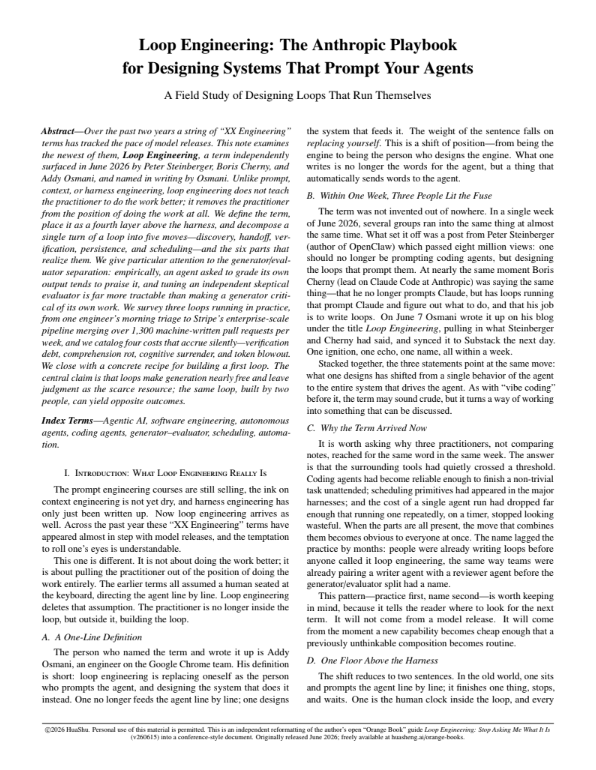
@rileywestreel shared (10 likes, 8 replies, 440 views, 10 bookmarks) a screenshot of the playbook's first page, confirming it attributes the term independently to Peter Steinberger, Boris Cherny, and Addy Osmani, all converging on the same idea within a single week in June 2026.
@4rblaber published (12 likes, 9 replies, 186 views, 9 bookmarks) a two-page architecture breakdown formalizing the five building blocks of a closed loop: (1) Trigger & Worktrees — isolates the execution environment; (2) Agent Harness (Skills) — operational guidelines injected as system prompt; (3) MCP Connectors — bridges to Sentry, Jira, CLI tools; (4) Persistent State — logs attempts and errors as GitHub Issue comments; (5) Parallel Sub-Agents — separates generation from evaluation. The Minimal Viable Loop (MVL) framework in the second image specifies a five-step cognitive cycle: Set Objective, Inject Context, Execute & Evaluate, Self-Reflect (pipe raw stderr back in, not speculative AI critique), Iterate or Terminate.

@_avichawla added (14 likes, 1 reply, 1,348 views, 15 bookmarks) the clearest explanation of what loop engineering actually automates: the outer loop — the human's involvement in reading agent output, writing the next prompt, and catching failures — is what is now being removed. The tradeoffs are explicit: taking yourself out of the loop means losing understanding even while keeping ownership, plus new requirements for stop conditions, context trimming, and independent verification.
Discussion insight: The highest-signal replies cut through the hype. @bojan_ai replied to cyrilXBT: "the 'with verification built in' part is the whole game. an agent loop without a verifier just compounds its own mistakes on a schedule." @ffflukeee added: "the repo gives you the anatomy, not the judgment. everyone can build the loop. almost nobody can tell it when to quit."
Comparison to prior day: June 25 brought loop architecture into the conversation as a design discipline. June 26 codified it with a named term, a repo exceeding 800 stars on launch day, an Anthropic-attributed playbook, and a clear tradeoff vocabulary.
1.2 The harness is the moat: structured context beats model selection (🡕)
A parallel theme treated the harness — not the model — as the primary competitive surface. Multiple high-engagement posts converged on the claim that model selection is a small fraction of outcomes, while the instructions, context, tools, observability, and verification wrapped around the model determine most results. At least four strong items supported this.
@businessbarista shared (140 likes, 14 replies, 24,643 views, 205 bookmarks) testimony from an engineering leader at Tenex Labs who described a complete operating model inversion: "Now we spend 95% of the time and effort planning and 5% executing." Tenex built custom tooling for structured engineering context that self-improves — giving agents instant access to product intent, architecture, conventions, delivery workflows, and plans — so "the system can almost assemble itself." The top reply from @dipankarsarkar named the mechanism precisely: "The moat moved. Not the agent. The structured context you feed it. Intent, conventions, plans. Once that substrate self-improves, the code is just a build output."
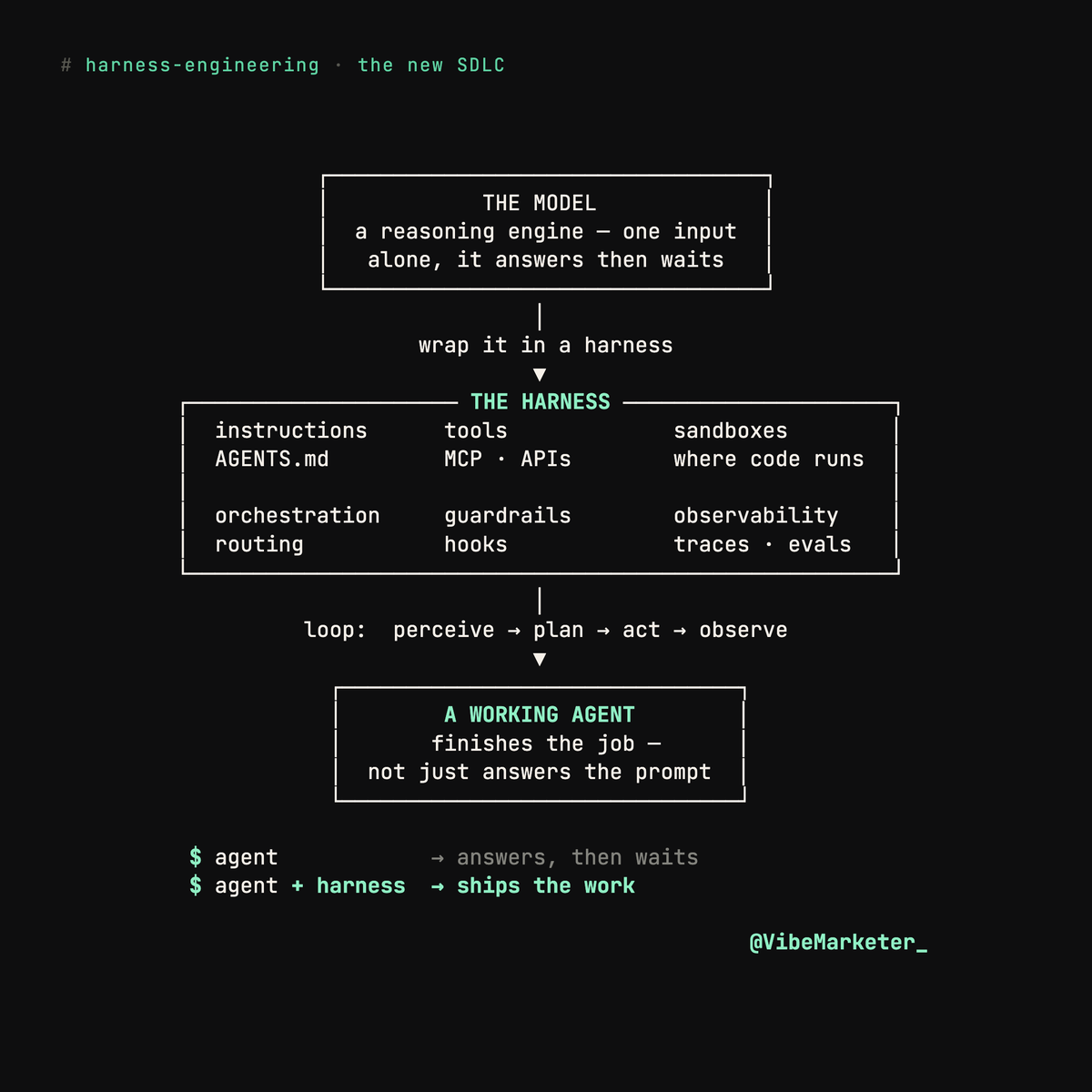
@VibeMarketer_ synthesized (39 likes, 11 replies, 2,702 views, 62 bookmarks) Google's 50-page agentic engineering playbook as: "the model is maybe 10% of your results. The other 90% is the harness." The attached diagram made the argument visual — model alone answers then waits; model wrapped in harness ships the work — with the harness defined as instructions, tools, sandboxes, orchestration, guardrails, observability, routing, hooks, and traces.
@omarsar0 clarified (105 likes, 18 retweets, 16 replies, 9,274 views, 148 bookmarks) that dynamic workflows — the frontier version of harness composition — apply to "a very small set of use cases," should be treated as test-time compute, require verifiers as a first-class component, and are a domain where "frontier models are not equipped for optimally generating harnesses on the fly." The attached image showed six Claude harness patterns recreated from Anthropic's dynamic workflows guide: Classify-and-Act, Fan-Out-and-Synthesize, Adversarial Verification, Generate-and-Filter, Tournament, and Loop Until Done.

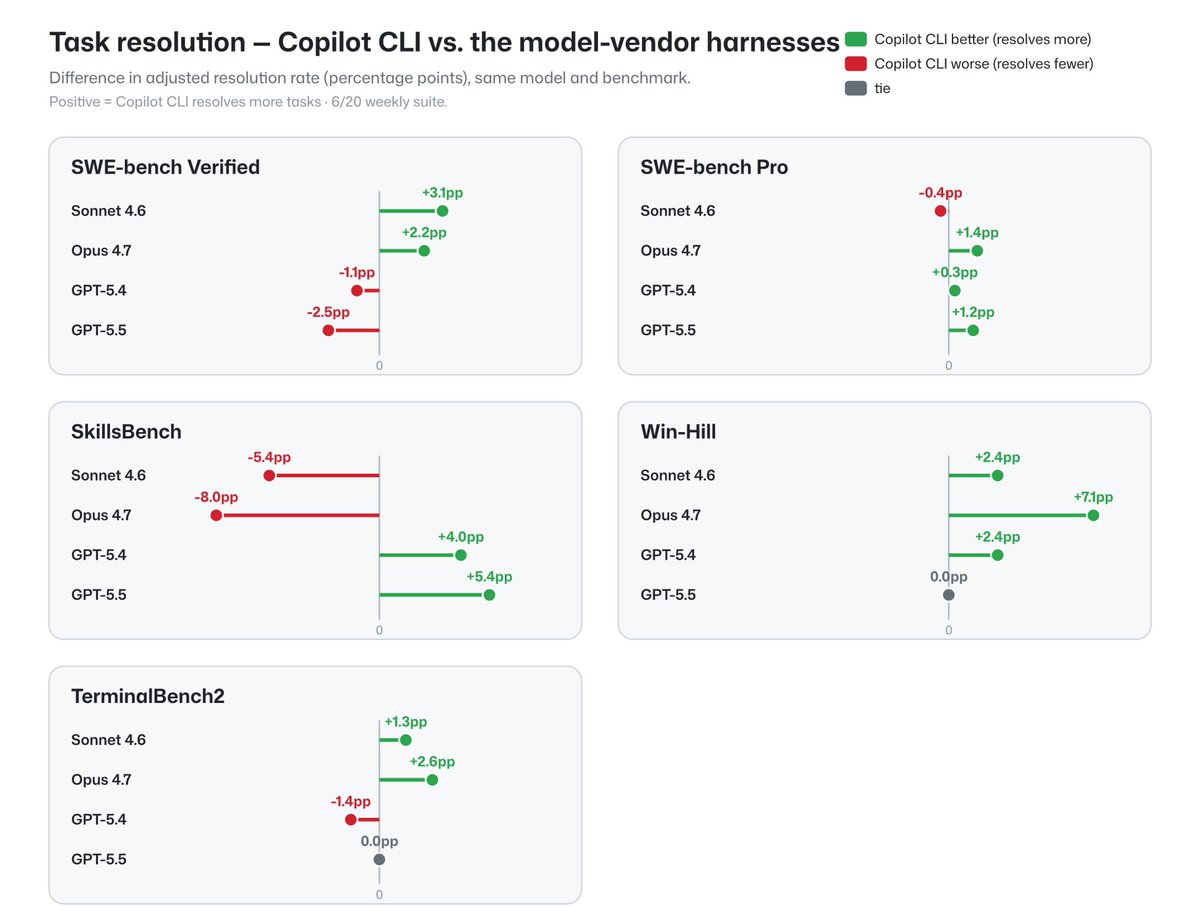
@pierceboggan published (56 likes, 5 replies, 3 quotes, 2,420 views, 16 bookmarks) the first public benchmark comparing GitHub Copilot's agentic harness against model-vendor harnesses. The chart showed harness advantage is model-dependent: Copilot CLI outperformed model-vendor harnesses on SWE-bench Verified with Claude models (+3.1pp for Sonnet 4.6, +2.2pp for Opus 4.7) but underperformed on SkillsBench (-5.4pp and -8.0pp respectively), while GPT-backed runs showed the reverse pattern. The data reinforced that harness and model interact rather than compose additively.
Discussion insight: The omarsar0 thread produced a useful exchange: one reply asked whether verifiers should be literal parts of the prompt or separate files, implying teams are now architecting verification as an explicit layer. Another noted that newer models like Mythos may eventually be better trained for orchestration harnesses than general frontier models.
Comparison to prior day: June 25 introduced harness vocabulary mainly through architecture guides. June 26 added quantitative benchmark evidence (Copilot data), a Google playbook synthesis, and a live practitioner account of the 95/5 planning-to-execution shift.
1.3 Memory OS: EverOS reaches 8.7k stars with a distinctive local-first design (🡕)
Memory infrastructure was the third major theme, anchored by two separate posts surfacing EverOS — a Python library and local-first memory runtime — on the same day. Both circulated enough to become the top memory conversation of the date.
@kate_osita_ described (125 likes, 51 retweets, 28 replies, 8,648 views, 73 bookmarks) EverOS as an open-source memory OS designed to help agents remember, reflect, and evolve over time, with a portable memory layer that works across different agent workflows. The features she highlighted — Knowledge Wiki, Reflection as Dreaming, Portable agent memory, Self-evolving skills — were the same ones the repo's README uses to distinguish it from conventional memory libraries.
@KylieHopkinsX provided (117 likes, 52 retweets, 28 replies, 10,983 views, 71 bookmarks) the technical details: Markdown as the source of truth, local SQLite + LanceDB retrieval, separate user and agent memory tracks, multimodal ingestion, and self-evolving skills. Her post linked to the GitHub repo at github.com/EverMind-AI/EverOS, which showed 8.7k stars and 776 forks at time of screenshot. The repo description: "Self-evolving memory across Agent and platform. The one portable memory layer for every agent they use — Claude Code, Codex, OpenClaw, Hermes, and more."


Discussion insight: The most useful reply came from @Timur_Yessenov: "Memory systems fail when the agent can only retrieve a blob but humans can't inspect or fix it. I'd test stale preference cleanup before multimodal ingestion." That tradeoff — human inspectability versus feature richness — framed the practitioner concern more sharply than the launch posts did.
Comparison to prior day: June 25 introduced memlawb as a zero-knowledge memory layer. June 26 brought EverOS with a broader local-first design that covers the full workflow — not just encryption but the complete storage, retrieval, and self-improvement cycle — and at 10x the star count.
1.4 Razorpay's Slash: one month at 5,000 tasks per day, planning model routing (🡕)
@shashank_kr posted (106 likes, 11 retweets, 12 replies, 17,732 views, 80 bookmarks) a one-month update on Slash, Razorpay's internal agent. At last count, Slash handles more than 5,000 tasks per day and continues growing rapidly. It generates code, reviews every PR, writes test cases, monitors production, supports incident reviews, and triages incoming bugs. Sales, marketing, and support teams also use it. The team's roadmap includes WhatsApp and email channels (not only Slack), model routing that automatically selects the right harness and model based on task complexity, and Slash continuously updating the organization's knowledge base with each interaction.
The original Slash launch post, quoted in the update, provided the detailed metrics: 14,854 tasks in one week, 2,150 PRs raised, 1,152 merged, 45% shipped with zero human rework, a $560/month K8s cost savings from one automated resizing run, and a marketing banner fix delivered by a non-developer through Slash with no front-end engineer involved. Engineers who shipped 11 or more Slash PRs averaged a 63% merge rate without rework versus 37% for first-timers.
Discussion insight: @killix raised the most substantive governance point: "5,000 tasks/day is already production traffic, not an experiment. The part I'd watch is not codegen quality, but which writes, deploys, refunds, or customer-facing actions can happen without a second actor in the loop."
Comparison to prior day: June 25 showed vertical domain agents with early beta metrics. June 26 showed one of the most concrete scale-up stories yet: organic cross-functional adoption, real cost savings, and a planning horizon that includes routing, channels, and memory.
1.5 Opaque multi-model orchestration burns quotas with no visibility (🡕)
@SaharaAI analyzed (33 likes, 7 retweets, 17 replies, 6,687 views) Sakana's Fugu model as a case study in orchestration opacity. Fugu is a coordinator (~7B parameter) trained to break tasks apart and route them to a pool of larger third-party models, then call itself recursively. The published benchmarks — 54.2 on SWE-Pro, 95.1 on GPQA-D, 93.2 on LiveCodeBench v6, above Opus, Gemini 3.1, and GPT 5.4 on each — are frontier-tier scores from a coordinator that size, strongly suggesting the underlying models do much of the work. Two users hit their usage limits unexpectedly: @LLMJunky reported one prompt consuming 100% of a five-hour quota; @cortesi paid for the $200 tier, found the API slow, and hit his limit in under an hour. The post also noted that when Anthropic briefly opened access to Fable, users reported similar quota burns.
@demian_ai mapped (74 likes, 8 retweets, 8 replies, 8,201 views, 49 bookmarks) how every agent step routes into hardware — CPU for orchestration, DRAM for context and state, SSD for logs and traces, networking for distributed jobs, sandbox for tool use, observability for telemetry — and argued that agentic workloads make "boring" infrastructure central in a way that GPU-focused narratives miss.

Discussion insight: @sooyoon_eth coined "ambient authority" as a name for the trust hazard: "the real complexity and risk is in the orchestration layer and tool sandboxing." @demian_ai responded: "ambient authority is a beautiful naming for it." The term captures the danger precisely — agents that can call tools across systems accumulate permissions no single call requested.
Comparison to prior day: June 25 discussed payment and data access layers as infrastructure. June 26 named the visibility and trust gap in multi-model systems as the next unsolved problem.
2. What Frustrates People
Agents cannot grade their own work, and most loops have no independent verifier
Severity: High. The loop engineering discourse surfaced a repeated pain point: self-grading agents produce systematically overconfident results. @DataChaz described (34 likes, 3,822 views, 33 bookmarks) the Anthropic playbook's explicit rule: "Never let agents self-grade." @rileywestreel summarized the catch: "an agent grading its own work always passes itself. Judgment is the scarce resource now — not generation." @4rblaber formalized this as the Generator-Critic Validation Pattern: a Builder Agent proposes a solution and an independent QA Agent — instructed to assume the code is broken — attempts to break it in a parallel loop. The two agents converse, critique, and refactor collaboratively. This constraint is missing from most loop implementations people ship in practice. The workaround is always adding a second model or a binary/deterministic test as the external verifier, but the engineering cost is real.
Context bloat degrades long-running loops, and there is no standard remedy
Severity: High. @_avichawla identified (14 likes, 1,348 views, 15 bookmarks) four compounding problems in outer-loop automation: the context grows every turn (the model gets worse as it fills), there is no standard approach to trimming it, moving large outputs to files and splitting subtasks into separate runs adds system complexity, and every turn resends the whole context, making long loops expensive. The standard workaround is manual context management — trimming, summarizing, routing — but no automated standard exists.
Multi-model orchestration burns usage quotas with no visibility into why
Severity: High. @SaharaAI documented two specific quota-exhaustion cases from Sakana's Fugu launch: one prompt at 100% of a five-hour quota, one $200-tier user at limit in under an hour. Neither could explain which models ran, how many recursive calls were made, or why a single prompt cost that much. The same pattern appeared when Anthropic opened Fable access. "You can't price what you can't predict, and you can't debug what you can't trace." This is worth building for because it affects production budget planning, not just hobby use.
Most companies are stalled at Layer 1 (task automation) and can't progress to workflow redesign
Severity: Medium. @mardehaym put numbers on the adoption gap (18 likes, 15 retweets, 543 views, 8 bookmarks): 88% of companies stop at Layer 1 (task automation, 20-30% time saved, zero structural change) and never reach Layer 2 (workflow redesign, where ROI compounds) or Layer 3 (agentic teams: 2-5 humans supervising 50-100 agents, where 6% of companies operate today).

3. What People Wish Existed
A standard outer loop that handles discover, verify, persist, and schedule automatically
The loop engineering discourse pointed to a concrete gap: the inner loop (model + tools) has always been automatic, but the outer loop — discovering work to do, isolating tasks into worktrees, verifying outputs with a separate agent, persisting state to disk, and re-triggering on a schedule — is still being assembled by hand, pattern by pattern. @hasantoxr published a repo with starter patterns, but multiple replies made clear that "the repo gives you the anatomy, not the judgment." What people want is a production-ready loop harness that bundles stop conditions, context management, verification gates, and scheduling into a package that works reliably in CI. Opportunity: direct.
Memory that persists across sessions, is locally inspectable, and evolves from experience
@kate_osita_ summarized the sentiment: "The next generation of AI products won't be defined by model size. They'll be defined by memory." EverOS's 8.7k stars and the reply threads around it showed strong appetite for memory that is locally stored, human-readable and editable as Markdown, structured with separate user and agent tracks, and capable of evolving skills from experience rather than just storing raw history. The key need articulated by @Timur_Yessenov was inspectability: "Memory systems fail when the agent can only retrieve a blob but humans can't inspect or fix it." Opportunity: direct.
Execution visibility for multi-model and orchestrated agent runs
@SaharaAI stated the need plainly: "execution visibility becomes core infrastructure." When one API call fans out into a swarm of sub-calls — each potentially spawning more — users lose the ability to forecast cost, attribute performance, or audit what ran. A tool that traces which models ran, how many times, what each call cost, and what the original prompt triggered would directly address the quota exhaustion and debugging problems from Fugu and Fable. @demian_ai pointed to the same need from an infrastructure angle: every agent step routes into hardware, and the teams that make those runs legible enough to trust will win the next infrastructure layer. Opportunity: direct.
Structured engineering context tooling that self-improves
@businessbarista reported that Tenex Labs built custom tooling for structured engineering context that gives agents instant access to product intent, architecture, conventions, delivery workflows, and plans — and the system self-improves over time. The top reply asked: "Are you versioning the context like you version code yet?" Nobody in the thread had a clean answer. Practitioners want a ready-made solution for maintaining, versioning, and surfacing structured engineering context in the same way they version source code. Opportunity: direct.
4. Tools and Methods in Use
| Tool | Category | Sentiment | Strengths | Limitations |
|---|---|---|---|---|
| Loop Engineering repo | Agentic loop framework | (+) | Concrete patterns for daily triage, CI sweeping, PR babysitting; CLI tooling for scaffolding and cost estimation | Provides anatomy, not judgment; stop conditions and verification must be added manually |
| EverOS | Agent memory / memory OS | (+) | 8.7k stars, local-first (Markdown + SQLite + LanceDB), self-evolving skills, human-inspectable, Apache-2.0 | Self-hosting responsibility; stale-preference cleanup and multimodal ingestion noted as areas to validate |
| Claude Code + dynamic workflows | Agentic coding harness | (+/-) | Six composable harness patterns; strong with Sonnet/Opus on SWE-bench | Dynamic workflows apply to a narrow set of use cases; frontier models not optimally trained for harness generation |
| GitHub Copilot agentic harness | Coding agent harness | (+/-) | Beats model-vendor harnesses on SWE-bench Verified for Claude models (+3.1pp Sonnet); strong on Win-Hill | Underperforms on SkillsBench for Claude models (-5.4pp Sonnet); performance is model-and-benchmark-specific |
| Hermes Atlas | Resource hub / agent ecosystem | (+) | Free guide library, skills, memory tools, plugins, extensions; high bookmark rate (67/4,977 views) | Community-curated; no official maintenance signal |
| Sakana Fugu | Multi-model orchestrator | (+/-) | Frontier-tier benchmarks from ~7B coordinator (54.2 SWE-Pro, 95.1 GPQA-D); single API | Opaque execution; users burned $200+ quotas in under an hour with no visibility into sub-calls |
| Ampersend Marketplace | Agentic commerce / API payments | (+) | Live marketplace with pay-per-use services, no subscriptions or per-provider billing; Exa, Laso Finance, BlockRun.AI listed | Early marketplace; service catalog depth depends on provider participation |
| n8n + Claude + MCP | Personal automation stack | (+) | Connects GTM stack and automations through one channel; MCP integration enables native tool access | Requires configuration discipline; practitioners note they stay cautious about automating everything |
The overall pattern on June 26 was a shift from evaluating which model to pick toward evaluating which loop architecture and memory stack to build on. Tool discussion centered on system-level questions: how to compose verification into the loop, how to make memory human-inspectable, and how to make multi-model runs traceable. Claude-family models dominated concrete tool mentions; Codex, Cursor, and Grok appeared as alternatives in the loop engineering context.
One migration pattern emerged clearly: developers who previously approached AI coding as "prompt, wait, copy, fix, repeat" are transitioning toward loop-designed systems where they operate outside the loop rather than inside it.
5. What People Are Building
| Project | Who built it | What it does | Problem it solves | Stack | Stage | Links |
|---|---|---|---|---|---|---|
| Loop Engineering repo | Addy Osmani et al. | Framework of patterns and CLIs for designing systems that prompt agents automatically | Removes humans from the inner feedback cycle of agent coding work | Node.js/npm, Claude Code/Codex/Cursor/Grok compatible, GitHub Actions | Shipped | tweet, GitHub |
| EverOS | EverMind-AI | Local-first memory OS for agents with self-evolving skills | Agents forget context across sessions and lack a portable, inspectable memory layer | Python 3.12+, Markdown, SQLite, LanceDB, Apache-2.0 | Shipped | tweet, GitHub |
| Slash (Razorpay) | @shashank_kr + Razorpay engineering | Internal agent that generates code, reviews PRs, triages bugs, supports 5,000 tasks/day across engineering and business teams | Manual engineering coordination, cross-team knowledge bottlenecks | Claude, Slack, GitHub, Linear, K8s; expanding to WhatsApp/email | Shipped | tweet |
| Cohere vLLM-skills | Cohere AI | Open-source agent skills for maintaining a long-lived vLLM fork | Fork-sync work (weeks of effort) compressed to days via an automated rebase/test/fix control loop | vLLM, Cohere models, open-source skills library | Shipped | tweet, GitHub |
| Guardian CLI | @VivekIntel | AI-powered penetration testing framework with 50+ security tools, multi-agent workflows, RAG-powered analysis | Autonomous security auditing across reconnaissance, vulnerability assessment, evidence collection, and reporting | Python 3.11+, OpenAI/Claude/Gemini/OpenRouter/Ollama, Nmap, Nuclei, SQLMap, Semgrep, BloodHound, MIT | Shipped | tweet, [GitHub link in tweet] |
| Ampersend Marketplace | @ampersend_ai | Pay-per-use API marketplace for agents — no subscriptions, no per-provider billing | Agents need to browse and pay for external API services without manual credential management | AgentCore Payments, x402, agent-native wallet, 9+ service categories live | Shipped | tweet |
| Cantina Apex | @chrispyprojects | Autonomous AI bug hunter for Web3 security audits | $500K+ traditional audits take months; AI delivers comparable results in days for thousands | Multi-provider LLM, agentic loop, harness-scaled compute | Shipped | tweet |
Loop Engineering and EverOS are the two highest-signal open-source releases on this date. Loop Engineering provides the outer-loop automation framework the community has been assembling piecemeal; EverOS provides the memory substrate that makes loops stateful across runs.
Cohere's vLLM-skills release is notable for a different reason: it demonstrates that loop engineering applied to DevOps maintenance — specifically fork synchronization — delivers measurable time compression (weeks to days) and produces artifacts (the skills themselves) that go back upstream as shared infrastructure.
Cantina Apex's security auditing data is the strongest published ROI claim in the dataset: log-linear valid-bug scaling with compute, saturation detection, indeterminism removed at scale, and 1/100th to 1/1000th the cost of expert-led audits with equivalent or better performance on benchmarks.
A repeated pattern across Slash, vLLM-skills, and Loop Engineering: the most compelling builder stories are not product launches but control loops applied to specific, bounded operational problems — PR review, fork maintenance, CI sweeping — where the outcome is measurable and the loop terminates on a real condition.
6. New and Notable
Loop engineering reached vocabulary convergence across Anthropic, Google Chrome, and the open-source community
Three independent practitioners — Peter Steinberger, Boris Cherny (Claude Code lead at Anthropic), and Addy Osmani (Google Chrome) — converged on the term "loop engineering" independently within one week in June 2026, according to the playbook's own abstract. That convergence is unusual: when practitioners at different companies name the same shift without coordination, it typically means the underlying practice has already been adopted widely enough to be legible. The Loop Engineering repo reached over 800 stars on its launch day, and the Anthropic playbook circulated across at least six threads with engagement from practitioners at LangChain, Razorpay, and independent builders. @rileywestreel noted (10 likes, 440 views, 10 bookmarks) that "judgment is the scarce resource now — not generation."
AI Engineer World Fair scheduled a dedicated "harness engineering" track at LangChain
@Vtrivedy10 announced (47 likes, 6 replies, 5,120 views, 16 bookmarks) a session at the AI Engineer World Fair (July 1, 2026) titled "Improving Agents is a Data Mining Problem," framing the next frontier after loop engineering as trace mining and continual learning. The session card confirms Harness Engineering as an official conference track and positions trace data as the lifeblood of agent improvement: "every continual learning platform ends up looking like an observability platform."

Razorpay's 95/5 planning-to-execution ratio went viral as the enterprise calibration signal
@businessbarista shared (140 likes, 24,643 views, 205 bookmarks) a specific operating model metric that resonated beyond the engineering community: 95% of time on planning, 5% on execution. That ratio stands in contrast to the traditional agentic framing of "just tell the agent what to do," and it implies that the critical engineering investment is not in the model or the loop but in the structured context system that feeds both.
7. Where the Opportunities Are
[+++] Production-ready outer loop tooling with verification and scheduling built in — Evidence from sections 1, 2, 3, and 5: the Loop Engineering repo provides patterns, but every practitioner thread identified the same missing pieces — reliable stop conditions, external verification gates, context trimming, and scheduling that works in production CI. The fact that Anthropic, Google, and an independent community builder all converged on the same term in the same week confirms that demand is real and adoption is early. The opportunity is to package the anatomy into a deployable harness that handles the tradeoffs _avichawla enumerated.
[+++] Agent memory infrastructure that is local-first, inspectable, and self-evolving — Evidence from sections 1, 3, and 5: EverOS reached 8.7k stars by making memory human-readable (Markdown), locally runnable (no managed services), and structured for evolving agent behavior over time. The gap identified by Timur_Yessenov — inspectability before feature richness — is an unsolved design constraint. Memory infrastructure that addresses the whole lifecycle (store, retrieve, expire, update, surface as skill) and works portably across Claude Code, Hermes, Codex, and OpenClaw has a large addressable surface.
[++] Execution visibility and tracing for multi-model orchestration — Evidence from sections 1, 2, and 3: Fugu's quota exhaustion stories are an early signal of a systematic problem. When one API call fans out into a recursive swarm, users cannot budget, debug, or prove what ran. The next infrastructure competition will be won by the teams that make complex agentic runs legible. Existing observability tools were not built for recursive multi-model fan-out, and the LangChain trace-mining framing (section 6) points toward the same gap from the agent improvement side.
[++] Agentic workflow redesign for enterprises stuck at Layer 1 — Evidence from sections 1 and 2: mardehaym's four-layer model with hard statistics (88% at Layer 1, 6% at Layer 3, <1% at Layer 4) describes both the distribution of current enterprise adoption and the value gap at Layer 2 (workflow redesign). The Razorpay Slash case study shows what Layer 3 looks like at production scale. Consulting services, tooling, or harness products that help companies move from Layer 1 to Layer 2 represent a large, currently underserved transition.
[+] Autonomous security auditing at sub-$10K cost — Evidence from section 5: Cantina Apex's published data — $500K+ audits replaced at 1/100th to 1/1000th the cost, log-linear bug-finding with compute, indeterminism removed at scale — is the clearest published ROI evidence for agentic automation in any domain on this date. The emerging concern that "hiring a researcher may mean hiring their custom-built harness" points toward a market that will converge on harness quality rather than researcher headcount.
8. Takeaways
-
Loop engineering crystallized as a named practice with community-wide vocabulary adoption in a single week. Three independent practitioners at Anthropic, Google, and the open-source community converged on the term simultaneously, and the supporting repo exceeded 800 stars on its launch day. The shift it describes — from prompting agents to designing systems that prompt agents — is the same shift that businessbarista, VibeMarketer_, and mardehaym each described independently on the same date. (source)
-
The harness is now a competitive surface, not a configuration detail. The Tenex Labs 95/5 planning-to-execution split, the Google playbook's "model is 10%" framing, and the GitHub Copilot benchmark data all point to the same conclusion: harness engineering determines most of the outcome variability in production agent systems, and harnesses that include structured context, independent verification, and observability outperform those that do not. (source)
-
EverOS's 8.7k stars confirmed that local-first, human-inspectable memory is a distinct and valued product category. The architecture details — Markdown as source of truth, local SQLite + LanceDB, separate user and agent tracks, self-evolving skills — address the memory tradeoffs that vendor-hosted solutions do not, and the star count indicates the demand is not theoretical. (source)
-
Sakana Fugu's quota exhaustion stories named "ambient authority" as the trust problem in multi-model orchestration. When a coordinator routes to multiple models recursively, users lose the ability to forecast cost or prove what ran. Production teams need execution visibility before they can trust orchestrated agents with real workflows. (source)
-
Razorpay's Slash at 5,000 tasks per day, one month in, is the clearest published evidence of what agentic Layer 3 adoption looks like in practice. The 63%-vs-37% merge rate for experienced Slash users, the 45% zero-rework PRs, and the planned model routing roadmap show a system that compounds in quality with use rather than plateauing. (source)