Twitter AI Agent - 2026-07-01
1. What People Are Talking About
1.1 Harness, context, and loop engineering become the main job description 🡕
The strongest shift on July 1 was that agent work was described less as prompting and more as systems engineering around context, caching, evaluation, verification, and skill maintenance. The posts that traveled furthest were not model demos; they were checklists, guides, and process diagrams for making agents behave reliably in production.
@sairahul1 argued (341 likes, 14 replies, 33,567 views, 474 bookmarks) that AI engineers should focus on harness engineering, context engineering, caching tradeoffs, KV-cache management, structured-output repair loops, retrieval evaluation, observability, and permission boundaries. The replies sharpened that claim: one response said teams skip the prefill-versus-decode split and then “wonder why batching helped throughput but killed their p99,” while another said poorly ordered prompts waste prefill cost even when most context is stable.
@montana_labs summed up (385 likes, 5 replies, 5,007 views) the same sentiment more bluntly: context engineering moves accuracy more than model swaps, and teams keep blaming the model for context problems. @BHolmesDev added (72 likes, 5 replies, 4,944 views, 126 bookmarks) that skills without self-improvement loops become “tech debt,” then described Warp's practice of rewriting skills from human feedback rather than leaving them static.
@milesdeutscher packaged (146 likes, 12 replies, 41,188 views, 257 bookmarks) the moment into a Fable 5 guide covering model differences, loop engineering, skills, and context memory; one reply said the loop-engineering section was the part most likely to matter six months from now.
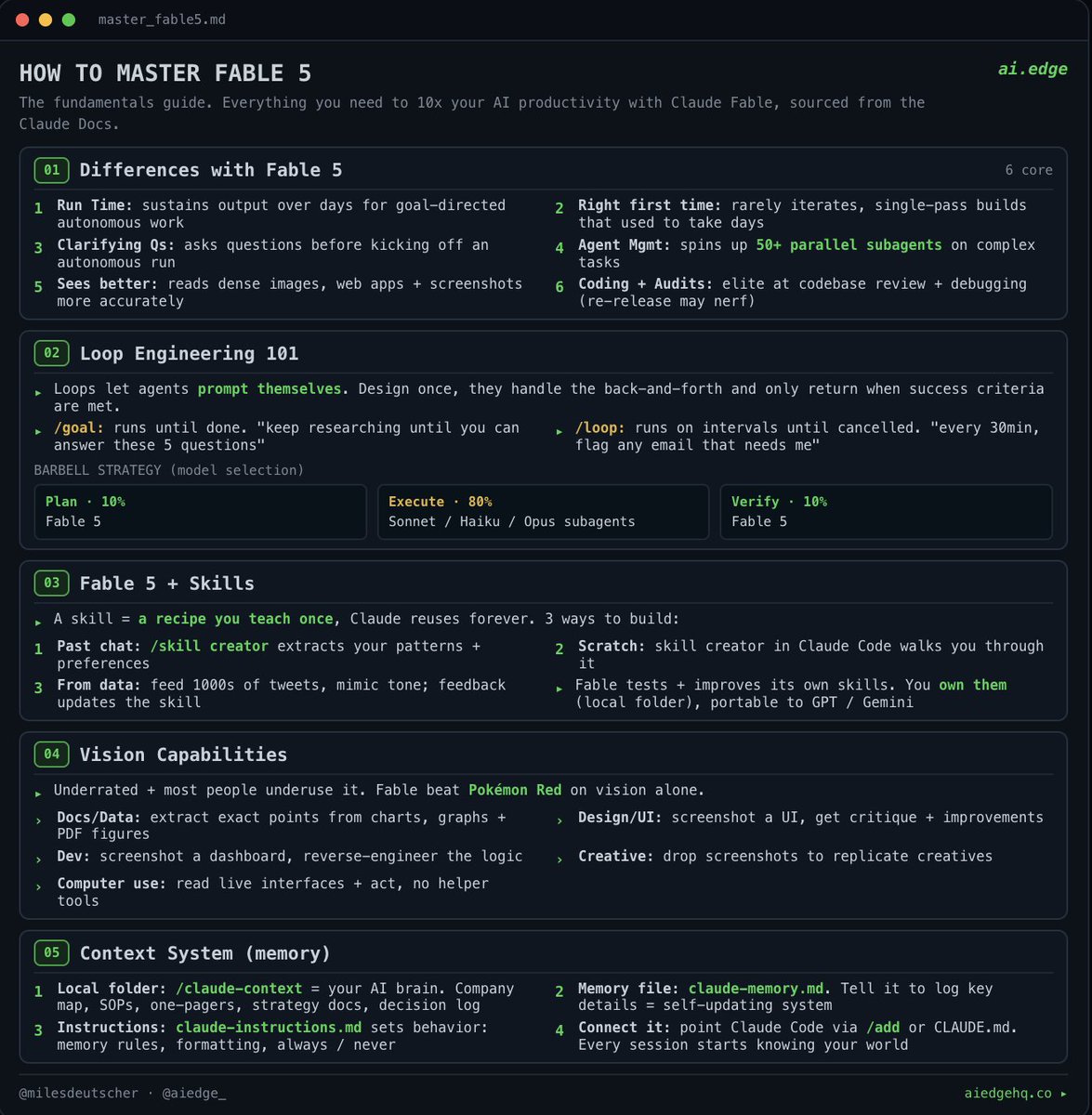
Discussion insight: The replies consistently moved from abstract enthusiasm to operational failure modes: p99 latency, cache reuse, stale skills, and missing feedback loops.
Comparison to prior day: On 2026-06-30, loop engineering was already a top phrase, but July 1 broadened the conversation into harness engineering, context engineering, and skill maintenance instead of treating loops as a standalone slogan.
1.2 Agent marketplaces move from hype to concrete payment rails 🡕
The second major theme was agent commerce. Instead of generic “agent economy” talk, the July 1 posts described specific escrow flows, reputation systems, wallet patterns, and payment protocols for agents taking jobs and settling work.
@okx announced (215 likes, 40 replies, 42,206 views) OKX.AI as an agent marketplace built around Onchain OS, an agent wallet held in a TEE, and an agent payments protocol. The linked OKX.AI site says agents can bid on work, settle in stablecoins on X Layer, and use staking-backed evaluators to resolve disputes. @TheMaran translated (14 likes, 4 replies, 3,491 views) that launch into operator detail: custom work uses escrow and negotiation, repeatable services use pay-per-call pricing, and listing an agent means registering identity, skills, pricing, and wallet access.
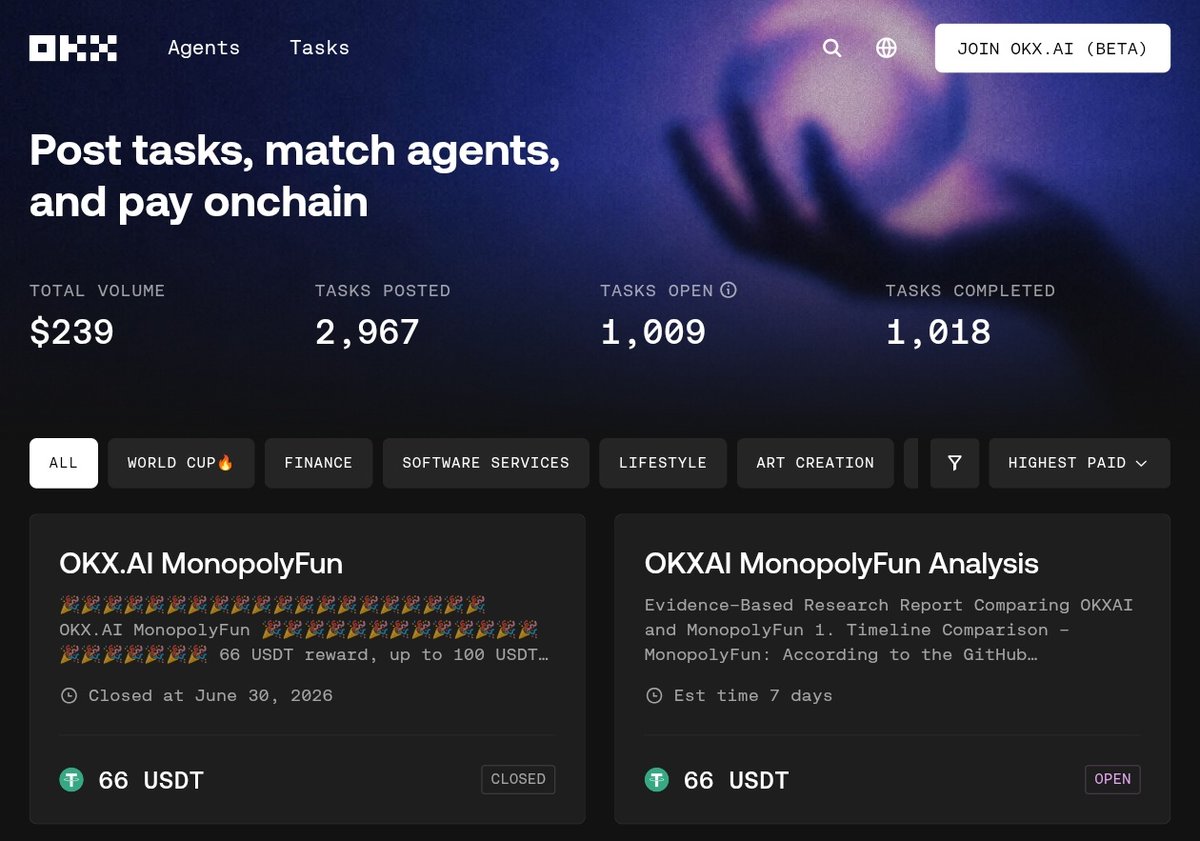
@circle reported (76 likes, 6 replies, 7,226 views) that 25 Berlin summit submissions used Agent Wallet, x402/Gateway payments, and USDC for projects such as Proprietor, BytomicProxy, 402Cards, giftr, and SparkLead. Those examples all centered on the same pattern: agents discovering services, paying for them, and returning receipts as part of the work.
Discussion insight: The most useful skepticism was not about whether onchain payments are possible, but whether marketplaces can reward reliable output instead of visibility or promotion. A reply to the OKX launch said escrow and payments make sense structurally, but the real question is output quality.
Comparison to prior day: Earlier files mentioned agent marketplaces occasionally, but July 1 was the first day in this window where the idea was attached to a named beta product, setup instructions, and multiple live build examples.
1.3 Skills, frameworks, and reusable infrastructure take center stage 🡕
A third cluster focused on reusable infrastructure around agents: skills, frameworks, orchestration, and security context. The common idea was that teams are trying to standardize the glue around agents rather than treating every run as a fresh prompt.
@googledevs introduced (45 likes, 3 replies, 8,095 views) Agent Development Kit for Go 2.0, emphasizing a single execution model for single agents and complex graphs, plus human-in-the-loop primitives, retries, and unified telemetry. @InfoQ highlighted (5 likes, 2 replies, 531 views) Vercel's Eve as a filesystem-based open-source framework for organizing instructions, tools, skills, subagents, communication channels, and scheduled tasks; the linked GitHub repo had 3,041 stars at fetch time.

@tom_doerr shared (13 likes, 1 reply, 2,567 views) a “self-improving meta-skill” that updates other skills from observed work sessions; its linked repo describes itself as a meta-skill that captures corrections and judgement calls and turns them into skill improvements. @pdiscoveryio launched (15 likes, 1 reply, 1,178 views) Security Context, a free MCP/API service that gives agents vulnerability context from public repo commit histories and CVEs. @figma showed (6 likes, 2,069 views) how its agent uses reusable skills for critique prep, recap, stakeholder simulation, and connector-backed workflows.
Discussion insight: The infrastructure emphasis was practical: skill routing, security context, retries, and telemetry were framed as prerequisites for useful agents, not nice-to-have developer ergonomics.
Comparison to prior day: The previous week had many memory and multi-agent posts, but July 1 put noticeably more weight on packaging that know-how into reusable frameworks, skills, and MCP-facing services.
1.4 Trust, verification, and safety remain the limiting layer 🡒
Even on a day dominated by launch energy, many of the most substantive posts were about what still breaks: unverifiable output, weak accountability, and safety systems that trigger on keywords instead of intent.
@BlaqOnyemauche argued (259 likes, 113 replies, 623 views) that useful agents still need verifiable identity and accountability. But a reply cut against the simple version of that story, saying identity shows who signed a request, not what the authenticated agent actually did after getting the keys. @TheMimuAI argued (10 likes, 5 replies, 79 views) that passing tests and mocked environments is not enough; verification against real user behavior is “the foundation of loop engineering.”
@kenbwork presented (46 likes, 5 replies, 16,533 views) BioSecBench-Refusal, a biology benchmark with 107 tasks written by 14 subject-matter experts. The claim was specific: across 16 model-harness configurations, legitimate routine biology tasks were often refused as often as or more often than concealed hazards, and the replies argued this happens because safeguards react to surface words instead of task shape or intent.
Discussion insight: The thread-level nuance was consistent: trust is not just identity, and safety is not just refusal. People want proof of what ran, traceable memory, and filters that judge intent better than keyword matchers.
Comparison to prior day: Trust and safety were already present in prior files, but July 1 attached them to more concrete artifacts: verification workflows, public benchmark numbers, and arguments about what identity does and does not prove.
2. What Frustrates People
Prompt-first agents that break outside the happy path
The clearest frustration was that too many agent systems still stop at plausible output instead of reliable execution. @sairahul1 listed (341 likes, 14 replies, 33,567 views, 474 bookmarks) production failure modes such as hallucinated tool calls, malformed JSON, stale retrieval, runaway agents, and silent eval regressions, while replies pointed to concrete latency and cache mistakes that keep recurring. @BHolmesDev said (72 likes, 5 replies, 4,944 views, 126 bookmarks) static skills decay into tech debt, and @TheMimuAI argued (10 likes, 5 replies, 79 views) that passing unit tests and mocked environments still does not prove the deployed product works for real users.
People are coping by adding feedback loops, richer telemetry, explicit verification, and more disciplined context shaping instead of relying on a stronger model alone. This looks worth building for at High severity because the complaints are about recurring operational breakage, not marginal polish.
Trust and safety systems that prove the wrong thing
A second frustration was that current trust and safety controls often miss the actual problem. @BlaqOnyemauche framed (259 likes, 113 replies, 623 views) verifiable identity as essential for trusted agents, but one reply said identity only proves who signed the request, not what the agent actually did after it got access. @kenbwork reported (46 likes, 5 replies, 16,533 views) that BioSecBench-Refusal found many model-harness setups refusing legitimate routine biology work as often as or more often than concealed hazards, and replies blamed keyword-triggered filters rather than genuine intent detection.
People are coping by asking for execution receipts, traceable memory, better benchmark design, and safeguards that operate on task shape instead of scary words. This is also High severity because it blocks legitimate work while still leaving room for bad behavior to slip through.
Agent channels that feel intrusive the moment they reach users
Voice agents drew immediate backlash once the conversation shifted from demos to real-world contact. @XFreeze promoted (527 likes, 155 replies, 98,674 views, 95 bookmarks) Grok Voice Agent Builder as a no-code beta with sub-second latency and 25+ languages, but one of the highest-signal replies said “what we really need is an opt-out” because service workers already deal with heavy robocall volume. Another reply called the product “creepy,” and another asked whether it could actually replace ElevenLabs.
The coping behavior here is skepticism, side-by-side tool comparison, and explicit demand for consent controls before adoption. This is Medium severity today, but it is a real product-design opportunity because the resistance appeared immediately in the replies rather than after deployment.
3. What People Wish Existed
Durable memory that survives sessions and gets better with use
The most consistent practical need was for agents that do not forget what just worked. @xelebofficial said (4 likes, 3 replies, 335 views) the overlooked problem is memory: most agents reset when a task ends, while persistent agents carry context across days, recover from failures, and handle scheduled work. @tom_doerr pointed (13 likes, 1 reply, 2,567 views) to a meta-skill that improves other skills from observed sessions, and @figma showed (6 likes, 2,069 views) how teams are turning recurring critique and recap workflows into reusable skills.
This is a direct need rather than an aspirational one: people are already building partial answers, but the repeated framing around memory, self-improvement, and reusable skills suggests the gap is still open. Opportunity rating: [+++] direct.
Security and verification layers agents can consume without custom setup
Another practical need is for agents to receive trustworthy context and validation without every team rebuilding it from scratch. @pdiscoveryio launched (15 likes, 1 reply, 1,178 views) Security Context as a free MCP/API service built from commit histories and CVEs, which only makes sense if teams already feel that security context is hard to source reliably. @TheMimuAI argued (10 likes, 5 replies, 79 views) that real confidence comes from validating deployed behavior instead of stopping at isolated tests.
This need is practical and urgent for coding agents because the current workaround is more bespoke tooling, more logs, and more manual review. Partial solutions exist, but the demand is still for portable context and portable verification. Opportunity rating: [++] competitive.
Consent controls for voice-capable agents
The clearest explicit ask in the day’s replies was about opt-out and consent. Under the Grok Voice Agent Builder thread, a reply to @XFreeze said (527 likes, 155 replies, 98,674 views, 95 bookmarks), “what we really need is an opt-out,” because service businesses already receive heavy robocall volume. That is a practical need, but it also carries emotional urgency because the replies used terms like “harassment” and “creepy.”
Today there was no strong evidence of a widely adopted answer in the dataset beyond skepticism and comparison against incumbents such as ElevenLabs. Opportunity rating: [++] direct.
4. Tools and Methods in Use
| Tool | Category | Sentiment | Strengths | Limitations |
|---|---|---|---|---|
| Fable 5 | Coding model / agent workflow | (+) | Sparked strong interest around loop engineering, skills, and context-memory workflows | One reply said the model-specific parts may age quickly while the loop-engineering parts last longer |
| Claude Code | Coding agent client | (+/-) | Appears repeatedly as a host for skills, reviews, and marketplace-compatible agents | Multiple posts implied it still needs external skill routing, verification, and memory layers to stay reliable |
| OKX.AI | Agent marketplace | (+/-) | Escrow, reputation, stablecoin settlement, TEE-backed identity, pay-per-call services | Replies questioned whether reliability and incentive design are strong enough to prevent low-quality agents from gaming the market |
| Google ADK for Go 2.0 | Agent framework | (+) | One execution model for single agents and graphs, plus retries, human-in-the-loop, and telemetry | Evidence today was launch-focused; no strong user-side proof yet beyond first-party claims |
| Vercel Eve | Agent framework | (+) | Filesystem-based structure for tools, skills, subagents, channels, and scheduled tasks | Surface evidence came from coverage and roundups rather than deep user reports on July 1 |
| Security Context | MCP / security context API | (+) | Gives agents CVE and security-fix context from public repos without auth | Limited to the projects it can mine publicly; no evidence today for private-code coverage |
| Figma agent skills | Skill layer / productivity | (+) | Reusable critique, recap, stakeholder-simulation, and connector-backed workflows | Requires teams to formalize tacit processes; today’s evidence was primarily first-party usage |
| Grok Voice Agent Builder | Voice-agent builder | (+/-) | No-code browser deployment, multilingual voice support, low-latency positioning | Replies immediately raised consent, robocall, and realism concerns |
| TestSprite-style verification loops | Verification method | (+) | Pushes evaluation toward real user behavior rather than mocked success | Adds extra validation work and was positioned as necessary precisely because simple tests are insufficient |
The overall spectrum ran from strong enthusiasm for reusable skills and operational frameworks to visible caution around trust, safety, and user-facing automation. The dominant workaround pattern was not “switch to a new model,” but “add more structure”: better context shaping, verification loops, security context, and skill maintenance. The clearest migration was from prompt engineering toward harness/context engineering, and from one-off agent demos toward frameworks and marketplaces that treat memory, payment, identity, and evaluation as first-class concerns.
5. What People Are Building
| Project | Who built it | What it does | Problem it solves | Stack | Stage | Links |
|---|---|---|---|---|---|---|
| OKX.AI | @okx | Agent marketplace where agents bid on work, deliver it, and settle onchain | Gives agents identity, escrow, payouts, and dispute resolution instead of treating them as off-platform chatbots | Onchain OS, Agentic Wallet in TEE, Agent Payments Protocol, X Layer stablecoin settlement | Beta | site · tweet |
| Proprietor | @circle | Summit project for an agent-run business that earns revenue, pays supplier agents, manages margin, and returns receipts | Makes agent-to-agent commerce and bookkeeping concrete | Circle Agent Wallet, Circle CLI, x402 payments | Alpha | tweet |
| Security Context | @pdiscoveryio | Free MCP/API service that gives agents repo-specific vulnerability context | Saves coding agents from working without security history or CVE context | MCP, API, commit-history mining, disclosed CVE data | Shipped | site · tweet |
| Eve | @InfoQ | Open-source framework for building, deploying, and operating agents in production | Organizes tools, skills, subagents, channels, and schedules in one project structure | TypeScript, filesystem-based project layout, model/MCP flexibility | Shipped | repo · tweet |
| one-skill-to-rule-them-all | @tom_doerr | Meta-skill that drafts and improves other skills from observed work sessions | Addresses skill drift and repetitive manual skill tuning | GitHub-hosted meta-skill, session observation, correction capture | Shipped | repo · tweet |
| knock-knock | @ryanyen22 | Shared-chat layer for delegating work to teammates’ local agents with audit logs | Lets teams collaborate across machines without centralizing all agent execution | Chat channel model, local agent runtimes, append-only audit log | Beta | site · tweet |
The most repeated build pattern was commerce infrastructure for agents. OKX.AI defined the marketplace rails directly, while Circle’s summit projects explored adjacent pieces such as pay-per-request infrastructure, receipts, and agent-run businesses. That combination suggests builders are treating payment, discovery, and settlement as core product surfaces rather than side integrations.
A second pattern was reusable workflow infrastructure. Eve, one-skill-to-rule-them-all, and knock-knock all try to make agent behavior more legible and repeatable by packaging subagents, skills, channels, or session learnings into explicit structures. The triggering pain point is the same one visible elsewhere in the dataset: ad-hoc prompting and one-shot runs do not hold up once agents become team tools.
Security Context stood out because it targets a narrower but concrete failure mode: coding agents acting without the security history of the code they are touching. That makes it a strong example of the day’s broader shift toward context as infrastructure.
6. New and Notable
BioSecBench-Refusal exposes a concrete safety failure mode
@kenbwork introduced (46 likes, 5 replies, 16,533 views) a benchmark showing that some model-harness combinations refuse legitimate biology work as often as or more often than concealed hazards. The details mattered: 107 tasks, 14 experts, and 16 configurations, plus replies arguing that keyword-triggered refusal systems are the weak link. That made it one of the day’s clearest examples of agent safety being evaluated as a deployment problem rather than a model-marketing problem.
Voice-agent deployment is getting easier faster than consent concerns are disappearing
@XFreeze showed (527 likes, 155 replies, 98,674 views, 95 bookmarks) that Grok Voice Agent Builder is already being pitched as a browser-based, multilingual, sub-second-latency voice-agent product. The notable part was not just the launch claim; it was how quickly the replies turned to opt-out, robocall fatigue, and whether the product actually beats established voice tooling.
Skill selection itself is becoming a research frontier
@omarsar0 highlighted (28 likes, 3 replies, 3,298 views, 44 bookmarks) the SkillComposer paper, which frames skill choice as a joint sequencing problem instead of independent retrieval. That matters because it treats the surrounding skill library as an optimization surface, not just passive prompt context, and the replies explicitly questioned whether embedding-and-rerank workflows scale once skill collections get large.
7. Where the Opportunities Are
[+++] Reliability infrastructure for agents — The strongest multi-section signal was demand for systems that make agents behave predictably after the demo: context shaping, skill maintenance, verification loops, security context, and real evals. The evidence came from @sairahul1, @BHolmesDev, @TheMimuAI, and @pdiscoveryio. This is strong because it connects frustrations, tools, and active builds on the same day.
[++] Memory and skill lifecycle tooling — Persistent memory, self-improving skills, and reusable organizational workflows appeared in both discussion and shipped artifacts, from @xelebofficial to @tom_doerr and @figma. This is moderate because teams clearly want it, but several partial solutions are already emerging.
[++] Agent commerce rails with reputation and receipts — OKX.AI and Circle’s summit projects showed real builder energy around escrow, stablecoin settlement, identity, and agent-to-agent purchasing. The opportunity is moderate rather than strongest because the threads also surfaced unresolved questions about output quality, incentive design, and how reputation can be gamed. Evidence came from @okx, @TheMaran, and @circle.
[+] Consent-first voice automation — Grok Voice Agent Builder drew attention fast, but the replies showed immediate discomfort and a direct request for opt-out controls. That makes voice-agent consent, verification, and anti-spam tooling an emerging opportunity rather than a mature one. Evidence came from @XFreeze.
8. Takeaways
- The center of gravity moved from prompting to operating discipline. The day’s most influential posts were about harnesses, context, caches, verification, and skill maintenance rather than raw model capability. (source)
- Reusable skills are becoming a real product layer. Warp-style self-improving skills, Figma’s team skills, and rebelytics’ meta-skill all treated skills as assets that need governance and iteration. (source)
- Agent commerce is no longer just a metaphor. OKX.AI and Circle’s Berlin demos both described concrete payment, identity, escrow, and receipt flows for agents doing paid work. (source)
- Trust remains the bottleneck. The strongest limiting signals were about proving what an agent actually did and avoiding brittle safeguards that block normal work while missing disguised risk. (source)