Twitter AI Agent - 2026-07-07
1. What People Are Talking About
1.1 Harnesses became the main object of optimization 🡕
The biggest theme was not prompt wording but the runtime around the model: workflow shape, durable artifacts, evaluators, stop conditions, and even harnesses that improve future harnesses. Compared with the prior week of loop-engineering explainers, the July 7 discussion spent more time on what the agent should remember, how it should verify, and where the control logic should live.
@lilianweng argued (2,689 likes, 54 replies, 181,202 views, 3,145 bookmarks) that harness engineering is the near-term path for agent self-improvement, then used the linked essay to define a harness as the system that handles planning, tool use, context, file storage, and evaluation around a base model. The essay's concrete patterns mattered more than the slogan: workflow automation, file systems as persistent memory, and sub-agents plus backend jobs all show up as reusable design primitives. The replies immediately turned to failure modes, with one reader warning that a loop is only as good as the eval it optimizes against and another asking how an auto-research loop avoids compounding its own mistakes.
@gregisenberg framed (350 likes, 47 replies, 16,118 views, 204 bookmarks) the same shift in product language, calling the harness the new OS, hallucinations the new bugs, permissions the new firewall, and trust the new bottleneck. That post mattered because the replies sharpened the operational reading instead of just cheering it on: one reply called context overflow the new silent crash, and another said durable memory is the real persistence layer. The result was less “agents can do anything” hype and more focus on the software layers that keep an agent from failing invisibly.
@VaibhavSisinty summarized (10 likes, 2,584 views, 16 bookmarks) the practical side in plainer terms: the agent that writes the code should not be the agent that judges it, and a loop without machine-verifiable “done” criteria is just a billing event. That thread added two concrete constraints missing from many top-line explainers: unattended loops need hard spend ceilings, and fast output that humans cannot understand quickly becomes comprehension debt.
Discussion insight: The main disagreement was no longer whether loops work. It was whether the verifier, stop condition, and memory layer are strong enough to keep the loop from grading its own homework.
Comparison to prior day: On 2026-07-06, loop engineering still circulated mostly as workshops, cheat sheets, and reading lists. On July 7, the center of gravity shifted upward toward harnesses that can inspect, constrain, and improve the workflow around the model itself.
1.2 Voice-agent tooling turned into productized infrastructure 🡕
Voice-agent discussion also got more concrete. Instead of treating voice as a novelty interface, the strongest posts focused on deployable surfaces: multilingual voice catalogs, no-code builders, free phone numbers, speech-to-text inside coding tools, and runtime patterns that keep a call alive while slow tools are still working.
@XFreeze reported (870 likes, 128 replies, 207,056 views) that Grok Voice added 21 new flagship multilingual voices and made them available through the Realtime Voice Agent API, the Text-to-Speech API, and the new Voice Agent Builder. The attached image is what made the post more useful than a generic launch blurb: it shows xAI's own launch page tying the voices to API access and the builder surface, not just to a consumer demo.

A smaller but more specific image from @teslayoda showed (12 likes, 1,350 views) the Voice Agent Builder beta notice itself: a no-code builder, a free phone number for every account, and a promise that a production voice agent can be created in under two minutes. That detail mattered because it exposed the onboarding and distribution story that higher-engagement summary posts only hinted at.

@livekit introduced (11 likes, 4 replies, 597 views, 8 bookmarks) async tools for voice agents, and the linked public guide spells out the operational problem it is trying to solve: dead air during long-running tool calls. The guide documents progress updates, filler speech, cancellation, and duplicate-call handling, which makes it one of the day's clearest examples of voice work moving from “can it speak?” to “can it behave like a usable call flow?”. @AuraVision_Co described (27 likes, 8 replies, 319 views) TONI as a patient-navigation voice agent with practice-defined care pathways and an intake dashboard, grounding the theme in a real vertical workflow rather than a tooling launch alone.
Discussion insight: The most telling replies were about operational gaps, not model quality. People asked for full-duplex behavior, visible progress during long tasks, and confidence that the system can stay within practice or business guardrails once a real call begins.
Comparison to prior day: July 6 already had voice-oriented product examples, but the July 7 evidence was more infrastructural. The conversation moved toward builders, runtimes, and the specific UX failures that keep voice agents from feeling production-ready.
1.3 Memory and specs were rebuilt around auditability and portability 🡕
A third theme was that “memory” increasingly meant inspectable state rather than a bigger vector store. The strongest posts emphasized replayable retrieval, layered memory, human-readable knowledge stores, and upstream artifacts that can survive handoff between people and agents.
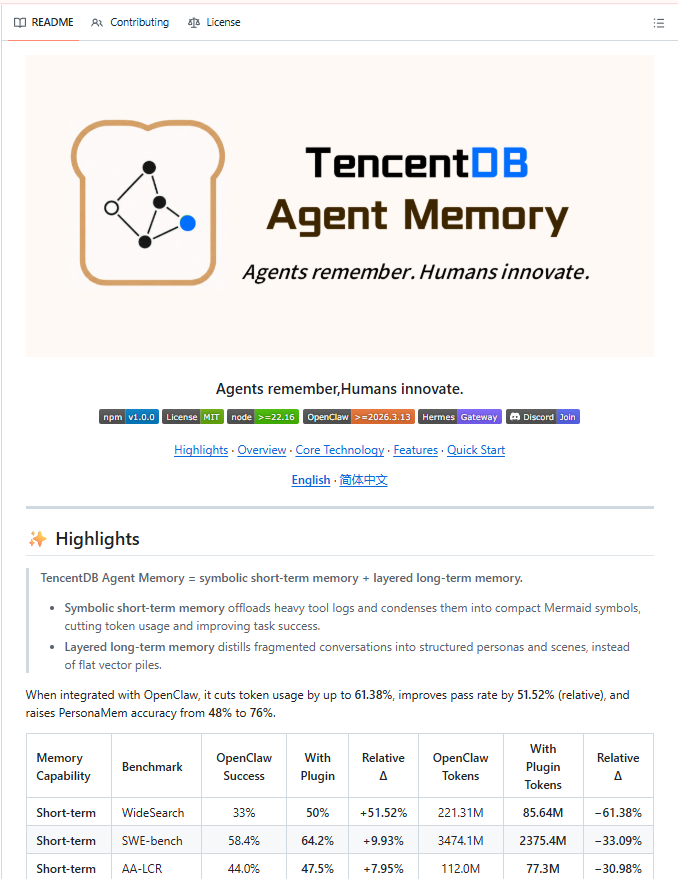
@Shruti_0810 highlighted (5 likes, 875 views) TencentDB Agent Memory as a local memory system built around symbolic short-term memory plus layered long-term memory. The linked repo and the attached README image are what made it notable: they claim a local TypeScript implementation with zero external API dependencies, up to 61.38% lower token usage, and PersonaMem accuracy moving from 48% to 76%.
@guifav argued (1 like, 30 views) that long-term agent memory should be auditable by construction, then attached a MOSS diagram that lays out the mechanism explicitly: the agent analyzes intent, a QueryProfiler compiles that intent to SQL, the retrieval core runs with no LLM in the middle, and the same query should return the same rows. The image also adds production context that does not appear in most “better memory” threads: about one year in production over 44M tokens, 110,183 segments, 163,494 documents, 569 concepts, and 322,662 annotations.

@hwchase17 said (29 likes, 7 replies, 5,464 views, 46 bookmarks) that LLM wikis are a glimpse of the future of agent memory, and the replies sharpened the attraction: people want memory they can read and edit, not just a hidden recall layer. The same portability logic showed up one layer upstream when @gokulr proposed (36 likes, 7 replies, 6,088 views, 64 bookmarks) ProductSpec as an open Markdown format for software intent before implementation; the linked repo turns that into a parser/CLI, required sections for problem, hypothesis, scope, acceptance criteria, and success metrics, plus spec_revision handles for living specs.
Discussion insight: When people said “memory,” they kept asking for explainability, revision handles, and replayable evidence rather than just more tokens in context.
Comparison to prior day: On 2026-07-06, local memory and skill libraries were already getting attention. On July 7, the strongest evidence went further toward auditable SQL retrieval, benchmark tables, and formal artifacts that can move cleanly across human and agent handoffs.
1.4 Orchestration and agent markets grew around the agent itself 🡕
The last major theme was infrastructure above the individual agent: supervisor-worker control planes, hosted MCP plus skills packages, and marketplaces with escrow, reputation, and dispute handling. The shared pattern was that builders are spending more time on coordination, signing boundaries, and market rules than on the base model alone.
@DanKornas pointed (14 likes, 3 replies, 1,715 views, 13 bookmarks) to CLI Agent Orchestrator (CAO), and both the tweet image and the public README make the same case: an 808-star Python project that runs real coding CLIs in isolated tmux sessions and coordinates them through MCP handoff, assign, and send-message primitives. That matters because it preserves provider-native behavior while still giving a supervisor a clean worker model.

@hedera launched (161 likes, 6 replies, 13,514 views) a hosted MCP server plus an open-source skills marketplace, and the linked launch post is unusually explicit about the trust boundary: the hosted server can build transactions, but signing and submission stay on the user's side through returned bytes rather than private-key custody. On the market side, @vanvster described (18 likes, 10 replies, 554 views, 9 bookmarks) OKX AI as a labor stack with task discovery, escrow, onchain reputation, and evaluator-based dispute resolution, while @0X_CUPZ used (20 likes, 18 replies, 184 views) a wallet-glitch anecdote to argue that agent economies need adjudication layers, not just deterministic contracts.
Discussion insight: Even supportive replies were about failure handling. People wanted to know what happens when a worker fails mid-handoff, when a market is unavailable in their region, or when an agent delivers the wrong thing and still claims it completed the contract.
Comparison to prior day: On 2026-07-06, agent startups were still being framed as an open opportunity category. On July 7, more posts showed the actual control planes, signature boundaries, evaluator roles, and market mechanics those products are being built around.
2. What Frustrates People
Self-grading loops and weak stop conditions
High severity. @lilianweng argued (2,689 likes, 54 replies, 181,202 views, 3,145 bookmarks) that harnesses are where self-improvement will happen, but the most useful replies under the post said the loop is only as good as the eval it optimizes against and asked how unattended research loops avoid compounding their own errors. @VaibhavSisinty repeated (10 likes, 2,584 views, 16 bookmarks) the same pain point in plainer language: if the code-writing agent also judges the result, or if “done” is not machine-verifiable, the loop quietly ships confidence instead of correctness.
People are coping with builder-checker splits, hard budget caps, and human review gates. That is a strong build signal because the failure mode is ordinary, expensive, and still shows up even in the highest-signal “loop engineering” threads.
Memory is still too opaque or too disposable
High severity. @guifav complained (1 like, 30 views) that long-term agent memory built on embedding similarity gives no good answer to “why did it retrieve that?”, then attached a MOSS diagram built around explicit SQL and logged retrieval. @cyrusnewday offered (19 likes, 3 replies, 1,118 views, 17 bookmarks) a different workaround for coding agents: cap'n hook saves focused codebase discoveries locally and deletes them when the backing files change, with the repo claiming 77% fewer tokens on repeat questions.
The same frustration shows up in the lighter-weight memory discourse. @hwchase17 said (29 likes, 7 replies, 5,464 views, 46 bookmarks) LLM wikis are the future, and the sharpest reply said memory humans can read and edit beats memory that just accumulates. Teams are coping with local files, wikis, layered memory, and ask-first recall tools, which makes this worth building for at High severity.
Voice agents still break on dead air and turn-taking gaps
Medium severity. @livekit framed (11 likes, 4 replies, 597 views, 8 bookmarks) async tools around one concrete failure: a normal tool blocks the conversation and silence makes the caller think the call dropped. The linked guide treats progress updates, filler speech, cancellation, and duplicate-call control as core runtime features, not polish. Replies under the bigger Grok voice thread made the same frustration visible from the user side, with one reply to @XFreeze asking (870 likes, 128 replies, 207,056 views) for full-duplex behavior explicitly.
Builders are coping by adding narration, cancellation hooks, and narrower guardrails, but the fact that these basics are still being called out suggests the operational layer is not solved yet.
Agents that act publicly still lack identity, recourse, and regional reliability
High severity. @AiswaryaVenkit1 said (36 likes, 9 replies, 416 views) Microsoft Entra Agent ID brings identity, governance, and visibility controls to AI agents, which is notable because the official Microsoft overview treats agent identities as a real access-governance problem, not just a naming issue. In markets, @vanvster described (18 likes, 10 replies, 554 views, 9 bookmarks) OKX AI's evaluator-based dispute model, but replies immediately asked what disputes actually look like in practice. @0X_CUPZ pushed (20 likes, 18 replies, 184 views) that point further with the Lobstar Wilde wallet-glitch story, arguing that deterministic contracts alone cannot adjudicate agent mistakes.
Even product-marketplace enthusiasm had friction attached to it. In replies to @defidarling sharing (112 likes, 37 replies, 3,819 views) OKX AI's listing flow, one user said the product does not work in their region. That mix of governance demand and availability friction makes this a High-severity pain point for anyone building agents that spend, call, trade, or publish.
3. What People Wish Existed
Auditable memory that can be replayed, edited, and ported
This was the clearest direct need in the dataset. @guifav wanted (1 like, 30 views) recall that can be re-run and explained, @Shruti_0810 highlighted (5 likes, 875 views) local layered memory with measurable token savings, @hwchase17 surfaced (29 likes, 7 replies, 5,464 views, 46 bookmarks) memory as editable wikis, and @cyrusnewday showed (19 likes, 3 replies, 1,118 views, 17 bookmarks) a codebase-specific memory map that self-invalidates when files change.
What people seem to want is not “more memory,” but memory they can inspect, prune, cite, and carry across sessions or tools without trusting a black box. Opportunity rating: [+++] direct.
Voice-agent runtime layers that feel like real call operations
The voice posts were full of capability, but the need hiding underneath them was operational: instant acknowledgement, no dead air, interruption handling, and fast deployment into real phone surfaces. @teslayoda showed (12 likes, 1,350 views) a builder with a free phone number and sub-two-minute setup, @XFreeze described (870 likes, 128 replies, 207,056 views) a much bigger multilingual voice catalog, and @livekit documented (11 likes, 4 replies, 597 views, 8 bookmarks) the low-level mechanics needed to keep a caller from hanging up.
This looks urgent because the workaround today is still custom runtime glue, narrow guardrails, and product-specific fixes for silence or cancellation. Opportunity rating: [+++] direct.
Identity, escrow, and dispute systems for agent actions
The market and governance threads were all circling the same wish: if agents are going to act like workers, they need the equivalent of identity, policy, escrow, and courts. @AiswaryaVenkit1 connected (36 likes, 9 replies, 416 views) agent identity to enterprise controls, @vanvster spelled out (18 likes, 10 replies, 554 views, 9 bookmarks) a task-discovery to dispute-resolution stack, and @0X_CUPZ argued (20 likes, 18 replies, 184 views) that agents need a justice system before they can run a real economy.
This is a direct need rather than a speculative one because products are already live and users are already asking what happens when something goes wrong. Opportunity rating: [+++] direct.
Intent artifacts that survive handoff into multi-agent work
Another visible need was for an artifact between a vague PRD and a running agent loop. @gokulr called (36 likes, 7 replies, 6,088 views, 64 bookmarks) ProductSpec “the open standard for software intent before implementation,” while @DanKornas pointed (14 likes, 3 replies, 1,715 views, 13 bookmarks) to CAO as the orchestration layer once that work reaches multiple real agents. The shared need is durable context that survives handoff instead of getting reinterpreted from scratch at every stage.
This looks practical and competitive: the problem is obvious, but multiple standards and control planes are already forming around it. Opportunity rating: [++] direct.
4. Tools and Methods in Use
| Tool | Category | Sentiment | Strengths | Limitations |
|---|---|---|---|---|
| Harness engineering / meta-harness | Method | (+/-) | Moves quality work into workflow design, files, evaluators, retries, and sub-agents | Still depends on explicit checks, stop conditions, and protection against silent failure |
| Grok Voice + Voice Agent Builder | Voice platform | (+) | 21 multilingual voices, realtime API, no-code builder, free phone number | Users still ask for full-duplex behavior and more production proof |
| LiveKit async tools | Voice runtime | (+) | Progress updates, filler speech, cancellation, and duplicate-call control for slow tools | Developers still need to design safe long-running actions and interruption boundaries |
| TencentDB Agent Memory | Memory layer | (+/-) | Local symbolic short-term memory, layered long-term memory, concrete token and accuracy claims | Evidence is early and tied to specific OpenClaw/Hermes-style workflows |
| MOSS | Retrieval memory architecture | (+) | Deterministic SQL recall, explicit logs, replayable retrieval chain | Research-heavy and far less adopted than mainstream RAG stacks |
| cap'n hook | Coding-agent memory | (+) | Claims 77% fewer tokens on repeat codebase questions and auto-invalidates stale answers | Narrowly focused on codebase recall and still early in community adoption |
| CLI Agent Orchestrator (CAO) | Orchestration framework | (+) | Real CLI agents, tmux isolation, MCP coordination, cross-provider workflows | Handoff failure and context-bleed questions remain open |
| ProductSpec | Spec / intent standard | (+) | Portable Markdown spec, revision handles, structured eval and metric blocks | Early standard; code/spec drift and adoption remain open problems |
| Microsoft Entra Agent ID | Identity / governance | (+) | Agent identity, lifecycle, audit, Conditional Access, shadow-AI discovery | New and Microsoft-centric; real-world operating patterns are still forming |
| OKX AI | Agent marketplace | (+/-) | Escrow, bidding, reputation, evaluator-backed disputes | Beta availability and regional limits still show up in user replies |
Overall, the satisfaction spectrum ran from “this finally feels structured” to “this still needs receipts.” People liked local memory, revision-aware specs, and orchestration that keeps real CLIs intact, but they did not trust self-verifying loops, silent voice runtimes, or hidden memory layers. The common workaround pattern was consistent: keep a human or an explicit checker outside the main generator, prefer local or readable artifacts over opaque recall, and make state or permissions inspectable.
The migration pattern was also clear. Discussion kept moving from flat vector recall toward layered or SQL-like memory, from one-agent chat to supervisor-worker orchestration, from generic chatbot voice demos to phone numbers plus runtime controls, and from overloaded PRDs toward formal intent sections and revision handles. Competitive pressure is shifting upward too: base models still matter, but differentiation in this dataset came from orchestration, memory, governance, and payment rails around the models rather than from the models alone.
5. What People Are Building
| Project | Who built it | What it does | Problem it solves | Stack | Stage | Links |
|---|---|---|---|---|---|---|
| Voice Agent Builder | xAI | No-code builder for phone-accessible voice agents with multilingual Grok voices | Fast deployment of production-style voice agents without custom telephony setup | Grok Realtime Voice Agent API, Text-to-Speech API, Voice Agent Builder | Beta | launch tweet, builder image tweet |
| TONI | @AuraVision_Co | Patient-navigation voice and chat agent with practice-defined care pathways and intake dashboard | Front-desk and triage overload in GP practices | Voice agent, web chatbot, management dashboard | Beta | tweet, site |
| CLI Agent Orchestrator (CAO) | @DanKornas / awslabs | Coordinates real coding CLIs in isolated tmux sessions with supervisor-worker delegation over MCP | Multi-agent coding orchestration without giving up provider-native CLI behavior | Python, tmux, MCP, web UI, flows | Beta | tweet, GitHub |
| TencentDB Agent Memory | TencentDB | Local long-term memory system with symbolic short-term memory and layered long-term memory | Opaque, expensive, vendor-locked agent memory | TypeScript, SQLite, local memory layers | Alpha | tweet, GitHub |
| cap'n hook | @cyrusnewday | Ask-first codebase memory map that invalidates stale findings when files change | Repeated codebase rediscovery and wasted tokens in coding agents | TypeScript, local file-backed memory | Alpha | tweet, GitHub |
| ProductSpec | @gokulr | Open Markdown standard plus parser/CLI for software intent before implementation | PRDs and specs that fail during human/agent handoff | TypeScript, Markdown, parser/CLI | Alpha | tweet, GitHub |
| Hosted MCP Server + Hedera Skills | @hedera | Hosted MCP server paired with an open-source skills marketplace for Hedera transactions and workflows | Tool access plus reusable playbooks for blockchain-capable agents | Hosted MCP server, RETURN_BYTES signing flow, TypeScript skills | Shipped | tweet, launch post, GitHub |
| OKX AI | @defidarling / OKX AI | Marketplace where agents bid on tasks, work under escrow, build reputation, and face evaluator-led disputes | Discovery, payment, trust, and recourse for agent labor | Web marketplace, escrow, onchain reputation, evaluator staking | Beta | listing tweet, labor-stack tweet, site |
CAO and ProductSpec were two sides of the same build pattern. @gokulr defined (36 likes, 7 replies, 6,088 views, 64 bookmarks) a durable intent artifact upstream of implementation, while @DanKornas showed (14 likes, 3 replies, 1,715 views, 13 bookmarks) a supervisor-worker execution layer downstream of it. Together they illustrate how much builder effort is moving into handoff and control surfaces rather than just code generation.
The memory builders were similarly convergent. TencentDB Agent Memory and cap'n hook both assume that the default “ask the model to remember” approach is too costly or too opaque, but they solve it at different layers: one is a general local memory system, the other is a codebase-specific discovery map. The repeated build trigger was obvious in the discussions: people do not want to keep paying to rediscover the same facts.
The voice projects split into horizontal infrastructure and vertical workflow. xAI's builder compresses deployment and distribution, while TONI narrows the problem to patient navigation with guardrailed practice flows and dashboard intake. Taken together, the two posts separate a generic builder surface from a healthcare-specific workflow.
Hedera and OKX AI extended the same logic into public action and payment. Hedera focused on signing boundaries and reusable skills, while OKX AI focused on marketplaces, escrow, reputation, and evaluator-backed disputes. Multiple builders were independently working on the layers around the agent, not just the agent itself.
6. New and Notable
Hosted MCP plus skills shipped as a package
@hedera launched (161 likes, 6 replies, 13,514 views) a hosted MCP server and open-source skills marketplace together, and the linked launch post is notable because it separates transaction construction from transaction signing. The packaging is the signal: not just tools, but tools plus reusable playbooks.
Agent identity became an explicit enterprise control plane
@AiswaryaVenkit1 surfaced (36 likes, 9 replies, 416 views) Microsoft Entra Agent ID, and the official overview describes identity, lifecycle management, Conditional Access, Identity Protection, and auditability for nonhuman agents. That is notable because it turns “agent governance” from a loose concern into a documented product surface.
Memory posts came with concrete receipts instead of abstract claims
@Shruti_0810 shared (5 likes, 875 views) token and accuracy deltas for TencentDB Agent Memory, while @guifav shared (1 like, 30 views) a MOSS diagram with production-scale logs and deterministic retrieval design. Even though the engagement differed sharply, both posts stood out because they offered inspectable mechanisms and numbers rather than generic “better memory” positioning.
“Software intent before implementation” became a named artifact
@gokulr proposed (36 likes, 7 replies, 6,088 views, 64 bookmarks) ProductSpec as an open standard for intent that sits upstream of engineering specs, tasks, code, and evaluation. That is notable because the thread named a gap that many agent builders have been implying for weeks without formalizing: an artifact that both humans and coding agents can read without overloading the PRD.
7. Where the Opportunities Are
[+++] Auditable memory infrastructure — Evidence came from frustrations with opaque retrieval, from MOSS's replayable SQL-based recall, from TencentDB Agent Memory's local layered design, and from cap'n hook's change-aware codebase memory. The strongest opportunity is a memory layer that humans can inspect, prune, replay, and port across tools.
[+++] Verifier-first agent runtimes — Lilian Weng's harness essay, Vaibhav Sisinty's builder-checker framing, and Greg Isenberg's “trust is the new bottleneck” thread all point to the same gap: teams need runtime infrastructure for checks, receipts, spend ceilings, and machine-verifiable completion, not just faster generation.
[+++] Production voice-agent operations — xAI's voice launches, LiveKit's async-tool runtime, and TONI's vertical deployment all show demand for voice agents that can acknowledge quickly, handle long tasks, respect guardrails, and ship to real phone surfaces. The missing layer is operational reliability, not raw speech synthesis.
[++] Agent identity, escrow, and dispute middleware — Entra Agent ID, Hedera's signing boundary, OKX AI's escrow and evaluator model, and the Lobstar Wilde dispute story all show that agents need policy and recourse once they act publicly. This is already an active product surface, but the implementations are still fragmented by ecosystem and use case.
[+] Portable intent artifacts for human-agent handoff — ProductSpec and CAO show one emerging path from intent to execution, but the threads also exposed drift and resynchronization as open problems. There is room for tools that keep specs, tasks, code, and evals aligned as the work evolves.
8. Takeaways
- The discussion moved from prompts to harnesses around the model. The day's strongest loop-engineering evidence focused on evaluators, memory, workflow automation, and sub-agents rather than prompt phrasing alone. (Lilian Weng)
- Voice-agent progress is being judged on runtime behavior, not just voice quality. The most concrete voice posts were about builders, phone deployment, progress updates, and cancellation during long tool calls. (xAI voice launch, LiveKit async tools)
- Readable, replayable memory is gaining ground over opaque recall. TencentDB Agent Memory, MOSS, LLM wikis, and cap'n hook all converged on the same preference: memory should be inspectable and revisable, not hidden inside a vector store. (TencentDB Agent Memory, MOSS, LLM wikis)
- Builders are formalizing both intent and orchestration. ProductSpec addressed the artifact before implementation, and CAO addressed the control plane once multiple real agents are involved. (ProductSpec, CAO)
- Governance and recourse are no longer side topics. Entra Agent ID, Hedera's hosted MCP flow, OKX AI's escrow and evaluator model, and the agent-economy dispute discussion all treated trust boundaries as core infrastructure. (Entra Agent ID, Hedera, OKX AI)