Twitter AI Agent - 2026-07-08
1. What People Are Talking About
1.1 Hybrid orchestration and model routing turned into operator playbooks 🡕
Multiple high-signal posts treated agent quality as an orchestration problem: one model plans, another executes, a third repairs configuration, and all of it needs machine-readable boundaries. Compared with July 7's broader talk about harnesses and control planes, July 8 moved closer to copy-pasteable operating procedures.
@cjzafir showed (994 likes, 45 replies, 125,387 views, 2,062 bookmarks) how to install the Codex plugin inside Claude Code and then run Fable 5 as planner/reviewer while Codex acts as the executor. The setup steps were only half the signal. The replies added the operational reality: the handoff gets choppy enough that the author recommends a custom /handoff skill, and another practitioner argued that the inverse setup is more reliable on mobile because Codex keeps the terminal and permission model in the driver seat.
@bindureddy teased (364 likes, 20 replies, 478,515 views, 65 bookmarks) custom router APIs that mix Fable and GPT 5.6 Sol. The replies made it more concrete: routing is based on task type, the author claims better than 95% router accuracy, and budget caps are the next extension. That made the post a real build signal for multi-model routing instead of another vague “best model” claim.
@RoundtableSpace pointed (122 likes, 8 replies, 47,615 views, 109 bookmarks) to Peter Steinberger's agent-scripts, a 5,690-star repo of AGENTS instructions, skills, scripts, and hooks that he symlinks into projects. @vercel_dev added (49 likes, 2 replies, 3,623 views) that vercel project update now lets an agent repair framework and build settings from the CLI with JSON output, while @_avichawla mapped (29 likes, 4 replies, 3,667 views, 35 bookmarks) Google's agents-cli as a single interface for scaffolding, evaluating, and deploying ADK agents with seven injected skills.
Discussion insight: The replies were not mostly about model quality. They were about reliability boundaries: when a handoff loses context, whether routing can avoid mispricing hard tasks, and whether agents should be allowed to mutate deployment settings outside infrastructure-as-code.
Comparison to prior day: On July 7, orchestration was still being framed as a control-plane problem. On July 8, it showed up as concrete loadouts, routers, and CLI write paths that people could actually adopt.
1.2 Harness and loop engineering became benchmarked workflows 🡕
Multiple posts moved from “the harness matters” to “here is the loop, the checker, and the benchmark.” Compared with July 7's harness-first framing, July 8 added benchmark cards, research artifacts, and applied bug-fix workflows.
@muratcan released (145 likes, 8 replies, 7,167 views, 204 bookmarks) a Self-Improvement Loops skill in the 17,005-star Agent-Skills-for-Context-Engineering repo. The linked skill file says evaluators, permission control, and budget enforcement must stay outside the surface the loop can edit. The attached summary board turns that argument into an explicit optimization ladder, PAC-style design rules, and a file-based pipeline instead of a slogan.

@Brian_Bo_Li highlighted (37 likes, 2 replies, 2,535 views, 19 bookmarks) the HarnessOpt / SkillOpt-Lite paper, which argues for consensus mining across trajectories, held-out validation gating, and treating rollout files as flat debug artifacts rather than increasingly complex optimization topologies. The poster image is the distinctive evidence here: it shows the minimal pipeline, the benchmark framing, and the spreadsheet-style result table that the tweet only summarizes.

@clairevo showed (115 likes, 9 replies, 11,913 views, 150 bookmarks) a custom harness built with ClaudeDevs SDK to triage Sentry bugs, verify root cause, and ship fixes. @free_ai_guides summarized (14 likes, 4 replies, 2,823 views) Talha Sheikh's argument that instructions are not verification and that the agent's “done” state cannot be trusted without an independent checker. A smaller taxonomy post from @DataScienceDojo framed (31 likes, 1,723 views) the stack as prompt, context, harness, and loop engineering, which matched the more detailed threads.

Discussion insight: The most consistent correction was that better instructions are not enough. Builders kept insisting that the checker must live outside the editable loop, whether that checker is a held-out validation set, deterministic tests, or a human review layer.
Comparison to prior day: July 7 established the harness as the new object of optimization. July 8 added benchmarked self-improvement, concrete SDK workflows, and repeated reminders that verification is a separate system, not a paragraph in the prompt.
1.3 Skills, registries, and intent artifacts became packaging problems 🡕
Instead of treating skills as snippets pasted into chat, multiple posts treated them as packages that need naming, storage, retrieval, versioning, and audit trails. Compared with July 7's portability discussion, July 8 spent more time on how teams actually publish and retrieve the pieces.
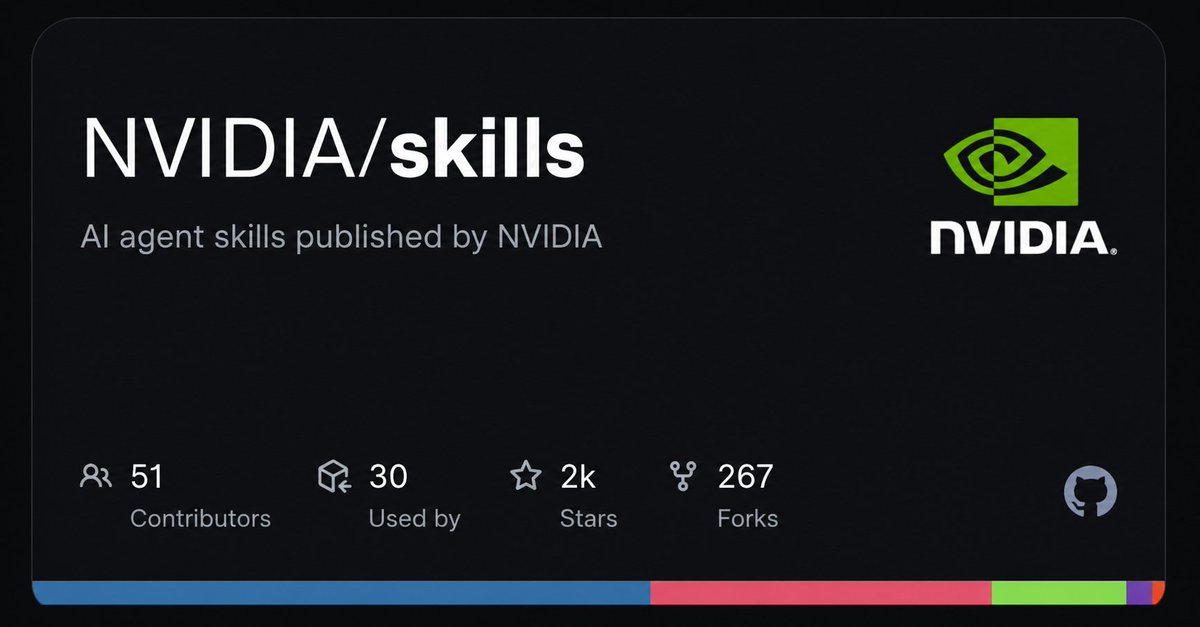
@QCXINT_ surfaced (24 likes, 1,952 views, 47 bookmarks) NVIDIA/skills, a 2,324-star public catalog that the README calls “official, NVIDIA-verified skills for AI agents.” The repo card screenshot made that concrete by showing the catalog as a real shared artifact with contributors, forks, and downstream use, not just a blog claim.
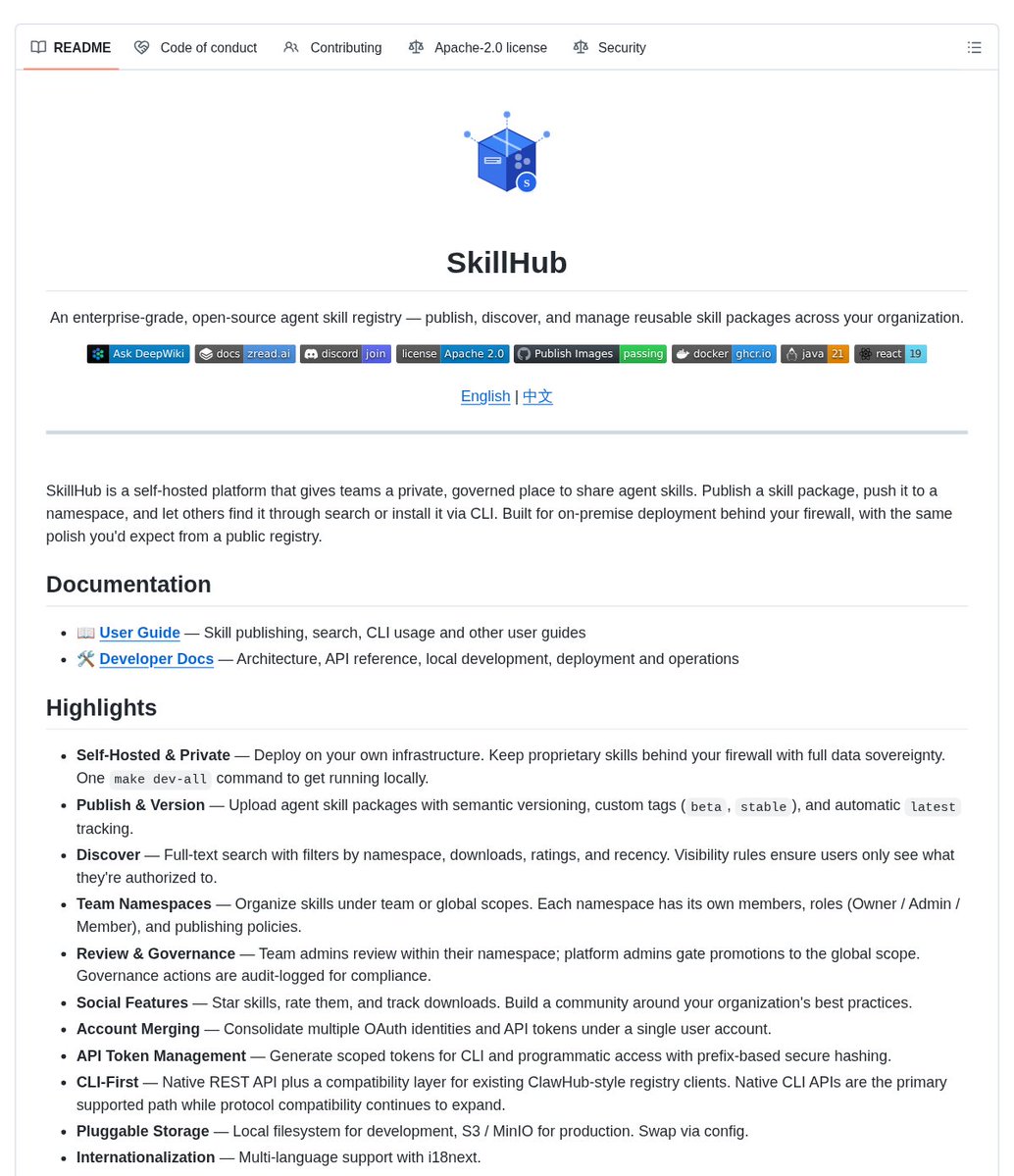
@DanKornas described (13 likes, 1 reply, 1,175 views, 20 bookmarks) SkillHub as a self-hosted registry with versioning, namespaces, search, CLI install, and audit logs. @gokulr extended (17 likes, 4 replies, 2,888 views, 20 bookmarks) ProductSpec with Decision Trace so intent, drift, approvals, and revised intent can live beside code instead of disappearing into chat history. A smaller but specific post from @ModelScope2022 added (9 likes, 441 views) R3-Embedding-0.6B and the paper “Skill Is Not Document” as a retrieval stack built specifically for agent skill routing, not generic document search.
Discussion insight: The common subtext was skill sprawl. One post literally called the alternative “Slack archaeology,” and another built a retrieval model on the premise that skills should not be treated like generic text documents.
Comparison to prior day: July 7 emphasized memory layers and portable specs. July 8 pushed one level outward to catalogs, registries, and retrieval systems for the skills themselves.
1.4 Applied agent infrastructure moved into privacy, payments, and runtime isolation 🡕
Several concrete posts focused on what happens after the agent leaves the code editor: privacy removal, per-request payments, and isolated runtime state all appeared as distinct operational layers. Compared with July 7's identity-and-marketplace framing, July 8 had more operational mechanisms.
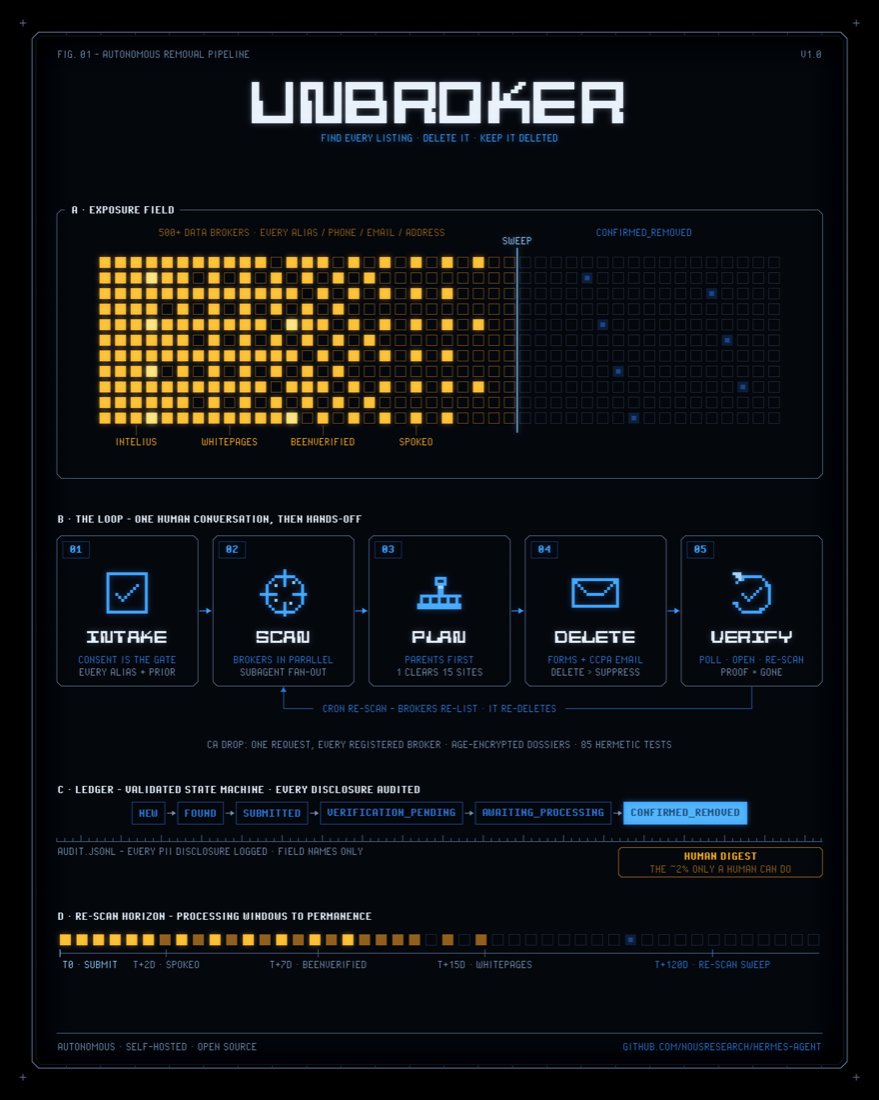
@milesdeutscher shared (62 likes, 15 replies, 23,715 views, 150 bookmarks) Unbroker, a Hermes Agent skill for self-hosted data-broker removal. The linked README says it is consent-gated, multi-tenant, and hands work back to a human only when CAPTCHA, ID, phone, or fax steps block automation. The image makes the workflow legible by showing an autonomous removal pipeline with re-scan and re-list detection instead of just saying “privacy agent.”
@MRRydon argued (72 likes, 26 replies, 12,417 views) that x402-style edge payment gateways matter because an agent that can research or produce work but cannot settle per-request costs is only half an economic actor. @Clarissa_Krypto extended (287 likes, 30 replies, 7,998 views) the same theme into confidential spend control, describing Cluster's CodeXero plus Mind Network's x402z as a way to pay for model calls, compute, and datasets without exposing the agent's strategy in plain text. @CoralRelief offered (20 likes, 2 replies, 5,053 views) moo as another kind of runtime rail: per-agent Linux VMs so worktrees stop colliding on ports, services, and databases.
Discussion insight: Once agents move beyond code completion, the objections shift quickly from “can it call the tool?” to “who approves the spend, who owns the liability, and how do you stop shared state from leaking across runs?”
Comparison to prior day: On July 7 trust boundaries were still discussed mostly through identity and marketplaces. On July 8 the evidence got more operational: privacy opt-outs, per-request billing, and VM-level isolation.
2. What Frustrates People
Delegation handoffs still lose state or visibility
High severity. @cjzafir showed (994 likes, 45 replies, 125,387 views, 2,062 bookmarks) a powerful planner/executor split, but the replies immediately exposed the pain: handoff gets choppy enough to need a dedicated /handoff skill, and another reply argued the inverse setup is more reliable because Codex asks for fewer permissions mid-run. @bindureddy added (364 likes, 20 replies, 478,515 views, 65 bookmarks) a router layer, but even there the author acknowledged prompts can still be sent to the wrong place. @vercel_dev drew (49 likes, 2 replies, 3,623 views) a reply asking whether anyone really wants autonomous agents mutating live project architecture outside infrastructure-as-code. People are coping with handoff skills, explicit role splits, and tighter control surfaces. This is worth building for because the complaints come from the most advanced users, not the beginners.
Verification still lives outside the agent
High severity. @free_ai_guides repeated (14 likes, 4 replies, 2,823 views) Talha Sheikh's point that instructions are not verification. @muratcan received (145 likes, 8 replies, 7,167 views, 204 bookmarks) the clearest correction of the day in a reply: if the harness is both optimizer and benchmark, it will game the metric. @Brian_Bo_Li shared (37 likes, 2 replies, 2,535 views, 19 bookmarks) a paper centered on independent validation gating, and @clairevo showed (115 likes, 9 replies, 11,913 views, 150 bookmarks) a bug-fix harness that explicitly verifies root cause before shipping. Builders are coping with deterministic tests, held-out evaluators, and human spot checks. This is worth building for because it blocks self-improving systems from becoming trustworthy systems.
Skill discovery and governance are messy
Medium severity, rising. @DanKornas called (13 likes, 1 reply, 1,175 views, 20 bookmarks) the alternative to a registry “Slack archaeology,” @ModelScope2022 argued (9 likes, 441 views) that skill routing needs its own retrieval benchmark, and @AiwithDharmik circulated (46 likes, 5 replies, 348 views) a “Claude Code Resource Bible” poster listing 54 separate docs, MCP servers, skills, multiplexers, and frameworks. The poster is useful evidence that people are coping with manual curation because the ecosystem is already too fragmented for memory alone.

Teams are coping with registries, curated lists, and specialized retrievers, but the fact that all three appeared in the same day's data makes this worth building for.
Autonomous action still stalls on approvals, payments, and shared runtime state
High severity. @Clarissa_Krypto said (287 likes, 30 replies, 7,998 views) that agents need to pay for inference, compute, data, and API calls thousands of times a day without a human clicking approve. @MRRydon drew (72 likes, 26 replies, 12,417 views) the ownership question immediately in replies: who actually pays in practice, the calling agent or the human who deployed it? Unbroker's README still hands work back when CAPTCHA, ID, phone, or fax steps block automation, and @CoralRelief argued (20 likes, 2 replies, 5,053 views) that parallel agents still trip over shared databases and ports. Builders are coping with human fallback digests, stablecoin rails, and VM isolation. This is worth building for because autonomy is now blocked by operational edges more than by missing tool calls.
3. What People Wish Existed
Budget-aware orchestration policies
This was a practical need, not an abstract one. @cjzafir showed (994 likes, 45 replies, 125,387 views, 2,062 bookmarks) a planner/executor split that still needs handoff hygiene, @bindureddy described (364 likes, 20 replies, 478,515 views, 65 bookmarks) task-type routing with budget caps still to come, and @_avichawla mapped (29 likes, 4 replies, 3,667 views, 35 bookmarks) a CLI that injects seven lifecycle skills so scaffolding, evals, and deployment stay in one interface. What people seem to want is a reusable policy layer for “who does what, when, and at what cost,” rather than a pile of ad hoc delegation prompts. Opportunity rating: [++] direct.
Governed skill discovery, routing, and reuse
This need showed up from three angles at once: @DanKornas wanted (13 likes, 1 reply, 1,175 views, 20 bookmarks) registries instead of Slack archaeology, @QCXINT_ pointed (24 likes, 1,952 views, 47 bookmarks) to vendor-verified skills, and @ModelScope2022 argued (9 likes, 441 views) that skill routing needs its own benchmark and two-stage retriever rather than generic semantic search. The ecosystem already has too many skills to browse manually, but not enough governance to trust random reuse. Opportunity rating: [+++] direct.
Durable intent and drift traces
@gokulr described (17 likes, 4 replies, 2,888 views, 20 bookmarks) specs drifting as prototypes change, tests codify undocumented behavior, and eval thresholds move. Decision Trace is a direct answer: record what changed, why it changed, who approved it, and whether the spec or implementation got revised. This is a practical workflow need for teams that want humans and agents to share the same evolving intent artifact instead of silently overwriting it. Opportunity rating: [++] direct.
Agent-native payments and approval boundaries
The payment threads were really requests for a missing operating layer. @MRRydon framed (72 likes, 26 replies, 12,417 views) x402 as the missing way for agents to pay per request, @Clarissa_Krypto added (287 likes, 30 replies, 7,998 views) privacy-preserving settlement so spend patterns do not leak strategy, and @milesdeutscher showed (62 likes, 15 replies, 23,715 views, 150 bookmarks) the same boundary from another direction by escalating only the steps that still require a person. The missing product is not just a checkout API; it is payer identity, limits, approval policy, and compliance-aware escalation wrapped around the payment. Opportunity rating: [+++] direct.
Full runtime isolation for concurrent agents
This was a narrow but concrete ask. @CoralRelief said (20 likes, 2 replies, 5,053 views) that worktrees solve file isolation but not databases, ports, or services, and the Vercel reply worried about invisible infra changes when agents act directly on production settings. People seem to want isolated, reproducible machine state that moves with the code and exposes changes clearly enough for review. Opportunity rating: [++] direct.
4. Tools and Methods in Use
| Tool | Category | Sentiment | Strengths | Limitations |
|---|---|---|---|---|
Fable 5 + Codex plugin / codex-rescue |
Orchestration stack | (+/-) | Clear planner/executor split, lower planner token burn, cross-vendor review path | Handoffs get choppy, setup/auth friction, permission prompts and availability debates remain |
| Custom router APIs (Fable + GPT 5.6 Sol) | Model routing | (+) | Task-type routing, cheap inference plus stronger one-shotting, claimed 95% accuracy | Misroutes still happen; budget caps were described as future work |
| Self-Improvement Loops / HarnessOpt | Harness method | (+/-) | Consensus mining, held-out validation, explicit optimization ladder, measurable self-evolution | Needs an evaluator outside the loop; easy to game the metric if boundaries collapse |
| ClaudeDevs SDK harness | Agent framework | (+) | Concrete bug-triage and root-cause workflow instead of generic chat | Still requires engineers to define verification and performance measurement |
| NVIDIA/skills | Skill catalog | (+) | Official, verified, portable skill catalog with vendor docs and governance framing | Catalog value depends on surrounding discovery, registry, and approval layers |
| SkillHub | Skill registry | (+) | Versioned packages, namespaces, search, CLI/API install, RBAC, audit logs, self-hosting | Another service to operate; cross-tool portability is still forming |
| ProductSpec + Decision Trace | Spec / audit standard | (+) | Portable intent, drift handling, approvals, and revised-intent history | Early standard; requires discipline to keep spec and trace in sync with reality |
| Hermes Agent + Unbroker | Security / privacy skill | (+/-) | Self-hosted broker-removal automation, digests, subagents, consent gates | CAPTCHA, ID, phone, and fax steps still require humans; US-first scope |
vercel project update |
Deployment CLI | (+/-) | Structured JSON output, explicit settings repair, no dashboard dependency | Raises visibility and IaC concerns when autonomous agents mutate live config |
| x402 / x402z | Payment rail | (+/-) | Per-request machine payments, stablecoin settlement, confidentiality direction | Payer ownership, compliance, and approval policy are not settled |
| moo | Runtime isolation | (+) | Per-agent Linux VMs versioned with git state; isolates ports, DBs, packages, and services | Very early project with low adoption and strong environment assumptions |
| Google agents-cli | Lifecycle CLI | (+) | Scaffold/evaluate/deploy in one interface, injected skills, explicit cloud lifecycle | Tied to Google ADK and cloud stack rather than broad cross-provider use |
Overall, satisfaction was highest wherever the control surface was explicit. People liked named planner/executor roles, skills with bounded actions, registries with audit trails, and CLIs with structured errors. Skepticism appeared when the agent had to pass state informally, grade its own output, or mutate live systems without a reviewable artifact.
The migration pattern was clear. The feed kept moving from one-model chat workflows to routers and role splits, from prompt snippets to skills and registries, from dashboard-only admin surfaces to parseable CLIs, from worktrees to full machine isolation, and from human-billed subscriptions to per-request x402-style payments. Competitive pressure is shifting upward: model vendors, cloud platforms, and open-source builders are all racing to own the layers around the agent rather than only the model inside it.
5. What People Are Building
| Project | Who built it | What it does | Problem it solves | Stack | Stage | Links |
|---|---|---|---|---|---|---|
| agent-scripts | Peter Steinberger | Shared AGENTS rules, skills, hooks, and helper scripts reused across repos | Codifies personal agent guardrails so every project starts from the same operating model | Shell, AGENTS.MD, skills, hooks | Shipped | tweet, GitHub |
| Self-Improvement Loops | @muratcan | Skill/reference for loops that optimize harness or scaffold code | Gives builders patterns for self-modifying agent systems without collapsing evaluator and optimizer together | Python repo, skill docs, evaluation rules | Alpha | tweet, repo |
| HarnessOpt / SkillOpt-Lite | Yifei Shen et al. | Research pipeline for self-evolving agent skills from flat rollout files | Seeks measurable skill/harness improvement without increasingly complex optimizer scaffolding | Flat rollout files, autonomous coding agent, validation gating, benchmark suite | Alpha | tweet, paper |
| SkillHub | iflytek (highlighted by @DanKornas) | Self-hosted registry for publishing, discovering, and governing skill packages | Skill sprawl, missing versioning, and internal distribution problems | Java, React, Docker/Kubernetes, CLI/API, RBAC, audit logs | Beta | tweet, GitHub |
| ProductSpec + Decision Trace | @gokulr | Open standard for software intent plus post-implementation drift decisions | Keeps specs from silently diverging as humans and agents change code, tests, and eval thresholds | TypeScript, Markdown, JSON schema | Alpha | tweet, GitHub |
| NVIDIA/skills | NVIDIA | Official verified catalog of portable agent skills | Packages reusable vendor capabilities as auditable skill artifacts | Python, Agent Skills spec, NVIDIA docs/blog | Shipped | tweet, GitHub |
| Unbroker | Nous Research / Hermes ecosystem | Self-hosted skill that removes exposed personal data from data brokers and rechecks relisting | Privacy cleanup without paying a third-party SaaS to hold the same sensitive data | Python CLI, Browserbase, email automation, Hermes subagents | Beta | tweet, repo, site |
| moo | heyito | Git-linked per-agent Linux VM snapshots | Stops parallel agents from colliding on DBs, ports, packages, and services | Rust, Linux VMs, git snapshots | Alpha | tweet, GitHub |
| Google agents-cli | CLI plus skills for scaffolding, evaluating, and deploying ADK agents | Replaces fragmented lifecycle tooling with one interface | Python CLI, ADK, Google Cloud, injected skills | Beta | tweet, GitHub |
agent-scripts, Self-Improvement Loops, and HarnessOpt all express the same builder instinct at different levels: take tacit agent behavior and move it into files that can be versioned, reviewed, and improved. One is a personal loadout, one is a reusable skill, and one is a research optimizer, but all three treat the operating layer around the model as the real product surface.
SkillHub, ProductSpec, NVIDIA/skills, and Google agents-cli show the same packaging trend from different angles: registry, spec standard, vendor catalog, and cloud lifecycle CLI. The repeated build trigger was obvious in the tweets and images: people no longer want skills trapped in chat logs, screenshots, or one-off repos.
Unbroker and moo show a second pattern: builders are spending time on the boring edges of autonomy—privacy removals, human fallback, machine state, and shared-service isolation—rather than only adding more reasoning. Those projects were motivated by failure modes that appeared directly in the surrounding discussion: relisting, CAPTCHA blocks, payer ambiguity, and collisions between concurrent runs.
6. New and Notable
Benchmark marketing centered on agent workloads instead of generic chat quality
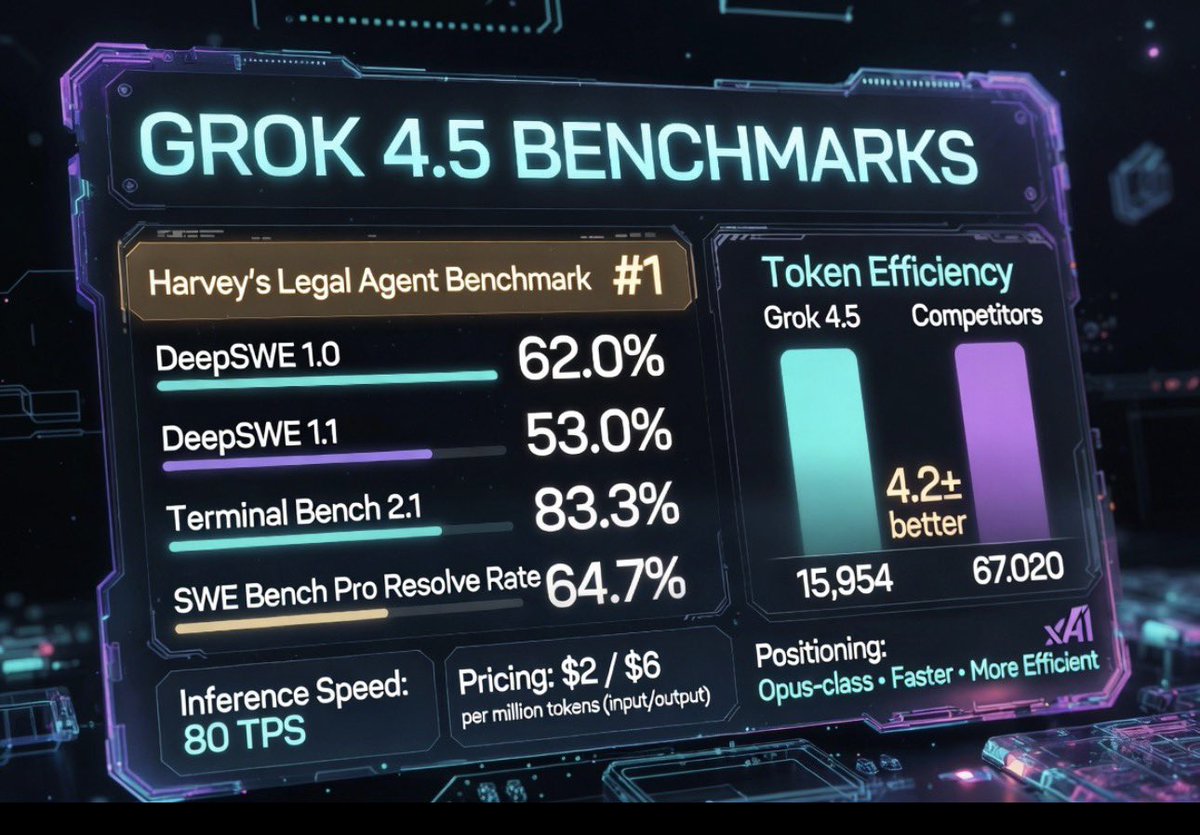
@BrianRoemmele circulated (79 likes, 7 replies, 18,522 views) a Grok 4.5 benchmark card that framed the model around Harvey's Legal Agent Benchmark, Terminal Bench 2.1, SWE Bench Pro resolve rate, token efficiency, 80 TPS inference, and $2/$6 per-million token pricing. Regardless of how much weight readers put on a community-circulated benchmark card, the noteworthy part is what was being marketed: coding-agent throughput and agent benchmark performance, not generic chat ability.
Deployment settings got an agent-writable CLI path
@vercel_dev announced (49 likes, 2 replies, 3,623 views) that agents can now update framework, build, dev, install, and output settings from vercel project update, and the changelog confirms the JSON and structured-error design. That is notable because it shows what agent-native operations tooling actually looks like in practice: a reviewable write surface instead of dashboard clicks.
Skills became first-class vendor and cloud surfaces
@QCXINT_ surfaced (24 likes, 1,952 views, 47 bookmarks) NVIDIA's verified skill catalog, while @_avichawla mapped (29 likes, 4 replies, 3,667 views, 35 bookmarks) Google's agents-cli as a scaffold/eval/deploy surface with injected skills. The notable shift is that skills are no longer just community prompt files; vendors and cloud platforms are productizing them as primary interfaces.
7. Where the Opportunities Are
[+++] Governed skill discovery and distribution — Evidence came from SkillHub, NVIDIA/skills, ModelScope's “Skill Is Not Document” retriever, and even the 54-resource Claude Code poster. The need is strong because the ecosystem already has too many capabilities to manage informally, but not enough packaging and trust infrastructure.
[+++] Verifier-first orchestration and routing — cjzafir's handoff pain, bindureddy's router work, muratcan's outside-the-loop invariant, and Talha Sheikh's “instructions are not verification” all point to the same gap: teams need routing, receipts, and independent checks, not just more agent autonomy.
[++] Agent-native payments with approval and privacy controls — MRRydon's x402 framing, Clarissa_Krypto's confidentiality argument, and Unbroker's human-fallback boundaries all show demand for machine payment rails that still expose payer identity, limits, and escalation points clearly enough for humans to trust.
[++] Runtime isolation for concurrent agents — moo's per-agent VMs and the Vercel configuration debate both show a missing layer between simple worktrees and fully reviewable operational autonomy. This is moderate rather than overwhelming today, but the pain is concrete and technical, not hypothetical.
[+] Durable intent and decision traces — ProductSpec and Decision Trace show an emerging opportunity in keeping specs, code, tests, and agent behavior aligned as work evolves. The problem is real, but the market is earlier and more process-heavy than the routing or registry opportunities above.
8. Takeaways
- Hybrid multi-model workflows are already normal for advanced users. The clearest posts split planning, execution, and review across Fable, Codex, GPT-5.6 Sol, and cloud lifecycle CLIs instead of trusting one model to do everything. (source)
- Verification remains the non-negotiable boundary around self-improvement. The strongest loop-engineering evidence today kept repeating the same rule: the evaluator has to stay outside the loop that is being optimized. (source)
- Skill governance is becoming its own infrastructure category. Registries, vendor catalogs, retrieval models, and intent artifacts all appeared in the same day's feed because teams are already overwhelmed by unmanaged skill sprawl. (source)
- The next autonomy bottlenecks are payment, approval, and runtime isolation. The limiting factor is increasingly who pays, who approves, and whether concurrent agents can act without stepping on each other's machine state. (source)
- The market is valuing agent-facing control surfaces as much as model quality. Grok benchmark cards, Vercel's settings CLI, and Google's agents-cli all framed progress in terms of benchmarks, configuration, lifecycle, and deployment rather than chat alone. (source)