Twitter AI Agent - 2026-07-27
1. What People Are Talking About
1.1 Context engineering turned into runtime architecture (🡕)
The day’s most repeated idea was that agent quality now lives in how context is assembled, trimmed, and routed over time, not in ever-longer prompts. At least six high-signal posts converged on the same shift: delete prompt bulk, load references only when needed, move durable behavior into skills and memory, and separate generation from evaluation.
@harleyfoote_ argued (137 likes, 7 replies, 231,629 views) that Anthropic engineers reportedly removed over 80% of Claude Code’s system prompt for Opus 5 / Fable 5 with no measurable coding-eval loss, then used replies to spell out the deeper point: prompts are only one slice of a larger environment assembled from Skills, CLAUDE.md, memory, and other runtime state. @aiedge_ laid out (7 likes, 3 replies, 2,212 views, 24 bookmarks) a similar Claude 5 checklist: replace rigid rules with judgment, design cleaner tool interfaces instead of stuffing examples, and progressive-load context instead of maintaining one bloated project file.
@alex_verem wrote (19 likes, 6 replies, 3,515 views, 28 bookmarks) that prompt, context, harness, and loop each fail at different scopes, with the real danger being loop state that survives long enough to become “load-bearing,” so a separate skeptical evaluator matters more than a smarter generator. @0xRafy framed (22 likes, 9 replies, 2,218 views, 26 bookmarks) graph engineering as the missing fifth layer after prompt, context, harness, and loop, arguing that graphs solve cross-agent state and provenance rather than just retrieval.

@AiandTechHub pointed to (46 likes, 11 replies, 615 views) IBM’s structured knowledge-graph curriculum as proof that the topic is becoming teachable, not just memetic. @kv1nsiii warned (24 likes, 9 replies, 1,287 views, 22 bookmarks) that the surrounding skills ecosystem is still sloppy: six viral “42 Claude skills” links pointed to the wrong repo, four more dumped people at a root folder, and the cited ToxicSkills study pushed the conversation from “install more skills” to “read the SKILL.md first.”
Discussion insight: The replies were less interested in naming the next layer than in keeping it lean. Deletion, deferred loading, and separate evaluators kept showing up as maturity signals, while unsafe or low-quality skill packs were treated as a real supply-chain problem around the model.
Comparison to prior day: July 21 centered on explaining graph engineering through a mentor card, course, and paper. July 27 pushed the idea closer to operating practice: remove prompt bulk, split behavior into tools and skills, and treat graphs and evaluators as production control surfaces.
1.2 Benchmarks got more domain-specific and long-horizon (🡕)
The second cluster was measurement. Instead of generic leaderboards, people shared benchmarks that stress codebase maintenance, exploit reproduction, rare-disease diagnosis, and agentic RL infrastructure, which makes the evaluation conversation much more about end-to-end systems than raw models.
@dexhorthy shared (226 likes, 16 replies, 41,709 views, 437 bookmarks) a third SlopCodeBench write-up for Opus 5, and the sharpest reply came from @rohangupta_ saying his team had already applied an “adversarial backpressure harness” to the same benchmark, a sign that long-horizon coding evals are already changing harness design rather than just ranking models. @testingcatalog flagged (47 likes, 2 replies, 5,461 views) Microsoft’s 96% CyberGym result, while @rohanpaul_ai unpacked (12 likes, 2 replies, 2,604 views) that MDASH’s advantage comes from a 100+-agent orchestration layer with specialized roles, tools, prompts, and stopping rules around MAI-Cyber-1-Flash.

@danielmckinn0n introduced (3 likes, 1 reply, 630 views) RareBench 0.1 as a 122-case rare-disease benchmark backing Gamow’s “George” diagnostic agent, and the attached charts matter more than the thread rhetoric: Opus 5 leads diagnosis rate, Kimi K3 lands surprisingly close at materially lower estimated cost, and the error matrix suggests ensembles could outperform any single model. @xdotli flagged (15 likes, 1 reply, 1,139 views, 7 bookmarks) Kimi’s AgentENV release, which the AgentENV project and its launch post describe as a Firecracker-based runtime for large-scale agentic RL with snapshot/fork workflows and major environment-cost reductions.
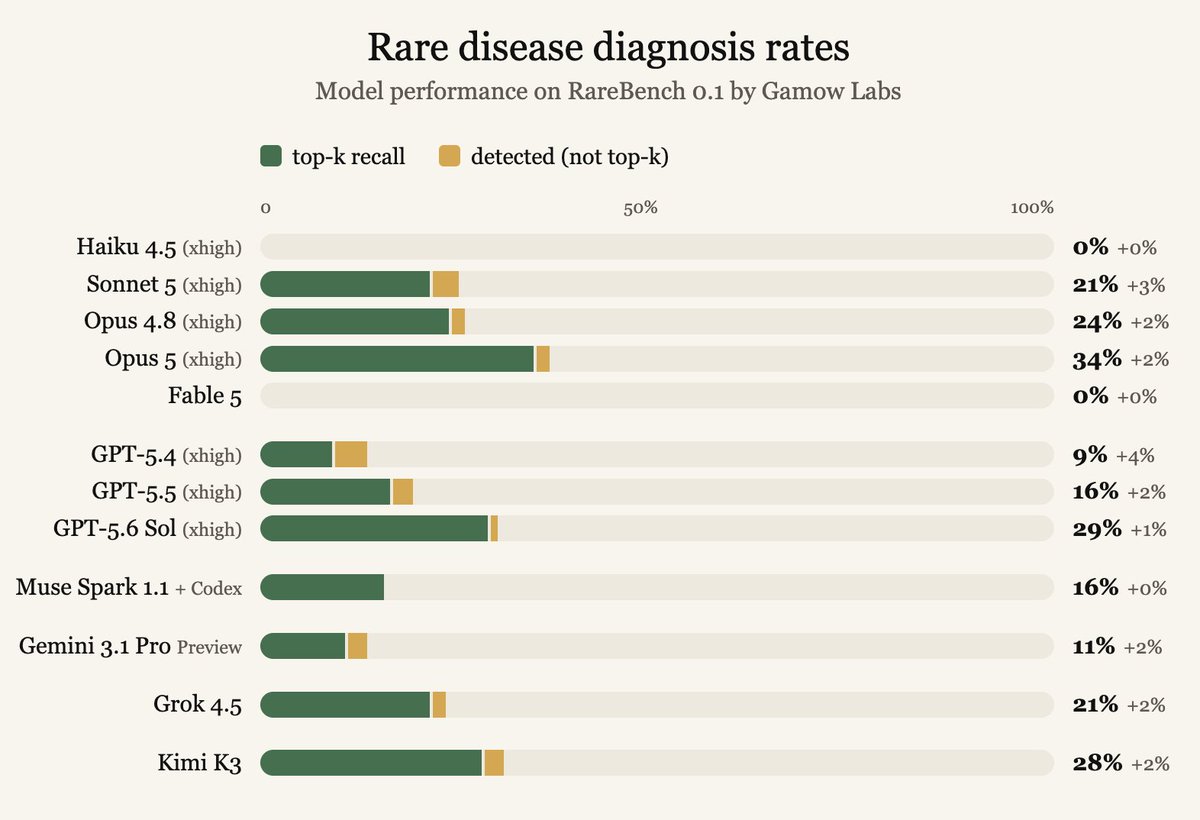
Discussion insight: Two kinds of nuance kept showing up. First, benchmark wins were being attributed to harness design, specialized routing, and environment control at least as much as to base-model quality. Second, the Kimi/Gamow posts pushed the feed to think about cost-per-outcome and error diversity, not just top-line accuracy.
Comparison to prior day: Earlier July discussions leaned heavily on pedagogy around loops and graphs. July 27 made the conversation more empirical, with benchmark artifacts spanning coding, cybersecurity, medicine, and RL infrastructure on the same day.
1.3 Security moved from “be careful” to authorization, proofs, and coalitions (🡕)
The strongest trust theme was that agent security is being re-specified around permission boundaries and public evidence, not generic red-teaming slogans. At least five substantial items pointed to the same design instinct: who asked, what task is allowed, what action is justified, and what proof comes back.
@NVIDIAAI announced (752 likes, 52 replies, 35,377 views) its contribution to the Open Secure AI Alliance, centering NOOA as an open agent-harness research project and turning agent security into a 37-member coalition story instead of a one-vendor positioning move. @fly51fly linked (2 likes, 101 views) the paper “Agent Security Needs Redefinition through a Holistic Framework,” whose attached figures show the same action text can be safe or malicious depending on source authorization, task alignment, action alignment, and data isolation. @posthog argued (24 likes, 2,677 views, 31 bookmarks) that trusting smarter agents without extra controls is like skipping a seatbelt because the car improved, which neatly matched the day’s more formal research language.

@Acurast demonstrated (60 likes, 29 replies, 10,641 views) a Confidential TEE agent on the OKX AI Marketplace that runs shell or Python inside a trusted execution environment on a decentralized smartphone network, with replies emphasizing signed proof of execution and x402 payments. @yashaswini_s_s shared (9 likes, 3 replies, 407 views) a WhatsApp grocery-ordering agent for her grandmother, and the sharpest reply immediately added the missing control model: pre-approved baskets and hard price ceilings so cloned or garbled voice cannot invent a new payable intent.
Discussion insight: The most practical security advice was not “ban autonomy.” It was to narrow authority, prove execution, and separate allowed intents from merely plausible text. That matches both the research paper’s framework and the more productized TEE/payments examples.
Comparison to prior day: July 21 focused on bounded autonomy in wallets and package safety. July 27 broadened that into a coalition launch, an explicit contextual-security framework, and a consumer-payment example that made the authorization problem easy to see.
1.4 Agent workspaces started looking like full operating environments (🡕)
A fourth theme was that “using agents” increasingly means assembling persistent surfaces around them: cloud sandboxes, browser workspaces, terminals, voice layers, memory backends, and review loops. The strongest posts were less about model choice than about where the agent lives and what surrounds it.
@vinvan wrote (65 likes, 10 replies, 16,880 views, 132 bookmarks) that companies are unprepared for the move to cloud agents, then used replies to spell out the operational stack: Open-Inspect/Devin/Cursor for the worker layer, Infisical for secrets, AgentMail for email, and Limrun for iOS simulation. @chakhan22 documented (1 like, 2 replies, 133 views) a real weekly setup built from Claude Code, Codex, Hermes Agent, WezTerm, Herdr, and a post-run “No Mistakes” review pipeline, while also reporting repeated context-limit issues when pairing GPT-5.6 with Claude Code as the harness. @pavlenex showed (228 likes, 9 replies, 9,530 views, 372 bookmarks) Buzz as a collaborative orchestration surface for video capture, reporting, bug triage, and scheduled workflows, but replies immediately complained about battery drain, token tracking, and session caps.
@witcheer explained (34 likes, 6 replies, 865 views, 16 bookmarks) Hermes Agent’s concrete memory and skill controls: timed nudges, a post-reply review pass, optional write approvals, verbose notifications, and a stale-skill curator. @mhdfaran highlighted (17 likes, 9 replies, 4,164 views) Voicebox as a local-first voice layer for MCP-compatible agents, with cloning, dictation, and on-device processing, while @Daniel_Farinax introduced (30 likes, 6 replies, 3,127 views, 12 bookmarks) GrokTerm as a multi-tab PTY host with voice and a shared control plane. @ag2oss released (9 likes, 2 replies, 364 views, 5 bookmarks) AG2 v1.0.0 as a protocol-driven AgentOS for long-running, multi-agent work.

Discussion insight: The common pattern was not “one super-agent.” It was layered surfaces: one tool for secrets, another for browser state, another for voice, another for post-run review, another for memory and skills. Even optimistic operator posts were still full of caveats about caps, cost, approvals, and state management.
Comparison to prior day: July 21 pushed agents into office artifacts like docs, decks, and inboxes. July 27 kept widening the surface area, but the emphasis moved toward the control plane around the agent itself: cloud readiness, terminal hosts, voice I/O, long-lived memory loops, and explicit review surfaces.
2. What Frustrates People
Skill sprawl without provenance
People trying to operationalize skills are still tripping over broken discovery and weak trust boundaries. @kv1nsiii warned (24 likes, 9 replies, 1,287 views, 22 bookmarks) that six viral “42 Claude skills” links pointed to the wrong repository, four more landed at a root folder, and the cited ToxicSkills study found critical flaws in a meaningful share of tested skills. The complaint is not just link rot; it is that installing a skill often means executing a stranger’s code with agent privileges. @vinvan wrote (65 likes, 10 replies, 16,880 views, 132 bookmarks) that cloud-agent stacks now need explicit secrets and sandbox tooling, while the Open-Inspect README states that its shared GitHub App design is safe only for single-tenant deployments. Severity: High. People are coping by reading SKILL.md files first, installing fewer bundles, and narrowing repo or secret scope. This is worth building for because both first-time skill users and advanced cloud-agent operators are still hand-rolling the same trust decisions.
Loops that grade themselves and hide bad state
The core reliability frustration is still invisible drift. @alex_verem wrote (19 likes, 6 replies, 3,515 views, 28 bookmarks) that a bad loop can turn one wrong assumption into “load-bearing” state over many turns, which is why a separate skeptic matters more than a nicer generator. @fly51fly linked (2 likes, 101 views) a paper arguing that the same surface action can be benign or malicious depending on source authorization, task alignment, action alignment, and data isolation, which means content-only checks miss the actual violation. @witcheer explained (34 likes, 6 replies, 865 views, 16 bookmarks) that Hermes now needs explicit memory and skill approval toggles plus a curator process just to keep self-improvement legible. Severity: High. Builders are coping with external evaluators, approval gates, and more visible memory writes. This is worth building for because the failure is subtle, expensive, and repeatedly rediscovered across coding, security, and memory systems.
Cloud agents make secrets and execution state an ops problem
The move to background and cloud agents is exposing a new class of operational pain. @vinvan argued (65 likes, 10 replies, 16,880 views, 132 bookmarks) that many companies are not ready for cloud agents, and one reply said the agent never gets direct AWS access because secrets stay behind moto and database state is restored from snapshots instead. The Infisical guide for Cursor cloud agents makes the same complaint explicitly: static secrets UIs do not solve rotation, audit trails, or snapshot leakage, so secrets need to be pulled at runtime instead of baked into the environment. Severity: High. People are coping with machine identities, runtime secret injection, constrained repo scopes, and isolated sandboxes. This is worth building for because the pain appears exactly where adoption is moving next: long-running agents with real infrastructure access.
Real operator stacks are still expensive, battery-heavy, and context-limited
Even the most enthusiastic workflow posts came with day-to-day friction. In replies to @pavlenex's Buzz walkthrough (228 likes, 9 replies, 9,530 views, 372 bookmarks), one user complained that the app drains battery, hides token usage, and runs into session limits quickly. @chakhan22 documented (1 like, 2 replies, 133 views) repeated context-limit problems when testing GPT-5.6 behind Claude Code, even inside a carefully assembled workflow with Hermes, WezTerm, and a post-run review pass. Severity: Medium. People are coping with local-first layers like Voicebox, tabbed hosts like GrokTerm, and post-run review loops, but the underlying issues are not resolved. This is worth building for because operator fatigue showed up in the same threads that were otherwise most bullish on agent adoption.
3. What People Wish Existed
Authorization-aware control planes
The clearest practical ask was not “make agents smarter.” It was “make them understand who is allowed to ask for what.” @fly51fly linked (2 likes, 101 views) a framework arguing that the same action text can be safe or malicious depending on source authorization, task alignment, action alignment, and data isolation. @posthog argued (24 likes, 2,677 views, 31 bookmarks) that smarter models do not remove the need for external restraints, while the top reply to @yashaswini_s_s's WhatsApp grocery agent (9 likes, 3 replies, 407 views) immediately asked for a pre-approved basket and hard price ceiling. @Acurast shows (60 likes, 29 replies, 10,641 views) one partial answer on the execution side with TEE-backed proof, but not the full user-intent layer. This is an urgent practical need with only partial answers today. Opportunity: direct.
Cloud-agent readiness kits for normal teams
People want a deployable recipe for long-running cloud agents that covers secrets, snapshots, repo access, and sandbox choice without forcing every team to invent the stack from scratch. @vinvan wrote (65 likes, 10 replies, 16,880 views, 132 bookmarks) that many companies are unprepared for cloud agents, then used replies to enumerate the stack pieces: Open-Inspect, secrets tooling, email surfaces, and simulator support. The Infisical guide for Cursor cloud agents covers runtime secret injection, and the Open-Inspect README documents a strong but explicitly single-tenant design, which means the need is partly addressed but still operationally heavy. This is a practical need with direct budget and security consequences. Opportunity: direct.
Memory that survives sessions and changes the next decision
The feed keeps describing memory as the thing that makes agents useful, but the sharper asks are about action, not recall. @Mnilax argued (12 likes, 3 replies, 182 views, 12 bookmarks) that current memory benchmarks ask whether an agent can recall what it saw instead of whether memory changes the next decision after action and feedback. @witcheer showed (34 likes, 6 replies, 865 views, 16 bookmarks) how Hermes now needs explicit approval, notifications, and curation around memory writes, while @chakhan22 uses (1 like, 2 replies, 133 views) Hermes as a practical “second brain” in a larger workflow stack. @0xRafy positions (22 likes, 9 replies, 2,218 views, 26 bookmarks) graph engineering as one answer, but the overall need remains open. This is a practical need with several partial competitors. Opportunity: competitive.
Curated, auditable skill paths instead of viral skill dumps
People want smaller, better, safer skill bundles and learning paths. @kv1nsiii showed (24 likes, 9 replies, 1,287 views, 22 bookmarks) why: broken repositories, duplicate lists, and unreviewed stranger code are a terrible onboarding experience. At the same time, @AiandTechHub pointed to (46 likes, 11 replies, 615 views) IBM’s structured knowledge-graph specialization as the sort of curriculum people actually trust, and @rlaope packaged (18 likes, 1 reply, 1,676 views, 26 bookmarks) Oh My Hermes as a curated operating layer instead of another loose list. This is a practical need with early productized answers, but no clear default. Opportunity: competitive.
4. Tools and Methods in Use
| Tool | Category | Sentiment | Strengths | Limitations |
|---|---|---|---|---|
| Claude Code + Codex | Coding-agent pair | (+/-) | Daily-driver pair for real operator workflows; strong ecosystem around skills, memory, and review loops | Context limits, cost/caps, and still needs external verification |
| Kimi K3 | Open-weight model | (+/-) | Strong coding/agent focus with competitive cost-per-outcome in benchmark charts | Heavy infra footprint; benefits depend on strong surrounding runtime and harnesses |
| MDASH + MAI-Cyber-1-Flash | Cybersecurity harness | (+) | 96% CyberGym result, specialized routing, and lower cost than Microsoft’s prior stack | Domain-specific, preview-style system that depends on large telemetry and orchestration layers |
| Hermes Agent | Agent shell / memory layer | (+/-) | “Second brain” workflows, auto-memory, skill creation, and explicit approval controls | Needs curation, approval tuning, and ongoing cleanup to stay legible |
| Buzz | Collaboration / orchestration | (+/-) | Shared workspace for reporting, bug triage, schedules, and agent coordination | Battery drain, weak token accounting, and session-limit complaints |
| Open-Inspect | Background coding agent | (+/-) | Slack/GitHub/Linear/webhook triggers, scheduled runs, browser automation, and parallel sandboxes | Single-tenant security model and shared GitHub App assumptions |
| Infisical | Secrets management | (+) | Runtime secret injection, rotation, audit trails, and tighter blast-radius control for cloud agents | Adds identity/bootstrap overhead and another operational surface |
| Voicebox | Voice I/O / MCP layer | (+) | Local-first voice cloning, dictation, privacy, and one-call speech for MCP-aware agents | Local setup and hardware/runtime overhead remain on the user |
| AG2 v1.0 | Agent framework / AgentOS | (+) | Protocol-driven multi-agent network, event stream, MCP/A2A, and evaluation hooks | Not a drop-in upgrade from classic AutoGen-style flows |
| AgentENV | Sandbox runtime / agentic RL infra | (+) | Firecracker isolation, fast snapshot/fork, and large-scale agent execution economics | Infra-heavy, Linux/KVM-first, and unsafe to expose directly without extra auth controls |
| GrokTerm | Terminal host | (+) | Multi-tab PTYs, shared control plane, and two-way voice over real shell sessions | Still a WIP, macOS-first, and Linux builds were described as not fully tested yet |
Below the table, the overall satisfaction spectrum ran from “promising but needs scaffolding” to “useful only if you also bolt on the missing control layer.” @chakhan22 uses (1 like, 2 replies, 133 views) Claude Code, Codex, Hermes Agent, and a post-run review pipeline together because no single surface covers memory, execution, and verification alone. @pavlenex showed (228 likes, 9 replies, 9,530 views, 372 bookmarks) the upside of collaborative orchestration, but replies still complained about battery, session limits, and opaque token usage.
The most common workarounds were all boundary-setting moves: runtime secret pull instead of stored secrets, single-tenant deployment instead of shared trust, explicit memory approvals instead of silent writes, and separate review loops instead of self-grading. @vinvan treated (65 likes, 10 replies, 16,880 views, 132 bookmarks) cloud-agent readiness as a stack problem spanning sandboxes, secrets, email, and device simulators, while @witcheer turned (34 likes, 6 replies, 865 views, 16 bookmarks) Hermes memory into an explicitly governed subsystem.
The migration pattern was away from monolithic prompting and toward layer specialization. Model choice still matters, but the day’s strongest artifacts said the durable edge is in context assembly, routing, observability, memory, and proof. Competitive dynamics therefore look less like “one agent wins” and more like a stack split: frontier models such as Kimi K3 fight on cost/performance, systems like MDASH fight on domain harness quality, shells like Hermes and terminal hosts like GrokTerm fight on operator experience, and frameworks like AG2 or runtimes like AgentENV compete on the infrastructure around the model.
5. What People Are Building
| Project | Who built it | What it does | Problem it solves | Stack | Stage | Links |
|---|---|---|---|---|---|---|
| Buzz | @pavlenex | Collaborative agent workspace for reporting, bug triage, video capture, triggers, and schedules | Turns isolated one-person agent sessions into shared team workflows | Shared channels, triggers, schedules, agent actions; deeper stack not disclosed publicly | Beta | post |
| Acurast Confidential TEE agent | @Acurast | Executes Shell or Python inside a trusted execution environment on a decentralized smartphone network | Gives agents confidential compute with signed proof and payment rails | TEE-backed smartphones, Shell/Python, x402 payments, IPFS, OKX AI Marketplace | Beta | post |
| Oh My Hermes | @rlaope | Bundles memory, coding orchestration, wiki building, and domain-specific Hermes workflows | Replaces plugin sprawl with a curated operating layer for Hermes Agent | Hermes Agent, 36 skills, 7 role agents, Kanban, delivery evidence workflow | Beta | post |
| GrokTerm | @Daniel_Farinax | Runs voice-driven agent sessions inside a real multi-tab terminal | Gives agents a native PTY host instead of a fake browser terminal | Rust, PTY host, Grok Voice, multi-tab sessions, macOS app/CLI | Alpha | post, site |
| Voicebox | jamiepine | Local-first voice studio that lets MCP-compatible agents speak and listen | Adds privacy-preserving voice cloning, dictation, and speech output without a cloud voice stack | MCP server, local/offline processing, 7 TTS engines, 23 languages | Beta | repo |
| AgentENV | kvcache-ai | Firecracker-based runtime for large-scale agentic RL and sandbox execution | Cuts the environment cost of training and evaluating agents at scale | Firecracker microVMs, snapshot/fork, fast resume, Linux/KVM | Shipped | repo, post |
| AG2 v1.0 | ag2ai | Protocol-driven AgentOS for long-running multi-agent systems | Gives builders a production-oriented framework with event streams and evaluation hooks | Python package, event stream, multi-agent Network, MCP/A2A, AG-UI, evals | Shipped | repo, post |
| Reelful | @katedeyneka | Mobile-first agentic video editor that plans, edits, verifies, and renders from a prompt | Hides agent complexity behind a phone-native editing flow | Mobile app, media analysis, isolated VM, in-house editing skills, Remotion, verifier | Shipped | post |
| Nextbrowser | @nextbrowser_oss | Managed browser sessions where agents can reuse profiles, scripts, and skills | Gives agents a persistent place to work on the web | Managed browser profiles, live streaming, custom scripts, reusable skills, desktop app | Beta | site, post |
| George / RareBench | @danielmckinn0n | Benchmarks and builds an agentic rare-disease diagnosis workflow | Tries to improve low neonatal diagnosis rates with benchmark-guided agent design | RareBench eval, phenotype+genome inputs, model harnesses, ensemble/error analysis | Alpha | post |
The most distinctive consumer-facing build was Reelful. @katedeyneka showed (12 likes, 1 reply, 251 views) a pipeline that starts with user media and a prompt, asks for explicit plan approval, then hands work to a sandboxed agent that writes a Remotion composition and passes it through a verification layer before render. That same “hide the complexity, keep the guardrails” pattern also showed up in Buzz and Voicebox, where the product surface stays simple while orchestration or voice infrastructure stays underneath.
The biggest repeated build pattern was “give the agent somewhere real to work.” GrokTerm turns the terminal into a multi-session agent host with voice delegation; Nextbrowser does the same for browser profiles and scripts; Oh My Hermes does it for memory, skills, and operating procedure. These are independent projects, but they are solving the same problem from different angles: chats are too thin, so builders are adding persistent workspaces around the model.
The infrastructure-heavy projects were also converging on explicit boundaries. AgentENV optimizes the runtime substrate, AG2 ships a protocol-and-evaluation layer for long-running systems, Acurast adds confidential execution plus proof, and George/RareBench treats benchmark design as the path to a medical agent rather than a side artifact. Across all four, the common pattern is that serious builders are investing in sandboxes, evals, proofs, and reusable control planes before promising more autonomy.
6. New and Notable
Open Secure AI Alliance put agent security into coalition mode
@NVIDIAAI announced (752 likes, 52 replies, 35,377 views) that it is contributing NOOA and other open assets to the Open Secure AI Alliance. That matters because the public framing shifted from one company’s security posture to a shared open-defense effort with concrete harness research and shared tooling.
AgentENV made the agent-runtime layer a product category
@xdotli flagged (15 likes, 1 reply, 1,139 views, 7 bookmarks) AgentENV as its own newly released framework instead of a hidden internal component. The accompanying public docs describe Firecracker snapshots, forkable environments, and large overhead reductions, which makes runtime economics itself part of the day’s news, not just model performance.
AG2 v1.0 pushed open-source frameworks toward AgentOS design
@ag2oss released (9 likes, 2 replies, 364 views, 5 bookmarks) a ground-up AG2 rewrite with event streams, multi-agent networking, MCP/A2A support, evaluation hooks, and a permission-first assistant on top. The important part is not just version number inflation; it is that framework authors are now packaging long-running orchestration, observability, and protocol support as first-class defaults.
RareBench 0.1 made medical-agent evaluation concrete
@danielmckinn0n previewed (3 likes, 1 reply, 630 views) RareBench 0.1 as a 122-case benchmark for rare genetic disease diagnosis and tied it directly to Gamow’s future “George” agent. The attached charts were unusually informative: they compared diagnosis rate, cost, and error diversity in a domain where the baseline problem is still severe.
Acurast showed a public proof-of-execution path for paid agents
@Acurast demonstrated (60 likes, 29 replies, 10,641 views) an OKX marketplace agent that takes shell or Python jobs, runs them inside a TEE-backed smartphone network, and returns signed proof after x402 payment. It stood out because the execution, payment, and proof loop were all described in one public artifact.
7. Where the Opportunities Are
[+++] Cloud-agent runtime governance — The strongest direct opportunity is the layer that sits between a long-running agent and real infrastructure. @vinvan described cloud-agent readiness as a stack spanning worker infra, secrets, email, and simulators, while the Infisical cloud-agent guide, the Open-Inspect README, and @Acurast's TEE demo all point to the same missing bundle: scoped credentials, sandbox policy, execution proof, and reviewable state.
[+++] Persistent agent workspaces — Multiple independent builders tried to give agents a durable place to work instead of another floating chat window. GrokTerm, Nextbrowser, Voicebox, Hermes Agent, and Buzz each attack that from a different surface — terminal, browser, voice, memory, or team collaboration — which makes this a strong convergence signal rather than one-off product taste.
[++] Trustworthy skill and memory supply chains — @kv1nsiii showed that skill discovery is already a trust and install-quality problem, while Hermes and Oh My Hermes show one coping strategy: approvals, curation, role bundles, and lifecycle management. The opportunity is meaningful, but it will be competitive because many teams can ship some version of “curated skills plus review.”
[++] Domain harnesses and benchmark products — SlopCodeBench, MDASH, RareBench, and George all argue that the value is shifting toward benchmarks and orchestration tuned for one job, not generic model access. This looks especially strong in security and healthcare, where buyers can justify paying for evals, routing, stopping rules, and audit trails around a narrower workflow.
[+] Consumer-safe action agents — @yashaswini_s_s showed a believable everyday use case with voice grocery ordering, and Reelful did the same for mobile video editing. The signal is still emerging because the product desire is obvious, but the control layer — payment ceilings, approval plans, verification, and voice safety — is not standardized yet.
8. Takeaways
- Agent quality is increasingly being framed as runtime architecture, not prompt cleverness. Harley Foote’s Claude Code summary, Alex Verem’s prompt/context/harness/loop split, and 0xRafy’s graph-engineering layer all described the durable work as context assembly, evaluation, and state management rather than longer prompts. (source)
- Benchmarking is becoming domain- and workflow-specific fast. The same day produced SlopCodeBench discussion, Microsoft’s 95.95% CyberGym MDASH result, and RareBench 0.1 for rare-disease diagnosis, which is unusually strong evidence that agent builders now optimize for named workloads instead of generic leaderboards. (source)
- Security conversation moved from vague caution to authority, proof, and scope. The contextual-security framework, PostHog’s “seatbelt” framing, Acurast’s proof-backed TEE execution, and the grocery-agent reply about approved baskets all focused on who can authorize an action and how the system proves what happened. (source)
- The most active builders are constructing workspaces around agents, not just agents themselves. GrokTerm, Nextbrowser, Voicebox, Hermes, and Buzz each give the model a more durable environment — terminal tabs, browser profiles, voice I/O, managed memory, or team collaboration — which suggests the interface layer is now a major product surface. (source)
- Cloud-agent adoption will be bottlenecked by ops maturity before it is bottlenecked by raw model capability. The strongest operator thread of the day was Vin Van’s stack checklist for cloud agents, and it lined up with external guidance from Infisical and Open-Inspect on secrets, snapshots, and tenancy. (source)