Twitter AI Agent - 2026-08-01
1. What People Are Talking About
1.1 Context, loop, graph, and harness engineering displaced prompt-only thinking (🡕)
The clearest AI-agent theme was a move away from treating prompts as the whole system. Multiple high-signal posts instead decomposed agent quality into context assembly, retry/control loops, workflow graphs, and harness rules around tools and side effects. The discussion looked less like "which model?" and more like "which layer failed?" — a meaningful shift from generic prompting advice toward operational architecture.
@milesdeutscher said (49 likes, 19 replies, 20,823 views, 77 bookmarks) that Anthropic's new Claude 5 context-engineering guidance convinced him most people were still using Claude wrong. The strongest reply did not ask for a better prompt template; it argued that Claude 5 rewards leaner context and less rule-stuffing. That made the post useful as a public signal that context engineering had become a first-class practice rather than a buzzword.

@elune0x argued (53 likes, 12 replies, 1 quote, 3,261 views, 48 bookmarks) that "your prompt is not your agent architecture" and separated agent failure into loop engineering, graph engineering, and harness engineering. The post's framing was precise enough to be diagnostic: if work repeats forever the loop is broken, if state lands in the wrong node the graph is broken, and if a correct workflow causes the wrong side effect the harness is broken. @DanKornas reinforced the same shift with an open-source Context Engineering learning repository organized around templates, examples, and an evaluation cookbook.
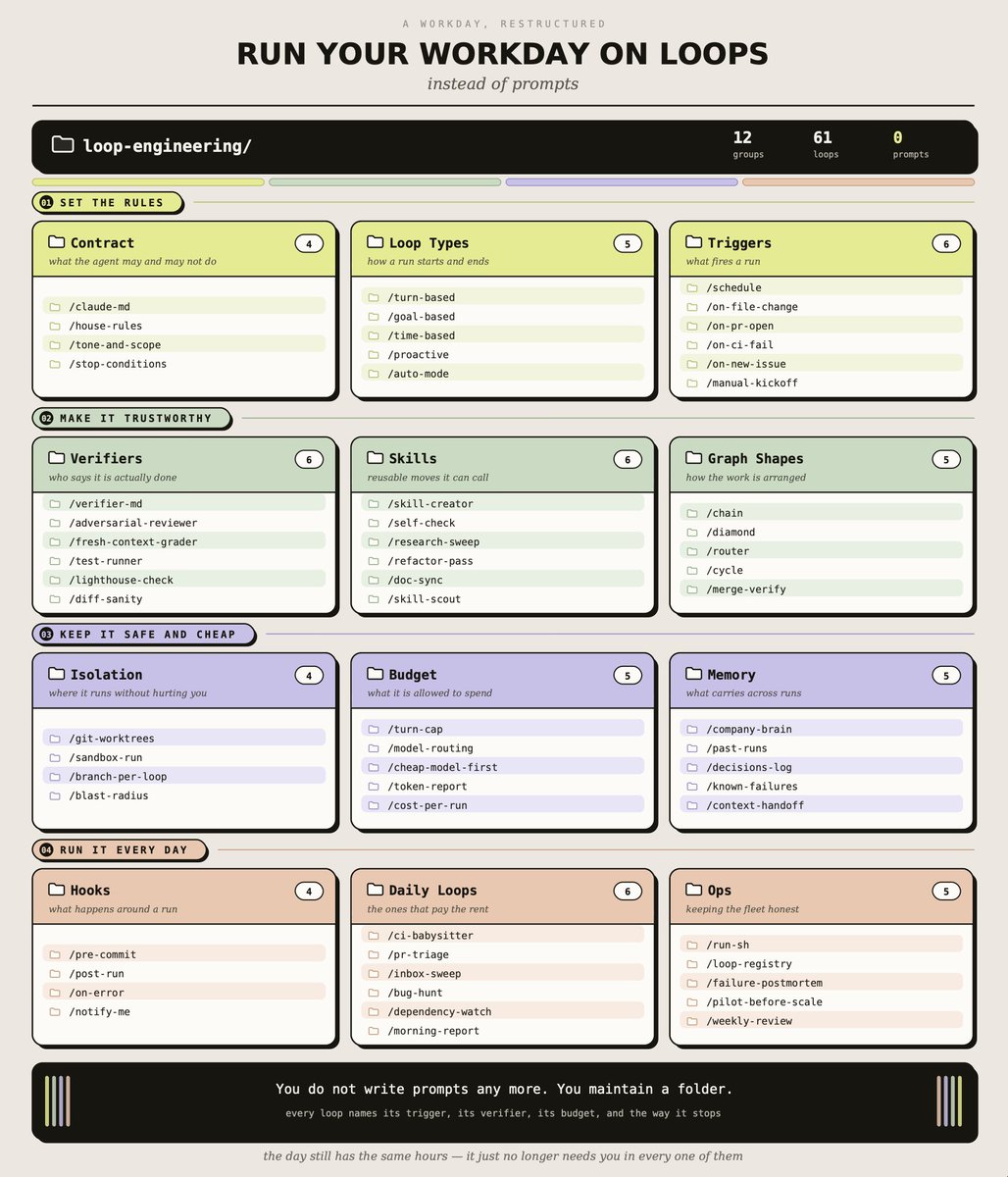
Discussion insight: The replies were not generic hype. They centered on how much context to carry forward, where to place evaluators and verifiers, and how to tell a prompt problem from a topology or safety problem.
Comparison to prior day: July 31 already featured skills and memory packaging. August 1 made the taxonomy itself the product: public diagrams, repos, and mini-playbooks that treat prompting as only one layer of a larger agent system.
1.2 Enterprise harnesses moved from demos to control-plane specifics (🡕)
The second major theme was the jump from "agents are coming" to concrete control-plane design. The strongest posts described scoped memory, durable sandboxes, causal observability, auth layers, and incident-response practices for agent systems already operating at organizational scale. This was the most important productionization signal in the dataset.
@akshay_pachaar broke down (59 likes, 16 replies, 1 quote, 8,832 views, 59 bookmarks) YC's open-sourced QM harness as a multi-user system built around per-scope memory, files, credentials, permissions, scheduled jobs, and durable sandboxes. The linked repo describes a TypeScript/Node/Fastify core backed by Postgres and explicitly designed to swap between Claude Code, Codex, OpenCode, and Pi. The post also singled out QM's Auto security mode, which screens provenance-labelled external data and tool results before they reach the model.

@praveenTweets said (22 likes, 4 replies, 2 quotes, 958 views, 6 bookmarks) that Uber now runs 50,000+ agent sessions per day across thousands of endpoints and open-sourced Agentic Detection and Response (ADR) plus ADR-Bench. The notable detail was not just detection. It was the causal chain ADR captures — prompt to reasoning to tool call to outcome — because traditional EDR sees the file write or network call without seeing the intent that triggered it. The post also reported 97.2% precision on shift-left secret blocking and zero false positives on Uber's internal enterprise benchmark.

@VKazulkin linked (2 likes, 1 quote, 445 views, 8 bookmarks) AWS's new OAuth support for the AWS MCP Server, pushing agent access toward normal identity and governance controls instead of ad hoc credential sharing.
Discussion insight: Replies repeatedly returned to approval fatigue, taint propagation, and whether a system can explain why a tool call happened — not just whether it happened.
Comparison to prior day: July 31 centered model policy and access. August 1 added more specific answers about sandbox lifetime, per-scope isolation, provenance screening, and how enterprise security teams observe agent workflows.
1.3 Portable skills and broader agent surfaces kept spreading (🡕)
The third theme was portability. Builders were not just creating new agents; they were creating ways to move instructions, skills, and working habits across surfaces, and they were widening the set of tasks agents are expected to handle beyond code edits alone.
@startupideaspod described (78 likes, 12 replies, 8,324 views, 98 bookmarks) Buzz as a nearly zero-setup multi-agent surface where the key operational move was pinning each agent to a model and routing work through a chief agent officer. The same post was also unusually candid about limitations: recurring workflows were "not really landing," and the server relay made it slower than working directly in Claude Code for serious software engineering. That mix of enthusiasm and caveat made it more valuable than a generic launch post.
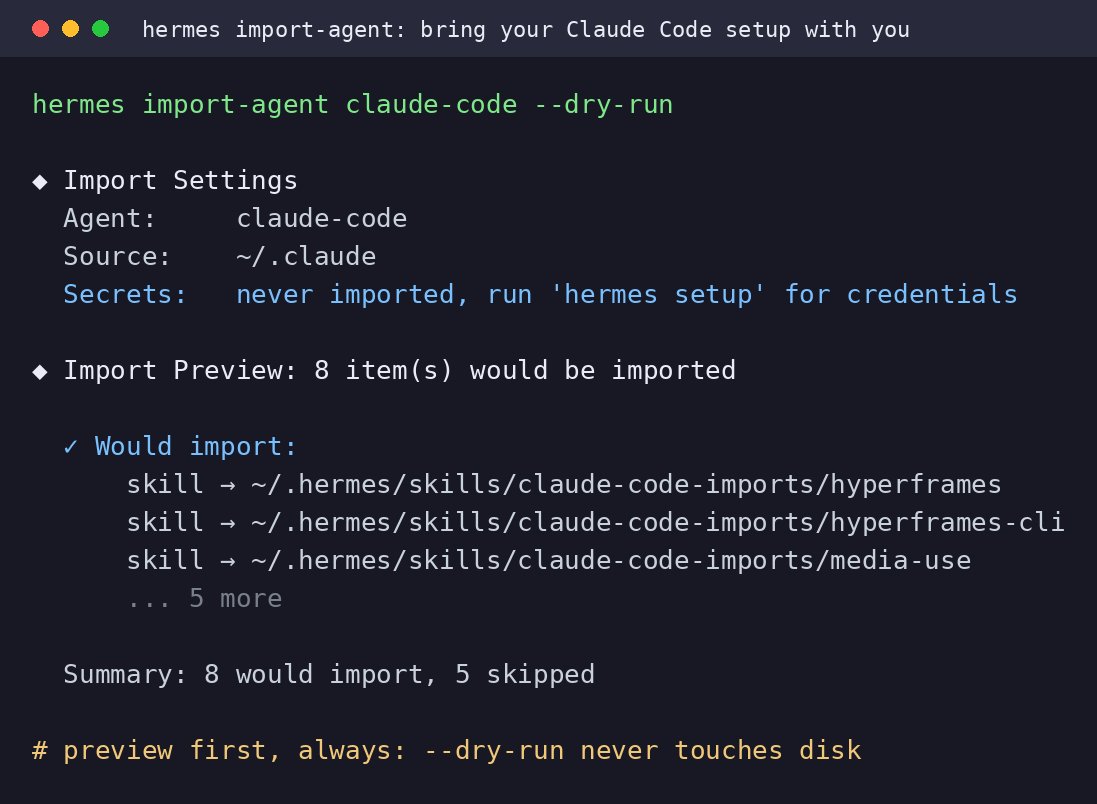
@witcheer showed (18 likes, 7 replies, 1,016 views, 12 bookmarks) that hermes import-agent can migrate a Claude Code or Codex CLI setup into Hermes by mapping global instructions into memories, preserving skills, carrying over MCP configuration, and translating Claude permission rules into an allowlist. The emphasis on preview-before-write and --dry-run mattered because it treated migration as an operational concern, not a toy demo. @mikenevermiss framed (33 likes, 18 replies, 645 views, 9 bookmarks) ByteDance's DeerFlow as an "AI employee" runtime with local or cloud models, long-term memory, isolated sandboxes, and multi-step work that can continue on its own machine.
@elder_plinius (310 likes, 26 replies, 3 quotes, 16,791 views, 162 bookmarks) pushed the same boundary from another angle by treating coding agents as universal editors for video, audio, images, PDFs, spreadsheets, and data cleanup rather than code-only assistants.
Discussion insight: The replies under Buzz and DeerFlow quickly moved from "can this work?" to "will it drift, remember enough, and stay safe?" Portability is becoming useful only when paired with durable operating behavior.
Comparison to prior day: July 31 highlighted skill packs and shared memory. August 1 extended that logic into migration utilities, long-running runtimes, and agents acting as general-purpose file and media operators.
2. What Frustrates People
Long-running loops still drift, repeat work, and burn budget
Severity: High. The frustration was not that people cannot spin up agents. It was that agents become expensive and unreliable once they run long enough to matter. @startupideaspod said Buzz still struggled with recurring workflows and felt slower than direct Claude Code sessions for complex software work, while a reply from an operator running 400+ agents said the hard problems were drift, redoing yesterday's work, and forgetting failed approaches. @ClutchPBCFO documented (68 likes, 5 replies, 11,267 views, 4 bookmarks) a single Scout configuration that burned $1,149.26 of HyperAgent credit before the controls were repaired and backed by a 75-pass test suite. This is worth building for because users now have concrete dollar figures for uncontrolled loops, not just vague anxiety.
Tool access, memory, and approval boundaries are still too weak
Severity: High. @Gustafssonkotte warned (15 likes, 3 replies, 1 quote, 85 views, 11 bookmarks) that the RufRoot issue in Ruflo was not just an exposed MCP bridge with shell access; it was a memory-poisoning problem that survives key rotation and container rebuilds unless the learned store is audited too. @praveenTweets made the same point from the enterprise side: once users approve 50+ actions in a session, manual approval becomes rubber-stamp theater. People are coping by adding provenance filters, auth layers, and audit trails, but the data still shows too many weak boundaries between model intent and real side effects.
Prompt fixes are still over-applied to architecture problems
Severity: Medium. The clearest corrective signal came from @elune0x and @DanKornas: many failures that get treated as prompting mistakes are really loop, graph, or harness bugs. @milesdeutscher pushed the same idea from the Claude 5 docs angle, where the public correction was to simplify and structure context rather than endlessly stuff prompts. This is a meaningful pain point because teams waste time optimizing the wrong layer.
3. What People Wish Existed
Governed execution layers with real memory forensics
Practical need. Posts about ADR, RufRoot, and AWS MCP OAuth all pointed at the same missing layer: systems that can explain why an effect happened, constrain what can happen next, and audit what persisted after an incident. The opportunity is direct because current server-style incident response does not cover agent memory stores or causal chains well enough. Opportunity: direct.
Cost-bounded loop infrastructure with routing, checkpoints, and evaluator gates
Practical need. Buzz's model pinning, Polydao's folderized loop system, and the HyperAgent postmortem all show users reaching for the same missing primitives: cheap-model-first routing, explicit budgets, repeat detection, stop conditions, and post-run verification. The demand is already operational rather than aspirational. Opportunity: direct.
Portable skill, memory, and migration packs
Practical need. Hermes import-agent, DeerFlow, the Context Engineering repo, and Claude Code guide posts all pointed to the same desire: knowledge and operating habits should move with the user across Claude Code, Codex, Hermes, and other surfaces. The opportunity is competitive because many projects are circling it, but the migration and compatibility pain is clearly real. Opportunity: competitive.
Agent surfaces for ordinary files, media, and internal workflows
Emerging need. Posts about DeerFlow, universal file conversion, and Weaver's native widget framework show demand for agents that live outside chat and code editors. This is a broader, more aspirational frontier, but the underlying tasks — documents, images, dashboards, small internal tools — already show up in public use cases. Opportunity: emerging.
4. Tools and Methods in Use
| Tool | Category | Sentiment | Strengths | Limitations |
|---|---|---|---|---|
| Claude 5 context engineering | Method | (+) | Moves users toward leaner context, better retrieval, and less prompt stuffing | Still easy to confuse context design with prompt writing |
| Loop/graph/harness engineering | Method | (+) | Gives clearer failure diagnosis across retries, topology, and governed effects | Needs more tooling and shared vocabulary to apply consistently |
| QM | Harness | (+) | Per-scope memory/files/permissions, durable sandboxes, swappable harness layer | Multi-user wiring and taint propagation remain hard |
| Buzz | Multi-agent workspace | (+/-) | Model pinning, routing agent, shared Claude Code skills | Alpha maturity, slow relay round-trips, weak recurring workflows |
| ADR | Security/observability | (+) | Captures causal chains and triages suspicious sessions cheaply | Approval fatigue and enterprise rollout complexity remain real |
| AWS MCP Server with OAuth | Auth/governance | (+) | Adds standard authorization and better access management | Solves auth, not the broader memory and tool-governance problem |
| DeerFlow | Agent runtime | (+/-) | Local/cloud model support, long-term memory, isolated sandboxes | Safety and trustworthiness still questioned in replies |
| hermes import-agent | Migration utility | (+) | Reuses tuned Claude/Codex setups without rebuilding from scratch | Migration preview helps, but cross-agent parity is still incomplete |
| Context Engineering repo | Learning artifact | (+) | Gives templates, examples, and evaluation guidance | Educational layer, not a runtime on its own |
The overall satisfaction spectrum was widest around work orchestration rather than raw model quality. People sounded most satisfied when a tool added durable state, routing logic, or security boundaries, and most frustrated when it exposed autonomy without budgets, observability, or memory hygiene.
5. What People Are Building
| Project | Who built it | What it does | Problem it solves | Stack | Stage | Links |
|---|---|---|---|---|---|---|
| QM | Y Combinator | Multiplayer agent harness for work with isolated scopes | Lets organizations run many agents without collapsing permissions and state together | TypeScript, Node, Fastify, Postgres, Slack/web, Claude Code/Codex/OpenCode/Pi | Shipped | repo, tweet |
| ADR | Uber | Detects and investigates risky agent behavior across prompts, reasoning, tool calls, and outcomes | Gives enterprise teams observability and detection for agent workflows | Sensor, detection framework, ADR-Bench benchmark | Shipped | tweet |
| Buzz | Jack Lipstone and team | Multi-agent workspace with model-pinned roles and a routing agent | Helps small teams coordinate idea work conversationally | Claude Code harness, global skills, server relay | Alpha | tweet |
| DeerFlow | ByteDance | Open-source runtime for multi-step work with memory and sandboxes | Pushes agents closer to persistent AI-employee workflows | Local/cloud models, long-term memory, isolated sandboxes | Beta | tweet |
| hermes import-agent | Hermes | Imports Claude Code or Codex setups into Hermes | Reduces migration pain between agent surfaces | CLI, memories, skills, MCP config, allowlists | Beta | tweet |
| Context Engineering | Dan Kornas | Open-source learning repo for designing context beyond a single prompt | Helps builders operationalize context design and evaluation | Guides, templates, YAML, Python example, evaluation cookbook | Shipped | tweet |
QM was the strongest builder signal because both the tweet and the repo described the same thing: a thin core around identity, policy, scheduler, and loop execution, with everything else hanging off a durable per-scope sandbox. ADR was equally notable because it treated enterprise agent security as workflow analysis rather than isolated tool-call scanning. Buzz and DeerFlow showed the opposite end of the market: smaller teams want ready-made multi-agent surfaces, but they still immediately run into drift, speed, and trust issues once the work becomes serious.
6. New and Notable
Uber open-sourced ADR and ADR-Bench
The most notable enterprise release was Uber's ADR stack, because it combined public production numbers, a concrete causal-chain model, and a benchmark built from real enterprise telemetry rather than toy prompt-injection examples. (source)
AWS pushed MCP access toward normal OAuth governance
AWS MCP Server OAuth support mattered less as a feature checklist item than as a signal that agent tool access is getting folded into standard identity and security policy. (source)
RufRoot made audit-the-memory-not-just-the-code a visible security lesson
The RufRoot post was one of the clearest public explanations of why agent incident response has a second surface: poisoned memory that survives the patch. (source)
DeerFlow pushed the AI-employee framing into open source
DeerFlow stood out because the pitch combined long-term memory, local or cloud models, and isolated sandboxes in a package framed as continuous work, not assistant chat. (source)
7. Where the Opportunities Are
[+++] Governed execution and memory forensics — ADR, RufRoot, and AWS OAuth all point to the same gap: teams need better policy, observability, and incident response around what agents did and what they learned.
[++] Cost-bounded autonomy for team agents — Buzz, Polydao's loop folder, and the HyperAgent postmortem show demand for budgets, evaluators, stop conditions, and cheap-model-first routing.
[++] Portable skill and migration layers — Hermes import-agent, Context Engineering, and DeerFlow show that users want their tuned instructions, memories, and workflows to survive vendor switching.
[+] Agent surfaces beyond chat and IDEs — Universal file conversion, Weaver, and broader desktop/runtime posts suggest a growing market for agents that work on documents, media, dashboards, and internal widgets.
8. Takeaways
- The conversation shifted from prompt craft to systems craft. The highest-signal posts decomposed failures into context, loop, graph, and harness layers rather than asking for better one-shot prompting. (source)
- Enterprise agent adoption is now forcing real control-plane work. QM and ADR both treated scope isolation, policy, and observability as the hard problems, not model access. (source)
- Security discussions are expanding from tool misuse to memory persistence. RufRoot's lesson was that fixing the exposed interface is not enough if poisoned memory survives the incident. (source)
- Portable operating knowledge is becoming a product layer. Context guides, importers, and migration utilities mattered because people increasingly expect workflows to move across Claude Code, Codex, Hermes, and similar surfaces. (source)
- Agent capability is spreading into ordinary work surfaces. DeerFlow, universal file conversion, and native widget experiments all show agents escaping the narrow coding-assistant box. (source)