Twitter AI Agent - 2026-08-03
1. What People Are Talking About
1.1 Skills stopped looking like prompt snippets and started looking like governed internal infrastructure (🡕)
The clearest shift was from “skills” as reusable prompts to “skills” as an operating layer for company work. The strongest items bundled skills with profiles, approvals, CI, evals, connectors, and dependency management. Compared with the prior day’s catalog and role-library talk, August 3 supplied more evidence about how those catalogs get installed, tested, promoted, and routed inside real organizations.
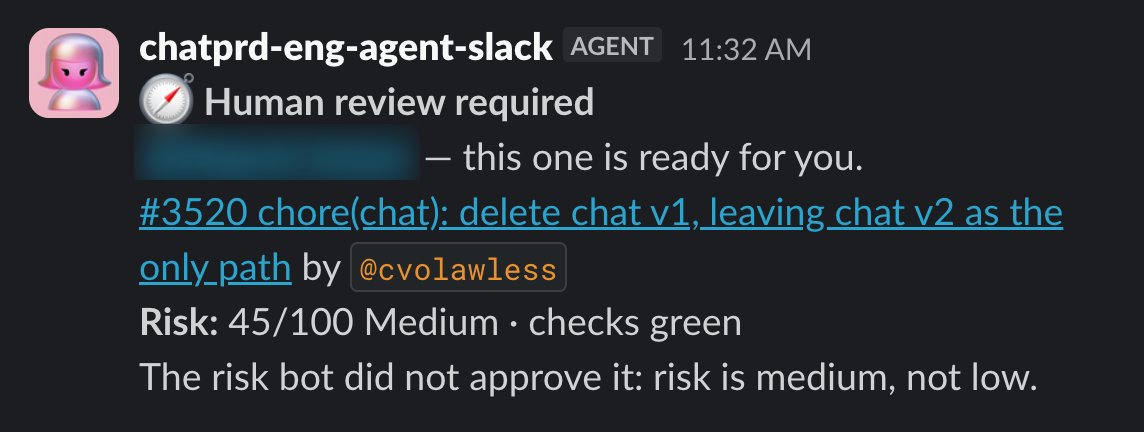
@clairevo recommended (76 likes, 7 replies, 10,893 views, 77 bookmarks) Eve as a default framework for internal agents because it gives builders instructions, skills, channels, and connectors. The quote-tweeted Vercel post said internal agent v already handles finance, comms, docs, marketing, engineering, and business analytics, while @rauchg said (35 likes, 3 replies, 5,033 views, 18 bookmarks) Vercel had “dozens” of agents before consolidating around v as the front door and router. The two screenshots mattered because they showed a real approval loop rather than a slogan: medium-risk PRs required human review, and the review bot surfaced a risk score, confidence, and a written reason for blocking auto-approval.

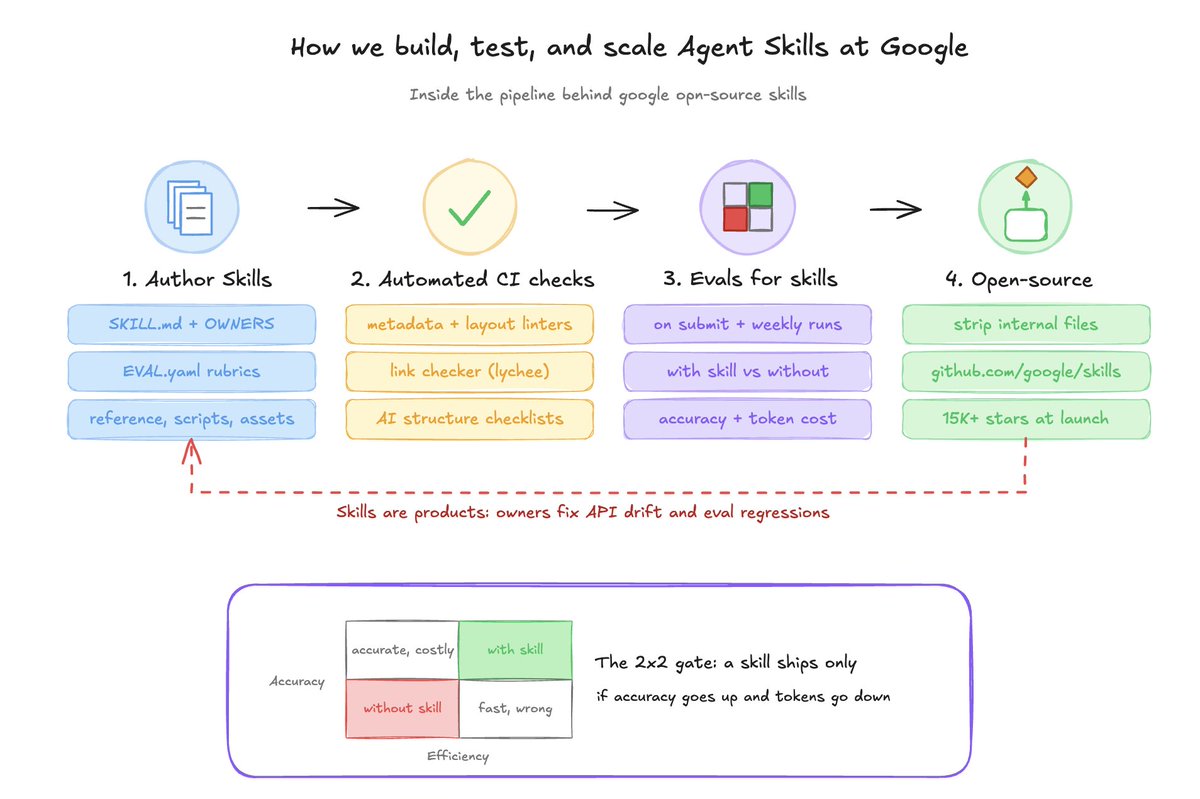
@Saboo_Shubham_ pointed (7 likes, 2 replies, 495 views, 4 bookmarks) to Google’s open-source skills repo and a pipeline for building, testing, and scaling those skills. The image made the governance model unusually explicit: standardized SKILL.md files, automated CI checks, evals, and a 2x2 release gate that ships only if accuracy improves and token cost falls. The public google/skills repo matches that framing with an installable catalog and plugins for Claude Code and Codex.
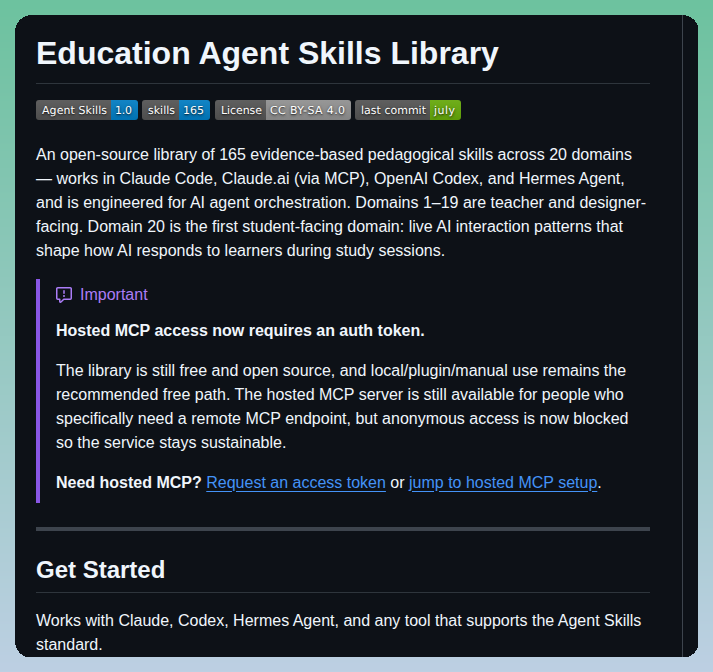
@AIatAMD introduced (52 likes, 3 replies, 1,885 views, 12 bookmarks) AMD Skills as an installable catalog for Cursor, Claude Code, Codex, and Gemini CLI, while @tom_doerr highlighted (12 likes, 1 reply, 2,267 views, 9 bookmarks) an education-specific library with 165 evidence-based skills across 20 domains for Claude, Codex, and Hermes. The Education Agent Skills screenshot also showed a practical distribution wrinkle: hosted MCP access now requires an auth token, while local and plugin installs remain the default free path. A smaller but related operating-layer signal came from @HermesWatcher saying (20 likes, 2,210 views, 29 bookmarks) that Hermes Desktop now has a Kanban board where tasks can be routed to a profile with chosen model, skills, and dependencies.
Discussion insight: The language around skills was more operational than inspirational. Instead of asking what prompt to write, people focused on ownership, CI, auth, install surfaces, routing, and when a skill deserves promotion into a wider org workflow.
Comparison to prior day: August 2 already had large skill catalogs and role-specific method libraries. August 3 pushed further into governance, task routing, and company-internal operating layers.
1.2 Harness and graph engineering became measurable, testable system design (🡕)
The second dominant thread treated agent quality as an engineering problem at the harness layer. Posts centered on performance deltas, failure taxonomies, cross-harness benchmarks, and named stack components rather than general advice about prompting. Compared with August 2’s loop/graph/harness framing, August 3 added harder numbers and clearer repair vocabularies.
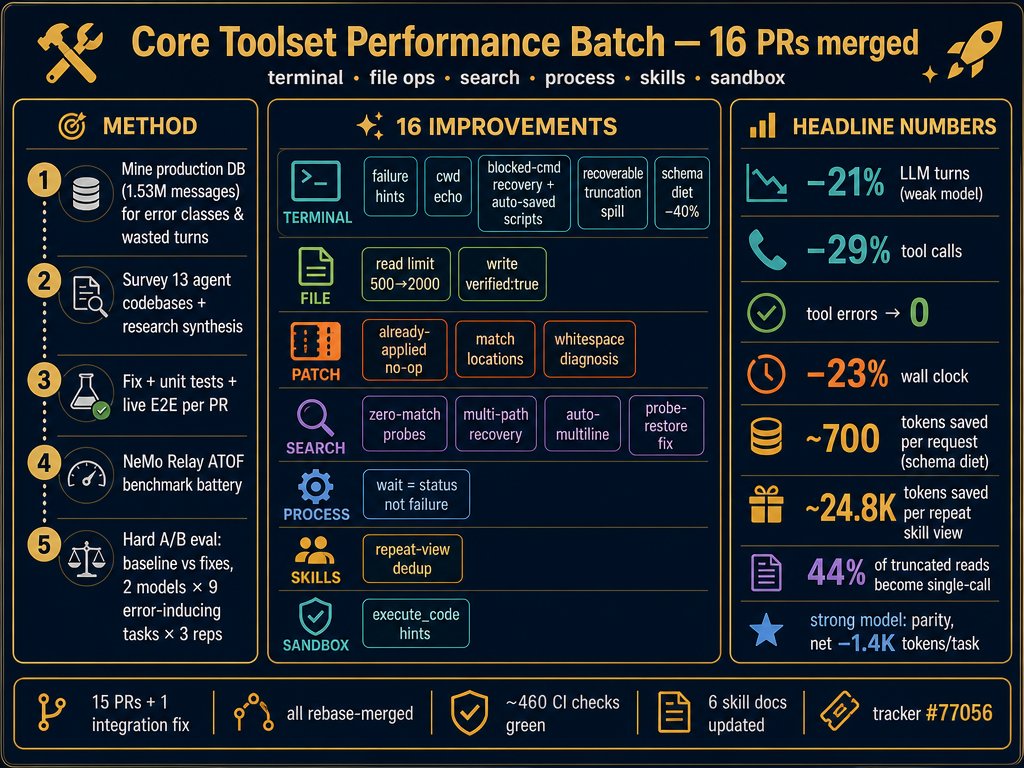
@Teknium reported (769 likes, 58 replies, 56,595 views, 255 bookmarks) that Hermes Agent became “dramatically more efficient” after optimization work across 250,000 conversations. The attached dashboard named 16 changes—from failure hints and larger read limits to NeMo Relay benchmarking—and claimed -21% LLM turns on weak models, -29% tool calls, zero tool errors, and -23% wall-clock time. Replies added practical model-routing nuance: one user said Gemma 4 26B had struggled in Hermes until now, and Teknium replied that he would pick a small Qwen over Gemma.
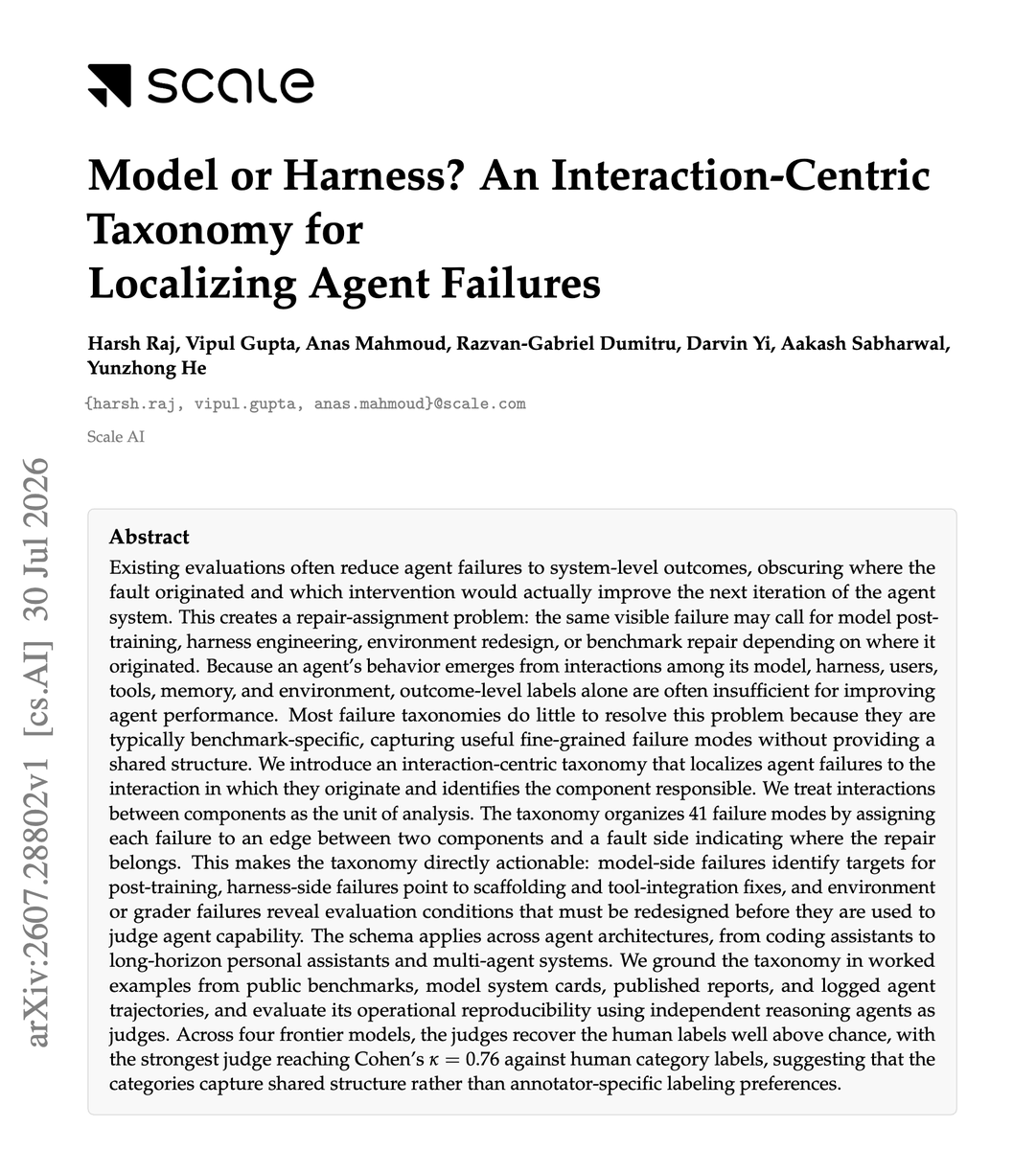
@omarsar0 shared (38 likes, 5 replies, 3,640 views, 67 bookmarks) a paper that localizes 41 agent failure modes to edges between model, harness, user, tools, memory, and environment. The cover image and abstract mattered because they supplied a repair model, not just a complaint: the taxonomy assigns where the fix belongs, and the paper reports Cohen’s kappa of 0.76 between the strongest judge and human labels across four frontier models. A reply from @shlokbuilds sharpened the point by saying many real bugs collapse to the same pattern: the agent acts on a tool response it never checked.
@YangKevinG argued (19 likes, 1 reply, 2,184 views, 15 bookmarks) that Qwen3.8-Max post-training varies task, workspace, harness, skills, and verifier together so the model learns a more portable agent policy instead of overfitting to one scaffold. The attached chart showed Qwen3.8-Max staying within a narrow band of Claude Code, Codex, OpenClaw, and Hermes on cross-harness CoWorkBench, WorkspaceBench, and JobBench comparisons.

@iiiichigo_chan listed (20 likes, 4 replies, 566 views, 19 bookmarks) a concrete graph-engineering stack built from LangGraph, Pydantic AI, OpenAI Agents SDK, Google ADK, Microsoft Agent Framework, Temporal, LiteLLM, Langfuse, and Flowise. The image simplified the argument down to a clear distinction: a single prompt answers once, while a graph branches, verifies, recovers, and routes. The teaching wave was broader than one tweet: @LunarResearcher shared (32 likes, 9 replies, 2,450 views, 35 bookmarks) Andrew Ng’s course on agentic knowledge graphs as structured memory, and @0xMorlex framed (39 likes, 16 replies, 1,862 views, 33 bookmarks) graph engineering as testing which node ran, which tool fired, and where correction loops broke.

Discussion insight: Replies did not ask for “better prompting.” They focused on tool skepticism, edge-localized debugging, evaluator design, and how well a system generalizes across different harnesses.
Comparison to prior day: August 2 turned loop, graph, and harness into a shared vocabulary. August 3 added dashboards, taxonomies, and benchmark charts that treat the harness as something to measure and regress-test.
1.3 Open workspaces and role-routed stacks competed to become the default agent shell (🡕)
A third theme was the rise of public repos that package the shell around the agent: org-wide workspaces, role-routed coding stacks, and JSON-first tool surfaces. The common move was not “one smarter agent,” but an interface that scopes work, routes it, and leaves a cleaner audit trail. This extended August 2’s Buzz and DeepSeek discussion by adding more public implementation detail and open-source surfaces.
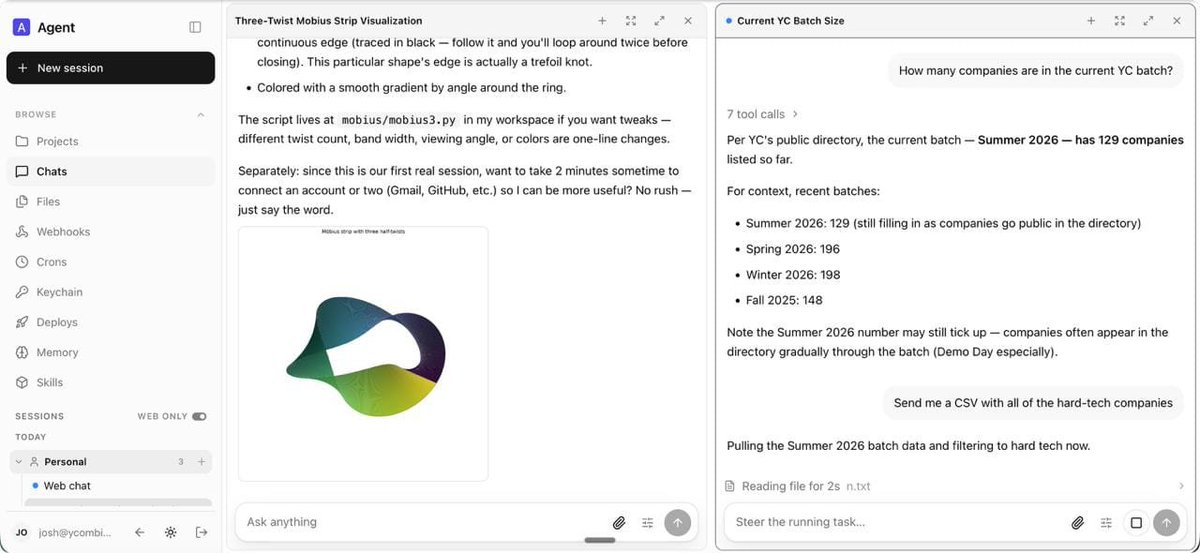
@RoundtableSpace said (60 likes, 18 replies, 50,500 views, 19 bookmarks) Y Combinator open-sourced QM, its multiplayer harness for running work in Slack and on the web. The public repo describes per-person and per-room memory, files, keychain views, permissions, crons, web apps, and durable sandboxes, and the screenshot showed a web chat UI beside a scoped workspace rather than a consumer-style chat box.
@cyrilXBT claimed (156 likes, 16 replies, 26,428 views, 250 bookmarks) that GPT-5.6 plus open-source Sol Advisor let him cancel a $200/month Claude subscription. The public repo describes a Codex-native workflow where a primary Sol session owns requirements and verification, Terra handles bounded implementation, and a fresh Sol review is mandatory before acceptance. That mattered less as model tribalism than as evidence that people are actively packaging role-routed coding systems around the same base models.
@thetreygoff released (1 like, 3 replies, 149 views, 2 bookmarks) an open-source exa-agent CLI that exposes the Exa API as a non-interactive, JSON-first tool for agents, while @marcominerva updated (3 likes, 1 reply, 65 views) SqlDatabaseVectorSearch to use Microsoft Agent Framework for reformulation, RAG, streaming, and SQL-backed vector search. Both projects mattered because they were not model launches; they were agent-facing infrastructure surfaces.
Discussion insight: The differentiators were routing, scopes, JSON contracts, and durability—not just model brand. Builders kept reaching for shells that make an agent easier to supervise, replay, or slot into an existing workflow.
Comparison to prior day: August 2 had rumor-heavy coding-agent competition and router-style demos. August 3 added more public repos and more concrete implementation surfaces.
1.4 Containment, untrusted input, and memory hygiene became explicit architecture requirements (🡕)
Security talk shifted from generic trust worries into specific control models: who the agent authenticates as, what external data reaches the model, and what memory is allowed to persist. That made the day feel more operationally serious than yesterday’s remote-desktop and OAuth conversation. The strongest items did not ask whether agents are risky in the abstract; they asked how to classify, constrain, and audit them.
@MalwareJake released (50 likes, 6 replies, 3,564 views, 25 bookmarks) the CUSTODY framework as a shorthand for agentic risk and containment. The public repo defines a Level/Mandate/Reach profile plus seven pillars covering release conditions, untrusted input, supervision, temporary authority, observability, disposal, and egress, which is much more concrete than generic “AI safety” language.
@mardehaym warned (23 likes, 5 replies, 1,385 views) that coding agents can be weaponized through README files, config files, and comments when repo content is treated as trusted instructions. The post was specific about countermeasures too: 0% AI zones for auth, payments, encryption, and PII; least-privilege file access; full prompt/response logging; and a V.U.E. gate that requires outputs to be verified, understood, and explainable before they ship.
@koplenkoo argued (24 likes, 3 replies, 1,353 views, 19 bookmarks) that persistent memory without write rules quietly becomes an unchecked dossier, and his checklist—who said it, is it still true, should it survive this session, when does it expire, can the user delete it—was one of the clearest memory-governance prompts in the dataset. The linked New Stack article reinforced the same point from the MCP side: direct API allowlists are not governance once agents act across enterprise trust boundaries; structural least privilege and tool-call audit context are.
Discussion insight: The most useful replies and linked material cared less about “responsible AI” branding than about inherited credentials, kill switches, structural scoping, and write-policy questions.
Comparison to prior day: August 2 centered trust on where the agent ran and whether OAuth existed. August 3 focused on containment taxonomies, repo prompt injection, and memory write gates.
2. What Frustrates People
Too many standalone agents and not enough shared operating layers
Severity: High. @rauchg said (35 likes, 3 replies, 5,033 views, 18 bookmarks) Vercel had “dozens” of agents until v became the router and front door, @clairevo recommended (76 likes, 7 replies, 10,893 views, 77 bookmarks) Eve as a default framework for internal agents, and @HermesWatcher said (20 likes, 2,210 views, 29 bookmarks) Hermes Desktop only “finally has an operating layer” now that Kanban can route tasks to profiles with chosen models, skills, and dependencies. The frustration is not that agents cannot do work; it is that too many of them show up as disconnected entry points with no shared routing, review, or ownership model. The coping move in today’s data was consolidation: one front door, explicit profiles, shared skills, and task-level dependency management. This is worth building for because multiple high-signal posts treated it as a prerequisite for serious internal use.
Agent failures still hide in the seams between model, harness, tools, memory, and environment
Severity: High. @omarsar0 shared (38 likes, 5 replies, 3,640 views, 67 bookmarks) a 41-mode failure taxonomy because outcome-only debugging does not say where a repair belongs, and one reply summarized the everyday version of the problem: the agent acted on a tool response it never checked. @Teknium reported (769 likes, 58 replies, 56,595 views, 255 bookmarks) a large optimization pass across 250,000 Hermes conversations just to cut wasted turns and tool errors, while @0xMorlex framed (39 likes, 16 replies, 1,862 views, 33 bookmarks) graph testing as verifying which node ran, which tool fired, and where correction loops broke. The common workaround is to add reviewers, evaluators, graphs, and more structured harnesses around the model. This is worth building for because today’s data kept pointing to the harness as the real repair surface.
Over-privileged agents and untrusted repo content are still a live operational risk
Severity: High. @MalwareJake released (50 likes, 6 replies, 3,564 views, 25 bookmarks) CUSTODY because an agent’s effective authority can drift well beyond its granted authority, and @mardehaym warned (23 likes, 5 replies, 1,385 views) that README files, config files, and comments can steer coding agents into attacker-controlled behavior when repository content is treated as trusted context. The linked MCP governance article added the enterprise version of the same complaint: allowlists are not enough once agents act across teams, trust boundaries, and inherited credentials. Today’s visible coping strategies were least-privilege path restrictions, human approval, audit logging, and structural scoping. This is worth building for because the objections appear before the work starts.
Persistent memory still lacks clear write rules
Severity: Medium. @koplenkoo argued (24 likes, 3 replies, 1,353 views, 19 bookmarks) that the real problem is not storing memory but deciding what gets written, whether it remains true, when it expires, and whether users can inspect or delete it. @Skaly__Bull warned (19 likes, 4 replies, 1,429 views, 16 bookmarks) that long interaction histories turn retrieval stale and can make an agent “poison itself with its own notes.” The workaround in today’s data was to move toward structured graphs or curated write gates rather than dump everything into long-lived memory. This is worth building for, but it looks more like systems policy than a cosmetic memory feature.
3. What People Wish Existed
Company-wide agent front doors, not dozens of disconnected bots
Practical need. @rauchg wrote (35 likes, 3 replies, 5,033 views, 18 bookmarks), “I just want ${company}.com!,” which is the cleanest statement in the dataset of the need for one shared agent surface instead of a sprawl of separate bots. The Claire/Eve post, the Hermes Kanban post, and QM’s public repo all point at the same missing layer: one interface that routes work to the right profile, skill set, dependency chain, and approval flow. Opportunity: direct.
Skills that ship with owners, CI, and evaluation gates
Practical need. The Google skills pipeline image showed skills moving through CI and a 2x2 eval gate before release, @AIatAMD said (52 likes, 3 replies, 1,885 views, 12 bookmarks) users should be able to “pick only the skills you need,” and the Education Agent Skills screenshot showed distribution itself now needs auth and sustainable hosting rules. The common request is not more prompts in the abstract; it is curated, installable skill packs with clear ownership, low noise, and compatibility across agent runtimes. Opportunity: competitive.
Structural containment and least-privilege defaults for agents
Practical need. The public CUSTODY repo exists to keep granted authority aligned with effective authority, while the linked MCP governance article says an administrator should be able to inspect active connections, exposed tools, and users without chasing config files. @mardehaym described (23 likes, 5 replies, 1,385 views) coding agents with shell access and production credentials following instructions hidden in repository files, which makes the need urgent rather than theoretical. Opportunity: direct.
Memory that can forget on purpose
Practical need. @koplenkoo asked (24 likes, 3 replies, 1,353 views, 19 bookmarks) the right design questions for any persistent memory layer: who said it, is it still true, should it survive this session, when does it expire, and can the user see and delete it? The counterpoint from today’s graph and knowledge-graph posts is that relationships, provenance, and structure matter more than simply storing more text. Opportunity: emerging.
4. Tools and Methods in Use
| Tool | Category | Sentiment | Strengths | Limitations |
|---|---|---|---|---|
| Hermes Agent | Agent runtime | (+) | Teknium reported fewer turns, fewer tool calls, zero tool errors, and better efficiency for smaller or local models after harness changes | Today’s evidence still showed model-specific tuning choices rather than one universally best setup |
| Eve | Internal-agent framework | (+) | Claire highlighted instructions, skills, connectors, and chat SDK support; screenshots showed approval and risk-review steps in real PR work | No strong limitations surfaced in today’s data |
| QM | Org agent harness | (+) | Shared Slack and web surface with per-scope memory, files, keychain views, permissions, crons, web apps, and durable sandboxes | Deployment requires an org security posture and configuration layer; the default Auto mode still depends on content screening |
| Sol Advisor | Coding-agent orchestrator | (+) | Separates architecture, bounded implementation, and fresh final review in a Codex-native workflow | Requires specific model access and plugin or task setup; the Luna lane only works with explicit authorization |
| Google Agent Skills | Skill catalog | (+) | Standardized SKILL.md layout, automated CI, evals, and plugin distribution across agent harnesses |
Repo is still under active development |
| AMD Skills | Skill catalog | (+) | Official AMD knowledge, scripts, and best practices from client to cloud, installable with the Skills CLI | Tech preview; several catalog items in the README are still planned rather than live |
| Education Agent Skills Library | Skill catalog | (+) | 165 evidence-based skills across 20 domains for Claude, Codex, and Hermes | Hosted MCP access now requires an auth token; curated local installs remain the recommended free path |
| Graph engineering stack (LangGraph, Pydantic AI, Agents SDK, ADK, Temporal, Langfuse, Flowise) | Framework stack | (+/-) | Covers branching, validation, guardrails, routing, retries, tracing, and visual graph building | Presented as a multi-repo composition, not a single integrated product |
| CUSTODY | Containment framework | (+/-) | Gives a shared taxonomy for authority drift, supervision, teardown, and egress | Framework docs are public, but the annex control matrix is still in development |
| Microsoft Agent Framework | Agent framework | (+) | Appeared inside a practical RAG/vector-search app with reformulation, streaming, and built-in source citations | Today’s evidence came from a project update, not a broad comparative discussion |
| exa-agent CLI | Agent-first CLI | (+) | Full Exa API surface, one JSON envelope per call, stable exit codes, and offline self-description | Pre-1.0 and lightly discussed in today’s dataset |
Overall satisfaction was highest when a tool made one of four things explicit: routing, scoped workspaces, governed skills, or containment boundaries. The workaround pattern was to add a layer around the model—Kanban boards, routers, skill catalogs, graph runtimes, JSON-first CLIs, or security frameworks—rather than rely on a bigger prompt. The migration dynamic inside today’s data ran from standalone agents toward shared front doors and from flat context stuffing toward graphs, write gates, and typed tool surfaces.
5. What People Are Building
| Project | Who built it | What it does | Problem it solves | Stack | Stage | Links |
|---|---|---|---|---|---|---|
| QM | yc-software | Multiplayer agent harness for work in Slack and on the web | Gives each person and room an isolated but collaborative agent workspace instead of a personal-only assistant | TypeScript, Fastify, Slack, web UI, Postgres, durable sandboxes, multi-harness core | Shipped | repo, tweet |
| Sol Advisor | DannyMac180 | Codex-native architect workflow with Sol/Terra/Luna lanes and mandatory fresh review | Separates planning, bounded implementation, and acceptance in coding tasks | Codex plugins, GPT-5.6 Sol/Terra/Luna routing, fresh Sol review | Shipped | repo, tweet |
| Google Agent Skills | Open-source catalog of installable skills for Google products and Google Cloud | Distributes reusable operational knowledge to agent harnesses with testing and evals | SKILL.md format, CI, evals, npx install, Claude/Codex plugins |
Shipped | repo, tweet | |
| AMD Skills | AMD | Open catalog of AMD-focused agent skills from local AI to Instinct deployment | Gives coding agents hardware-specific workflows and best practices | Agent Skills standard, Skills CLI, Ryzen/ROCm/Instinct skills | Beta | repo, tweet |
| Education Agent Skills Library | Gareth Manning | 165 evidence-based pedagogical skills across 20 domains | Supplies a structured education knowledge layer for Claude, Codex, and Hermes | SKILL.md skills, local/plugin installs, optional hosted MCP |
Shipped | repo, tweet |
| CUSTODY | MalwareJake | Vendor-neutral containment framework for autonomous agents | Gives teams a machine-readable way to classify and constrain agent authority | Versioned framework docs, Level/Mandate/Reach taxonomy, seven pillars | Shipped | repo, tweet |
| exa-agent | treygoff24 | Agent-first CLI over the full Exa API | Makes web search and research capabilities scriptable for agent runtimes | Rust static binary, JSON envelopes, stable exit codes, offline docs | Alpha | repo, tweet |
| SQL Database Vector Search | Marco Minerva | RAG and vector-search app using SQL Server or Azure SQL plus Microsoft Agent Framework | Lets teams build enterprise retrieval without a separate vector store | .NET 10, Blazor, Minimal API, Azure OpenAI, Microsoft Agent Framework | Shipped | repo, tweet |
The repeated build pattern was “agent infrastructure around other agents”: shared skills, scoped sandboxes, routers, review gates, or JSON-first tools. QM, the Vercel/Eve-style internal-agent layer, and Hermes Kanban all point to the same shape of demand: one durable operating surface for work, not a pile of unrelated bots. A second pattern was specialization—vendor catalogs like Google and AMD, vertical skill packs like education-agent-skills, containment frameworks like CUSTODY, and agent-native tools like exa-agent—that narrow the agent’s job instead of widening it.
6. New and Notable
Cross-harness generalization became an explicit benchmark target
@YangKevinG argued (19 likes, 1 reply, 2,184 views, 15 bookmarks) that Qwen3.8-Max post-training varies task, workspace, harness, skills, and verifier instead of holding the scaffold fixed. The accompanying chart showed cross-harness comparisons against Claude Code, Codex, OpenClaw, and Hermes on three agent benchmarks. That matters because it pushes harness robustness upstream into model training rather than leaving it entirely to downstream prompt choreography.
Containment got a public, release-grade vocabulary
@MalwareJake released (50 likes, 6 replies, 3,564 views, 25 bookmarks) CUSTODY as a public framework with Level/Mandate/Reach profiles and seven control pillars. Paired with @mardehaym warning (23 likes, 5 replies, 1,385 views) about README and config-file prompt injection, it suggests the security conversation is getting more deployable: taxonomies, kill switches, scoping rules, and machine-readable controls rather than generic caution.
7. Where the Opportunities Are
[+++] Company-internal agent operating systems — The strongest evidence today came from Claire/Eve, Vercel’s v, Hermes Kanban, and QM. Multiple posts converged on the same unmet need: one front door that owns routing, shared skills, dependencies, approvals, memory scopes, and collaborative workspaces.
[++] Harness observability and failure-localization tooling — Teknium’s dashboard, omarsar0’s 41-mode taxonomy, Qwen’s cross-harness training notes, and the graph-engineering stack lists all point to the same gap: teams need better ways to see where an agent failed, why it failed, and whether a harness change actually fixed it.
[++] Containment and memory-governance layers for coding agents — CUSTODY, README-injection warnings, MCP structural least privilege, and memory write-gate complaints all show demand for products that can scope authority, quarantine untrusted inputs, enforce write rules, and prove what the agent did.
[+] Vertical and vendor skill packs with real governance — Google Skills, AMD Skills, and education-agent-skills show that packaged expertise is spreading fast, but the durable win appears to be curation, ownership, CI, evals, and distribution controls rather than raw catalog size.
8. Takeaways
- Skills are being treated like product units, not prompt snippets. Google’s pipeline image put CI, evals, and token-cost gates around skill releases, while AMD and education libraries showed installable, multi-runtime distribution. (source)
- The harness is where much of the engineering work moved today. Teknium’s Hermes dashboard and omarsar0’s failure taxonomy both focused on turns, tool errors, and repair boundaries rather than bigger prompts or bigger context windows. (source)
- Teams want one durable agent shell for internal work. The Vercel
vdiscussion, Claire’s Eve workflow, Hermes Kanban, and QM all pointed toward shared routing, scoped memory, and approval-aware task management instead of one-off bots. (source) - Security discussion is shifting toward authority, untrusted input, and memory policy. CUSTODY, README prompt injection warnings, and memory write-gate complaints all treated control boundaries as system design work, not after-the-fact review. (source)
- Open-source agent infrastructure is diversifying around orchestration and tooling surfaces. Sol Advisor, exa-agent, QM, and SQL Database Vector Search were all concrete builds around existing models, showing that the competitive layer is increasingly the shell, workflow, and control plane. (source)