Twitter AI Agent - 2026-08-10
1. What People Are Talking About
1.1 Real deployments moved from copilots to operating models (🡕)
Compared with August 9's emphasis on business workflows and harness vocabulary, August 10's strongest cluster pushed one level deeper: how to redesign an organization or delivery process so agents own meaningful work without losing control. At least five high-signal items described agents as operating infrastructure with specs, verifiers, or tightly-scoped harnesses rather than as freeform assistants.
@a16z shared (150 likes, 8 replies, 75,616 views) that Kavak now runs about 95% of customer interactions and transactions end-to-end on AI, with tripled NPS, doubled sales conversion, 26% lower warranties, and loan approvals in under three minutes. The distinctive angle was organizational redesign: the post explicitly tied the gains to an "agent per customer" architecture, retraining mechanics to ship agents, and throwing away two years of older architecture when it no longer matched the models.
@VirtualElena reframed (119 likes, 8 replies, 22,726 views) the same Kavak material around harness churn and model change. Her thread said every major model release should trigger a fresh model-harness experiment, and replies agreed that the real lesson was deleting scaffolding once it becomes deadweight rather than protecting sunk-cost orchestration.
@mardehaym described (31 likes, 6 replies, 13,642 views) a brownfield financial-services rebuild where a two-person team shipped automated funds movement, underwriting, and investor-access systems inside a live-transaction environment. The key evidence was not "AI was faster" but the process: spec-driven development, prewritten tests, and a deterministic harness because "code that compiles" is not sufficient when money can move incorrectly.
@ravithejads reported (98 likes, 7 replies, 7,895 views) finishing fifth in a GPU kernel competition after building a research loop around coding agents with goal, rules, experiment memory, verifier, and compute. The most useful reply said the artifact trail was the real contribution, because it made the result learnable instead of just impressive.
Discussion insight: The replies valued visible control more than raw autonomy. Kavak responses focused on deleting obsolete orchestration, AutoResearch replies praised verifiers and artifact trails, and the finance thread centered specs and deterministic checks instead of model cleverness.
Comparison to prior day: August 9 treated business agents as repeatable GTM and reporting loops. August 10 extended that into whole-company redesign, regulated delivery discipline, and explicit verifier-driven execution.
1.2 Context, memory, and proof surfaces became the reliability frontier (🡕)
A second cluster treated the reliability problem as one of memory control rather than missing model intelligence. At least six high-signal items converged on the same point: better agents need deliberate forgetting, persistent external state, and evidence that a remembered fact still maps to a real source.
@divaagurlxw argued (128 likes, 5 replies, 4,862 views) that AI engineers should be learning harness engineering, context engineering, cache management, schema repair, evals, observability, cost attribution, and isolation boundaries instead of stopping at prompt engineering. The 176 bookmarks mattered because the post read like a field syllabus for what practitioners think production work now includes.
@_avichawla warned (38 likes, 8 replies, 7,018 views) that ReAct-style loops often keep every failed search result and raw HTML chunk in the prompt forever, so more memory can make an agent worse. Replies pushed the point further: the hard problem is deciding what to drop without discarding the one observation that later makes the plan coherent.
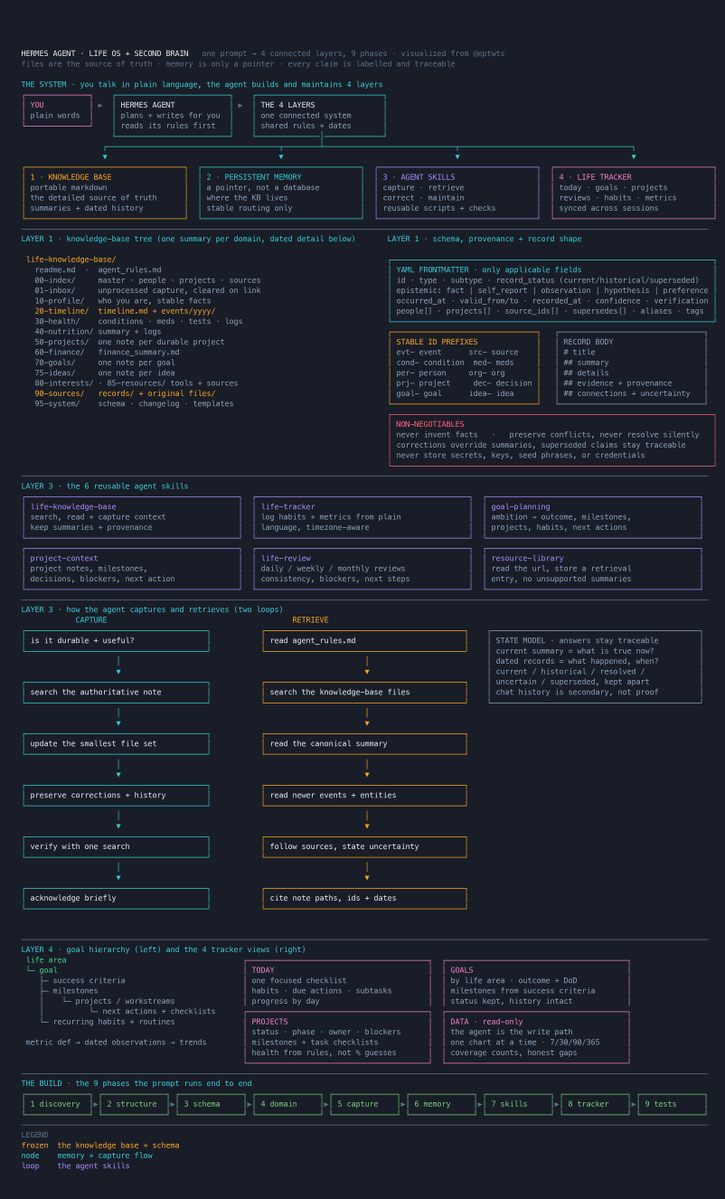
@shannholmberg visualized (57 likes, 3 replies, 6,252 views) a Hermes-based "Life OS" as four connected layers: a markdown knowledge base, a persistent memory pointer, reusable agent skills, and a life tracker that carries habits, goals, and reviews across sessions. The attached diagram mattered because it turned vague "second brain" talk into a concrete file layout, retrieval flow, schema rules, and capture/retrieve loops.
@Vectorizeio claimed (9 likes, 3 replies, 637 views) that coding agents with memory made up to 65% fewer corrections at up to 52% lower cost when paired with self-updating "Knowledge Pages." Even with modest engagement, the signal was notable because it translated memory from a convenience feature into a correction-rate and cost variable.
Discussion insight: The replies were not asking for bigger context windows. They were asking where the durable record lives, who can edit it, whether local or cloud storage is safer, and how an agent should preserve uncertainty instead of silently overwriting it.
Comparison to prior day: August 9 focused on skill-selection ceilings and provenance problems in shared memory. August 10 made the conversation more concrete with file-based memory layouts, self-healing documentation, and explicit arguments for forgetting aggressively.
1.3 The stack diversified below the prompt layer (🡕)
The third cluster moved the conversation below the application surface into models, runtimes, caches, packaging, and custom harnesses. At least seven retained items treated the agent stack as infrastructure that has to be tuned for cost, latency, portability, and approval flow, not just model quality.
@AIatMeta introduced (54 likes, 5 replies, 3,733 views) Muse Glimmer, an open-weight 30B model "optimized for local, always-on agent workflows." Meta's public model page describes it as Apache 2.0 licensed, runnable on a single GPU, and tuned for tool use, long tasks, and failure recovery, while the attached benchmark table put it in direct comparison with Gemma4-31B and Qwen3.6-27B across agentic, coding, safety, and reasoning tasks.
@RedHat_AI reported (28 likes, 1 reply, 1,368 views) that Mooncake pools KV cache across vLLM replicas, pushing prefix-cache hits on agentic traces from 1.7% to 92.2%, cutting time-to-first-token 46x, and lowering latency 8.6x. That is the kind of runtime optimization that only shows up once teams are already running enough agent traffic for cache topology to matter.
@grokkedd said (6 likes, 3 replies, 46 views) that Agent Plugins launched as a shared format for packaging skills and MCP server configs across Codex, ChatGPT, Cursor, GitHub Copilot, VS Code, and Kiro, while @sagar_batchu added (12 likes, 2 replies, 673 views) the operational details teams actually care about: legacy compatibility, exact spec pinning, OAuth-based auth outside the package, and no silent degradation when a plugin cannot be represented faithfully.
@linear linked (5 likes, 292 views) a rare public design note on Linear Agent, where system skills are progressively loaded and a custom harness handles dynamic tool injection, contextual approval, and suspend/resume for sub-agents. @matthewcarano positioned (11 likes, 3 replies, 293 views) Pane as the complementary local-first answer: project-aware context, BYOK models, and OpenClaw-native memory so users stop re-briefing the AI from scratch.
Discussion insight: The recurring question was no longer which model to use. It was where to place the responsibility: in the local model, the cache layer, the packaging format, the custom harness, or the workspace that controls context and approval.
Comparison to prior day: August 9's stack conversation emphasized phone, inbox, and voice surfaces. August 10 shifted deeper into the substrate with single-GPU local models, cluster-wide cache reuse, vendor-neutral plugin packaging, and product-specific harness design.
2. What Frustrates People
Context windows that keep the wrong evidence
The most repeated frustration was not too little context but too much low-value context. @_avichawla warned (38 likes, 8 replies, 7,018 views) that ReAct-style loops keep failed search results and raw HTML in the prompt long after they stop helping, while @divaagurlxw treated (128 likes, 5 replies, 4,862 views) context engineering, cache tradeoffs, and stale-retrieval failure modes as baseline AI-engineering work. @Vectorizeio made (9 likes, 3 replies, 637 views) the same issue measurable by tying better memory to fewer corrections and lower cost, and @matthewcarano positioned (11 likes, 3 replies, 293 views) project-specific context as the practical workaround. People are coping with aggressive pruning, smaller canonical summaries, and memory layers outside the chat window. Worth building for: High.
Harnesses that age faster than the systems they protect
A second frustration was orchestration debt. @a16z reported (150 likes, 8 replies, 75,616 views) that Kavak deleted two years of working architecture to start over, and @VirtualElena argued (119 likes, 8 replies, 22,726 views) that this is the real lesson teams miss when they keep layering on scaffolding after each model improvement. @mardehaym showed (31 likes, 6 replies, 13,642 views) why the pain is severe in brownfield finance: live systems need specs, deterministic harnesses, and tests written before implementation. Linear's public design note, surfaced by @linear here (5 likes, 292 views), makes the same tradeoff explicit by preferring custom harness logic over a generic "call run and wait" flow. Teams are coping by narrowing tool scopes, loading skills progressively, and rebuilding orchestration when models invalidate old assumptions. Worth building for: High.
Agent output people still have to verify by hand
The proof gap remained acute across research and operational threads. @IBuzovskyi said (26 likes, 4 replies, 2,054 views) that before Hermes grounded citations, a research summary could sound confident while still hallucinating a quote or inventing a statistic, and one reply immediately pointed out the next problem: fetched page text is still untrusted input if the source is hostile. @ravithejads used (98 likes, 7 replies, 7,895 views) a verifier and experiment memory to keep an agentic research loop honest, while @amasad proposed (42 likes, 7 replies, 5,886 views) HelpPeer because thousands of agents still investigate the same issue independently. Current workarounds are claim-to-passage links, artifact trails, approval gates, and explicit lookup layers before expensive work starts. Worth building for: High.
3. What People Wish Existed
Durable memory that stays editable and source-aware
The strongest practical need was for memory that survives sessions without becoming a second source of fiction. @shannholmberg showed (57 likes, 3 replies, 6,252 views) a file-based pattern with a knowledge base, persistent pointer, reusable skills, and a life tracker, while @Vectorizeio argued (9 likes, 3 replies, 637 views) that memory should automatically rewrite project documentation so it does not go stale. Pane's public site, surfaced by @matthewcarano here (11 likes, 3 replies, 293 views), makes the same demand explicit with project-specific context and editable memory trails. This is a direct need, and the repeated emphasis on editability, provenance, and local control suggests people want a durable system of record, not a larger chat transcript. Opportunity: direct.
One packaging format for skills and MCPs that does not drift per client
Packaging surfaced as a practical coordination problem, not a standards hobby. @grokkedd summarized (6 likes, 3 replies, 46 views) Agent Plugins 1.0 as a single format for skills and MCP server configs across multiple clients, and @sagar_batchu spelled out (12 likes, 2 replies, 673 views) the operational wish list behind it: exact spec pinning, legacy compatibility, OAuth handled outside the package, and no silent feature loss. The need is concrete and immediate because teams are already running mixed fleets of Cursor, Codex, Claude Code, OpenCode, and others. Opportunity: direct.
Cheaper, always-on runtimes for agents that should not need a frontier bill
Several posts pointed at the same infrastructure desire from different layers of the stack: @AIatMeta introduced (54 likes, 5 replies, 3,733 views) Muse Glimmer as an open 30B model for always-on local agents, @RedHat_AI showed (28 likes, 1 reply, 1,368 views) how cluster-wide KV cache reuse changes latency economics, and @BrianRoemmele argued (36 likes, 12 replies, 3,661 views) that agents need a browser runtime optimized for extraction and screenshots rather than human tabs and animations. Pane adds the same wish from the workspace side with BYOK providers and local-first execution. This is a competitive need: multiple builders are addressing different pieces, but there is still no single obvious default stack. Opportunity: competitive.
Shared coordination layers that let agents reuse each other's work safely
@amasad proposed (42 likes, 7 replies, 5,886 views) HelpPeer around two simple APIs, tell and lookup, so agents can publish what they discover and check whether another agent has already solved the same problem. The desire is practical, especially for security or research workflows where duplicate investigation is wasteful, but the replies show why it is still early: trust, incentives, and adversarial behavior are unresolved. That makes the need real but the market more aspirational than settled. Opportunity: aspirational.
4. Tools and Methods in Use
| Tool | Category | Sentiment | Strengths | Limitations |
|---|---|---|---|---|
| Kavak agent-per-customer system | Vertical operations system | (+) | End-to-end sales, lending, and mechanic workflows with clear business metrics | Stack details are private; the architecture had to be rebuilt as models changed |
| Linear Agent | Product agent / harness | (+) | Progressive system-skill loading, contextual approvals, dynamic tool injection | Custom stack complexity; breadth is intentionally traded for predictability |
| Hermes grounded citations | Research / verification | (+/-) | Claim-to-passage links, quote matching, explicit confirmed/unverified/contradicted states | Still relies on fetched page text as input; hostile or low-quality sources can still mislead |
| Muse Glimmer | Local LLM | (+/-) | Open 30B model for always-on local agents, single-GPU deployment, tuned for tool use and failure recovery | Replies question how much reasoning quality survives aggressive quantization |
| Mooncake | Cache / inference infrastructure | (+) | Large prefix-cache reuse gains on agentic traces; much lower TTFT and latency | Requires multi-replica inference infrastructure and enough repeated-prefix work to matter |
| Agent Plugins 1.0 | Packaging standard | (+/-) | Portable skills plus MCP packaging across multiple clients | Auth, permissions, installation UX, and some clients remain outside the standard |
| Pane | Local-first workspace | (+) | Project-specific context, shared notes/tasks, BYOK models, OpenClaw-native memory | Another workspace layer to adopt; desktop-focused today |
| HelpPeer | Coordination network | (+/-) | Tell/lookup APIs let agents reuse discoveries instead of repeating work | Incentive design, trust, and abuse resistance are unresolved |
Overall satisfaction was highest when the system exposed a narrow and inspectable control surface: Kavak's explicit metrics, Linear's skill-loading boundary, Hermes's citation states, Mooncake's cache numbers, or Pane's project-scoped memory. The most common workarounds were spec-first development, verifier steps, project-level memory rather than one giant transcript, cache pooling, and packaging that keeps auth outside the portable artifact. Migration patterns ran from prompt-centric framing toward stack-centric framing, from cloud-only default setups toward local or BYOK execution, and from per-client agent configuration toward portable packaging. Competitive pressure was visible in every layer: local models versus frontier APIs, product-embedded agents versus general workspaces, and open packaging formats versus vendor-specific conventions.
5. What People Are Building
| Project | Who built it | What it does | Problem it solves | Stack | Stage | Links |
|---|---|---|---|---|---|---|
| Kavak agent-per-customer system | Alejandro Maza | Runs sales, lending, mechanic coaching, and one city operation on AI | Replaces fragmented human handoffs in used-car operations | Persistent agent-per-customer architecture, internal operational data, repeated model-harness experiments | Shipped | a16z tweet; VirtualElena thread |
| AutoResearch loop | Ravi Theja | Research harness for a GPU kernel competition with memory and a verifier | Makes an unfamiliar technical domain learnable and auditable for coding agents | Goal, rules, experiment memory, verifier, compute | Alpha | tweet |
| Hermes grounded citations | Ivan Buzovskyi | Research skill that links claims and quotes back to source passages | Reduces hallucinated summaries and misquoted sources | official/research/grounded-citations, passage matching, source links |
Shipped | tweet |
| HelpPeer | Amjad Masad | Shared tell/lookup network for agents | Lets agents reuse discoveries instead of redoing the same investigation | Two APIs: tell and lookup | Beta | site; tweet |
| Muse Glimmer | Meta AI | Open-weight local model for always-on agent workflows | Lowers the hardware and licensing barrier for local agents | 30B open weights, single-GPU inference, tool-use tuning, Apache 2.0 | Shipped | model page; tweet |
| Linear Agent | Linear | Product agent that progressively loads system skills and tools | Keeps a broad product surface usable without overwhelming the agent | System skills, custom harness, durable workflow engine, contextual approvals | Shipped | blog; tweet |
| Pane | Matthew Carano | Local-first workspace where notes, projects, and AI context live together | Stops users from re-briefing the agent every session | Local-first desktop app, Anthropic/OpenRouter/Ollama, OpenClaw-native memory | Shipped | site; tweet |
Kavak, the anonymous finance rebuild in @mardehaym's thread (31 likes, 6 replies, 13,642 views), and Linear Agent all point to the same build pattern: narrow the agent's world with specs, system skills, or approval logic before you ask it to touch meaningful business state. The differentiator was not model novelty; it was how much control the builder kept over tool scope, evaluation, and recovery.
AutoResearch and Hermes grounded citations show a second pattern around verifiable work. In both cases, the agent is more useful because it leaves behind evidence: experiment memory, a verifier, explicit source passages, or a contradiction state that a human can inspect.
Pane and HelpPeer represent two different answers to the persistent-context problem. Pane keeps memory local, project-scoped, and editable inside one workspace, while HelpPeer treats other agents as a reusable knowledge network that can answer "has anyone already solved this?" before a new run starts. Muse Glimmer sits one layer lower by trying to make that whole stack practical on local hardware instead of defaulting to an expensive frontier API.
6. New and Notable
Hermes made verification visible instead of implied
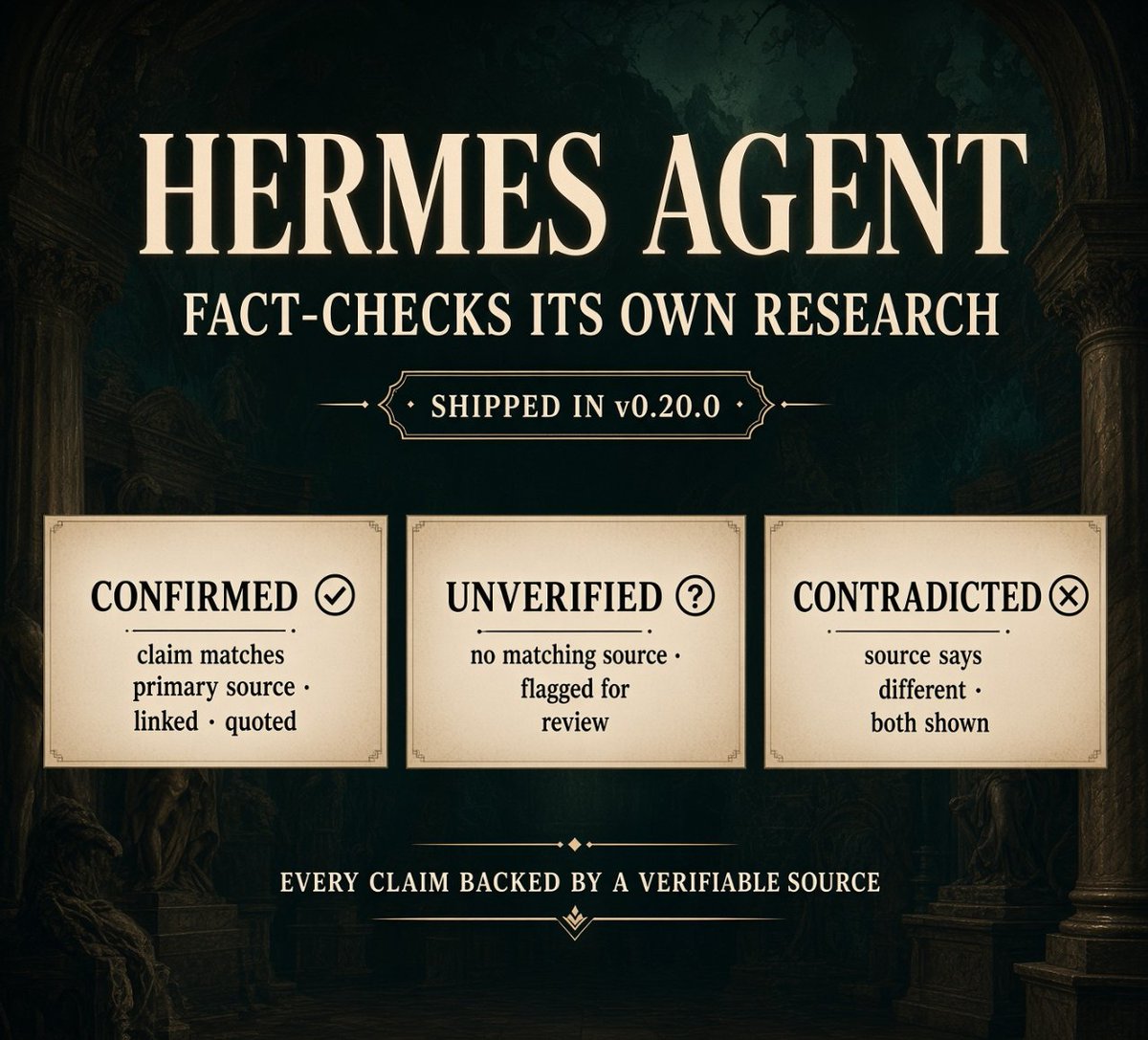
@IBuzovskyi announced (26 likes, 4 replies, 2,054 views) grounded citations for Hermes research, with every claim tied to a source page and every quote checked against page text. What made it notable was not just "better citations" but the explicit output states in the attached image: confirmed, unverified, and contradicted, which turn verification into a user-facing surface rather than a hidden backend step.
Muse Glimmer pushed local-agent models into the benchmark conversation
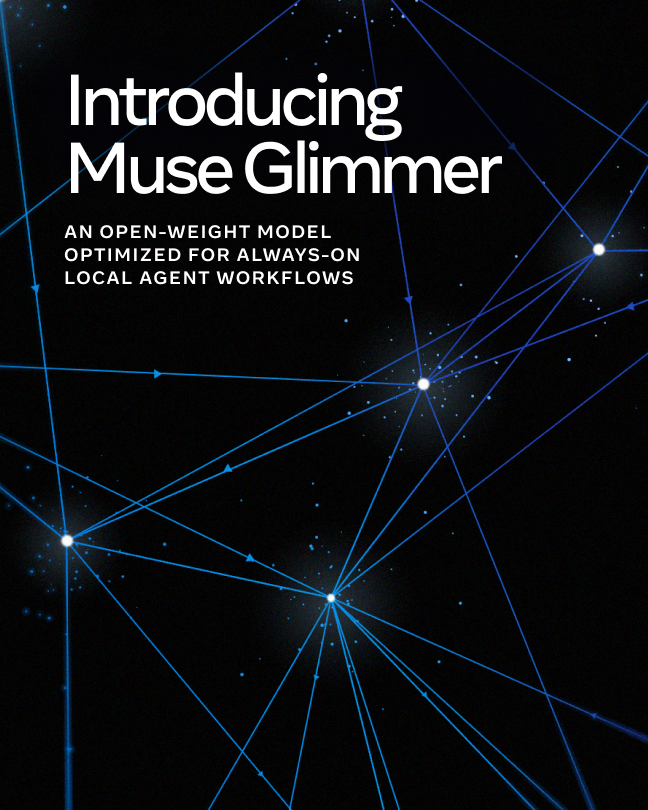
@AIatMeta introduced (54 likes, 5 replies, 3,733 views) Muse Glimmer as an open-weight 30B model for always-on local agents, and Meta's public model page says it runs on a single GPU under Apache 2.0 while targeting tool use, long tasks, and failure recovery. The benchmark table mattered because it framed the release as a serious entry in the agentic/local stack rather than as a hobbyist model drop, even as replies warned that preserving multi-step reasoning under 4-bit quantization is the real test.
Agent Plugins turned portability from a complaint into a shipping format
@grokkedd summarized (6 likes, 3 replies, 46 views) the launch of Agent Plugins as a shared format across Codex, ChatGPT, Cursor, GitHub Copilot, VS Code, and Kiro, while @sagar_batchu showed (12 likes, 2 replies, 673 views) why that matters operationally: one portable package, legacy compatibility, OAuth outside the artifact, and exact spec pinning. The notable part was not that a new spec exists, but that packaging drift is finally being treated as a daily workflow problem instead of an ecosystem footnote.
Kitesurf treated the browser itself as agent infrastructure
@BrianRoemmele argued (36 likes, 12 replies, 3,661 views) that Cloudflare's Kitesurf is a browser built for agents rather than for people, emphasizing low memory/CPU use, fast cold starts, structured extraction, and large-scale parallel sessions. Even without an official URL in the harvested tweet, the signal was notable because it pushed the optimization target below the agent and down into the browser runtime itself, with claimed 3–7x resource savings and compatibility with existing Puppeteer, Playwright, and CDP clients.
7. Where the Opportunities Are
[+++] Memory control layers with provenance and editable summaries — @shannholmberg mapped (57 likes, 3 replies, 6,252 views) a file-based memory stack, @Vectorizeio tied (9 likes, 3 replies, 637 views) memory to fewer corrections and lower cost, Pane's site centers project-specific context, and @_avichawla showed (38 likes, 8 replies, 7,018 views) what happens when context is never pruned. This is strong because the pain, the workaround, and multiple product directions were all visible on the same day.
[+++] Verification and approval surfaces for agent work — Hermes grounded citations, AutoResearch's verifier, the finance rebuild's deterministic harness, and Linear Agent's contextual approvals all point to the same demand: users want agents that leave inspectable proof before or during action, not after a mistake. The evidence came from both research and production settings, which makes this stronger than a niche feature request.
[++] Portable packaging and skill distribution — @grokkedd surfaced (6 likes, 3 replies, 46 views) the format-level launch and @sagar_batchu added (12 likes, 2 replies, 673 views) the day-to-day details of publishing once and installing across clients. The need is immediate, but the remaining auth, trust, and client-coverage gaps keep it in the moderate tier.
[++] Local-first runtimes and cost-optimized agent infrastructure — Muse Glimmer, Mooncake, Pane, and Kitesurf all attacked the same cost/latency problem from different layers: model, cache, workspace, and browser runtime. The opportunity is moderate because the market is clearly forming, but no single stack has emerged as the default answer.
[+] Shared agent commons and cross-agent coordination — @amasad proposed (42 likes, 7 replies, 5,886 views) HelpPeer as a public tell/lookup network for agents. The idea is promising because duplicate investigation is obviously wasteful, but security and incentive questions are still wide open.
8. Takeaways
- The strongest proof points came from teams that redesigned the surrounding system, not just the prompt. Kavak reported that about 95% of interactions and transactions now run on AI with large KPI gains, while the finance-rebuild thread emphasized specs and deterministic harnesses in live systems. (Kavak)
- The hard memory problem is deciding what to keep, what to forget, and how to correct it later. The day's memory discussion centered on pruning, file-based state, self-updating docs, and project-specific context rather than on bigger windows. (shannholmberg)
- Verification is becoming part of the product surface. Hermes grounded citations exposed confirmed, unverified, and contradicted states, while AutoResearch used a verifier as a core part of the loop rather than as an afterthought. (Hermes)
- Cost and latency optimization is moving down into the infrastructure layers beneath the model. Mooncake's cache numbers and Muse Glimmer's single-GPU local-agent pitch both treated always-on agents as an economics problem as much as a model problem. (Mooncake)
- Portability and project-scoped context look like the main escape routes from client drift and re-brief fatigue. Agent Plugins packages skills and MCP configs once across clients, and Pane keeps project context resident in a local-first workspace. (Agent Plugins)