Twitter AI Agent - 2026-08-12
1. What People Are Talking About
1.1 Harness engineering became the default explanation layer for agent quality (🡕)
At least nine retained items treated agent quality as a systems problem around loops, gates, state, and evidence rather than as a prompt-writing problem. The strongest posts were specific about what fails in production: agents declaring victory too early, unnecessary subagent stacks, silent context decay, and parallel joins that erase most of the benefit of fan-out.
@unclebobmartin argued (1,081 likes, 65 replies, 30,640 views, 212 bookmarks) that wrangling “dangerously capricious” agents into a productive harness is the software-engineering challenge of the decade. The replies made the claim more concrete: one builder said the real pain begins once code is production and complex, and another pushed the key design question to what must remain outside the agent’s control.
@khushiirl pointed people to (94 likes, 11 replies, 2,036 views, 73 bookmarks) Learn Harness Engineering, whose public site describes it as a project-based course on environments, state, verification, and control systems for Codex and Claude Code. The tweet itself was thin, but the linked course and screenshot showed why it spread: harness engineering is now being taught as a repeatable discipline rather than as scattered lore.

@femke_plantinga mapped (60 likes, 5 replies, 1,733 views, 40 bookmarks) the progression from prompt engineering to context engineering to harness engineering, with the harness defined as the layer that strings hundreds of turns together with memory, tools, and guardrails. The most useful reply came from @eriks_b, who said a real “Done?” check has to point at a test that was red before and green after; the model saying “yes” does not count.
@gippp69 warned (32 likes, 11 replies, 885 views, 23 bookmarks) that jumping straight from a simple request to an orchestrator-plus-subagents stack can burn 10x the tokens and multiply the failure surface for no gain. @monokern added (18 likes, 8 replies, 362 views, 16 bookmarks) the research version of that argument by surfacing a Stanford Systems Intelligence Lab survey on router, planner-worker, supervisor, and hierarchical designs, with explicit warnings about context decay, token blowout, and shared-state engineering.

Discussion insight: The crowd was not really debating model quality. It was debating where the durable control surface belongs: in external state, evidence gates, schema repair, AST-aware tooling, and smaller architectures that only grow when the task forces them to.
Comparison to prior day: August 11 already pushed the conversation below prompting and into context, harnesses, and governance. August 12 made that language more explicit and more teachable through courses, diagrams, anti-pattern warnings, and loop-design checklists.
1.2 Skills and plugins became the packaging layer for agent capability (🡕)
A second cluster treated skills, plugins, and packaged workflows as the main way agent capability now moves between tools and teams. The conversation was not just about better prompts inside one client; it was about how to package memory, MCP servers, domain logic, and internal workflows so they can be installed, governed, and reused.
@garrytan announced (109 likes, 24 replies, 10,926 views, 71 bookmarks) GBrain v0.45.6.0 with 17 new “brain skills,” saying it now works with Codex and Claude Code. The screenshot mattered because it showed the actual primitives being added — correction-pipeline, fact-check, data-loss-gate, conversation-archive, citation-graph-ingest, and skill-autobench — and the public repository describes GBrain as a 28,312-star persistent brain with synthesis, graph traversal, and gap analysis rather than a plain retrieval box.

@code announced (76 likes, 2 replies, 7,762 views, 24 bookmarks) Agent Plugins 1.0 support, and GitHub’s public changelog says the spec packages skills and MCP servers into one installable plugin that works across VS Code, Copilot CLI, the Copilot app, and SDK clients. The post also made governance part of the story: plugins can be distributed through marketplaces and managed with existing enterprise settings and MCP allowlists.
@I_AM_AYASHA circulated (36 likes, 4 replies, 1,051 views, 33 bookmarks) a list of 13 free Anthropic courses that now explicitly includes Introduction to Agent Skills, Claude Code in Action, and both MCP courses. @ShrivuShankar added (5 likes, 440 views, 4 bookmarks) a production nuance from Abnormal’s internal harness: they treat per-agent skill-definition files as workflow primitives, let integrations interface directly with the sandbox filesystem, and give agents three VM tiers for compute optionality.
Discussion insight: A shared abstraction is starting to appear on both sides of the market. Public vendors are standardizing how skills and MCP servers ship between clients, while internal teams are turning skill definitions into the unit of workflow composition inside their own harnesses.
Comparison to prior day: August 11 showed installable context kits and plugin-style packaging as an emerging pattern. August 12 broadened that into an official plugin standard, a formal course catalog, and public “brain skill” releases that position capability packaging as a first-class product surface.
1.3 Coding agents looked more like long-running operators than copilots (🡕)
The third cluster was about agents as persistent workers with issue boards, desktops, routable tasks, and explicit review boundaries. At least seven retained items described agents that operate over time with sandboxes, worktrees, or dedicated computers, rather than agents that simply answer one prompt and stop.
@harjotsgill announced (133 likes, 50 replies, 10,456 views, 40 bookmarks) Abnormal’s $143M Series C and said the market has moved from arguing that AI code needs its own reviewer to moving the work into the change itself. The linked Nora article makes that claim concrete: Nora ships 200+ pull requests per day, handles about 1,000 Slack requests per day, and runs workflows through skills and personas instead of isolated bot prompts.
@reach_vb shipped (123 likes, 13 replies, 5,415 views, 16 bookmarks) Codex for Linux with parallel agents, worktrees, diffs, skills, automations, and browser workflows. Replies added real operator nuance instead of launch hype: usage burn changes a lot by model and auto-review settings, and one reply said worktree-based parallelism still has an unresolved reconciliation problem when two agents each “succeed” on conflicting changes.
@mardehaym showed (26 likes, 9 replies, 4,350 views, 16 bookmarks) Velocity Core, an autonomous task executor where a board status change triggers a sandbox, a repair loop, a CI pass, and a reviewed pull request. The slide was unusually concrete about the operating shape: trigger, sandbox, loop, gate, and routed execution, with humans kept at intake and review rather than in the middle of the run.

@testingcatalog showed (80 likes, 8 replies, 6,320 views) the same operator shift in voice agents: post-call SMS, email, and API actions tied to system variables such as the caller’s phone number. @Voxyz_ai described (24 likes, 5 replies, 2,887 views, 7 bookmarks) Grok Bot as a named role with its own always-on Linux computer, files, routines, and memory, while also noting the counter-pressure: it is hard to justify another $200 seat when Codex and Claude Code already exist, and replies questioned how isolated each bot’s machine really is.
Discussion insight: The human role keeps moving up a layer. The operator now writes the ticket, approves the PR, defines the budget, or takes over for auth and payments; the agent is increasingly expected to hold the work state in between.
Comparison to prior day: August 11 centered dashboards, cloud playbooks, and operator consoles. August 12 stayed operational but got closer to execution with Linux-native workspaces, board-to-PR loops, lifecycle evaluation frameworks, and hosted per-role computers.
2. What Frustrates People
Systems that still declare victory before the work is actually done
The sharpest frustration was not “the model is dumb.” It was that agent systems still self-grade too easily. @unclebobmartin framed (1,081 likes, 65 replies, 30,640 views, 212 bookmarks) the whole problem as turning capricious agents into a productive harness, and the replies immediately pushed toward control boundaries and regulated-industry customization. @femke_plantinga spelled out (60 likes, 5 replies, 1,733 views, 40 bookmarks) the move from prompt work to harness work, while a reply argued that “Done” only counts if there is external evidence such as a previously failing test that now passes. @mardehaym kept (26 likes, 9 replies, 4,350 views, 16 bookmarks) a human review gate in Velocity Core even after the rest of the loop is autonomous, and @OracleDevs argued (11 likes, 527 views, 6 bookmarks) that evaluation has to span onboard, develop, release, assure, and recover. Current coping strategy: move judgment into explicit gates, evidence files, or reviewer checkpoints instead of trusting the model’s own success narration. Worth building for: High.
Parallelism and orchestration that spend more time waiting than working
A second frustration was that “multi-agent” still hides a lot of waste. @gippp69 warned (32 likes, 11 replies, 885 views, 23 bookmarks) that a four-level stack can burn 10x the tokens for work that needed one call, and replies reduced the lesson to “start dumb and add complexity only when you have to.” @hanakoxbt described (18 likes, 15 bookmarks, 835 views) a subtler version of the same problem: a barrier join can make a 20-agent fan-out finish at the speed of its slowest branch while the trace looks “clean” because idle waiting is not an event. @monokern added (18 likes, 8 replies, 362 views, 16 bookmarks) the research warning that standard handoffs degrade context at every node, and @vincentzed_cuda put numbers on (9 likes, 364 views) the infrastructure version by claiming CPU sandboxes can sit idle more than 75% of the time while vendor billing hides a 20x cost gap. People are coping by keeping the architecture smaller, streaming work past joins when possible, and moving runtime onto spare in-house capacity. Worth building for: High.
Memory and structure layers that still need trust, repair, and measurement
The third frustration was that agents still lose reliability when their memory or tool interface is too loose. @garrytan shipped (109 likes, 24 replies, 10,926 views, 71 bookmarks) GBrain features such as correction-pipeline and fact-check precisely because persistent memory that cannot repair itself compounds mistakes over long horizons. @MrAhmadAwais argued (63 likes, 7 replies, 2,060 views, 6 bookmarks) that many open-model failures are really a finite set of schema bugs that should be patched deterministically in 30–100 lines of code instead of paying for more model calls, while @devagrawal09 said (15 likes, 1 quote, 417 views, 11 bookmarks) coding agents need an AST layer because text-only matching cannot guarantee bindings, imports, or exact locations. The official @AgentMemoryL launch (1 reply, 1 quote, 4 views) mattered for the same reason: the field now wants public rankings instead of vague claims about “better memory.” Current workarounds are self-correcting memory, structural tooling beneath the model, and benchmark frameworks that make competing claims comparable. Worth building for: High.
3. What People Wish Existed
Portable skill packs and managed marketplaces
The clearest practical need was for agent capability to ship once and work across many clients and internal harnesses. @code announced (76 likes, 2 replies, 7,762 views, 24 bookmarks) Agent Plugins 1.0 precisely because teams do not want separate manifests and packaging rules per client, while @garrytan treated (109 likes, 24 replies, 10,926 views, 71 bookmarks) “brain skills” as a reusable layer above Codex and Claude Code. @I_AM_AYASHA showed (36 likes, 4 replies, 1,051 views, 33 bookmarks) that formal training is already following the same abstraction with agent-skills and MCP courses. This is a direct need: people want installable capability packs plus governance, not one-off prompt cargo cults. Opportunity: direct.
Durable control planes for multi-day agent work
The second need was for a state layer that survives sessions, handoffs, and wall-clock time. @mardehaym presented (26 likes, 9 replies, 4,350 views, 16 bookmarks) Velocity Core as a board-to-PR loop with routed metadata and human review gates, and @Chinazhidx surfaced (9 likes, 3 replies, 334 views, 6 bookmarks) LoopX as a control plane that keeps objectives, gates, todos, evidence, quota, and handoffs outside the model context. @reach_vb added (123 likes, 13 replies, 5,415 views, 16 bookmarks) the desktop side with Codex for Linux, where worktrees, browser workflows, and automations live in the same environment developers already use. The need is urgent because long-running work breaks the moment state lives only in the chat transcript. Opportunity: direct.
Memory that can repair itself and also be measured publicly
People also want memory that is more than recall and more than marketing. @garrytan showed (109 likes, 24 replies, 10,926 views, 71 bookmarks) self-correcting memory primitives such as correction-pipeline and fact-check, while the official @AgentMemoryL launch (1 reply, 1 quote, 4 views) published side-by-side rankings instead of just another claim that one framework “remembers better.” @OracleDevs argued (11 likes, 527 views, 6 bookmarks) that evidence depth should rise with autonomy and production risk, which is the same need from another angle. This is practical and increasingly competitive: many people want it, but several credible approaches are already forming. Opportunity: competitive.
Hosted agent workstations without DIY ops or subscription sprawl
A more emotional but still practical need was for persistent agent computers that feel like teammates without making every user become their own infra team. @Voxyz_ai described (24 likes, 5 replies, 2,887 views, 7 bookmarks) the appeal of Grok Bot as a named role with its own always-on Linux computer, files, memory, and routines, and the quoted launch thread claims each bot gets its own hosted machine. But the same post also captured the unmet part: the product still has to justify an additional $200 seat, and replies raised questions about whether bots are really isolated from each other. This is a competitive need: users want the convenience of hosted persistence, but they also want clear boundaries, pricing, and trust. Opportunity: competitive.
4. Tools and Methods in Use
| Tool | Category | Sentiment | Strengths | Limitations |
|---|---|---|---|---|
| Learn Harness Engineering | Course / harness method | (+) | Focuses directly on environments, state, verification, and control systems for Codex and Claude Code | Educational resource, not a turnkey harness |
| GBrain | Memory / knowledge layer | (+/-) | Synthesis, graph traversal, gap analysis, correction pipeline, Codex/Claude Code support | Best used as a separate memory agent; trust still depends on verification and upkeep |
| Agent Plugins 1.0 | Plugin packaging | (+) | Bundles skills and MCP servers once for multiple clients; marketplace and enterprise settings built in | Still requires manifest work and client-specific capability boundaries |
| Codex for Linux | Agent desktop / IDE | (+/-) | Parallel agents, worktrees, diffs, skills, automations, browser workflows on Linux | Usage burn varies by model and auto-review; worktree reconciliation questions remain |
| Velocity Core | Agentic CI harness | (+) | Board-to-PR loop, disposable sandboxes, routed metadata, explicit human review gate | Enterprise integration burden is high; autonomy stops at review |
| LoopX | Control plane | (+) | Keeps objectives, gates, todos, evidence, quota, and handoffs outside model context; supports multi-day loops | Adds another state layer to operate and intentionally keeps final judgment with humans |
| OCI Agent Evaluation Framework | Evaluation / governance | (+) | Lifecycle model ties evidence depth to autonomy, data sensitivity, and production exposure | Framework-level guidance rather than an off-the-shelf product |
| SpaceXAI Voice Agent Builder | Voice agent platform | (+/-) | Post-call SMS/email/API actions, caller variables, stronger action layer after conversations | End-of-call detection and action timing are still tricky product boundaries |
| Agent Memory Leaderboard | Benchmarking | (+) | Makes memory systems comparable beyond generic retrieval claims | Early release and limited to text-memory tracks so far |
| Agentic Data Scientist | Domain framework | (+) | Planning/review agents, continuous validation, MCP integration, scientific-skill support | More moving parts, model coordination, and operator setup than a simple analysis script |
Overall satisfaction was highest when the tool exposed explicit state and review surfaces: GBrain’s correction pipeline, Agent Plugins’ packaging rules, Velocity Core’s gate, LoopX’s control state, Oracle’s lifecycle model, and the voice builder’s action hooks. The common workaround was to move fragile logic out of a single chat turn and into something inspectable: tests, worktrees, quotas, lifecycle phases, plug-in manifests, graph memory, or external control state. Migration pressure ran from prompt tuning toward harness design, from ad hoc local skills toward standardized plugin packaging, and from stateless assistants toward agents that keep durable context across sessions or runs.
5. What People Are Building
| Project | Who built it | What it does | Problem it solves | Stack | Stage | Links |
|---|---|---|---|---|---|---|
| Nora | Abnormal AI | Company-wide agent harness for PRs, Slack workflows, research, and meeting prep | Moves teams from isolated reviewer bots to skills/personas that run inside normal company operations | Slack, GitHub, Jira, Confluence, personas/skills, Python SDK, Airflow-style background jobs | Shipped | article; tweet |
| GBrain | Garry Tan | Persistent “brain” layer that synthesizes answers, maintains a graph, and stores long-term agent memory | Prevents coding and personal agents from forgetting context between sessions and over long horizons | Markdown memory, synthesis layer, knowledge graph, local-first DB, Codex/Claude Code integration | Shipped | repo; tweet |
| Velocity Core | @mardehaym | Autonomous task executor that turns board tickets into reviewed pull requests | Reduces manual handoffs between ticket intake, coding, testing, CI, and PR creation | Jira/ClickUp triggers, disposable sandboxes, GitHub, CI, routed LLM gateway | Shipped | tweet |
| Agent Plugins 1.0 | @code | Open packaging standard for skills and MCP servers across compatible agent clients | Removes duplicated packaging work across IDEs and agent tools | plugin.json, skills/, mcp.json, marketplaces, enterprise managed settings |
Shipped | blog; tweet |
| Codex for Linux | @reach_vb | Linux desktop agent environment with worktrees, diffs, skills, automations, and browser workflows | Brings the full coding-agent desktop workflow to Linux-native development environments | Desktop app, parallel agents, git worktrees, browser automation, diff/review surfaces | Shipped | tweet |
| LoopX | huangruiteng | Local-first control plane that keeps objectives, gates, todos, evidence, quota, and handoffs outside model context | Makes long-running agent work restartable, reviewable, and governable across sessions and agents | Python state kernel, CLI control plane, Codex/Claude Code/Cursor integrations, local durable state | Shipped | repo; tweet |
| Agentic Data Scientist | K-Dense AI | Adaptive multi-agent workflow for planning, executing, and validating data-science tasks | Packages the multi-agent pattern for a specific vertical instead of leaving it as a generic coding demo | Python, Google ADK, Claude Agent SDK, OpenRouter, MCP, scientific skills | Beta | repo; tweet |
The strongest build pattern was “externalize the state, then bound the run.” Nora, Velocity Core, Codex for Linux, and LoopX all add persistent surfaces around the model — ticket state, worktrees, review gates, quotas, or handoffs — instead of assuming the transcript alone is enough.
GBrain stands out because it externalizes a different layer: not workflow state but memory state. Its public positioning is that a coding or personal agent needs a brain that can synthesize, verify, and tell you what it does not know yet, while LoopX does the same kind of externalization for objectives and evidence rather than knowledge retrieval.
Agent Plugins 1.0 and Agentic Data Scientist point to a second pattern: capability packaging and verticalization. One standardizes how skills and MCP servers ship across clients, while the other shows how quickly the multi-agent template is being repackaged for domain-specific work such as data science rather than generic “AI agent” demos.
6. New and Notable
Agent Plugins 1.0 turned skills plus MCP into a portable, governed package
@code announced (76 likes, 2 replies, 7,762 views, 24 bookmarks) Agent Plugins 1.0 support, and GitHub’s public changelog says the spec now packages agent skills and MCP servers into one installable plugin that works across multiple compatible clients. What made this notable was not just portability; the same post also tied plugins to marketplaces, enterprise managed settings, and MCP allowlists, which turns “skills” from a loose community convention into something that enterprises can actually distribute and govern.
LoopX made the control-plane idea concrete with public long-running examples
@Chinazhidx surfaced (9 likes, 3 replies, 334 views, 6 bookmarks) LoopX as a loop-engineering framework that persists objectives, gates, todos, evidence, and quotas outside model context for 200+ hour agent runs. The public repository positions it as a 4,432-star, provider-neutral state kernel and local-first control plane, with documented 200+ hour contribution and experiment trajectories. That matters because it gives the day’s most repeated advice — durable state, bounded slices, handoffs, human judgment — a concrete public implementation.

Agent memory got its first public leaderboard instead of another marketing claim
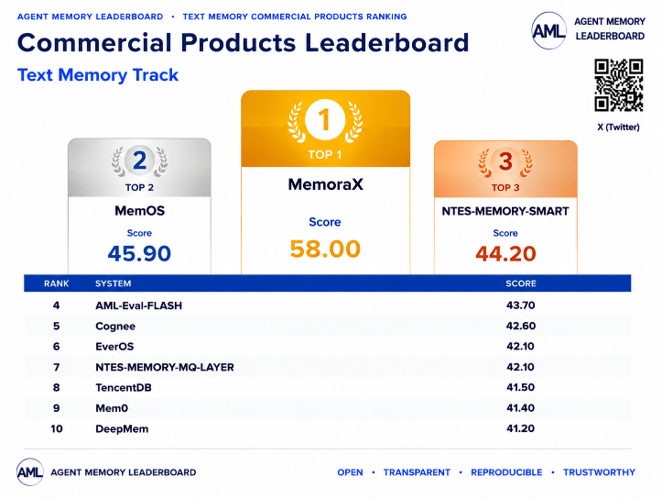
The official @AgentMemoryL launch (1 reply, 1 quote, 4 views) was notable because it published public rankings for both commercial and open-source text-memory systems. The commercial ranking image put MemoraX first at 58.00 ahead of MemOS at 45.90 and NTES-MEMORY-SMART at 44.20, while the open-source ranking image put InvMem first at 45.06 ahead of ReFind at 44.97 and ActiveMemoryIndex at 44.84. After weeks of memory threads, this was one of the first items in the dataset that tried to make the category comparable instead of rhetorical.
A 180-million-repository census suggested coding agents are now visible at ecosystem scale
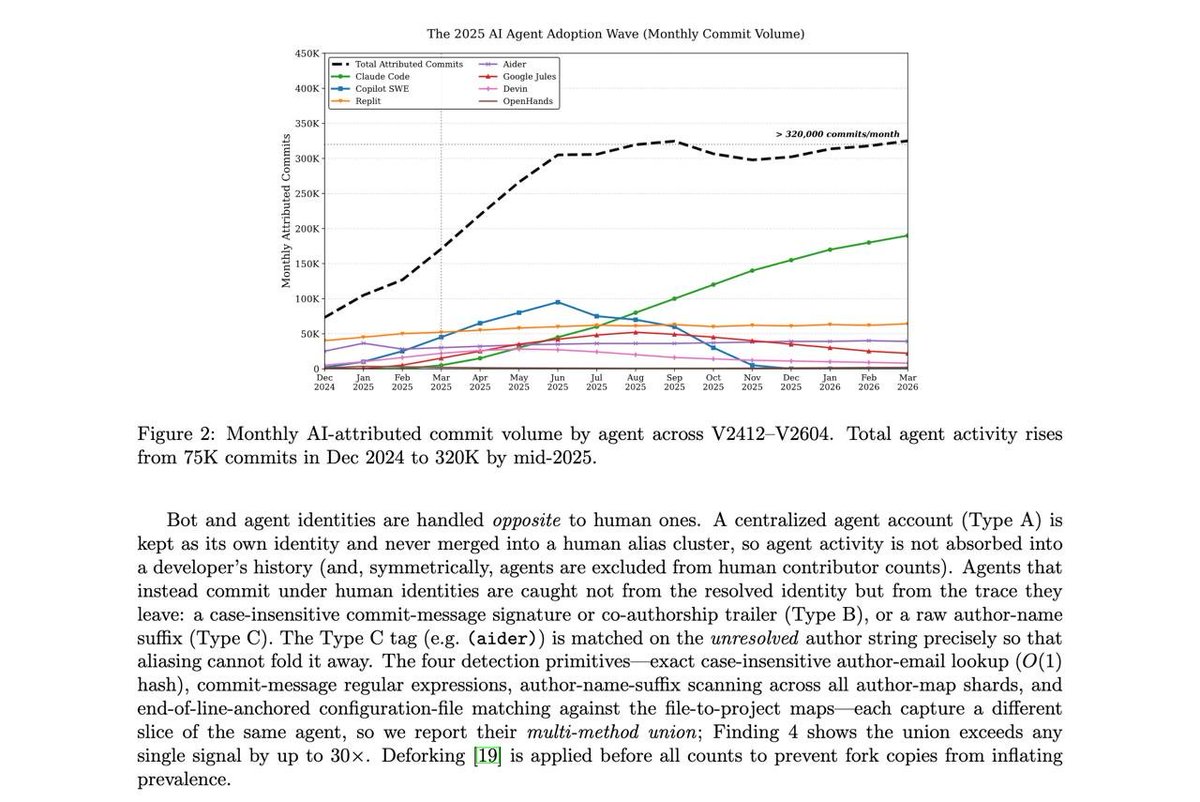
@ikyinusa shared (3 likes, 3 replies, 16 views) a paper claiming that AI coding agents can be detected across more than 180 million repositories. The image in the thread showed monthly AI-attributed commit volume rising from about 75,000 in December 2024 to about 320,000 by mid-2025. Even with low engagement, that is one of the clearest “outside the demo” adoption signals in the day’s material because it points to observable repository activity rather than vendor usage claims.
7. Where the Opportunities Are
[+++] Evidence-backed harnesses for long-running coding agents — @unclebobmartin framed (1,081 likes, 65 replies, 30,640 views) the harness as the decade’s challenge, @mardehaym showed (26 likes, 9 replies, 4,350 views, 16 bookmarks) a board-to-PR loop with a hard review gate, @OracleDevs supplied (11 likes, 527 views, 6 bookmarks) a lifecycle evaluation model, and @devagrawal09 said (15 likes, 1 quote, 417 views, 11 bookmarks) agents need an AST layer while @MrAhmadAwais argued (63 likes, 7 replies, 2,060 views) for structural schema repair below the model. This is strong because the pain, the desired guardrails, and multiple implementation styles all appeared on the same day.
[+++] Cross-client skill and plugin distribution — @code made (76 likes, 2 replies, 7,762 views, 24 bookmarks) packaging and governance official with Agent Plugins 1.0, @garrytan treated (109 likes, 24 replies, 10,926 views, 71 bookmarks) “brain skills” as a reusable product layer, and @ShrivuShankar showed (5 likes, 440 views, 4 bookmarks) the same abstraction inside a production harness. This is strong because users now want skills to behave like installable software, not copied prompt snippets.
[++] Durable control planes and hosted workstations for persistent agents — @Chinazhidx pointed (9 likes, 3 replies, 334 views, 6 bookmarks) to LoopX, @reach_vb shipped (123 likes, 13 replies, 5,415 views, 16 bookmarks) Codex for Linux, and @Voxyz_ai described (24 likes, 5 replies, 2,887 views, 7 bookmarks) the appeal of hosted per-role bot computers. The opportunity is moderate because the need is obvious, but several strong product shapes are already emerging.
[++] Memory systems that can self-correct and also prove they work — @garrytan added (109 likes, 24 replies, 10,926 views, 71 bookmarks) correction-pipeline and fact-checking features to GBrain, and the public @AgentMemoryL rankings (1 reply, 1 quote, 4 views) point to a category where users want both durability and evidence. This is moderate because the need is real and repeated, but the field is already fragmenting into many competing frameworks and benchmarks.
[+] Tooling that reduces hidden orchestration waste — @hanakoxbt exposed (18 likes, 15 bookmarks, 835 views) join barriers, @vincentzed_cuda exposed (9 likes, 364 views) idle vendor billing, and @gippp69 exposed (32 likes, 11 replies, 885 views, 23 bookmarks) architecture overkill. This is emerging rather than mature, but the complaints are concrete enough to support schedulers, profilers, and “smallest viable loop” diagnostics.
8. Takeaways
- Harness engineering is now about proof, not prompt polish. @unclebobmartin framed (1,081 likes, 65 replies, 30,640 views) the category as a harness problem, and the rest of the day kept moving the success condition outside the model and into tests, gates, evidence, and bounded loops.
- Skills are becoming a real distribution unit for agent capability. @code announced (76 likes, 2 replies, 7,762 views, 24 bookmarks) Agent Plugins 1.0, while @garrytan shipped (109 likes, 24 replies, 10,926 views, 71 bookmarks) brain skills on top of GBrain.
- The market is moving from “AI reviewer” toward “AI change executor.” @harjotsgill announced (133 likes, 50 replies, 10,456 views, 40 bookmarks) the move into Agentic Change Management, and @mardehaym showed (26 likes, 9 replies, 4,350 views, 16 bookmarks) the board-to-PR version of that loop.
- Memory discussions are getting more serious because they now include repair and ranking. @garrytan emphasized (109 likes, 24 replies, 10,926 views, 71 bookmarks) correction and fact-checking, while the official @AgentMemoryL launch (1 reply, 1 quote, 4 views) published public scoreboards instead of vague memory claims.
- Long-running agents are escaping the transcript and becoming durable work environments. @Chinazhidx pointed (9 likes, 3 replies, 334 views, 6 bookmarks) to LoopX, and @reach_vb shipped (123 likes, 13 replies, 5,415 views, 16 bookmarks) Codex for Linux as a desktop expression of the same persistence shift.