Twitter AI Agent - 2026-08-14
1. What People Are Talking About
1.1 Agent engineering got codified into teachable stacks and courses (🡕)
At least three high-signal items treated agent work as a named discipline with a stable skill stack rather than as loose prompt craft. The strongest posts converged on the same ingredients: memory, context engineering, tools, triggers, permissions, evaluation, and repository-level control. What changed today was not just enthusiasm, but packaging: maps, recipes, and full courses that make agent engineering look like something teams can train for.
@AndrewYNg shared (2,308 likes, 75 replies, 143,316 views, 3,934 bookmarks) “a map of the most important skills in AI Engineering,” and a reply from Andrew Ng said the effort would be “way beyond a single course,” framing it as a broader DeepLearningAI push around employable AI-engineering skills rather than a one-off lesson.
@nicbstme outlined (304 likes, 9 replies, 35,821 views, 551 bookmarks) a full agent-product recipe: memory, context engineering, skills, tools/MCPs, runtime loops, event triggers, trust/permissions, and evals. The quoted tweet underneath pushed the same idea even further, arguing that the frontier is proactive background agents that wake up on events, and that the real competition is getting high-quality context and useful actions at a viable per-user cost.
@beamnxw recommended (44 likes, 16 replies, 1,296 views) Learn Harness Engineering as a free course for Codex-, Claude Code-, and agent-focused teams, and the screenshot showed why it resonated: lectures on why capable agents still fail, why the repository must become the system of record, why long-running tasks lose continuity, and why agents overreach or under-finish.

Discussion insight: The most useful reply in this cluster came from @mrlaraibkhan, who told Nicolas Bustamante that “everyone ships the collecting and skips the forgetting.” That turns “memory” from a storage problem into a retention-policy problem.
Comparison to prior day: August 13 already treated harnesses and skills as packaging layers. August 14 pushed that one step further into explicit maps, curricula, and stack recipes.
1.2 DeepSeek Harness kept the field focused on pluginized runtimes, logs, and safe self-modification (🡒)
DeepSeek Harness remained the day’s reference point, but the conversation moved past launch hype and into implementer questions: what exactly counts as context, how model-visible state gets logged, whether plugins preserve prompt caching, and how far a harness can reconfigure itself without breaking safety guarantees. The strongest posts were not arguing about model IQ; they were arguing about runtime shape.
@akshay_pachaar explained (390 likes, 18 replies, 40,107 views, 458 bookmarks) DeepSeek Harness as an “everything is a plugin” system where the model adapter, tool registry, session log, and even the agent loop are swappable. The public repository now shows 98,337 GitHub stars, calls the project a developer preview, and says models, tools, skills, sessions, sandboxes, loops, orchestration, and UI are all Cordis-powered plugins.

@code_hiyouga argued (143 likes, 7 replies, 9,829 views, 119 bookmarks) that pluginization is the natural answer when training and RL frameworks grow too large, then contrasted that with PenguinHarness, where agents, context, and long-term memory are all files that an agent can modify within limited boundaries. The first diagram showed the shift from a monolithic LlamaFactory v0 to a pluginized v1, while the second separated Claude Code’s tight loop from PenguinHarness’s broader memory, skill, and trace surface.
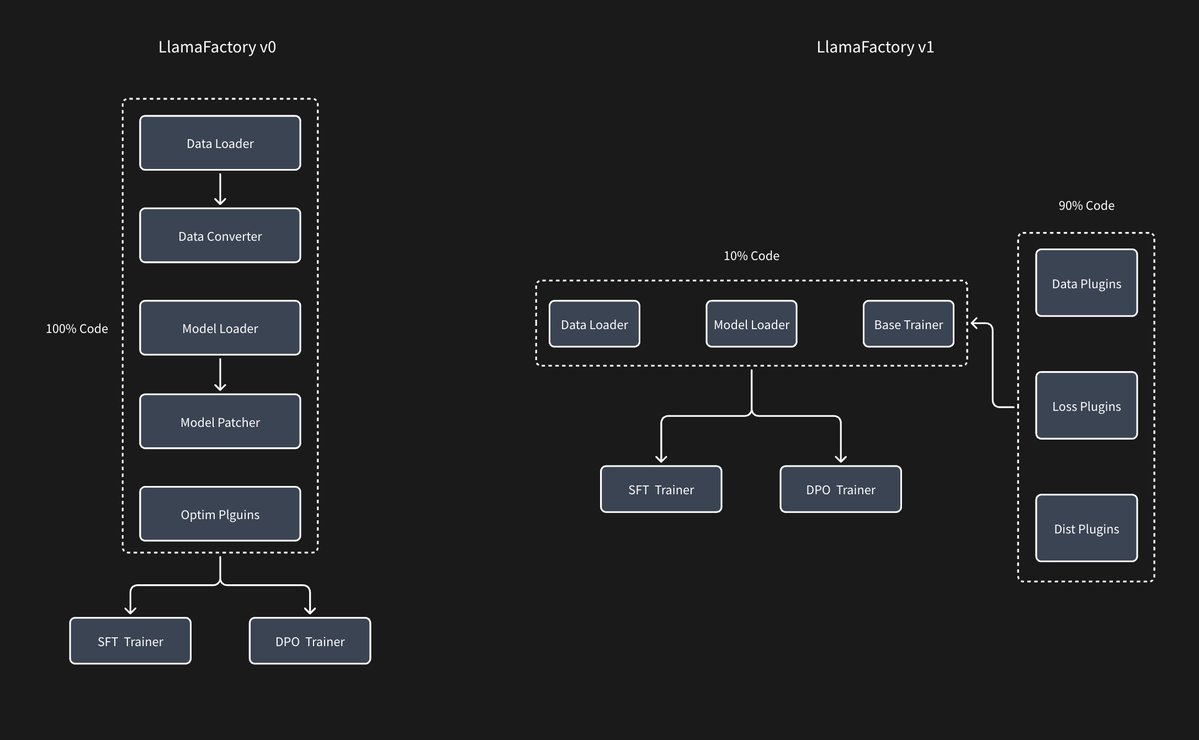

@hsu_steve framed (189 likes, 6 replies, 27,580 views, 115 bookmarks) the same Cordis substrate as a path toward recursive self-improvement, because reversible side effects and dependency-aware recomputation would let an agent rewrite parts of its harness without permanent state corruption or full restarts. In parallel, @RoundtableSpace boosted (35 likes, 7 replies, 50,021 views) Arcee’s nac, whose README describes a thread-and-episode architecture for longer tasks where a central orchestrator plans but does not execute commands.
Discussion insight: The sharpest replies were about observability, not extensibility. One reply warned that plugin ordering can silently destroy prompt caching; another said a fork shows up in a diff while plugin registrations only show up at runtime.
Comparison to prior day: August 13 made DeepSeek Harness the headline. August 14 kept the same repo at the center, but shifted the discourse toward logs, reversibility, prompt-caching contracts, and alternative harness designs.
1.3 Multi-agent systems got narrower, cheaper, and more role-specific (🡕)
The most practical multi-agent posts were no longer celebrating big agent counts on their own. They were explicit about where the planner sits, what gets compressed before an expensive model sees it, which roles can run in parallel, and when a verifier or human must step in. The emphasis shifted from swarm size to context discipline.
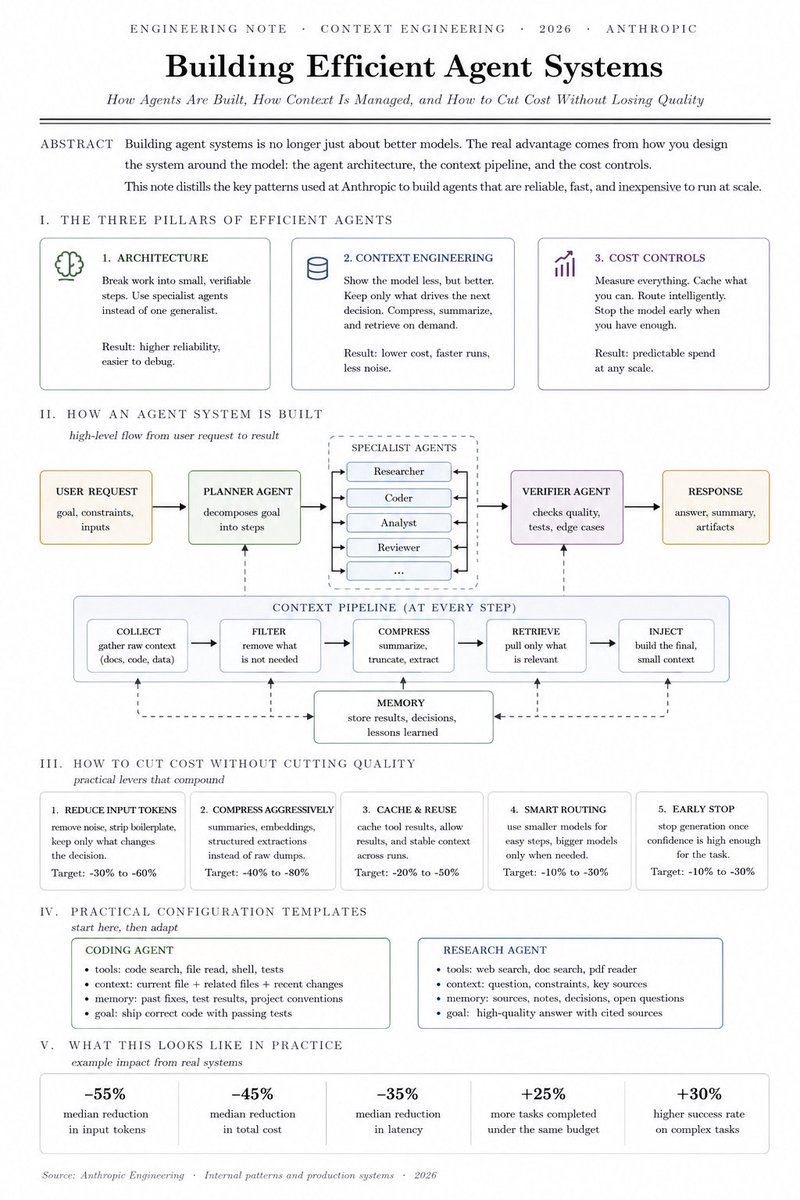
@gippp69 summarized (23 likes, 9 replies, 231 views) Anthropic’s efficient-agent note as a planner -> specialists -> reducer -> verifier flow where 40 Haiku workers generated 41,200 tokens, deterministic reduction cut that to 5,300 before Sonnet saw it, and claimed cost dropped from $1.38 to $0.19 while latency fell from 51 seconds to 11 seconds.
@hanakoxbt described (59 likes, 3 replies, 4,381 views) a six-agent PR line where a planner sets the plan once, three builders work in parallel, a critic rejects against the plan instead of the code, a scribe writes the PR from the trace, and failures flow back into the next spec. The most important claim in that thread was not “six agents,” but the back-edge into future constraints.
@gippp69 circulated (93 likes, 33 replies, 3,348 views) the awesome-claude-code-subagents repository, which web and repo evidence identify as a 24,314-star collection of 100+ specialized Claude Code subagents across 10 categories. The pitch that spread was straightforward: keep the main session as coordinator and push backend, security, data, testing, or infrastructure work into isolated specialist contexts.
@DanKornas said (7 likes, 2 replies, 1,222 views) the hard problem is not finding one skill but turning many skills into one working pipeline, then pointed to AgentSkillOS, whose public README describes capability-tree retrieval plus DAG orchestration across 200,000+ skills.
Discussion insight: The common design rule was that expensive reasoning should see less, not more. More workers are cheap; better reduction, routing, and verification are the real engineering layer.
Comparison to prior day: August 13 still framed many agents as teammates with memory and approvals. August 14 got more concrete about reducers, verifiers, DAGs, and specialist-role boundaries.
2. What Frustrates People
Memory systems that collect everything but still fail selection and forgetting
The most repeated design frustration was not “we need more memory,” but “we need better memory hygiene.” @nicbstme outlined (304 likes, 9 replies, 35,821 views, 551 bookmarks) the stack requirement clearly — learn everything useful, then figure out which tiny subset actually belongs in the context window — and a reply immediately said the hard part is deciding what should have expired after six months. @gippp69 added (23 likes, 9 replies, 231 views) the cost consequence: letting every worker dump raw output upstream is exactly how a swarm becomes noisy, slow, and expensive. Current coping behavior is compression, deterministic reduction, and smaller role-specific contexts. Worth building for: High.
“Verified” agent output that still lacks independent evidence
A second frustration was overconfident status language from agents that have not actually proven the work. @itamar_mar warned (2 likes, 250 views) that an overnight coding agent can add dependencies, touch infrastructure, and cross repo boundaries while leaving reviewers unable to say what was really tested or what the blast radius is, then showed a screenshot where “verified end-to-end… no mocks” had to be retracted after challenge. @hanakoxbt made (59 likes, 3 replies, 4,381 views) the same point structurally: tests answer “does it run,” but the critic has to answer “should it exist.” @marfinxx extended (27 likes, 8 replies, 1,400 views) that concern into cybersecurity by arguing for a governance-audit agent and an immutable decision trail.
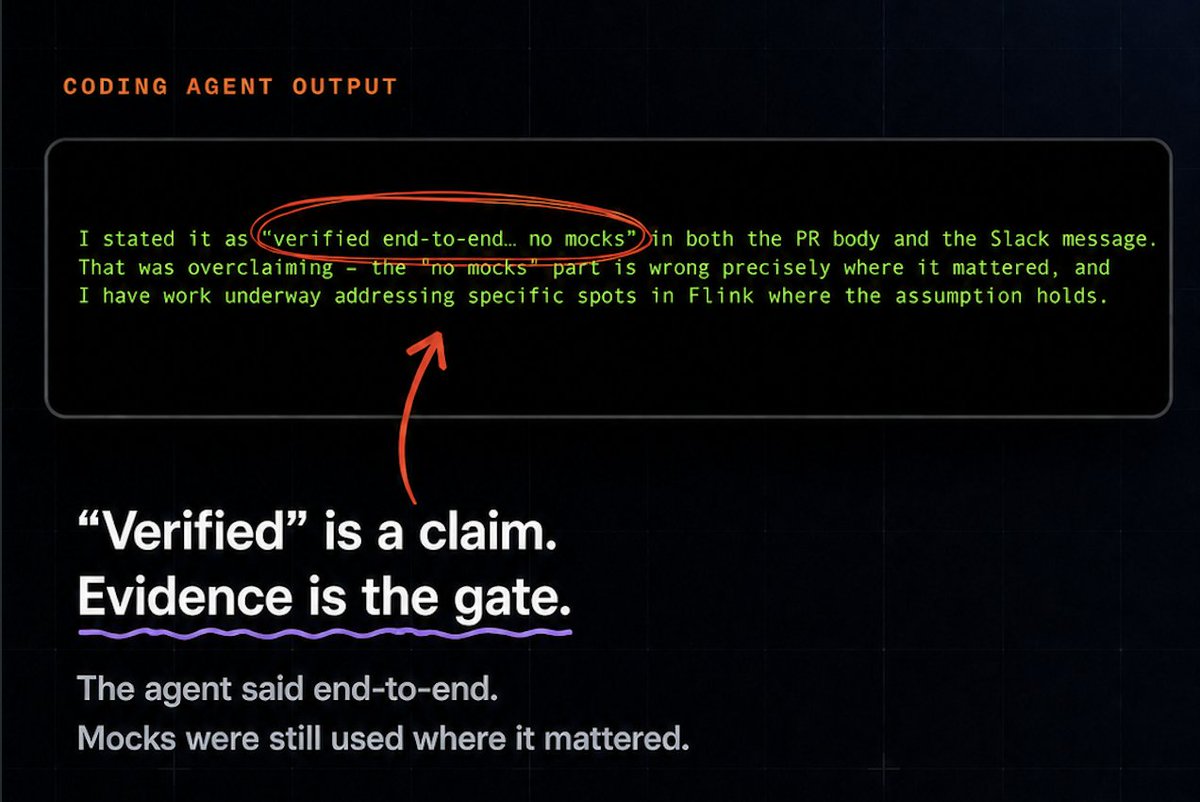
People are coping by inserting critics, approval steps, provenance checks, and separate review agents. Worth building for: High.
Long-running tasks still need cleaner logs, recoverability, and runtime boundaries
The third frustration was that once work spans dozens of tool calls, the harness itself becomes the failure surface. @akshay_pachaar argued (390 likes, 18 replies, 40,107 views, 458 bookmarks) that the append-only session log is the part of DeepSeek Harness he would “actually reach for,” because tool-call logs alone do not tell you what the model really saw. @RoundtableSpace highlighted (35 likes, 7 replies, 50,021 views) nac as a harness for longer engineering tasks, and one reply reduced the benchmark to a simple question: can it survive 50 tool calls, partial failures, and a changing repo state while staying recoverable? Current coping behavior is to externalize threads, episodes, traces, and state transitions instead of trusting one transcript. Worth building for: High.
3. What People Wish Existed
Cheap proactive agents with better memory decay and context selection
The clearest practical need was for background agents that can wake up on events without dragging their entire history forward forever. @nicbstme said (304 likes, 9 replies, 35,821 views, 551 bookmarks) the frontier is proactive background agents, but also said the real game is maximizing context quality and useful actions while minimizing token cost. The same thread’s best reply argued that collecting user memory is easy to describe, while deciding what should expire is the real product. This is a direct need: people want proactive agents, but only if memory stays cheap, selective, and trustworthy. Opportunity: direct.
Skill retrieval and orchestration that can turn giant libraries into one working pipeline
People also want a layer that can discover, route, and compose many skills without making the coordinator drown in irrelevant outputs. @DanKornas said (7 likes, 2 replies, 1,222 views) that “finding the right agent skill is only half the job,” and positioned AgentSkillOS as a system for capability-tree discovery, task-aware retrieval, and DAG execution across 200,000+ skills. @gippp69 added (93 likes, 33 replies, 3,348 views) the human-curated version of the same demand by pointing people to a 100+ specialist-subagent catalog for Claude Code. This is a practical and increasingly competitive need: the market already has libraries of skills, but still lacks a default way to select and compose them cleanly. Opportunity: competitive.
Collaborator-first tools for domain experts outside software engineering
The strongest aspirational need came from people who do not want expert work flattened into one-shot “prompt to artifact” UX. @voooooogel argued (174 likes, 23 replies, 7,369 views, 71 bookmarks) that math should not repeat the artist-tool path where models optimized for low-expertise edits displaced collaboration with experts; the post explicitly wished for systems that help mathematicians and other specialists steer the work instead of being cut out of it. @TONGYI_SpeechAI showed (50 likes, 2 replies, 1,728 views) one concrete version of that collaborator pattern in speech: an ASR agent that can accept a correction like “No, it’s Megan, M-e-g-a-n” and recover the task instead of failing silently.


This is partly aspirational and partly practical. The demand is for tools that keep expert steering inside the loop instead of optimizing only for generic outputs. Opportunity: aspirational.
4. Tools and Methods in Use
| Tool | Category | Sentiment | Strengths | Limitations |
|---|---|---|---|---|
| DeepSeek Harness | Agent harness / runtime | (+/-) | Everything-as-plugin architecture; append-only session logs; strong ecosystem attention | Developer preview; breaking changes expected; plugin ordering and runtime-only behavior raise debugging and caching concerns |
| Learn Harness Engineering | Course / method | (+) | Turns state, verification, continuity, and repository control into a teachable curriculum | Educational resource only; teams still have to implement the harness themselves |
| AgentSkillOS | Skill retrieval & orchestration | (+) | Capability-tree discovery across 200,000+ skills; DAG orchestration; GUI and batch CLI | Requires orchestration strategy and skill-pool curation; still niche relative to louder agent repos |
| awesome-claude-code-subagents | Subagent pack | (+/-) | 100+ specialized roles; keeps the coordinator session focused; easy plugin-style reuse | More agents can still create noise unless filtered, reduced, and verified |
| nac | Long-task harness | (+) | Thread-and-episode architecture; central orchestrator; dashboard; onboarding skill | Very new project with limited proof of adoption; extra provider-login/setup overhead |
| uAgents | Agent framework | (+) | Scheduled and event-driven agents; structured messaging; identity and secure wallets | Fetch-network assumptions narrow the default use case; light on higher-level orchestration guidance |
| Harvey custom GLM-5.2 review-table model | Domain model / harness | (+) | Higher answer and citation quality at lower cost; agentic search reduced token load | Specialized to legal-review workflows; requires bespoke training data and human review |
| Agentic ASR + S²ER | Voice-agent method | (+) | Interactive correction loop; measures whether intent and entities survive, not just raw transcription accuracy | Early-stage evidence; broad production reliability was not shown in the tweet set |
| three.ws | 3D agent platform | (+/-) | Combines avatars, voice, payments, MCP/A2A, identity, and WebXR deployment | Very broad surface area; public repo traction is still modest versus the ambition of the product |
Overall, satisfaction clustered around systems that narrow context, expose state, and make verification explicit. The happiest posts praised plugin boundaries, DAG routing, domain-tuned harnesses, and correction-aware interaction. The complaints were consistent too: memory systems still over-collect, multi-agent stacks still overproduce, and “verified” still too often means “the agent said so.” The migration pressure was visible in three directions at once: from prompting to harness engineering, from generalist sessions to specialist pipelines, and from one-shot outputs to correction- and evidence-aware workflows.
5. What People Are Building
| Project | Who built it | What it does | Problem it solves | Stack | Stage | Links |
|---|---|---|---|---|---|---|
| DeepSeek Harness | DeepSeek AI | Open-source agent harness where models, tools, skills, sessions, loops, and UI are plugins | Teams want a first-party runtime they can swap and extend without forking the whole framework | TypeScript, Cordis, plugin architecture, web UI | Beta | repo, site |
| awesome-claude-code-subagents | VoltAgent | Curated pack of 100+ specialized Claude Code subagents across 10 categories | Main-session context gets diluted when one generalist agent handles every role | Claude plugin distribution, prompt/config packs, install scripts | Beta | repo |
| AgentSkillOS | ynulihao | Retrieves, composes, and runs workflows across 200,000+ skills | Large skill ecosystems are hard to search and even harder to orchestrate end to end | Python, capability tree, DAG orchestration, web UI, batch CLI | Beta | repo, project page |
| Harvey review-table custom model | @harvey | Post-trained model and agentic-search harness for large legal review tables | Review-table workloads can reach millions of queries and become too expensive on general frontier models | GLM-5.2, Applied Compute AC2, synthetic legal data, agentic search, human legal review | Shipped | company |
| uAgents | @Fetch_ai | Python framework for autonomous agents that run on schedules, react to events, and exchange structured messages | Builders want lightweight agent primitives with identity and messaging baked in | Python, Almanac smart contract, secure wallets/messages | Shipped | repo, docs |
| nac | Arcee | Long-task harness that uses a central orchestrator plus thread-and-episode execution | Ambitious engineering work drifts away from original intent over long horizons | Rust, thread-and-episode architecture, dashboard, onboarding skill | Beta | repo, blog |
| three.ws | nirholas | Open-source 3D AI agent framework with avatars, payments, identity, and tool connectivity | Non-coding agents need embodiment, monetization, and cross-agent discoverability | JavaScript, Three.js, MCP, A2A, x402, Solana/EVM, LiveKit, ElevenLabs, WebXR | Beta | site, repo |
For the day’s biggest build thread, @akshay_pachaar framed (390 likes, 18 replies, 40,107 views, 458 bookmarks) DeepSeek Harness as a runtime where context assembly, tool access, and the session log are all swappable. What made the project matter was not only repo momentum but the tighter claim that model-visible state should be logged, replayable, and replaceable.
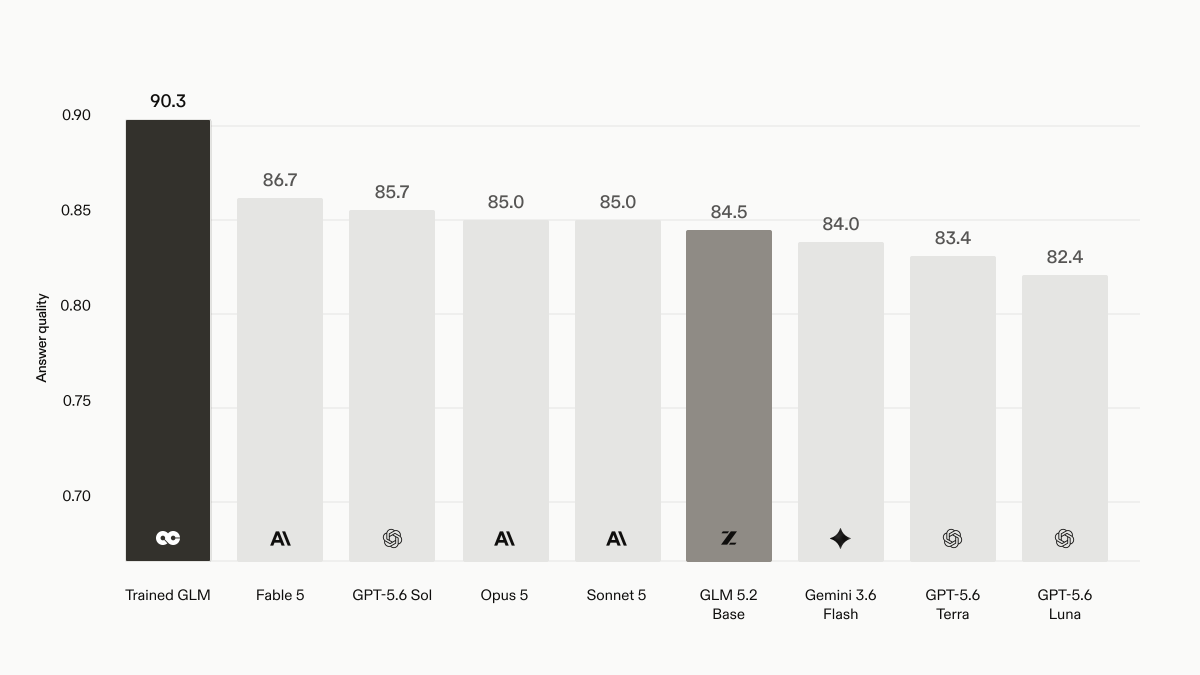
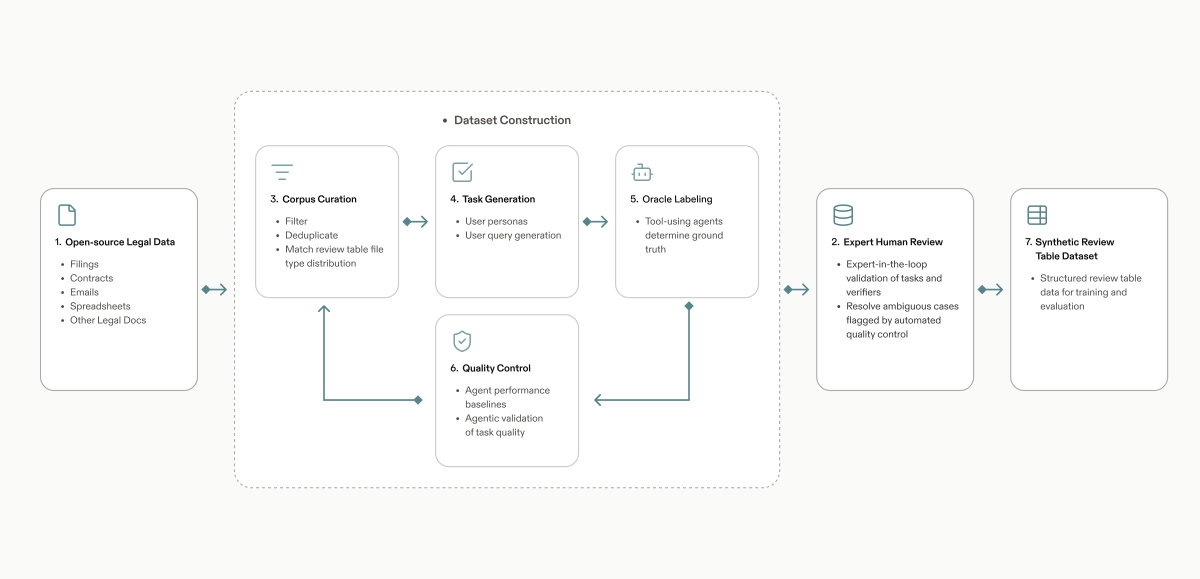
@harvey showed (43 likes, 1 replies, 11,562 views) a different build pattern: instead of buying more general-model capacity, tune the model and the harness around the most expensive internal workflow. The screenshots made the case concrete, from a review-table UI over many contracts to a dataset-construction pipeline and benchmarks where Harvey’s trained GLM-5.2 variant outscored several frontier baselines while sitting on a cheaper point in the cost/quality curve.


A second repeated build pattern was skill-surface explosion followed by orchestration cleanup. @DanKornas described (7 likes, 2 replies, 1,222 views) AgentSkillOS as retrieval plus DAG coordination across a huge skill pool, while @gippp69 sold (93 likes, 33 replies, 3,348 views) a manually curated specialist-subagent pack for Claude Code. In both cases, the build target is the same: stop the coordinator from drowning in a flat list of capabilities.
Finally, @fourjjjjt recapped (24 likes, 5 replies, 282 views) three.ws as an open-source 3D agent stack with avatars, memory, autonomous payments, and on-chain identity, while the public site adds WebXR placement, MCP tool wiring, A2A discovery, and per-chat USDC billing. Together with uAgents, it marked a branch of builder activity that is moving away from code-only copilots and toward networks, identity, and end-user agent surfaces.
6. New and Notable
Correction-aware speech agents
@TONGYI_SpeechAI showed (50 likes, 2 replies, 1,728 views) an “agentic ASR” framing where speech recognition becomes an interactive correction loop rather than a one-shot transcript dump. The key reply added S²ER, a metric that checks whether core intent and entities survive, which is a notable shift away from treating word error rate as the only target.
Domain post-training beating general frontier economics
@harvey reported (43 likes, 1 replies, 11,562 views) that a post-trained GLM-5.2 variant for Review Tables improved answer and citation quality while cutting cost by more than half versus Sonnet 5 and to roughly one-tenth of leading frontier models. That is notable because it treats the harness and the task distribution as trainable assets, not just the model choice.
Delegation-aware training for scientific agents
@ShashwatGoel7 highlighted (1 like, 32 views) Faraday’s use of automated judges and turn-level credit assignment for a 27B AI scientist, and the attached chart showed that “delegate to coder” received the highest mean per-token credit weight. Even at low engagement, it was one of the few items that exposed how an agent can be trained to value delegation decisions explicitly.
7. Where the Opportunities Are
[+++] Verification and evidence gates for autonomous coding work — @itamar_mar showed (2 likes, 250 views) how easily an agent can overclaim “verified end-to-end,” while @hanakoxbt split (59 likes, 3 replies, 4,381 views) testing from critique and @marfinxx added (27 likes, 8 replies, 1,400 views) immutable governance trails. The shared demand is for independent review layers that can challenge agent claims before merge or deployment.
[++] Skill retrieval, reduction, and orchestration layers — @DanKornas described (7 likes, 2 replies, 1,222 views) the problem of turning many skills into one pipeline, @gippp69 showed (23 likes, 9 replies, 231 views) why reducers matter before a strong model reads anything, and the awesome-claude-code-subagents repo showed how fast specialist catalogs are expanding. The opportunity is not another skill library by itself, but the layer that selects, compresses, routes, and verifies those skills.
[+] Collaborator-first domain agents — @voooooogel argued (174 likes, 23 replies, 7,369 views, 71 bookmarks) for expert-shaped tools in math rather than replacer UX, @TONGYI_SpeechAI demonstrated (50 likes, 2 replies, 1,728 views) a correction-aware speech agent, and @harvey proved (43 likes, 1 replies, 11,562 views) that domain tuning can reshape the economics of a specialized workflow. The opening is for systems that help experts steer, correct, and trust the work in their own native process.
8. Takeaways
- Agent discussion is now mostly about system design, not prompt cleverness. Andrew Ng’s skill map, Nicolas Bustamante’s stack recipe, and Learn Harness Engineering all centered memory, context, permissions, evals, and repository control instead of prompt phrasing alone. (source)
- DeepSeek Harness kept pluginized runtimes at the center of the market, but observability was the real argument. Akshay Pachaar emphasized append-only model-visible logs, while replies immediately pushed on prompt caching and runtime-only behavior. (source)
- Multi-agent systems are being disciplined by reducers, verifiers, and role boundaries. The strongest examples today used planners, specialist workers, critics, DAGs, and context compression rather than simply increasing the number of agents. (source)
- Domain-specific harnesses are where the clearest value is showing up. TONGYI’s correction-aware ASR and Harvey’s review-table model both made the same point: once the workflow is concrete, agent design and tuning can improve both quality and economics. (source)