Twitter AI Agent - 2026-08-21
1. What People Are Talking About
1.1 Agent engineering was framed as an operating discipline, not prompt craft (🡕)
The strongest cluster treated agent work as a systems-engineering problem with explicit controls for evals, state, token budgets, and security boundaries. At least seven retained items made the same move from different angles: Andrew Ng's skills map, harness-first system-design threads, token-budget tooling, state-machine patterns, PR-review skepticism, and credential-boundary checklists. Compared with August 20's focus on packaged harnesses and reusable procedures, August 21 pushed one layer deeper into how those systems are instrumented, reviewed, and kept from drifting.
@AndrewYNg shared (2,918 likes, 65 replies, 158,540 views, 4,914 bookmarks) a skills map for building and deploying AI applications, and the replies made the interesting part more specific than the headline. One detailed response argued that outcome-only evals miss whether an agent retrieved the right context or merely guessed correctly, and explicitly elevated trace reading as a missing skill between eval design and observability. That turned a broad education post into evidence that practitioners are now naming agent operations as a stack of reviewable skills rather than as “prompt engineering.”
@kmeanskaran argued (92 likes, 4 replies, 5,286 views, 127 bookmarks) that harness design, LLMOps, loop engineering, and evals matter more than the model itself, then described an end-to-end harness proof of concept spanning prompts, tools, context engineering, memory, caching, and deployment. The replies agreed on the same load-bearing components, especially loop engineering and evals, which makes this less a lone opinion than a compact summary of the day's consensus.
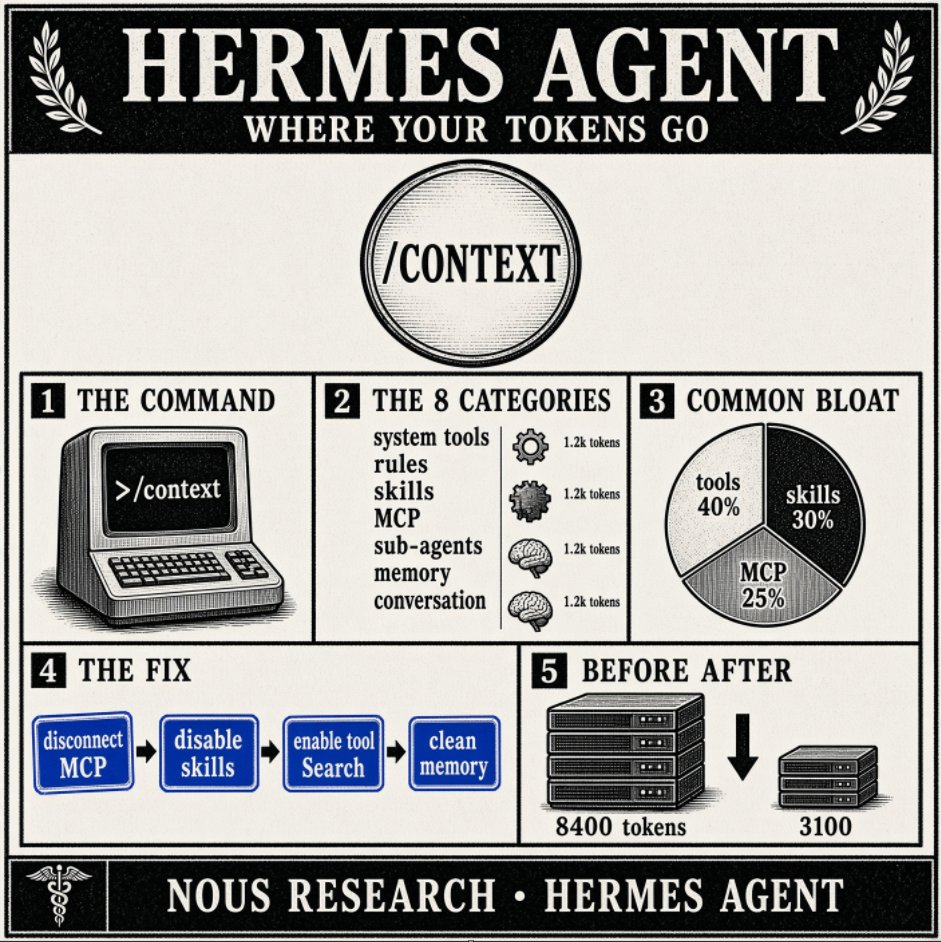
@IBuzovskyi showed (16 likes, 4 replies, 876 views, 21 bookmarks) a /context command for Hermes Agent that breaks session overhead into system tools, rules, skills, MCP, sub-agents, memory, and conversation. The attached explainer is unusually concrete: it claims common bloat comes from tools (40%), skills (30%), and MCP schemas (25%), and illustrates a before/after cut from 8,400 fixed tokens to 3,100 by disconnecting unused MCP servers, disabling unused skills, enabling on-demand tool search, and cleaning memory.
@AiCamila_ proposed (6 likes, 162 views, 6 bookmarks) an explicit state machine for long-running agent tasks, and the image made the value obvious: NEW, PLANNING, ACTING, WAITING, REVIEW, DONE, and FAILED are connected by guard conditions, retry paths, and timeout handling. That is not abstract “agent orchestration”; it is an argument that progress, waiting, rework, and failure should live outside the prompt in an observable task lifecycle.

@nykdotdev warned (74 likes, 13 replies, 6,482 views, 52 bookmarks) that “oversight fails when the key enters the prompt,” then proposed a Credential Boundary Card, mandatory revoke paths, and failure if secrets hit the transcript or diff. In parallel, @bybardiia argued (133 likes, 90 replies, 6,279 views) that clicking Approve on autogenerated PRs is not an agent-security plan. Together with the public paper on constraint-based oversight, those posts show the trust conversation moving away from human sign-off theater and toward enforceable execution boundaries.
Discussion insight: The sharpest replies did not ask for smarter models. They asked for trace quality, approval owners, revoke paths, retry semantics, and a way to distinguish a correct result from a lucky one.
Comparison to prior day: August 20 emphasized harnesses, skills, and managed-versus-owned agent stacks. August 21 kept the harness focus but moved toward operator mechanics: state transitions, token accounting, credential boundaries, and the failure modes of blind review.
1.2 Skills and context layers became the preferred way to package agent know-how (🡕)
A second cluster treated skills, plugins, and retrieval layers as the new distribution format for agent expertise. The common pattern was to take knowledge that used to live in docs, tacit team memory, or ad hoc prompts and turn it into something installable, routable, and reusable across tools. At least eight retained items supported this theme, spanning skill authoring toolkits, large cross-domain skill packs, repo-to-prompt utilities, session-memory MCP servers, and repo-aware development environments.
@DanKornas introduced (2 likes, 2 replies, 703 views, 4 bookmarks) Skill Forge as an open-source toolkit for designing, building, reviewing, evolving, evaluating, benchmarking, and publishing Claude Code skills. The public repository expands that promise into a full workflow with four complexity tiers and explicit commands for /skill-forge plan, /build, /review, /evolve, /publish, /convert, /eval, and /benchmark, which makes “skill authoring” look more like software delivery than like prompt templating.

@jack_9947 shared (4 likes, 2 replies, 105 views) a public architecture for a marketing-oriented Claude stack: 300+ prompts, 400+ skills across 7 repos, 50+ named agents, multi-step workflows, and linked systems for LinkedIn, sales, and Notion. Even though access to the full course is DM-gated, the image itself is strong evidence that teams are now packaging departmental operating knowledge as layered agent infrastructure.

@tom_doerr pointed to (12 likes, 1,873 views, 20 bookmarks) the DevOps & Security Agent Skills repository, which publicly advertises 160+ production-ready skills covering DevOps, security, infrastructure, AI engineering, and compliance for Claude Code, Cursor, Codex, and other file-reading agents. The README matters because it is not an “awesome list”: it claims copy-pasteable configs, automation scripts, references, and deep operational guidance that an agent can load when matched.
@DanKornas also highlighted (4 likes, 2 replies, 700 views, 3 bookmarks) GitReverse, a public app that turns a GitHub repo into one synthetic prompt. The corresponding repo shows the scope clearly: take repo metadata, a depth-1 file tree, and the README, then produce a short prompt grounded in that context, with multi-provider support and shareable /owner/repo routes.
@tarunsachdeva introduced (6 likes, 1 reply, 100 views) Traces MCP, a read-only session-memory server that lets agents search and read earlier coding traces via OAuth. The docs make the positioning specific: discovery is separated from reading, support exists for Claude Code, Codex CLI, Cursor, OpenCode, and VS Code, and the intended value is recovering prior decisions, files, and rationale without pasting them back into a live chat.
@SpotifyEng reported (26 likes, 1 reply, 1,182 views, 9 bookmarks) that Xirp now supports four harnesses and can switch between them mid-project without losing context. The linked product page explains the deeper problem: agents ship code faster, but still make operationally wrong decisions when they do not know service ownership, dependencies, or architecture, so Xirp plus Portal is being positioned as a retrieval layer for repo reality rather than as another chat surface. More narrowly, @peterfriese shared (2 likes, 3 replies, 184 views, 3 bookmarks) a SwiftUI skill pack that patches Liquid Glass blind spots with installable, task-specific guidance.
Discussion insight: The common move was to make context loadable on demand. Whether the unit was a skill, a repo prompt, a trace server, or a context layer tied to ownership metadata, the day’s builders kept externalizing know-how so agents could re-enter it instead of relearning it.
Comparison to prior day: August 20 showed skills as an emerging primitive. August 21 showed the next step: authoring systems, installable libraries, repo-grounding tools, and memory servers that make those primitives portable across multiple agents and environments.
1.3 Agents looked more credible when they were attached to domain-specific execution loops (🡕)
The third theme was that agents felt most convincing when they were given a real environment and a repeatable loop, not just a bigger prompt. The examples came from benchmark reasoning, game development, and molecular design, but the pattern was the same: inspect the environment, act, read feedback, keep state, and iterate. Compared with August 20's general debate about hosted agent products, August 21 provided more domain-specific proof of what those loops actually look like.
@daniel_mac8 argued (90 likes, 16 replies, 4,831 views, 34 bookmarks) that NVIDIA's AVO plus Opus 5 pushed ARC-AGI-3 public-set performance from roughly 30% to 100%, and the public NVIDIA write-up backs the core architecture claim: persistent memory, supervision, and an inspect → plan → implement → evaluate → diagnose/repair loop matter as much as the base model. The attached diagram is important because it shows how the harness keeps solution lineage, docs, code, and evaluator feedback in the loop while a supervisor redirects stalled trajectories.

@ImmatureGamer summarized (46 likes, 6 replies, 1,807 views, 18 bookmarks) Epic's long MCP-in-UEFN stream and made the practical shift explicit: an agent can now write Verse, compile it, start a Fortnite session, read the logs, push changes, and iterate inside the editor instead of depending on manual copy-paste. The same thread also names the current limits—no Control Rig toolset yet, no 3D mesh generation, no cross-project asset migration—which makes it a stronger signal than a pure launch claim.
@anindyadeeps introduced (208 likes, 40 replies, 10,689 views, 61 bookmarks) LiteMol-1 as a multi-molecule diffusion language model explicitly framed as “a model for agents.” The post and public LiteFold materials say the point is not just molecule generation, but giving an AutoResearch loop a compact sequence-space interface for proposing, inspecting, editing, scoring, and regenerating candidates instead of repeatedly reasoning over bulky structure files.


Discussion insight: The notable convergence was that game tools, biology models, and benchmark harnesses all emphasized the same primitives: environment access, persistent state, verification feedback, and a narrow interface the agent can iterate through cheaply.
Comparison to prior day: August 20 focused on who hosts the agent and who owns the state. August 21 added sharper evidence for what agents actually do once those questions are answered: they compile and read logs in UEFN, loop through benchmark trajectories under supervision, or search molecule space through a sequence-first interface.
2. What Frustrates People
Blind approvals and loose credential handling still fail the trust test
The clearest frustration was that many teams still treat review as a human button press instead of as a controlled execution boundary. @nykdotdev said (74 likes, 13 replies, 6,482 views, 52 bookmarks) the problem bluntly: once the key enters the prompt, oversight has already failed, so the workflow needs credential boundaries, revoke paths, and automatic failure if secrets land in the transcript or diff. @bybardiia made (133 likes, 90 replies, 6,279 views) the same complaint from the PR side by arguing that clicking Approve on autogenerated diffs is not a security plan. The public paper behind @nykdotdev also points in that direction by arguing for machine-enforced constraints over prompt-only oversight. Severity: High. Worth building for: High.
Agent sessions still waste too much money and quality on context bloat
A second frustration was economic and operational: people think they are hitting model limits when they are often paying for their own clutter. @IBuzovskyi showed (16 likes, 4 replies, 876 views, 21 bookmarks) a /context breakdown where unused tools, skills, and MCP schemas dominate the fixed overhead. @sairahul1 responded (36 likes, 13 replies, 5,922 views, 64 bookmarks) with a complicated orchestration workaround—Claude for planning, Codex for execution, multiple GPT-5.6 tiers for cost shaping—precisely because one model and one session no longer feel economically stable for long days of coding. The replies under that setup added the coping behavior people are already learning: same-chat reuse causes context rot, handoff files can preserve bad state, and “savings” may just move the spend into another meter. Severity: High. Worth building for: High.
Multi-agent speedups are still fragile when planning and workflow control are weak
The third frustration was that parallel agents can multiply mistakes as easily as they multiply throughput. @mattpocockuk tested (27 likes, 7 replies, 1,705 views, 15 bookmarks) an /implement-spec skill that fans work out to subagents, then immediately noted in replies that it is slower, limited by the orchestrator's context window, and replaces deterministic systems with an agent “which is always worse.” @AiCamila_ proposed (6 likes, 162 views, 6 bookmarks) explicit task states because free-form loops hide stuck work, while @SpotifyEng positioned (26 likes, 1 reply, 1,182 views, 9 bookmarks) Xirp around a similar pain: agents make technically correct but operationally wrong moves when they do not understand ownership and dependencies. The subtext is that faster execution is easy; dependable coordination is still the hard part. Severity: High. Worth building for: High.
3. What People Wish Existed
Portable skills that work across agents without being rewritten
The most explicit need was for agent know-how to travel as installable artifacts instead of being recopied into every new tool. @DanKornas framed (2 likes, 2 replies, 703 views, 4 bookmarks) Skill Forge around that exact problem by giving skill authors a plan/build/review/eval/publish workflow. @tom_doerr pointed (12 likes, 1,873 views, 20 bookmarks) to a 160+ skill library for infrastructure and security work, while @peterfriese showed (2 likes, 3 replies, 184 views, 3 bookmarks) the same pattern at a narrower scale with Liquid Glass skills for iOS 26. This is a direct need: people are already building the skill layer, but they still need better packaging, review, and cross-agent portability. Opportunity: direct.
A default control plane for state, cost, and reviewability
People also want agents to expose their own operating surfaces instead of hiding them inside a long transcript. @IBuzovskyi effectively asked (16 likes, 4 replies, 876 views, 21 bookmarks) for built-in cost observability with /context. @AiCamila_ asked (6 likes, 162 views, 6 bookmarks) for explicit task states and legal transitions, and @nykdotdev asked (74 likes, 13 replies, 6,482 views, 52 bookmarks) for credential boundaries and revoke paths that are enforced by the system rather than by policy reminders. The need is practical and urgent because the complaints are about cost, leaks, and irreversible mistakes, not cosmetic UX. Opportunity: direct.
Context layers that understand the repo, the org, and prior work by default
A third need was for agents to start from grounded context instead of from a blank session plus stale docs. @DanKornas addressed (4 likes, 2 replies, 700 views, 3 bookmarks) repo understanding with GitReverse, which synthesizes one prompt from a repo's metadata, tree, and README. @tarunsachdeva extended (6 likes, 1 reply, 100 views) that need into team memory with Traces MCP, and @SpotifyEng described (26 likes, 1 reply, 1,182 views, 9 bookmarks) Xirp as a way to keep service ownership and dependency context live across harnesses. This is a competitive opportunity because multiple approaches are already shipping, but the pain is persistent and well-defined. Opportunity: competitive.
4. Tools and Methods in Use
| Tool | Category | Sentiment | Strengths | Limitations |
|---|---|---|---|---|
| AVO | Agent harness architecture | (+) | Persistent memory, supervisor loop, execution feedback, long-horizon iteration | Evidence today centered on the public ARC-AGI-3 result, not broad day-to-day deployment |
| pstack | Coding-agent workflow plugin | (+) | Playbooks, specialist skills, multi-model review, runtime verification, evidence-before-success reporting | Best fit is Cursor; some workflow pieces do not port cleanly outside that environment |
| Skill Forge | Skill authoring toolkit | (+) | Structured plan/build/review/eval/publish flow, multiple tiers, cross-platform conversion | Still a meta-tool for skill authors, not an end-user productivity shortcut |
| DevOps & Security Agent Skills | Skill library | (+) | 160+ installable skills, concrete configs, broad infra/security coverage | Quality depends on selecting the right skill and keeping the library current |
| GitReverse | Repo-grounding utility | (+) | Turns repo metadata, file tree, and README into a single reusable prompt | Still repo-wide by default; subfolder-aware grounding is not yet shipped |
| Traces MCP | Session-memory retrieval | (+) | Read-only access to prior sessions, OAuth setup, works across multiple coding agents | Search/read flow adds another dependency and requires a Traces account/context boundary |
| Xirp + Portal | Repo-aware development environment | (+/-) | Keeps ownership, dependencies, and architectural context live across harnesses | Public evidence today emphasized the problem framing more than hard usage metrics |
Hermes Agent /context |
Token/overhead observability | (+) | Makes fixed context cost visible and gives clear trimming actions | Tied to one agent stack; still requires users to act on the findings manually |
| Claude Code + Codex plugin workflow | Cost-shaping orchestration method | (+/-) | Splits planning, critique, and execution across models and subscriptions | Setup complexity is high, and replies questioned hidden cost movement and context-rot handoffs |
| UEFN MCP | Domain-specific agent runtime | (+/-) | Lets agents write Verse, compile, run sessions, inspect logs, and iterate in-editor | Still beta; no Control Rig support, no 3D mesh generation, and other asset/tooling gaps |
| LiteMol-1 | Domain-specific generation model | (+) | Compact sequence-space interface for agent loops, multiple molecule classes, competitive reported results | Research-stage evidence; practical value depends on downstream verifiers and scoring functions |
The overall satisfaction spectrum ran from “show me the controls” to “make the context portable.” People were positive when a tool made state, evidence, or domain knowledge explicit, and skeptical when it promised autonomy without strong review surfaces. The common workaround was layering: repo-grounding plus skills, skills plus traces, or one model for planning and another for execution. Migration pressure is visible too: users are moving away from one monolithic chat toward workflows that separate retrieval, planning, verification, and action.
5. What People Are Building
| Project | Who built it | What it does | Problem it solves | Stack | Stage | Links |
|---|---|---|---|---|---|---|
| LiteMol-1 | @anindyadeeps / LiteFold Research | Multi-molecule diffusion language model designed for agent-in-the-loop molecular design | Gives research agents a compact sequence-space interface for proposing, editing, evaluating, and regenerating molecules without living inside heavy structure files | Diffusion language model, molecular sequence tokens, multi-objective search, agent loop | Alpha | research page, tweet |
| Skill Forge | AgriciDaniel / @DanKornas | Toolkit for planning, building, reviewing, evaluating, and publishing agent skills | Replaces ad hoc skill writing with a structured, testable workflow | Claude Code, Agent Skills, Python, evaluation/benchmark scripts | Shipped | repo, tweet |
| DevOps & Security Agent Skills | BagelHole / @tom_doerr | Large installable skills library for infrastructure, security, AI engineering, and compliance | Gives coding agents reusable expert operational knowledge instead of one-off prompts | SKILL.md format, scripts, configs, references, skills CLI | Shipped | repo, tweet |
| GitReverse | filiksyos / @DanKornas | Turns a public GitHub repository into one synthetic prompt for coding agents | Speeds repo understanding and reverse-engineering of existing projects | Next.js 16, React 19, TypeScript, Tailwind CSS 4, GitHub API | Shipped | repo, tweet |
| Traces MCP | Traces / @tarunsachdeva | Hosted MCP server for searching and reading prior coding sessions | Restores team memory and prior decisions without manually copying chat history | Hosted MCP, OAuth, read-only trace search/read tools | Shipped | docs, tweet |
| fwc-swiftui-skills | FloWritesCode / @peterfriese | Cursor skill pack for modern SwiftUI tasks, starting with Liquid Glass | Patches training-data gaps in coding agents on new iOS 26 UI APIs | Cursor skills, SKILL.md, Xcode iOS 26 SDK | Shipped | repo, tweet |
| pstack | Lauren Tan / poteto via Flavio Copes | Rigorous coding-agent workflow plugin with playbooks, reviewer panels, and subagents | Keeps long agent runs on track with verification and role-specific workflows | Cursor plugin, workflow skills, engineering principles, playbooks, subagents | Shipped | guide, tweet |
| Xirp | Spotify Engineering | Agentic development environment that preserves context across multiple harnesses | Stops agents from making operationally wrong choices when service ownership and dependencies are implicit | Xirp, Portal context layer, multi-harness switching | Shipped | product page, tweet |
| UEFN MCP tooling | Epic / Creating in Fortnite | Lets agents work inside UEFN across Verse, devices, assets, logs, and test loops | Moves game-development agent work from copy-paste assistance into the actual editor/runtime loop | MCP, UEFN, Verse, Claude Code/Cursor/Codex-compatible agents | Beta | tweet |
The strongest build pattern was externalization. Skill Forge, DevOps & Security Agent Skills, fwc-swiftui-skills, pstack, and GitReverse all take something that used to live in taste, tribal knowledge, or chat history and turn it into a reusable artifact—skills, playbooks, grounded prompts, or review workflows.
A second pattern was domain-specific surfacing. Xirp attaches agents to service topology and ownership context, UEFN MCP attaches them to an actual game-development runtime, and LiteMol-1 attaches them to a compact molecular design loop. The repeated trigger is the same across rows: once a task has real environment state and real consequences, builders stop asking for a better generic chatbot and start building a narrower operating surface around the agent.
6. New and Notable
Harness engineering broke into the open as a headline, not a backend detail
@daniel_mac8 turned (90 likes, 16 replies, 4,831 views, 34 bookmarks) NVIDIA's AVO result into a simple market message: the right harness can move a frontier model from partial competence to full public-set completion on a long-horizon benchmark. What made this notable was not only the score, but how many other posts that day immediately reused the same language—loops, graphs, supervision, persistent memory, and evaluation feedback—to talk about unrelated systems. The harness is no longer hidden implementation detail; it is being treated as the product surface. (NVIDIA blog)
Skills are turning into a supply chain for agent capability
@DanKornas showed (2 likes, 2 replies, 703 views, 4 bookmarks), @tom_doerr showed (12 likes, 1,873 views, 20 bookmarks), and @peterfriese showed (2 likes, 3 replies, 184 views, 3 bookmarks) different layers of the same stack: authoring tools, large cross-domain libraries, and narrow domain patches. That is notable because it turns “skills” from a marketing noun into a distribution pipeline with creation, packaging, installation, and reuse across multiple agents.
Domain-specific loops are getting much easier to demonstrate publicly
@ImmatureGamer made (46 likes, 6 replies, 1,807 views, 18 bookmarks) UEFN MCP legible by describing the full write → compile → test → read-logs loop, while @anindyadeeps did (208 likes, 40 replies, 10,689 views, 61 bookmarks) the same for biomolecular design with LiteMol-1. The notable shift is that agent posts are increasingly persuasive when they expose the environment and feedback loop directly instead of relying on general autonomy claims.
7. Where the Opportunities Are
[+++] Agent control plane for cost, state, and security — Multiple sections pointed to the same missing layer: teams want agents that expose token overhead, task state, credential boundaries, and review evidence by default. The evidence spans @IBuzovskyi, @AiCamila_, @nykdotdev, and @bybardiia. This is strong because the pain is about money, secrets, and stuck work, not merely convenience.
[+++] Portable skill supply chain — The day showed clear demand for tools that let teams author, test, publish, install, and port skills across agents and domains. Evidence came from Skill Forge, DevOps & Security Agent Skills, fwc-swiftui-skills, and pstack. This is strong because the ecosystem already has builders on every layer, but the workflow is still fragmented.
[++] Repo- and org-aware retrieval layers — GitReverse, Traces MCP, and Xirp all attack the same problem from different angles: agents still lose context between repos, sessions, and harnesses. This is moderate because good solutions are shipping, but the market has not settled on a standard way to carry repo structure, ownership, prior traces, and active constraints into every run.
[++] Domain-specific agent runtimes with built-in verification loops — UEFN MCP and LiteMol-1 both became persuasive because they expose a narrow environment, clear artifacts, and feedback loops that can be tested. This is moderate because the opportunity is real, but each vertical requires deeper product and domain work than a general-purpose agent wrapper.
[+] Budget-aware orchestration presets — The popularity of the Claude-plus-Codex token-saving workflow shows demand for opinionated presets that split planning, critique, and execution across models or subscriptions without manual glue. This is emerging because the workaround clearly resonates, but its current form is still too brittle and operator-heavy.
8. Takeaways
- The conversation moved from “what model?” to “what operating discipline?” The highest-signal items emphasized evals, traces, state, loop design, and explicit workflow control over raw model choice. (source, source, source)
- Security concerns were framed as boundary problems, not review problems. Credential handling, revoke paths, and blind PR approval came up more often than abstract safety language. (source, source, source)
- Skills are becoming the main package format for reusable agent expertise. The day linked together skill-authoring systems, installable libraries, domain-specific patches, and rigorous workflow plugins. (source, source, source, source)
- Context portability is now a product category of its own. Repo-grounding, trace retrieval, and cross-harness continuity all appeared as distinct products rather than as incidental features. (source, source, source)
- Agents looked most credible when attached to a real environment and a verifiable loop. The convincing examples were not generic chat agents, but a benchmark harness, a game-development runtime, and a molecular-design system. (source, source, source)