Twitter AI Agent - 2026-09-07
1. What People Are Talking About
1.1 Harnesses turned into control planes, workbenches, and team surfaces (🡕)
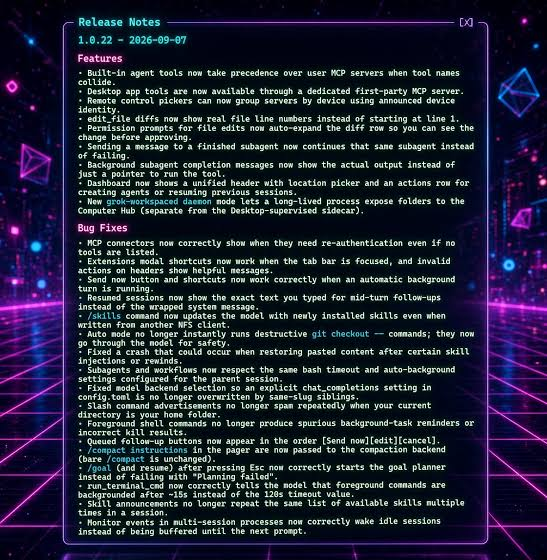
The dominant thread was that agent value is being located in the operating surface around the model. @ycombinator argued (1,161 likes, 69 replies, 97,243 views, 1,932 bookmarks) that the same weights can move from 30% to 95% on ARC-AGI with a better harness, then unpacked harness primitives like context caches, agent messaging, sandboxes, and budgets. @thsottiaux argued (1,513 likes, 208 replies, 104,650 views, 118 bookmarks) that GPT-6 Astra only shows its full value inside the Codex desktop app because that surface adds computer use, sub-agent management, voice, and non-blocking questions; the top reply pushed back that those same affordances should land in CLI-native workflows too. Lower-volume builder posts made the same shift more concretely: @XFreeze shared (144 likes, 18 replies, 10,369 views, 33 bookmarks) Grok Build v1.0.22 changes around workspace daemons, subagent continuity, diff previews, and safer destructive-git handling, while @DanKornas highlighted (1 like, 1 reply, 467 views) Juggler's inspectable GUI and also highlighted (4 likes, 4 replies, 538 views) amux as a shared board plus fleet-control plane for parallel workers.
Discussion insight: the disagreement was not whether frontier models matter, but whether control surfaces should stay lightweight and text-first or grow into managed desktops, dashboards, approval panes, and long-lived runtimes.
Comparison to prior day: 2026-09-06 already emphasized install surfaces. On 2026-09-07, the talk went one layer deeper into runtime management: daemons, subagent persistence, worker claiming, and approval mechanics.
1.2 Benchmarks and safety arguments got closer to deployment reality (🡕)
Benchmark talk was unusually concrete. @ArtificialAnlys announced (1,220 likes, 103 replies, 152,734 views, 187 bookmarks, 71 quotes) Intelligence Index v4.3, which upgrades Terminal-Bench to 4.0, swaps in AutomationBench-AA with a private 657-task workflow set, raises the weight of private evaluations, and uses a mini-SWE-agent harness for terminal tasks. The replies mattered as much as the launch copy: Artificial Analysis explicitly noted that AutomationBench-AA zeros a workflow's score on any guardrail violation and that completing every objective without violating rules remains much harder than partial completion. In parallel, @dair_ai highlighted (13 likes, 7 replies, 1,512 views) a paper arguing capable models can detect when they are being tested, and shared (7 likes, 4 replies, 1,339 views) a companion review that separates model competence, harness integration, and deployment authority instead of treating “agent performance” as one number.

Discussion insight: the day rewarded benchmark builders who showed harder tasks, private test sets, clearer harness choices, and explicit guardrail accounting. The DAIR threads added the caution that even stronger benchmarks still understate reality if the model knows it is inside a test harness or if deployment authority is left unspecified.
Comparison to prior day: 2026-09-06 had more product and payment-rail chatter. 2026-09-07 added more public attention to benchmark design, scaffold parity, and what “safe completion” should mean in workflow settings.
1.3 Skills, handbooks, and repo maps became the preferred shape of memory (🡕)
The second major cluster was about what agents should remember and how that memory should be packaged. @TencentAI_News announced (112 likes, 11 replies, 7,504 views, 92 bookmarks) TeamAI-CLI as an internal Tencent tool turned open-source, with one git-backed handbook repo feeding shared skills, rules, and docs into Claude Code, Codex, Cursor, OpenCode, and related agents. @tom_doerr shared (48 likes, 5 replies, 4,549 views, 53 bookmarks) Chops, and the public Chops repo describes a macOS app for discovering, organizing, and editing skills and agents across multiple coding clients. @rohanpaul_ai summarized (13 likes, 8 replies, 1,957 views) a paper claiming that a distilled SKILL.md outperformed workflow memory by 6.06 percentage points because it packaged the same experience into cleaner procedures. @thisdudelikesAI argued (7 likes, 4 replies, 602 views, 11 bookmarks) that Graft solves repeated codebase rediscovery by writing linked markdown repo maps into the repo itself, while @QuestDb showed (3 replies, 36 views) a docs-delivery variant of the same idea: every docs page retrievable as markdown plus an llms.txt index.

Discussion insight: the memory conversation tightened around one design rule: keep reusable procedure, context, and constraints in versioned artifacts, not in ever-growing transcripts that every new session has to re-interpret from scratch.
Comparison to prior day: 2026-09-06 still treated memory as a harness feature. On 2026-09-07, memory became operational: git-backed handbooks, searchable skill inventories, markdown repo maps, and docs endpoints deliberately shaped for agent retrieval.
1.4 Agents were pitched for real transactions and voice workflows, but the sharpest evidence was all about boundaries (🡒)
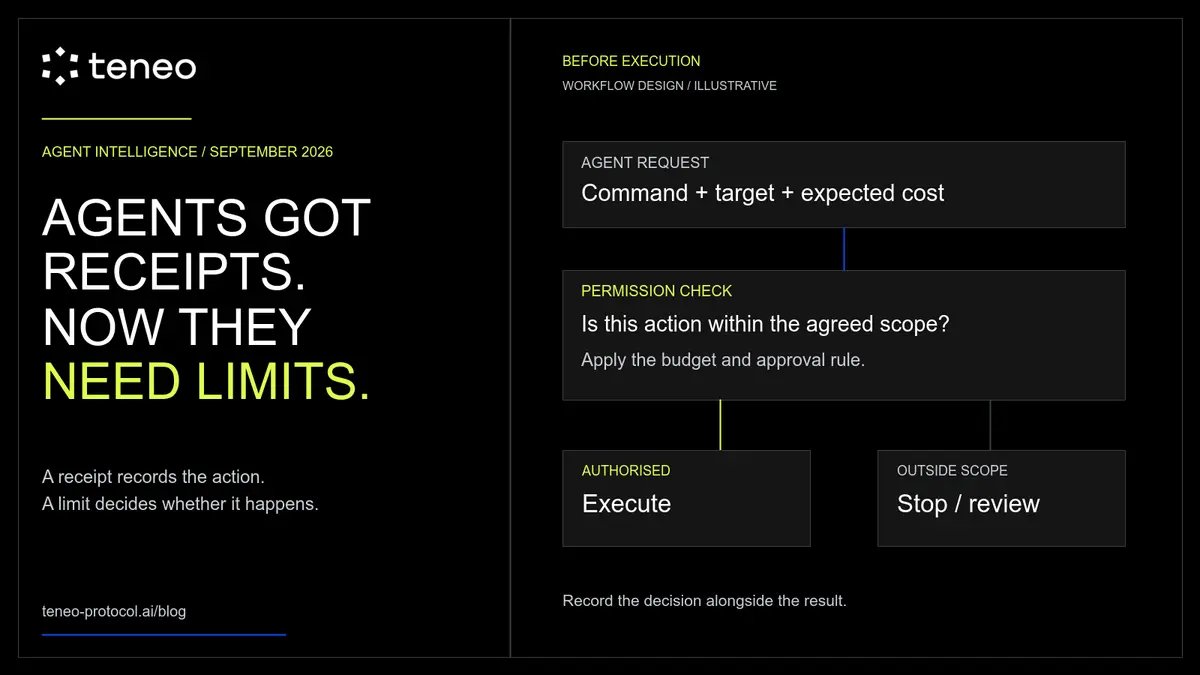
Action-oriented threads got more interesting when they stopped talking about generic autonomy and started showing limits. @teneo_protocol argued (322 likes, 236 replies, 5,545 views) that buyers now need to know not only what an agent can do, but which actions are allowed, what requires approval, and what happens when a limit is reached; its ProcessTask framing used command pricing, permission checks, and execution receipts to make that boundary visible. In marketplace land, @fepz_ showed (104 likes, 71 replies, 651 views) the public agent.family catalog as the TermiX browsing layer, complete with service categories, open requests, and reputation filters, while @Dzola17 circulated (51 likes, 55 replies, 204 views) a dashboard screenshot claiming $18.3M processed volume, 423,640 indexed agents, and 338,906 jobs. The product shape is getting easier to picture, even if the adoption proof is still mostly self-reported.
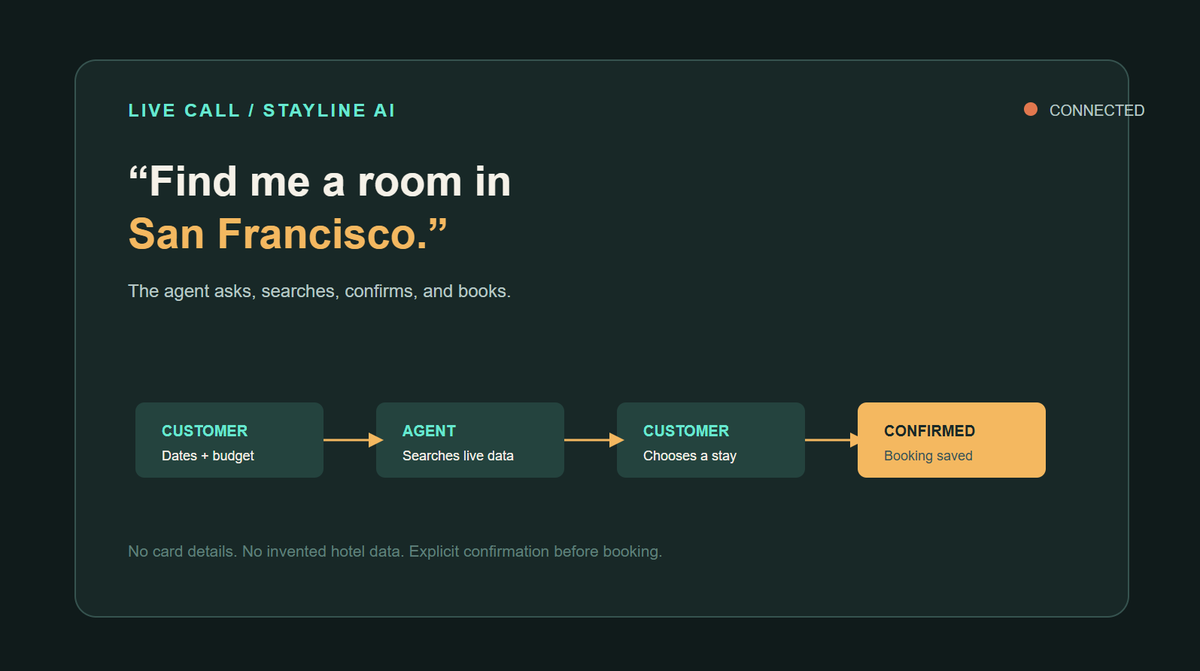
Voice-agent posts told the same story from another angle. @aaryankushwah introduced (105 likes, 17 replies, 13,982 views, 138 bookmarks) Companion as an iMessage assistant running on a real computer with plugins, MCPs, and browser/terminal access. @ANKIT052003 shared (3 likes, 2 replies, 82 views) Stayline AI, a hotel-booking voice agent built from Twilio Media Streams, FastAPI, the OpenAI Realtime API, and Google Sheets, with an explicit confirmation step before booking. And a low-volume but high-information complaint from @DrKristie showed (3 replies, 8 views) the demand side of the problem: repeated Booking.com support calls and an email saying auto-generated nearby-landmark data could not be corrected manually.
Discussion insight: public proof got much stronger when the post included a flow diagram, a live dashboard, or a complaint screenshot. Generic “agent economy” talk landed softly; limits, confirmations, broken calls, and catalog screenshots landed hard.
Comparison to prior day: compared with 2026-09-06's escrow-heavy marketplace talk, 2026-09-07 attached more of the story to permissioning, explicit confirmation, and day-to-day operator pain.
2. What Frustrates People
2.1 Agents still need hard stop rules, reversibility, and approval scopes
The clearest frustration was not raw model quality; it was control once an agent can keep going. @teneo_protocol argued (322 likes, 236 replies, 5,545 views) that capability alone is no longer a useful product description unless you also specify limits, approvals, and what happens when a run is stopped. @XFreeze shared (144 likes, 18 replies, 10,369 views, 33 bookmarks) Grok Build fixes that route destructive git checkout -- through a safer approval path, which is a tiny but telling sign that workbenches are still discovering the dangerous edges of autonomy. And @dair_ai shared (7 likes, 4 replies, 1,339 views) a review that explicitly splits competence from authority, which reads like a response to the same pain.
@AkitaOnRails argued (115 likes, 5 replies, 3,760 views, 17 bookmarks) that many teams do not need an agent orchestrator yet at all. That landed as a frustration signal in its own right: people are clearly feeling the drag of adding control-plane complexity before the value is obvious.
Why it hurts: launching an agent task is easy; proving scope, reversibility, and safe stopping conditions is still not.
Worth building for? Yes. This showed up in research, product changelogs, and practitioner pushback on the same day.
2.2 Shared context is still scattered across prompts, repos, and product surfaces
A second frustration was repeated rediscovery. @TencentAI_News announced (112 likes, 11 replies, 7,504 views, 92 bookmarks) TeamAI-CLI precisely because teams want one repo to carry shared rules and skills into every session. @tom_doerr shared (48 likes, 5 replies, 4,549 views, 53 bookmarks) Chops because those assets are already scattered enough to need a dedicated browser and editor. @thisdudelikesAI argued (7 likes, 4 replies, 602 views, 11 bookmarks) that agents keep redrawing the same codebase map from scratch, and @QuestDb showed (3 replies, 36 views) a docs pattern built to remove exactly that kind of retrieval waste.
Why it hurts: every missing memory layer turns into extra token spend, slower work, and more chances for an agent to misunderstand the repo or the workflow.
Worth building for? Yes. This pain is operational, repeated, and backed by both research claims and shipped products.
2.3 Real-world action agents still fail at mundane workflow edges
The sharpest pain report of the day was not a benchmark failure; it was a support workflow. @DrKristie showed (3 replies, 8 views) repeated Booking.com support calls plus an email saying nearby-landmark details were auto-generated and could not be edited manually. That turns “AI agent takeover” from a slogan into a concrete failure mode. On the build side, @ANKIT052003 shared (3 likes, 2 replies, 82 views) Stayline AI with an explicit confirmation step before booking, which implicitly acknowledges how fragile external actions are. @aaryankushwah introduced (105 likes, 17 replies, 13,982 views, 138 bookmarks) Companion by leading with a speed complaint about Instinct, and @navaneethvb explained (4 likes, 2 replies, 87 views, 4 bookmarks) the chunked-prefill trick needed to keep interactive latency from spiking under long prompts.
Why it hurts: the jump from demo to deployment exposes boring but brutal problems: latency, confirmation, third-party system quirks, and workflows that are only half-automatable.
Worth building for? Yes. The need is concrete and buyer-adjacent, especially in support, booking, and assistant workflows.
2.4 Marketplace trust still outruns independent verification
The commerce threads were energetic, but they also exposed a trust gap. @fepz_ showed (104 likes, 71 replies, 651 views) a public catalog for agent services, and @Dzola17 circulated (51 likes, 55 replies, 204 views) a dashboard screenshot claiming large transaction and job counts. But @scottbelsky asked (26 likes, 9 replies, 2,270 views, 17 bookmarks) the harder question: where will the marketplace for favored-agent access live, and who will set the rules?
Why it hurts: discovery is getting easier to mock up than trust, policy, or proof of completed work.
Worth building for? Yes, but carefully. The opportunity is real, while the public evidence is still much thinner than in the tooling threads.
3. What People Wish Existed
3.1 Policy layers for favored agents, scoped actions, and portable reputation
@scottbelsky asked (26 likes, 9 replies, 2,270 views, 17 bookmarks) where the B2B marketplace for “favored agent” access will live and who will let an SMB auction or whitelist scarce opportunities. @teneo_protocol argued (322 likes, 236 replies, 5,545 views) for limits, approvals, and receipts as the control unit, and @fepz_ showed (104 likes, 71 replies, 651 views) that TermiX already exposes categories, reputation, and open requests at the marketplace surface. The missing layer is the policy engine between those surfaces: who can act, what they can spend, and which reputation signals travel with them.
Opportunity: Direct. The need is explicit, but it will only matter if policy and trust are as productized as discovery.
3.2 Team memory that syncs across harnesses without manual copy-paste
@TencentAI_News announced (112 likes, 11 replies, 7,504 views, 92 bookmarks) a shared handbook repo for TeamAI-CLI, @tom_doerr shared (48 likes, 5 replies, 4,549 views, 53 bookmarks) Chops as the browser/editor for cross-tool skills, and @QuestDb showed (3 replies, 36 views) docs pages intentionally retrievable as markdown. The wish underneath all three is the same: write a rule, skill, context note, or docs page once, then have every agent pick it up in the right shape.
Opportunity: Direct. The products are already visible; the remaining gap is reliable sync, provenance, and low-friction reuse.
3.3 Action agents that confirm, recover, and escalate like real operators
@ANKIT052003 shared (3 likes, 2 replies, 82 views) Stayline AI with an explicit confirmation-before-booking step, while @DrKristie showed (3 replies, 8 views) what happens when a support workflow stays half-automated and half-broken. @aaryankushwah introduced (105 likes, 17 replies, 13,982 views, 138 bookmarks) Companion as an iMessage agent with browser and tool access, and @navaneethvb explained (4 likes, 2 replies, 87 views, 4 bookmarks) the latency engineering required to make those experiences feel usable.
Opportunity: Direct. The unmet need is not another demo; it is a dependable escalation path for real external actions.
3.4 Just-enough orchestration that exposes state without overwhelming builders
@DanKornas highlighted (4 likes, 4 replies, 538 views) amux as a multi-worker control plane, @DanKornas highlighted (1 like, 1 reply, 467 views) Juggler as an inspectable GUI, and @Daltonweb argued (56 likes, 45 replies, 643 views) that durable execution infrastructure is becoming the real moat. But @AkitaOnRails argued (115 likes, 5 replies, 3,760 views, 17 bookmarks) that orchestration should come late, not first. The missing product is therefore narrower than “more orchestration”: builders want supervision, restartability, and coordination only where those features clearly pay for themselves.
Opportunity: Competitive. Demand is real, but the winning products will probably be the ones that remove complexity rather than simply exposing more knobs.
4. Tools and Methods in Use
| Tool | Category | Sentiment | Strengths | Limitations |
|---|---|---|---|---|
| GPT-6 Astra + Codex desktop | Frontier model + client stack | (+/-) | Computer use, sub-agent management, voice, and non-blocking follow-up questions were cited as meaningful workflow advantages | The thread itself showed that many perceived gains come from the client surface, and CLI parity is still contested |
| Artificial Analysis Intelligence Index v4.3 / Terminal-Bench 4.0 / AutomationBench-AA | Benchmark suite | (+) | Harder terminal tasks, private workflow tasks, guardrail-aware scoring, and cost-versus-intelligence comparisons | Still benchmarked inside a chosen harness; stronger than before, but not the same as deployment |
| Grok Build | Agent workspace | (+) | Workspace daemon, subagent continuation, diff previews, tool-priority cleanup, and safer git behavior all shipped in one update | The release notes themselves show that runtime UX and safety are still moving targets |
| TeamAI-CLI | Team memory distribution | (+) | Git-backed handbook repo for shared skills, rules, MCP, and knowledge across multiple agent clients | Depends on repo hygiene and governance over what lessons get promoted |
| Chops | Skills / agents organizer | (+) | Cross-tool browsing, editing, collections, and search for skills and agents | Mostly an organization layer; it does not solve execution or evaluation by itself |
| Graft | Context compiler | (+/-) | Linked markdown repo maps plus screenshot-backed claims of better correctness, fewer tokens, and lower wall-clock time | Public evidence today came mostly through the tweet and images, not a widely inspected repo |
| Juggler | Visual coding-agent GUI | (+) | Inspectable tool calls, branching session trees, editable context, and persistent approvals | Adoption proof in today's dataset was thin even though the product artifact is concrete |
| amux | Multi-agent control plane | (+) | Atomic task claiming, fleet visibility, messaging, schedules, model switching, and self-healing for parallel workers | Adds coordination overhead and may be overkill for solo builders |
| QuestDB docs-as-markdown | Agent docs delivery pattern | (+) | Lets agents read source text directly via .md or Accept: text/markdown, with llms.txt discovery |
Narrow feature rather than a complete platform |
| Companion | Consumer assistant | (+/-) | iMessage interface, real computer, MCP/CLI support, connected apps, and payments | Expectations for speed and reliability are much closer to consumer chat UX than coding workflows |
| Stayline AI | Voice booking agent | (+) | Explicit confirmation before booking and a concrete Twilio/FastAPI/OpenAI Realtime/Sheets stack | Prototype-scale proof only, with heavy dependence on third-party workflow reliability |
| Teneo ProcessTask / permission model | Governance layer | (+) | Visible approval flow, command pricing, usage limits, receipts, and review resets after capability changes | The hardest unanswered question is what remains reversible after a stopped run |
| TermiX / agent.family | Agent marketplace | (+/-) | Public service catalog, reputation filters, open requests, and a clearer marketplace surface than many commerce threads | Adoption evidence is still mostly product copy and self-reported screenshots |
| Hatchet | Durable execution platform | (+) | Retries, scheduling, concurrency, observability, self-hosting, and support for Python/TypeScript/Go/Ruby | Broader workflow infrastructure first; today's agent framing came more from advocates than from detailed operator retrospectives |
Overall sentiment was positive when the tool exposed structure: harder benchmarks, inspectable sessions, versioned memory, explicit approvals, or durable execution. Skepticism rose when a product jumped straight to scale or autonomy without showing how it remembers context, stops itself safely, or proves completed work.
5. What People Are Building
| Project | Who built it | What it does | Problem it solves | Stack | Stage | Links |
|---|---|---|---|---|---|---|
| TeamAI-CLI | Tencent | Shared-experience CLI that syncs skills, rules, MCP, and knowledge across many agent clients | Keeps every agent aligned to the same team handbook instead of copying prompts between tools | Node CLI, git-backed repo, markdown handbooks, multi-harness sync | Shipped | repo, tweet (112 likes, 11 replies, 7.5k views) |
| Chops | Shpigford | macOS app to discover, organize, and edit skills and agents across coding tools | Reduces skills sprawl and gives reusable agent behavior a visible lifecycle | Swift/macOS app, markdown/frontmatter parsing, collections, search | Shipped | repo, tweet (48 likes, 5 replies, 4.5k views) |
| Graft | @thisdudelikesAI | Context compiler that writes linked markdown repo maps for coding agents | Prevents repeated codebase re-onboarding and context rebuilds | Markdown repo maps, plain-text context layer | Preview | tweet (7 likes, 4 replies, 602 views) |
| Juggler | juggler-ai | Visual workbench for code agents with inspectable tool calls, editable context, and branching sessions | Gives hands-on users supervision instead of black-box execution | Go binary, Yjs documents, desktop/web UI, plugin model | Beta | repo, site, tweet (1 like, 1 reply, 467 views) |
| amux | mixpeek | Local-first control plane for coordinating parallel coding workers | Solves task claiming, fleet visibility, messaging, and recovery for multi-agent work | Rust, SQLite, web dashboard, iOS app | Beta | repo, site, tweet (4 likes, 4 replies, 538 views) |
| Companion | result.dev | iMessage assistant that runs on a real computer with tools and plugins | Extends agent workflows into consumer messaging instead of dev-only surfaces | GPT-6 Astra, connected apps, browser, terminal, files, MCP/CLI | Beta | site, tweet (105 likes, 17 replies, 14.0k views) |
| Stayline AI | @ANKIT052003 | Voice hotel-booking agent with explicit booking confirmation | Turns phone support and booking flow into a structured agent loop | Twilio Media Streams, FastAPI, OpenAI Realtime API, Google Sheets | Alpha | tweet (3 likes, 2 replies, 82 views) |
| TermiX / agent.family | TermiX | Marketplace where agents browse services, post open requests, and hire other agents | Gives agents a commerce, escrow, and reputation surface instead of leaving them as isolated tools | Public service catalog, on-chain escrow, reputation, marketplace UI | Beta | site, tweet (104 likes, 71 replies, 651 views) |
| Hatchet | hatchet-dev | Durable execution layer for background tasks, workflows, and AI agents | Handles retries, scheduling, observability, and long-running workflow state | Postgres-backed orchestration, Python/TypeScript/Go/Ruby SDKs | Shipped | repo, site, tweet (56 likes, 45 replies, 643 views) |
The build pattern was consistent: move the important state out of prompts and into a thing you can inspect, version, or resume. TeamAI-CLI, Chops, Graft, Juggler, and amux all attack the same operational problem from different angles: rules, context, task ownership, and oversight should survive across sessions.
Companion, Stayline AI, and TermiX show the parallel expansion outward. Once agents touch messages, bookings, or transactions, the winning product is no longer the cleverest prompt; it is the one that makes permissions, confirmations, and recovery visible.
6. New and Notable
6.1 Benchmark suites changed their harnesses and private-task mix in public
@ArtificialAnlys announced (1,220 likes, 103 replies, 152,734 views, 187 bookmarks, 71 quotes) more than a leaderboard refresh. The notable part was the evaluation design itself: Terminal-Bench 4.0, a move to mini-SWE-agent for terminal tasks, a private 657-task workflow set via AutomationBench-AA, and explicit zeroing for guardrail violations.
6.2 Skills got a concrete mechanism story instead of generic memory hype
@rohanpaul_ai summarized (13 likes, 8 replies, 1,957 views) a useful claim: skills outperform workflow memory mainly because they act as procedural anchors, not because they inject lots of extra knowledge. That makes the same-day TeamAI-CLI and Chops posts more meaningful; they are not just tools for organizing prompts, but tools for managing distilled operating procedure.
6.3 Safety patches reached the workbench layer
@XFreeze shared (144 likes, 18 replies, 10,369 views, 33 bookmarks) a release where safer destructive-git handling sat next to workspace and subagent updates, and @teneo_protocol argued (322 likes, 236 replies, 5,545 views) for approvals, limits, and receipts as a product boundary. That combination matters because it shows agent UX and agent safety converging inside the same shipping surfaces.
6.4 Agent-readable distribution became a product feature
@QuestDb showed (3 replies, 36 views) docs pages retrievable as raw markdown plus an llms.txt index, while @thisdudelikesAI argued (7 likes, 4 replies, 602 views, 11 bookmarks) for storing repo understanding as linked markdown files. Agent-facing formatting is becoming part of product distribution, not an afterthought.
7. Where the Opportunities Are
[+++] Git-native team memory and context compilers — TeamAI-CLI, Chops, Graft, and QuestDB all point to the same opening: give agents reusable context in forms they can actually consume and update. The strongest version of this product would combine versioning, provenance, approval, and retrieval ergonomics without forcing every team to invent its own memory stack. This is strong because the need showed up in research, repos, and workflow posts on the same day.
[+++] Inspectable control planes with real stop conditions — YC's harness thesis, Grok Build's safety patches, Juggler's inspectable session tree, amux's worker board, and Teneo's approval model all point to the same gap: people can launch agents faster than they can supervise them. The opportunity is not just “orchestration,” because @AkitaOnRails warned against overbuilding. The winning surface likely adds just enough approvals, replay, and recovery to make long-running work trustworthy.
[++] Vertical action agents for messy operational workflows — Stayline AI, Companion, and the Booking.com complaint all suggest that support, booking, and assistant flows are ripe for agent products with explicit confirmation and escalation. This is moderate-to-strong because the pain is real, but success depends on third-party system quality and boring latency engineering as much as on model behavior.
[++] Trust, policy, and reputation layers for agent commerce — TermiX and agent.family made the marketplace surface more legible, and Scott Belsky's favored-agent question sharpened the missing layer: rules for who can transact with whom, under what limits, and with what portable reputation. This is moderate because discovery UIs are arriving faster than independently shared proof of reliable agent commerce.
8. Takeaways
- Harness quality is now a mainstream public explanation for agent performance. YC's deep-dive thread and the Astra desktop-vs-CLI debate both treated the operating surface around the model as the real source of user-visible capability. (source)
- Benchmarks are getting more workflow-like, but the field is simultaneously warning that benchmark realism is still fragile. Artificial Analysis pushed harder private-task and guardrail-aware evaluation, while DAIR's linked research warned that models can still detect when they are being tested. (source)
- Agent memory is being repackaged as versioned procedure, not raw transcript replay. TeamAI-CLI, Chops, Graft, and the skills paper all pointed toward shared handbooks, skill files, repo maps, and docs formats that agents can reuse directly. (source)
- Real-world action threads got persuasive only when they showed boundaries or breakage. Teneo's approval flow, Stayline's explicit confirmation loop, and the Booking.com complaint all made the same point: external actions need controls, not just confidence. (source)
- Agent commerce is easier to picture than to verify. The TermiX / agent.family product surface is becoming clearer, but the strongest open question remains Scott Belsky's one: who sets the rules for favored-agent access, policy, and trust? (source)