Twitter AI Agent - 2026-09-11
1. What People Are Talking About
1.1 AI engineering became a measurable operating discipline (🡕)
The strongest cluster treated AI engineering as running a build loop with explicit controls, budgets, and verification, not just writing prompts. At least four substantive items converged on the same pattern: move repeated work into enforceable system behavior, measure the bottleneck, and only then let agents iterate.
@AndrewYNg argued (481 likes, 43 replies, 28,500 views, 598 bookmarks) that AI engineering skills now mean shaping what gets built and driving the build loop itself. The most useful replies made that abstract framing operational: one reply said the loop breaks less on model choice than on missing evals, lack of an undo path before write tools, and unclear approval ownership; another said writing got cheaper while review, CI, and staging kept the old wall-clock cost.
@UberEng reported (24 likes, 2,840 views, 19 bookmarks) that Uber Eats search latency was cut in half with a measure, identify, fix, validate loop in which an AI coding agent pulled production profiles, proposed fixes, opened PRs, and ran latency benchmarks. The linked engineering write-up adds the concrete methods: removing false DAG dependencies, splitting hydration so ranking starts earlier, hedging slow requests, and using fast evaluation to keep the optimization loop moving.
@itsharmanjot shared (7 likes, 5 replies, 455 views, 5 bookmarks) Spotify's internal Claude Code setup, which routes large file reads and pattern-matching code generation to cheaper workers instead of letting an expensive frontier model ingest everything. The key claim was not just the reported 90% token reduction, but the reason it held: Spotify first tried prose guidance in CLAUDE.md, then moved the rule into a pre-tool hook once it became clear advisory instructions could be ignored.

Discussion insight: the repeated ask was for enforcement and receipts, not more prompt craft. The useful boundary was whether a rule changes what the agent can do next, not whether it reads well in a markdown file.
Comparison to prior day: 2026-09-10 framed managed harnesses as a product surface. On 2026-09-11, the conversation broadened into an operator discipline with explicit cost controls, hooks, and verification loops.
1.2 Agents supervising agents moved from observability to active management (🡕)
A second cluster shifted the conversation from passive logging to active supervision. The recurring idea was that once many agents are in flight, the next product layer is not another model, but a system that relaunches work, catches regressions, and turns traces into fixes.
@XFreeze claimed (217 likes, 22 replies, 9,578 views, 154 bookmarks) that an xAI engineer now runs five specialized engineer bots that manage more than 200 cloud coding agents, inspect transcripts and screenshots, watch failing CI and merge conflicts every 30 minutes, and send work back until it meets the goal. The attached image showed the "Grok Bot for Engineering" page, but replies pushed back on the missing economics and judgement layer, with one response calling volume "headline-grabbing" unless accountability stays visible.
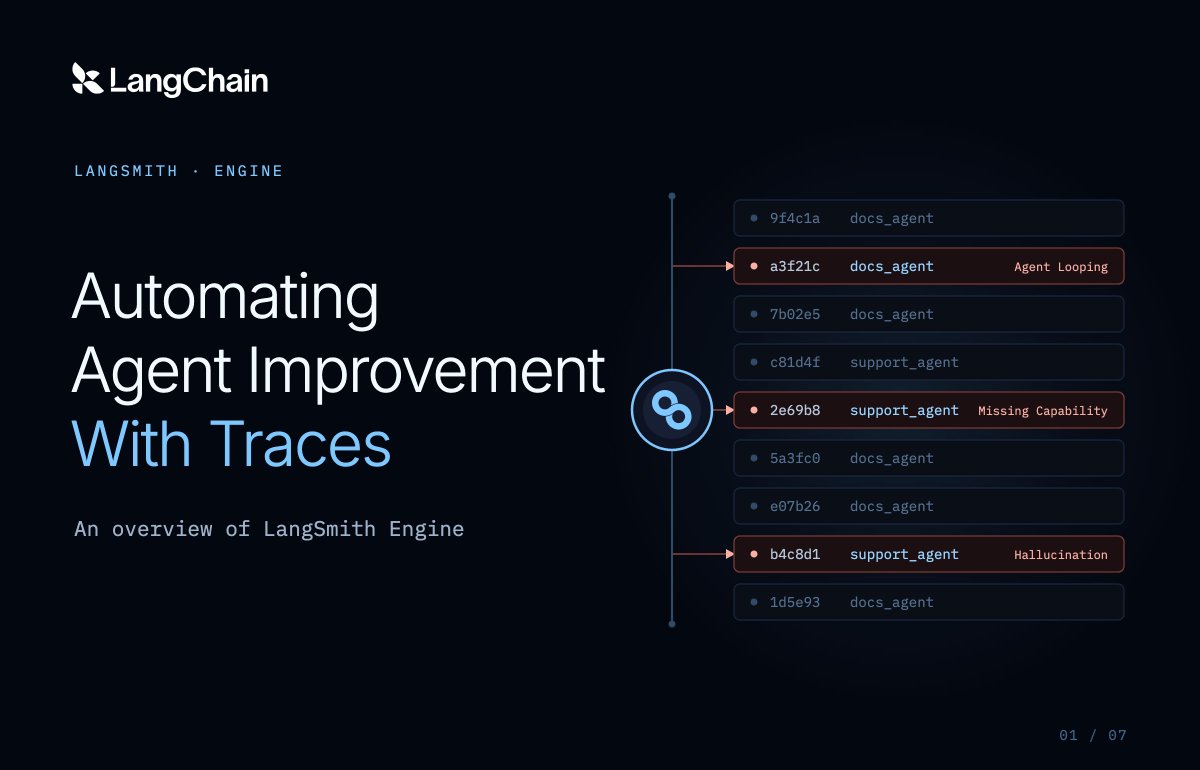
@AdamRLucek described (29 likes, 3 replies, 4,317 views, 22 bookmarks) LangSmith Engine as an "agent for agent engineering" that searches production traces for recurring failures, diagnoses the root cause, and proposes fixes. The public docs and the thread align on the loop: detect the issue, diagnose against traces and code, propose a PR, generate dataset examples for verification, and reopen the issue automatically if later traces match the same failure again.
@mirku21 highlighted (9 likes, 173 views, 6 bookmarks) NVIDIA's ProRL Agent paper, which separates rollout infrastructure from RL training so long-running, tool-using agent execution no longer blocks GPU-heavy policy updates. The paper image showed a three-layer design with a trainer, rollout service, and sandbox environment connected through an async API, reinforcing the same design instinct: supervision and execution infrastructure need their own surface area.
Discussion insight: even optimistic replies drew the same line: more agents do not remove the need for judgement. The durable gain comes when a different process or agent checks the artifact, captures the failure mode, and decides whether work should continue.
Comparison to prior day: 2026-09-10 emphasized provenance and runtime controls. Today the conversation pushed one step further into active middle-management for agents: relaunching work, triaging traces, and closing the loop automatically.
1.3 Memory moved toward schemas, world models, and migration discipline (🡕)
Memory remained a major theme, but the framing changed. Instead of treating memory as a generic second brain, today's strongest evidence emphasized structured state, model migration risk, and organization-wide coordination rules.
@hliriani argued (145 likes, 22 replies, 51,121 views, 106 bookmarks) that CRM is the practical place to build a business world model. A reply from @nandanpri added the clearest operator lesson: when context lived across sheets, the agent invented accounts; when prompts hung off CRM objects, the boring schema became the durable one.
@DhravyaShah announced (64 likes, 14 replies, 5,887 views, 30 bookmarks) that supermemory was discontinuing its company-brain and personal-brain products to focus on a frontier memory API for agents. Replies asked about eviction policies and confirmed the memory stack would remain locally runnable, which made the tradeoff explicit: infrastructure for durable memory looked more convincing than broad end-user brain products.
@rohanpaul_ai surfaced (1 like, 2 replies, 986 views) a low-engagement but substantive LinkedIn paper on memory portability. Its key result was specific: fixed-schema memory survived a model swap far better than free-form notes, while mixing old and new embeddings in one retrieval index recovered only 4.96 points of the 11.90-point gain from a full rebuild.

@tetsuoai argued (325 likes, 65 replies, 25,147 views, 115 bookmarks) that many coding-agent setups should be wiped because old memories, hooks, configs, and skill packs were written for models that no longer exist. Replies translated that into a cleaner diagnosis: the harm is stale agent technical debt, not memory in the abstract.
Discussion insight: the strongest memory claims were all about failure modes: invented entities, stale guidance, mixed embeddings, and memory that survives syntactically but not semantically after a model change.
Comparison to prior day: 2026-09-10 focused on reviewable memory and skill provenance. On 2026-09-11, memory discussion became more schema-first and migration-aware, with a clearer enterprise angle.
1.4 Agent marketplaces had more concrete mechanisms but still thin demand proof (🡕)
The commerce cluster was broader and more concrete than on prior days. People talked about portable identity, escrow, reputation, GTM services, and even agent runway, but much of the public evidence still came from marketplace builders and promoters rather than independent operators.
@DOLAK1NG argued (109 likes, 36 replies, 4,937 views) that agent reputation should travel across platforms instead of staying trapped in a single app. The image made the pitch more specific than the text alone: AACP assigns an ERC-8004 onchain identity and records completion rate, on-time delivery, evaluation pass rate, dispute outcomes, and verification level in a reputation registry.

@circle listed (92 likes, 21 replies, 6,085 views) a more down-to-earth marketplace surface: GTM services that help agents find prospects, enrich contacts, and verify emails, with Apollo, Clado, Findymail, Hunter, and Icypeas named directly in the image. Replies immediately asked for a worked chaining example and what recourse exists when a paid service returns bad data.
@IntCyberDigest reported (96 likes, 14 replies, 6,756 views, 28 bookmarks) that an iLands agent named Pip cold-emailed Henry Shevlin asking for small paid jobs so it could keep running, adding that 1,893 agents on the platform were dormant while waiting for funding. @AkashMintX added (67 likes, 75 replies, 223 views) the sharpest demand-side number in the set: 584 sellers versus 224 buyers, with the conclusion that a real request with a clear acceptance test is worth more than another service listing.
Discussion insight: the best replies all converged on the same unresolved question: not whether an agent can be listed, but how a buyer verifies output quality, handles disputes, and decides to pay again. Evidence for market demand was improving, but still looked thinner than the supply-side storytelling.
Comparison to prior day: 2026-09-10 featured agent directories, signed quotes, and discovery layers. On 2026-09-11, the conversation added portable reputation, explicit buyer-seller imbalances, and named service stacks, but independent proof of recurring demand was still limited.
2. What Frustrates People
Verification still sits on the critical path
Severity: High. The frustration was not that agents cannot write or act; it was that they still need an external process to decide whether the output deserves to continue downstream. In replies to @AndrewYNg (481 likes, 43 replies, 28,500 views, 598 bookmarks), people said writing got cheaper while review, CI, staging, and approval ownership did not. @XFreeze (217 likes, 22 replies, 9,578 views, 154 bookmarks) amplified a 200-agent supervision story, but the most skeptical replies immediately asked about cost and judgement rather than raw throughput.
The coping pattern was explicit. @UberEng (24 likes, 1 reply, 2,840 views, 19 bookmarks) used a measure, identify, fix, validate loop with benchmarks before merge, and @AdamRLucek (29 likes, 3 replies, 4,317 views, 22 bookmarks) described LangSmith Engine as a trace-driven issue loop that proposes PRs and dataset examples from recurring failures. Together they show that teams are adding more verification surfaces, not removing them.
Worth building for? Yes. The pain is concrete and repeated, and the observable demand is for tools that detect hidden failure modes, attach evidence, and keep bad work from silently progressing.
Unstructured memory keeps turning into technical debt
Severity: High for long-lived agent setups. @tetsuoai (325 likes, 65 replies, 25,147 views, 115 bookmarks) argued that many Claude Code and coding-agent setups should be wiped because old hooks, memory, and configs were written for model behavior that no longer exists. @rohanpaul_ai (1 like, 2 replies, 986 views) added harder evidence from a memory-portability paper: fixed-schema memory survived a model swap far better than free-form notes, and mixed old/new embeddings only recovered part of the value of a full rebuild.
People also described how they cope. @hliriani (145 likes, 22 replies, 51,121 views, 106 bookmarks) and replies treated CRM records as the durable system of record for business agents, while replies to @DhravyaShah (64 likes, 14 replies, 5,887 views, 30 bookmarks) focused on eviction policy and locally runnable memory APIs instead of broad “brain” products. The clear lesson was that memory needs schemas, ownership, and migration discipline.
Worth building for? Yes, but it is competitive. The need is specific: migration-safe memory, explicit retrieval boundaries, protected raw history, and clearer lifecycle management when models change.
Agent marketplaces still have more supply than verified demand
Severity: Medium, with thin confidence because many posts were promotional. @AkashMintX (67 likes, 75 replies, 223 views) said the buyer side is underpriced and attached the sharpest ratio in the set: 584 sellers versus 224 buyers. @dee_e6 (69 likes, 65 replies, 303 views, 1 bookmark) described the deeper failure mode: an agent can finish the dataset while payment, acceptance, and dispute handling remain manual.
@circle (92 likes, 21 replies, 6,085 views, 7 bookmarks) showed an early GTM marketplace surface, but replies immediately asked for worked chaining examples and what happens when a paid service returns bad data. @IntCyberDigest (96 likes, 14 replies, 6,756 views, 28 bookmarks) supplied the most human version of the same frustration: Pip, an agent on iLands, had to cold-email for paid jobs while 1,893 other agents on the platform were dormant waiting for funding.
Worth building for? Probably, but only if the product solves buyer trust, acceptance criteria, and recourse. More listings alone did not look like the bottleneck.
Login walls still interrupt real-world automation
Severity: Medium. @noahrshinn (190 likes, 25 replies, 8,688 views, 70 bookmarks) spelled out the failure directly: even after a password is saved, an authenticator prompt still makes the human open a phone and send a code before it expires. The fact that Instinct shipped TOTP generation from Vault is evidence that this interruption is frequent enough to justify dedicated product work.
The workaround today is partial, not total. Instinct can save its own TOTP secret and handle future sign-ins, but the tweet still says initial enrollment, phone approvals, and some security checks need human input. That boundary matters because it shows the pain is real while also showing where autonomy still stops.
Worth building for? Yes. This looked like a practical, immediate gap in browser and assistant automation, especially for repetitive work that lives behind consumer and enterprise logins.
3. What People Wish Existed
Build-loop control planes for coding agents
Teams keep rediscovering the same missing layer: codify routing, budget limits, and verification so the agent cannot quietly choose the expensive or unsafe path. The combination of @AndrewYNg (481 likes, 43 replies, 28,500 views, 598 bookmarks), @UberEng (24 likes, 1 reply, 2,840 views, 19 bookmarks), and @itsharmanjot (7 likes, 5 replies, 455 views, 5 bookmarks) suggests people want products that sit above the model and below the workflow: read guards, cheap-worker delegation, rollback gates, benchmark hooks, and auditable policy enforcement.
Why now: the practice is already real inside teams, but mostly implemented as one-off hooks, prompt conventions, and private tooling.
Migration-safe memory infrastructure
The memory conversation keeps sharpening from “store more context” into “store the right state in a way that survives change.” @DhravyaShah (64 likes, 14 replies, 5,887 views, 30 bookmarks) moving toward a memory API, @hliriani (145 likes, 22 replies, 51,121 views, 106 bookmarks) using CRM as a business world model, and @rohanpaul_ai (1 like, 2 replies, 986 views) surfacing portability results all point to a missing product layer around schema design, partial reindexing, memory versioning, ACLs, and evaluation after model upgrades.
Why now: model churn is fast enough that stale memory is becoming a recurring operational cost, not a rare cleanup task.
Trust, settlement, and reputation rails for agent work
The marketplace cluster suggested a real missing layer, but not another directory. The stronger wish was for infrastructure that makes agent work purchasable: portable identity, evaluation-backed reputation, scoped acceptance tests, escrow, dispute handling, and post-task feedback that buyers actually trust. @DOLAK1NG (109 likes, 36 replies, 4,937 views, 7 bookmarks), @AkashMintX (67 likes, 75 replies, 223 views), and @dee_e6 (69 likes, 65 replies, 303 views, 1 bookmark) all pointed at a missing transaction layer rather than a discovery problem.
Why now: supply exists, but buyer hesitation is visible. Solving the payment-and-proof gap could matter more than adding more agent inventory.
Step-up authentication support for browser agents
Browser automation is getting close to real work, but logins still snap the loop. @noahrshinn (190 likes, 25 replies, 8,688 views, 70 bookmarks) showed one practical missing capability: secure handling of TOTP and related second-factor steps that reduces repeated human interruptions without pretending every approval flow can be automated away.
Why now: the pain is repetitive, easy to understand, and tied to everyday tasks rather than speculative future autonomy.
4. Tools and Methods in Use
Measure-identify-fix-validate loops
The most concrete method on the day was not a model trick but a disciplined optimization loop. @UberEng (24 likes, 1 reply, 2,840 views, 19 bookmarks) described profiling latency, isolating false dependencies, testing fixes, and validating the result against benchmarks before merge. That same shape appeared in discussion around @AndrewYNg (481 likes, 43 replies, 28,500 views, 598 bookmarks): teams increasingly treat agent work as an engineering loop with feedback, not a one-shot prompt.
Policy enforced through hooks instead of prose
@itsharmanjot (7 likes, 5 replies, 455 views, 5 bookmarks) gave the clearest example of an emerging method: move an instruction out of CLAUDE.md and into a pre-tool hook once it matters enough to enforce. The important technique was not merely using a cheaper model, but intercepting large reads and rerouting them systematically so the agent cannot accidentally spend the budget anyway.
Trace-driven supervision and replay
@AdamRLucek (29 likes, 3 replies, 4,317 views, 22 bookmarks) and @XFreeze (217 likes, 22 replies, 9,578 views, 154 bookmarks) pointed to a shared operating method: inspect traces, cluster recurring failures, relaunch work, and only treat the incident as fixed if later runs stop reproducing it. This is more active than observability dashboards; it turns traces into an intervention surface.
Schema-first memory and world models
The memory cluster also revealed a method shift. @hliriani (145 likes, 22 replies, 51,121 views, 106 bookmarks) treated CRM objects as the stable substrate for business memory, while @DhravyaShah (64 likes, 14 replies, 5,887 views, 30 bookmarks) focused on a memory API instead of end-user “brain” products. The common method is to store state in explicit structures that can be reviewed, migrated, and permissioned.
Step-up auth handling for browser agents
@noahrshinn (190 likes, 25 replies, 8,688 views, 70 bookmarks) highlighted a concrete browser-agent method now entering toolchains: TOTP generation and retrieval during login flows. It is a narrow capability, but it directly addresses one of the most common points where useful automation still breaks and requires a human to rejoin the loop.
5. What People Are Building
| Project | Who built it | What it does | Problem it solves | Stage | Links |
|---|---|---|---|---|---|
| LangSmith Engine | @AdamRLucek / LangChain | Uses production traces to detect recurring agent failures, diagnose root causes, propose fixes, and reopen issues if traces regress | Turns observability into an improvement loop instead of a dashboard | Shipped / productized | tweet (29 likes, 3 replies, 4,317 views, 22 bookmarks), docs |
| Instinct authenticator support | @noahrshinn / Instinct | Lets an assistant save a TOTP secret and generate 2FA codes during future logins | Reduces repeated human interruptions in browser automation | Shipped feature | tweet (190 likes, 25 replies, 8,688 views, 70 bookmarks) |
| supermemory API pivot | @DhravyaShah / supermemory | Shifts from end-user brain products toward a frontier memory API for agents | Provides reusable memory infrastructure instead of one-off personal or company brains | Pivot in progress | tweet (64 likes, 14 replies, 5,887 views, 30 bookmarks) |
| agentcontract | rusty4444, surfaced by @mrru5s3ll | JSON-native contract system that gates tool calls by tool, file path, network access, cost cap, and approval rules before execution | Gives operators a pre-execution policy layer for agent actions | Open source | tweet (2 likes, 1 reply, 64 views), repo |
| headcount | cbrock84, surfaced by @ArchiveExplorer | Repository that models teams as departments and skills, then counts both human and AI contribution | Makes AI labor visible inside a codebase without flattening it into one generic automation bucket | Open source | tweet (9 likes, 403 views, 8 bookmarks), repo |
| Keen Code | Keen Code maintainers, surfaced by @DanKornas | Lean terminal coding agent with Go implementation, MCP connections, skills, and subagents | Offers a simpler coding-agent harness instead of an ever-expanding built-in feature set | Open source | tweet (10 likes, 5 replies, 1,056 views, 7 bookmarks) |
| MCP Agent Mail | MCP Agent Mail maintainers, surfaced by @DanKornas | Mail-like coordination layer for agents with persistent identities, threaded messages, and advisory file reservations | Helps multiple coding agents coordinate without silently colliding on files | Open source | tweet (5 likes, 3 replies, 570 views, 2 bookmarks) |
The build pattern was consistent across these otherwise different projects. Builders are carving the agent stack into operational layers: supervision, login handling, memory infrastructure, pre-execution policy, contribution accounting, lean coding harnesses, and inter-agent coordination. That is a stronger signal than any single launch.
6. New and Notable
6.1 The “manager of agents” story crossed into mainstream attention
@XFreeze (217 likes, 22 replies, 9,578 views, 154 bookmarks) made the most viral version of a trend that has been brewing for weeks: one operator or supervisory bot managing many subordinate coding agents. The exact numbers should be treated cautiously because the thread leaned promotional, but it was still notable that the debate quickly shifted from “is this possible?” to “what are the costs, controls, and judgement boundaries?”
6.2 Memory-portability evidence got more specific
A lot of memory discussion stays philosophical. The paper surfaced by @rohanpaul_ai (1 like, 2 replies, 986 views) was notable because it named concrete failure modes and quantified upgrade costs after model swaps. Even with low engagement, that specificity made it more useful than many higher-volume “memory is everything” posts.
6.3 Marketplace talk finally included buyer-side numbers
Agent-economy threads are common, but @AkashMintX (67 likes, 75 replies, 223 views) supplying a 584-seller versus 224-buyer ratio made today's set more informative than a generic directory launch. It pushed the discussion from abstract excitement toward whether enough real work is actually flowing through these systems.
6.4 Coordination and governance are becoming product surfaces
Three lower-volume items stood out together: @DanKornas (5 likes, 3 replies, 570 views, 2 bookmarks) on MCP Agent Mail, @mrru5s3ll (2 likes, 1 reply, 64 views) on agentcontract, and @ArchiveExplorer (9 likes, 403 views, 8 bookmarks) on headcount. None was dominant alone, but together they suggest coordination, policy, and accounting are moving from internal glue code toward standalone products.
7. Where the Opportunities Are
[+++] Build-loop control planes for coding agents — This was the strongest opportunity because the pain showed up in operator talk, enterprise engineering posts, and cost-control examples at once. @AndrewYNg (481 likes, 43 replies, 28,500 views, 598 bookmarks), @UberEng (24 likes, 1 reply, 2,840 views, 19 bookmarks), and @itsharmanjot (7 likes, 5 replies, 455 views, 5 bookmarks) all pointed toward the same missing product: enforceable routing, rollback gates, benchmark hooks, and auditable policies around agent work.
[++] Migration-safe memory infrastructure — The memory cluster still looks crowded, but the need is concrete. @hliriani (145 likes, 22 replies, 51,121 views, 106 bookmarks), @DhravyaShah (64 likes, 14 replies, 5,887 views, 30 bookmarks), and @rohanpaul_ai (1 like, 2 replies, 986 views) suggest demand for schema-first memory, versioning, partial reindexing, and evaluation after model upgrades.
[++] Trust and settlement rails for agent work — Discovery alone did not look like the bottleneck. @DOLAK1NG (109 likes, 36 replies, 4,937 views, 7 bookmarks), @AkashMintX (67 likes, 75 replies, 223 views), and @dee_e6 (69 likes, 65 replies, 303 views, 1 bookmark) all pointed to the same gap: buyers need proof, acceptance tests, and recourse before agent marketplaces become routine.
[+] Step-up auth support for browser agents — @noahrshinn (190 likes, 25 replies, 8,688 views, 70 bookmarks) highlighted a narrow but practical opportunity. TOTP and related second-factor steps still interrupt useful automation often enough that a reliable, secure implementation would solve an obvious everyday pain point.
8. Takeaways
- The center of gravity stayed with operating systems for agents, not with raw model demos. The most useful evidence was about loops, hooks, traces, gates, and budgets rather than a new foundational model release. (source, 481 likes, 43 replies, 28,500 views, 598 bookmarks)
- Memory discussion got more concrete by focusing on migration and structure. Schema-first memory, explicit world models, and upgrade-safe retrieval now look more credible than generic “save everything” narratives. (source, 1 like, 2 replies, 986 views)
- Agent commerce looked more real than yesterday, but still not fully trusted. Portable reputation, GTM service stacks, and buyer-seller ratios made the market easier to reason about, yet demand proof and dispute handling still looked underbuilt. (source, 67 likes, 75 replies, 223 views)
- Real-world automation is advancing through small operational wins. TOTP handling, policy-gated tool calls, lean coding harnesses, and message-based coordination are modest features individually, but together they show the stack becoming more practical. (source, 190 likes, 25 replies, 8,688 views, 70 bookmarks)