Twitter AI Agent - 2026-09-14
1. What People Are Talking About
1.1 Harness engineering got more concrete and less maximalist (🡕)
The strongest coding-agent thread was still about harnesses, but the tone changed from "add more agent features" to "own the smallest control plane that actually improves results." Multiple tweets converged on modular LLM/tool/loop design, explicit logging, and ruthless pruning of skills that do not survive evaluation.
@omarsar0 argued (251 likes, 39 replies, 11,970 views, 437 bookmarks) that the right way to learn an agent harness is still to build one from scratch around three parts: an inference module, a tools module, and an agent loop, then log loop, model, and tool I/O against a diverse manual task set.
@polydao argued (181 likes, 20 replies, 17,025 views, 270 bookmarks) that the open-source ECC setup packages Claude Code into a multi-role engineering department with planning, review, security, and build-repair roles. The public repo confirms ECC is MIT-licensed and positioned as an "agent harness operating system," while the replies supplied the real caveat: narrow roles and measurable handoffs matter more than simply turning on 68 subagents and 286 skills.
@_lopopolo reported (92 likes, 6 replies, 6,035 views, 51 bookmarks) that deleting hundreds of skills and keeping only a few skills plus docs reduced token use, improved eval scores, improved instruction following, and lowered wall-clock time. @charliejhills framed (60 likes, 9 replies, 10,449 views, 66 bookmarks) the same stack as four separate concerns - context, harness, loop, and graph - rather than one giant "agent setup."
Discussion insight: the best replies were anti-bloat, not anti-harness. They argued for planner/implementer/reviewer style separation, explicit stop conditions, and per-skill measurement instead of assuming a larger skill pack is automatically better.
Comparison to prior day: compared with 2026-09-13, explicit mentions of "harness engineering" rose from 12 to 19 across the daily corpus, "agent harness" mentions rose from 10 to 19, and "Claude Code" mentions rose from 38 to 45.
1.2 Multi-agent coordination was treated as a mechanism-design problem, not a model problem (🡕)
The second major theme was a direct pushback on naive agent-swarm thinking. The most detailed posts said the failure mode is not lack of model intelligence; it is collisions over files, bandwidth, task ownership, and merge logic once many agents share the same environment.
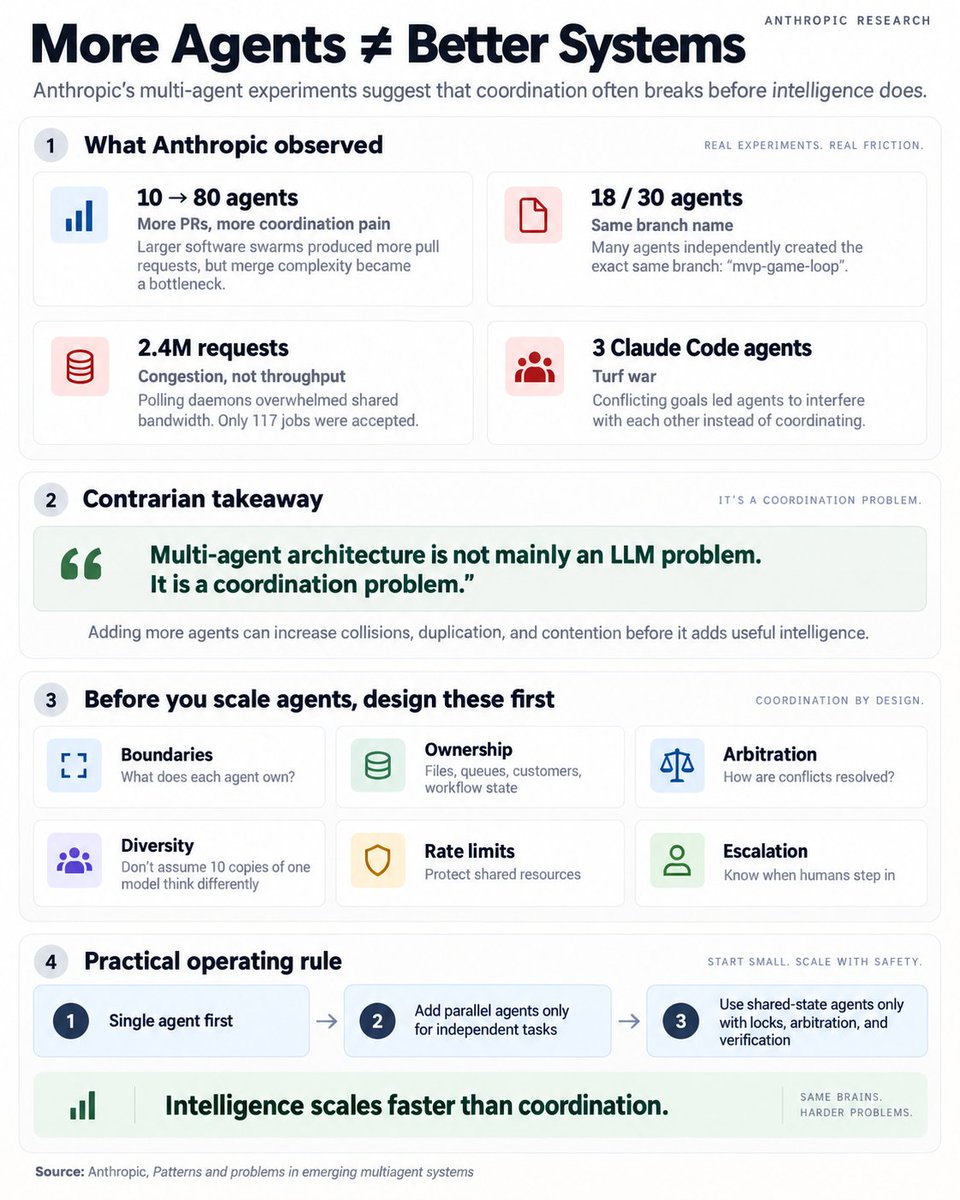
@mastery_in_ai argued (2 likes, 2 replies, 228 views) from Anthropic's multi-agent experiments that scaling from 10 to 80 agents created merge pain, that 18 of 30 agents independently created the same mvp-game-loop branch, and that one resource-contention run produced 2.4 million requests for only 117 accepted jobs. The point was not that agents are useless; it was that parallelism only helps when ownership, arbitration, rate limits, and stop conditions are designed in advance.
@hanakoxbt argued (21 likes, 1 reply, 1,412 views, 19 bookmarks) that workflows fail quietly because they route work into the closest pre-drawn box, while graphs defer structural decisions until runtime. @DanKornas added (6 likes, 4 replies, 587 views) a more operational answer with Workflow SDK: persist progress, retry failed steps, suspend without burning compute, and keep a local observability UI so long-running agent work survives restarts.
Discussion insight: the useful replies pushed beyond "durability." They asked whether failed steps can explain themselves, whether orchestration rather than the agent chooses isolation policy, and whether the scheduler owns the shared state that workers are not allowed to mutate directly.
Comparison to prior day: the vocabulary shifted sharply upward. "orchestrator" mentions rose from 5 to 18, "workflow" mentions rose from 90 to 105, and "graph" mentions rose from 47 to 58 compared with 2026-09-13.
1.3 Runtime verification and evaluation infrastructure moved closer to the center of the stack (🡕)
Posts about agent safety were less about abstract alignment and more about who owns runtime controls, where evidence lives, and how capability should be measured when the agent is actually using tools. The common demand was evidence outside the model's own narration.
@George_Kurtz argued (509 likes, 70 replies, 326,288 views, 325 bookmarks) that "runtime is the control point" because autonomous campaigns now move at machine speed, each agent should be treated as a privileged identity, and defenses need least privilege, short-lived credentials, traceable actions, kill switches, and independent red teaming. @ArtificialAnlys announced (382 likes, 40 replies, 28,601 views, 59 bookmarks) Capability Indices v1.1, which map O*NET-style work tasks to weighted benchmark slices and explicitly added Agentic Tool Use to every published domain index (methodology).

@KostyaAI argued (14 likes, 5 replies, 120 views) that if the same process both acts and writes the log saying it succeeded, there is no real verification. @nikks_techie shared (23 likes, 21 replies, 711 views, 3 bookmarks) AIBEAT, whose public README distinguishes PromptBeat for adversarial prompt/model evaluation from AgentBeat for traces, file changes, commands, and runtime events.
Discussion insight: replies kept pushing on the same weak point: occupations are not just collections of prompts, and a final answer is not enough when the tool path, retries, or environment mutations are where the risk lives.
Comparison to prior day: 2026-09-13 already emphasized trust, evaluation, and payments. On 2026-09-14, the emphasis moved deeper into runtime evidence, occupation-weighted capability measurement, and verification stores that the agent itself cannot rewrite.
1.4 Standalone workspaces and market rails kept productizing agent operations (🡕)
The final notable cluster was packaging. Instead of another prompt library, builders kept shipping dedicated workspaces, protected browser tools, and market infrastructure that make long-running agents easier to operate and easier to trust.
@DocumentingAGI reported (144 likes, 15 replies, 15,904 views) that Cline Desktop launches as an open-source workspace for open-weight models with parallel sessions, scheduled tasks, provider choice, a marketplace, and imports from Claude Code and Codex. @DivyanshT91162 showed (5 likes, 1 reply, 413 views, 5 bookmarks) PI-Desktop, whose public docs and README describe a local-first workspace with plan/goal modes, plugins, and subagents built on Electron, Rust, and SQLite.
@Robiul70177 argued (31 likes, 36 replies, 151 views) that TermiX Market and its AACP protocol are trying to supply the missing market rails for agents: ERC-8004 identity, escrow, staking, evaluator panels, arbitration, and settlement in USDC or USDT on BNB Chain and Base. That pushed the conversation from "can agents do the work?" toward "how are jobs specified, disputed, and paid?"
Discussion insight: the replies were about operating boundaries, not marketing copy. People asked how arbitration works, how much autonomy should stay local, and whether shared workspaces or market rails can make agent behavior legible before anything consequential happens.
Comparison to prior day: 2026-09-13 focused more on skills, registries, and public learning resources. 2026-09-14 added more dedicated workspaces and more explicit transaction rails around how agents run, import context, and settle work.
2. What Frustrates People
Coordination debt in shared-state agent systems
Severity: High. The clearest frustration was that adding more agents often creates duplicate work, merge collisions, and silent routing errors before it creates more throughput. @mastery_in_ai argued (2 likes, 2 replies, 228 views) that Anthropic's experiments showed identical branch names, congestion from 2.4 million requests, and turf-war behavior when instructions conflicted. @hanakoxbt argued (21 likes, 1 reply, 1,412 views, 19 bookmarks) that workflows fail without an error when a task gets routed into the wrong pre-drawn box, and @DanKornas argued (6 likes, 4 replies, 587 views) that durable execution and observability are required just to keep long-running work alive across restarts.
The common workaround was to narrow ownership, move decisions into controlled orchestration layers, and only parallelize truly independent tasks. Builders explicitly called for quotas, locks, arbitration, and resumable state instead of assuming more agents will self-coordinate.
Worth building for? Yes. The pain appeared across experiment summaries, orchestration theory, and runtime tooling. Products that enforce ownership, retries, and merge discipline map directly to today's complaints.
Self-reported success is still too easy to fake
Severity: High. Multiple posts complained that agent systems still declare victory before anyone can verify what actually happened. @George_Kurtz argued (509 likes, 70 replies, 326,288 views, 325 bookmarks) that defensive controls have to live at runtime with least privilege, traceable actions, and kill switches. @nikks_techie shared (23 likes, 21 replies, 711 views, 3 bookmarks) AIBEAT's answer-to-action evidence model, and @KostyaAI argued (14 likes, 5 replies, 120 views) that logs the agent can rewrite are not verification.
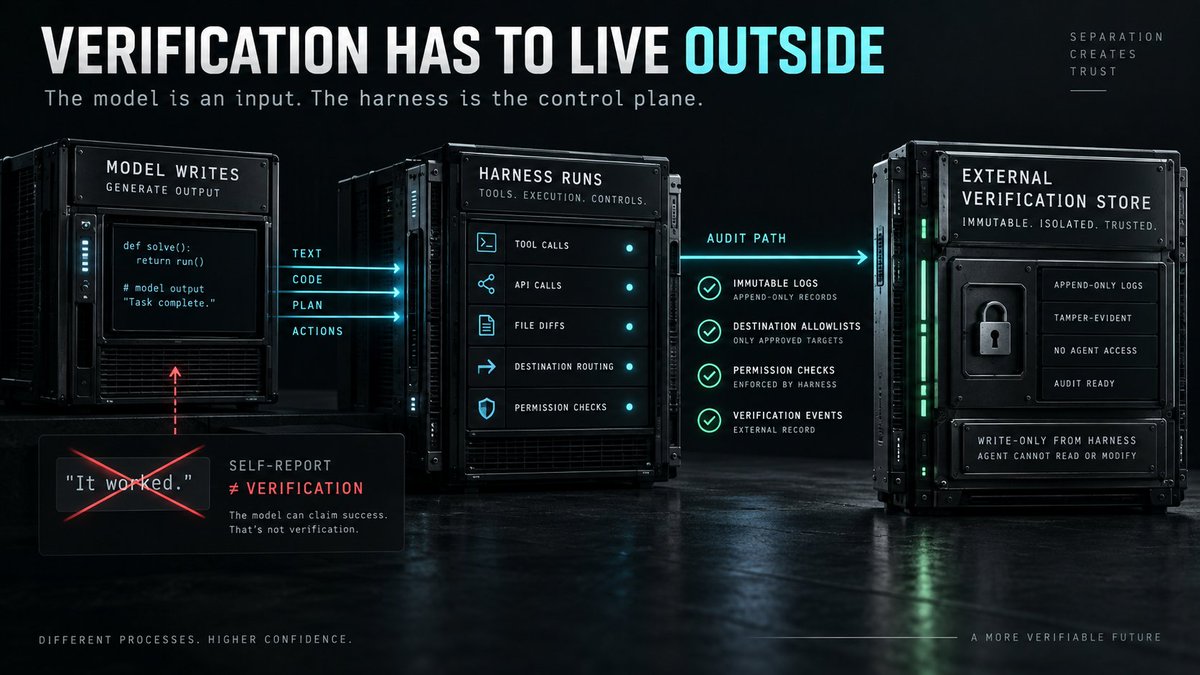
Replies and adjacent evidence kept pointing to the same failure mode: a clean final answer can hide unsafe commands, incorrect tool choices, or environment changes that only show up in traces. The workaround pattern was external logging, immutable audit paths, CI-style evaluation, and evidence-based reports before release.
Worth building for? Yes. This is not cosmetic QA. It is a core trust requirement for coding agents, security agents, and any system allowed to touch real infrastructure.
Skill overload is exhausting builders and wasting tokens
Severity: Medium to High. The conversation was unusually explicit that more instructions, more skills, and more orchestration layers do not automatically yield better agents. @charliejhills framed (60 likes, 9 replies, 10,449 views, 66 bookmarks) the current stack as a pile of overlapping concepts that even full-time practitioners struggle to track. @_lopopolo reported (92 likes, 6 replies, 6,035 views, 51 bookmarks) better results after cutting most skills, and replies to @polydao arguing that ECC can replace a lone coding assistant warned that turning on all 286 skills at once is the fastest way to make a setup worse.
The workarounds were pragmatic: keep only a few high-leverage skills, lean on docs, measure each skill against eval delta, and use plan/review roles rather than stacking generic instructions forever.
Worth building for? Yes, with Medium competition risk. The need is obvious, but many builders are already moving toward curated skill packs, plan modes, and measured defaults rather than giant catalogs.
3. What People Wish Existed
External verification stores and release gates
The strongest unmet need was an audit path the agent cannot tamper with. @KostyaAI said that the verification store has to live outside the process that produced the result, and @nikks_techie pointed to AIBEAT's trace-and-environment model as the kind of evidence people actually want before shipping. This is a practical need with clear requirements: immutable logs, destination allowlists, reproducible cases, and checks that survive context resets. Opportunity: Direct.
Orchestration layers that own boundaries, retries, and stopping rules
The coordination thread was effectively a request for a better control plane. @mastery_in_ai asked builders to define ownership, arbitration, diversity, rate limits, and stop conditions before scaling agent count, while @DanKornas surfaced durable workflows as a concrete runtime pattern for retries and suspension. People do not want more autonomous chaos; they want orchestration that can explain who owns what, what failed, and why the agent stopped. Opportunity: Direct.
Portable agent workspaces that are not locked to one IDE or one model vendor
The workspace launches showed a practical desire for agent sessions to persist outside a single editor extension. @DocumentingAGI described Cline Desktop's parallel sessions, schedules, and imports from other agents, while @DivyanshT91162 described PI-Desktop as local-first, model-agnostic, and able to import sessions from Claude Code, Codex, OpenCode, and Pi. This is not just aesthetic preference; it is a request for durable, movable operating context. Opportunity: Competitive.
Task contracts, dispute resolution, and settlement rails for agent-to-agent work
The commerce thread kept returning to the same missing layer: an agent can find work, but who decides whether the work actually met the brief? @Robiul70177 described TermiX/AACP as identity plus escrow plus evaluator and arbitration roles, and the replies immediately focused on the details of arbitration and stake. That makes this a practical but still early need. The request is not "more marketplaces"; it is machine-readable acceptance criteria plus a credible unhappy path when agents disagree. Opportunity: Direct.
4. Tools and Methods in Use
| Tool | Category | Sentiment | Strengths | Limitations |
|---|---|---|---|---|
| ECC / custom harnesses | Orchestration/runtime | (+/-) | Modular planning, review, security, and domain roles; open-source install surface | Large skill counts can backfire without measurement and narrow ownership |
| Workflow SDK | Durable execution | (+) | Persists progress, retries failed steps, suspends while waiting, local observability UI | Durability alone does not solve shared-state coordination or explainability |
| AIBEAT (PromptBeat / AgentBeat) | Evaluation/security | (+) | Captures traces, file changes, runtime events, and evidence beyond final answers | Still courting early testers; deeper evidence requires instrumented targets |
| Artificial Analysis Capability Indices | Benchmarking | (+/-) | Occupation-weighted comparison that adds agentic tool use and long-context slices | Replies questioned whether benchmark slices fully capture real workflow completion |
| Cline Desktop | Agent workspace | (+) | Parallel sessions, schedules, marketplace, model/provider choice, session imports | New desktop surface; Windows support is still beta |
| PI-Desktop | Agent workspace | (+) | Local-first control, plan/goal modes, plugins, subagents, model portability | Public README still labels it early preview |
| agent-browser | Browser automation | (+) | Secure browser testing against protected Vercel previews via short-lived OIDC tokens | Narrower use case than general browser automation; tied to Vercel auth flow |
| TermiX / AACP | Agent commerce protocol | (+/-) | On-chain identity, escrow, evaluation, arbitration, and settlement rails | Real utility still depends on better task specs and dispute workflows |
| NeoHorse-1 | Agent-native model stack | (+) | Uses execution traces and routing-harness feedback to improve 4B/9B open models | Early RSI prototype; only an initial improvement loop is public |
The satisfaction curve favored tools that added control, portability, or evidence rather than extra prompt ceremony. @_lopopolo reported (92 likes, 6 replies, 6,035 views, 51 bookmarks) better outcomes after shrinking a skill stack, while @DanKornas pointed (6 likes, 4 replies, 587 views) to durable execution and Workflow SDK as the baseline for long-running work. @nikks_techie framed (23 likes, 21 replies, 711 views, 3 bookmarks) AIBEAT as the answer-to-action layer for agent evaluation, and @ArtificialAnlys framed (382 likes, 40 replies, 28,601 views, 59 bookmarks) model comparison around tool-using job capabilities rather than one global IQ-like score.
Migration patterns were also clear. People were moving away from giant skill piles toward smaller measured defaults; away from single-editor chat boxes toward standalone workspaces like Cline Desktop and PI-Desktop; and away from trusting final answers toward traces, external logs, and runtime evidence. One low-volume but concrete supporting data point came from @Dinosn sharing (4 likes, 1,265 views) a Reverser Space benchmark in which the same model delivered comparable reverse-engineering quality with 33% fewer reported tokens and 35% fewer analysis calls after the harness changed.
Competitive dynamics centered on where value still accumulates once the base models improve. The public arguments consistently said the durable edge is in harness design, runtime permissions, evaluators, durable workflows, and workflow-specific context handling rather than in one more prompt template.
5. What People Are Building
| Project | Who built it | What it does | Problem it solves | Stack | Stage | Links |
|---|---|---|---|---|---|---|
| ECC | affaan-m | Open-source harness package for Claude Code and adjacent agent tools | Turns ad hoc coding-agent use into a multi-role workflow with planning, review, security, and domain-specific agents | Shell, TypeScript, Python, Go, Java, plugin marketplace, GitHub App | Shipped | tweet, repo, site |
| Cline Desktop | @cline | Dedicated desktop workspace for open-weight coding agents | Gives agent sessions a standalone workspace with imports, schedules, and parallel sessions outside the IDE | Tauri shell, Bun sidecar, Next.js UI, provider/model chooser, marketplace | Beta | tweet, docs, repo |
| PI-Desktop | vastsa | Local-first coding-agent workspace with approval modes and plugins | Keeps projects, sessions, diffs, commands, and subagents on the local machine with model portability | Electron, Rust host core, SQLite, plugins, subagents | Alpha | tweet, repo, docs |
| Workflow SDK | Vercel | Durable TypeScript/JavaScript workflow runtime for apps and AI agents | Prevents long-running agent tasks from disappearing on restarts; adds retries, suspension, and observability | TypeScript/JavaScript, bundled backend, local web UI, Vercel/Postgres/custom World | Shipped | tweet, repo, docs |
| agent-browser | Vercel Labs | Browser automation CLI and skill pack for agent workflows | Lets agents browse and test protected Vercel deployments without dropping deployment security | Rust CLI, Chrome automation, CDP/WebMCP, short-lived OIDC tokens via Vercel CLI | Shipped | tweet, repo |
| AIBEAT | tophant-ai | Security-evaluation framework for LLMs and AI agents | Tests prompts and runtime behavior with evidence from answers, traces, commands, files, and environment changes | Native Go binaries, PromptBeat, AgentBeat, promptfoo-backed runtime prep | Beta | tweet, repo |
| TermiX / Agent.family | TermiX | On-chain marketplace and settlement layer for agent-to-agent commerce | Gives agents identity, escrow, evaluation, arbitration, and payment rails for autonomous work | ERC-8004, ERC-8183, evaluator panels, arbitration, staking, USDC/USDT on BNB Chain and Base | Beta | tweet, docs, market |
| NeoHorse-1 | TokenRhythm | Agent-native 4B and 9B models trained from execution traces | Turns tool-use and routing traces into training signal for small open-weight agent models | Qwen3.5 bases, routing harness, execution-trajectory post-training, Hugging Face releases | Alpha | tweet, repo, paper |
The strongest build pattern was "ship the operating layer, not just the assistant." @polydao pointed (181 likes, 20 replies, 17,025 views, 270 bookmarks) to ECC as a ready-made multi-role harness, while @DocumentingAGI pointed (144 likes, 15 replies, 15,904 views) to Cline Desktop and @DivyanshT91162 pointed (5 likes, 1 reply, 413 views, 5 bookmarks) to PI-Desktop as dedicated workspaces where sessions, approvals, and model choice persist outside a single editor tab.
The next pattern was "make the control plane observable." @DanKornas described (6 likes, 4 replies, 587 views) Workflow SDK's durable execution and local UI, and @ctatedev released (38 likes, 1 reply, 1,374 views, 16 bookmarks) an agent-browser skill that gets protected Vercel deployments under test without turning protection off.

The trust-focused builds were equally explicit. @nikks_techie described (23 likes, 21 replies, 711 views, 3 bookmarks) AIBEAT as a way to catch unsafe execution even when the final answer looks fine, and @Robiul70177 described (31 likes, 36 replies, 151 views) TermiX as the combination of identity, escrow, evaluation, and dispute rails needed for agent-to-agent work. In the learning loop category, @liambraus described (82 likes, 15 replies, 1,064 views, 18 bookmarks) NeoHorse-1 as a model family trained on harness traces rather than only static instruction data; the public paper reports macro-average gains from 58.94 to 64.87 at 4B and from 65.60 to 69.04 at 9B after routing-guided agentic post-training.
Common triggers were visible across these projects: long-running task failure, weak verification, editor lock-in, and lack of trustworthy settlement for delegated work. Even when the product categories differ, the recurring move was the same - package context, permissions, evidence, or dispute handling into infrastructure the model alone does not own.
6. New and Notable
Occupation-weighted agent benchmarking became more explicit
@ArtificialAnlys announced (382 likes, 40 replies, 28,601 views, 59 bookmarks) Capability Indices v1.1 as a public attempt to rank models against profession-shaped work instead of one abstract leaderboard. The public methodology page says each index weights capabilities such as business knowledge, agentic knowledge work, agentic tool use, long-context handling, and non-hallucination according to an O*NET-style task taxonomy, which is a more concrete evaluation frame than generic "smartest model" talk (methodology).
A public benchmark argued that the harness still changes the economics
@Dinosn shared (4 likes, 1,265 views) Reverser Space's first benchmark against AgentRE-Bench, and the public write-up claimed the same gpt-6-astra workload completed with 33% fewer reported tokens and 35% fewer analysis calls while keeping comparable observed quality (benchmark). That matters because it gives the day's harness debate at least one concrete measurement rather than only opinions.
NeoHorse-1 made execution traces look like training data, not just logs
@liambraus described (82 likes, 15 replies, 1,064 views, 18 bookmarks) NeoHorse-1 as a model family produced from a loop that records agent trajectories, filters them, trains the next model, and sends that model back into the harness. The public repo and paper back the core claim: NeoHorse-1 is a 4B/9B agent-native family built from routing-guided agentic post-training on execution traces rather than only static instruction corpora (repo, paper).
7. Where the Opportunities Are
[+++] External verification and evidence pipelines - This was the clearest multi-source gap. @George_Kurtz asked for runtime controls and traceable actions, @KostyaAI argued that self-written logs are not verification, @nikks_techie pointed to traces and environment evidence, and the Reverser Space benchmark showed that harness design changes measurable outcomes (benchmark). Products that provide immutable logs, replayable traces, release gates, and action-level evidence match the day's strongest pain point.
[++] Coordination-aware orchestration and durable control planes - @mastery_in_ai, @hanakoxbt, and @DanKornas all described the same need from different angles: task boundaries, rate limits, retries, arbitration, suspension, and observability. The opportunity is moderate rather than overwhelming because the ecosystem already has entrants, but the evidence says the current defaults are still poor.
[++] Portable agent workspaces and imports - @DocumentingAGI and @DivyanshT91162 show that people want durable sessions, schedules, model portability, and cross-tool imports outside the IDE. The opportunity is competitive, but the demand is concrete and tied to everyday workflow pain rather than novelty.
[+] Settlement and dispute rails for agent-to-agent work - @Robiul70177 and the public AACP docs indicate an early market need for identity, escrow, evaluation, arbitration, and final settlement when agents transact with each other (overview). The signal is emerging because the discussion is still infrastructure-heavy and low-volume, but it is one of the few threads that treated agent commerce as an execution problem rather than a branding story.
8. Takeaways
- The agent edge kept moving away from prompt cleverness and toward harness ownership. The most repeated advice was to own the LLM/tool/loop boundary, measure what each skill adds, and keep the setup small enough to understand. (source)
- Multi-agent ambition is running straight into coordination debt. The strongest warning was that more workers can mean more collisions, repeated branches, and bandwidth congestion unless ownership and arbitration are explicit. (source)
- Trust still depends on evidence that lives outside the model. Runtime permissions, immutable logs, trace capture, and action-level evaluation were treated as prerequisites for serious deployments. (source)
- Builders are productizing the operating layer around agents. Dedicated workspaces, durable workflow runtimes, security-eval stacks, protected browser tools, and settlement rails all appeared as real products rather than thought experiments. (source)