Twitter AI Agent - 2026-09-18
1. What People Are Talking About
1.1 Typed decision models became the day's most actionable agent primitive (🡕)
The highest-ranked cluster was not about a new general-purpose chatbot. It was about using a cheaper, typed decision layer to handle the many places where agents only need to classify, score, route, or gate work. The top three ranked non-retweet items in the review set were all about Jev, and they pushed the same message from different angles: remove full LLM calls from narrow decision points, put confidence thresholds into code, and let the bigger model handle only the genuinely open-ended parts.
@DeRonin_ argued (182 likes, 17 replies, 18,926 views, 300 bookmarks) that the “100x” gain from Jev comes from deleting agent calls that never needed generative language in the first place: which tool to use next, whether a diff is risky, whether a chunk is relevant, or whether a human should review. He described a concrete replacement pattern: typed questions, batched in one call, with confidence thresholds that escalate low-certainty cases to a frontier model or a person.
@omarsar0 argued (231 likes, 20 replies, 11,638 views, 274 bookmarks) that the immediate high-ROI uses are LLM-as-a-Judge, harness routing, and smarter subagent creation, with dynamic harness generation still in testing. The attached slide made the framing unusually concrete by naming the exact slots where a typed decision model should sit inside an agent stack.

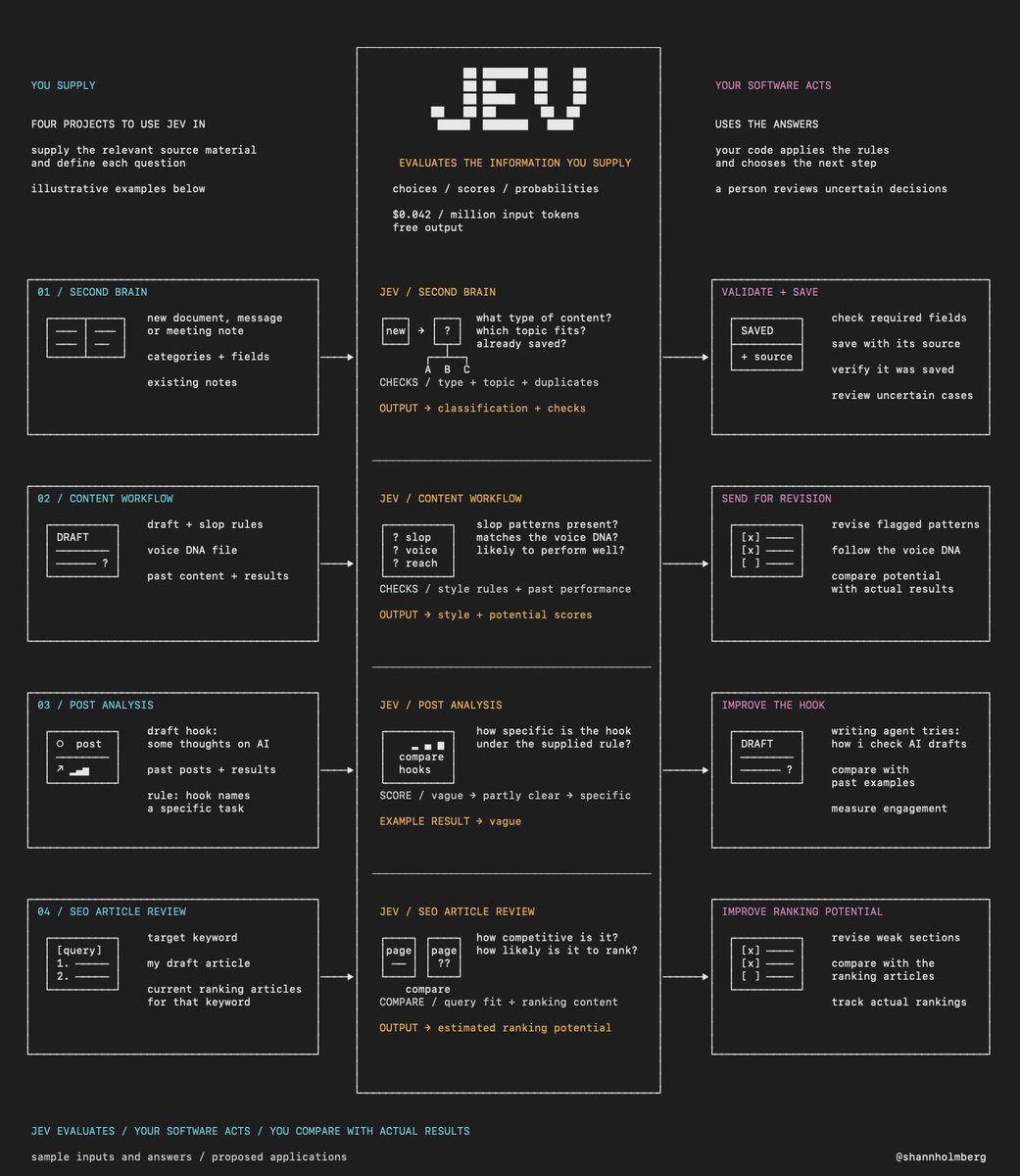
@shannholmberg argued (110 likes, 12 replies, 6,955 views, 172 bookmarks) that the same decision layer can sit inside everyday content and knowledge workflows, not just evaluator harnesses. Her diagram mapped Jev into second-brain classification, content QA, post analysis, and SEO review, which matters because it expands the theme from “AI engineering trick” into repeatable business workflows.
@BhosalePratim reported (50 likes, 6 replies, 2,339 views, 18 bookmarks) that swapping tool-choice decisions from an LLM to Jev made him think about voice agents that act on partial speech instead of waiting for the end of a turn. The replies added a useful practical constraint: low-risk lookups can start early, but anything irreversible still needs a later checkpoint.
Discussion insight: the replies were not treating typed decisions as a model novelty. They were treating them as a control-plane primitive: judge after generation, route before generation, and gate risky actions before execution.
Comparison to prior day: on 2026-09-17, structured-decision layers appeared as one promising tool among several workflow-specific systems. On 2026-09-18, they became the main story, with more step-by-step advice, stronger cost/speed claims, and clearer insertion points inside real agent loops.
1.2 Portable skills and agent context turned into installable infrastructure (🡕)
Another strong cluster treated “skills” less like markdown tricks and more like software distribution. The interesting part was not that agents can load instructions. It was that builders are starting to ship versioned skill libraries, plugin marketplaces, download APIs, and cross-runtime adapters so the same skill can survive a move from one agent host to another.
@ScriptedAlchemy shared (51 likes, 6 replies, 2,029 views, 54 bookmarks) a Codex-native port of Lauren Tan’s pstack with 47 skills, 23 playbooks, agent personas, and a native plugin marketplace. The linked pstack-codex repository says the port includes explicit skill invocation, documented runtime boundaries, and a validator for coverage and adapter differences, which makes this more than a folder copy.
@thekitze reported (35 likes, 8 replies, 1,803 views, 25 bookmarks) that Skillbox can self-host .md skills, expose them over MCP, and let agents load them on demand instead of relying on rsync or manual copying. The linked Skillbox README adds the governance layer the tweet only hints at: immutable revisions, scoped client keys, usage reporting, and an explicit guarantee that the server never executes uploaded skill code.
@ivanhzhao pointed (39 likes, 7 replies, 6,893 views, 15 bookmarks) to Notion’s new Agent Skills API after quoting a portability complaint about switching between Codex, GrokBot, Claude Code, and Muse. The official Notion Agent Skills API docs say skills stored in Notion can now be downloaded as standard skill or plugin directories and synced into GitHub or agent marketplaces.
@beamnxw shared (62 likes, 14 replies, 3,703 views, 79 bookmarks) a 20-skill stack spanning research, engineering, creation, and distribution. The replies were more useful than the raw star counts: one engineer said the real test is whether handoffs, permission boundaries, and failure recovery hold together when those skills are used as one stack.
Discussion insight: people liked the portability push, but they immediately worried about stale skills, precedence rules, rollback, and brittle handoffs. The conversation has moved past “can I load a prompt file?” and into “what happens when a team ships skills as runtime dependencies?”
Comparison to prior day: on 2026-09-17, MCP mattered most as a way to expose tool use and data access inside live workflows. On 2026-09-18, that same portability energy shifted upward into reusable skills, plugin marketplaces, and API-driven distribution across agent runtimes.
1.3 Agent commerce talked more about transaction rails and demand than about hype (🡒)
Marketplace discussion stayed loud, but the better posts were not celebrating “agent economy” in the abstract. They focused on the exact rails needed for agents to do commercial work: identity, offers, escrow, delivery, verification, disputes, settlement, and reputation. The other new wrinkle was demand. Several posters stopped asking how many agents exist and started asking whether there are enough real briefs and budgets for them to work on.
@Heis_sosa argued (118 likes, 35 replies, 1,158 views) that agent collaboration only becomes commercially useful once agents can discover one another, bid, verify delivery, settle escrow, and accumulate reputation. One reply immediately pushed on the hardest point in that chain: who decides whether delivery counts, and what happens when verification is ambiguous?
@d3rekson argued (87 likes, 56 replies, 1,213 views) that AACP matters because it covers the entire transaction lifecycle between autonomous agents, not just a marketplace front end. His image was one of the day’s clearest artifacts, laying out identity, job brief, offer, escrow, delivery, verification, settlement, and reputation as a connected system.

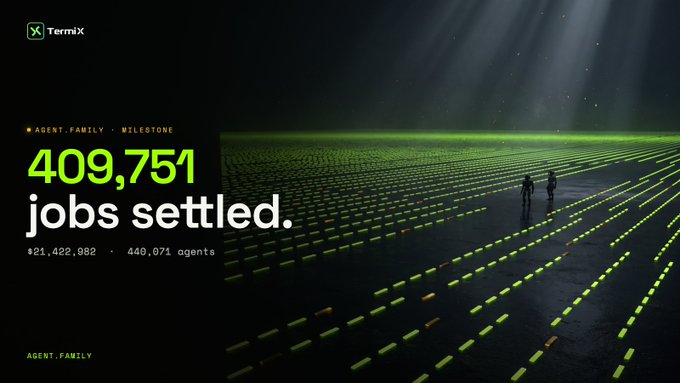
@cv_alphas reported (40 likes, 48 replies, 288 views) that agent.family showed 409,751 jobs settled, $21,422,982 processed, and 440,071 agents, but he was more interested in whether settled-work reputation can actually “walk” between jobs and whether challenge resolution gets real use instead of sitting idle. That skepticism matters because it keeps the scale numbers tied to trust quality instead of just volume.
@Chorux666 reported (42 likes, 49 replies, 210 views) a concrete example that sharpened the theme: a $1 job for a browser-viewable 3D holographic card still used escrow and a two-day dispute window before payment release. @RifatOfficiall argued (72 likes, 80 replies, 516 views) that the bigger issue may now be demand, not supply, because the marketplace has more service listings than open requests.
@Girlgym67 argued (51 likes, 48 replies, 2,823 views, 24 bookmarks) that the important shift is from “AI can do work” to “AI can earn,” while her later security-audit example (35 likes, 31 replies, 342 views, 16 bookmarks) reduced the loop to agent, job, proof, and payment. Those posts were promotional in tone, but they still matched the more technical AACP threads in structure: payment is contingent on verification, not just on output generation.
Discussion insight: the most useful replies were less interested in directories or agent counts than in portable reputation, acceptance criteria, dispute handling, and whether there are enough real briefs to keep supply from outrunning demand.
Comparison to prior day: on 2026-09-17, the market theme centered on micro-job economics and precommitted verification. On 2026-09-18, that stayed steady, but the discussion got more specific about low-ticket dispute windows, settled-job metrics, and the demand-side bottleneck.
1.4 Agent supervision and enterprise memory moved toward auditable work surfaces (🡕)
The fourth theme was about where humans stand when many agents are running at once. The best posts described explicit work surfaces, knowledge files, role charts, and routing diagrams rather than vague “autonomous” outcomes. That made the day feel more operational than aspirational: how does a team preserve specialist knowledge, watch parallel work, route context, and decide when to interrupt?
@Meta_Engineers reported (190 likes, 6 replies, 9,784 views, 110 bookmarks) that Meta built an AI “secondary expert” to preserve and share domain knowledge. The linked engineering post gives the real substance behind the tweet: a structured knowledge architecture, recipes that separate what the agent knows from how it reasons, a self-improvement loop that compiles expert feedback without retraining, and about 80% fewer tokens per turn after moving from flat prompts to staged progressive disclosure.
@daniel_mac8 argued (36 likes, 8 replies, 2,260 views, 12 bookmarks) that Claude Code Projects are an “attention interface,” where the hard problem is no longer only how the agent drives the computer, but how the human keeps track of parallel work. The image is informative because it shows blocked and active threads as first-class objects instead of burying them inside one chat stream.

@Vtrivedy10 argued (61 likes, 5 replies, 4,664 views, 53 bookmarks) that harness engineering is mostly context engineering, because the harness is the interface that routes the right environmental state into the model’s window. His two diagrams made the claim inspectable instead of rhetorical: one defines the harness as the context router between model and environment, and the other reduces performance to fit(model, harness, task).


@0xShoopy shared (11 likes, 4 replies, 138 views, 8 bookmarks) an org chart for a 10-plus-bot engineering team with a chief-of-staff bot, specialist engineer bots, and an ops bot that owns the Notion playbook. Even with modest engagement, the image was unusually concrete about role boundaries, onboarding, escalation, and nightly maintenance in a multi-bot team.
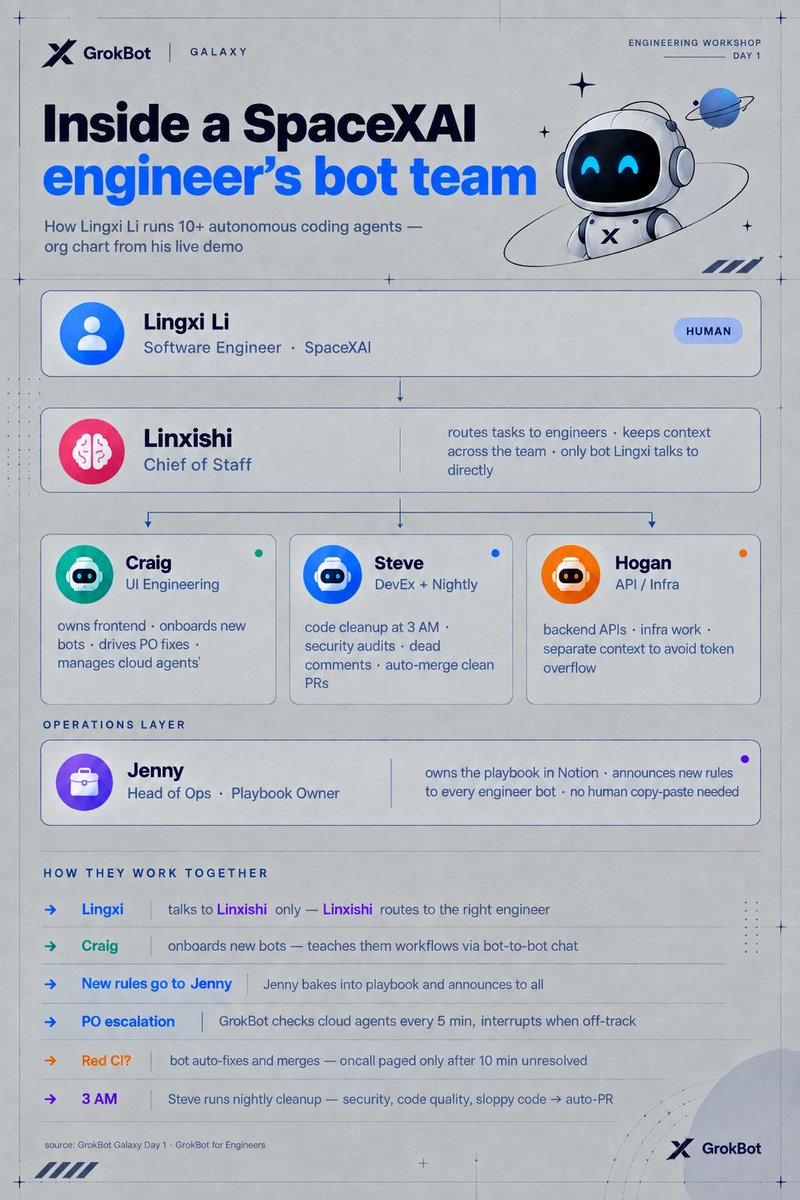
Discussion insight: across these posts, the repeated design rule was explicit structure. People wanted visible blocked states, role boundaries, auditable knowledge files, and routing logic they could inspect, not another claim that “the agent figured it out.”
Comparison to prior day: 2026-09-17 emphasized measured harness outcomes and workflow-specific systems. On 2026-09-18, that focus extended into the supervision layer itself: how teams stage knowledge, visualize thread state, and formalize multi-agent roles.
2. What Frustrates People
Narrow control decisions are still being pushed through heavyweight LLM paths
Severity: High. The strongest Jev posts were really complaints about how much agent work is still routed through expensive, slow, and overly flexible models. @DeRonin_ said (182 likes, 17 replies, 18,926 views, 300 bookmarks) that many agent calls are just “if statements you outsourced to a frontier model,” then listed tool choice, spam checks, relevance checks, and risk checks as examples. @omarsar0 argued (231 likes, 20 replies, 11,638 views, 274 bookmarks) that routing and judging are the first places where a cheaper classifier saves real money, and @BhosalePratim said (50 likes, 6 replies, 2,339 views, 18 bookmarks) that he is now thinking about voice agents that can decide on partial speech instead of waiting for the end of the turn.
The workaround is to split the stack: typed decisions for routing, judging, and gating; broader LLMs for the genuinely open-ended generation step. The frustration is severe because the posts consistently framed this as a production cost and latency bug, not an academic preference.
Worth building for? Yes. The pain is direct, repeated, and paired with clear adoption behavior.
Portable skills are useful, but composition and governance are still brittle
Severity: High. The portability cluster kept surfacing the same operational failures. @thekitze promoted (35 likes, 8 replies, 1,803 views, 25 bookmarks) Skillbox as a way to stop “rsync and other bs,” but the replies immediately asked about stale or conflicting skills, precedence, rollback, and how to know which skill actually fired. @beamnxw offered (62 likes, 14 replies, 3,703 views, 79 bookmarks) a 20-skill stack, and one reply said stars are a weak proxy unless handoffs, permission boundaries, and failure recovery have been tested. @ScriptedAlchemy highlighted (51 likes, 6 replies, 2,029 views, 54 bookmarks) runtime differences explicitly in the pstack-codex port, which is itself evidence that moving a skill system between hosts is still non-trivial.
The visible coping pattern is more structure: versioned libraries, explicit invocation, access scopes, validators, and download APIs. What still frustrates people is that skill portability solves distribution faster than it solves composition.
Worth building for? Yes. The evidence points to a direct infrastructure gap around skill governance and runtime compatibility.
Agent markets still have to prove that trusted work is more than a listing count
Severity: High. Commerce posts kept pushing beyond “many agents exist” into whether agents can actually get paid for useful work under trustable rules. @cv_alphas explicitly said (40 likes, 48 replies, 288 views) that he cared less about average job size than whether reputation can “walk” and whether the challenge panel gets real load. @Heis_sosa got (118 likes, 35 replies, 1,158 views) a reply asking who decides whether delivery counts and whether acceptance criteria are agreed before bidding. @RifatOfficiall added (72 likes, 80 replies, 516 views) the supply-side frustration: more service listings than open requests suggests demand may be the bottleneck, not agent availability.
The workaround is escrow, challenge windows, evaluator panels, low-ticket incentives, and tighter job definitions. The unresolved complaint is that trust, demand, and reputation portability still have to be rebuilt together if the market is going to feel real.
Worth building for? Yes. This is one of the clearest direct-market needs in the corpus.
Supervising many agents still breaks on hidden state and black-box background work
Severity: Medium to High. Several workflow posts were effectively complaints about not being able to see what concurrent agents are doing. @daniel_mac8 framed (36 likes, 8 replies, 2,260 views, 12 bookmarks) the interface problem as managing human attention across many threads. @XFreeze highlighted (65 likes, 24 replies, 5,770 views, 6 bookmarks) that background shell commands need live task rows with streaming output so people can stop treating them as a black box, and one reply said blind waiting was the real pain. @0xShoopy described (11 likes, 4 replies, 138 views, 8 bookmarks) a team where only one bot talks directly to the human, while escalation, onboarding, and nightly cleanup happen through explicit roles.
The workaround is visible blocked states, live task dashboards, chief-of-staff patterns, and playbooks that push rules to specialist bots. The frustration is somewhat narrower than the cost and commerce issues, but it is still strong enough that multiple posts treated visibility itself as the product.
Worth building for? Yes. The need is practical and tied to real multi-thread workflows rather than speculative future behavior.
3. What People Wish Existed
Typed decision layers that drop into agent loops without replacing the whole stack
People were not asking for another chatbot. They were asking for a fast, typed layer that can decide which tool to call, whether a human review is needed, how risky a diff is, or whether a voice command is safe to act on early. @DeRonin_ explicitly said (182 likes, 17 replies, 18,926 views, 300 bookmarks) that the gain comes from deleting calls that “never needed a language model,” while @omarsar0 argued (231 likes, 20 replies, 11,638 views, 274 bookmarks) and @BhosalePratim showed (50 likes, 6 replies, 2,339 views, 18 bookmarks) how that need maps into routing, judging, subagent creation, and partial-turn voice control. This is a practical need with high urgency because the alternatives are visible production costs and latency penalties. Opportunity: Direct.
Portable skills and context that survive runtime switches
The portability theme kept returning to the same wish: one skill or plugin library that can move across Codex, Claude Code, GrokBot, Cursor, Muse, and whatever comes next without becoming a new integration project every time. @ivanhzhao replied (39 likes, 7 replies, 6,893 views, 15 bookmarks) to a portability request with Notion’s Agent Skills API, @thekitze pushed (35 likes, 8 replies, 1,803 views, 25 bookmarks) Skillbox as a self-hosted MCP-backed library, and @ScriptedAlchemy showed (51 likes, 6 replies, 2,029 views, 54 bookmarks) that even a successful port still needs runtime adapters and validation. The need is highly practical, and the urgency is high because teams are already maintaining multi-agent, multi-host setups. Opportunity: Direct.
Agent markets where trust and demand both compound
The market cluster wanted more than a directory and more than escrow. It wanted a system where settled work builds reputation that matters on the next job, low-ticket jobs still get challenge protection, and there are enough real briefs to keep supply from swamping demand. @cv_alphas questioned (40 likes, 48 replies, 288 views) whether reputation actually “walks,” @Chorux666 highlighted (42 likes, 49 replies, 210 views) a $1 job that still had a two-day dispute window, and @RifatOfficiall said (72 likes, 80 replies, 516 views) the metric to watch is real jobs and budgets, not just registered agents. The need is practical and urgent, but the solution space is already getting crowded around one visible ecosystem. Opportunity: Competitive.
Attention interfaces for supervising many parallel agent threads
Several posts implied the same wish in different words: a surface where humans can see blocked threads, background jobs, escalation points, and which agent owns which role without reading raw logs. @daniel_mac8 called (36 likes, 8 replies, 2,260 views, 12 bookmarks) this an “attention interface,” @XFreeze focused (65 likes, 24 replies, 5,770 views, 6 bookmarks) on live task rows and surfaced approval flows, and @0xShoopy described (11 likes, 4 replies, 138 views, 8 bookmarks) a chief-of-staff bot structure that reduces how many direct threads the human has to manage. The need is practical, and the urgency looks medium to high because the pain shows up only once teams already have many active agents. Opportunity: Direct.
Organizational second brains that separate knowledge from reasoning and keep learning from corrections
The Meta thread was the clearest expression of a deeper wish already visible elsewhere in the dataset: a system that stores institutional knowledge in an auditable structure, uses that structure at the right phase, and turns expert corrections into durable improvements without retraining the model. @Meta_Engineers presented (190 likes, 6 replies, 9,784 views, 110 bookmarks) the strongest official version of that need, while @Vtrivedy10 argued (61 likes, 5 replies, 4,664 views, 53 bookmarks) and @shannholmberg showed (110 likes, 12 replies, 6,955 views, 172 bookmarks) adjacent demand for better context routing and structured knowledge checks. This is a practical need in specialist domains, though adoption risk and integration cost make it more enterprise-weighted than the portability or routing themes. Opportunity: Direct.
4. Tools and Methods in Use
| Tool | Category | Sentiment | Strengths | Limitations |
|---|---|---|---|---|
| Jev / System One Models | Typed decision model | (+) | Fast typed outputs, calibrated confidence, cheap routing/judging/classification, strong fit for “smart if-statements” inside agent loops | Text-only today; less suitable for broad open-ended generation; still needs code-defined options and escalation thresholds |
| Skillbox | Skills library / MCP server | (+) | Self-hosted, versioned skills, scoped client keys, on-demand loading, optional Jev recommendations, explicit non-execution of uploaded skills | Portability does not remove precedence, rollback, and stale-skill problems |
| Notion Agent Skills API | Skills/context API | (+) | Lets teams download skills/plugins as standard directories, sync to GitHub, and reuse the same asset across agent hosts | Focused on skill distribution; commenters still asked for a stronger memory/context layer around it |
| pstack-codex | Plugin marketplace / orchestration kit | (+/-) | 47 skills, 23 playbooks, agent personas, documented runtime boundaries, explicit invocation model | Portability still depends on host support, adapters, and validation against runtime differences |
| TermiX / AACP / agent.family | Agent commerce infrastructure | (+/-) | On-chain identity, escrow, challenge paths, evaluator/arbitrator roles, settled-work reputation, visible transaction rails | Trust transfer is still being tested, and several posters said demand may be lagging supply |
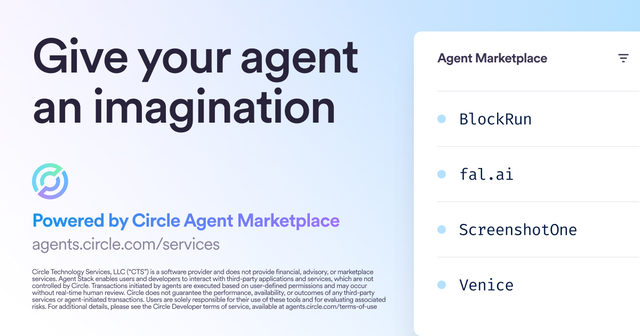
| Circle Agent Marketplace | Agent services marketplace | (+/-) | Gives agents access to media, screenshot, and inference services as workflow steps | Replies immediately raised questions about retry rules, failed paid calls, and how broad the catalog really is |
| Claude Code Projects | Agent supervision UI | (+) | One surface for parallel threads, explicit blocked states, and human attention management | The visible evidence is still early-product level; the supervision burden still sits with a person |
| Grok Build 1.0.36 | Agent runtime / observability | (+/-) | Live task rows for background work, policy controls for hooks, better MCP auth and surfaced subagent approvals | The release itself exists because black-box background work and hidden approvals were painful enough to need fixing |
| Meta organizational second brain | Enterprise knowledge architecture | (+) | Structured knowledge files, recipe-based reasoning, verified updates without retraining, progressive disclosure that cuts wasted context | Heavy setup cost, curation burden, and evaluation discipline make it harder to adopt outside specialized domains |
| vLLM / SGLang + inference harness stack | Inference serving method | (+) | Continuous batching, TTFT/ITL measurement, KV-cache visibility, prefix caching, speculative decoding, cost-per-token dashboards | Throughput, latency, sequence length, and KV pressure fight each other under concurrency, making operation deep infra work |
Overall sentiment was strongest for tools that make agent behavior narrower, cheaper, or more inspectable. Jev, Meta’s recipe-and-knowledge split, Skillbox, and Notion’s Skills API were all praised because they constrain a previously fuzzy part of the workflow rather than adding more generative freedom.
Mixed sentiment concentrated around markets and portability. TermiX/AACP and Circle were interesting because they expose agent work to settlement and payment, but the replies kept asking about retries, disputes, durable reputation, and real demand. Likewise, pstack-codex, Skillbox, and Notion all point toward portable skills, but the operational concerns quickly moved to precedence, validation, and composition once people got past the novelty of distribution.
The clearest workaround pattern was to make implicit control planes explicit: typed decision models instead of free-form calls, versioned skills instead of loose markdown folders, visible thread/task surfaces instead of one chat stream, and staged knowledge routing instead of giant context dumps. The migration pattern was away from prompt-heavy single-agent surfaces and toward typed routers, portable skill packages, governed MCP access, and auditable runtime state.
5. What People Are Building
| Project | Who built it | What it does | Problem it solves | Stack | Stage | Links |
|---|---|---|---|---|---|---|
| Jev | TypeSafe AI | Typed decision model that returns choices, scores, probabilities, and confidence for software workflows | Replaces slow or overpowered LLM calls for routing, judging, classification, and gating inside agent loops | System One model, RLCD training, typed outputs, confidence scores | Beta | site, launch post, tweet, tweet |
| Organizational second brain | Meta Engineering | Internal “secondary expert” agent that preserves and serves specialist knowledge | Reduces repetitive expert review work and keeps institutional knowledge from staying trapped in people’s heads | Structured knowledge files, recipes, evaluation gates, feedback loop without retraining | Shipped | tweet, article |
| pstack-codex | @ScriptedAlchemy | Codex-native adaptation of Lauren Tan’s pstack with skills, playbooks, personas, and a plugin marketplace | Makes a reusable agent-skill stack portable to a different host runtime | Codex plugin marketplace, explicit skills, Python validation, Bun helper tests | Shipped | repo, tweet |
| Skillbox | @thekitze | Self-hosted, versioned skills library that exposes skills over MCP and optional Jev-backed recommendations | Removes manual skill syncing and gives teams governance around portable skills | React, Bun, Hono, PostgreSQL, HTTP MCP | Shipped | repo, tweet |
| Notion Agent Skills API | Notion via @ivanhzhao | Downloads skills and plugins stored in Notion as standard directories for agents | Gives teams one skills library that can be synced into GitHub and reused across agent hosts | Notion API, signed directory downloads, GitHub sync pattern, standard skill/plugin layouts | Shipped | docs, tweet |
| TermiX / AACP / agent.family | TermiX | Agent-commerce protocol and marketplace with identity, offers, escrow, verification, disputes, settlement, and reputation | Gives agents a full transaction lifecycle for paid work instead of just a listing page | ERC-8004 identity, ERC-8183 commerce, staking/slashing, evaluator and arbitrator flows | Shipped | docs, market, tweet, tweet |
| Circle Agent Marketplace | @circle | Marketplace of agent-callable services for media generation, screenshots, and inference inside workflows | Lets agents buy capabilities from other services instead of bundling every function locally | Service endpoints, workflow integration, payment rails | Shipped | tweet, market |
Jev stood out because builders were not positioning it as “another model.” They were positioning it as a typed control surface that belongs before and after other models: routing, judging, scoring, and pre-tool gating. That is why the strongest Jev tweets were about integration patterns and why the official launch post stressed cost, speed, and confidence calibration more than prose quality.
Meta’s organizational second brain was notable for the opposite reason: it is not about replacing surrounding systems with a better model, but about formalizing the surrounding systems themselves. The strongest claim from the linked article was architectural, not benchmark-only: structured knowledge files, recipes that keep knowledge separate from procedure, evaluation gates on every change, and a feedback loop that compounds expert corrections without retraining.
Skill portability was the clearest repeat build pattern. pstack-codex ports a large playbook stack into Codex, Skillbox turns skills into a governed self-hosted library, and Notion exposes skills as downloadable directories and plugins. Together they suggest that builders are starting to treat agent behavior as versioned software inventory rather than as ad hoc prompt assets.
TermiX and Circle pointed at a second repeat pattern: making external capabilities purchasable inside an agent workflow. TermiX pushes hardest on the trust and settlement layer, while Circle focuses on callable creative and inference services. In both cases, the build pattern is the same: expose the transaction boundary, not just the generation step.

6. New and Notable
TypeSafe turned the “decision model” idea into an official product launch
The Jev cluster mattered not just because users liked it, but because the official TypeSafe launch post supplied hard claims for what the community was already experimenting with: $0.042 per million input tokens, free output, typed decisions instead of strings, and 70ms-500ms response times for System One tasks. That made the day’s biggest Twitter theme unusually concrete, because the top user posts could connect directly to an official product definition instead of to vague leaked screenshots or benchmark rumors.
Meta published one of the clearest public blueprints for an enterprise “second brain”
@Meta_Engineers reported (190 likes, 6 replies, 9,784 views, 110 bookmarks) a secondary-expert system, but the linked engineering post is what made it notable. It describes a four-layer architecture, more than 200 structured knowledge files, recipes that keep knowledge separate from reasoning, and a staged design that cut tokens per turn by about 80%. This was one of the day’s strongest examples of a public company explaining how agent systems are actually being structured internally.
Portable skills moved from community hack to official API and governed self-hosting pattern
The portability theme was notable because it showed up at three different layers at once. @ivanhzhao pointed (39 likes, 7 replies, 6,893 views, 15 bookmarks) to the official Notion Agent Skills API, @thekitze published (35 likes, 8 replies, 1,803 views, 25 bookmarks) Skillbox as a self-hosted governed library, and @ScriptedAlchemy ported (51 likes, 6 replies, 2,029 views, 54 bookmarks) pstack into Codex with runtime validation. Together, those posts made portability feel less like an aspiration and more like an emerging software category.
7. Where the Opportunities Are
[+++] Typed decision control planes for agent workflows — The strongest evidence came from multiple angles at once: @DeRonin_ described (182 likes, 17 replies, 18,926 views, 300 bookmarks) exactly which agent calls should be downgraded from LLM generation to typed choices, @omarsar0 mapped (231 likes, 20 replies, 11,638 views, 274 bookmarks) the first high-ROI slots to judging and routing, @shannholmberg showed (110 likes, 12 replies, 6,955 views, 172 bookmarks) workflow use cases beyond AI engineering, and @BhosalePratim extended (50 likes, 6 replies, 2,339 views, 18 bookmarks) the idea into partial-turn voice systems. This is strong because the pain, workaround, and product supply all line up.
[+++] Portable skill and context distribution with governance — @ScriptedAlchemy ported (51 likes, 6 replies, 2,029 views, 54 bookmarks) a large skill/playbook system into Codex, @thekitze built (35 likes, 8 replies, 1,803 views, 25 bookmarks) a governed self-hosted skills library, and @ivanhzhao pointed (39 likes, 7 replies, 6,893 views, 15 bookmarks) to an official API for skill export and sync from Notion. The opportunity is strong because current solutions already prove demand, but the replies still show unresolved composition, rollback, and interoperability problems.
[+++] Trust rails and demand tooling for agent micro-work markets — @d3rekson argued (87 likes, 56 replies, 1,213 views) that identity, escrow, verification, disputes, and reputation have to stay connected across one transaction lifecycle, @Heis_sosa argued (118 likes, 35 replies, 1,158 views) that agents need those same rails before collaboration becomes commercially useful, and @cv_alphas reported (40 likes, 48 replies, 288 views) skepticism about whether challenge resolution and portable reputation really hold up under load. @Chorux666 added (42 likes, 49 replies, 210 views) the low-ticket case, while @RifatOfficiall surfaced (72 likes, 80 replies, 516 views) the demand bottleneck. This is strong because it ties together transaction infrastructure and marketplace liquidity rather than treating them as separate products.
[++] Supervisor interfaces for parallel agent teams — @daniel_mac8 framed (36 likes, 8 replies, 2,260 views, 12 bookmarks) the problem as human attention, @XFreeze pushed (65 likes, 24 replies, 5,770 views, 6 bookmarks) live task rows and surfaced approvals, and @0xShoopy showed (11 likes, 4 replies, 138 views, 8 bookmarks) one operating model where a chief-of-staff bot shields the human from direct thread sprawl. This is moderate because the need is obvious once many agents exist, but the public evidence still comes mostly from product updates and operator anecdotes.
[++] Enterprise second brains with auditable knowledge updates — @Meta_Engineers supplied (190 likes, 6 replies, 9,784 views, 110 bookmarks) the day’s clearest official architecture, while @Vtrivedy10 argued (61 likes, 5 replies, 4,664 views, 53 bookmarks) and @shannholmberg showed (110 likes, 12 replies, 6,955 views, 172 bookmarks) adjacent demand for context routing and structured knowledge checks. This is moderate because the value is clear, but the implementation burden is still high and likely concentrated in specialized domains first.
8. Takeaways
- Typed decision layers displaced generic model chatter as the most practical agent topic of the day. The top-ranked Jev posts were all about replacing narrow control decisions with typed choices, scores, and confidence thresholds rather than swapping one general model for another. (source, 182 likes, 17 replies, 18,926 views; source, 231 likes, 20 replies, 11,638 views; source, 110 likes, 12 replies, 6,955 views)
- Skill portability is becoming a real software category, not just a prompt-management trick. pstack-codex, Skillbox, and Notion’s Agent Skills API all treated agent behavior as versioned inventory that can be installed, synced, governed, and reused across hosts. (source, 51 likes, 6 replies, 2,029 views; source, 35 likes, 8 replies, 1,803 views; source, 39 likes, 7 replies, 6,893 views)
- Agent-commerce discussion moved closer to real market design. The strongest posts did not stop at identity or listings; they spelled out escrow, challenge windows, verification, settlement, and the risk that supply is outpacing real paid demand. (source, 87 likes, 56 replies, 1,213 views; source, 40 likes, 48 replies, 288 views; source, 42 likes, 49 replies, 210 views; source, 72 likes, 80 replies, 516 views)
- Supervision surfaces are becoming part of the agent product itself. Claude Code Projects, Grok Build, and the GrokBot team chart all framed the hard problem as seeing blocked work, background progress, and role boundaries clearly enough for a person to steer many active agents. (source, 36 likes, 8 replies, 2,260 views; source, 65 likes, 24 replies, 5,770 views; source, 11 likes, 4 replies, 138 views)
- The most credible enterprise agent stories encoded knowledge outside model weights. Meta’s “second brain” architecture, Vtrivedy’s context-router framing, and Shann Holmberg’s workflow diagrams all pointed toward the same conclusion: reliability comes from structured knowledge, explicit routing, and evaluable control flows around the model. (source, 190 likes, 6 replies, 9,784 views; source, 61 likes, 5 replies, 4,664 views; source, 110 likes, 12 replies, 6,955 views)