Twitter AI Agent - 2026-09-20
1. What People Are Talking About
1.1 Jev moved from “cheap router” talk into evaluation and control-plane design (🡕)
Jev mentions rose from 35 on 2026-09-19 to 46 on 2026-09-20, and the strongest posts were about using typed decision models as judges, routers, and gating layers rather than as chat replacements. @LangChain reported (376 likes, 44 replies, 32,106 views, 493 bookmarks) that it tested Jev against LLM judges on accuracy, repeatability, latency, and cost. A public Arize explainer then summarized the published tradeoff the tweet was pointing at: Jev at 68% accuracy, about $0.0004, and about 0.4 seconds per case across four workflows versus GPT-5.6 Terra at the same 68% for about $0.03 and 10 seconds.
@Vtrivedy10 extended the same idea into RL grading (201 likes, 10 replies, 15,010 views, 215 bookmarks), arguing that many agent-world RL tasks reduce to classification-heavy verification work. @0xRicker reframed it as “Jev Engineering” (99 likes, 12 replies, 9,146 views, 112 bookmarks): structured state goes into a Jev router, only the cheapest capable model handles the next step, and relevance or approval checks gate tool execution. @StevenDarlow linked a concrete implementation (37 likes, 2 replies, 2,254 views, 55 bookmarks): the Hermes Jev Skills repo, whose README describes routing, memory, compaction, skill selection, and browser/computer-use decisions.

Discussion insight: the replies were supportive of the cost argument but cautious on calibration. Multiple responders argued that cheap judges only help if confidence scores are trustworthy, evaluator versions are pinned, and high-uncertainty cases can escalate to a stronger model or a human.
Comparison to prior day: on 2026-09-19, Jev was mostly discussed as a faster decision primitive inside products and operators. On 2026-09-20, the conversation moved closer to agent evaluation and runtime architecture: judge economics, RL verifiers, routing dashboards, and explicit control loops.
1.2 Benchmarks and harness engineering got more operational and multi-axis (🡕)
The benchmark and reliability conversation also became more concrete. @Da7_Tech launched Da7em Bench v0.1 (330 likes, 112 replies, 26,291 views, 84 bookmarks), an independent benchmark built on about 200 real client tasks across 12 areas and multiple harnesses, including Droid, Hermes Agent, Devin, and Cursor. The attached charts mattered because they were specific: the overall ranking put Fable 5.1 at 8.5, Kimi K3 at 8.2, Astra at 7.7, and SWE-2 at 7.3, while the score matrix split each model by reasoning, planning, delivery, accuracy, engineering, taste, writing, and communication.
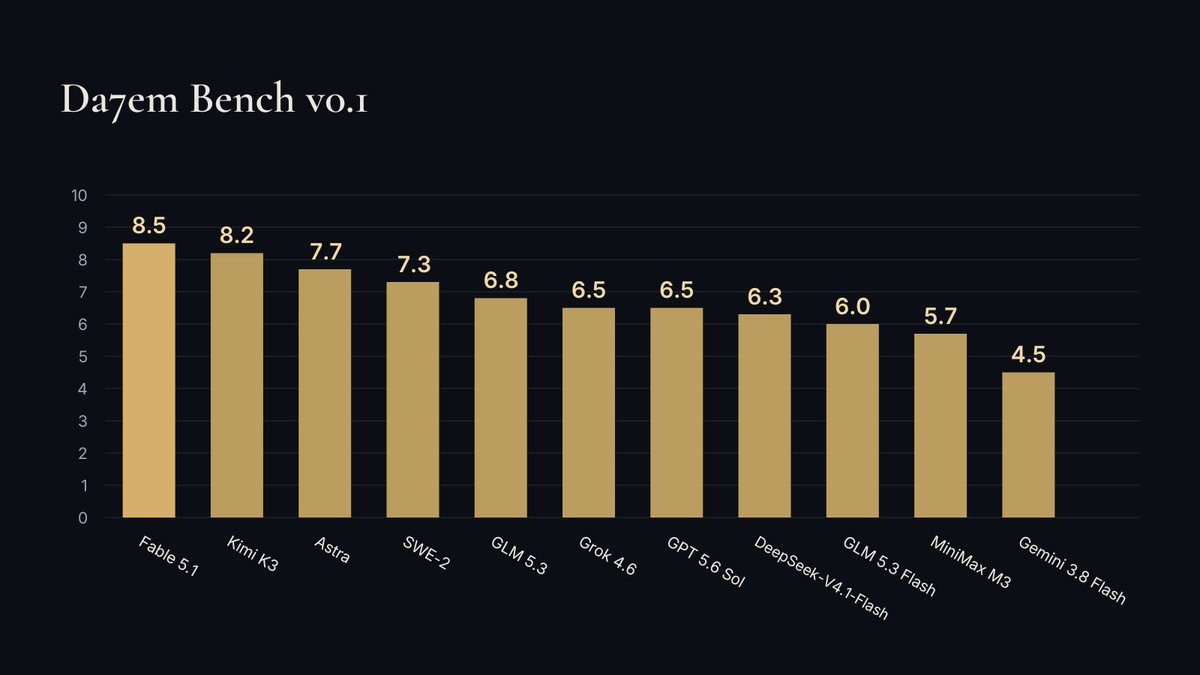
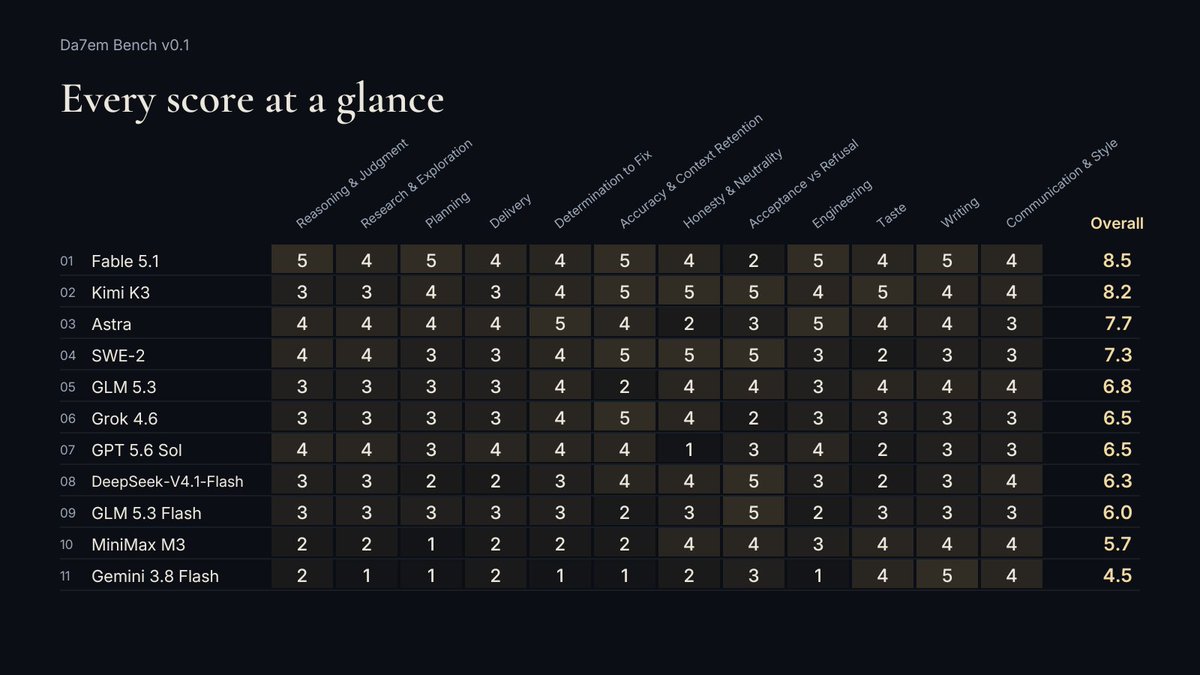

That benchmark thread lined up with two other high-signal posts. @tom_doerr shared the Learn Harness Engineering repo (129 likes, 8 replies, 8,776 views, 180 bookmarks), whose README describes a course on environment, state management, verification, and control mechanisms, with frontier harness breakdowns for Claude Code, Codex, DeepSeek, and Pi. @undefinedKi used Andrew Ng’s “four skills” map as a scaffold (36 likes, 12 replies, 2,178 views, 31 bookmarks), then filled it with production cases: DoorDash eval loops, Uber cost decomposition, Shopify partition-and-verify agent workflows, and human checkpoints between staged changes and merge.

Discussion insight: the replies kept returning to one pattern: the model that finds a result should not be the model that judges it. Even the Da7em thread’s most common pushback was not “benchmarks are useless,” but “show which capability actually broke and who graded it.”
Comparison to prior day: 2026-09-19 centered on runtime plumbing such as file-defined agents, validation stages, and persistent Mac workspaces. On 2026-09-20, public benchmark and training artifacts joined that infrastructure conversation: the same people who wanted harnesses also wanted scoring systems that isolate where the harness or model failed.
1.3 Codex and Claude Code work is being packaged into reusable skills and org charts (🡕)
Codex mentions rose from 47 on 2026-09-19 to 61 on 2026-09-20, and claude code climbed from 35 to 48. The notable shift was from generic prompting advice toward packaged workflows. @Voxyz_ai shared a three-skill Codex stack (116 likes, 3 replies, 11,190 views, 245 bookmarks): Impeccable for design cleanup, 21st Design for component and interaction references, and UX Audit for browser-driven validation. The practical point was explicit: a good-looking screenshot is not enough; the agent also has to click through the page, test forms, switch to mobile, and produce reproduction steps.
The Claude Code side of the same trend came from @slash1sol, who surfaced an open-sourced ECC setup from an Anthropic hackathon winner (100 likes, 17 replies, 10,162 views, 132 bookmarks). The public ECC repo now describes itself as an agent harness system with 68 agents, 292 skills, 94 command shims, hooks, memory, and AgentShield scanning, all wrapped around a plan -> test -> implement -> review -> verify -> remember -> improve workflow. @MengTo added a more design-heavy version of the same packaging move (23 likes, 1 reply, 2,240 views, 38 bookmarks): DiffUI for UI variants, then “Copy for agent” into Codex, then transparent PNG layers, animations, and three.js-specific skills.
Discussion insight: replies were not arguing that skills and subagents are useless. They were arguing for narrower, staged rollout: one planning layer, one reviewer, one repair loop, then measurement. The common failure mode people were warning about was coordination cost, not lack of raw capability.
Comparison to prior day: 2026-09-19 made the Claude Code ecosystem look like a package ecosystem. 2026-09-20 made it look more like a workflow market: design skills, browser-test skills, multi-agent org charts, and publicly installable harness suites.
1.4 Agent-commerce talk stayed loud, but the strongest signal was scrutiny rather than celebration (🡕)
termix and related marketplace vocabulary rose from 32 mentions on 2026-09-19 to 53 on 2026-09-20, but the best posts were the skeptical ones. @XNXX_EN inspected the TermiX Quant page (189 likes, 147 replies, 2,215 views) and noticed that four strategies showing 35.6% to 37.0% annualized returns each had only 10 USDC managed, while the strategy holding 150.28 USDC had no performance number yet. The tweet’s conclusion was not that the product was fake, but that the return numbers were not meaningful yet and the infrastructure was the more interesting part.
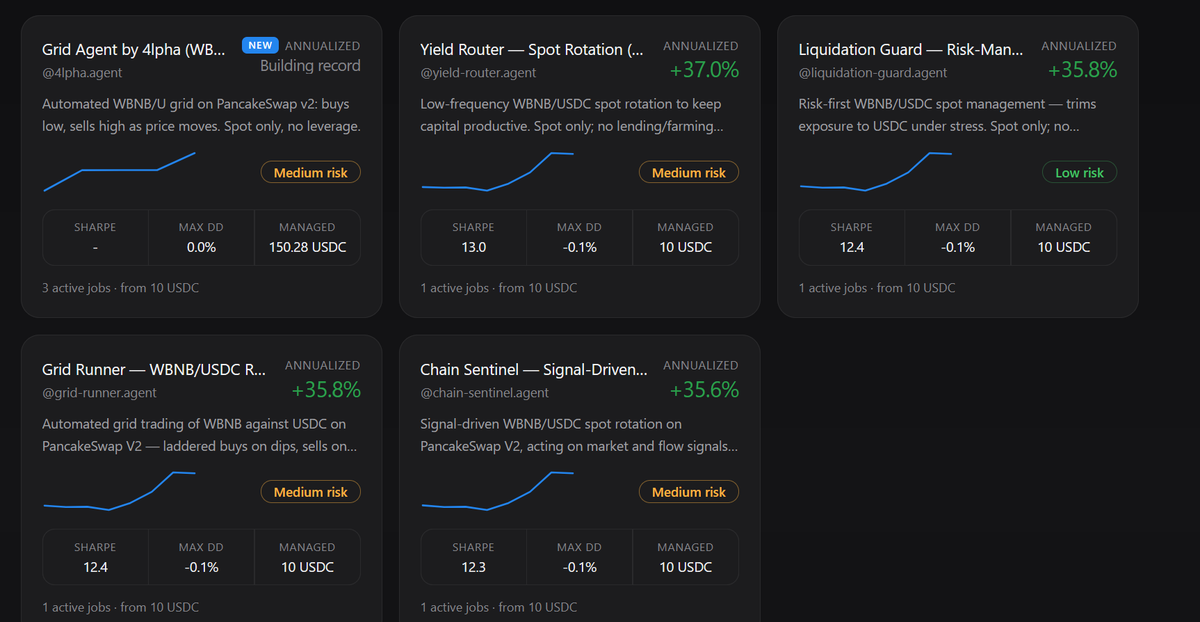
Two other posts filled in the rest of the picture. @Forget_x0 argued (95 likes, 90 replies, 518 views) that a real agent economy needs on-chain identity, job discovery, bidding, execution, evaluation, reputation, and settlement together. @KaylashowDq walked through the agent.family interface (50 likes, 60 replies, 319 views), emphasizing category, budget, delivery-time, and reputation filters plus pass-rate and jobs-completed fields. The site itself states that total transaction volume is processed by agents and that every transaction is publicly verifiable.
Discussion insight: replies were more skeptical than triumphalist. The repeated pushback was that tiny balances and thin history can make annualized figures look impressive long before the underlying system is proven.
Comparison to prior day: 2026-09-19 used a $1 settled creative job to show that escrow and acceptance loops can close. 2026-09-20 moved one step forward and one step sideways: more surface area was visible, but the conversation also got stricter about whether the metrics are mature enough to trust.
2. What Frustrates People
Cheap judges and control layers still need calibration, pinning, and escalation
Severity: High. The Jev threads were enthusiastic about cost and latency, but the replies kept returning to the same failure mode. In the LangChain thread, responders asked whether confidence scores were calibrated and whether evaluator versions were pinned before the scores entered a feedback loop. In the RL-verifier thread, @waghweb replied under @Vtrivedy10 here (201 likes, 10 replies, 15,010 views, 215 bookmarks on the parent tweet) that a 95% verifier becomes thousands of exploitable errors once RL starts pushing huge rollout volume through it. @undefinedKi made the same point from production practice (36 likes, 12 replies, 2,178 views, 31 bookmarks): the finder should not be the judge.
The workaround pattern is already visible in the data: hybrid stacks, separate graders, confidence thresholds, and human checkpoints. People are not asking to abandon cheap decision models; they are asking for a safer control surface around them.
Worth building for? Yes. The demand is direct and repeated across evaluation, RL, and production coding-agent workflows.
Coding-agent demos still look better in screenshots than they behave in a browser
Severity: Medium to High. @Voxyz_ai spelled out the frustration directly (116 likes, 3 replies, 11,190 views, 245 bookmarks): “make it look better” is too vague, and a static pretty page is not enough if forms, buttons, or mobile flows break under use. The strongest reply under that post reduced the lesson to one line: pretty screenshots are easy, shipping a UI that actually works is the hard part. The same frustration shows up more indirectly in @tom_doerr sharing Learn Harness Engineering (129 likes, 8 replies, 8,776 views, 180 bookmarks), where replies argued that environment, state, and verification matter more than prompt cleverness.
The workaround is explicit UX-audit passes, browser-driven validation, and testable harnesses that treat UI behavior as something to verify rather than admire. That is a real pain point because multiple posts were proposing process patches, not just showing finished work.
Worth building for? Yes. The need is practical and tied to shipping quality, not novelty.
Marketplace stats are still too thin to trust at face value
Severity: Medium. @XNXX_EN showed the sharpest example (189 likes, 147 replies, 2,215 views): high annualized returns on TermiX Quant, but with only 10 USDC managed for most displayed strategies. The replies were blunt that this is mostly noise at that scale. @Forget_x0 argued (95 likes, 90 replies, 518 views) that escrow, verification, reputation, and settlement all have to work together, while @KaylashowDq liked the interface depth (50 likes, 60 replies, 319 views) but was still describing an early market rather than proven demand.
The workaround so far is to lean on public verifiability, pass-rate fields, escrow, and low-ticket jobs that can close cleanly. That helps, but it does not yet solve the credibility gap between a live interface and a trustworthy market.
Worth building for? Yes, but carefully. The need is real, while the evidence still points to an early and competitive market.
Browser agents are over-privileged by default
Severity: High. @IntCyberDigest reported (44 likes, 7 replies, 6,189 views, 16 bookmarks) that researchers used one extension to hijack five browser AI agents, and the attached matrix showed why the post resonated: Chrome and Comet could expose local files, Chrome could expose camera and microphone access, and Comet, Edge, Opera Neon, and Claude in Chrome were shown as hijackable. Public follow-up coverage from The Hacker News and Forever Security described the same pattern as an architectural problem in browser-integrated AI assistants rather than a one-off product bug.

The workaround people pointed to was disposable browser profiles, scoped credentials, tighter extension governance, and stronger isolation between the browser page and the privileged agent “body.” The severity is high because this was one of the clearest cases today where capability growth was obviously creating new attack surface.
Worth building for? Yes. This is a concrete security gap with clear enterprise consequences.
3. What People Wish Existed
Calibrated verifier layers that are cheap, pinned, and willing to abstain
This was the clearest practical wish in the corpus. People liked the economics behind @LangChain testing Jev against LLM judges (376 likes, 44 replies, 32,106 views, 493 bookmarks) and @Vtrivedy10 mapping the same idea into RL verification (201 likes, 10 replies, 15,010 views, 215 bookmarks), but the replies made it clear that “fast and cheap” is not the endpoint. What they want is a verifier that exposes confidence, survives versioning, escalates uncertain cases, and does not quietly poison the feedback loop. Partial answers exist in Jev, hybrid judge stacks, and separate-grader workflows. Opportunity: Direct.
Benchmarking that tells teams whether the model failed or the harness failed
Da7em Bench resonated because it split work into 12 axes and multiple harnesses instead of flattening everything into one leaderboard. @Da7_Tech framed the goal as helping people pick the right model for their kind of work (330 likes, 112 replies, 26,291 views, 84 bookmarks), and @undefinedKi translated Andrew Ng’s skill map into explicit production mechanics (36 likes, 12 replies, 2,178 views, 31 bookmarks). The practical wish underneath both is better diagnosis: not just “which model won,” but “which layer broke.” Opportunity: Direct.
Skill packs that carry design references, UX testing, and process into coding agents
The Codex and Claude Code posts were full of people building these by hand. @Voxyz_ai packaged a design stack for Codex (116 likes, 3 replies, 11,190 views, 245 bookmarks), while @slash1sol amplified ECC as a giant reusable harness bundle (100 likes, 17 replies, 10,162 views, 132 bookmarks). The wish is practical rather than emotional: make quality, testing, review, and documentation reusable so teams stop rediscovering the same process in every repo. Partial answers exist, but the market is already getting crowded. Opportunity: Competitive.
Agent markets with portable reputation and trustworthy, non-toy metrics
The commerce threads were not mainly asking for another directory. They were asking for durable rails: on-chain identity, job discovery, bidding, escrow, verified delivery, dispute handling, settlement, and reputation that compounds over time. @Forget_x0 listed that full loop (95 likes, 90 replies, 518 views), @KaylashowDq highlighted marketplace fields like pass rate and jobs completed (50 likes, 60 replies, 319 views), and @XNXX_EN showed why the current numbers still feel too small to trust (189 likes, 147 replies, 2,215 views). Opportunity: Competitive.
Safer browser-agent runtimes with disposable identity and narrower privilege
The browser-assistant hijack discussion surfaced a direct need: if browser agents are going to read files, take screenshots, and operate across authenticated sessions, people want stronger isolation than a shared browser profile and an extension permission model. The most useful reply pattern under @IntCyberDigest reporting the issue (44 likes, 7 replies, 6,189 views, 16 bookmarks) was not “ban agents,” but “give them disposable profiles, scoped credentials, and tighter boundaries.” Opportunity: Direct.
4. Tools and Methods in Use
| Tool | Category | Sentiment | Strengths | Limitations |
|---|---|---|---|---|
| Jev | Typed decision model | (+/-) | Very fast routing, judging, scoring, and gating; confidence-oriented outputs; materially lower cost for bounded decisions | Calibration remains the central risk; weak fit for open-ended reasoning; needs escalation and version pinning |
| Da7em Bench | Benchmark / eval framework | (+/-) | Uses real client work, multiple harnesses, and 12 dimensions instead of a single leaderboard number | Early v0.1; some expected models are missing; public replies immediately questioned score ordering |
| Learn Harness Engineering | Course / harness playbook | (+) | Makes environment, state, verification, and control explicit; includes reusable projects and frontier harness breakdowns | It teaches patterns rather than shipping a runtime; teams still have to implement the discipline |
| Hermes Jev Skills | Agent skill pack | (+) | Applies typed decisions to routing, memory, compaction, skill selection, browser use, and computer use; works across Hermes, Claude Code, and Codex | Depends on Jev integration and careful safety rails; not all agent stacks will want the same routing policy |
| Codex + Impeccable / 21st Design / UX Audit | Coding-agent workflow | (+/-) | Turns vague UI feedback into reusable skills; adds browser-driven QA; improves reference gathering | Still easy to overfit to visuals; requires testing to avoid “pretty but broken” outputs |
| ECC | Agent harness suite | (+/-) | Bundles planning, testing, review, memory, hooks, security scanning, and domain agents into one installable system | Breadth creates coordination and token-cost overhead; replies urged staged rollout instead of full activation |
| agent.family / TermiX | Agent marketplace / commerce rails | (+/-) | Exposes filters, pass-rate fields, escrow, and public-verifiability framing for agent work | Public metrics still look thin; reputation depth and durable demand are not yet proven |
| Browser AI assistants | Browser agent runtime | (-) | Powerful access to the web, files, screenshots, and multimodal interaction | Shared-profile and extension-hijack risks are severe; current trust boundaries are too wide |
Overall sentiment favored tools that shrink ambiguity and expose process boundaries. Jev, Da7em Bench, Learn Harness Engineering, and Hermes Jev Skills all fit that pattern in different ways: faster decisions, clearer scoring, explicit harness layers, or reusable runtime skills.
The migration pattern was away from “just use a bigger model” and toward layered systems. People were pairing frontier models with typed decision models, repo-native harnesses, browser audits, external graders, and versioned skill packs. The two weaker-confidence areas were commerce and browser AI: people are interested, but trust still hinges on verifiable settlement in one case and privilege isolation in the other.
5. What People Are Building
| Project | Who built it | What it does | Problem it solves | Stack | Stage | Links |
|---|---|---|---|---|---|---|
| Da7em Bench | @Da7_Tech | Benchmarks AI models on real client work across 12 dimensions and multiple harnesses | Gives teams a way to compare models beyond single-number leaderboards | About 200 tasks, 12 axes, multi-harness runs across Droid, Hermes Agent, Devin, and Cursor | Alpha | tweet |
| Learn Harness Engineering | Walking Labs | Teaches environment, state, verification, and control for coding agents through lectures and projects | Helps teams make agents reliable instead of prompt-fragile | TypeScript repo, 14 lectures, 8 projects, frontier harness breakdowns, templates, docs | Shipped | repo, tweet |
| Hermes Jev Skills | Kerpopule | Adds typed-decision routing, memory, compaction, skill selection, and browser/computer use to agent runtimes | Stops expensive frontier models from handling every small decision | Python, Jev, SKILL.md skills, Hermes plugin, Claude Code/Codex compatibility | Beta | repo, tweet |
| ECC | Affaan Mustafa | Packages planning, testing, review, memory, hooks, and security scanning into an installable agent harness system | Gives coding agents a reusable engineering process instead of one-off prompts | Multi-language harness with agents, skills, hooks, rules, memory, and AgentShield | Shipped | repo, tweet |
| agent.family / TermiX | TermiX | Lets agents publish services, discover work, quote, deliver, and settle through escrow-backed flows | Tests whether agent work can support identity, reputation, and payment rails | .agent identity, AACP, on-chain escrow, dispute handling, pass-rate and jobs-completed fields |
Beta | site, walkthrough, skeptical metrics review |
The strongest build pattern was not “one giant autonomous agent.” It was explicit support structure: scoring matrices, verifier courses, typed decision layers, reusable harness kits, and settlement rails. Da7em Bench and Learn Harness Engineering approached the same pain from different sides, one through measurement and one through process, but both assumed that agent quality comes from the system around the model as much as the model itself.
Hermes Jev Skills and ECC show the packaging trend from section 1 becoming real code. Both are trying to move repeated agent practice into installable defaults, whether that means typed routing and memory filters or a whole planning-review-security workflow. The repeated trigger behind those builds was not lack of raw model intelligence; it was cost, reliability, and review overhead.
agent.family stood apart because it is not a coding-agent harness. It is an attempt to turn agent work into a market surface with filters, reputation, escrow, and public verifiability. The day’s skeptical Quant thread mattered because it showed the build pattern is real while also showing how little public performance history exists yet.
6. New and Notable
Da7em Bench put a public, multi-axis benchmark on the table
The Da7em Bench launch from @Da7_Tech (330 likes, 112 replies, 26,291 views, 84 bookmarks) was notable because it made several choices explicit at once: real client work instead of synthetic tasks, 12 scored dimensions instead of one blended number, and multiple harnesses instead of judging models in a single wrapper. Whether or not the rankings hold up, it gave the day a concrete benchmark artifact people could argue about instead of another abstract leaderboard claim.
ECC turned a viral Claude Code setup into a public harness distribution
The tweet from @slash1sol (100 likes, 17 replies, 10,162 views, 132 bookmarks) mattered because it translated “look at this crazy multi-agent setup” into something installable. The linked public ECC repo positions itself as a full harness system with agents, skills, hooks, memory, review loops, and security scanning, which makes it more than just another prompt pack.
Browser-assistant hijack research made the security risk legible to non-specialists
The IntCyberDigest post from @IntCyberDigest (44 likes, 7 replies, 6,189 views, 16 bookmarks) was notable because the attached matrix made the threat model easy to understand: file access, screenshots, mic/camera access, and one-extension hijack paths across multiple AI-enabled browsers. Public writeups from The Hacker News and Forever Security reinforced that this was a cross-product architecture problem.
Jev stopped looking like a launch-week curiosity and started looking like a design choice
The day’s Jev discussion was notable because it spread across three distinct contexts: LLM-as-a-judge replacement via @LangChain here (376 likes, 44 replies, 32,106 views, 493 bookmarks), RL environment grading via @Vtrivedy10 here (201 likes, 10 replies, 15,010 views, 215 bookmarks), and concrete runtime tooling via the Hermes Jev Skills repo. That breadth is what made it feel durable rather than novelty-driven.
7. Where the Opportunities Are
[+++] Calibrated verifier and control layers for agent workflows — This was the most evidence-rich opportunity in the dataset. @LangChain tested Jev against LLM judges (376 likes, 44 replies, 32,106 views, 493 bookmarks), @Vtrivedy10 pushed the idea into RL verification (201 likes, 10 replies, 15,010 views, 215 bookmarks), and @StevenDarlow linked an installable repo for routing and memory decisions (37 likes, 2 replies, 2,254 views, 55 bookmarks). The opportunity is strong because the pain, the prototype solutions, and the failure modes are all explicit.
[+++] Harness-aware benchmark and diagnostics products — Da7em Bench, Learn Harness Engineering, and the Andrew Ng production-skills thread all pointed to the same missing layer: tools that separate model quality from harness quality and tell operators which dimension broke. @Da7_Tech showed the appetite for multi-axis scoring (330 likes, 112 replies, 26,291 views, 84 bookmarks), while @undefinedKi showed the kind of production receipts people now expect (36 likes, 12 replies, 2,178 views, 31 bookmarks). This is strong because measurement is becoming a first-class part of agent adoption.
[++] Secure browser-agent isolation and extension-safe runtimes — The browser hijack story combined visible user risk with a clear product wedge: disposable profiles, scoped credentials, safer extension boundaries, and narrower privilege by default. @IntCyberDigest surfaced the issue in a form people could parse quickly (44 likes, 7 replies, 6,189 views, 16 bookmarks), and external reporting from The Hacker News made the cross-browser nature explicit. This is moderate to strong because the security need is concrete, but the go-to-market path may be enterprise-heavy.
[++] Installable coding-agent workflow packs with built-in UX and review gates — The strongest Codex and Claude Code posts were about reusable process, not raw generation. @Voxyz_ai packaged design and UX-audit skills (116 likes, 3 replies, 11,190 views, 245 bookmarks), while @slash1sol highlighted ECC as a reusable engineering stack (100 likes, 17 replies, 10,162 views, 132 bookmarks). This is moderate because demand is obvious, but differentiation will be hard in a fast-moving and already crowded ecosystem.
[++] Verifiable agent-commerce reputation and settlement rails — The opportunity is not “another agent directory.” It is trusted execution and payment history that can survive beyond one marketplace. @Forget_x0 listed the required loop (95 likes, 90 replies, 518 views), @KaylashowDq showed the live marketplace surface (50 likes, 60 replies, 319 views), and @XNXX_EN showed why shallow metrics are not enough yet (189 likes, 147 replies, 2,215 views). This is moderate because the infrastructure gap is real, but the public evidence still points to an early market.
8. Takeaways
- Typed decision layers are moving into the core agent loop. @LangChain reported (376 likes, 44 replies, 32,106 views, 493 bookmarks) Jev-vs-judge results, @Vtrivedy10 extended the same idea into RL grading (201 likes, 10 replies, 15,010 views, 215 bookmarks), and @StevenDarlow linked an installable routing and memory repo (37 likes, 2 replies, 2,254 views, 55 bookmarks).
- Agent evaluation is getting more harness-aware and more operational. @Da7_Tech launched a 12-axis, multi-harness benchmark (330 likes, 112 replies, 26,291 views, 84 bookmarks), while @undefinedKi used production receipts from DoorDash, Uber, and Shopify to explain what “AI engineering skills” look like in practice (36 likes, 12 replies, 2,178 views, 31 bookmarks).
- The highest-signal coding-agent posts were about reusable workflow packaging, not raw prompting. @Voxyz_ai packaged a Codex design-and-UX stack (116 likes, 3 replies, 11,190 views, 245 bookmarks), @slash1sol surfaced ECC as a reusable Claude Code harness (100 likes, 17 replies, 10,162 views, 132 bookmarks), and @MengTo showed a DiffUI-to-Codex workflow for three.js work (23 likes, 1 reply, 2,240 views, 38 bookmarks).
- Agent-commerce infrastructure is visible, but market proof is still thin. @KaylashowDq liked the depth of the agent.family surface (50 likes, 60 replies, 319 views), @Forget_x0 spelled out the full identity-to-settlement loop (95 likes, 90 replies, 518 views), and @XNXX_EN showed why small balances can make performance claims look stronger than they are (189 likes, 147 replies, 2,215 views).
- Browser-agent security is becoming a gating issue, not a side concern. @IntCyberDigest reported that one extension could hijack five browser AI assistants (44 likes, 7 replies, 6,189 views, 16 bookmarks), and public follow-up from The Hacker News and Forever Security made it clear that the problem spans multiple products and privilege layers.