Twitter AI Agent - 2026-09-22
1. What People Are Talking About
1.1 Enterprise rollout became a systems problem, not a prompt problem (🡕)
The strongest enterprise posts were not about getting a model to write more code. They were about how to govern agent work across teams, systems, and vendors once the code exists. The most cited ingredients were workflow redesign, multi-vendor control planes, access boundaries, auditability, and human roles that sit between engineering and operations.
@kskrygan introduced (260 likes, 27 replies, 50,680 views) JetBrains Air as a product system for software-development organizations. The public JetBrains Air launch post says Air spans IDE work, team coordination, governance, and ACP-based multi-vendor agent connectivity, with the explicit goal of making agent work visible, governable, and accountable rather than just easier to start.
@mardehaym argued (18 likes, 6 replies, 1,696 views) that enterprise AI only works after workflow redesign, not license rollout. The official Microsoft post What we’ve learned from Microsoft’s own AI transformation backs that up directly: it says access and usage do not equal transformation, that the cloud supply-chain team built a single source of truth before deployment, and that it then used more than 100 purpose-built agents across planning, sourcing, fulfillment, and logistics.
@suraj_sharma14 mapped (58 likes, 9 replies, 2,588 views, 80 bookmarks) the “forward deployed engineer” stack as OAuth2, SAML, SCIM, multi-tenancy, secure RAG permissions, MCP over customer systems, observability, incident management, and ROI proof. In replies to the same post, he said the allow-list for which CRM or ERP objects an agent may touch is “the boundary between an agent demo and an enterprise system.”
@Steve_Yegge proposed (50 likes, 10 replies, 3,691 views, 72 bookmarks) “agentic TPMs” as a lower-blast-radius route into the enterprise: agents that document, nag, map dependencies, and keep cross-functional work moving without directly shipping code. That widened the discussion from coding agents toward coordination agents.
Discussion insight: replies kept pulling the conversation away from “can the model do it?” and toward “who owns the boundary?” The questions were about which harness/model combinations actually work today, who owns the allow-list and audit trail, and whether a coordinating agent can change priorities without quietly becoming an actor.
Comparison to prior day: on 2026-09-21, @rileybrown described (170 likes, 27 replies, 11,173 views, 175 bookmarks) Claude Projects as a workspace for organized agent orchestration. On 2026-09-22, the strongest posts moved one layer higher: from workspace ergonomics into governance, workflow redesign, and role design.
1.2 Jev and harness engineering moved from slogan status to control-surface design (🡖)
Jev was still visible, but the tone changed. The highest-value posts were less interested in repeating “faster and cheaper” claims and more interested in where small typed decisions should sit, what states they should return, and how to keep agent loops reviewable.
@kmeanskaran pushed back (115 likes, 5 replies, 2,876 views, 76 bookmarks) on Jev-as-career-shortcut discourse. His point was direct: OpenClaw, Hermes Agent, and Jev may help, but jobs still depend on system design, harness engineering, inference, AWS, CI/CD, and Docker. The replies reinforced that “trend wrappers fade” while the loop and fail-closed checks stay.
@whemohere outlined (8 likes, 2 replies, 115 views) four Jev gates for multi-bot systems: route the task, check research, check completion, and guard actions. The post reduced Jev to a small set of fixed menus rather than a mystical supervisor layer.

@Serantych shared (7 likes, 1 reply, 66 views) a 10-step blueprint for “Jev-native coding agents” that splits the stack into LLM writes, Jev decides, and tools act. The blueprint emphasized typed outputs, state snapshots, confidence gates, context routing before model routing, selective tool exposure, and replayable decision logs.

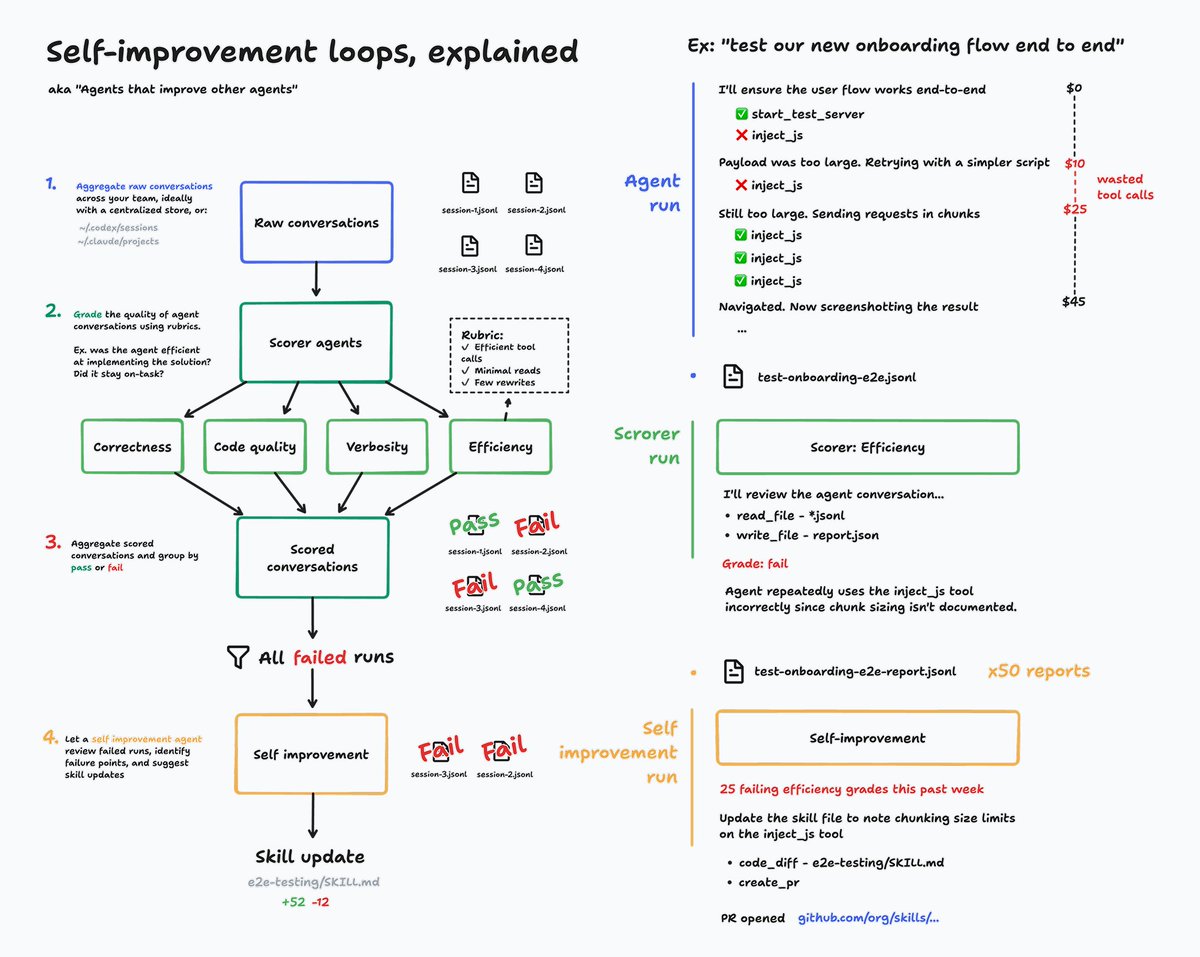
@BHolmesDev added (16 likes, 8 replies, 538 views) a post-deployment loop in which scorer agents grade past runs and self-improvement agents propose AGENTS.md or skill updates based on recurring failures. That treats the harness itself as the thing being iterated, not just the model.
Discussion insight: the useful skepticism today was about evidence, not ambition. Builders wanted explicit verify_more and human_review states, confidence thresholds, and logs that can be replayed later. The common warning was that a decision layer without those artifacts is just a new wrapper.
Comparison to prior day: on 2026-09-21, @teneo_protocol framed (243 likes, 201 replies, 4,858 views) the category around who checks the work after agents act, and @RoundtableSpace amplified (74 likes, 12 replies, 37,950 views, 37 bookmarks) the 193x faster / 444x cheaper Jev claim. On 2026-09-22, the surviving posts were less benchmark-heavy and more about the exact menus, thresholds, and logs that would make those claims operational.
1.3 Model evaluation talk focused on cost per finished task and native-harness fit (🡕)
Model posts today were not mainly arguing about who is smartest in the abstract. They were arguing about what a benchmark costs to reproduce, how much token burn hides behind a headline score, and whether the same model behaves differently inside the harness it was trained for.
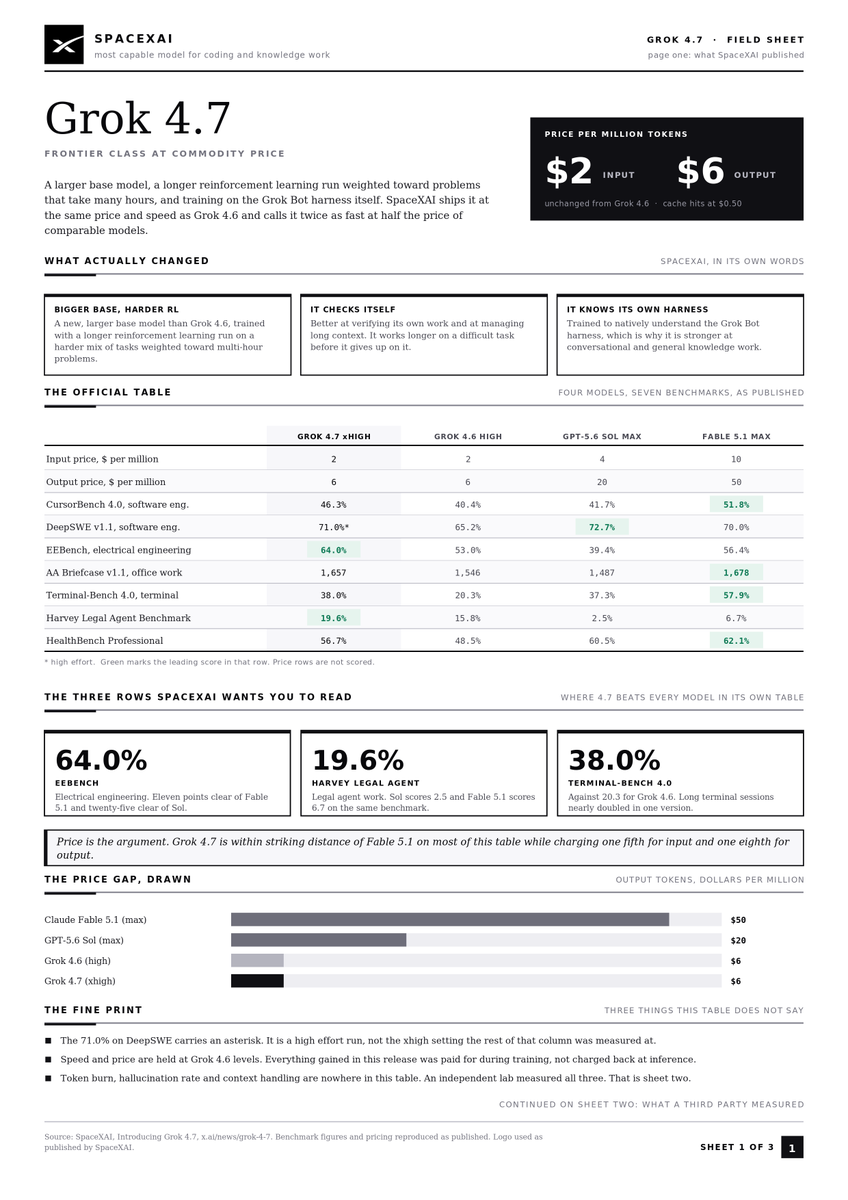
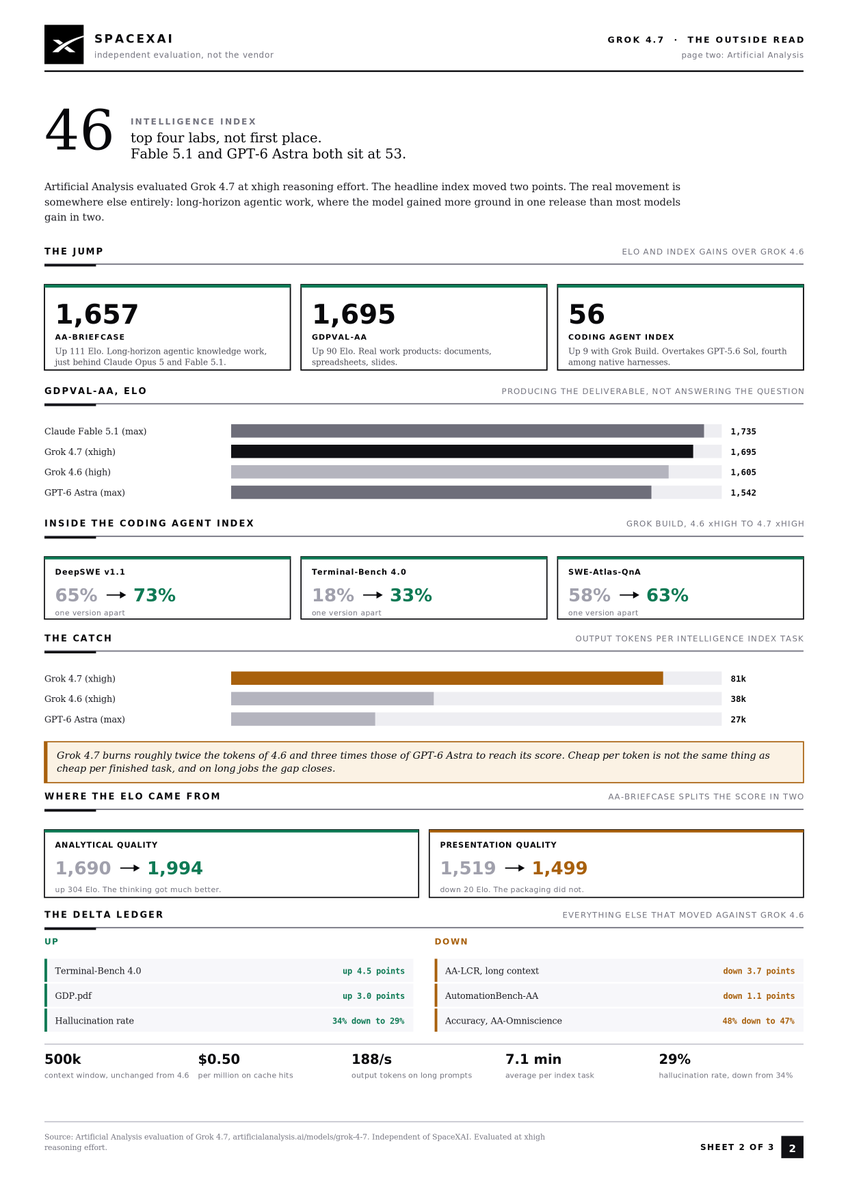
@N01ennn published (28 likes, 4 replies, 22 bookmarks) a three-page Grok 4.7 field guide. The post highlighted strong gains on the Coding Agent Index, DeepSWE, and legal-agent work, but also made the key caveat explicit: Grok 4.7 looks different inside Grok Build than inside a generic wrapper.
@ArtificialAnlys reported (99 likes, 13 replies, 4,925 views) that GPT-6 Sol and Luna roughly halve price versus GPT-5.6 Sol and Luna. The public GPT-6 Sol model page confirms the pricing cut, while the thread adds the tradeoff: Sol improves on the Coding Agent Index at lower cost, but both models regress on some knowledge-work evaluations.

@Jhaddix countered (225 likes, 18 replies, 14,428 views, 58 bookmarks) from a security-testing angle: reproducing frontier exploit evaluations at 10,000 concurrent agents and eight days of runtime would cost millions to tens of millions of dollars, before the harness engineering burden is counted.
@evio_wwww used (10 likes, 2 replies, 413 views) Step Code’s open-source launch to make the same point from the opposite direction: the harness target was “same smarts, fewer tokens.” The public Step Code repo describes a terminal agent optimized for long-horizon reliability and token efficiency, and the launch thread included a public score-versus-token chart.

Discussion insight: the strongest posts no longer treated “best model” as a single number. Builders kept asking where the model ran, what the rollout cost was, how many tokens it burned, and whether a generic harness reproduces the same result.
Comparison to prior day: the prior day’s public Jev discourse leaned more on decision-layer speed and cost multipliers. On 2026-09-22, the benchmark discussion spent more time on public score tables, per-task economics, and harness-specific caveats.
1.4 Agent commerce stayed visible, but the useful discussion moved into recovery, reputation, and discovery infrastructure (🡖)
Agent marketplace talk was still loud, but the signal improved when posts stopped at slogans and started naming the missing machinery: identity, registry/discovery, escrow, resumability, dispute handling, and reputation updates.
@KaylashowDq argued (56 likes, 64 replies) that agent.family is not “Upwork with AI added,” but a flow built around agents doing the work: onchain identity, reputation, discovery, bidding, escrow, delivery verification, and stablecoin settlement. The public agent.family docs currently present the system as a TermiX skill package that can be installed into an agent and then linked to a chain-specific account.
@CteaAminah focused (38 likes, 28 replies) on the failure case everyone else skipped: what happens when an agent starts a job and the API goes down, compute runs out, or the provider disappears. Her proposed recovery path was explicit: record progress, return unused escrow, preserve partial output, let another provider resume, and decide what happens to stake or reputation.

@miiportable_btc expanded (35 likes, 39 replies) that into a seven-step lifecycle: agree, escrow, deliver, record a work hash, review, challenge, evaluate, then settle and update reputation.

@oliviasand3va made (20 likes, 21 replies, 20 bookmarks) the adjacent discovery argument: Rokha’s Registry is built for skills, MCP servers, and agents rather than ordinary apps. The public rokha.ai page reinforces that framing by exposing an MCP endpoint, a machine-readable llms.txt, and registry / board / ledger APIs as live entry points for agents.
Discussion insight: replies kept rejecting profile-level trust. In replies to @Zakria_0987 trying (54 likes, 49 replies) his own .agent identity, one respondent argued that identity only matters if the system also exposes permissions, an audit trail, and a kill switch when something goes wrong.
Comparison to prior day: on 2026-09-21, @miiportable_btc was still explaining (37 likes, 46 replies) why agents need a path from capability to hireable service at all. On 2026-09-22, the stronger posts assumed that premise and concentrated on dispute windows, resumability, and capability discovery.
2. What Frustrates People
Verification, provider trust, and action boundaries are still the hardest part
Severity: High. The most concrete frustration of the day came from @CommandCodeAI reporting (418 likes, 36 replies, 22,892 views) that a fraud ring created about 40,000 fake accounts on its subsidized plan and tried to push about $450,000 of inference through unofficial proxies. The core complaint was not just billing abuse. It was that a proxy between the harness and the model can read prompts, code, and keys or inject fake tool calls. In the same broad lane, @whemohere reduced the problem to four missing gates, while @Serantych turned that into a blueprint with typed outputs, confidence thresholds, and decision logs.
People are coping by moving toward more explicit verification infrastructure. @yonasbe announced (32 likes, 10 replies, 3,553 views) StarSling Review Runners, and the public StarSling docs describe GitHub App-installed AI-native runners plus optimization PRs for CI. At the smaller-tool end, @PovilasKorop shared (3 likes, 2 replies, 346 views) Sloppy, whose public GitHub repo positions it as local deterministic analysis for the debt AI coding agents leave behind.
The visible workaround pattern is consistent: official providers over unofficial proxies, typed decisions over free-form orchestration, and review artifacts over “trust me” summaries. Teams seem willing to accept slower or narrower loops if they can see what was checked.
Worth building for? Yes. This pain is direct, repeated, and tied to fraud, supply-chain risk, and release accountability.
Benchmark numbers are hard to reproduce and easy to misread
Severity: High. @Jhaddix argued (225 likes, 18 replies, 14,428 views, 58 bookmarks) that frontier-lab exploit evaluations are effectively out of reach for most defenders because the API bill alone would run into the millions. @N01ennn showed (28 likes, 4 replies, 22 bookmarks) why the next frustration appears immediately after that: even when benchmark tables are public, the result may depend heavily on the native harness. @ArtificialAnlys added that GPT-6 Sol and Luna improved the cost frontier, but not every knowledge-work evaluation moved in the same direction.
What people do instead is optimize the harness they can actually run. @evio_wwww said Step Code started from a simple goal: the same smarts with fewer tokens. That is a much more reproducible target for ordinary teams than trying to recreate a 10,000-agent public benchmark.
The underlying frustration is that benchmark discourse still compresses several variables into one number: cost per task, token burn, harness quality, degree of guardrail removal, and whether the result survives outside the model’s home environment.
Worth building for? Yes. Cheap, reproducible evals and honest benchmark context are still undersupplied.
Autonomous commerce still does not have a good default failure story
Severity: Medium to High. @CteaAminah spelled out (38 likes, 28 replies) the missing path when an agent starts a job and then the API fails, compute expires, or the provider disappears. @miiportable_btc responded (35 likes, 39 replies) with a more formal lifecycle built around escrow, review, challenge windows, and evaluator panels. In replies to @Zakria_0987 trying his own .agent identity, people still asked for permissions, audit trails, and kill switches before they would treat onchain identity as operational trust.
The coping mechanism today is to push more logic into process: escrow before work begins, explicit review phases, and dispute windows after delivery. That is better than pure optimism, but it still reads like a market designing its incident-response policy in public.
Worth building for? Yes. The need is practical, not aspirational: unattended agents need recovery, resumability, and adjudication.
Tool and skill discovery is becoming its own tax
Severity: Medium. @oliviasand3va said Rokha’s Registry matters because the object of discovery is no longer just apps, but skills, MCP servers, and agents. One reply made the pain explicit: “half my build time now goes into picking MCP servers and skills, not writing the agent itself.” A different version of the same frustration appeared under JetBrains Air, where the most immediate question was which model / harness combinations work today, not whether multi-vendor choice sounds good. And @undefinedKi accumulated 18 skills, 72 slash commands, 6 subagents, and 87 resources into one package, which only makes sense in a landscape that is already too fragmented to remember unaided.
The workaround today is curation: operator guides, registries, install prompts, and ever-larger second-brain bundles. That helps individuals, but it also shows the market has not standardized how capabilities are named, ranked, or composed.
Worth building for? Yes, but it is becoming competitive quickly. Discovery, compatibility, and trust signals now look as important as raw capability count.
3. What People Wish Existed
Reusable learning across sessions and harnesses
This is a practical need. @RoundtableSpace pitched (27 likes, 6 replies, 36,236 views, 28 bookmarks) Beacon as a way to mine past agent sessions and turn lessons into reusable skills across Claude Code, Codex, Cursor, and other harnesses. @BHolmesDev described a scorer-agent plus self-improvement-agent loop that turns failing runs into skill or AGENTS.md updates. @undefinedKi packaged a second-brain stack with 18 skills, 72 slash commands, and six subagents because people clearly do not want to rediscover working practices from scratch.
What people want is not just more memory. They want reusable operational knowledge that survives tool changes and fresh sessions. Today that need is partially addressed by Beacon-like session mining, second-brain kits, and hand-maintained guides, but there is no shared standard for promotion, pruning, or cross-harness portability.
Opportunity: Direct.
Compatibility maps for models, harnesses, skills, and MCP servers
This is a practical need with urgency. Under @kskrygan launching JetBrains Air, one of the first replies asked which model / harness combinations really work today. @oliviasand3va argued that Rokha’s Registry matters because the problem is now skills, MCP servers, and agents, not just apps. The public rokha.ai page leans into exactly that need by exposing MCP, llms.txt, registry, board, and ledger endpoints as machine-readable surfaces.
What people appear to want is a compatibility layer that answers basic operator questions before trial-and-error: which agents work with which harnesses, which skills compose cleanly, which servers are trustworthy, and what permissions they require. Current registries and guides address discovery, but not yet confidence.
Opportunity: Direct.
Deterministic review and debt cleanup around agent-written code
This is a practical need and a crowded one. @whemohere wanted lightweight decision gates between Grok bots. @Serantych wanted typed outputs, confidence gates, decision logs, and eval loops. @yonasbe announced Review Runners for GitHub Actions, while @PovilasKorop shipped Sloppy to catch deterministic PHP and Laravel debt left by coding agents.
The wish here is not merely “better code review.” It is a repeatable, inspectable layer between agent output and production. Some solutions already exist, but they are fragmented across CI products, static-analysis tools, and harness-level control planes.
Opportunity: Competitive.
Recovery and dispute primitives for autonomous commerce
This is a practical need that still feels early. @CteaAminah asked what happens when an agent starts a job and then the environment fails mid-task. @miiportable_btc described the current TermiX answer as escrow, review, challenge, evaluator review, settlement, and reputation updates. @KaylashowDq framed the broader goal as infrastructure for agents to find work, get paid, and build a track record.
What people want, in their own words, is a cleaner failure path, not just a happy-path marketplace. There are partial answers today, but they still look like custom process design rather than a stable standard.
Opportunity: Emerging.
4. Tools and Methods in Use
| Tool | Category | Sentiment | Strengths | Limitations |
|---|---|---|---|---|
| JetBrains Air | Control plane / IDE system | (+/-) | Multi-vendor support, ACP connectivity, explicit governance and cost-visibility layer, team coordination | Early product system; replies immediately asked which combinations work in practice and what the product boundary actually is |
| Jev | Decision layer / control method | (+/-) | Typed outputs, confidence gates, dynamic context and tool routing, replayable decisions | Repeated pushback that it is not a substitute for system design, evals, or engineering fundamentals |
| Grok 4.7 | LLM / coding-agent model | (+/-) | Strong price-performance claims, gains on some coding and legal-agent benchmarks, native-harness awareness inside Grok Build | Native-harness dependence is a recurring caveat; token burn remains high; not a clean top-of-board win everywhere |
| GPT-6 Sol / Luna | LLM / coding-agent models | (+/-) | Roughly half the price of GPT-5.6 Sol / Luna, lower hallucination, Sol improves on the Coding Agent Index | Mixed evaluation picture; Luna regresses on some coding metrics and both models regress on some knowledge-work tasks |
| Command Code | Harness / provider access | (+/-) | Very low-cost official access path; provider packages meant to reduce third-party glue | Subsidized access attracted large-scale fraud; unofficial proxies create trust and exfiltration risk |
| StarSling Review Runners | CI / verification | (+) | AI-native GitHub Actions runners, optimization PRs, code-review-agent framing, faster CI | Docs say runner support is org-only and some AI optimization features are paid-plan only |
| Rokha Registry | Registry / MCP runtime | (+) | Live MCP endpoint, agent-readable llms.txt, registry and ledger APIs, no-install discovery model |
Discovery quality and trust signals are still part of the product problem, not fully solved by listing alone |
| TermiX + AACP / agent.family | Commerce protocol / marketplace | (+/-) | Explicit identity, escrow, review, evaluator, and reputation model for agent-to-agent work | Failure recovery, permissions, auditability, and provider availability are still active design questions |
| Sloppy | Static analysis | (+) | Deterministic, local cleanup of AI coding debt; Laravel-aware rules; integrates with Rector, Pint, Pest, and MCP | Narrowly scoped to PHP / Laravel rather than a cross-stack answer |
Across the stack, sentiment was most positive when the tool made agent behavior easier to inspect or constrain. JetBrains Air, StarSling, Rokha, TermiX, and Sloppy all sell some version of visibility, repeatability, or safer composition, even though they operate at different layers.
The common workarounds were also consistent: use official provider channels, keep agents behind typed decision gates, add local static analysis or CI review, and move reusable lessons into skills or guides. Migration is happening away from generic “chat plus tools” setups and toward native harnesses, repo workflows, registries, and organization-specific control planes. On the model side, Grok 4.7 pressed the price/performance argument hardest, while GPT-6 Sol tried to reclaim the efficient-frontier slot at the premium end.
5. What People Are Building
| Project | Who built it | What it does | Problem it solves | Stack | Stage | Links |
|---|---|---|---|---|---|---|
| JetBrains Air | JetBrains / @kskrygan | Open system of products for agentic software development across IDEs, team workflows, and governance | Coordination, visibility, and control across multi-vendor agent work | JetBrains IDEs, ACP, multi-vendor agents, governance services | Beta | post, JetBrains Air |
| StarSling Review Runners | @yonasbe | Code-review agents and AI-native GitHub Actions runners that optimize CI over time | Slow CI and repeated manual verification work | GitHub Actions, GitHub App, model-key review agents, workflow optimization | Beta | post, docs |
| Rokha Registry | Rokha | Registry and execution layer for skills, MCP servers, and agents | Capability discovery, execution, and composability across agent workflows | MCP JSON-RPC, llms.txt, registry API, ledger / board APIs, Rokha SDK |
Shipped | rokha.ai, registry/api |
| TermiX + agent.family | TermiX | Agent-first marketplace with identity, escrow, review, dispute handling, and settlement | Hiring, paying, and verifying autonomous agents | AACP, onchain identity, escrow, evaluator flow, reputation | Beta | post, agent.family docs, termix.ai |
| Beacon | @RoundtableSpace | Extracts lessons from prior agent sessions and turns them into reusable skills across harnesses | Session knowledge loss and repeated mistakes across tools | Jev, session mining, cross-harness skill packaging | Beta | post |
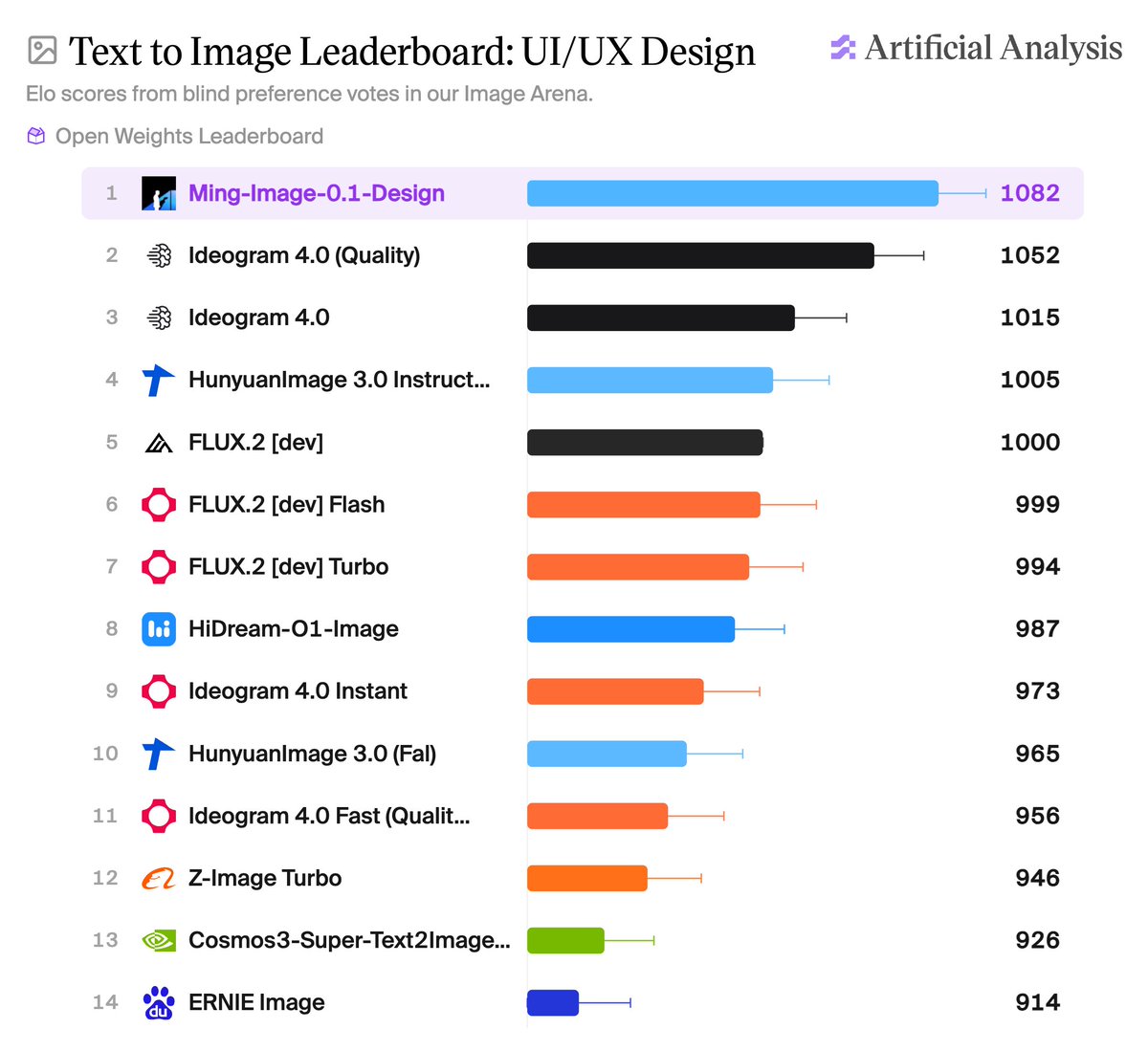
| Ming-Image-0.1-Design + Ling UI Design Skill | inclusionAI / @AntLingAGI | Open-weight design model and companion agent skills for UI, posters, and editable design workflows | Visual design generation and design-to-assets pipelines | 6B design model, Hugging Face model card, Python repo, RGBA output | Shipped | post, Hugging Face, repo |
| Step Code | StepFun / @evio_wwww | Open-source terminal agent CLI tuned for token efficiency and long-horizon work | Expensive rollout costs and weak long-task ergonomics in coding agents | TypeScript, MCP, multi-agent orchestration, StepPage publishing | Alpha | post, repo |
| Sloppy | Heyosseus / @PovilasKorop | Local static analysis for the code-quality patterns AI coding agents leave behind | Mechanical debt in AI-written Laravel and PHP code | PHP, Laravel-aware rules, Rector, Pint, Pest, MCP | Shipped | post, repo |
JetBrains Air and StarSling both attack the same macro problem from different sides: code generation is getting cheaper, while coordination and verification are getting more expensive. Air builds a multi-vendor control layer above the agent, and StarSling moves review and CI optimization deeper into the delivery path.
Rokha and TermiX are building adjacent layers of the agent economy rather than the same product. Rokha is about discovering and running capabilities through MCP and registry surfaces; TermiX is about how agents get identified, hired, escrowed, reviewed, disputed, and paid. The common trigger behind both is that capability alone does not make an agent operational.
Ming-Image, Step Code, and Sloppy show how fast the “agent skill” idea is escaping pure chat UX. One project turns UI and presentation generation into open-weight skills, another squeezes more work out of the harness with fewer tokens, and the third cleans up deterministic debt after the model writes code. Multiple builders are solving the same underlying pain: the hard part is less “make the agent output something” and more “make the output usable, reviewable, and cheap enough to keep.”
6. New and Notable
MemoHarness made adaptive harnesses concrete
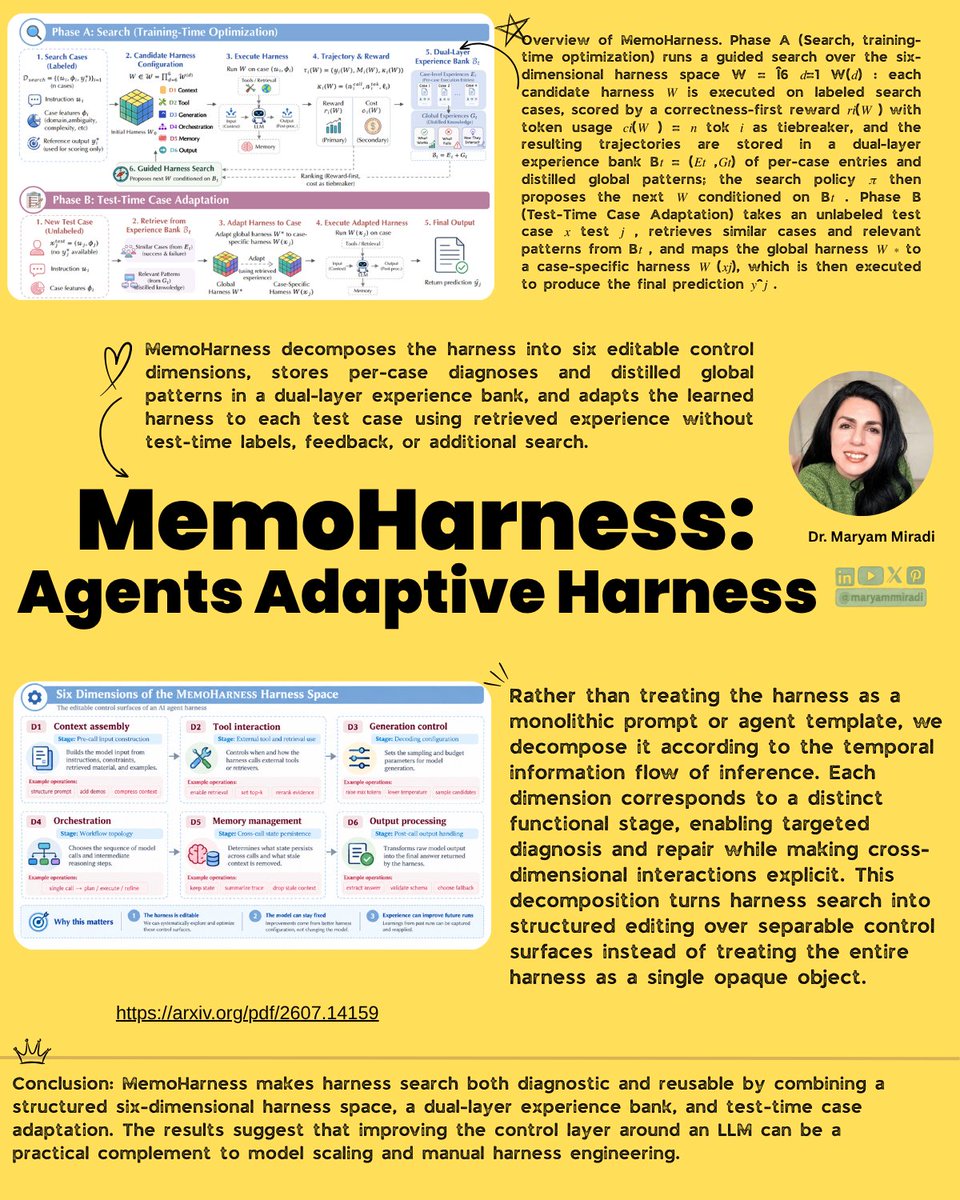
@MaryamMiradi summarized (11 likes, 1 reply, 326 views, 9 bookmarks) the MemoHarness paper as a shift away from treating the harness as one giant prompt. The post broke the harness into six editable control dimensions — context, tool interaction, generation control, orchestration, memory management, and output processing — and described a dual-layer experience bank that adapts the control layer by case rather than retraining the base model.
Self-improvement moved from memory dump to reviewable diff
@BHolmesDev described a multi-agent self-improvement loop in which scorer agents grade past runs and self-improvement agents propose updates to skills and AGENTS.md files. The distinctive angle was not “better memory.” It was reviewable operational change based on repeated failure patterns.
Agent skills expanded beyond coding into design workflows
@AntLingAGI announced (71 likes, 4 replies, 14,821 views, 35 bookmarks) the open-source Ming-Image-0.1-Design family plus two agent skills: Ling UI Design Skill and Image-to-Editable-PPT Skill. The public Hugging Face model card describes the model as a 6B system for UI, infographics, posters, and text-rich visual designs with RGBA support, and the public Ming-Image repo provides installation and inference code.
The second-brain bundles kept getting larger and more explicit
@undefinedKi packaged (56 likes, 11 replies, 4,103 views, 86 bookmarks) a free repo-and-site bundle containing 109 pages, 18 agent skills, 72 slash commands, six subagents, and 87 resources. The signal was not a single breakthrough feature. It was that operators increasingly want a maintained knowledge stack for Jev engineering, harnesses, evals, and knowledge graphs instead of scattered threads and disposable chats.
7. Where the Opportunities Are
[+++] Verification fabric for multi-agent coding and CI — Multiple sections point to the same gap: unofficial proxy risk from @CommandCodeAI, Jev gates from @whemohere, typed review/control loops from @Serantych, AI-native CI from StarSling, and deterministic debt cleanup from Sloppy. The evidence is strong because the pain is immediate, security-sensitive, and already spawning several different product shapes.
[+++] Workflow-native enterprise rollout kits — The Microsoft transformation post, JetBrains Air launch, Suraj Sharma’s forward-deployed-engineer roadmap, and Steve Yegge’s agentic-TPM concept all converge on the same message: enterprises do not need more generic assistants first; they need workflow redesign, permissions, observability, and role-specific operating models. This looks strong because the demand is tied to deployment, not just curiosity.
[++] Cross-harness memory and learning transfer — Beacon, BHolmes’ scorer/self-improvement loop, undefinedKi’s second-brain bundle, and Maryam Miradi’s MemoHarness summary all point toward the same missing layer: preserving what worked and promoting it across sessions and tools. The signal is moderate because the need is obvious, but standards for promotion, pruning, and portability are still unsettled.
[++] Agent capability discovery and compatibility maps — Rokha’s registry surface, JetBrains Air’s ACP framing, and the day’s large curation bundles all point to discovery and compatibility as a real bottleneck. The opportunity is moderate because registries already exist, but trust, ranking, and composition are still underdeveloped.
[+] Failure recovery and dispute standards for autonomous commerce — Ctea Aminah’s mid-task failure path, miiportable’s escrow-and-evaluator lifecycle, and the skepticism under Zakria’s identity test show that agent commerce still lacks robust recovery defaults. The signal is emerging because the market is early, but the design problem is already concrete.
8. Takeaways
- Enterprise agent adoption is being reframed as workflow and governance design, not seat rollout. JetBrains Air positioned itself as a coordination-and-governance system, and Microsoft’s own transformation write-up emphasized workflow redesign plus more than 100 purpose-built agents over raw tool access. (source, source)
- Jev only keeps its value when it becomes a small, typed control surface. The day’s better posts were about gates, confidence thresholds, and replayable decisions rather than vague “judge” claims. (source, source)
- Model comparisons now depend on harness fit and cost per finished task as much as raw benchmark rank. Grok 4.7 discourse leaned on native-harness behavior and price, GPT-6 Sol leaned on Pareto efficiency, and Jhaddix highlighted how unrealistic it is for most teams to rerun frontier-scale security evals. (source, source, source)
- Agent-commerce discussion is maturing from identity slogans into escrow, review, and failure handling. The most useful posts were about recovery paths, challenge windows, evaluator panels, and capability discovery, not just “hireable agents.” (source, source, source)
- Reusable operational knowledge is becoming a product layer of its own. Beacon, self-improvement loops, second-brain kits, and MemoHarness all treated agent lessons as artifacts to capture, score, promote, and reuse across future runs. (source, source, source, source)