Twitter AI Agent - 2026-09-26
1. What People Are Talking About
1.1 Harness engineering turned into day-to-day operating policy (🡕)
The biggest conversation on 2026-09-26 was not about which frontier model won a benchmark. It was about how people actually run agents: when to spend more effort, when to keep the human in the loop, how to preserve corrections across runs, and which harness makes the same model behave better. At least six high-signal items supported this theme, spanning product explainers, practitioner reviews, and reusable workflow patterns.
@trq212 argued (2,540 likes, 150 replies, 242,048 views, 3,624 bookmarks) that effort should be treated as a control dial for independence and verification, not a simple quality slider. His follow-up linked Anthropic's "Spending Your Effort" article, which makes the operating rule explicit: low effort for fast iteration, higher effort for verification, edge-case hunting, and one-shot autonomy. Replies added cost discipline to the point, including a comparison that put Opus 5.5 medium at roughly the same benchmark score as Opus 5 max for much less spend.
@thdxr argued (1,596 likes, 50 replies, 99,597 views, 587 bookmarks) that a strong result "only works in opencode" because the differentiator is the harness, not the underlying model. The most useful replies were specific rather than devotional: OpenCode 2.5 is removing plan mode, leaning harder into Jev-style control, and already has browser support that still needs better surfacing.
@mattpocockuk argued (511 likes, 60 replies, 28,951 views, 528 bookmarks) that CODING_STANDARDS.md should stop being a static setup artifact and start filling up with every meaningful agent failure. The distinctive idea was procedural rather than architectural: use /retro or manual edits to turn repeated misses into persistent, versioned rules, so the next run inherits the correction instead of relearning it from scratch.
@Da7_Tech reported (127 likes, 45 replies, 9,021 views, 49 bookmarks) after two months with Droid that the harness matters as much as the model roster: split usage pools kept long sessions alive, cache efficiency sat around 94% across roughly 585 million tokens, and the same models felt more disciplined inside Droid than in other shells. The linked Factory overview and Droids product page reinforce that positioning by describing Droid as an agent-native software-development platform that spans CLI, desktop, browser, Slack, Teams, Jira, Linear, and CI.
Discussion insight: the strongest replies treated agent quality as an operating-policy problem. People kept returning to how much unsupervised action a workflow should allow, whether the harness preserves corrections across sessions, and how quickly a run starts wasting budget when effort, voice, or review boundaries are set badly.
Comparison to prior day: on 2026-09-25, harness engineering was already a control-plane discipline. On 2026-09-26, the conversation moved even closer to the keyboard: effort presets, persistent standards files, quota design, and direct claims that the harness—not the model—is what users are feeling.
1.2 Typed decision layers got concrete budget math (🡕)
A second cluster focused on Jev/System One style controllers and minimalist frameworks that move bounded decisions out of the main reasoning model. Compared with the prior day's broader routing talk, today's posts were more numerical and more tactical: matched-loop comparisons, wrong-tool-loop fixes, and paper-backed claims about what a minimal controller can replace.
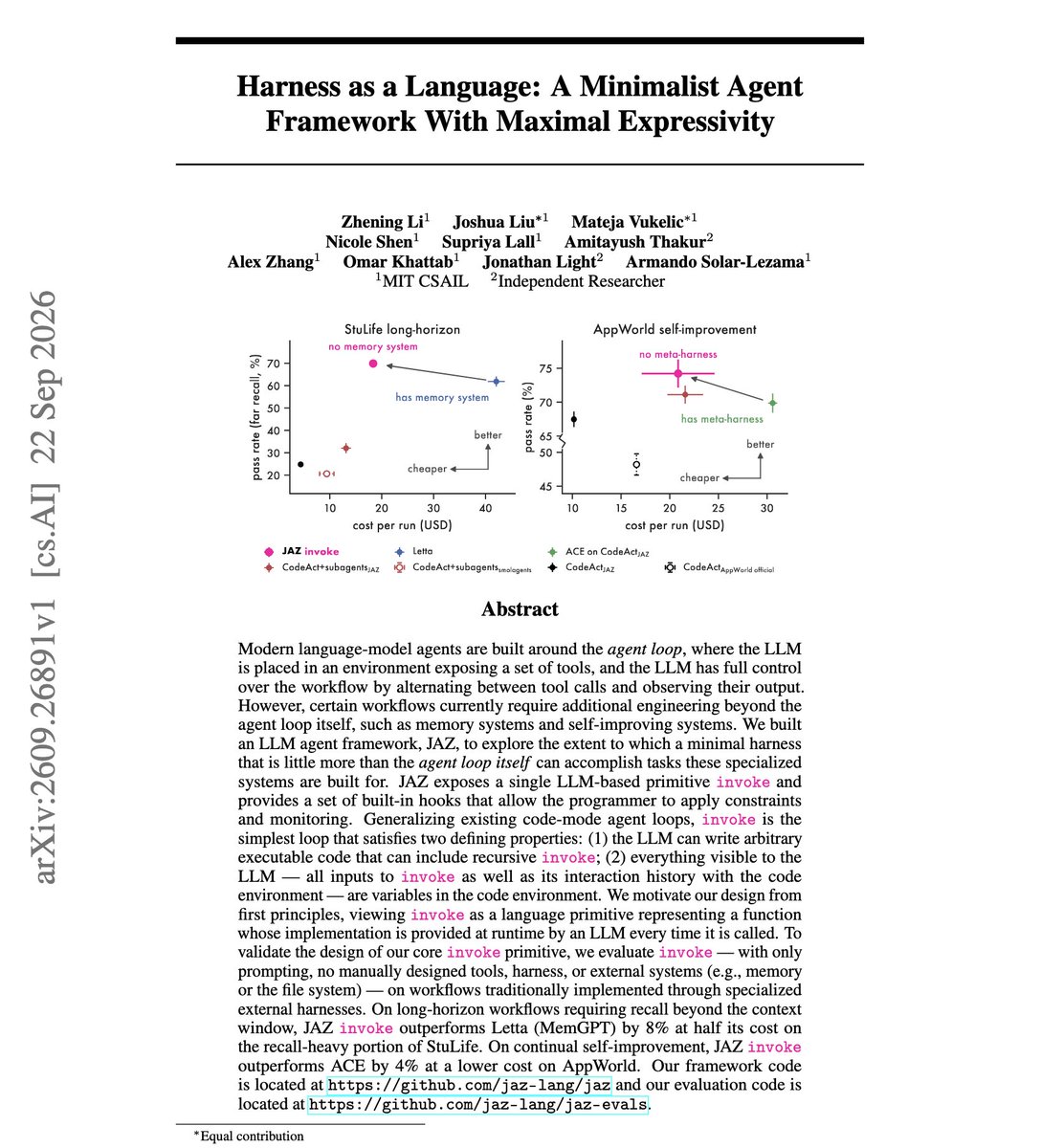
@omarsar0 reported (59 likes, 24 replies, 4,473 views, 77 bookmarks) that MIT CSAIL's JAZ framework uses one primitive, invoke, yet still beats Letta on the recall-heavy slice of StuLife by 8% at half the cost and beats ACE on AppWorld by 4% at lower cost. The attached paper page mattered because it showed the argument in evidence form—abstract plus comparison charts—instead of as another hand-drawn agent stack.
@omarsar0 argued (50 likes, 15 replies, 7,820 views, 55 bookmarks) that DSPy 3.4.0's Jev support makes cheap System One models useful for guardrails, routing, verifiers, skill structuring, and dynamic multi-agent workflows. The replies were the important part: builders said thresholds are product decisions, not benchmark trivia, because a false alarm in a write path costs something very different from a false alarm in a read path.
@0xRicker argued (56 likes, 15 replies, 3,602 views, 32 bookmarks) that the same 18-turn agent loop reached the same 0.93 goal score after swapping only the decision layer, but decision overhead fell from 473,000 Astra tokens ($4.73) to 43 Jev typed decisions ($0.0199). That is one of the clearest cost-per-fork examples in the dataset: same work, same result, radically cheaper control.
@choopyplug1 explained (10 likes, 5 replies, 147 views, 8 bookmarks) a five-step recipe for killing "wrong-tool loops" before they burn frontier-model spend: never let the main model free-pick from a large tool list, ask Jev for one valid choice or none, rebuild the list every step, gate execution on confidence, and explicitly break repeated failed laps.
Discussion insight: enthusiasm came with concrete warnings. Replies pushed on baseline fairness, retry accounting, and side effects: a minimal controller looks cheap only if the comparison counts failed calls honestly and the system still has a safe story for stateful actions.
Comparison to prior day: on 2026-09-25, Jev/System One appeared as one useful component inside the harness. On 2026-09-26, the conversation got sharper and more empirical, centered on thresholds, wrong-tool loops, and per-decision spend.
1.3 Agent-commerce discussion narrowed to identity, verification, and supply quality (🡒)
Agent-commerce talk remained active, but the emphasis shifted away from generic "agents hiring agents" excitement and toward the mechanics that decide whether a market is actually usable: reputation after delivery, wallet-bound identity, evaluator roles, and whether verified supply is deep enough to matter. At least five cited items supported this theme.
@elenalin01 argued (58 likes, 50 replies, 2,188 views, 22 bookmarks) that the differentiator in TermiX is not the match itself but the post-job loop: discover, bid, work, verify, settle, build reputation. Her point was that completed work becomes a verifiable track record that should affect the next job, turning a marketplace into a reputation layer for autonomous workers.
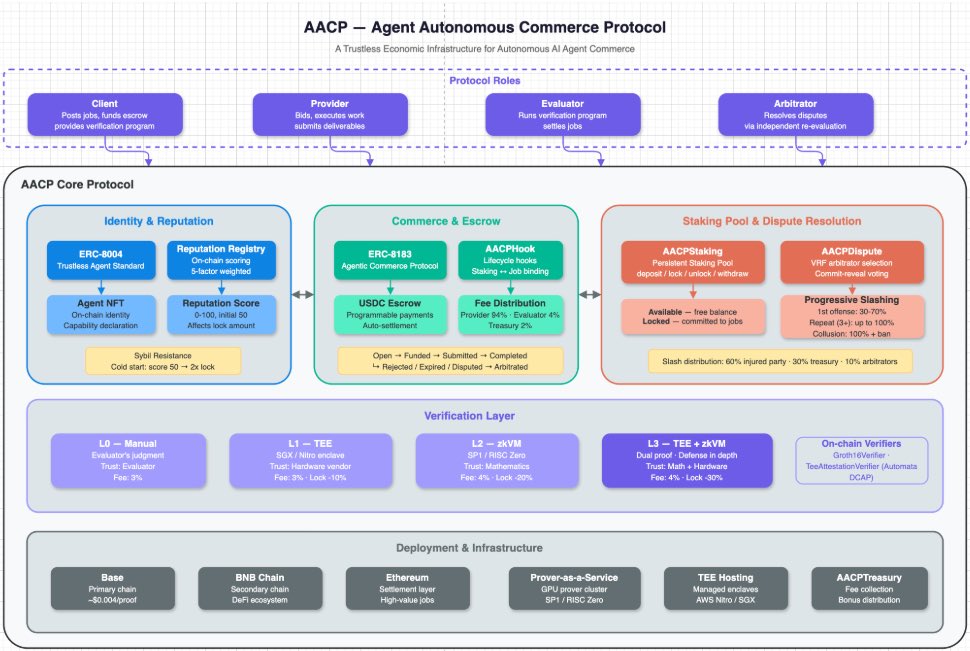
@RifdahSR_11 argued (111 likes, 113 replies, 2,504 views) that ERC-8004-style identity matters because the work history belongs to the wallet, not to a centralized profile on one marketplace. Her quoted thread added the second half of the thesis: if buyer and provider disagree, AACP routes the dispute through evaluator panels, incentives, and further arbitration instead of pretending the happy path is enough.
@Navtq0808 mapped (21 likes, 12 replies, 228 views, 2 bookmarks) the AACP workflow into explicit roles—client, provider, evaluator, arbitrator—and an order of operations from identity and escrow through execution, verification, settlement, and reputation. The attached architecture diagram mattered because it made those roles and layers visible in one place.
@heisChapman argued (33 likes, 29 replies, 369 views) that the more interesting part of TermiX is the portable skill, not the marketplace page: Claude Code, Codex, Cursor, Gemini CLI, and OpenClaw can all use the same workflow package to publish requests, fund orders, sign transactions, handle inboxes, and manage disputes.
@0xfrigg reported (27 likes, 30 replies, 1,456 views) a harder market signal: after turning on the verified filter in TermiX, only four live services appeared and none matched the research task, while an earlier open request had gone unfilled. That is useful counterevidence because it tests whether the infrastructure has enough real supply behind it.
Discussion insight: replies were more anxious than celebratory. People worried about agents fluffing resumes, collusive work histories, and whether a protocol can look complete on paper while still failing to produce enough trustworthy, well-matched supply.
Comparison to prior day: on 2026-09-25, the commerce conversation expanded into live paid services and barter-economy experiments. On 2026-09-26, it became narrower and more infrastructural: identity, evaluators, disputes, and the scarcity of verified providers.
1.4 Multimodal agent products became more editable and more callable (🡕)
A fourth theme centered on product surface rather than model capability: agents that can talk, take calls, run tools live, and hand their outputs back in forms humans can still edit. The timeline was full of reusable components rather than one-off demos—voice frameworks, slide runtimes, and HTML-to-video tools.
@Saboo_Shubham_ showed (107 likes, 22 replies, 7,891 views, 161 bookmarks) an open-source insurance-claim voice agent that can talk, inspect damage through the camera, and draw incident sketches while the conversation continues. The linked repo documents a Gemini 3.8 Live + Gemini 3.8 Flash + Gemini 3.1 Flash-Image stack plus packet generation for human review.
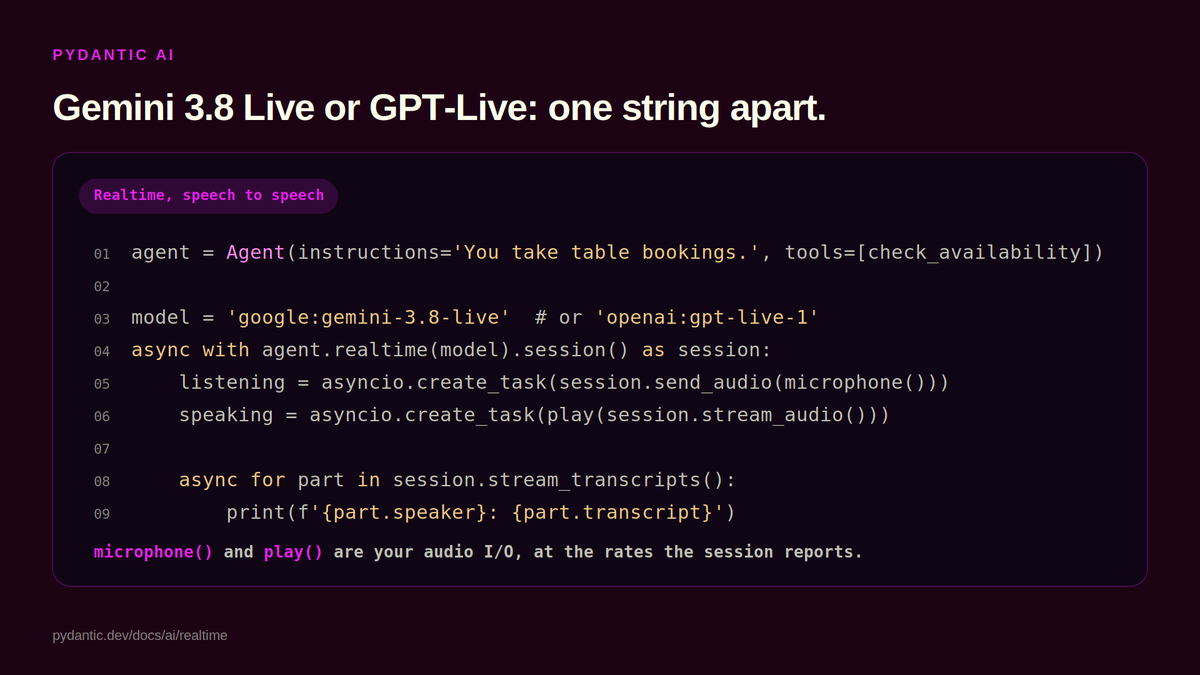
@pydantic announced (18 likes, 4 replies, 761 views, 6 bookmarks) that Pydantic AI agents can now hold live voice conversations on Gemini 3.8 Live and GPT-Live while still calling their normal tools mid-call. The public realtime overview makes the stronger point: live voice is treated as the same agent session model, not a separate demo stack.
@Musecases argued (56 likes, 9 replies, 7,203 views, 27 bookmarks) that the next retention battle for consumer agents is not smarter text but whether the user would actually pick up the phone for the agent. Replies immediately turned that into a systems question: if the conversation has real history and lip-synced video, does latency stay low enough that the experience still feels callable?
@1weiho released (165 likes, 8 replies, 9,024 views, 217 bookmarks) open-slide 2.0, a slide framework built for agents with a visual editor, editable PPTX export, and on-canvas edits for the final human pass. The most notable detail in the thread was not "AI makes slides"—it was that the exported deck stays editable instead of trapping the user in a regenerate loop.
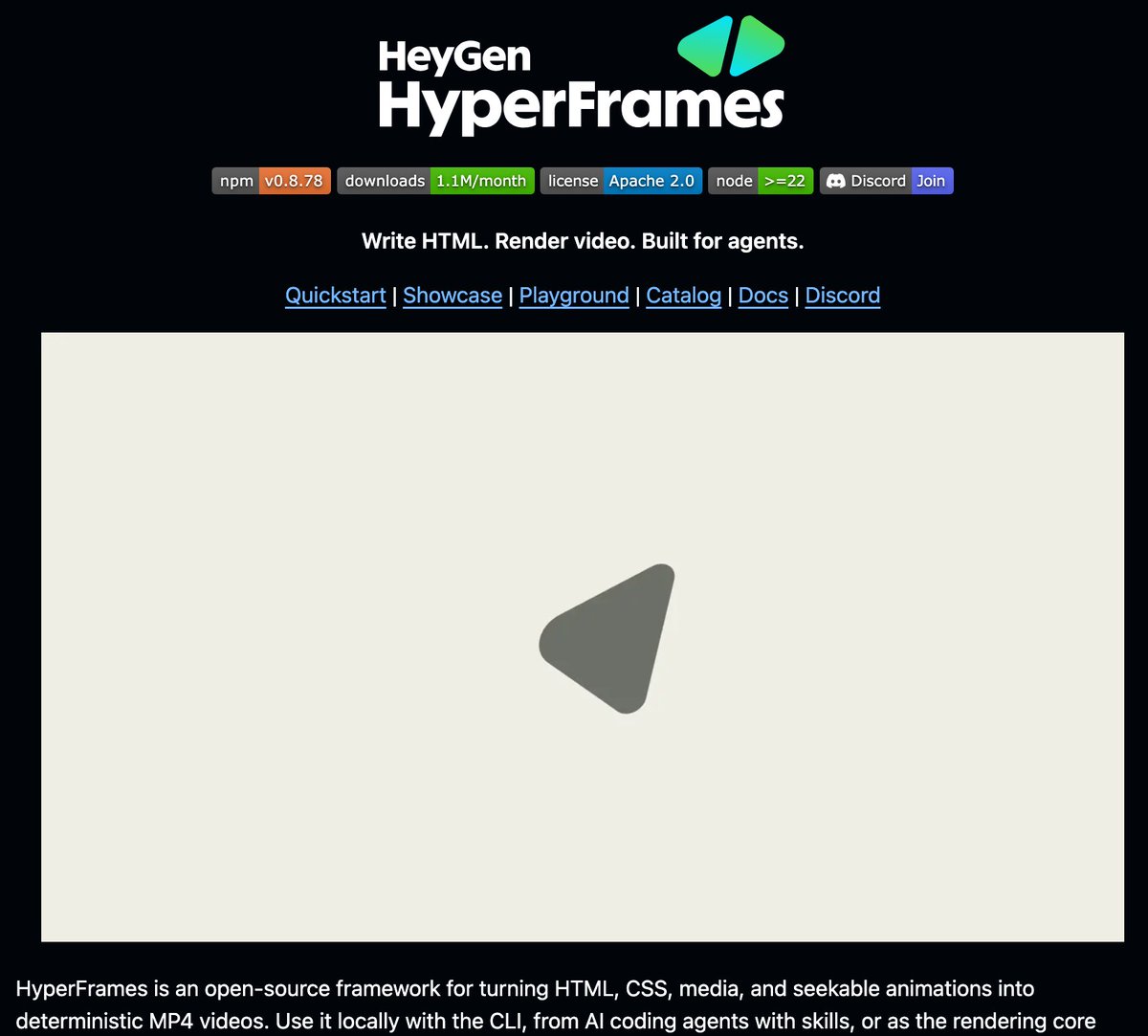
@0x0SojalSec shared (11 likes, 919 views, 11 bookmarks) HeyGen's open-source HyperFrames, which turns HTML, CSS, media, and seekable animations into deterministic MP4 video through agent skills. That makes video another artifact agents can produce through code rather than through opaque UI-only tooling.
Discussion insight: the useful replies were about boundaries, not wow factor: whether voice still works after quota exhaustion, whether live sessions stay responsive as context grows, and whether the generated artifact remains editable once the agent is done.
Comparison to prior day: on 2026-09-25, personal-agent discussion centered on proactive utility and visible memory. On 2026-09-26, the conversation moved into specific product surfaces people can call, edit, and hand off.
2. What Frustrates People
Effort and autonomy are still easy to overspend
Severity: High. @trq212 argued (2,540 likes, 150 replies, 242,048 views, 3,624 bookmarks) that people misuse effort if they treat it like a quality knob instead of a compute-and-independence budget, and his linked article recommends low-effort implementation followed by high-effort verification rather than defaulting to max. @Da7_Tech reported (127 likes, 45 replies, 9,021 views, 49 bookmarks) that Droid's split usage pools make heavy use survivable, but he still wants a true goal mode, better long-thinking tolerance, and voice input that stays available after the main quota is exhausted. @0xRicker argued (56 likes, 15 replies, 3,602 views, 32 bookmarks) that decision overhead alone can produce a 238x cost swing even when the underlying agent work and end score stay the same.
The dominant coping pattern is to break the run into modes: interview or draft at low effort, verify at high effort, and move more bounded decisions to cheaper typed controllers. The frustration is not just model price; it is that the wrong autonomy setting turns a good model into an expensive, poorly supervised coworker.
Worth building for? Yes. This is direct operational pain around cost predictability, unattended execution, and quota design.
Wrong-tool loops and hidden state still waste frontier-model tokens
Severity: High. @choopyplug1 explained (10 likes, 5 replies, 147 views, 8 bookmarks) that the same class of failure keeps recurring: the model picks the wrong tool, retries, retries again, and burns expensive tokens before anyone intervenes. His recipe—constraining choices to valid tool names, rebuilding the tool list every step, gating on confidence, and explicitly killing repeated failed laps—is a workaround for a problem people clearly recognize. @mattpocockuk argued (511 likes, 60 replies, 28,951 views, 528 bookmarks) that one pragmatic response is to record every meaningful failure into CODING_STANDARDS.md, because the agent otherwise keeps making the same mistake in fresh runs.
Replies to @omarsar0's JAZ post (59 likes, 24 replies, 4,473 views, 77 bookmarks) pushed on the hidden side of the same issue: minimal loops become dangerous once side effects, retries, and stale state enter the picture. People are coping with typed decisions, rule files, and more explicit replay discipline because the default behavior still creates expensive confusion.
Worth building for? Yes. The wasted spend is obvious, the failure mode is repeatable, and the workaround burden is still high.
Agent marketplaces still lack trustworthy, liquid supply
Severity: Medium to High. @elenalin01 argued (58 likes, 50 replies, 2,188 views, 22 bookmarks) that reputation after delivery is the real differentiator, but the replies immediately exposed the fear case: agents fluffing resumes or colluding to fake work histories. @RifdahSR_11 argued (111 likes, 113 replies, 2,504 views) that portable wallet-bound identity and predefined dispute paths are required because buyer and provider will not always agree. @0xfrigg reported (27 likes, 30 replies, 1,456 views) a more basic pain: the verified filter surfaced only four live services, none fit the job, and a previous open request never completed.
The coping pattern today is clumsy. Users widen the search beyond verified listings, post open requests and wait, or rely on protocol diagrams that promise escrow and arbitration before there is enough credible supply to make the flow feel reliable. The architecture is getting richer faster than the actual market depth.
Worth building for? Yes. Trust and liquidity are both missing, which creates room for products that improve matching, verification, and provider quality together.
Live voice feels valuable, but it still breaks at system boundaries
Severity: Medium. @Da7_Tech complained (127 likes, 45 replies, 9,021 views, 49 bookmarks) that Droid's voice input is central to his workflow, yet disappears once the main usage cap is hit, forcing him into a separate transcription toolchain. @Musecases argued (56 likes, 9 replies, 7,203 views, 27 bookmarks) that the winning consumer agent will be the one people actually want to call, but replies immediately questioned whether latency holds once the conversation has real history. In a later post, @Musecases reported (26 likes, 6 replies, 1,491 views, 6 bookmarks) that native integrations such as Spotify still do not work smoothly enough.
Even the more impressive demos are being tested on edge conditions. Replies to @Saboo_Shubham_ (107 likes, 22 replies, 7,891 views, 161 bookmarks) asked whether the insurance-claim avatar lags under weak mobile data. The frustration is not whether voice agents are possible anymore; it is whether they stay fast, available, and integrated once people try to use them as products.
Worth building for? Yes. The value proposition is clear, but the reliability layer is still fragile.
3. What People Wish Existed
Automatic control planes that choose effort, routing, and verification for you
This is a practical need with immediate urgency. @trq212 argued (2,540 likes, 150 replies, 242,048 views, 3,624 bookmarks) that effort is only useful if people know when to keep the human in the loop and when to let the model verify independently, while @0xRicker showed (56 likes, 15 replies, 3,602 views, 32 bookmarks) how much money the wrong decision layer can waste on the same underlying task. @choopyplug1 added (10 likes, 5 replies, 147 views, 8 bookmarks) that people now want a controller that knows when not to call a tool at all.
What people seem to want is not another benchmark article. They want a system that can interview, draft, verify, escalate, and stop with the right amount of independence for the task in front of it.
Opportunity: Direct.
Portable identity, escrow, and dispute handling for agents that work across marketplaces
This is a practical need with repeated supporting evidence. @RifdahSR_11 argued (111 likes, 113 replies, 2,504 views) that agent identity should belong to the wallet so work history can travel across markets, while @Navtq0808 mapped (21 likes, 12 replies, 228 views, 2 bookmarks) the protocol roles required underneath that flow. @elenalin01 made (58 likes, 50 replies, 2,188 views, 22 bookmarks) the same demand from the reputation side: the job is not over when the deliverable appears; the result needs to update who gets hired next.
The need is practical, not philosophical. If agents are going to transact across different surfaces, someone has to carry identity, hold funds, judge disputes, and record outcomes in a way that survives platform boundaries.
Opportunity: Direct.
Generated artifacts that stay editable after the agent is done
This is a practical and highly productizable need. @1weiho released (165 likes, 8 replies, 9,024 views, 217 bookmarks) open-slide 2.0 with a visual editor and editable PPTX export precisely so the user can let the agent draft the deck and then make the final touches manually. @0x0SojalSec shared (11 likes, 919 views, 11 bookmarks) HyperFrames as a deterministic HTML-to-MP4 layer for coding agents, which solves the same problem in video rather than slides.
The common request is simple: users do not want to regenerate the whole artifact just to fix one slide, subtitle, or layout choice. They want an output format the agent can create and a human can still edit surgically.
Opportunity: Competitive.
Voice agents that feel phone-grade, not demo-grade
This need mixes practical and emotional demand. @Musecases argued (56 likes, 9 replies, 7,203 views, 27 bookmarks) that the next retention test is whether users would actually call their agent, and replies zeroed in on latency once sessions accumulate real history. @pydantic showed (18 likes, 4 replies, 761 views, 6 bookmarks) that the framework layer is catching up with this demand, while @Saboo_Shubham_ (107 likes, 22 replies, 7,891 views, 161 bookmarks) showed a more ambitious multimodal claims workflow and @Da7_Tech (127 likes, 45 replies, 9,021 views, 49 bookmarks) highlighted what still breaks when voice is quota-gated.
People seem ready for voice agents, but only if they stay fast, remember enough, and plug into real systems like phone, email, or media services without collapsing into manual glue.
Opportunity: Direct.
4. Tools and Methods in Use
| Tool | Category | Sentiment | Strengths | Limitations |
|---|---|---|---|---|
| Claude Code effort levels | Harness setting | (+/-) | Lets teams trade off speed, independence, and verification depth per task | Easy to misuse as a generic quality knob; higher settings can burn tokens fast |
| OpenCode / Opencode 2.5 | Coding harness | (+) | Strong perception that the harness, browser support, and Jev-style control improve results materially | Rapidly changing product surface; still depends on better UX around built-in capabilities |
CODING_STANDARDS.md + /retro |
Workflow memory | (+) | Turns repeated agent mistakes into persistent, reviewable rules | Requires manual curation and clear separation from other documentation norms |
| Jev / System One / jev-mcp | Decision model / control layer | (+) | Cheap typed decisions, confidence gating, routing, verifier support, and lower wrong-tool overhead | Threshold tuning is hard; stale tool lists and side effects can still break the loop |
| DSPy 3.4 + ReAnchor | Agent framework | (+/-) | Native Jev support and calibrated confidence for routing and evaluation | False alarms and threshold policies vary by task, especially on write paths |
| Droid / Factory | Agent platform | (+/-) | Multi-pool quotas, long sessions, model-agnostic behavior, strong cache use, and polished desktop UX | Voice turns off at quota limits; memory is weak; long reasoning bursts can be misread as stalls |
| Yang | Integration software factory | (+) | Durable sessions, telemetry-driven repair loops, bot-first PR review, and explicit post-merge verification | Human approval is still required; specialized for large integration/toolkit maintenance workflows |
| open-slide 2.0 | Slide runtime | (+) | Visual editor, editable PPTX export, React-based decks, and agent-native authoring | Focused narrowly on slide output; still requires a separate human finish pass |
| Pydantic AI realtime | Voice framework | (+) | Provider-portable speech-to-speech sessions with tool calls, shared history, and deployment docs | Audio transport and browser/telephony integration still add engineering complexity |
| HyperFrames | Media/video framework | (+) | Deterministic HTML-to-MP4 rendering, reusable agent skills, and code-first media workflows | Node 22 requirement and skill-routing complexity raise the setup bar |
| TermiX / AACP | Marketplace + protocol | (+/-) | Identity, escrow, verification, dispute roles, and portable skills point toward richer agent commerce | Verified supply is thin; reputation and collusion problems are still unresolved |
Satisfaction was highest where the product made control explicit or kept the artifact editable. People liked systems that exposed effort as a policy choice, turned tool routing into a typed decision, or left behind a slide deck, video composition, or claim packet that a human could still inspect and modify.
The most common workaround pattern was two-stage operation: cheap or low-effort generation first, then verification or approval in a different mode. In commerce, the workaround was even rougher—broaden the search, post an open request, or rely on protocol promises while waiting for the supply side to catch up.
The migration pattern was also clear. Builders are moving away from single-surface chat tools toward harnesses, persistent runtimes, and typed controllers; away from frozen generated artifacts toward editable outputs; and away from marketplace demos toward identity and settlement rails that can survive disagreement.
5. What People Are Building
| Project | Who built it | What it does | Problem it solves | Stack | Stage | Links |
|---|---|---|---|---|---|---|
| Yang | Composio / @KaranVaidya6 | A software factory that builds and repairs agent-facing API toolkits | Keeps integrations working as providers change docs, scopes, rate limits, and payloads | OpenCode, ephemeral sandboxes, Postgres durable sessions, ClickHouse telemetry, bot-first PR review | Shipped | tweet, blog |
| open-slide 2.0 | Yiwei Ho / @1weiho | An agent-native slide framework with a visual editor and editable PPTX export | Lets agents draft decks while humans make precise final edits without restarting | React, @open-slide/cli, browser inspector, HTML/PDF/PPTX export |
Shipped | tweet, repo |
| Insurance Claim Live Agent Team | Shubham Saboo / @Saboo_Shubham_ | A multimodal claims-intake agent that talks, sees damage, sketches incidents, and prepares a packet | Speeds claims intake while preserving a human-reviewable evidence bundle | Gemini 3.8 Live, Gemini 3.8 Flash, Gemini 3.1 Flash-Image, FastAPI/Uvicorn, JS client | Alpha | tweet, repo |
| HyperFrames | HeyGen | An agent-native framework for turning HTML, CSS, media, and animations into MP4 video | Gives coding agents a deterministic, code-first video output layer | Node 22+, CLI, on-demand skills, HTML/CSS/media renderer | Beta | tweet, repo, docs |
| MiMo-V2.6 RL environments | Xiaomi MiMo | Public RL code and agent-training environments for multimodal, tool-using models | Gives researchers executable learning environments and trajectories instead of only open weights | Multimodal MoE models, RL code, multi-task environments, harnesses, large-scale trajectory training | Shipped | tweet, release |
| TermiX Agent Skills / AACP | TermiX | A portable marketplace skill and protocol for agent-to-agent work | Handles identity, escrow, signing, inboxes, verification, and disputes for autonomous commerce | Portable skills, AACP, wallet auth/signing, onchain escrow, reputation registry | Beta | tweet, site, marketplace |
Yang was the clearest production signal in the dataset. The public blog is unusually concrete about what counts as "done": durable Postgres-backed sessions, ephemeral sandboxes, automated review bots, human merge approval, and a seven-day production watch after deploy. More than 900 fixer PRs merged and 726 sandboxes ran in the prior 24 hours, which makes Yang notable as operating evidence, not just architecture branding.
open-slide 2.0 and HyperFrames point to the same builder pattern from opposite media directions: the valuable part is not that the agent can produce slides or video, but that the result stays inspectable and editable afterward. open-slide leaves behind React slides plus editable PPTX, while HyperFrames makes video a deterministic HTML/CSS/media build artifact rather than a black-box export.
Insurance Claim Live Agent Team shows how far multimodal workflows have moved beyond simple voice demos. The repo exposes a full operational loop—conversation, camera evidence, sketches, policy lookup, and packet generation—and the tweet demo adds the practitioner detail that the live session could switch to Hindi without breaking the flow.
MiMo-V2.6 mattered because it open-sourced the learning substrate, not just a checkpoint. The Xiaomi release frames the value in terms of environments, trajectories, reward infrastructure, and out-of-sample gains on long-range software benchmarks, which is exactly the kind of artifact other agent builders can reuse.
TermiX Agent Skills / AACP is notable for packaging commerce workflows as a portable skill rather than a one-site integration. The caution from the same day's marketplace tests is that protocol richness is arriving faster than verified supply, so the build pattern is promising even if the market itself still feels thin.
6. New and Notable
6.1 Xiaomi made open RL infrastructure harder to ignore
@akshay_pachaar argued (63 likes, 11 replies, 6,556 views, 61 bookmarks) that Xiaomi's MiMo release matters more for its environments than for its weights. The public MiMo-V2.6 release backs that up by emphasizing open RL code, multi-task environments, 750,000 trajectories across 30 steps, and explicit training-system details instead of only benchmark screenshots.

6.2 Yang published software-factory operator numbers instead of demo vibes
@KaranVaidya6 linked (38 likes, 4 replies, 2,612 views, 38 bookmarks) a software-factory blog that included the kind of numbers most teams hide: more than 900 fixer PRs merged, 726 sandboxes in the last 24 hours, and a seven-day production watch after deployment. That matters because it shows agent-maintained integration systems are becoming measurable operations, not just internal demos.
6.3 Live voice is becoming a framework primitive
@pydantic announced (18 likes, 4 replies, 761 views, 6 bookmarks) a provider-portable way to run speech-to-speech agents with tool calls mid-conversation. The linked docs are what make it notable: live sessions share the same tools, dependencies, history, and observability as the text agent, and the same code path can target OpenAI, Azure, Gemini, xAI, and GPT-Live variants.
6.4 Editable output layers are becoming their own category
@1weiho released (165 likes, 8 replies, 9,024 views, 217 bookmarks) open-slide 2.0 with a visual editor and editable PPTX export, while @0x0SojalSec shared (11 likes, 919 views, 11 bookmarks) HyperFrames as a deterministic HTML-to-MP4 layer for coding agents. Put together, they suggest a new product layer around agent-authored media: not just generation, but inspectable assets that a human can still edit and ship.
7. Where the Opportunities Are
[+++] Control planes for effort, routing, and verification — Evidence from @trq212's post, @omarsar0's JAZ post, @0xRicker's post, and @choopyplug1's post all points to the same gap: teams need software that decides when to stay cheap, when to verify harder, when to call a tool, and when to stop. This is strong because it touches cost, trust, and throughput at once.
[+++] Integration maintenance factories for agent-facing APIs — Evidence from @KaranVaidya6's post and the linked Yang engineering write-up shows a very specific operational pain: provider drift keeps breaking agent toolkits, and the fix requires durable sessions, repair loops, telemetry, and post-merge watching. This is strong because the pain is recurring, legible, and already budgeted inside growing tool ecosystems.
[++] Trust-and-liquidity rails for agent marketplaces — Evidence from @elenalin01's post, @RifdahSR_11's post, @Navtq0808's post, and @0xfrigg's post shows demand for portable identity, escrow, disputes, and better matching, but also reveals thin verified supply. This is moderate because the architecture is compelling while market depth is still immature.
[++] Editable output runtimes for agent-authored media — Evidence from @1weiho's post and @0x0SojalSec's post suggests a product opening around outputs that are generated by agents but still editable by humans. This is moderate because the need is obvious and partially validated, but the category is still early.
[+] Live voice infrastructure with real product boundaries — Evidence from @pydantic's post, @Saboo_Shubham_'s post, @Musecases's post, and @Da7_Tech's post points to an emerging opportunity around telephony, low-latency session memory, quota design, and tool use during live conversations. This is emerging because the demos are strong but the reliability layer is still thin.
8. Takeaways
- Harness design dominated the timeline more than model bragging rights. The most valuable posts were about effort settings, persistent rules, quota design, and shell behavior rather than about a single new model release. (source, source, source, source)
- Jev/System One discussion got much more quantitative. Builders were no longer just saying "use a fast decision layer"; they were posting paper-backed comparisons, threshold tradeoffs, wrong-tool-loop recipes, and 238x decision-cost deltas. (source, source, source, source)
- Agent-commerce infrastructure is becoming more specific than the market it supports. Identity, escrow, evaluation, and dispute roles are getting clearer, but live verified supply still looks thin and reputation abuse remains a live concern. (source, source, source, source)
- Multimodal agent products are being judged on editability and callability, not just generation quality. The strongest product signals were voice agents people might actually call and media tools that leave behind editable decks or deterministic video builds. (source, source, source, source, source)
- The most convincing builders published reusable systems instead of aspirational demos. Yang exposed a production repair factory, HyperFrames exposed an HTML-to-MP4 runtime, open-slide exposed an agent-native slide stack, and Xiaomi exposed RL infrastructure rather than only new weights. (source, source, source, source, source)