Twitter AI Agent - 2026-10-04
1. What People Are Talking About
1.1 Harness engineering stopped sounding like lore and started sounding like a spec (🡕)
The biggest cluster on 2026-10-04 was about naming the harness itself: not just “which model,” but which loop, control plane, skill surface, memory policy, permission stack, and runtime shape an agent actually needs. At least seven retained items supported the theme, spanning a viral handbook, a steering-engineering guide, the Wavestone source-code study of eleven coding agents, and paired Andrew Ng / Anthropic teaching content. Compared with the last available report on 2026-09-28, the tone changed from curriculum-building to architectural convergence.
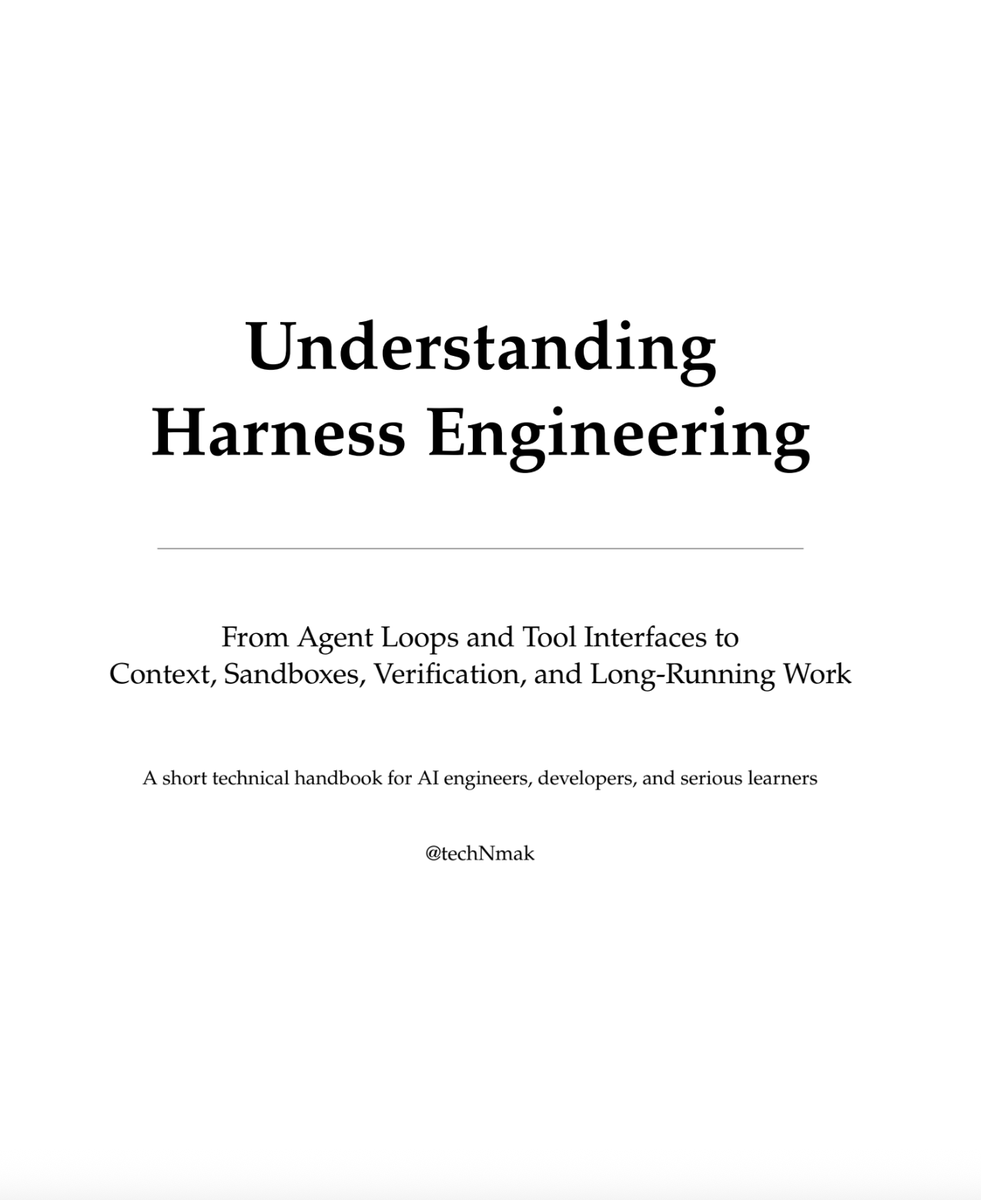
@techNmak argued (171 likes, 24 replies, 7,854 views, 230 bookmarks) that “harness engineering” is the layer that decides context, tools, retries, approvals, durable state, idempotency, subagents, and verification around a model. The post was notable for how comprehensive it was: instead of selling one framework, it treated agent reliability as the interaction between tool design, context policy, sandboxes, credentials, prompt-injection defenses, execution budgets, and evaluator loops. The replies sharpened the same point, especially one that said agents now need continuous evaluation as model + harness + environment rather than model-only tuning.
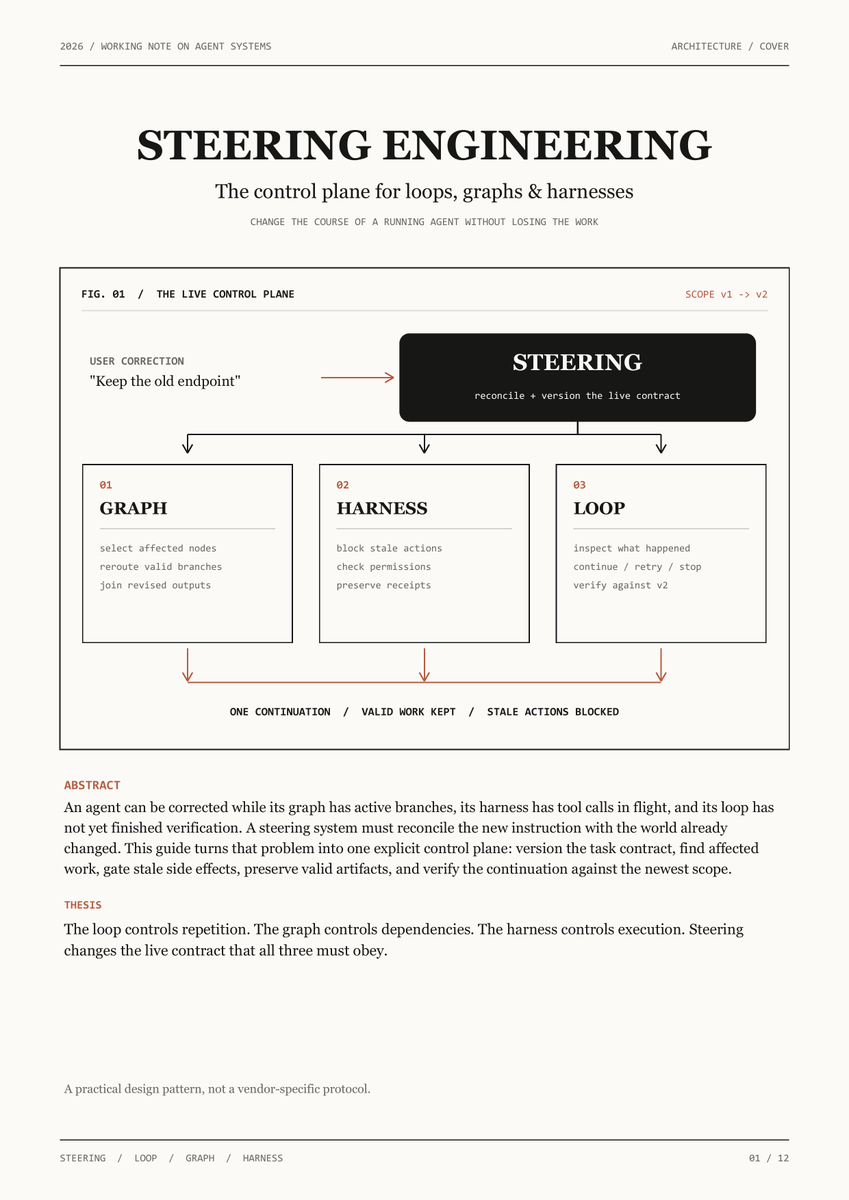
@0xwhrrari argued (63 likes, 21 replies, 2,041 views, 44 bookmarks) that stale behavior after a correction is not a prompting failure but a missing control plane. The thread split steering, graph, harness, and loop into separate jobs, then recommended versioning every correction, redrawing only the affected graph branches, and preventing actions proposed under an older instruction set from quietly executing after the contract has changed. That is a stronger operational model than “the agent said got it,” because it treats a correction as a live state transition rather than another chat sentence.
@slash1sol reported (56 likes, 23 replies, 1,690 views, 31 bookmarks) that Wavestone AI Lab read roughly four million lines across Claude Code, Codex, Gemini CLI, OpenHands, Aider, OpenCode, OpenClaw, and other systems and found the same seven harness parts recurring every time: loop, model layer, tools, memory, safety, orchestration, and extensions. That post mattered because it made two negative claims as well: none of the systems imported an agent framework, and none used embedding-based code retrieval as the core path. The paper gave the day a shared anatomical map rather than another vendor-specific narrative.
@stretchcloud argued (7 likes, 9 replies, 521 views) that the most important part of the same Wavestone result is where extension surfaces are heading: nine of eleven systems now ship SKILL.md-style skills, while eight use MCP, which means skills quietly became the more common integration surface. The post also framed the competitive dynamics differently, noting that Codex borrowed Claude Code’s hook vocabulary and OpenHands started reading Claude Code’s plugin format, so convergence is happening as open imitation at the API level rather than as isolated reinvention.
@kyr0stack argued (23 likes, 1 reply, 828 views, 23 bookmarks) that Andrew Ng’s new graph-engineering course is valuable precisely because it sequences the stack from first agent to loop engineering to graph orchestration and then to self-rewriting systems. @res1dualedge made the same case (12 likes, 1 reply, 695 views, 12 bookmarks) for Anthropic’s loop-engineering workshop, highlighting loop memory, check/build/commit, and the underbuilt problem of carrying accepted work into the next run. Together, the two posts made the educational consensus look clearer than it did a week earlier: prompts are only the entry point, and the real differences emerge in loops, graphs, memory carry-forward, and acceptance checks.
Discussion insight: The interesting pushback was not “does the model matter?” but “what still belongs in the harness?” Replies kept returning to retries with side effects, permission stacks, evaluator models, and whether extension layers increase ambiguity faster than they add power.
Comparison to prior day: Compared with 2026-09-28, when the conversation emphasized harness curriculum and staged learning paths, 2026-10-04 made the same territory look much more standardized. The field sounded less like it was discovering the stack and more like it was agreeing on the stack.
1.2 Manager layers, work-order handoffs, and reusable skills became the practical scaling pattern (🡕)
A second cluster answered coordination overload by adding a layer above the workers. At least six retained items supported the theme, spanning GrokBot demos, chief-of-staff workflows, the SwarmResearch paper, a warning about what subagents actually inherit, an open-source coordination protocol, and a public skills collection. The shared idea was not “spawn more agents”; it was “make routing, rejected options, and done criteria explicit.”
@0xRafy reported (30 likes, 2 replies, 1,596 views, 32 bookmarks) that a SpaceXAI engineer had built a GrokBot to break work into cloud agents, review progress, and keep existing agents running. The pitch was explicitly anti-babysitting: no constant checking, no twenty open chats, one bot owning the engineering loop while worker agents do the actual implementation. Even as a demo-led signal, it mattered because it named the new desired role clearly: an engineering lead for agents, not just another worker.
@0xGenAi added operating detail (9 likes, 1 reply, 387 views, 12 bookmarks) from a 45-minute workshop on the same pattern. Its concrete pieces were a chief-of-staff bot routing work to UI, DevX, and infra specialists; nightly research sweeps that leave PRs ready by morning; bots that own red CI first and escalate only if they still fail; and an operations bot that owns the playbook in Notion. That is more interesting than generic “multi-agent” talk because it turns the swarm into a shift schedule, org chart, and escalation policy.
@0xCodila reported (15 likes, 3 replies, 496 views, 16 bookmarks) a paperized version of the same idea in SwarmResearch, where a Shepherd Agent coordinates Search Agents working in separate git branches with separate local context. The paper summary matters because it adds measured outcomes to the chief-of-staff narrative: better or comparable results in 13 of 15 open-ended optimization tasks, plus a 4.58x speedup on one reasoning benchmark relative to a 1.80x baseline autoresearch loop. That makes “manager above workers” look like a reproducible architecture pattern instead of just a good workshop story.
@6AW0RON0k argued (7 likes, 2 replies, 176 views, 4 bookmarks) that many delegation failures are self-inflicted because subagents do not receive the main chat history. The post was unusually concrete about what does travel—the delegation note, the subagent’s own prompt file, CLAUDE.md hierarchy, startup git status, and preloaded skills—and what stays behind, including the full conversation and system prompt. That made the advice memorable: write the handoff like a contractor work order, settle every either/or decision first, and put standing rules where they actually propagate.
@DanKornas reported (1 retweet, 2 replies, 498 views) that Agent Orchestra tries to make those completion and handoff rules enforceable in code rather than advisory in prompts. Its contracts—task, resource, ownership, handoff, verification, evidence, approval, and recovery—exist to stop the specific failure where an implementer verifies its own work or silently claims “done.” That is still an early project, but it fits the day’s pattern exactly: agent teams now need coordination protocols, not just more context windows.
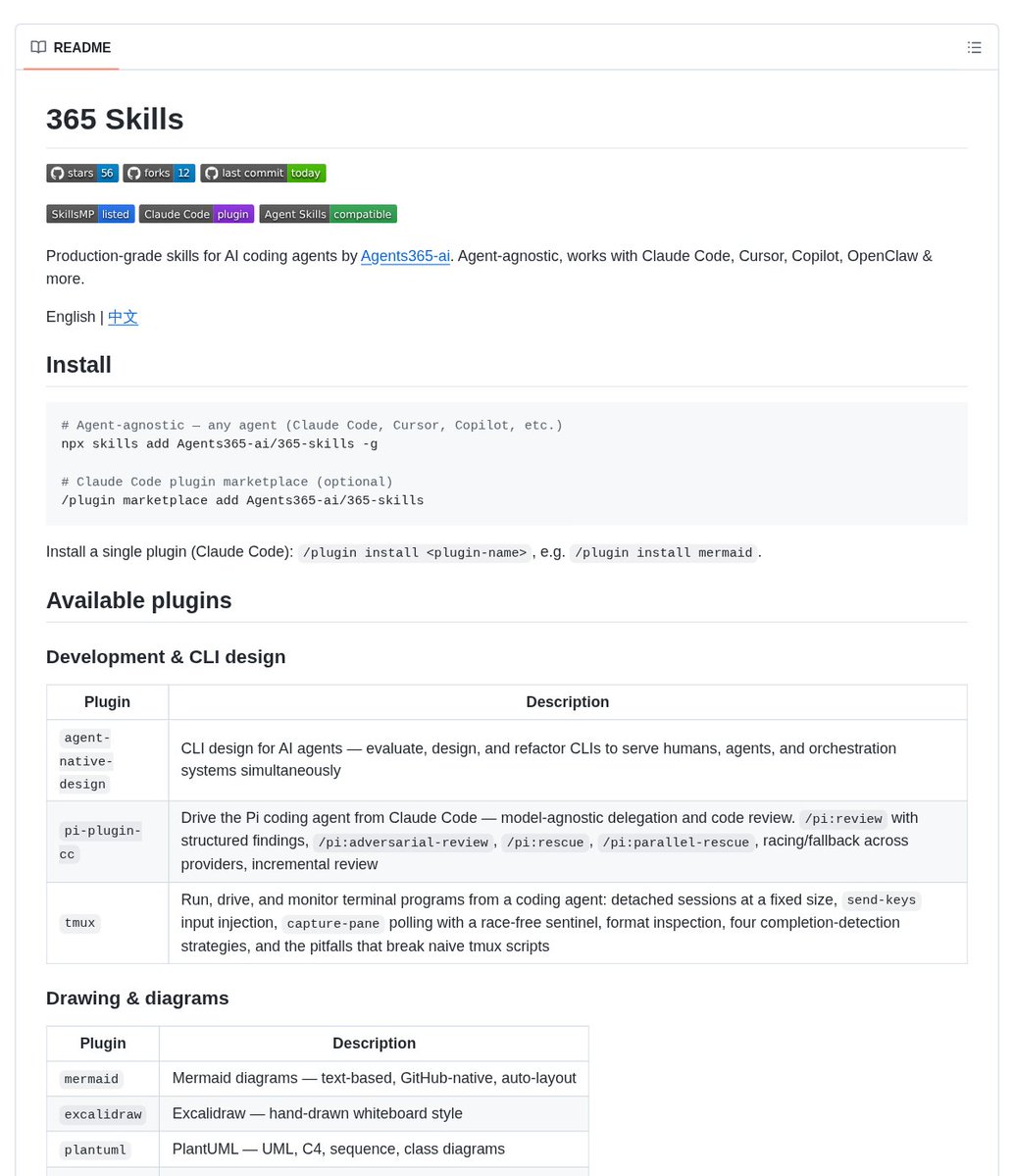
@DanKornas reported (7 likes, 6 replies, 1,035 views, 11 bookmarks) that 365 Skills is becoming a public collection of reusable agent skills and Claude Code plugins across coding, research, diagrams, notes, and media tasks. The repo and screenshot matter because they show another route to scaling: instead of teaching every team the same capability wiring, package it once and let people install it as a portable skill layer across Claude Code, Cursor, Copilot, and related tools.
Discussion insight: The most useful nuance here was that “multi-agent” did not mean “share everything.” The retained posts kept separating supervisor context, worker context, durable memory, and rule propagation, which is exactly why handoffs, rejections, and ownership now need explicit surfaces.
Comparison to prior day: On 2026-09-28, governed context mainly appeared as CI, database, and enterprise control surfaces. On 2026-10-04, that same governance instinct moved upward into chief-of-staff bots, skill packs, handoff protocols, and independent verification layers for agent teams themselves.
1.3 Reliability work shifted toward acceptance, permissions, memory, and cheap decision gates (🡕)
A third cluster treated agent quality as a sign-off problem rather than a generation problem. At least seven retained items supported it, spanning acceptance-layer framing, OS-level permission changes, local persistent memory, background-approval helpers, bounded decision models, and cost traces that cut through misleading cache-hit metrics. If the first theme was “what the harness is,” this one was “what the harness still fails to prove.”
@nateberkopec argued (4 likes, 1 reply, 354 views, 6 bookmarks) that the biggest missing piece in AI-assisted coding is a better acceptance layer. The striking part was how broad the checklist already is in practitioners’ minds: capability fit, bugs, security, speed, legal constraints, and “1000 other things,” with the author insisting this remains mostly human-first because agents can be delegated the how but not the product definition of what is acceptable. That post functioned as a thesis statement for the rest of the day’s reliability discussion.
@Musecases argued (11 likes, 4 replies, 986 views, 5 bookmarks) that Apple rewrote a macOS permission prompt because of AI agents, and @farrukh_codes argued (11 likes, 13 replies, 590 views) that the right default is task-scoped, time-bounded access rather than full laptop access. Those two posts made the same point from opposite ends: permission UX is becoming part of the product, and trust now depends on whether an agent can ask narrowly enough for the next action.
@ayandexyz reported (12 likes, 6 replies, 480 views, 5 bookmarks) that Hommies watches running coding agents and surfaces pending permission prompts or questions from a floating buddy or top bar, so the human does not come back hours later to find the agent frozen. The repo description is more important than the animation: it groups requests by agent and session, can jump to the exact terminal window, and treats “waiting on you” as a distinct runtime state. That is a small but concrete example of approval becoming its own product surface.
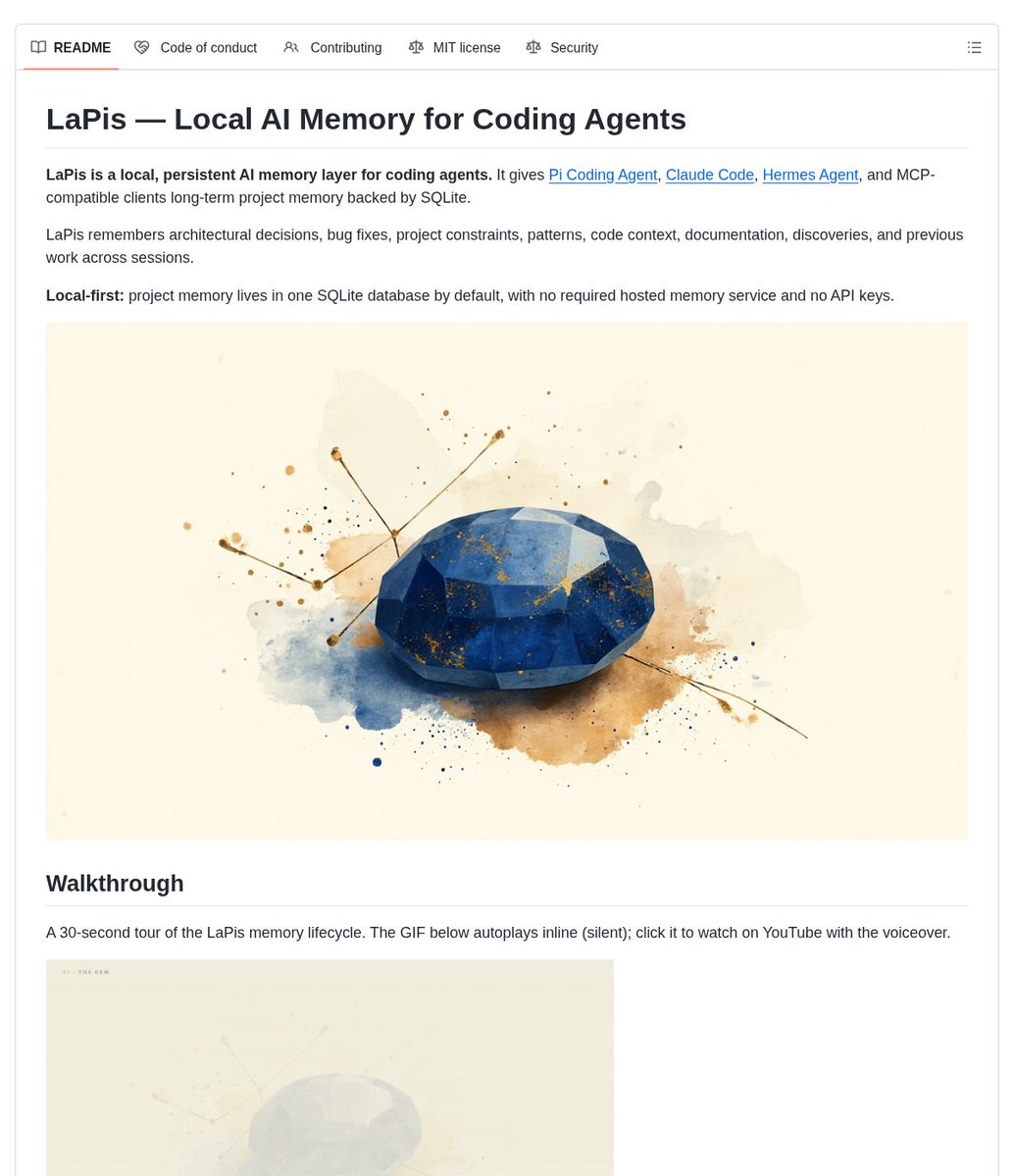
@DanKornas reported (6 likes, 3 replies, 749 views, 3 bookmarks) that LaPis offers local persistent memory for Pi, Claude Code, Hermes, and MCP-compatible clients using a SQLite-backed store. The README made the positioning clear: session recall, code and documentation indexing, trust tracking when code changes invalidate memories, and no mandatory hosted service. The important shift is that “agent memory” is now a product with install steps, lifecycle hooks, and invalidation logic, not just a vague promise that a bigger context window will remember enough.
@mr_kozh argued (22 likes, 8 replies, 669 views, 9 bookmarks) that the most important model in one showcased agent stack did not write any code at all: Jev only decided what happens next. The memorable evidence was procedural rather than performative—240 tests, 221 passing, 19 failing, a cheap verifier returning bounded choices or scores, and the harness deciding whether to continue, stop, or escalate. That is the same acceptance-layer instinct in another form: separate generation from adjudication.
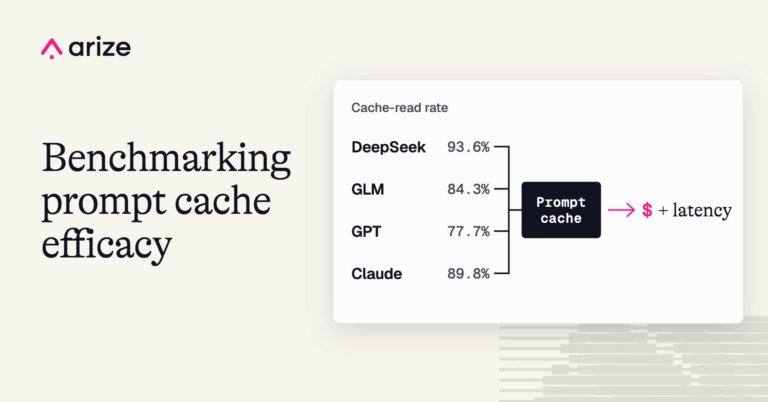
@arizeai reported (4 likes, 2 retweets, 126 views, 2 bookmarks) benchmark evidence in Arize’s prompt-caching study showing that more prompt cache reuse does not necessarily mean lower cost. DeepSeek had the highest cache-read rate at 93.6% and the lowest estimated cost across 100 runs, while Claude still had the highest estimated cost despite 89.8% cache reuse because output tokens drove the bill. That mattered because it replaced a comforting single metric with a more operational stack of traces, completion-token volume, latency, and provider pricing.
Discussion insight: Across acceptance, permissions, memory, Jev-style decision layers, and prompt-caching traces, the same principle kept showing up: the hard part is not getting an agent to attempt the work, but deciding what the system is allowed to do, what it remembers, and when the run truly counts as acceptable.
Comparison to prior day: The 2026-09-28 report already showed memory moving outside chat and consumer-agent safety centering on approval boundaries. On 2026-10-04, that same reliability conversation became more explicit and more operational: acceptance layers, permission prompts, local memory installs, verifier models, and trace-level cost evidence.
1.4 Agent commerce kept converging on proof, reputation, and settlement rails, but the evidence stayed builder-heavy (🡒)
A smaller but persistent cluster kept pushing the idea that agents need an economy designed for identity, evaluation, and payment order rather than just a marketplace homepage. At least six retained items supported it, but almost all of them came from builders or ecosystem promoters rather than clear end-user demand, which makes the signal real but still pre-mainstream.
@iam_islandboi argued (190 likes, 52 replies, 163 retweets, 1,892 views) that TermiX should be understood as a commerce and settlement layer where an agent can build identity, discover work, bid, execute, verify delivery, and get paid. @damonemcrp pushed the same thesis (23 likes, 9 replies, 183 views) from the microtask angle, arguing that lower take rates make $2–$5 jobs viable and therefore change what kinds of agent work can exist at all.
@dee_e6 argued (29 likes, 39 replies, 302 views) that verified work history matters more than a polished demo when hiring an agent, which is why its summary of AACP emphasized identity, reputation, bidding, escrow, delivery verification, dispute resolution, and settlement together. @Caccy_001 added (43 likes, 47 replies, 309 views) a sharper governance nuance: if evaluator behavior itself starts looking suspicious, the system should be able to initiate a dispute before a user explicitly complains.
@LiegeAgents reported (29 likes, 3 replies, 15 retweets, 351 views, 7 bookmarks) that Liege turns an X mention containing specialist, task, and budget into a reviewable proposal where the user approves, funds, evaluates, and settles. The key phrase was “no blind execution, no automatic spending,” which is exactly the kind of control-language the rest of the agent market is also reaching for. @MPP32_dev described (15 likes, 2 replies, 8 retweets, 313 views) the payments-infrastructure side with MPP32: multi-rail API discovery, local signing, delegated spend keys for sub-agents, and settlement straight to the builder wallet without a platform cut.
Discussion insight: The commerce discussion still cared far more about review order, delegated authority, evaluator neutrality, and payout mechanics than about discovery or branding. In other words, people want a trustworthy clearing process more than they want another agent directory.
Comparison to prior day: On 2026-09-28, the commerce cluster focused on courts, preserved evidence, and payout-after-verdict. On 2026-10-04, the same instinct expanded into fuller stacks—identity, bidding, reputation, delegated spend, and proposal review—while still falling short of broad end-user proof.
2. What Frustrates People
Multi-agent handoffs still drop critical context and let agents overclaim completion
Severity: High. @6AW0RON0k argued (7 likes, 2 replies, 176 views, 4 bookmarks) that subagents receive a brief, prompt file, CLAUDE.md hierarchy, git snapshot, and preloaded skills, but not the full conversation that led to the decision. @0xGenAi described (9 likes, 1 reply, 387 views, 12 bookmarks) the pain from the opposite side: one engineer had been juggling fifteen cloud agents by hand before moving to a chief-of-staff pattern. @DanKornas showed (1 retweet, 2 replies, 498 views) why coordination protocols now exist at all—without explicit verification and approval gates, everyone in the system can still say “done.”
The coping pattern was to make delegation more contractual. Builders recommended work-order handoffs, explicit rejection memory, separate supervisors above workers, and independent verification instead of self-certification. That is a practical systems response, but it also shows the baseline ergonomics are still too brittle.
Worth building for? Yes. This is a direct operating pain for anyone running more than one agent or more than one context window.
Acceptance, approval, and permission boundaries still do not have a good default surface
Severity: High. @nateberkopec argued (4 likes, 1 reply, 354 views, 6 bookmarks) that coding agents still lack a serious acceptance layer across capability fit, bugs, security, performance, and legal constraints. @Musecases argued (11 likes, 4 replies, 986 views, 5 bookmarks) that Apple had already changed a macOS permission prompt because of agents, while @farrukh_codes argued (11 likes, 13 replies, 590 views) for tighter, task-scoped boundaries instead of full-device trust.
The coping pattern was more interface, less invisible autonomy. @ayandexyz built around this (12 likes, 6 replies, 480 views, 5 bookmarks) with Hommies’ pending-request surface, and @LiegeAgents described the same instinct (29 likes, 3 replies, 15 retweets, 351 views) in Liege’s reviewable proposal flow before funding or settlement. People do not seem to want fewer agent actions; they want far better visibility into which actions are being requested and which ones are allowed.
Worth building for? Yes. This is one of the clearest current bottlenecks to broader trust.
Long-running state is still too fragile, and the wrong metrics still make it look simpler than it is
Severity: Medium-High. @DanKornas reported (6 likes, 3 replies, 749 views, 3 bookmarks) local persistent memory in LaPis because decisions, constraints, bug fixes, and documentation discoveries are still being lost between sessions. @mr_kozh showed (22 likes, 8 replies, 669 views, 9 bookmarks) why cheap decision models are attractive as a separate layer: they can adjudicate next steps after tests fail without asking another large model to hallucinate confidence. @arizeai added hard benchmark evidence (4 likes, 2 retweets, 126 views) that even a seemingly good metric like cache-read rate can hide the real cost story when output tokens dominate spend.
The same frustration also appeared in runtime architecture. @CloudNativeFdn summarized (2 likes, 1 reply, 800 views) a cloud-native harness design where durable session state, event logs, and multi-client access live outside the single desktop process. The fact that this theme is moving into dedicated memory products, verifier layers, trace tools, and distributed runtimes is itself evidence that the default single-session model is no longer enough.
Worth building for? Yes. The demand is practical, repeated, and still too infrastructure-heavy for most teams.
Agent commerce still lacks neutral trust rails even when the payment rails are improving
Severity: Medium. @dee_e6 argued (29 likes, 39 replies, 302 views) that verified work history matters more than glossy demos, which is why AACP binds identity, escrow, verification, disputes, and settlement together. @Caccy_001 pushed that further (43 likes, 47 replies, 309 views) by worrying about suspicious evaluator behavior itself. @MPP32_dev described (15 likes, 2 replies, 8 retweets, 313 views) delegated spend keys and direct builder settlement, while @LiegeAgents stressed (29 likes, 3 replies, 15 retweets, 351 views) reviewable proposals and no blind execution.
The coping pattern was procedural: add approval before spending, preserve evidence before disputes, and treat evaluator governance as part of the market. That is promising, but most of today’s evidence still came from builders describing their own rails, not from broad public usage.
Worth building for? Yes, with caution. The pain is real, but the demand evidence is still much more builder-led than user-led.
3. What People Wish Existed
A real acceptance layer that can sign off work without pretending “done” is obvious
This is a practical need with urgent evidence. @nateberkopec framed it directly (4 likes, 1 reply, 354 views, 6 bookmarks) as the biggest missing piece in AI-assisted coding, and @mr_kozh showed one partial answer (22 likes, 8 replies, 669 views, 9 bookmarks) in a verifier model that only decides what happens next after tests and evidence are visible. The Arize benchmark adds the same lesson in tooling form: people want better operational truth than a single flattering metric.
What the market still seems to lack is a portable sign-off layer that joins requirements, tests, security, performance, and approvals without forcing every team to build its own reviewer stack from scratch.
Opportunity: Direct.
Handoffs that preserve the right context without copying the entire chat
This is another practical need with repeated evidence. @6AW0RON0k made the failure concrete (7 likes, 2 replies, 176 views, 4 bookmarks) by showing how little context a subagent actually inherits, while @0xGenAi showed the manual workaround (9 likes, 1 reply, 387 views, 12 bookmarks) in chief-of-staff routing and written playbooks. @DanKornas pointed to memory (6 likes, 3 replies, 749 views, 3 bookmarks) as the other half of the solution, because durable project context still has to survive session boundaries.
People do not appear to want every agent to inherit everything. They want enough structured context—task, rejected options, relevant constraints, memory, and current state—to stop repeating already-settled mistakes.
Opportunity: Direct.
Portable skill packs and governed coordination rules instead of per-team reinvention
This need is practical but increasingly competitive. @DanKornas reported (7 likes, 6 replies, 1,035 views, 11 bookmarks) a public skills collection meant to work across agent hosts, @stretchcloud argued (7 likes, 9 replies, 521 views) that skills are now more common than MCP in the Wavestone sample, and @DanKornas pushed coordination rules into code (1 retweet, 2 replies, 498 views) with explicit verification and approval contracts.
The unmet need is not another generic assistant. It is a portable capability layer plus shared coordination rules that can move across tools, teams, and sessions without restarting from a blank prompt every time.
Opportunity: Competitive.
Permissioned background-agent interfaces that make approvals visible, fast, and scoped
This is a direct product need. @Musecases argued (11 likes, 4 replies, 986 views, 5 bookmarks) that the permission prompt is now the product, @farrukh_codes argued (11 likes, 13 replies, 590 views) for narrower access boundaries, and @ayandexyz built around the pain (12 likes, 6 replies, 480 views, 5 bookmarks) with a floating approval companion. @LiegeAgents applied the same idea (29 likes, 3 replies, 15 retweets, 351 views) to task procurement and settlement.
People are asking, implicitly, for faster approval surfaces that work while agents run in the background without widening the trust boundary to “the whole machine forever.”
Opportunity: Direct.
Settlement rails that can prove identity, evaluation, and payout order
This is a practical need, but still category-shaped. @iam_islandboi framed (190 likes, 52 replies, 163 retweets, 1,892 views) TermiX as a full economic loop, while @dee_e6 stressed (29 likes, 39 replies, 302 views) verified work history and @MPP32_dev stressed (15 likes, 2 replies, 8 retweets, 313 views) delegated spend and builder-direct settlement. The consistent request is for terms, evaluation, authority, and money movement to follow one auditable order.
This already looks crowded with protocols and rails, but the data still says the underlying need is unsolved.
Opportunity: Competitive.
4. Tools and Methods in Use
| Tool | Category | Sentiment | Strengths | Limitations |
|---|---|---|---|---|
| Harness handbook + Wavestone study | Architecture reference | (+) | Gives a shared vocabulary for loop, tools, memory, permissions, orchestration, and extension surfaces | Mostly explanatory; teams still have to operationalize the guidance themselves |
| Andrew Ng + Anthropic loop/graph courses | Course / method | (+) | Clear progression from prompt to loop to graph, with emphasis on accepted-result carry-forward | Educational only; does not solve deployment or governance on its own |
| 365 Skills | Skills marketplace | (+) | Agent-agnostic install path, plugin-marketplace mode, broad coverage across coding and research tasks | Early ecosystem with modest public adoption and manual trust review per skill |
| GrokBot / chief-of-staff pattern | Orchestration method | (+/-) | Reduces babysitting, routes specialists, schedules overnight work, and formalizes escalation | Public evidence is still heavy on demos and workshops; handoff quality remains fragile |
| LaPis | Memory layer | (+) | Local SQLite storage, session recall, code/doc indexing, and trust tracking across sessions | Requires hooks/MCP setup and disciplined memory hygiene |
| Hommies | Approval UI | (+) | Surfaces pending questions and permission requests from background agents, grouped by session | Omarchy-centric and dependent on hook integration |
| Jev engineering | Decision / verification layer | (+/-) | Cheap bounded decisions can gate next actions after tests and visible evidence | Promoter-heavy evidence; calibration and coverage remain unclear |
| Phoenix + Harbor prompt-caching benchmark | Benchmark / observability | (+) | Adds trace-level cache, cost, and latency visibility and shows why cache hit rate can mislead | Benchmark-specific and still not a generic ops dashboard |
| Mecatl / cloud-native harness | Runtime / infrastructure | (+/-) | Durable sessions, event logs, multiple clients, and Kubernetes-native reference deployment | Early project with significantly higher infrastructure complexity than a laptop harness |
| TermiX + AACP | Commerce / reputation rail | (+/-) | Connects identity, bidding, escrow, delivery verification, dispute logic, and settlement | Evidence remains largely builder/promoter-led rather than user-led |
| Liege + MPP32 | Procurement / payment surfaces | (+/-) | Reviewable proposals, delegated spend keys, and multi-rail settlement flows | Early trust model with little broad public operating evidence yet |
Overall sentiment was strongest wherever the surface became explicit. Skills, approval UIs, memory layers, verifier models, benchmarks, and cloud runtimes all got attention because they expose one concrete operational job instead of promising that a single chat box will absorb the whole stack.
The common workaround pattern was layering. Builders are mixing one system for orchestration, another for memory, another for approval handling, and yet another for evaluation or cost tracing. The Wavestone synthesis suggests this is no longer accidental: the market is converging on a repeatable set of subsystems and then competing on which one each team packages best.
Migration dynamics also looked different than they did in spring and summer. Instead of replacing one model with another, people are replacing invisible behavior with explicit surfaces: skill packs instead of repasted prompts, verifier layers instead of “looks good,” approval companions instead of missed terminal prompts, and cloud-native runtimes instead of one long-lived desktop process.
5. What People Are Building
| Project | Who built it | What it does | Problem it solves | Stack | Stage | Links |
|---|---|---|---|---|---|---|
| 365 Skills | @DanKornas | Public collection of reusable skills and Claude Code plugins that also installs across other coding-agent hosts | Stops teams from rewiring the same agent capabilities in every tool | Python repo, npx installer, Claude plugin marketplace, cross-agent skills |
Shipped | tweet, repo |
| LaPis | @DanKornas | Local persistent memory layer for coding agents | Carries project decisions, bug fixes, constraints, and docs across sessions | JavaScript, SQLite, MCP + hooks, code/doc indexing | Shipped | tweet, repo |
| Hommies | @ayandexyz | Floating Omarchy companion and bridge for background-agent questions and approvals | Prevents running agents from stalling unseen on permission prompts or clarifying questions | TypeScript bridge, QML plugin, hooks, session focus controls | Beta | tweet, repo, plugin |
| Agent Orchestra | @DanKornas | Governed coordination protocol with explicit ownership, verification, evidence, and approval contracts | Stops agents from self-certifying “done” and colliding on shared resources | JavaScript/Node, protocol spec, deterministic benchmark, conformance checks | Alpha | tweet, repo |
| Mecatl | @CloudNativeFdn | Cloud-native harness that separates the loop from clients, execution environments, and durable state | Makes long-running, multi-tenant agent sessions governable and restart-tolerant | Go, gRPC, HTTP/SSE, tools/skills, Redis/Kubernetes reference runtime | Alpha | tweet, article, repo |
| SwarmResearch | @0xCodila | Shepherd-agent supervisor over independent Search Agents for open-ended optimization | Tries to beat single-thread autoresearch by branching search with separate local context | Research system, supervisor + worker agents, separate git branches/worktrees | Alpha | tweet, paper |
| Liege Agents | @LiegeAgents | X mention that turns into a reviewable, budgeted agent-work proposal with approval and settlement | Makes agent procurement accountable before work or spending proceeds | Social mention surface, workspace proposals, funding/evaluation/settlement flow | Beta | tweet, site |
| MPP32 | @MPP32_dev | MCP-native payment proxy that discovers machine-payable APIs and settles directly to builders | Removes bespoke per-provider billing glue for agent-to-service spend | MCP, x402, Tempo, AGTP identity, local signing, delegated spend keys | Alpha | tweet |
365 Skills, LaPis, and Hommies all solve different problems, but they share one important build pattern: make an operational gap installable. One packages reusable capabilities, one packages memory, and one packages approval visibility. That is a stronger signal than the individual repos because it shows where builders think the “missing product surface” really lives.
Agent Orchestra and SwarmResearch show the coordination side splitting in two directions. One is protocol-first and tries to make failure modes impossible or at least measurable; the other is search-first and tries to make supervision over branching workers more effective than a single long-running research loop. Both assume that agent teams need more explicit structure than a shared backlog and good intentions.
Mecatl stood out because it pushed the harness conversation down into runtime architecture. The article and repo describe durable sessions, append-only event logs, multiple clients, and a Kubernetes deployment model, which is a very different answer to “agent runtime” than the laptop-centric assumption most earlier coding-agent discourse used.
Liege Agents and MPP32 reinforce the commerce pattern from section 1: approvals, budgets, identity, and settlement are being designed as first-class steps rather than post-hoc controls. The important part is not that agent commerce exists; it is that builders keep reaching for proof and payment order as the first design problem.
6. New and Notable
6.1 Wavestone’s source-code study gave the market a shared seven-part harness map
@slash1sol reported (56 likes, 23 replies, 1,690 views, 31 bookmarks) the clearest “common anatomy” signal in the dataset, and @stretchcloud added (7 likes, 9 replies, 521 views) the more provocative implication: skills may now matter more than MCP as the differentiating extension surface. That pair makes the harness conversation feel much more mature than it did a week earlier.
6.2 SwarmResearch gave the chief-of-staff pattern a real paper, not just a workshop
@0xCodila reported (15 likes, 3 replies, 496 views, 16 bookmarks) measurable gains from a Shepherd Agent supervising Search Agents in separate branches, which lines up neatly with the product-world GrokBot and chief-of-staff demos from @0xRafy and @0xGenAi. The important change is that “manager over workers” now has both demo energy and benchmark evidence.
6.3 Arize showed that prompt-cache hit rate is a poor proxy for operating cost
@arizeai reported (4 likes, 2 retweets, 126 views, 2 bookmarks) benchmark results where Claude reused 89.8% of prompt tokens and still cost the most, while DeepSeek reached 93.6% cache reuse and the lowest estimated cost. That is a useful corrective because it pushes builders away from one celebratory number and toward full trace inspection.
6.4 The cloud-native harness idea escaped the laptop and entered infrastructure design
@CloudNativeFdn summarized (2 likes, 1 reply, 800 views) Craig McLuckie’s CNCF argument for separating the agent loop from session state, clients, and execution environments, with Mecatl as the reference implementation. That is notable because it treats agent runtime design as a distributed-systems problem instead of a better terminal app.
7. Where the Opportunities Are
[+++] Acceptance, approval, and sign-off layers — Evidence from @nateberkopec, @Musecases, @ayandexyz, @mr_kozh, and @LiegeAgents points to the same gap: agents can generate work, but teams still lack a shared surface for proving that work is acceptable, authorized, and safe to continue.
[+++] Portable context, memory, and handoff control planes — Evidence from @6AW0RON0k, @0xGenAi, @DanKornas, and @CloudNativeFdn shows demand for better transfer of state across subagents, sessions, and long-running runtimes without inheriting the entire chat transcript.
[+++] Reusable skills and governed coordination protocols — Evidence from @DanKornas's 365 Skills and Agent Orchestra posts, @stretchcloud's Wavestone interpretation, and @0xCodila's SwarmResearch summary suggests a large opening above base models: packaged skills, coordination contracts, and supervisor patterns that teams can adopt without rebuilding their own stack logic.
[++] Cloud-native durable runtimes for long-lived agent work — Evidence from @CloudNativeFdn and the Wavestone harness framing says agent loops are drifting toward durable state, append-only logs, multiple clients, and explicit execution environments. That is a strong infrastructure opportunity, but it is farther from mainstream teams than skills or approvals.
[++] Settlement, reputation, and delegated-spend rails — Evidence from @iam_islandboi, @dee_e6, @LiegeAgents, and @MPP32_dev shows a coherent builder need around identity, verified work history, approvals, and money movement. The opportunity is real, but the proof base is still mostly the builders themselves.
[+] Cost-aware observability for agent loops — Evidence from @arizeai shows that teams still need better metrics that join cache, completion-token volume, latency, and price into one operating view. This feels more emerging than urgent, but it is becoming important as agents get longer-lived and more expensive to debug.
8. Takeaways
- Harness engineering is hardening into shared architecture, not just discourse. The strongest posts of the day were not about a new model; they were about the harness as a repeatable stack, from techNmak’s handbook to Wavestone’s seven-part anatomy. (source, source)
- The winning multi-agent pattern right now is manager-over-workers, not “more swarm.” GrokBot demos, chief-of-staff operating patterns, and SwarmResearch all pushed responsibility upward into supervisors that route, evaluate, and expand branches. (source, source, source)
- Reliability conversations have shifted from code generation to sign-off. Acceptance layers, permission prompts, approval companions, and decision models mattered more in this dataset than raw generation quality. (source, source, source)
- Persistent memory is becoming a product category, not a footnote. LaPis and the handoff debate both assume that context has to survive across sessions and agents in structured form, with trust and invalidation logic attached. (source, source)
- Single operating metrics are losing credibility. Arize’s benchmark made it explicit that cache reuse can look excellent while cost still explodes, which is a useful reminder that agent observability has to be trace-first. (source, source)
- Agent commerce is still infrastructure-first. The cluster around TermiX, AACP, Liege, and MPP32 was coherent, but it stayed focused on identity, evaluation, delegated authority, and settlement order rather than proven mass usage. (source, source, source, source)