Twitter AI Agent - 2026-10-06
1. What People Are Talking About
1.1 Agent work moved from single chats into operating systems for whole teams (🡕)
The clearest shift on 2026-10-06 was from "agent can code" anecdotes to operating models that span intake, triage, memory, execution, and approval. The strongest posts described agents sitting inside Slack, email, CRM, issue trackers, and PR loops rather than inside one IDE tab. Compared with 2026-10-05, the manager-over-workers pattern became much more concrete: the conversation spent less time on the idea of orchestration and more time on who owns each lane, which systems feed context, and what humans still approve.
@poteto described (557 likes, 59 replies, 20,018 views, 436 bookmarks) a Grok Bot workflow that starts with app context from calendar, CRM, Slack, and email, then hands bugs from Slack into Linear, launches Cursor cloud agents through pstack to reproduce them, fuzzes the PR with more agents, and auto-merges after a waiting window unless a human intervenes. The most useful evidence sat in the replies: verification skills and CLIs run the app, unit, integration, and end-to-end checks backstop the coding agent, CI finishes in about five minutes, and issue trackers double as memory for deduping similar reports.
@claudeai reported (811 likes, 72 replies, 93,827 views, 241 bookmarks) that the Every team routes as much work as possible through agents, built a company agent on Claude Managed Agents in Slack to spread new-model skills internally, and then released the same pattern to subscribers. That mattered because it reframed the agent from a personal power-user tool into a shared organizational interface.
@nateliason listed (169 likes, 11 replies, 14,816 views, 314 bookmarks) a chief-of-staff bot, post-meeting memory pushed into Notion, Linear, and Todoist, email drafts by default, lane-specific specialists, group rooms for multiple bots, Sentry monitoring, and cloud coding agents that pick up Linear issues and open PRs. The thread was unusually concrete about which systems become durable memory and which tasks stay approval-gated.
@beamnxw summarized (68 likes, 10 replies, 2,611 views, 47 bookmarks) a setup where specialist Grok Bots each own a codebase area and require screenshots, transcripts, and a working dev instance before the manager accepts the result. The substantive part was not the 200-plus-agent headline. It was the insistence on proof artifacts, board-driven retries, and named postmortem ownership.
Discussion insight: The replies kept pushing on the same boundary: not "can the model do it?" but "what evidence makes the run acceptable?" Drafts-first email, working-app proofs, and short CI cycles were the repeated compromises that let people delegate without pretending trust is solved.
Comparison to prior day: On 2026-10-05, manager loops and memory graphs were becoming the default explanation for scale. On 2026-10-06, those abstractions turned into explicit day-to-day operating procedures spanning Slack, Linear, Notion, Todoist, Sentry, and PR review.
1.2 Harness engineering turned into an economics and governance discipline (🡕)
Harness engineering remained a core phrase, but the emphasis shifted toward cost, retries, approvals, and the agent systems that improve other agent systems. The most useful posts were no longer just defining the harness. They were pricing its failures, showing how to verify work, and turning agent performance review into a recurring outer loop.
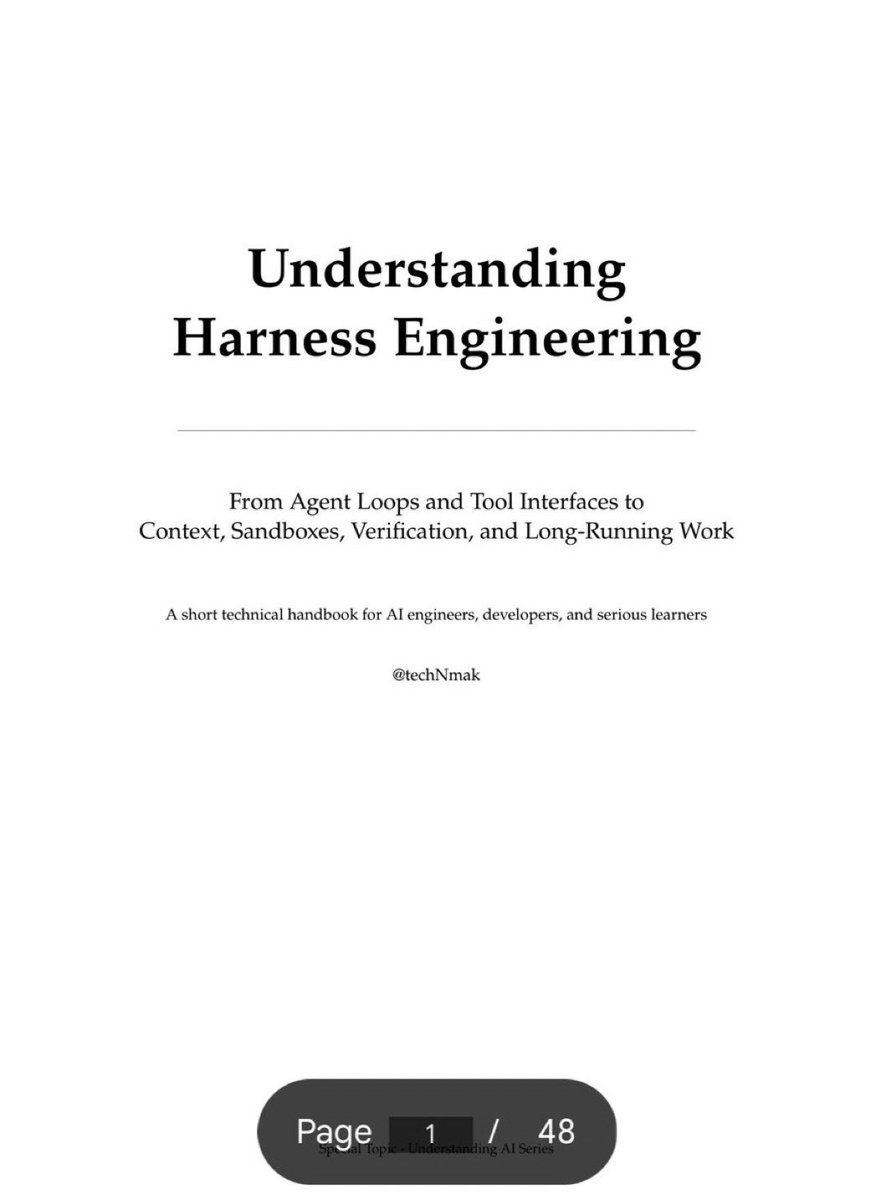
@KirkDBorne shared (147 likes, 7,720 views, 185 bookmarks) a 48-page "Understanding Harness Engineering" handbook whose cover explicitly centered loops, tool interfaces, context, sandboxes, verification, and long-running work. That was still the day's vocabulary anchor, but many other posts immediately operationalized it.
@beamnxw argued (56 likes, 15 replies, 7,864 views, 51 bookmarks) that unfinished Opus 5.5 runs are a budget problem before they are a model problem, and @0xwhrrari added (59 likes, 23 replies, 2,287 views, 45 bookmarks) that equal token list prices do not mean equal agent bills because retries, cache use, output length, and step-seven failures can force you to pay for steps one through six again. The replies under both posts converged on the same workaround: checkpoints, saved notes, and rerun caps matter more than headline pricing.
@mardehaym argued (42 likes, 21 replies, 3,937 views) that balance checks, permission enforcement, and account retrieval belong in code, not in the model, and that the relevant metric is cost per correctly completed workflow after retries, tools, and human review. @Yarilo7brigada explained (29 likes, 10 replies, 432 views, 16 bookmarks) the same economics from the prompt side by splitting cache strategy into KV cache, prefix caching, provider prompt caching, and semantic cache, with the sharpest point being that stable prompt material should live at the front if you want cache reuse to work.
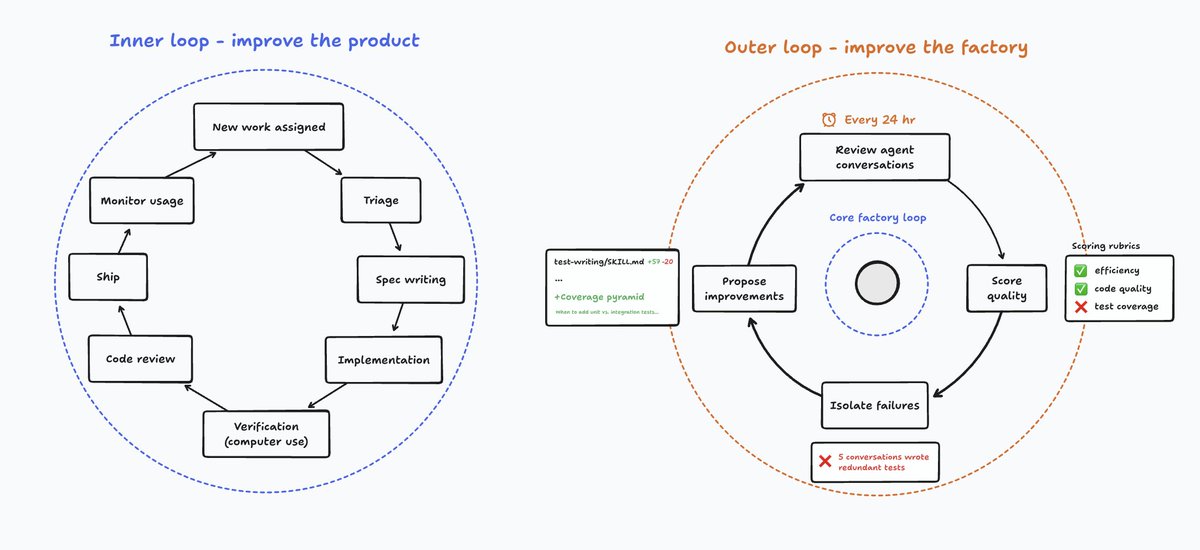
@BHolmesDev showed (20 likes, 5 replies, 1,323 views, 21 bookmarks) a separate but related turn: one inner loop of agents improves the product, while an outer loop reviews conversations, scores efficiency and code quality, isolates bad patterns, and suggests new skills or guardrails. That post mattered because it treated harness maintenance itself as agent work.
@ClaudeCodeLog reported (118 likes, 10 replies, 8,945 views, 14 bookmarks) that Claude Code 2.1.292 added an effort flag for spawned subagents and a marketplace install flag, making cost control and tool distribution more visible CLI surfaces rather than hidden conventions.
Discussion insight: The strongest agreement was that the cheapest turn is the one the agent never needs to take. Checkpoints, shorter verification cycles, code-handled deterministic steps, and explicit effort levels were all attempts to reduce wasted loops rather than merely negotiate lower token prices.
Comparison to prior day: The 2026-10-05 report already showed harness engineering becoming a repeatable discipline. On 2026-10-06, that discipline looked more financial and procedural: save state, constrain permissions, route deterministic work into code, score agent behavior, and expose effort as a user-visible knob.
1.3 Specialized agent environments started winning by bundling the missing harness with the model (🡕)
A third cluster made the same argument across very different domains: the differentiator is less the base model than the environment around it. The highest-signal product and research posts were about systems that already know the tools, context, verification rules, and production workflow for one kind of job.
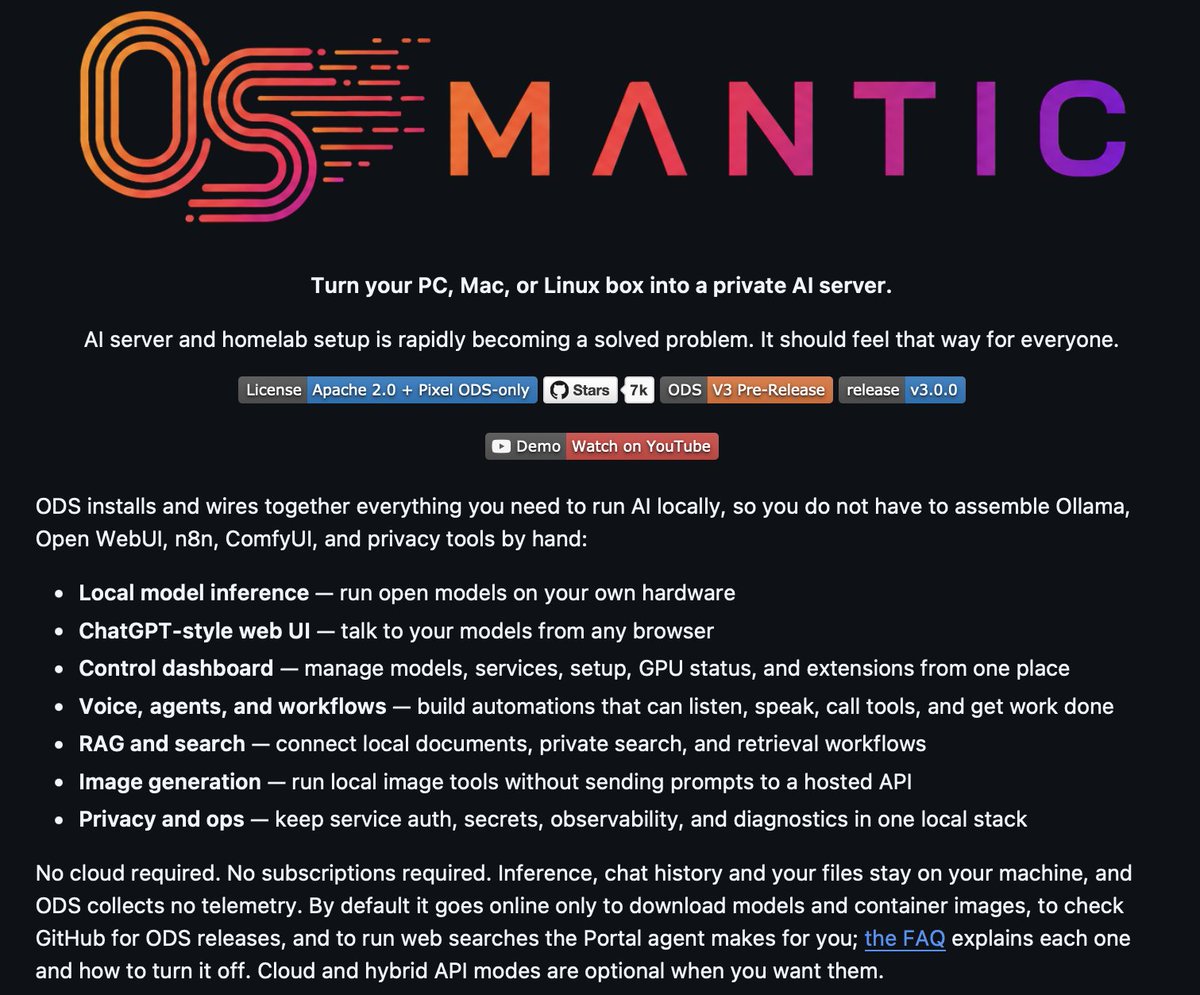
@TheAhmadOsman introduced (82 likes, 14 replies, 3,951 views, 54 bookmarks) ODS as a one-click local AI stack for Linux, Mac, and Windows that detects hardware, downloads a suitable model, and then exposes local inference, agents, workflows, RAG, search, image generation, and privacy controls from one dashboard. The quoted tweet mattered as much as the launch: it framed the unmet need directly as easy-to-use local AI with all the software pre-configured for normal laptop users.
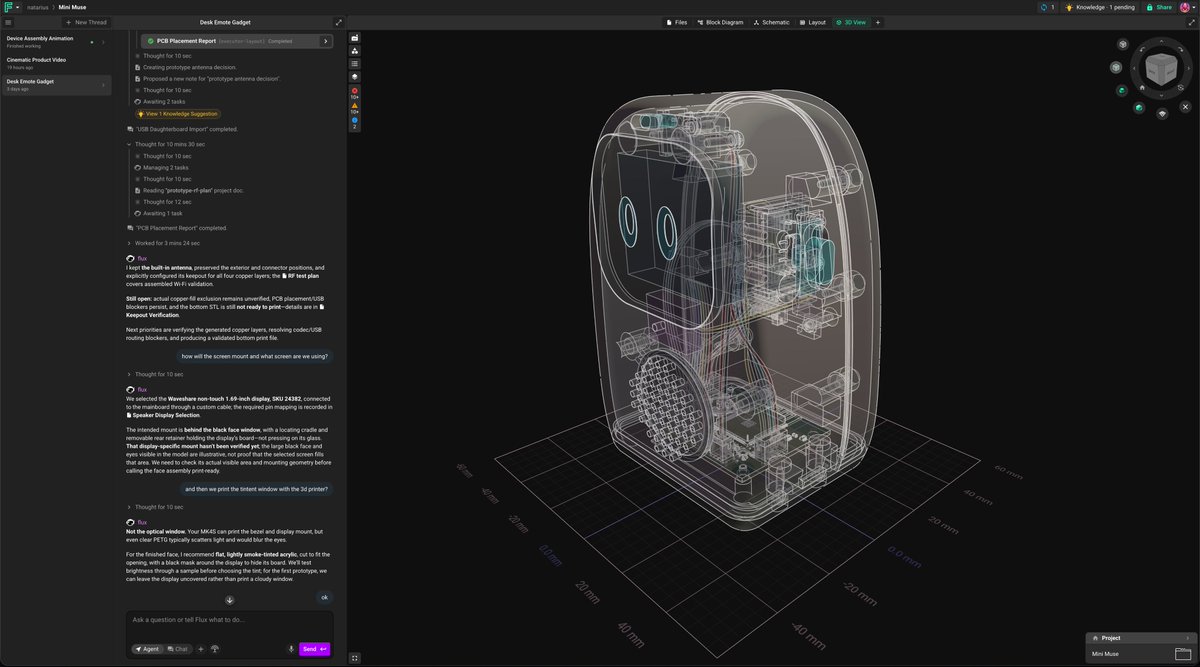
@MatthiasWagner argued (43 likes, 3 replies, 1,803 views, 43 bookmarks) that Flux differs from Claude for hardware design because it already contains the hardware-specific environment, tools, context, verification, and execution harness. The user mostly answers clarification questions while the system handles electronics, PCB, enclosure, firmware, simulation, sourcing, and documentation. That is a much stronger claim than chat-based design help because the orchestration burden lives inside the product.
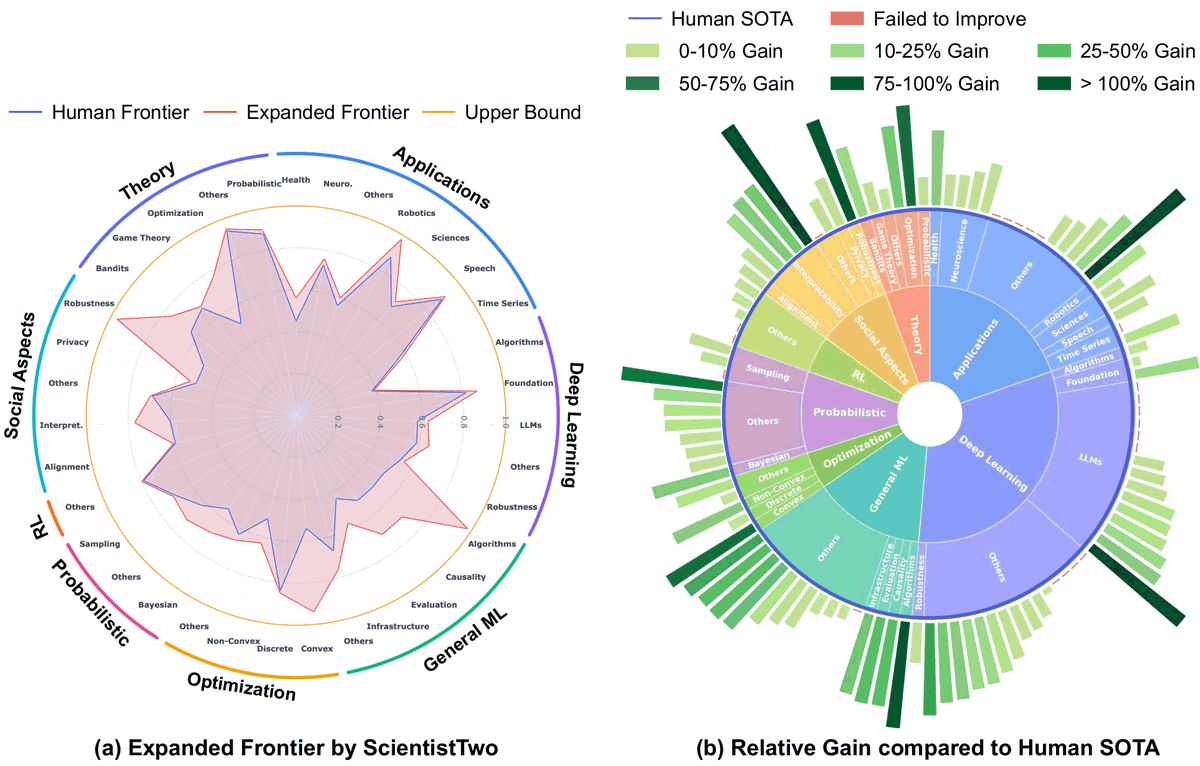
@GoogleResearch introduced (96 likes, 1 reply, 4,922 views, 41 bookmarks) ScientistTwo as an autonomous multi-agent framework that analyzes papers, identifies limitations, and produces verified codebases. Its project page adds an integrity-audit layer around code, empirical outputs, bibliography, and method-code alignment, while the launch image visualizes gains relative to human state of the art.
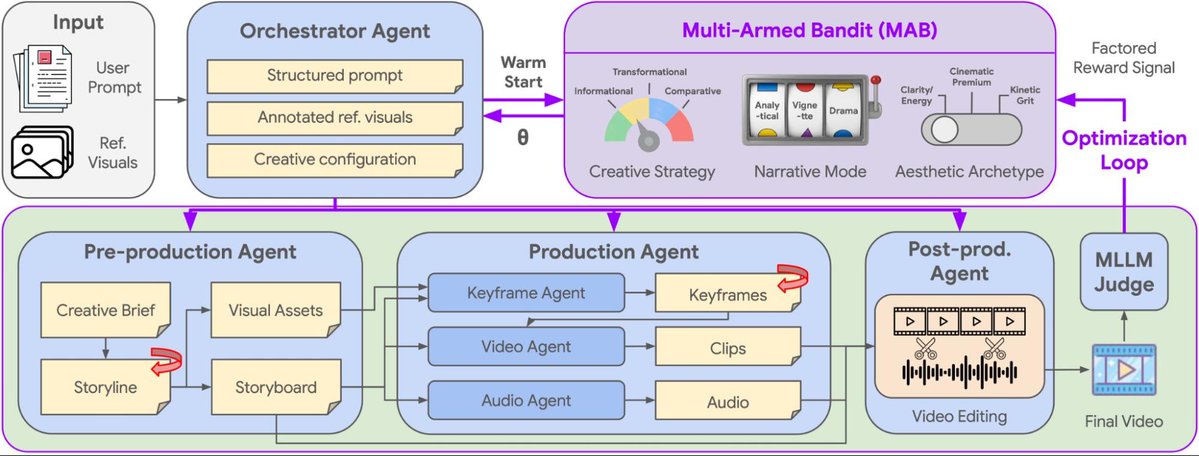
@GoogleResearch followed (98 likes, 4 replies, 4,391 views, 34 bookmarks) with Co-Director, a hierarchical multi-agent video system where an orchestrator picks a creative configuration, specialized agents generate keyframes, video, and audio, and an MLLM judge scores the result for iterative refinement. The key point was not simply that AI video is better. It was that long-form consistency is being attacked as a coordination problem across agents.
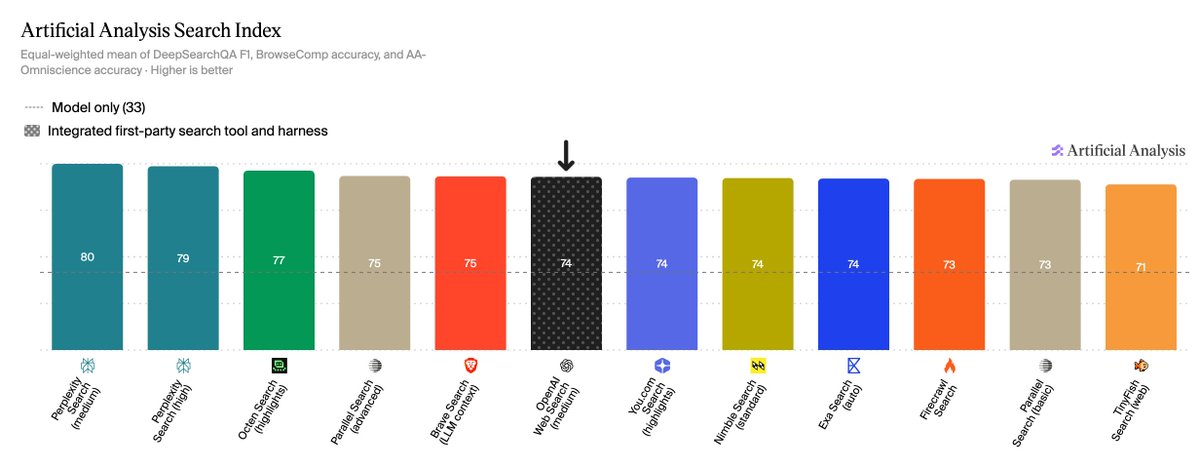
@ArtificialAnlys benchmarked (64 likes, 9 replies, 6,281 views, 20 bookmarks) the same design principle on search: OpenAI Web Search scored 74 on its Search Index, a 41-point lift over the same underlying model without search, because the search loop was built in rather than stitched together externally. The posted chart also made the limitation visible: integrated search landed in the top tier, but still trailed the strongest Perplexity and Octen variants.
Discussion insight: These posts converged on one product lesson: the valuable part is increasingly the domain-specific operating layer, not just access to a strong model. ODS promises preconfigured local infrastructure, Flux hides CAD and EDA orchestration, ScientistTwo bakes in research verification, Co-Director bakes in judge loops, and OpenAI's integrated search removes a whole external harness layer.
Comparison to prior day: On 2026-10-05, the installable layer was mostly a manager stack around coding agents. On 2026-10-06, the pattern spread outward into local AI servers, hardware design, scientific discovery, video production, and integrated search.
2. What Frustrates People
Proof, verification, and acceptance still take more engineering than the agent itself
Severity: High. @poteto described (557 likes, 59 replies, 20,018 views, 436 bookmarks) a loop that only works because verification skills, CLIs, tests, and CI sit around the agent, while @beamnxw summarized (68 likes, 10 replies, 2,611 views, 47 bookmarks) a manager pattern built around screenshots, transcripts, and a working dev instance before a result counts as complete. @mardehaym argued (42 likes, 21 replies, 3,937 views) that permissions and deterministic steps belong in code, not inside the model. The workaround is to move more of acceptance into tests, proofs, and code-enforced policies. Worth building: High.
Long-running agent sessions still waste money through rereads, retries, and oversized models
Severity: High. @beamnxw argued (56 likes, 15 replies, 7,864 views, 51 bookmarks) that unfinished Opus 5.5 runs quietly consume budget if the harness cannot save progress and resume cleanly. @0xwhrrari added (59 likes, 23 replies, 2,287 views, 45 bookmarks) that retries and cache behavior make agent bills diverge even when input-token prices look identical, while @Yarilo7brigada explained (29 likes, 10 replies, 432 views, 16 bookmarks) how repeated context rereads, bad prompt ordering, and missing caching turn every loop into an overpayment event. @ClaudeCodeLog reported (118 likes, 10 replies, 8,945 views, 14 bookmarks) a new per-subagent effort flag, which shows the market is now treating this as a product feature rather than a private tuning trick. Worth building: High.
Local and private agent setups still require too much assembly for ordinary users
Severity: Medium-High. @TheAhmadOsman introduced (82 likes, 14 replies, 3,951 views, 54 bookmarks) ODS precisely as a response to this pain: hardware detection, model download, local inference, agents, workflows, RAG, search, and privacy in one install. The quoted post inside the same thread asked for easy-to-use local AI with all the software preconfigured for normal Apple or Nvidia laptop users, which is the unmet need in plain language. The workaround today is turnkey local stacks like ODS, but the demand signal says most people still do not want to hand-assemble the full toolchain. Worth building: Direct.
Engineering context is still locked in senior heads and scattered systems
Severity: Medium. @Hi_Mrinal argued (120 likes, 4 replies, 2,768 views, 15 bookmarks) that higher-level software engineering remains gatekept because context, decisions, and reasoning are rarely documented. The most credible workaround posts on the day tried to externalize that context: @nateliason listed (169 likes, 11 replies, 14,816 views, 314 bookmarks) a shared knowledge base and cross-tool memory, while @claudeai reported (811 likes, 72 replies, 93,827 views, 241 bookmarks) a company agent in Slack that packages new-model skills for the whole team. Worth building: High.
3. What People Wish Existed
Turnkey local AI operating systems
This was the clearest direct request on the date. @TheAhmadOsman introduced (82 likes, 14 replies, 3,951 views, 54 bookmarks) ODS as a one-click local AI stack, and the quoted tweet underneath it explicitly asked for easy-to-use local AI with all the software preconfigured for regular laptop users. That is a practical need rather than an aspirational one: people want privacy, local control, and fewer setup steps, not another abstract framework. Opportunity: Direct.
Outer-loop supervisors that improve the agents, not just the product
@BHolmesDev showed (20 likes, 5 replies, 1,323 views, 21 bookmarks) an outer loop that reviews agent conversations, scores efficiency and code quality, isolates failures, and proposes skill changes, while @beamnxw summarized (68 likes, 10 replies, 2,611 views, 47 bookmarks) a manager flow where proof collection and task-board upkeep are first-class work. The need here is practical and urgent for teams already running many agents: they do not only want more workers, they want supervisors, ratchets, and playbook updates. Opportunity: Direct.
Cost-aware harnesses that checkpoint, cache, and step down models automatically
The repeated complaints about unfinished runs, repeated context rereads, and price lists that hide retry costs all point to a missing product surface. @beamnxw argued (56 likes, 15 replies, 7,864 views, 51 bookmarks) for a reusable seven-layer setup before long tasks, @Yarilo7brigada explained (29 likes, 10 replies, 432 views, 16 bookmarks) where caching actually saves money, and @ClaudeCodeLog reported (118 likes, 10 replies, 8,945 views, 14 bookmarks) a CLI effort flag for subagents. This is a practical need with clear willingness to adopt because users are already improvising the same controls manually. Opportunity: Direct.
Shared company memory and teachable engineering context
@Hi_Mrinal argued (120 likes, 4 replies, 2,768 views, 15 bookmarks) that too much engineering judgment stays undocumented, while @claudeai reported (811 likes, 72 replies, 93,827 views, 241 bookmarks) a company-wide Slack agent used to spread new-model skills across a team. @nateliason listed (169 likes, 11 replies, 14,816 views, 314 bookmarks) a GitHub-backed knowledge base plus cross-tool memory as part of the same answer. The need is partly practical and partly emotional: teams want less gatekeeping, faster onboarding, and less dependence on one senior person remembering how the system works. Opportunity: Competitive.
4. Tools and Methods in Use
| Tool | Category | Sentiment | Strengths | Limitations |
|---|---|---|---|---|
| Grok Bot + pstack | Agent control plane | (+/-) | Connectors, routines, manager loops, cloud-agent handoff | Needs proof loops and works best inside a specific Grok Bot and Cursor stack |
| Claude Managed Agents | Team agent platform | (+) | Shared Slack agent, fast internal skill distribution | Public evidence is still case-study heavy rather than broadly benchmarked |
| Cursor cloud agents | Coding runtime | (+) | Cloud repro, fix, fuzz, and PR flow | Requires CI, human review, and ownership boundaries |
| ODS | Local AI stack | (+) | One-click private stack, hardware detection, local inference, RAG and workflows | V3 is still a pre-release and hardware recommendations can shift |
| Flux | Hardware design platform | (+) | Domain-specific tools, verification, simulation, sourcing, and documentation in one loop | Specialized to hardware rather than general-purpose knowledge work |
| OpenAI Web Search | Integrated search tool | (+/-) | Strong quality lift, fewer tokens than many external API setups, single-call workflow | Ranked behind the strongest Perplexity and Octen variants and was weaker on multi-hop browsing |
| Prompt and prefix caching | Inference optimization method | (+) | Cuts repeated-context cost and latency dramatically | Exact-token-match reuse is brittle and semantic cache can answer the wrong question |
| ScientistTwo | Research framework | (+) | Limitation-driven research, verified codebases, integrity audit | Research-stage and narrow relative to general coding agents |
| AI Video Co-Director | Media generation framework | (+) | Global orchestration, specialized sub-agents, judge loop for long-form consistency | Research-stage and specialized to video production |
| Claude Code effort flag | CLI workflow control | (+) | Predictable per-subagent effort and cost control | Adds another tuning knob that teams need to observe and calibrate |
Overall satisfaction was highest when the tool already carried its own environment. @poteto described (557 likes, 59 replies, 20,018 views, 436 bookmarks) a Grok Bot plus Cursor flow that works because the connectors, queue, verification, and merge policy are already defined, while @claudeai reported (811 likes, 72 replies, 93,827 views, 241 bookmarks) a team-wide Slack agent that packages the same idea for non-specialists.
The recurring workaround pattern was consistent across the day: move deterministic steps into code, push repeated context behind caching, and keep humans in charge of acceptance and exceptions. @mardehaym argued (42 likes, 21 replies, 3,937 views) for code-handled permissions and cost-per-correct-workflow tracking, @Yarilo7brigada explained (29 likes, 10 replies, 432 views, 16 bookmarks) why cache strategy matters structurally, and @ArtificialAnlys benchmarked (64 likes, 9 replies, 6,281 views, 20 bookmarks) how much an integrated search harness can change quality and cost.
The visible migration path was away from blank-chat generalism and toward prewired operating environments: local stacks such as ODS, domain-specific workspaces such as Flux, research systems such as ScientistTwo, and judge-loop media pipelines such as Co-Director. That is the competitive dynamic the current data supports.
5. What People Are Building
| Project | Who built it | What it does | Problem it solves | Stack | Stage | Links |
|---|---|---|---|---|---|---|
| Company agent on Claude Managed Agents | Every team via @claudeai | Shared Slack agent that packages new-model skills for the whole team and later for subscribers | Stops every employee from relearning the same model behaviors alone | Claude Managed Agents, Slack | Shipped | Public rollout described in the cited post |
| ODS | Osmantic via @TheAhmadOsman | One-click local AI server and dashboard for agents, workflows, RAG, search, and image generation | Removes the manual assembly burden of running private local AI | Local inference, Open WebUI, n8n, ComfyUI, privacy tools | Beta | repo |
| Flux | Build with Flux via @MatthiasWagner | AI-native hardware design workspace that handles electronics, PCB, enclosure, firmware, sourcing, and documentation | Replaces manual orchestration across CAD, EDA, simulation, and manufacturing tools | Cloud CAD and EDA environment, simulation, sourcing, firmware, documentation | Shipped | site |
| ScientistTwo | Google Research | Autonomous research system that reads papers, finds limitations, runs experiments, and produces verified codebases | Turns scientific iteration and reproducibility into an agent workflow | Multi-agent research pipeline, integrity audit, code verification | Alpha | project, paper |
| AI Video Co-Director | Google Research | Hierarchical multi-agent pipeline for coherent long-form video storytelling | Keeps multi-shot narratives visually and semantically consistent | Orchestrator, multi-armed-bandit planner, keyframe/video/audio agents, MLLM judge | Alpha | blog |
| Outer-loop software factory | @BHolmesDev | Reviews agent conversations, scores quality, isolates failures, and proposes skill improvements | Helps agent teams improve the factory, not only the product | Scheduled review agents, scoring rubrics, skill diffs, guardrails | Alpha | Public pattern described in the cited post |
The common builder pattern was to package the missing layer, not just expose a better model. @claudeai reported (811 likes, 72 replies, 93,827 views, 241 bookmarks) a company agent that turns model know-how into a shared team interface, while @TheAhmadOsman introduced (82 likes, 14 replies, 3,951 views, 54 bookmarks) ODS as a prewired local stack rather than a pile of separate apps. @MatthiasWagner argued (43 likes, 3 replies, 1,803 views, 43 bookmarks) that Flux matters for exactly the same reason in hardware: it already knows the tools, artifacts, and verification flow.
A second builder pattern was to attach a judge loop above the generator loop. @GoogleResearch introduced (96 likes, 1 reply, 4,922 views, 41 bookmarks) ScientistTwo with research verification and code integrity checks, @GoogleResearch followed (98 likes, 4 replies, 4,391 views, 34 bookmarks) with Co-Director's orchestration and judging structure for long-form video, and @BHolmesDev showed (20 likes, 5 replies, 1,323 views, 21 bookmarks) the same instinct applied to coding agents themselves. The repeated build trigger was not raw generation quality. It was the need to keep specialized work coherent, inspectable, and improvable over time.
6. New and Notable
OpenAI Web Search entered the benchmark conversation as an integrated agent loop
@ArtificialAnlys benchmarked (64 likes, 9 replies, 6,281 views, 20 bookmarks) OpenAI Web Search at 74 on the Artificial Analysis Search Index, a 41-point lift over the same underlying model without search. That mattered because the comparison was explicitly about what happens when the search loop is built into the product rather than orchestrated externally.
ODS turned the local-agent stack into a one-command product pitch
@TheAhmadOsman introduced (82 likes, 14 replies, 3,951 views, 54 bookmarks) ODS as a local AI stack that detects hardware, picks a model, and exposes agents, workflows, RAG, search, image generation, and privacy controls from one dashboard. The notable part was not only the feature list. It was that the launch directly answered a quoted request for preconfigured local AI for ordinary laptop users.
Claude Code exposed per-subagent effort as a first-class control surface
@ClaudeCodeLog reported (118 likes, 10 replies, 8,945 views, 14 bookmarks) that Claude Code 2.1.292 added an effort flag for spawned subagents plus marketplace-install support. That is notable because it moves cost and distribution control out of hidden conventions and into visible CLI knobs.
The "improve the factory" idea became explicit
@BHolmesDev showed (20 likes, 5 replies, 1,323 views, 21 bookmarks) an outer loop that reviews agent conversations and proposes skill improvements, while @GoogleResearch introduced (96 likes, 1 reply, 4,922 views, 41 bookmarks) ScientistTwo as a research system with its own integrity audit. The shared novelty is that more builders are spending agent effort on evaluating and correcting other agent work.
7. Where the Opportunities Are
[+++] Acceptance, proof, and outer-loop QA for agent fleets — @poteto described (557 likes, 59 replies, 20,018 views, 436 bookmarks) a loop that depends on verification skills, tests, and CI, @beamnxw summarized (68 likes, 10 replies, 2,611 views, 47 bookmarks) proof-heavy manager workflows, and @BHolmesDev showed (20 likes, 5 replies, 1,323 views, 21 bookmarks) agents reviewing other agents. The evidence says the market still lacks a reusable layer for deciding when work is actually done.
[+++] Cost-aware harness infrastructure — @beamnxw argued (56 likes, 15 replies, 7,864 views, 51 bookmarks) for a seven-layer setup before long tasks, @0xwhrrari added (59 likes, 23 replies, 2,287 views, 45 bookmarks) that retries change the bill more than sticker prices do, and @ClaudeCodeLog reported (118 likes, 10 replies, 8,945 views, 14 bookmarks) a new effort knob for subagents. That is strong evidence for products that checkpoint, cache, reroute, and degrade gracefully by default.
[++] Turnkey private and local agent operating systems — @TheAhmadOsman introduced (82 likes, 14 replies, 3,951 views, 54 bookmarks) ODS directly against a quoted need for preconfigured local AI on ordinary hardware. The demand is practical, privacy-linked, and easier to explain than many abstract agent platforms.
[++] Shared company memory and teachable skill distribution — @claudeai reported (811 likes, 72 replies, 93,827 views, 241 bookmarks) a company agent used inside Slack, while @Hi_Mrinal argued (120 likes, 4 replies, 2,768 views, 15 bookmarks) that too much senior reasoning remains undocumented. The opportunity is moderate because many teams feel the pain, but the solution will compete with internal wikis, chat tools, and emerging managed-agent platforms.
[+] Domain-specific agent environments with embedded judges — @MatthiasWagner argued (43 likes, 3 replies, 1,803 views, 43 bookmarks) for a hardware-specific environment, and @GoogleResearch introduced (96 likes, 1 reply, 4,922 views, 41 bookmarks) ScientistTwo plus followed (98 likes, 4 replies, 4,391 views, 34 bookmarks) with Co-Director. The signal is emerging because the pattern is convincing, but most examples are still research or early specialist products rather than broad deployments.
8. Takeaways
- The practical unit of progress was the operating loop, not the single agent. @poteto described (557 likes, 59 replies, 20,018 views, 436 bookmarks) agents embedded in Slack, CRM, Linear, and PR flow, while @claudeai reported (811 likes, 72 replies, 93,827 views, 241 bookmarks) the same pattern as a team-wide Slack agent.
- Harness engineering is being measured in wasted retries, proof artifacts, and approval paths, not just prompt quality. @beamnxw argued (56 likes, 15 replies, 7,864 views, 51 bookmarks) that unfinished long runs eat budgets, and @mardehaym argued (42 likes, 21 replies, 3,937 views) that the right metric is cost per correctly completed workflow.
- Products that hide orchestration behind a domain-specific environment are gaining the clearest narrative edge. @TheAhmadOsman introduced (82 likes, 14 replies, 3,951 views, 54 bookmarks) ODS as a prewired local stack, while @MatthiasWagner argued (43 likes, 3 replies, 1,803 views, 43 bookmarks) that Flux matters because the hardware harness is already inside the product.
- Integrated tools can materially outperform the same model running without them. @ArtificialAnlys benchmarked (64 likes, 9 replies, 6,281 views, 20 bookmarks) a 41-point lift when search was built directly into the OpenAI workflow instead of added externally.
- More builders are using agents to supervise, score, and improve other agents. @BHolmesDev showed (20 likes, 5 replies, 1,323 views, 21 bookmarks) an outer loop that grades agent conversations, and @GoogleResearch introduced (96 likes, 1 reply, 4,922 views, 41 bookmarks) ScientistTwo with explicit integrity checks.